


TL;DR
AI is not coming for the game engine, the core that holds the rules and runs the shared world. It is coming for the content around it, the art, writing and testing that are what a studio spends on. The value of that work flows up to a handful of AI labs by default and a studio keeps it only if it owns the loop that produces it.
Owning that loop, what Nadella calls a studio’s token capital, means owning what the AI learns about its world, while renting a generic model underneath that can be swapped for a better one. Guild Wars 3, NCSoft’s new game on Unreal, is where a studio could get to make that choice.
The EVE Online deal is what ceding looks like: a loss-making studio sold to its own management for $120m, while Google DeepMind took a minority stake and the right to train on its twenty year, player-driven world. The fight is no longer over who owns the shares, but over who gets to learn.
The question is the loop, not the AI model
On 15 June 2026, Satya Nadella set out a distinction that had nothing to do with games and everything to do with what is about to happen to them. Every company, he wrote, will have to build two kinds of capital: human capital, the judgment and pattern recognition of its people, and token capital, “the firm’s AI capability it builds and owns.” The prize is not picking the best model but building a learning loop on top of one, where the two compound. As he put it: “You can offload a task, or even a job, but you can never offload your learning.”
What he calls token capital is made of specific, ownable parts: the evaluations a company writes to encode its own standards, the reinforcement it runs on its own accumulated information, the queryable memory of everything it has done before. Build that, and the generalist model underneath becomes a swappable part; you can change it for a better one and lose nothing, because the expertise that matters has been captured in the loop rather than rented from the model. Fail to build it, and the reverse happens. The work flows through someone else’s model, the learning accrues to them, and your craft is slowly commoditised into it.
That was written about software companies and enterprises, but it is a precise description of what AI is about to do to a game studio. For what it’s worth, AI does not arrive at the deterministic core, the movement, the combat feel, the shared simulation every connected player must agree on; the engine is the safe part. It arrives in the content and tooling stacked around that core, the art, the levels, the dialogue, the testing, the Live Services treadmill that keeps a world fed for years. That layer is what a studio spends its budget on, and as it moves to models, the question Nadella puts to every other industry is the one that now decides a studio’s worth: does it own the loop, or rent the intelligence and let the value flow upward to a few models that, in his words, “eat everything they see”?
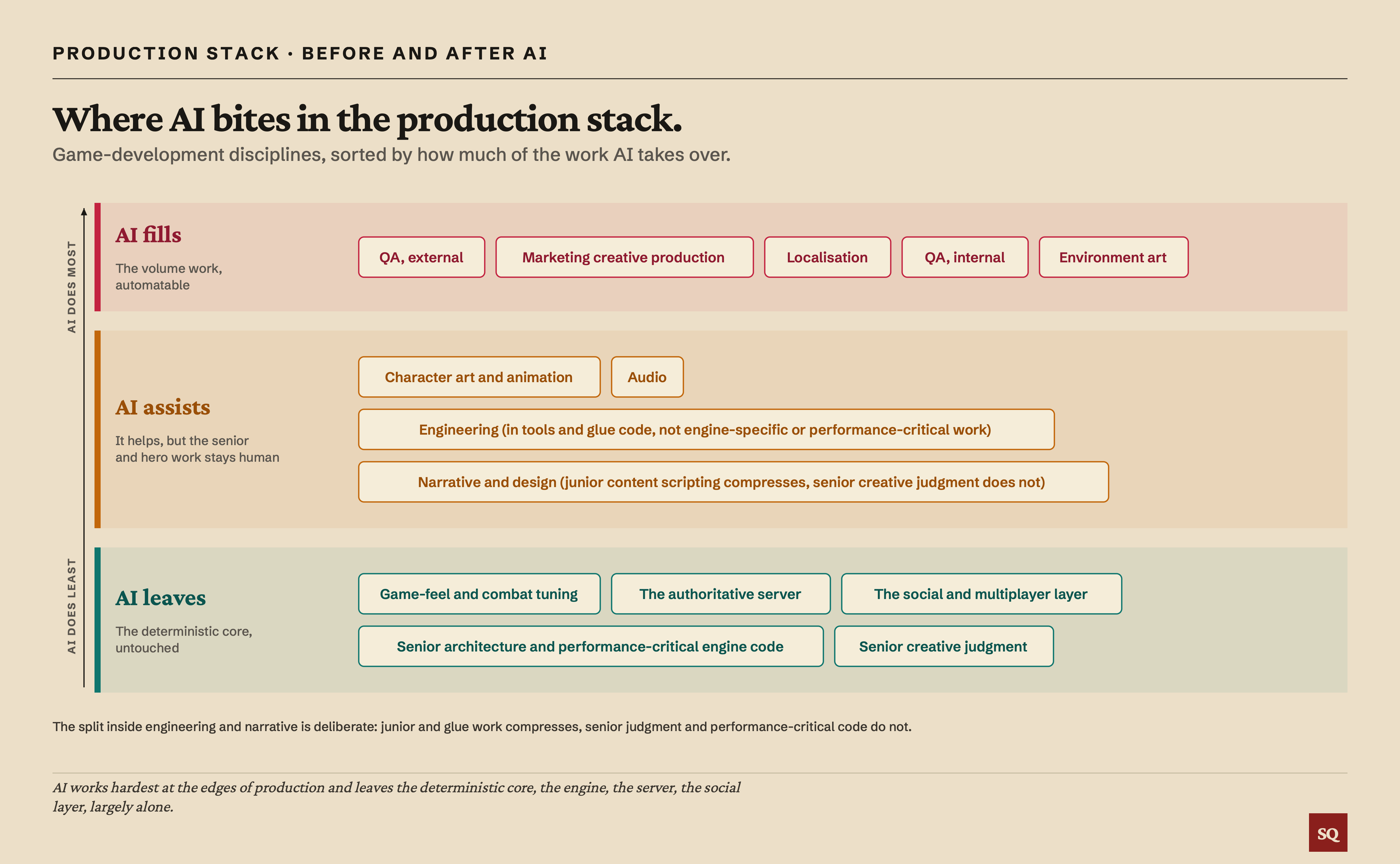
We have to be honest here that Nadella is not a neutral witness to this. He runs one of the handful of frontier models he is warning everyone else about, through Microsoft’s stake in OpenAI and its own Muse model for games. He also owns one of the largest libraries of games IP there is, in Activision and Xbox. The platform on which he would prefer every company to build its loop is Azure, so we need to take these words with a pinch of salt.
However, we could apply his view into the video games industry with the Massively Multiplayer Online (MMO) game Guild Wars 3 (GW3), which ArenaNet (NCSoft) announced on 5 June 2026 (its first new game in roughly fourteen years) and built on Unreal Engine 5.
A persistent online world is exactly the kind of game whose content layer AI is about to rework, and a studio in its position has years of its own production history and player data to rework it on. Whether that accumulates into a loop ArenaNet owns, or ends up training a model the studio merely rents, would hypothetically decide how much of GW3’s value it keeps.
Part 1. How a studio keeps its value: it owns the loop
An owned loop works at two levels, and GW3 shows both.
The first is a single function run as a loop.
The second is the whole game built as many of those loops feeding one core the studio owns.
The content treadmill becomes a flywheel
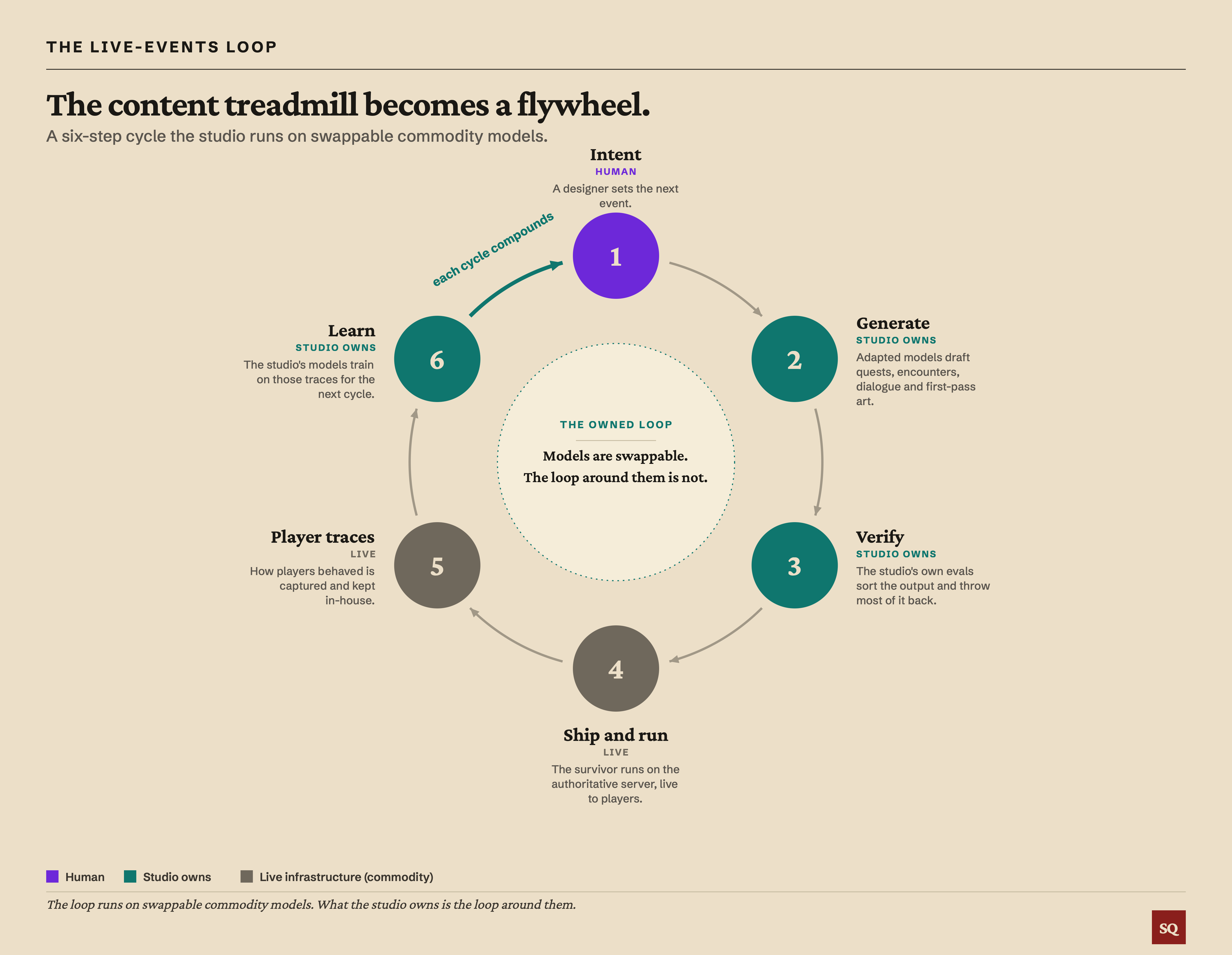
A great example of a single function run as a loop is with Live Services: the seasons, events and updates a persistent world needs to keep players paying attention for years after launch. It is the clearest place to see what owning a loop means, because the same grind can be run two ways, and the two pull apart a little further with every cycle.
This is what a Live Services loop could look like for GW3:
A designer sets the intent, the next event set in Orr, a reason to take players somewhere new (this is the human call about what should exist as content).
Models the studio has adapted on its own back catalogue generate the candidates, the quests, the encounters, the dialogue, the first-pass art, and so on.
The studio’s own evaluations (which encode what a thing has to do to feel like Guild Wars rather than generic fantasy) sort that output, and iterate towards what they feel is genuine and authentic to the game with the models.
What survives ships to the authoritative server and runs in front of players, on the deterministic core which AI never touches. How players then behave (e.g. where they spend time, where they don’t, what they ignore) returns back as information that the studio keeps.
That information is then used to train the next round’s content generation and sharpen the evaluation, and the loop starts again from a better place than the last.
Each cycle leaves the studio with more of its own production data than the last, with a more exact set of evaluations and models that are tuned a little more tightly to its world. This alters the way in which Live Services content can sharpen development over many years as the data from the asset compounds. Making extremely long-life content that spans over a decade can create a flywheel that becomes a moat.
In order to achieve this, none of this actually requires ArenaNet to train a model of its own. The generation and the learning run on commodity models rented from whichever lab leads the quarter.
So what the studio owns is the wrapper around them: the evaluations, the information, the models adapted on its own back catalogue and the memory of its own world.
Swap the model underneath for a better one and little is lost, only the model-specific tuning has to be redone, which will look cheap next to the years it took to build the rest.
Rent that wrapper instead, run the same circuit inside a vendor’s product, and the loop still turns, but the compounding accrues to the vendor: the studio gets this season’s content, and the vendor gets a system that has learned how to make GW3.
The whole game feeds one owned core
Live Services are an example of just one loop, but a game the size of GW3 inherently runs dozens: concept art has a loop, encounter design has a loop, so do dialogue, localisation, the balance pass, and the bug triage, and so on.
If each of these parts of development aren’t communicating effectively, then each method for developing effective loops can be radically different (i.e. each loop could be running a different vendor’s tool that is learning a slice of the game and keeping what it learns). So a studio that decides to use external tools this way ends up renting its own craft back from a dozen suppliers, none of whom hold the whole picture and all of whom improve on its work.
What turns those scattered loops into something the studio owns is a single core beneath them, the thing Nadella called token capital, and for a game it has five parts:
Models adapted on the studio’s own back catalogue, twenty years of Guild Wars art, systems and writing, so that what they generate starts from the house style rather than the open internet.
Private evaluations that encode the studio’s taste (i.e. the standing answer to what is good enough and what is unmistakably Guild Wars).
Agents trained on its own production history and player information (i.e. where the live game’s behaviour from the first loop accumulates).
A queryable memory of the canon, every faction, location, weapon and story beat, so a generated quest does not contradict twenty years of established world.
The architecture that holds these together and lets the commodity model beneath them be swapped out for a better one.
A deep IP fails in a particular way under generic AI: the output is fluent and slightly wrong, a sword that is not quite a Guild Wars sword, a character speaking half out of voice, a quest that quietly breaks old lore.
The queryable canon and the taste evaluations are what catch that, and they only work if every loop draws on the same ones. The shared core is also what keeps the functions consistent with one another, the dialogue agent and the quest agent and the art pipeline all answering to a single record of what is true in the world. If you run a dozen rented tools instead and there is no shared record, the world drifts with each function plausibly off in its own direction.
Owned this way, the whole Live Services life of the game feeds one asset. Every season of content, every fixed bug, every million hours of play thickens the same core, and each function improves because the others did. That is the difference between AI making GW3 more itself across a decade and AI scattering the studio’s craft among the suppliers it rents from.
The loop costs before it pays, and few studios can build it
Set against renting, owning the loop looks worse before it looks better. The adapters, the evaluation suites, the information pipelines, the canon memory all have to be built and staffed before one iteration of the cycle can begin to compound, and the compounding only shows after several seasons of play have run through them.
A studio that rents the equivalent tools pays less in year one and ships at much the same quality; the gap opens later, if it opens at all. The financial model in the previous piece (See: AI won’t make video games materially cheaper to develop) put the realised AI uplift at about three points of operating margin, well under the optimistic case once the offsets are counted, because a large part of the gross saving leaves again as tooling spend, paid straight to the vendors whose models do the work. The loop is an investment with a J-curve, not a discount that lands at launch.
Most studios also cannot build it. Studios do employ machine-learning engineers, for matchmaking, anti-cheat, animation and analytics, but building a generative loop is a newer and narrower discipline: evaluation design, reinforcement learning on a studio’s own information, and the data plumbing to feed them. That talent is scarce and expensive and competed for hardest by the labs themselves, and standing up the pipelines to turn raw play into usable information is its own programme of work. This, more than any argument about whether owning beats renting, is why most studios will rent: not because the loop is a bad idea, but because they have no way to staff one. The capability sorts the industry by size, and the lab deal is where that sorting is paid out.
And even a loop built and owned in full sits on ground the studio does not own. The commodity model at the base runs on someone else’s cloud and someone else’s chips, rented by the hour from the handful of firms that operate them. A studio can own every part of the wrapper, the taste, the information, the canon, and still depend on Azure or AWS, and on Nvidia beneath them, for the compute that makes any of it run. Owning the loop is sovereignty on one axis, what the studio knows and keeps. It says nothing about the other, whose platform it all runs on, and that second axis is where the lab deal does its work.
Part 2. The lab deal, and who ends up owning the loop
Every lab deal turns on one question: who keeps the core
A studio that cannot build the loop (which is most of them) gets one another way. It makes a deal with a firm that can, the frontier labs. There are four different ways in which a deal like this could occur, and the most important variable that matters is who owns the core when the deal is done, because that is the asset that compounds, and everything else is effectively terms around it.
The four methods are:
Supplier deal (studio keeps the core). The lab sells compute and models by the hour; the studio builds its own wrapper on top. This is the swappable-model relationship from earlier, written into a contract, and the loop stays the studio’s.
Minority stake (studio keeps the core). The lab takes equity and helps fund the work, but the studio still owns and operates the loop. The lab is invested in the outcome without holding the asset.
Co-development JV (contested). The core is built together and held jointly. Joint ownership of a compounding asset is a fight deferred rather than settled, and the terms of the eventual split tend to favour whoever can walk away first.
The lab gets to learn (the EVE shape). The studio may keep its equity and its loop and still cede the one thing the lab cannot generate for itself: the right to learn from a real world full of real players.
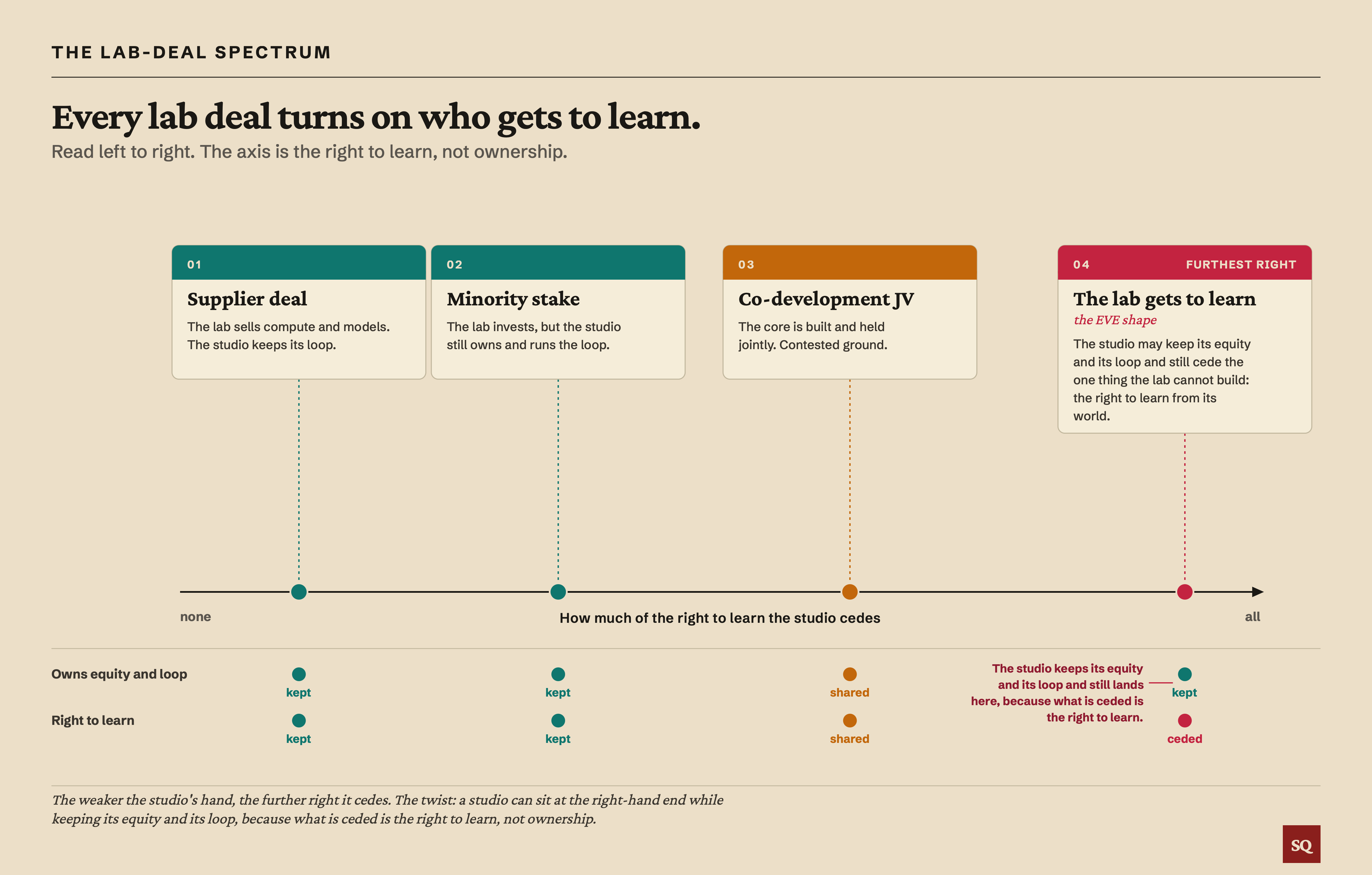
Where on that spectrum a studio lands is set by its leverage, and leverage here means whether it can say no.
What gives the studio leverage, and pulls the deal left:
It can fund the game itself, so it does not need the lab’s money and can walk from a bad deal.
It holds a live world the lab cannot synthesise, and more than one lab wants it, so the asset is contested rather than captive.
It can build the loop in-house, or credibly begin to, so the lab is a compute supplier and not a partner it depends on.
What gives the lab leverage, and pulls the deal right:
The studio is losing money, or its owner wants out, so there is a clock on the deal and a floor under the price the studio will accept.
The studio has no machine-learning or data capability and no path to building one, so the lab is the only way it gets a loop at all.
The lab has other worlds it could train on, so this studio’s environment is not unique to it, while the studio has nowhere else to
A studio’s strongest card, a unique world full of players, is worth most to a lab exactly when the studio is healthy enough not to have to sell it. The two move together, which is the trap. Distress forces the sale, and distress also strips the card of its value, because a forced seller cannot hold out for the price the asset would otherwise command. So the deals that cede the most loop tend to be struck by the studios whose asset was worth the most, sold cheaply because they had to. Which model a studio can pursue is decided years before the lab ever calls, by whether it stays fundable enough to keep the choice open: a healthy studio with a world the labs want can choose to cede the loop at a price that reflects it; a distressed one does not choose at all.
EVE Online, a twenty-year world, becomes the lab’s training ground
EVE Online is the kind of environment a frontier lab cannot build for itself. For more than twenty years it has run as a single shared universe, one world rather than thousands of copies, where hundreds of thousands of real players run a real economy, fight wars that last months, and build, infiltrate and betray alliances. It is precisely what today’s AI handles worst: long horizons, a world that never resets, thousands of players pursuing their own goals at once, consequences that compound over years. Those are the problems DeepMind has named as the hardest in building capable agents, long-horizon planning, memory, and continual learning, and a world like this exercises all three. A lab can spin up a simulated economy. It cannot spin up twenty years of real people learning to outwit one another inside a single one.
On 6 May 2026, CCP Games, the Icelandic studio behind it, was bought out of its Korean parent, Pearl Abyss, by its own management and a group of long-term investors, for $120m, and rebranded Fenris Creations. Google DeepMind took an undisclosed minority stake in the deal, and with it the right to run an offline copy of EVE on its own servers.
The announcement framed it as a homecoming from a position of strength. The filed accounts describe a managed exit from a loss-making, indebted business. This is the condition from the previous section made concrete: a genuinely rare asset, a twenty-year player-driven world at record revenue, parting cheaply because the entity that held it could not hold out and its owner wanted out.
Access to that world is what changed hands, whether you describe it as an environment to train in or as the behavioural record of everyone who has played. By the spectrum’s equity test this was a minority stake: management kept the company, the IP and the production loop. But the equity is not the core of it and what CCP ceded is the right to learn from that world.
Owning the loop is only half the sovereignty
The spectrum measures one axis: who owns the loop. There is a second, and EVE only sharpens it. Even a studio that keeps its core in full does not own the ground it runs on. The models underneath are rented from a handful of labs, the compute from a handful of clouds, and the engine, in GW3’s case Unreal, is licensed from Epic. A studio can own everything it learns and still depend, at every layer beneath that, on companies it does not control. Sovereignty has two axes, what you own and whose platform you own it on, and almost no one in games holds both.
The owners of that second axis take their cut without owning any studio’s loop. Epic is the clearest case in games: it owns Unreal, the engine a large part of the industry builds on, and keeps extending it by rolling up the tools and middleware around it. GW3 runs on Unreal, so Epic earns from it whether or not ArenaNet ever owns its own loop. A large publisher can avoid that toll by building its own engine, as EA does with Frostbite, but owning an engine for your own use is not the same as owning a platform others build on, and it still leaves the cloud and the models rented. The platform-owner’s position is one no studio reaches by owning its loop.
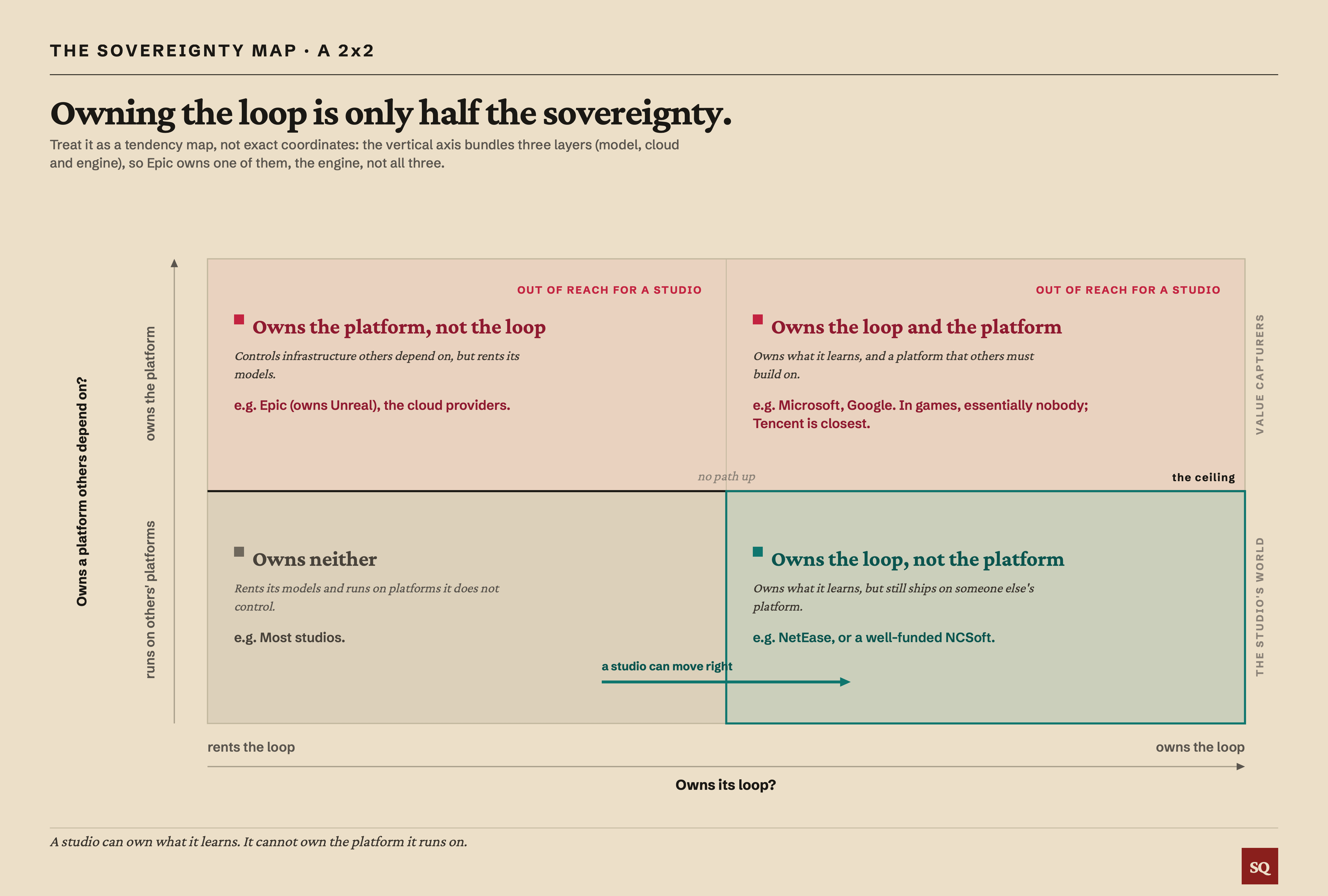
Nadella’s framing is right about the first axis and quiet about the second. The durable asset is indeed the loop, the thing a studio builds and keeps. But he would also like to own the second axis, the model you rent, the cloud you run on, the platform you build the loop atop. Telling studios to own their loops costs him nothing if they build them on Azure, on the models he supplies, on the terms he sets.
For GW3 the choice is NCSoft’s, and it is the first axis that is still open. NCSoft can fund the game, which means it can keep the loop if it chooses to build one, rather than take the EVE shape because it has to. The second axis is already half decided: the game runs on Unreal, and on whatever cloud and models sit beneath it. The most a studio in its position can do is own what it learns. Whether ArenaNet does is the question the next two years will answer, and it is a choice, not a forecast.
Own the loop, or be commoditised into it
The choice was never whether a studio uses AI because the reality is that every studio will. It is whether it owns what the AI learns or hands that to whoever it rents the model from. Most studios cannot build that capability for themselves, which is why the lab deal exists, and why the deal’s structure, not its label, decides who ends up with the core.
For an investor, this reframes the question to ask of any game in an AI world. Not whether AI will cut its costs, which it will, modestly, but whether the studio is building an asset it owns or renting one it does not. NetEase has built its own AI capability and runs rented models like DeepSeek’s underneath it; CCP, out of money and out of options, did the opposite, and a twenty-year world became someone else’s training ground.
GW3 is a great example of where the choice is still open. NCSoft can fund the game, so it can keep the loop if it decides to build one, and whether it does would be an interesting event to see for GW3. For a player, the same machine reads differently. The world gets livelier, its events quicker to arrive and its characters quicker to respond, and it is paid for partly with the record of how they played.
Appendix
Figures behind the claims in the body, set out so a sceptical reader can rebuild them. Currency figures are in $m and rounded, so rows and columns may not foot exactly. “(reported)” marks a figure drawn from press, deal-coverage or analyst sources rather than a company filing; each is flagged where it sits and re-checked at publication. The cost-model figures in A2 are a model, not anyone’s accounts, and are labelled as such.
A1. The EVE Online deal
This is the article’s worked example of ceding, and the announcement and the accounts tell different stories, so both are set out here. CCP Games, the maker of EVE Online, is held through Pearl Abyss Iceland, a subsidiary of the Korean publisher Pearl Abyss. The group accounts are filed in Iceland and reported in US dollars.
The filed numbers describe a business that grew its top line while its losses widened:
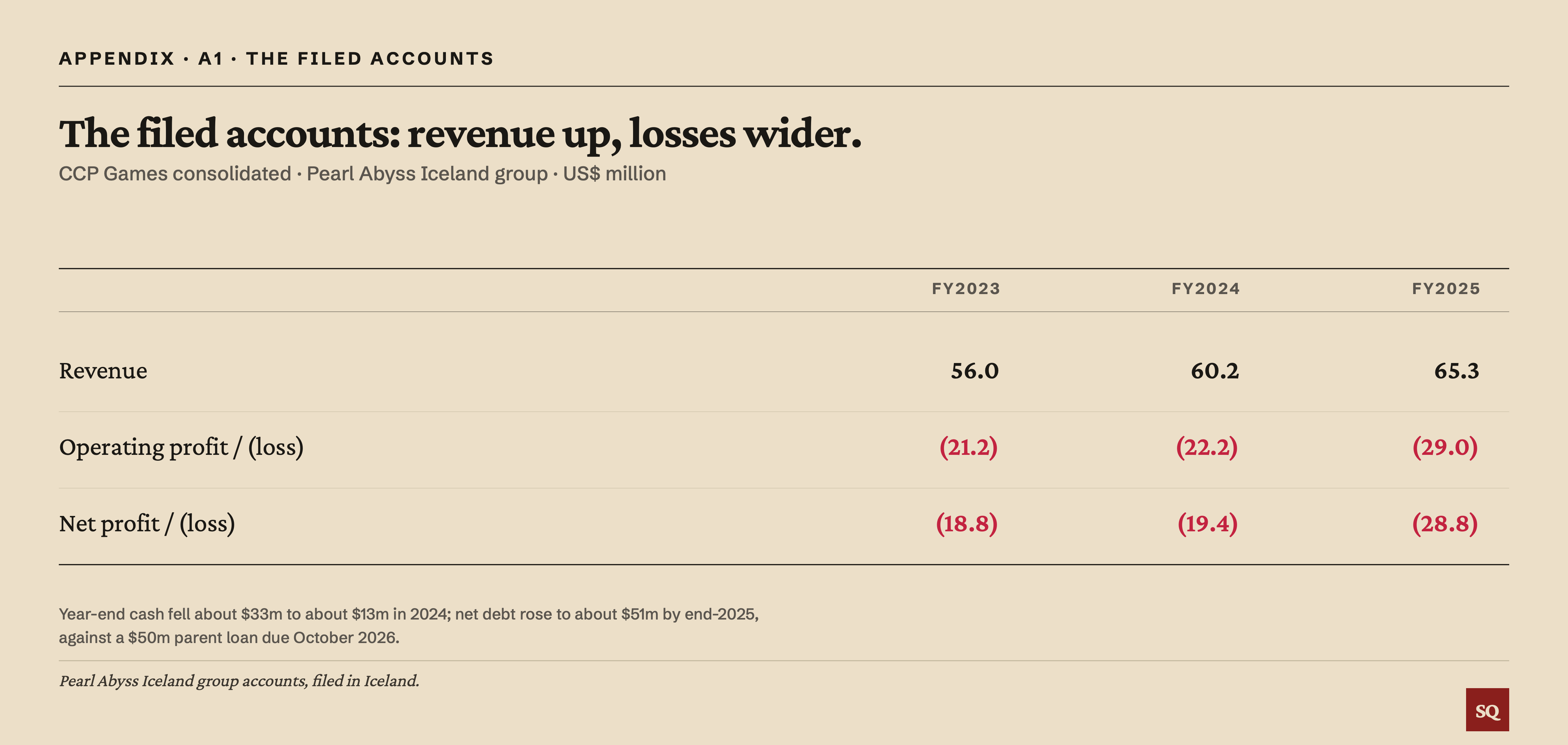
Year-end cash fell from about $33m in 2023 to about $13m in 2024. Net debt rose from about $37m at end-2024 to about $51m at end-2025, against a $50m loan from Pearl Abyss, originally a bank facility converted to a 4.6% intercompany loan in 2023, due October 2026. Source: Pearl Abyss Iceland group accounts (consolidated, audited), filed in Iceland; corroborated by two independent reads (marketsforISK; Nosy Gamer).
The exit math sets the 2026 price against what the asset cost and what it earns:
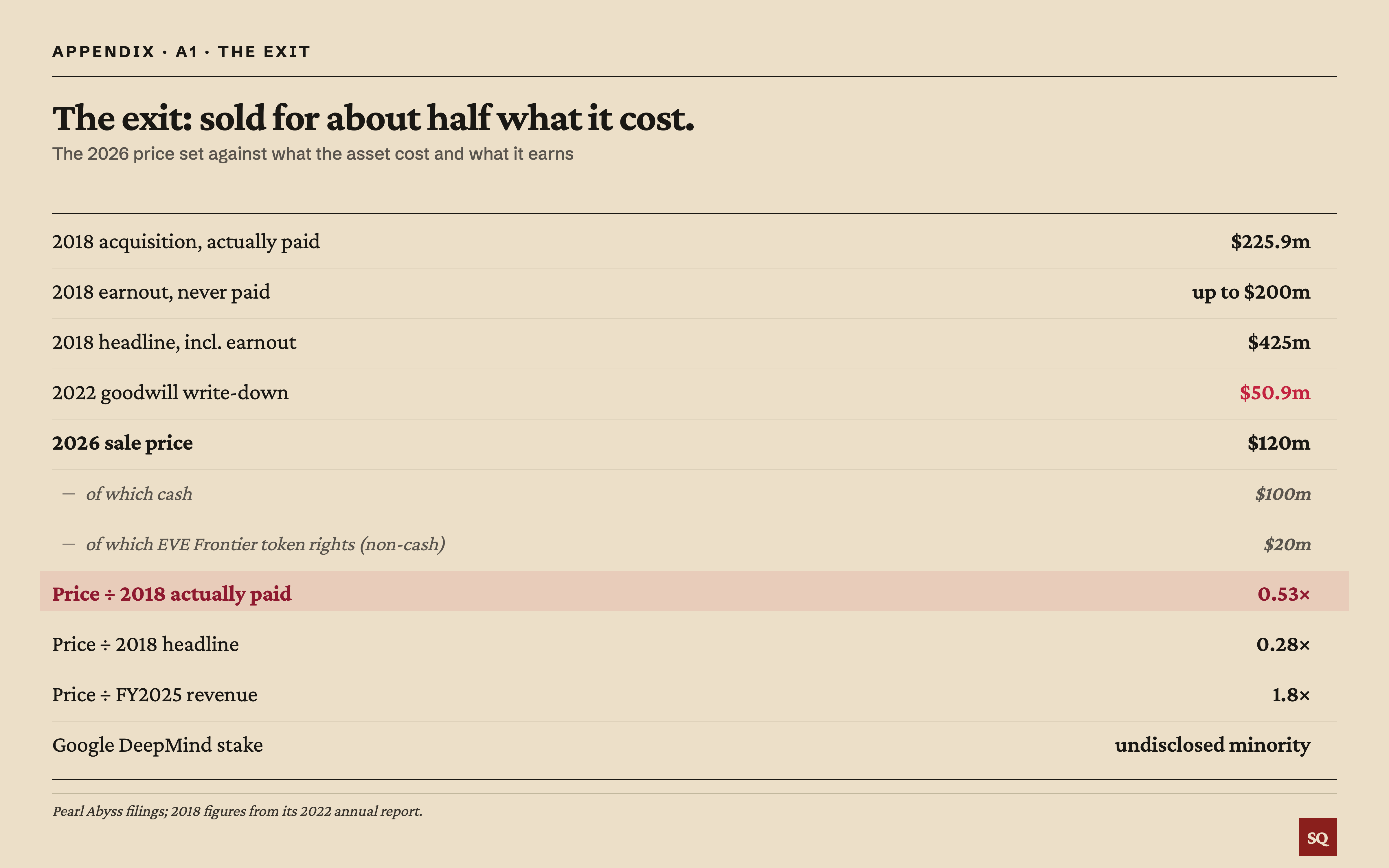
The $120m equalled 15.4% of Pearl Abyss’s consolidated assets and bought the entire holding, 10,973,763 CCP shares. On the company-level CCP figure the announcement cites, about $70m, the multiple is about 1.7x rather than 1.8x; on an enterprise basis it is higher again once the $50m parent loan is added. The 2018 headline of $425m included a $200m earnout that was never met and never paid, so $225.9m is what changed hands; the $120m is 0.53x that and 0.28x the headline. Source: 2026 deal and consideration split, Pearl Abyss 1Q26 earnings letter (English, 12 May 2026) and the Korean disclosure (KIND) on the disposal; 2018 figures and the impairment, Pearl Abyss 2022 annual report (KIND), via marketsforISK.
The deal mechanics: Pearl Abyss Iceland’s board resolved the sale on 30 April 2026 and it completed on 6 May 2026. Management, led by chief executive Hilmar Pétursson, bought the company out with a group of long-term investors and rebranded it Fenris Creations; advisers were Aream & Co. and Arion Bank on the Fenris side, with LOGOS as legal counsel. Google DeepMind took the undisclosed minority stake that helped finance the buyout, and with it the right to run an offline copy of EVE on its own servers (reported, from the Fenris announcement, not a filing). Pearl Abyss framed the sale as freeing it to fund Crimson Desert and DokeV, and in its own words “determined that selling the shares to the current management would be mutually beneficial after a comprehensive review of mid-to long-term growth strategies”, while keeping “the potential collaboration opportunities open with Fenris Creations” (Pearl Abyss 1Q26 letter). The disposal gain or loss was not in the first-quarter accounts, because the deal closed after the 31 March quarter-end; it falls in Pearl Abyss’s unreported Q2 2026 results, where one analyst put the pre-tax gain at about ₩69bn (reported, an estimate, not a disclosure).
One contradiction is worth holding against the announcement. The Fenris release described a record year for a business that “remains profitable” on revenue above $70m (reported). That $70m is CCP’s company-level revenue, about $70m and roughly flat on the prior year, at which level the entity still lost about $14m; the consolidated group lost $28.8m. “Profitable” holds only at the level of the EVE Online product, not of any filed legal entity. The honest read is record product revenue inside a loss-making, increasingly indebted company that its owner had already written down and wanted out of.
A2. The cost-model anchor: content is most of the spend, the engine is the safe part
The body’s claim, that AI enters the content and tooling around the deterministic core rather than the core itself, and that this is most of what a studio spends on, rests on the production cost model built for the companion piece (See: AI won’t make video games materially cheaper to develop). The model is a triangulated archetype, a third-party AAA single-player title on Unreal Engine 5, 2026 to 2030, not any one studio’s accounts. Its all-in cost is $350m: $250m production and $100m marketing. The production envelope breaks down by function as follows, with each function’s modelled AI compression rate, the share of that function’s cost the model expects AI to take out:
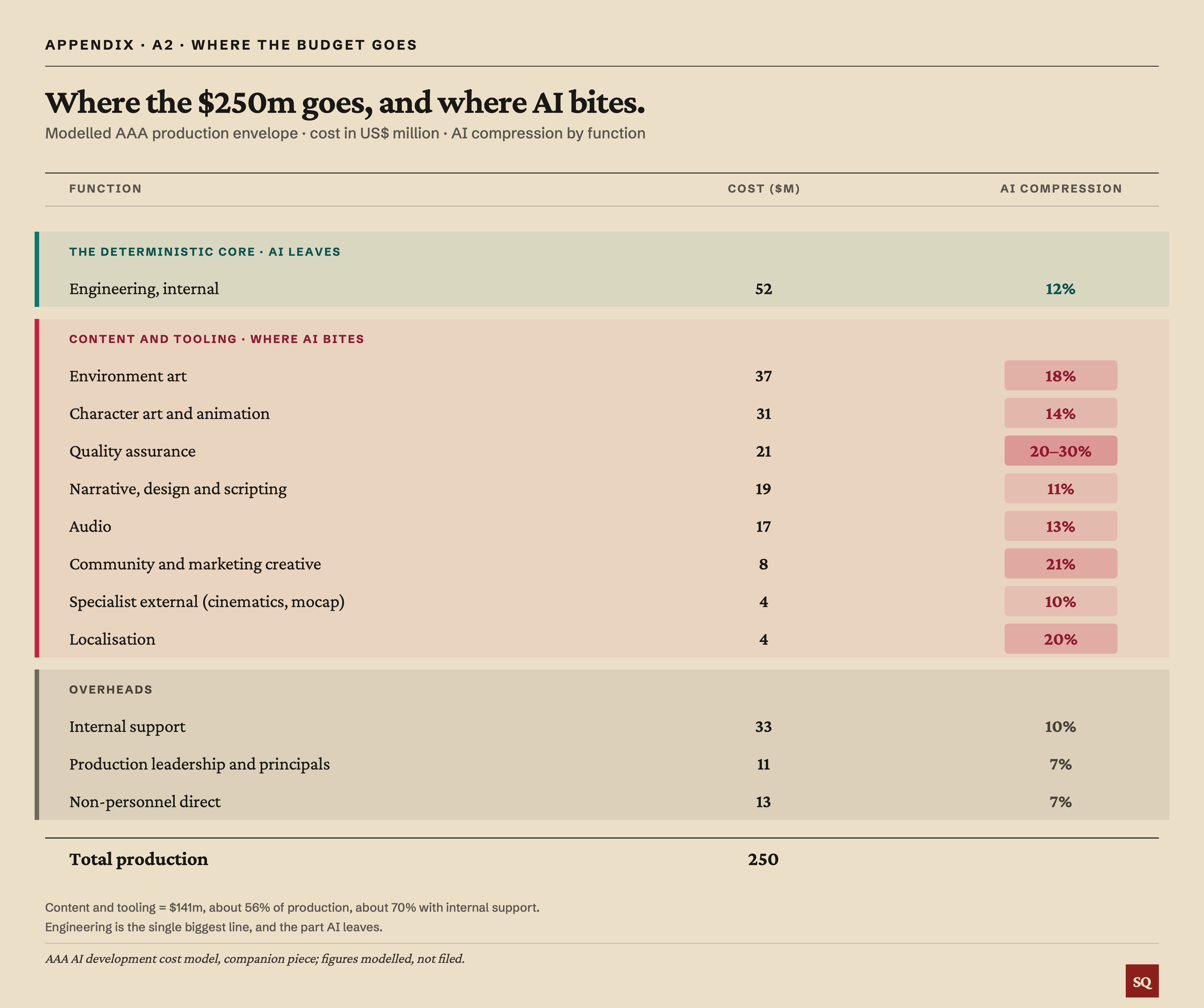
Three readings matter. First, the content and tooling functions where AI bites, art, narrative, audio, QA, localisation, marketing creative and the specialist external work, sum to $141m, about 56% of production; adding internal support takes it to about $174m, roughly 70%. Second, engineering is the single biggest line at $52m, and it is largely the part AI leaves: the game-feel and combat tuning, the authoritative server, the social layer and the senior architecture, with the modelled 12% compression concentrated in tools and glue code rather than the core. So the largest single cost is also the safest, and the exposure is the dispersed content majority around it. Third, the highest compression rates fall on the volume work at the edges, external QA at 30% and marketing creative at 21%, and the lowest on the human-judgment lines, production leadership at 7%. The “most of the spend” claim does not depend on any one function being biggest, which is why the body does not call art the largest line. Source: the AAA AI development cost model built for the companion piece [LINK], Inputs tab; figures are modelled, not filed.
A3. The Nadella post
The opening is anchored on a Satya Nadella post from mid-June 2026 about human capital and token capital.
A4. Guild Wars 3
The live worked example. ArenaNet, owned by the Korean publisher NCSoft, announced Guild Wars 3 on 5 June 2026 at Summer Game Fest, its first new game in roughly fourteen years. It is built on Unreal Engine 5 (listed on its Steam page; reported rather than confirmed by the studio), buy-to-play with no subscription, targeting PC and PlayStation 5, with a beta in late 2027 and launch around 2028. The reveal set it as a prequel in Orr, with the pillars given as the “joy of movement” and action combat. Verify before publication: the report that the game’s existence first surfaced at a hostile NCSoft shareholder meeting in about March 2024 (a single outlet); the specific Orr lore (the Vael spirits, the Seeker mount, the Vaelwardens); and the reveal’s own stance on AI, before any claim is made about how the studio frames AI in the game. The article’s argument does not turn on these details, only on the game being a persistent online world a studio could rework with its own production history and player data; the flags above guard the colour, not the thesis. Source: NCSoft announcement; Massively OP; Inven Global; the Steam listing.
A5. NetEase and DeepSeek
The close uses NetEase as the contrast to CCP: a studio that built its own AI capability and runs rented models underneath it, rather than ceding the loop. The verified footing is that NetEase owns a proprietary AI system and wires external models into its games, with DeepSeek’s R1 one of about six it has used in the MMO Justice Mobile (alongside Alibaba’s Qwen, Baidu’s ERNIE, MiniMax, Moonshot’s Kimi and ByteDance’s Doubao); its 2025 title Sword of Justice runs on NetEase’s own system plus DeepSeek. Chief executive Ding Lei has said models like DeepSeek’s raised game R&D efficiency by about 30%. The article therefore says NetEase rents “models like DeepSeek’s”, illustratively, and makes no claim that it runs its pipeline on DeepSeek alone. It also makes no claim that NetEase holds equity in DeepSeek. DeepSeek’s first external funding round, reported in mid-2026 at about 50bn yuan and a post-money valuation around 350-400bn yuan, has confirmed leads in founder Liang Wenfeng (who keeps control), Tencent and CATL; NetEase has been reported as in late-stage talks but is unconfirmed and has not commented, and the round is reported to have closed. If a NetEase stake is ever confirmed, it becomes the inverse of the EVE case, a healthy games company taking a position up the stack in a lab, and the article would note it; until then NetEase stays on the integration footing only. Source (reported throughout): Reuters, 36Kr and The Next Web on the round; RADII, Webull and Seeking Alpha on the integration.
A6. Conventions and sources
Currency. CCP and Pearl Abyss figures are stated in US dollars; the group reports in dollars, and Korean won amounts are converted at rates near the deal date (the $120m at ₩1,476.10 to the dollar) and are not marked to current spot.
Period basis. CCP’s results are the financial years 2023 to 2025 as filed in Iceland. Pearl Abyss’s “Q1 2026” is the quarter to 31 March 2026; the EVE sale closed on 6 May 2026, after that quarter-end, so its gain or loss lands in the unreported second quarter.
Reported versus filed. Figures marked “(reported)” come from press, deal coverage, company announcements or analyst estimates rather than a financial filing, and are re-checked against the latest reporting before publication. The deal financials and the 2018 and impairment figures are from Pearl Abyss filings and disclosures; the buyout’s framing, DeepMind’s use of an offline copy, the disposal-gain estimate and the EVE revenue records are reported. The cost-model figures in A2 are a model, not accounts. The verify-before-publication items in A3, A4 and A5 are listed in those sections.
Style. British spelling; currency as $Xm and $Xbn; financial years as FY2025 and calendar years as CY2026.