


TL;DR
We read the job postings on both sides of this market: the two ad networks, AppLovin and Unity, and the game studios that buy from them. The studios staff whole teams to independently check and reconcile the networks’ numbers, at their own expense, and one of them, AppLovin, is quietly hiring to extend beyond games into e-commerce.
Both companies are valued on the growth of an ad engine, AppLovin’s AXON and Unity’s Vector. That growth is real and disclosed. What the filings will not let you do is take it apart: how much is a genuinely better engine, and how much is mix, price or a cyclical bounce, and whether the edge lasts. AppLovin narrates a yield metric it never defines (net revenue per install); Unity discloses no standalone Vector line at all.
Their strategies are diverging. AppLovin is extending its demand into e-commerce while keeping a large mobile-game base; Unity is rebuilding its ad product. They still compete for game user-acquisition budgets, but each is aiming at an increasingly different market.
I write The Side Quest independently and take on select advisory and consulting work alongside it, and I'm open to the right full-time role. If any of that could be useful to you or your team, I'd be glad to hear from you. The Unity/AppLovin Model is available on request.
Mobile games spend heavily to acquire users. Across the listed publishers, user acquisition runs at roughly 30 to 40% of net revenue for the heavier spenders, and less for the lighter ones, and it is the main lever on growth, so how efficiently that money is spent is one of the most important lines an investor in the sector can look at. The companies on the other side of it, selling the tools that spend it, are AppLovin and Unity.
Recently I was asked, “Chirag, both AppLovin and Unity are priced on their ad engine being a genuine, durable edge. How do I actually know the engine is as good as they say, and not just growth that’s really mix, price, or a cyclical bounce?” I did not have a clean answer, and it turns out to be a genuinely hard question worth working through.
The valuation of AppLovin and Unity are based on a number they share, but isn’t disclosed
AppLovin and Unity arrived at the same place from opposite directions. Both came out of games, AppLovin making them, Unity making the engine they are built in. Both rebuilt themselves around a machine-learning advertising engine, AppLovin’s AXON and Unity’s Vector, that decides which ad to show which player and what to bid for the chance. Both are now valued less on the games they came from than on the belief that the engine is a durable, compounding advantage. AppLovin went further than belief and sold its entire games business in 2025 to become a pure advertising platform. Unity kept its engine and bet the other way, that owning the thing games are built in is the edge.
The official stories are clean and, to a point, true. AppLovin’s AXON scaled advertising revenue from $1.8bn to $5.5bn in two years with no acquisitions to explain it away. Unity’s Vector, after a period of self-inflicted damage, is recovering fast enough that its strategic advertising line is growing at a rate the headline number hides. This piece is about two things underneath those stories:
What neither company lets you establish is how much of that growth is the engine getting genuinely better, rather than a shift in mix, a change in price, or a cyclical recovery, and whether the advantage is durable. AppLovin narrates a yield metric that climbs on its own as its mix shifts (net revenue per install); Unity discloses no standalone Vector figure at all.
The two businesses’ strategies are diverging, and where the two were once compared to each other, they increasingly are not.
1. The machine both companies run
Many free mobile games, especially casual and hypercasual titles, make their money by selling the advertising slots inside them, and filling those slots profitably is the business both companies are really in. When a player opens the game, an engine decides within milliseconds which advertiser’s ad to show and what to bid for the chance to show it, pricing each impression on a prediction of how likely that particular player is to install or spend after seeing it. This is the part people mean when they say the engine: AppLovin’s is AXON and Unity’s is Vector, and it is the part both are now valued on.
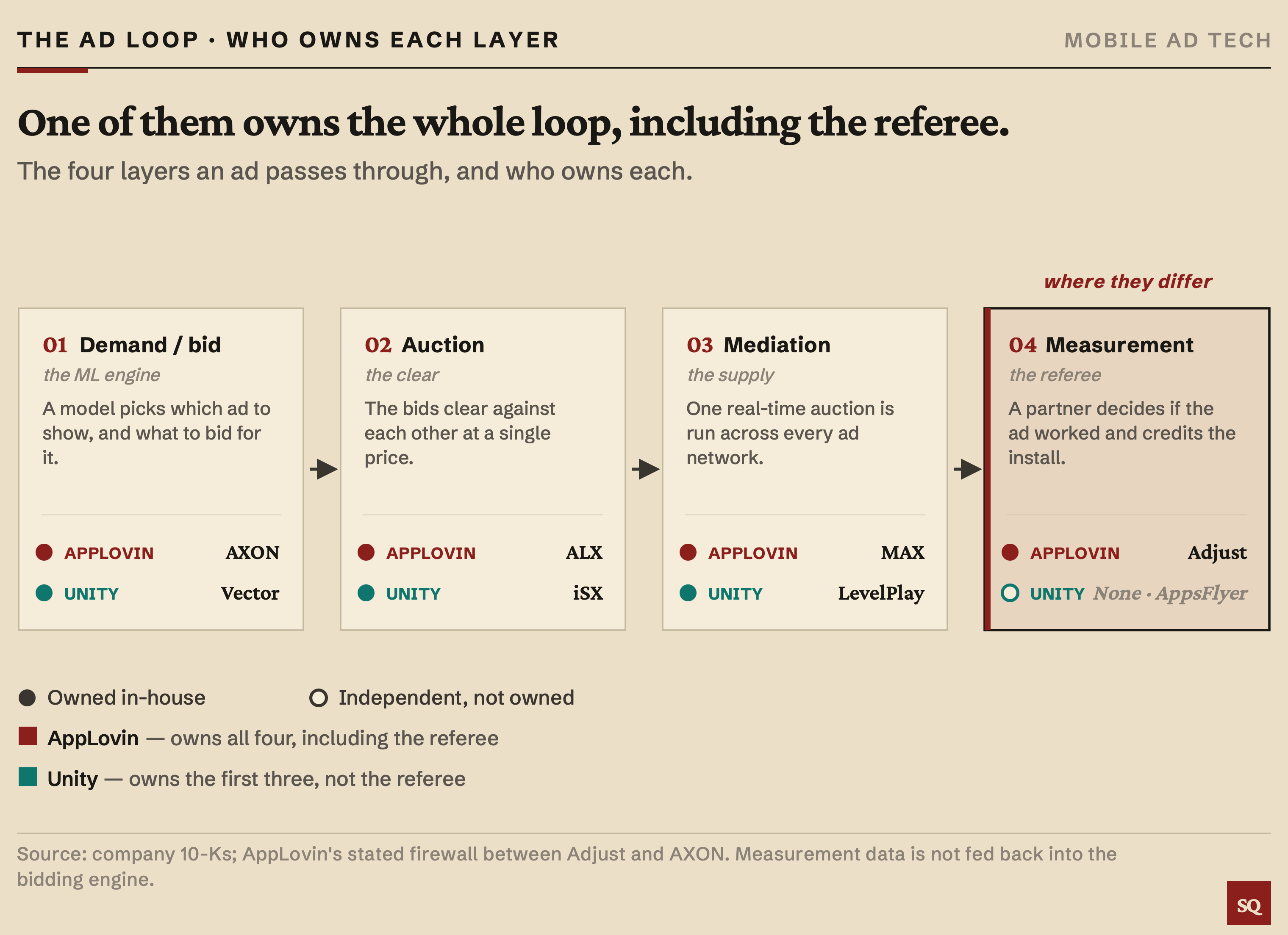
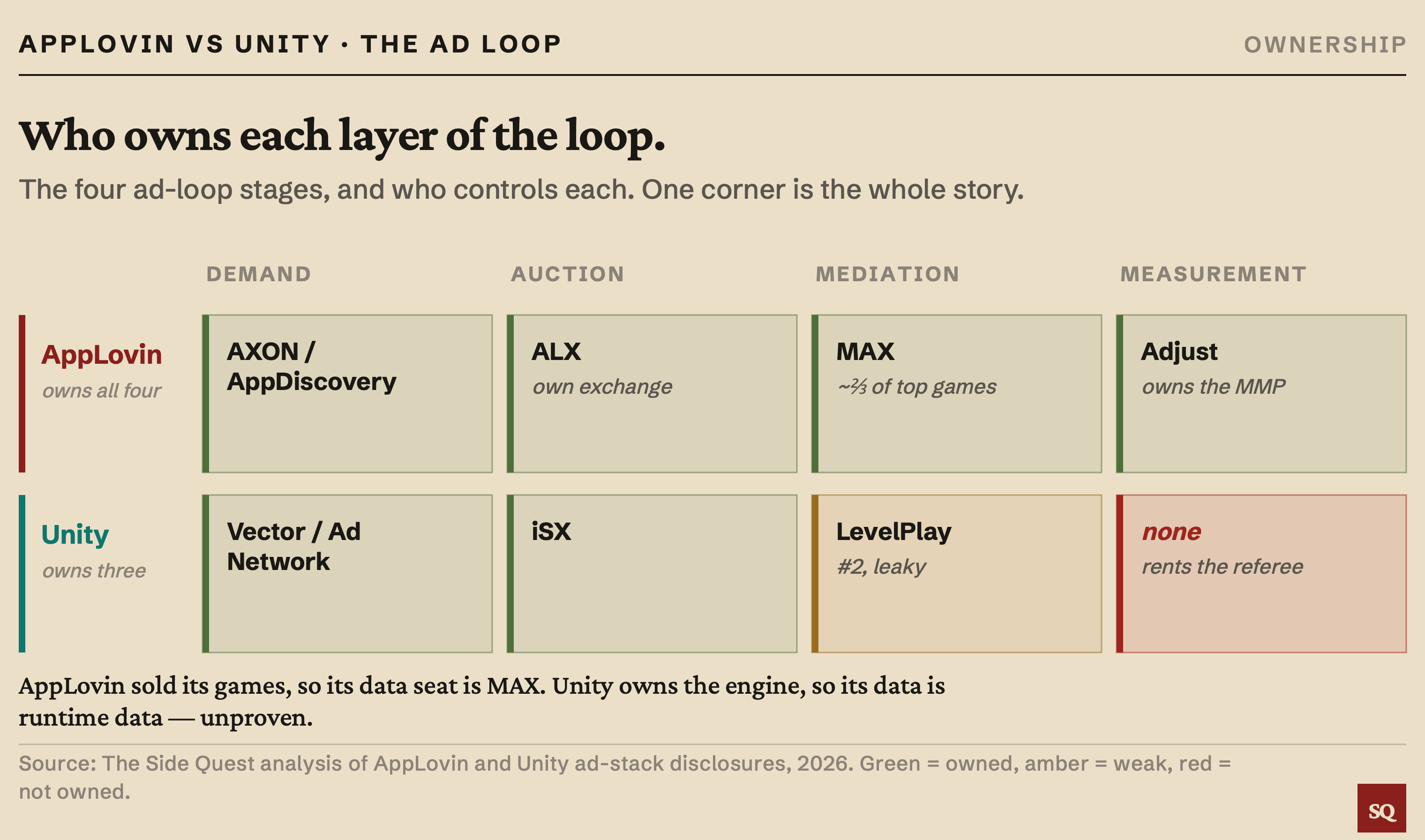
The winning bid clears an auction, and both companies run their own. Above the auction sits the mediation layer, the software inside the app that runs a single real-time auction across the ad networks that bid into it and gives the slot to the highest. Whoever operates that layer sees the competing bids on every impression routed through it, a commercially powerful position, because it is the one place from which a company can watch what its rivals will pay for a given user. AppLovin operates MAX, which sits in roughly two-thirds of the top games, and Unity operates LevelPlay.
Once an ad has run, someone has to decide which network to credit for the install that followed. Because each network reports on its own performance, that judgement usually goes to an independent measurement firm, a mobile measurement partner. AppLovin owns one of the measurement firms advertisers can choose, Adjust; where an advertiser picks it, the referee is owned by the network it is judging. Unity owns no controlling measurement firm, and relies on the independent one most of the industry uses. The chart below illustrates this loop:
This business model is the entirety of AppLovin, but only half of Unity as they also have a game engine, the software games are built and run in, which Unity licenses on a per-seat subscription. Unity is strongest in mobile and among smaller studios, while Epic’s Unreal, the other major engine, leads the high-fidelity PC and console work that Unity touches less. Beneath both, a free and open-source engine called Godot is rising from the indie end, though it has yet to displace either in professional or mobile games at any real scale.
Both advertising engines have grown, from very different starting points and at very different rates. AppLovin’s roughly tripled its advertising revenue in two years. Unity’s went flat and then began to recover, having been caught by the same industry-wide move to deep-learning ad models that carried AppLovin up.
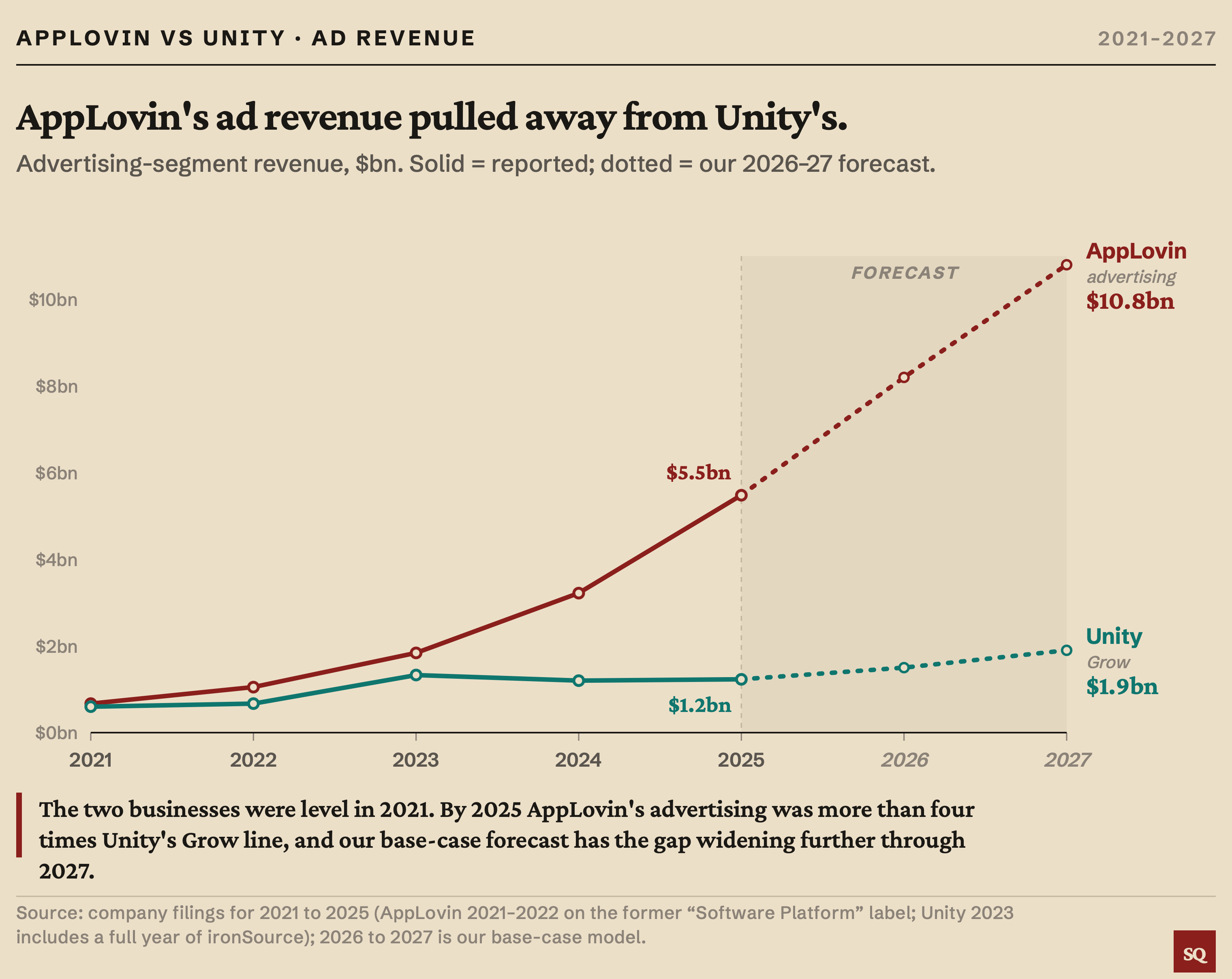
A better model wins a given quarter, but the model is a contestable capability, with rivals like Moloco and Liftoff running comparable engines. The durable difference is structural: the integrated loop each has built around the model, more than the model itself.
2. The people who buy the ads do not believe the numbers
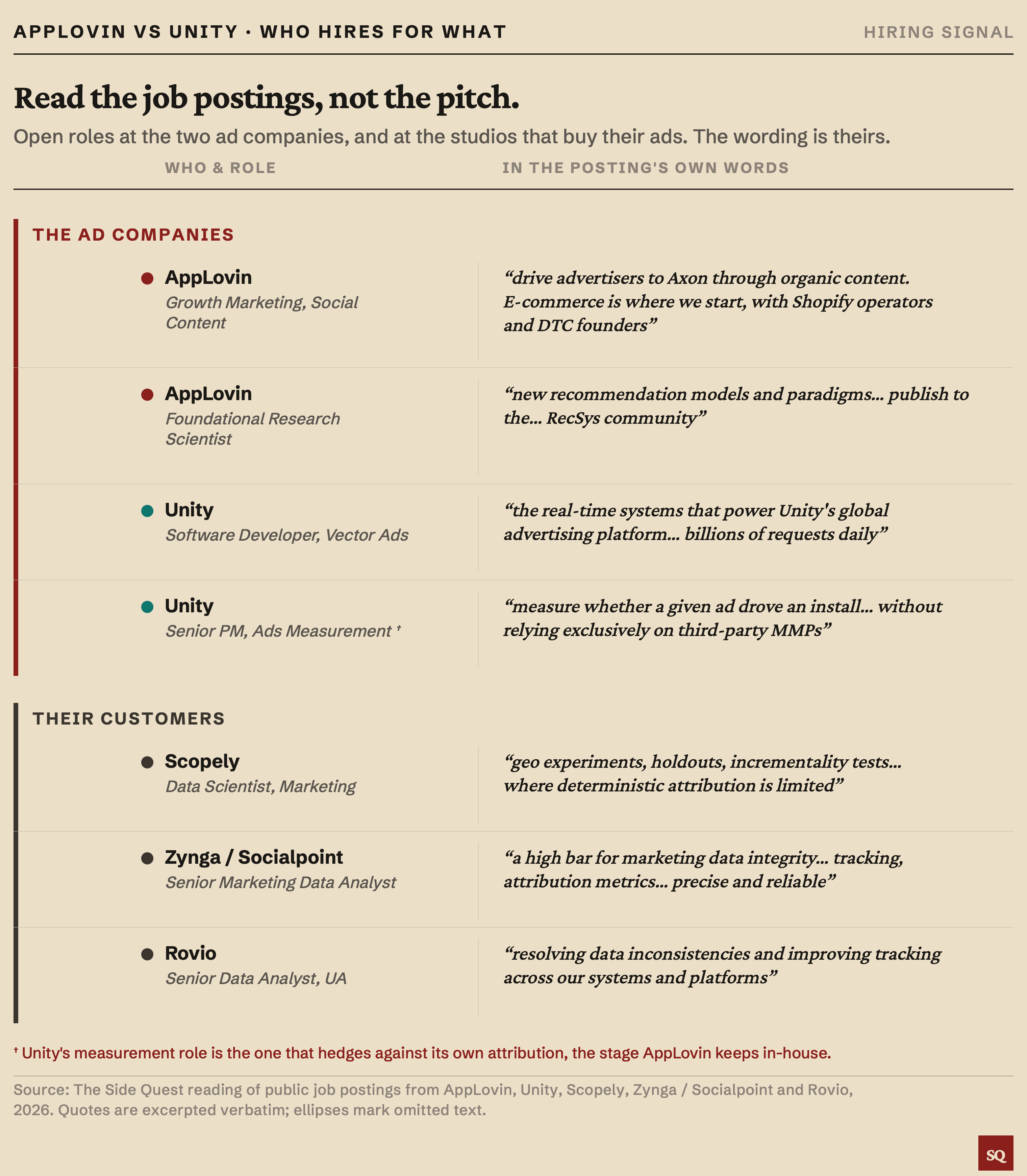
One way to validate the strategies of each company is to understand more about their hiring strategies and their customers. So I read the postings on both sides of this market: on the ad side, what AppLovin and Unity are recruiting for; on the customer side, the user-acquisition and marketing-data roles at a range of mobile game studios. The two answer different questions:
The ad companies’ postings show the strategy each is running: AppLovin expanding into e-commerce, Unity building out its core ad platform.
The studios’ postings show that the people spending the money build and reconcile their own version of the networks’ numbers rather than take the dashboards at face value.
For the ad companies:
AppLovin hires for very few roles. About half its open positions are demand-side sales, and most of the rest are machine-learning and research posts for the engine. That fits its model: one ad engine, run by a small commercial team, which is where its operating margins come from. Its newer roles are aimed at a different customer. Business-development posts target “eCommerce, retail, subscription and lead generation,” a growth role exists to bring e-commerce advertisers to AXON, “starting with Shopify operators and DTC founders,” and the careers board keeps standing teams for e-commerce and connected TV. The company that grew up selling ads inside games is now hiring to sell them to e-commerce brands.
Unity hires several times as many people, split between two jobs. One is the advertising stack: the Vector bidding engine, the ads SDK, a user-acquisition prediction team, and ads measurement. The other is the game engine: core-engine, 3D and on-device-AI roles. It is funding both at once, rather than running the engine down to pay for the ads. Its measurement roles are building the ability to judge, from Unity’s own first-party data, “whether a given ad drove an install,” without relying only on the third-party firms the rest of the industry uses.
For customers:
The large studios we sampled employ people to independently check and reconcile the numbers the networks report, and their postings describe the work directly.
Scopely hires marketing data scientists to run “geo experiments, holdouts, incrementality tests” and to measure results “where deterministic attribution is limited.”
Zynga and its studios want analysts to keep “a high bar for marketing data integrity” so that “tracking, attribution metrics and performance reporting are precise and reliable.”
Rovio asks a user-acquisition analyst to spend part of the role “resolving data inconsistencies and improving tracking across our systems and platforms.”
What these roles have in common is that the studio builds its own measure of what an install was worth and whether the ad caused it, and weighs that against the network’s dashboard rather than acting on the dashboard alone. It adds to the cost of running paid acquisition, a cost sophisticated buyers take on rather than treat the platform’s numbers as enough.
3. The quality of the number
Even Unity, which also sells a game engine, is bought mainly for the growth of its advertising business, the same as AppLovin. In both, the figure meant to show the ad engine is creating that growth, rather than riding a cyclical recovery, is one an outsider cannot check.
A large advertising business usually discloses two figures side by side:
A measure of how much it sold
A measure of what it charged for it.
Meta gives ad impressions and the average price per ad; Google gives paid clicks and their cost; Snap, Pinterest and Reddit give active users and the revenue per user. The pairing is the point: it separates growth that comes from selling more from growth that comes from charging more, which is most of what an investor wants to know.
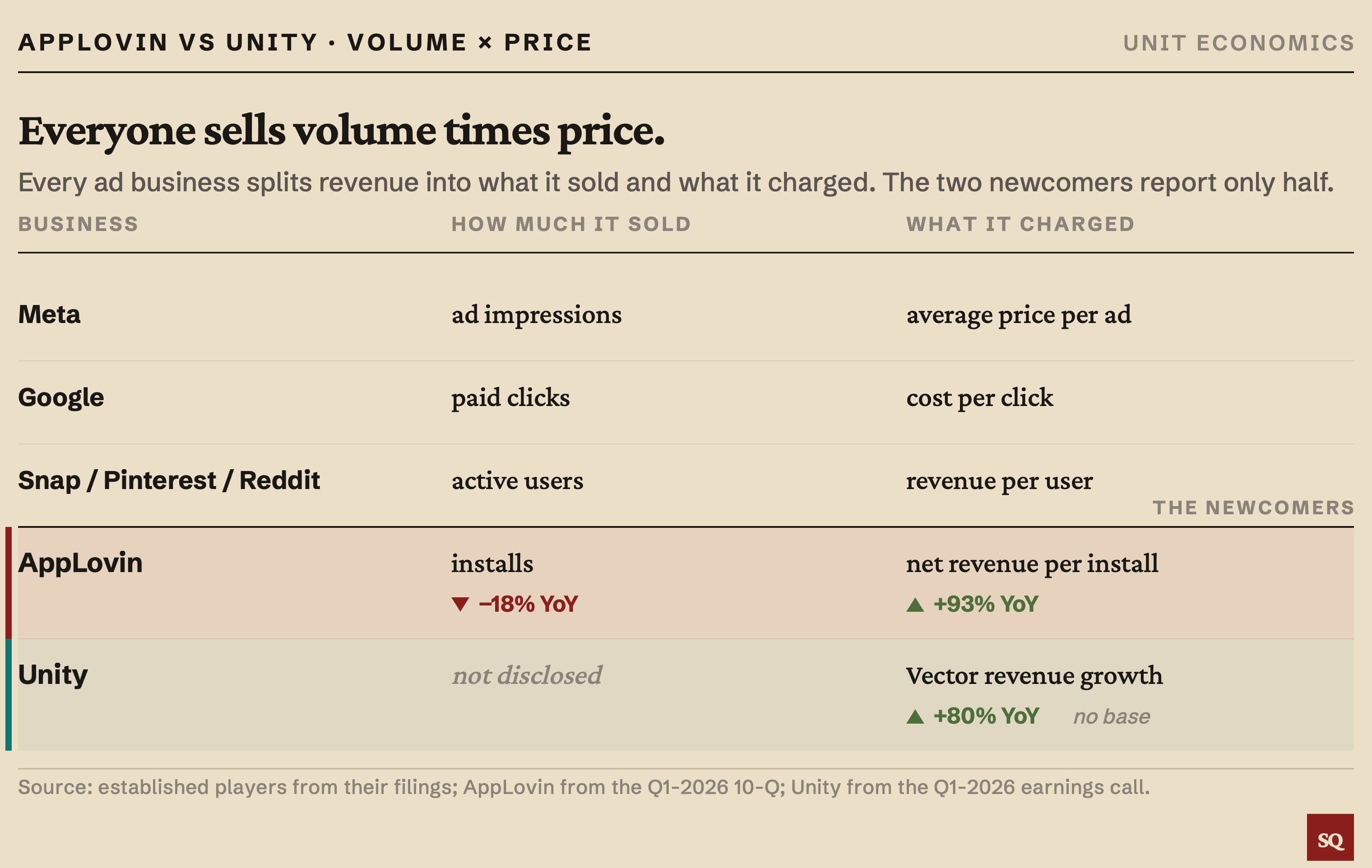
AppLovin reports both figures, but they do not line up. Its yield number is net revenue per install: all of its advertising revenue, divided by the number of installs.
The revenue on top is everything AppLovin sells, and a growing share of it, e-commerce and connected-TV advertising, has nothing to do with an install.
The count underneath is installs only. As that non-install revenue grows, the top rises while the bottom does not, so net revenue per install can climb without the engine improving at all. AppLovin’s CFO confirmed as much on the Q1 2025 call, that the numerator carries web and commerce revenue the install count does not; how much of the rise is this mix effect, and how much a genuinely better engine, cannot be separated from what it discloses.
The CFO has said as much: the figure goes up “because the installation volume in that metric is staying stagnant.”
Unity gives even less. Its headline figure is that Vector’s revenue grew 80% in a year, a number it repeats on its earnings calls but never attaches to a standalone dollar line. You can bound it from the mix Unity does give, though: in the first quarter of 2026 the ad network Vector powers was about four-fifths of a $279m strategic advertising line, so it runs near $220m a quarter. It will not break the advertising segment down either: asked to, the chief executive said “we are not reporting breakdowns in the ad revenue number.”
So the figure tells you the business is growing, not what is driving the growth: how much is the engine improving, and how much is mix, price or a cyclical recovery. You take that split on management’s word. Fuller disclosure, a defined metric on AppLovin’s side and a revenue line on Unity’s, would narrow the gap, though no single number would close it, since whether the edge is durable is a separate question again. The thin disclosure is as much a catalyst held in reserve as a shortcoming.
4. Only one of them owns its scorekeeper
The industry has a neutral party for exactly this problem: the mobile measurement partner, an independent firm that decides which network earned each install, so that none is taken at its own word.
AppLovin owns one. It bought Adjust, a mobile measurement partner, in 2021. Advertisers choose their own measurement partner, but for those who pick Adjust the firm grading AppLovin’s campaigns is owned by AppLovin, which also holds the bid through AXON and the auction it clears through. The analyst Eric Seufert flagged the oddity when the deal was done, a company on the buying side of advertising acquiring the neutral firm that scores it. AppLovin says the two are kept apart, that Adjust’s data is not shared with AXON or used to train it. Grant that entirely, and the conflict remains: the firm that marks AppLovin’s results is owned by AppLovin, whichever way the data flows.
The rest of the industry has moved the other way. In June 2026 Google, Meta, Moloco and Unity each agreed to take a non-controlling minority stake in AppsFlyer, the independent partner most of the industry uses, on terms that give none of them preference; the deal was signed subject to regulatory approval. Four competitors agreeing to buy into a shared referee, to keep it independent, is the opposite of a single advertiser owning its own measurement. AppLovin was not among them.
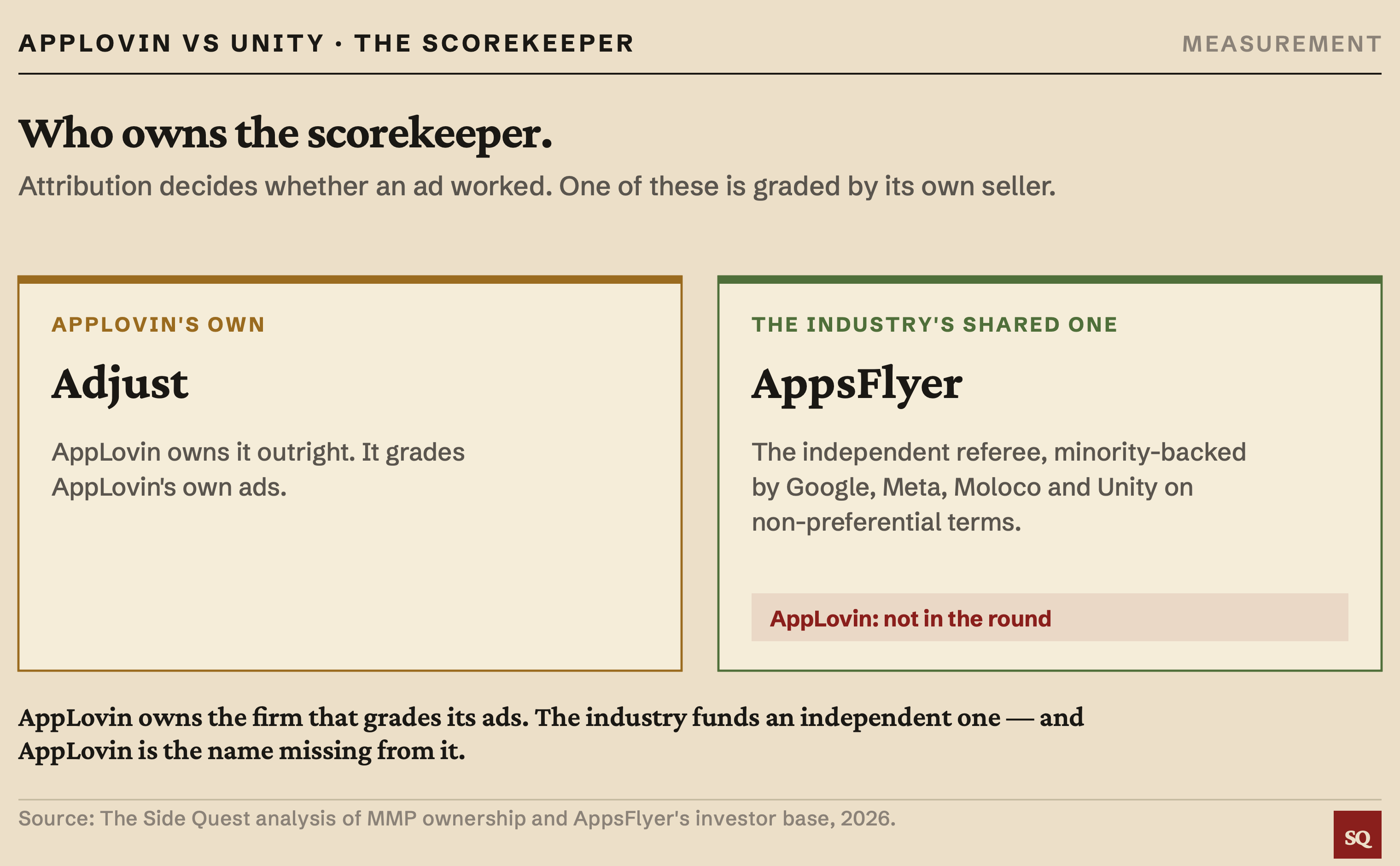
So the conflict runs one way. Where an advertiser chooses Adjust, AppLovin owns the firm grading its ads; Unity has agreed to a passive minority stake, next to its rivals, in the firm that grades everyone’s. In a market that is moving to keep measurement independent, the company that owns its own is the one not among the named backers.
5. The claim no one outside can test
The engine is supposed to create incrementality: sales that would not have happened without the ad, as opposed to ones the advertiser would have got anyway. The clearest public way to measure it is a holdout, where the ads are withheld from a matched group and the two are compared. It is not the only method, but it is the most direct. AppLovin could not be tested this way until recently; the geo-targeting a holdout needs arrived only in late 2024. Since then a few measurement firms and agencies have run tests, and they do not agree.
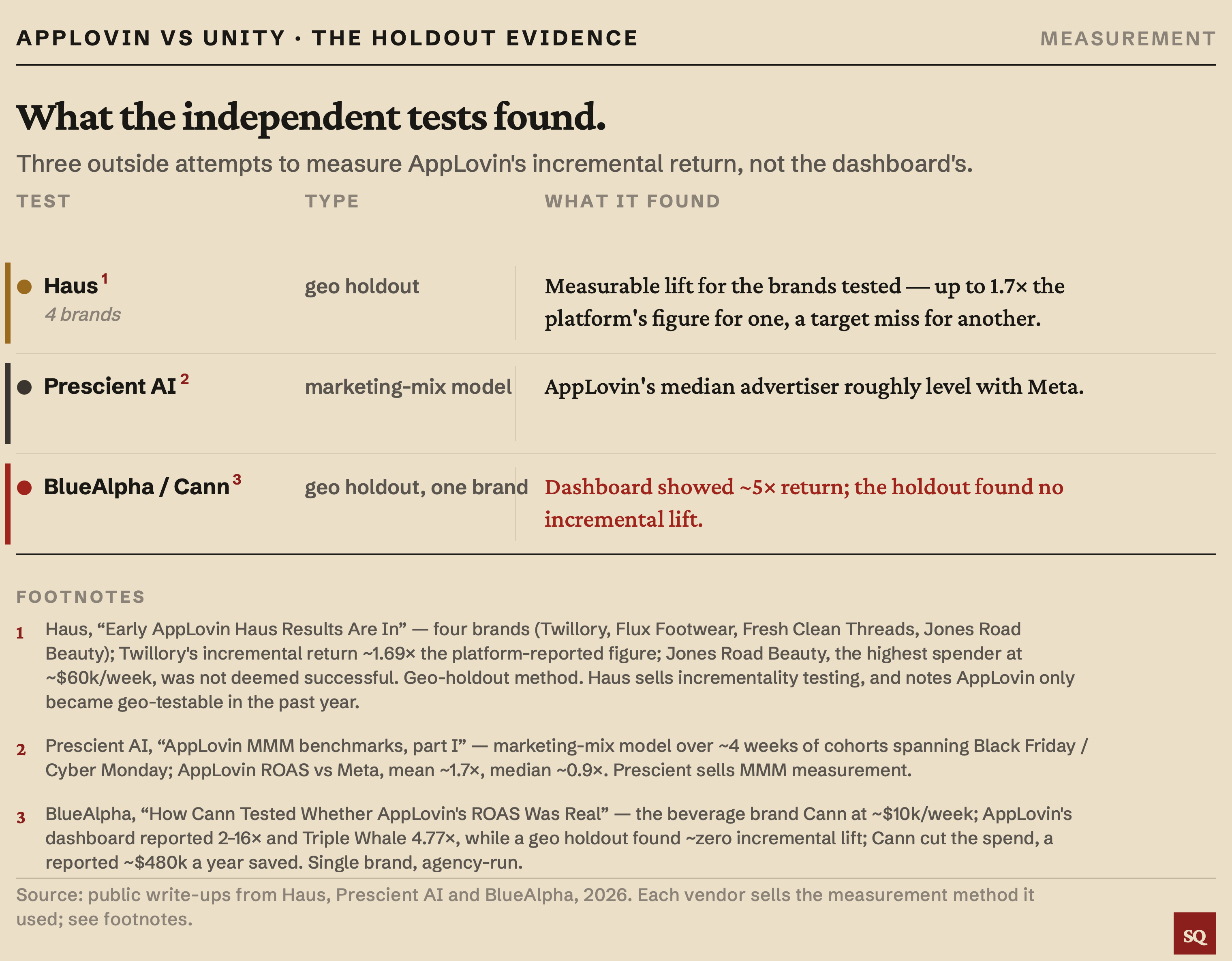
The results swing on the brand and on how much it spends.
Haus, an incrementality firm, ran geo holdouts for four brands and measured real lift for the ones it tested.
An agency called BlueAlpha ran the same kind of test for the beverage brand Cann, at a low weekly spend, and found none the test could detect: the dashboard had shown a large return, the holdout showed no incremental lift, and Cann cut the budget.
Prescient, a modelling vendor, put AppLovin’s median advertiser roughly level with Meta.
Each was run by a firm with a product to sell, on a handful of brands over a short window, and AppLovin has published no holdout of its own.
So the public evidence does not settle it. What there is skews positive, but it is all vendor-run and self-selected, so none of it establishes a typical incremental return or whether the lift scales. What they have in common is that the platform’s dashboard is not the same as the measured result, which is the whole of the incrementality problem.
On its late 2024 earnings call, AppLovin’s chief executive told investors that advertisers in its new e-commerce pilot were, “in many cases,” seeing “nearly a 100% incrementality” from its traffic. But that is the company grading itself, on early data from one new vertical, and the outside record is too thin and too mixed to confirm it. AppLovin has since assembled the favourable tests into its own published review, reporting that the measured incremental factor has more than doubled in a year, which is the company marshalling the evidence for itself, not an independent audit.
The strongest evidence on the bull side is not a test at all. Named advertisers have raised their AppLovin spend and said so on the record: the supplements brand Paleovalley more than fivefold over eight months while hitting its return targets, as Modern Retail reported. That is real, and it is adoption, sophisticated buyers acting as though the engine works. It is not a measurement that the spend was incremental, because the return an advertiser cites is an attributed number, and attribution is the very thing a holdout exists to check.
Unity has its own version of the same problem, a claim about its engine that no outsider can test: that feeding first-party gameplay data into Vector is an edge AppLovin cannot copy.
6. What Unity says it owns
An ad network already sees a great deal: which ad ran, whether it led to an install, and, through the SDK and its measurement partner, what the user did next, the purchases, the retention, the in-app events. What it does not see is the game itself, how long people play, where they give up, the sequence of behaviour inside a session. Unity’s bet is that feeding this gameplay signal into Vector targets better than ad signals alone, drawn not only from Unity’s own titles but from other games built on its engine where the developer has configured and consented to share it. That, Unity says, is the thing AppLovin cannot match, having sold the studios that were its window onto gameplay. AppLovin’s history reads at least as easily the other way: it bought those studios to train its early models and sold them once the models were built. Whether that means it no longer needs to own games to keep the engine sharp is our reading, not something it has said.
The bet is also still a bet. Unity scheduled runtime data to enter Vector’s live models during Q2’2026, and by its own chief executive’s account the growth so far came without it; whether that rollout has completed, and with what result, it has not disclosed. August brings the first management commentary since the rollout, not a test of it: isolating what the data actually adds would need a cohort comparison or a controlled experiment, which Unity has not promised. Until then the edge is a claim about what the engine will do, not something the numbers show, which leaves Unity where AppLovin sits: priced on a proposition about its engine no outsider can yet establish.
7. Where the next two years go
A two-year forecast is uncertain, so the method matters more than the estimate. We project each company’s advertising line a quarter at a time, run three scenarios, and carry the disclosed costs through to net income. As a check on the method, we ran it back against the recent past a quarter at a time: it fits AppLovin’s last eight reported quarters within about 3% each, and Unity’s within about the same over the three interior quarters where the split is disclosed. That is a fit to history, not proof the two-year path is right, and the 2028 figures are an annual extrapolation beyond the quarterly grid. What matters is not the number but what each forecast leans on.
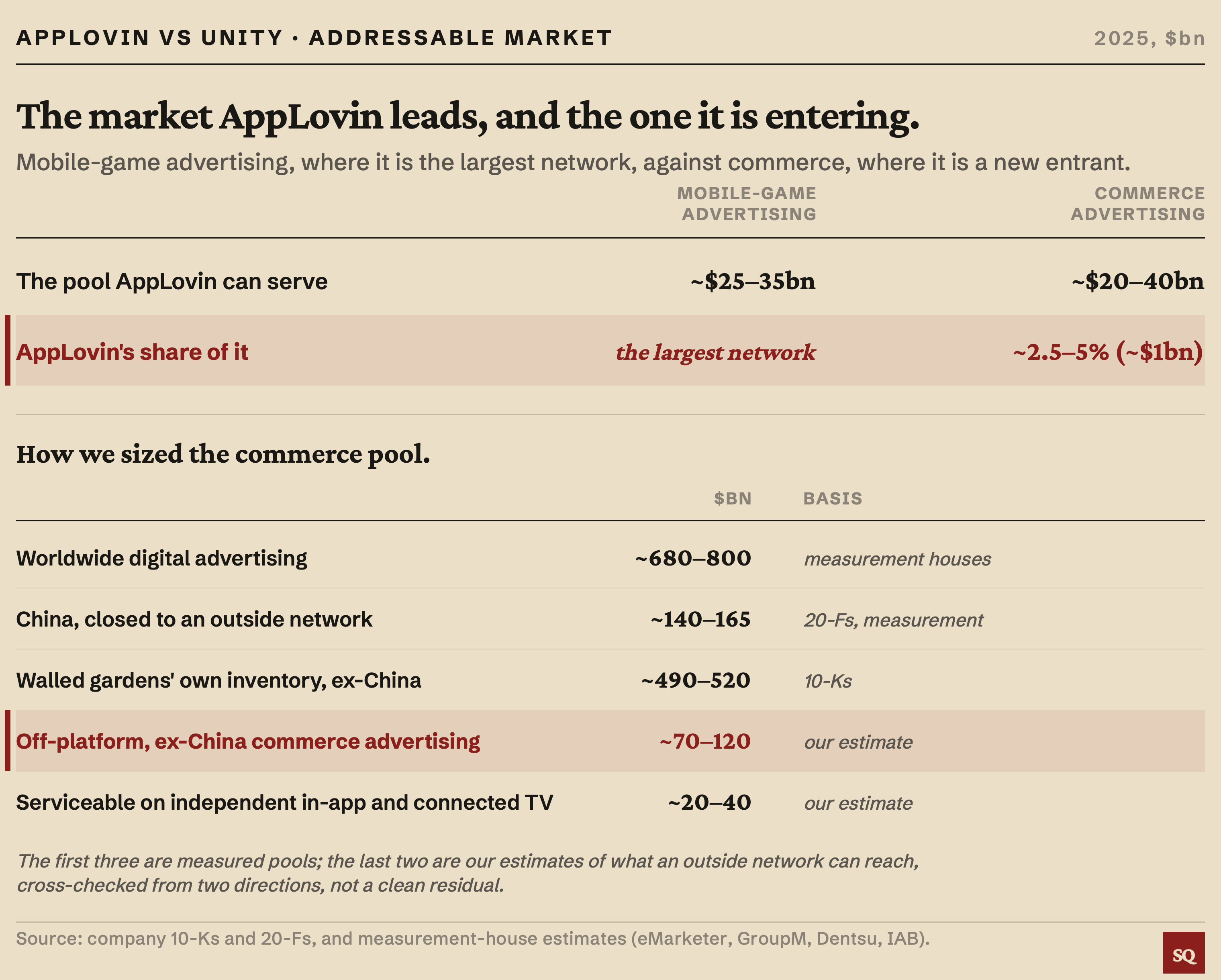
AppLovin’s forecast leans on net revenue per install, still climbing, and on its move into commerce. It has taken the top of mobile-game advertising, a mature market where it already takes the largest share, so commerce is the natural next market. Commerce advertising is far larger than games, but most of it is beyond an outside network’s reach: China is largely closed, and the big Western platforms and retailers keep their advertising on their own inventory. The part that remains, running in independent apps and on connected TV, roughly doubles the market AppLovin can address, on our estimate, and in it AppLovin holds only a few per cent, against Google, Meta and Amazon. The move is a raid on a contested slice, not the filling of white space.
In June 2026 it opened its platform to every advertiser on a self-serve basis, the step that lets the commerce push scale, on the same loop that won gaming. What it lacks is proof the loop scales in commerce: the three incumbents each run their own, and AppLovin’s commerce business, last quantified at about a tenth of revenue in early 2025 and larger now though unquantified, is still small beside them. The price already leans on it getting much bigger.
Unity’s forecast is the mirror. It is rebuilding its ad product, on Vector, to win back the game user-acquisition budgets AppLovin is extending beyond rather than leaving. Through 2025 Vector’s growth and ironSource’s decline cancelled out; that ended when Unity closed the ironSource ad network at the end of April 2026, though its exchange and programmatic demand continue, and the ad line has started to climb. Whether that climb is real share or a small base flattered by advertisers moving off Unity’s own legacy network is something Unity cannot show and an outsider cannot check. Its guided return to profit by end-2026, which our build reaches in the base and bull cases but not the bear, leans partly on old acquisition costs rolling off rather than on the ads. Vector is the widest single swing in that range, which runs from a return to profit to none at all, though Create’s growth, costs, stock compensation and tax move it too.
8. What you pay for it
The ruler we use is EV/EBITDA on next year’s earnings, with stock compensation charged as a cost. It is a choice, not the only one, but it is where the difference between these two shows up.
AppLovin barely moves between the two bases, about 26x either way, because it pays out almost no stock.
The Trade Desk trades near 5x with the stock added back and about 9x once it is charged, so the charge nearly doubles its multiple.
Even charged, AppLovin at about 27x is roughly three times the Trade Desk. That distance is a growth premium, not a stock-comp gap.
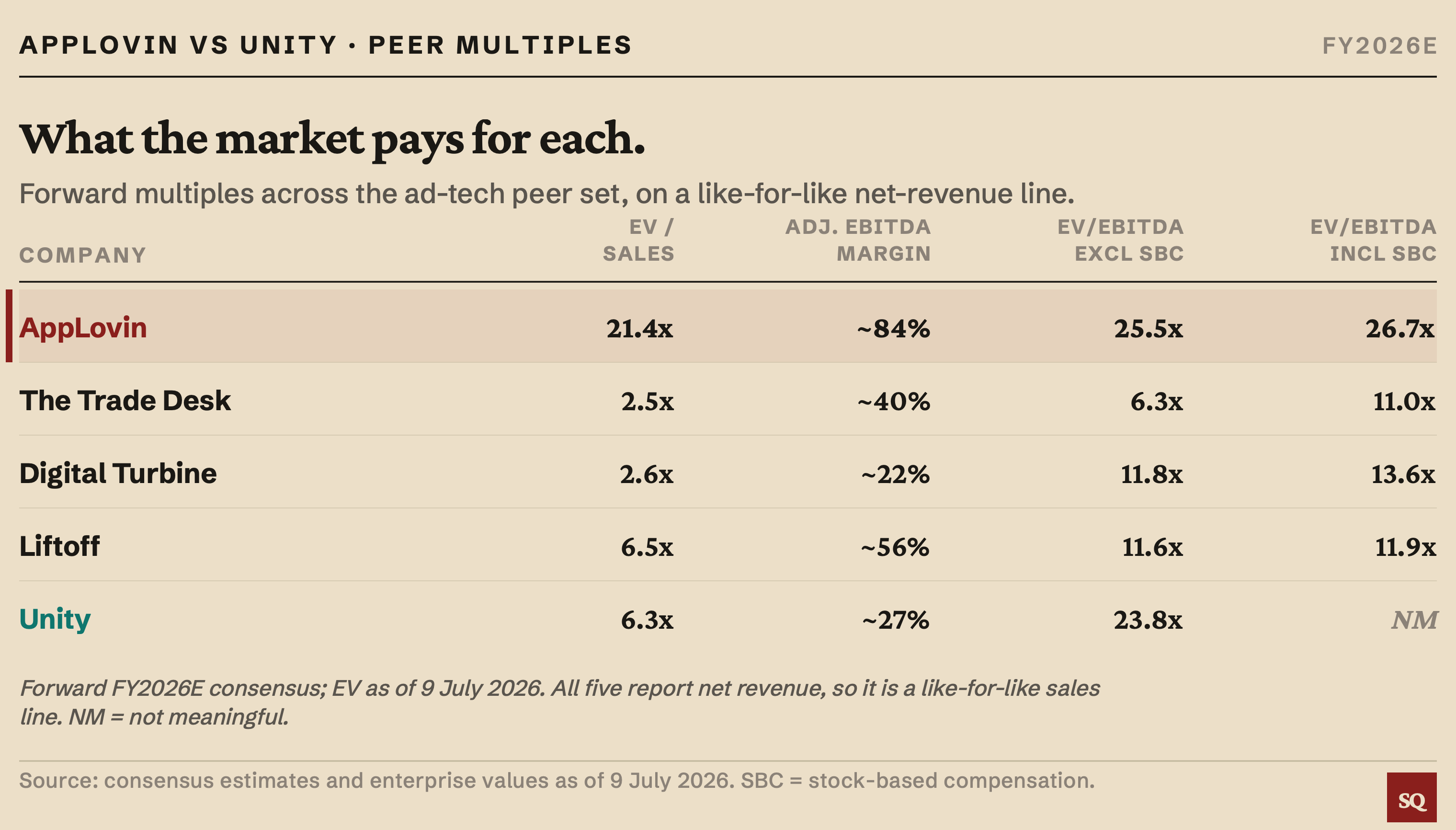
For Unity, the two columns pull apart.
With the stock added back, it trades around 32x, a growth multiple, a little above AppLovin’s.
Charge the stock as a cost and the multiple balloons past 130x, because almost all of Unity’s adjusted profit is the stock it pays out. Strip that stock and only a sliver of earnings is left to carry a $13bn enterprise value; and that sliver exists at all only because we set aside a one-off ironSource writedown from this year. On last year’s accounts, charged for the stock, Unity had no EBITDA and no multiple.
In fairness, Unity converts nearly all of its adjusted EBITDA to cash, and the stock is a dilution cost rather than a cash one, its share count rose about 6% in a year; and the reported operating loss is mostly a non-cash amortisation of the ironSource intangibles, now running off, not a cash hole. But once the stock is counted, there is little underneath.
A multiple tells you the price, not whether it is earned, so we also use a DCF. At a discount rate of about 11%, built from a 4.5% risk-free rate, a 4.2% equity risk premium and a beta of 1.5 we apply to both, and with the stock charged, only AppLovin’s bull case on a premium exit multiple reaches its price; every other case, and every Unity case, sits below. On a conservative terminal that reverts growth to 3% after 2028, both fall well short. The distance between those two terminals is a measure of how much of the price rests on the terminal assumption rather than on the years we actually forecast.
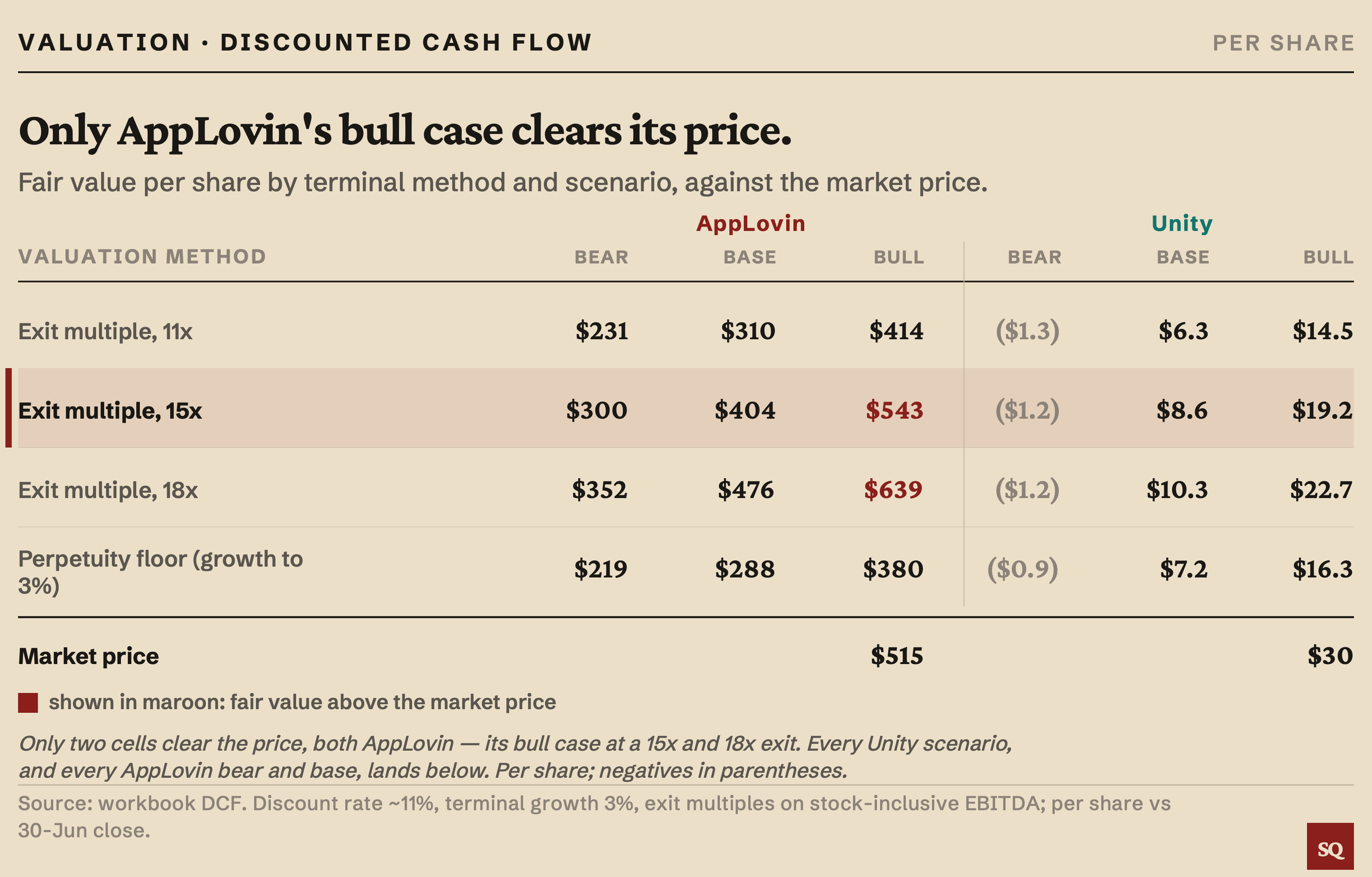
So we can run the DCF backwards: hold the share price fixed and solve for the growth the model then needs to reach it. The figure depends on the terminal method, so we show the range, from the exit multiple we lean on to the conservative perpetuity.
AppLovin’s $515 implies advertising revenue of about $18bn to $27bn by 2028, three to five times its 2025 level: the low end on the exit-multiple terminal, the high end on the perpetuity. Even the low end needs about +50% a year, and the high end +70%, at or below the pace it has just been reporting.
Unity’s $30 implies strategic Grow of about $8bn to $9bn by 2028, near seven times its 2025 level on either terminal, a pace of roughly +90% a year. That is well above what Unity has actually shown: its strategic advertising line grew about 49% last quarter, and even its Vector component, the fastest part, grew about 80%. The price is asking for acceleration, off a smaller and less-proven base.
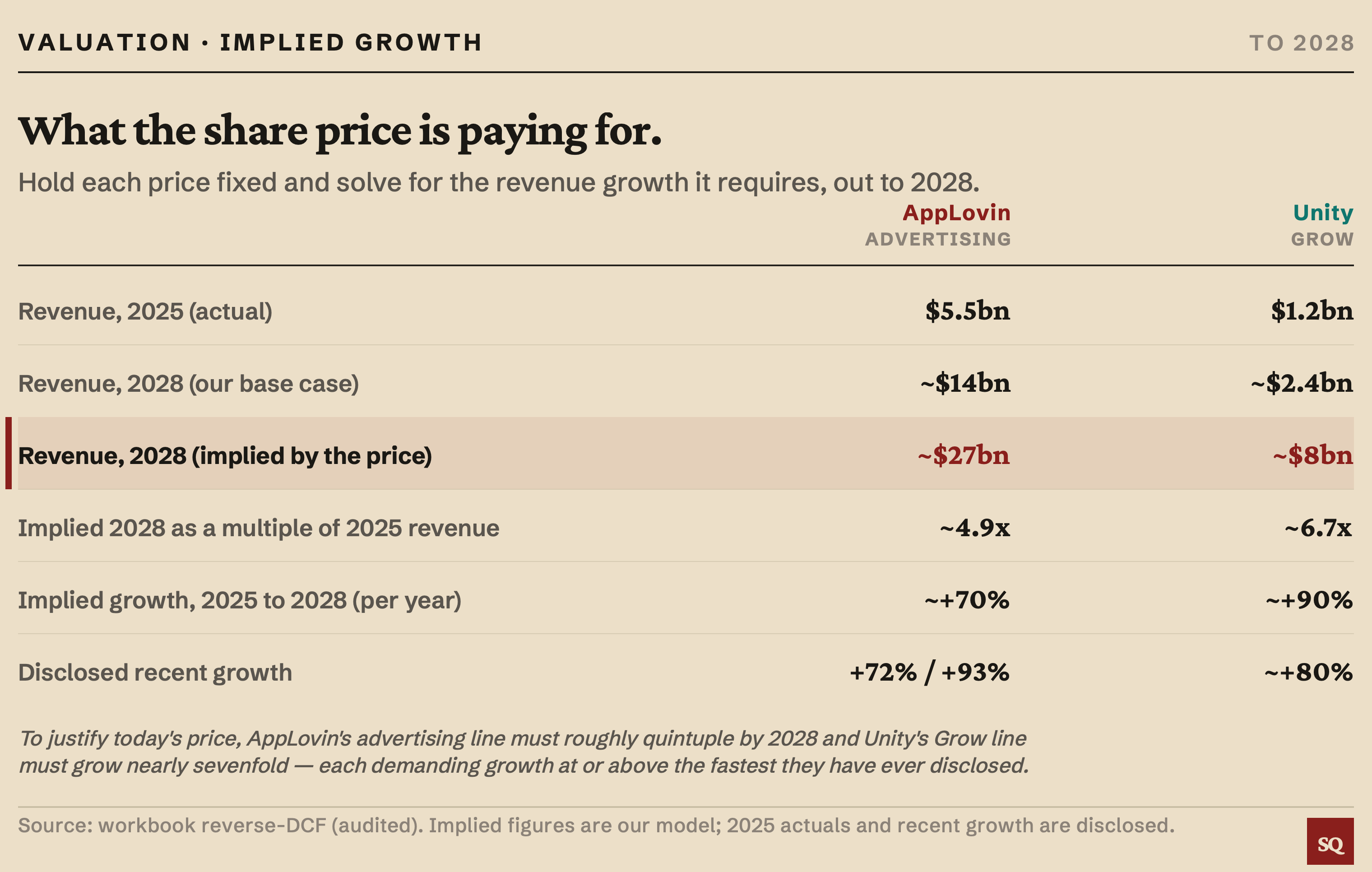
Both prices, then, are a bet on years of growth. AppLovin’s requires its advertising revenue to grow threefold to fivefold by 2028, at or below the pace it has already shown. Unity’s requires strategic Grow to grow sevenfold, faster than it has ever managed.
Close
AppLovin and Unity are each priced on the claim that their advertising engine is compounding real value, and the reverse-DCF turns that claim into a number. AppLovin’s price needs its advertising to keep growing at close to the exceptional pace it has just posted, and to hold a premium multiple at the end of it. Unity’s needs its strategic advertising line, which grew about 49% last quarter, to accelerate to nearer 90% a year and hold it. Both are demanding; Unity’s is the further reach from what it has actually shown.
What you cannot do from outside is verify the engine behind either number. AppLovin narrates a yield metric it will not define; Unity reports a growth rate and only a rough, self-derived figure for the revenue beneath it, and stakes part of its case on runtime data it has scheduled into Vector but not yet shown to work. None of this requires anyone to have done anything wrong. The growth is real; what it is made of, and whether it lasts, is the part the disclosure keeps out of reach.
More from The Side Quest
Epic Games: what is it worth, and what did the generosity cost? Fortnite pays for four free layers. The cash Epic captures is worth about $7.5bn; the tools it under-monetises lift fair value toward $14bn, and the last mark sits in between.
Roblox: A great company lost on valuation - It owns the most complete stack in interactive entertainment yet profits from it the least, and rising costs are eating into what little is left.
Microsoft and Xbox: Too small to sell, too strategic to spin - On the numbers, Xbox is worth about $49bn, a rounding error to Microsoft. It won’t be sold, and any separation keeps a grip on the data its games generate.
AI in Video Games: Own the Loop - why a studio keeps its value only if it owns the content-generating learning loop, not the model. Uses Guild Wars 3 as a worked example.
AI won’t make AAA games materially cheaper to develop - the productivity gains are real, but two-thirds of the value leaves the P&L to the AI vendors before it reaches the bottom line.
Appendix:
The appendix contains where its figures come from and how the analysis was built, section by section. Charts already shown in the article are referred to here, not repeated. Figures are stated from company filings unless flagged as an estimate, and are rounded for display, so rows may not foot.
A1. The opening claims.
Mobile-games studios spend heavily on user acquisition. Across the listed free-to-play peers the figure runs at roughly 22% to 40% of revenue, clustered at 30% to 40% for the heavy spenders (Modern Times Group, Playtika, Zynga, Huuuge) and lower for the lighter ones (PLAYSTUDIOS at about 24%, SciPlay in the low 20s). Neither AppLovin nor Unity discloses a user-acquisition efficiency figure of its own; that line is the buyer’s cost, which is the point of the second section.
AppLovin’s advertising revenue grew from $1.84bn in 2023 to $5.48bn in 2025, and the growth was organic: its filings record no business combinations in 2023, 2024 or 2025, the functional currency is US dollars with no material foreign-exchange effect, and the 2024 rename from “Software Platform” to “Advertising” did not change historical results. The games business it left was the Tripledot divestiture, closed on 30 June 2025 for $715.6m in cash and stock plus a roughly 20% retained stake.
Source: AppLovin’s filings; the peer UA figures from the studios’ own reporting, or derived from sales-and-marketing spend over revenue where a company does not disclose the ratio.
A2. The machine, and who owns each layer.
An ad passes through four layers: the bidding engine that picks it, the auction that prices it, the mediation layer that runs a single auction across networks, and the measurement partner that decides which network to credit. The ownership grid is shown in the article: AppLovin owns all four (AXON, ALX, MAX, Adjust), Unity the first three (Vector, iSX, LevelPlay) and not measurement.
Two figures on that grid are worth pinning. MAX sat in about 73% of the top 200 games by downloads in early 2025 (AppMagic), a share AppLovin partly compels by requiring MAX to reach its performance tools, so it is a reach figure rather than a pure choice. Adjust has been owned since 2021, and AppLovin states in its filings that Adjust’s data is not shared with or used to train AXON, so the conflict is ownership of the referee, not a data loop.
The growth-divergence chart plots advertising-segment revenue from 2021 to 2025: AppLovin from $0.67bn to $5.48bn, Unity’s Grow line from $0.60bn to $1.23bn and flat since 2023. AppLovin’s 2021 and 2022 figures sit under its former “Software Platform” label; Unity’s 2023 includes a full year of ironSource, so that year’s step up is acquisition arithmetic, not organic growth.
Source: both companies’ filings for the ownership and the revenue series; the MAX share from AppMagic (March 2025).
A3. The buyers’ survey.
The claim that studios build their own numbers rests on a job-postings survey, read on 3 July 2026 directly from each company’s own hiring system rather than an aggregator. On the selling side it covered five networks (AppLovin, with 28 openings; Unity, about 150; Moloco, 48; Digital Turbine, 32; Liftoff, 19). On the buying side it covered about nineteen studios, among them Scopely, Zynga, Dream Games, Supercell and Rovio. The roles quoted in the article are verbatim. Postings rotate daily, so the counts are a single-day snapshot.
Source: the companies’ applicant-tracking systems (Greenhouse, Lever, Workday), read 3 July 2026.
A4. The quality of the number.
Large advertising businesses disclose a volume figure and a price figure side by side, so an investor can separate growth from selling more from growth from charging more; the benchmark in the article shows Meta, Google, Snap and others doing exactly that. AppLovin reports installs and net revenue per install, but the two do not line up, which is the point of the card below: installs have gone from up 87% to down 18% year on year while net revenue per install has climbed from up 5% to up 93%.
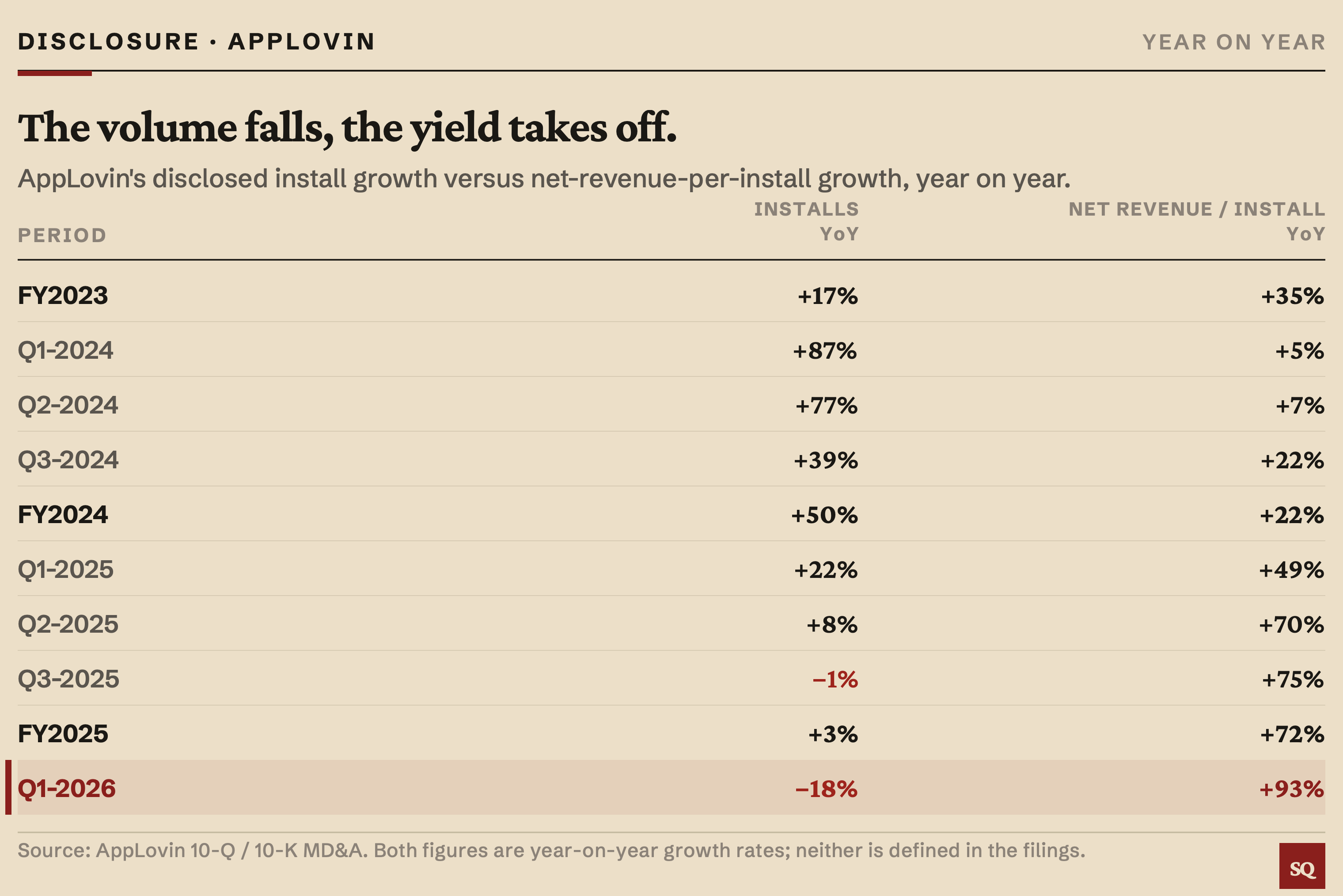
The reason they diverge is disclosed, not inferred. On its first-quarter 2025 call, asked directly, AppLovin’s chief financial officer confirmed that the yield metric’s numerator includes web and commerce revenue while its denominator counts only installs, so as non-install revenue grows the ratio rises on mix alone. How much of the climb is mix and how much a genuinely better engine cannot be separated from the disclosure.
Unity discloses less. Its headline is that Vector’s revenue grew 80% year on year in early 2026, a rate it repeats but never attaches to a dollar figure; from its own mix disclosure the Vector-powered network runs near $220m a quarter, though Unity never prints the standalone line. Asked for a breakdown of the advertising segment, its chief executive declined.
Source: AppLovin’s quarterly and annual management discussion for the install and yield series and the CFO’s remarks; Unity’s first-quarter 2026 release and call for the Vector figures.
A5. The scorekeeper.
AppLovin owns Adjust, one of the measurement firms an advertiser can choose; where an advertiser picks it, the firm grading the campaign is owned by the network being graded. In June 2026 the rest of the industry moved the other way: Google, Meta, Moloco and Unity each agreed to take a non-controlling, non-preferential stake in AppsFlyer, the independent partner most of the industry uses. The agreement was signed subject to regulatory approval and had not closed. AppLovin is not among the named investors.
Source: the AppsFlyer release (22 June 2026); Adjust’s ownership from AppLovin’s filings.
A6. Incrementality
Whether AppLovin’s ads cause sales that would not have happened anyway can only be settled by a holdout, and the few public tests disagree; the article’s table lists each with the tester’s conflict printed alongside. What they share is that every one was run by a firm with a product to sell, on a handful of brands over short windows, so none establishes a typical return, and each anti-engine figure traces to a vendor- or short-conflicted source. The strongest evidence for the engine is not a test but adoption: named advertisers have raised their spend on the record. AppLovin has since published its own review gathering the favourable studies, which is the company assembling the evidence for itself rather than an independent audit.
Source: the individual vendor and agency case studies (Haus, BlueAlpha, Prescient) cited in the article’s table; the adoption examples from Modern Retail (1 October 2025).
A7. Runtime data
Unity’s claimed edge, feeding first-party gameplay data into Vector, is prospective. The framework that collects it launched in 2025 and reaches live models only in the second quarter of 2026, and on three consecutive calls management has said Vector’s growth so far came without it. The first read on whether it works lands at the August 2026 earnings. Against the claim sits a reach-versus-yield gap: on third-party panels Unity’s ad software is in more games than AppLovin’s, about 40% against 28%, yet earns a far smaller share of ad revenue, roughly 10% to 16% against 27% to 37%. These are independent panels on different denominators, so the figures are directional.
Source: Unity’s earnings calls for the runtime-data timeline; the reach and revenue-share panels from AppFigures, Tenjin and Sensor Tower.
A8. The forecast and the market
The two-year forecast is built a quarter at a time from the filings, in three scenarios. Run backwards against the recent past, one quarter ahead at a time, it fits AppLovin’s last eight reported quarters within about 3% each; Unity’s fit covers the three quarters where the strategic-versus-legacy split is disclosed. The 2028 figures are an annual extrapolation beyond the quarterly model.
AppLovin’s out-years lean on its move into commerce. The addressable-market exhibit sizes that pool and AppLovin’s share of it; its two softest rows, the off-platform commerce pool and the slice serviceable on independent inventory, are our estimates rather than disclosed figures, and are shown as ranges for that reason. Unity’s out-years lean on Vector as the ironSource network is wound down, a closure that carried a $279m writedown in the first quarter of 2026.
Source: the model, built from both companies’ filings; the market-size ranges cross-checked against measurement-house estimates (eMarketer, GroupM, Dentsu, IAB).
A9. What you pay for it.
The article carries three valuation exhibits: the forward comparables, the discounted-cash-flow football field, and the reverse-DCF. The sourced build behind the comparables, revenue through to enterprise value for each name, is the card below.
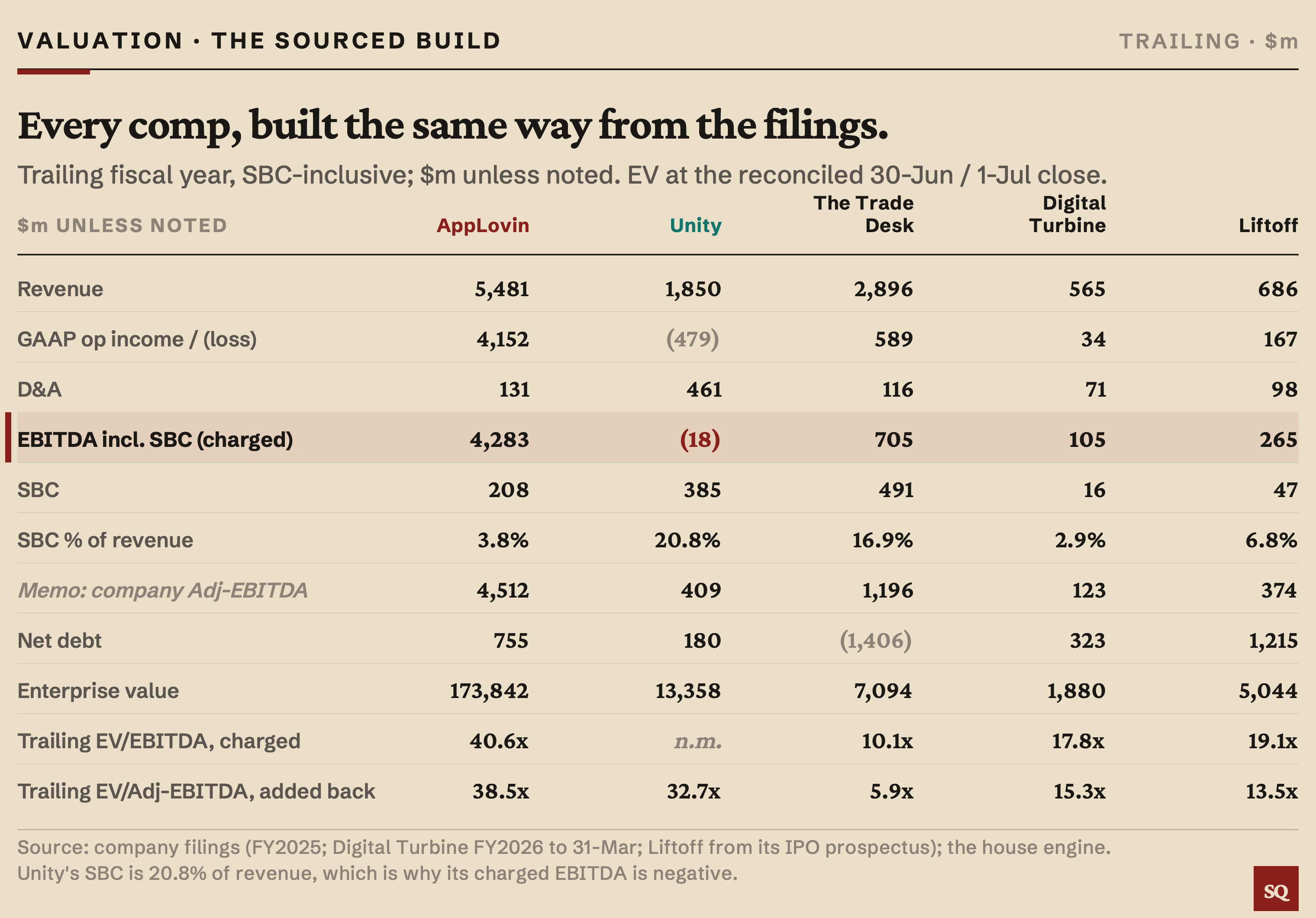
Every market price sits on one reconciled close, 30 June 2026 for AppLovin, the Trade Desk and Digital Turbine and 1 July for Unity, and the comparable multiples are struck on next-year earnings. The discount rate in the DCF, about 11%, is built from a 4.5% risk-free rate, a 4.2% equity risk premium and a beta of 1.5 applied to both companies; the exit multiples are struck on stock-inclusive terminal earnings, so a lower “adjusted” multiple is never applied to a stock-charged base.
Unity’s forward multiple carries one deliberate adjustment: the one-off ironSource writedown is set aside, without which its stock-charged EBITDA is negative and no multiple computes. Almost all of Unity’s adjusted profit is the stock it pays out, about $385m of a $409m adjusted EBITDA, which is why charging that stock moves its multiple so far, and AppLovin’s, which pays out almost none, so little. The reverse-DCF holds each price fixed and solves for the growth it would take to justify it under two terminal methods, and reports the range; those figures are in the exhibit.
Source: the valuation model, rebuilt from the filings and independently recomputed; the peer forward revenue from consensus estimates, the subjects’ forward earnings from the model.
A10. Conventions:
Profitability is stated with stock-based compensation left in as a cost; each company’s own “adjusted EBITDA”, which adds it back, is shown only as a memo and never used for a comparison multiple. Net debt is funded debt plus finance leases, with operating leases excluded. AppLovin’s figures are continuing operations throughout, its games segment discontinued after the June 2025 sale. Balance-sheet figures are as reported at the first quarter of 2026 unless noted. The forecast is bottom-up by quarter, full-year figures being the sum of the four quarters, with guidance anchoring the nearest forecast quarter. Figures are rounded for display and may not sum.