
TLDR
Epic is converting Fortnite into a creator platform, the thing Roblox was built as from the start. It discounts the engine, gives the online services away, runs its store at a loss, and funds a 40% creator pool, all on one declining game.
Of $100 a Fortnite player spends, the stores take about $26, Epic keeps about $63, and third-party creators receive about $11. The advertised 40% becomes an effective 15%, because Epic’s own Battle Royale is the pool’s largest claimant.
The cash Epic captures is worth $7.5-11bn of equity. A c$3bn premium for the strategic tools it under-monetises, Unreal and its online services, lifts fair value to $10.5-14bn. The freshest $12.16bn mark sits inside that range; only the $31.5bn 2022 peak still needs the metaverse.
If you enjoyed reading please forward on and share. Readers include the games community, CEOs, CFOs, Investor Relations, Board Members, Institutional Investors and many more.
This article is a follow on from Roblox: A great company lost on valuation.
The Epic Games model is available on request.
Epic Games is spending its way through a conversion. Fortnite is a maturing game in a shrinking genre, and Epic’s answer is to turn it into a creator platform, a place where the content is made by its players and the company’s job is to run the economy underneath them. This is not the move Roblox made, because Roblox never had to make it: Roblox was built as a user-generated-content platform from its first day, and its economics, for better and worse, were designed around that. Epic is attempting the conversion mid-life, out of a single game, while that game declines. The pitch is that the destination is worth it, that the market for platforms is far larger than the market for any one game, and that the way to win it is generosity:
Unreal Engine: the discounted royalty (5%, waived entirely on Epic’s own store, 3.5% for games that also ship there).
Epic Online Services: free by design, no revenue line, carrying the 972m-account identity and anti-cheat graph.
Epic Games Store: a 12% take against the industry’s 30%.
The UEFN engagement pool: 40% of Fortnite’s net revenue paid into the creator pool.
Sweeney’s stated logic has been consistent for years: the economy is shifting from buying games to buying things in games, and the most generous platform wins the shift. The generosity needs careful definition, because free tools are not what make Epic different. Creating on Roblox is also free as (a) Roblox Studio costs nothing to use (b) Roblox hosts every experience on its own servers at its own expense, an infrastructure and safety line that ran to about $1.2bn last year.
The difference is where the free things live and whether a ‘checkout’ sits at the end of them. Roblox’s free tools work only inside its walls, and everything built with them monetises through Roblox’s checkout, where the platform takes its share. Epic’s giveaways extend beyond its walls:
Unreal Engine: Powers games that never touch Epic’s store, on consoles and on Steam.
Epic Online Services: runs accounts, matchmaking and anti-cheat for any game on any engine and any store with game hosting (the expensive part) staying the developer's cost.
Epic Games Store: The store takes 12% of games against the 30% the industry grew up on.
Roblox subsidises creation it always ends up monetising. Epic subsidises creation it mostly never monetises, on the theory that the network converts into a business later.
Epic’s official story deserves a fair hearing, because the openness is real and more than $1bn has genuinely been paid to creators since 2023. The accounts, as far as a private company lets anyone read them, tell a more specific story.
What they show is that the pool pays Epic’s own islands first, that the ‘free’ layers feed a store few people buy from, and that the one business funding all of it is a battle royale whose engagement has been falling since 2025. The generosity is not a side cost of the strategy. On these numbers, the generosity is the mechanism of the loss.
1. The TAM: The increase is mostly a change of denominator
Roblox claims it holds 3.4% of a global gaming content market of $190bn, and that its target is 10%. Epic's bet is the same move: stop being a share of a game genre, and start being a share of all interactive content.
Build both markets from the bottom up and the denominator is doing the work. On Roblox’s chosen denominator, Roblox is 3.4% and Fortnite is about 2%, both minnows with vast runways. Measured against the money actually spent inside UGC platforms today, Roblox holds more than half the market and Fortnite’s pivot is a challenger position in a category its rival defines.
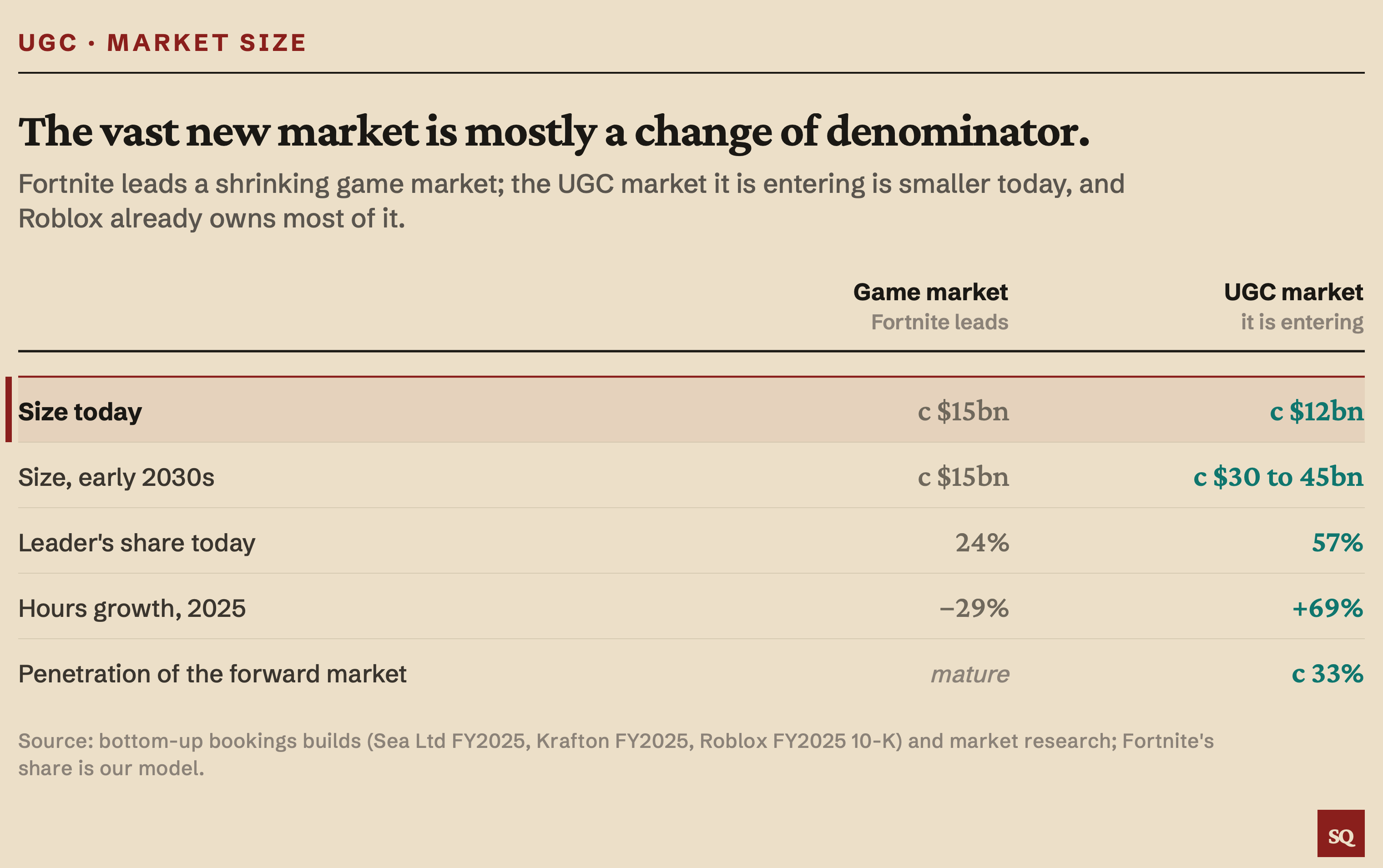
For both companies looking into TAM expansion the growth all sits in one place - adult UGC spending. So for Roblox, this is the 13-24 cohort Roblox is aging up into from below, at the same time as Fortnite pivots into it from above. Let’s not forget that there are other horses in this race as well, because Epic is not the first company to subsidise a UGC platform into existence.
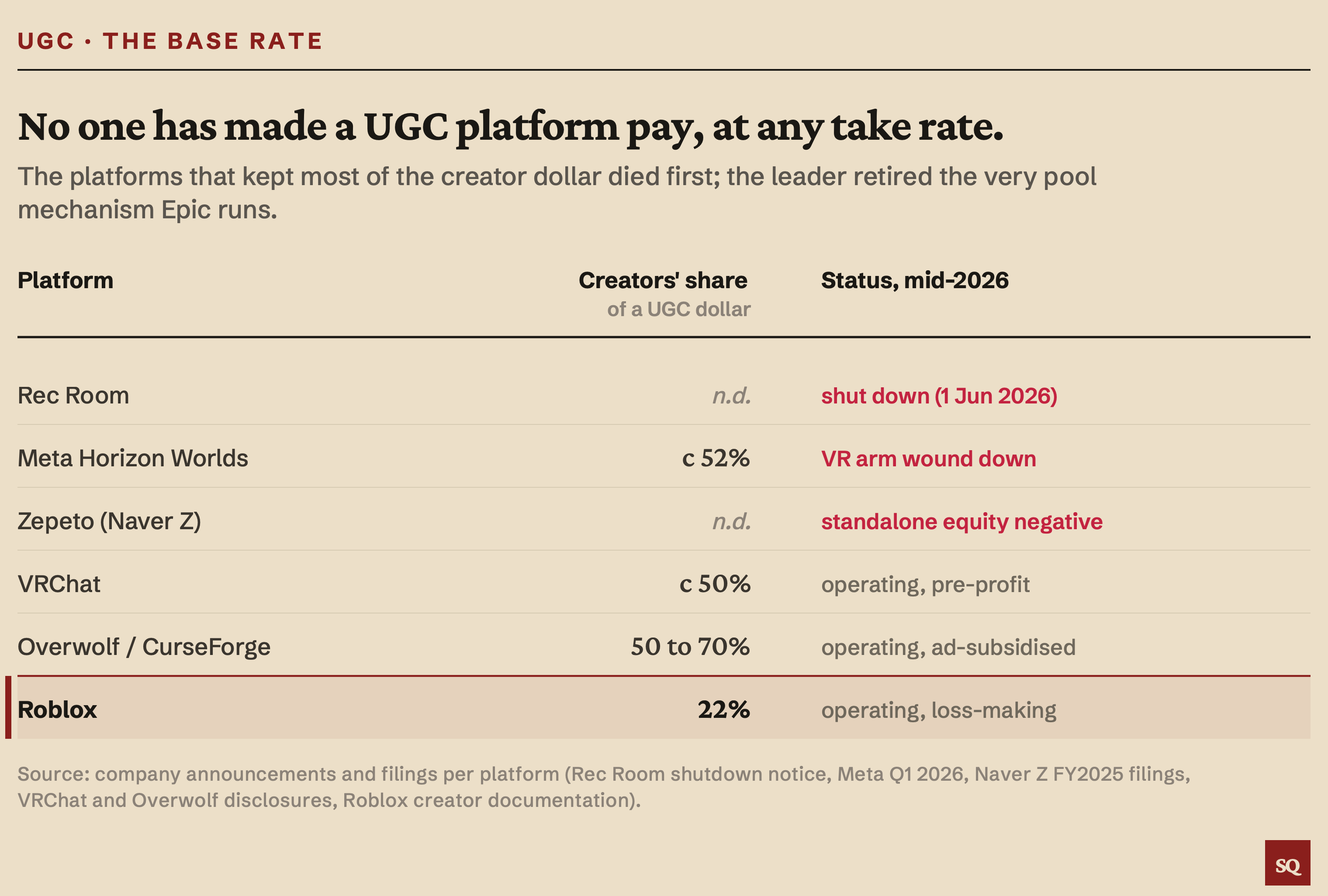
Yet the pattern in the table above is the context for everything that follows. No one has yet made a UGC platform profitable at any take rate. The one platform that disclosed its UGC margin was keeping 30c on the creator dollar against 70c on its own content, and it is the one that shut down.
The survivors either pay creators most of the dollar while losing money, or subsidise the platform from an unrelated business and the engagement-pool mechanism Epic adopted in 2023 is one Roblox itself retired in 2025. This is the market Epic is giving away four layers of its business to enter.
2. The two value chains: Roblox charges creators; Epic’s 40% pool recaptures to its own Battle Royale
Follow $100 of player spending through both machines.
Roblox’s version is in its filings, and the last piece walked through it (See Roblox: A great company lost on valuation). The app stores take $15.80, creators receive $22.14 through the Developer Exchange, and Roblox spends $52.26 running the platform, which turns that $100 into an operating loss of about $18. It is the most complete stack in the industry, taking the largest cut, and it loses money.
Store fees average 26% by Epic’s own disclosure.
Epic then reserves 60% of what remains for itself before the pool exists, and the 40% pool it advertises is distributed among all islands, explicitly including, in Epic’s own words, “Epic’s own islands like Battle Royale”.
In 2024, the one year with a disclosed outcome, third-party creators received 36.5% of that pool, in line with their share of playtime, and Epic’s own islands collected the rest.
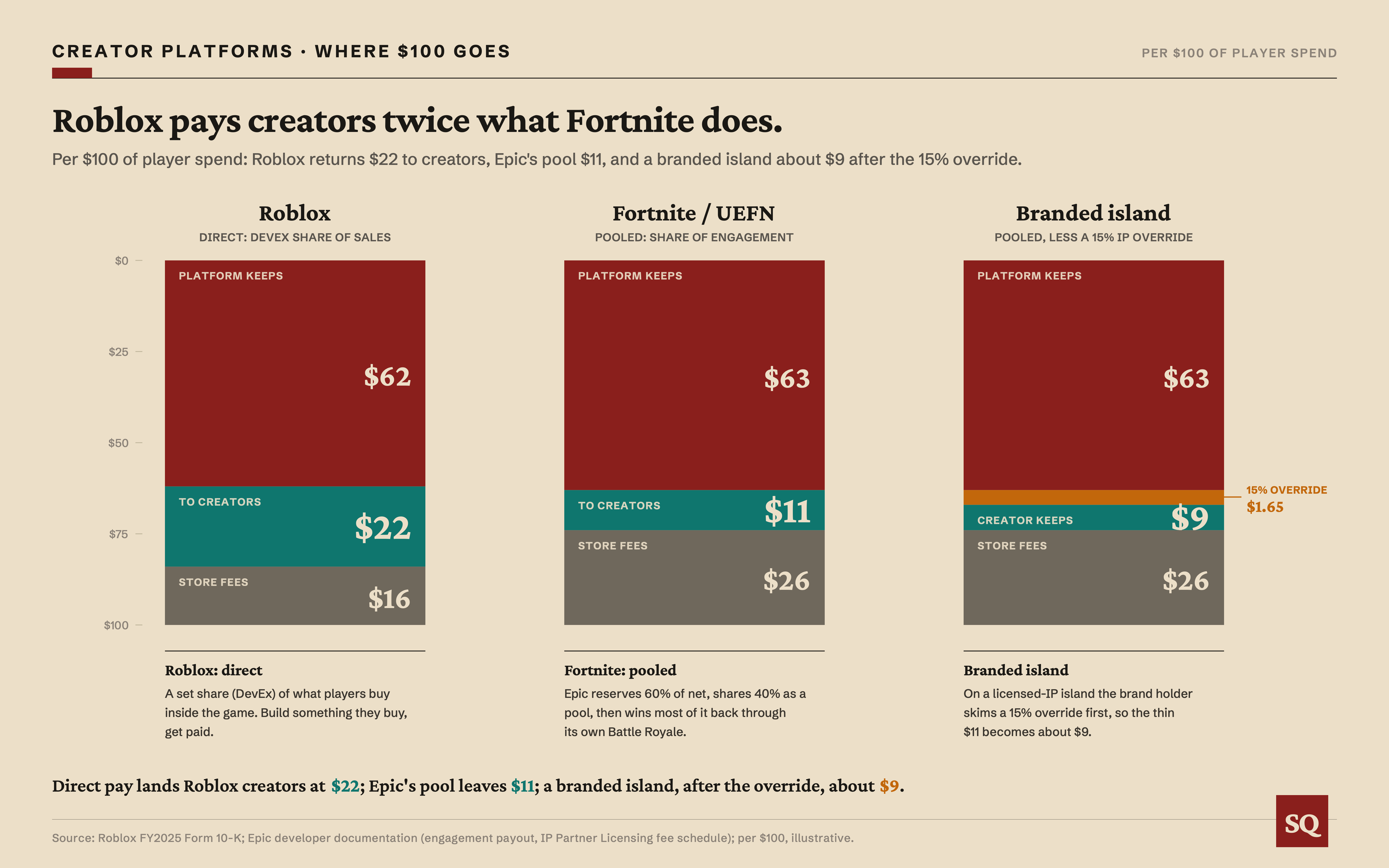
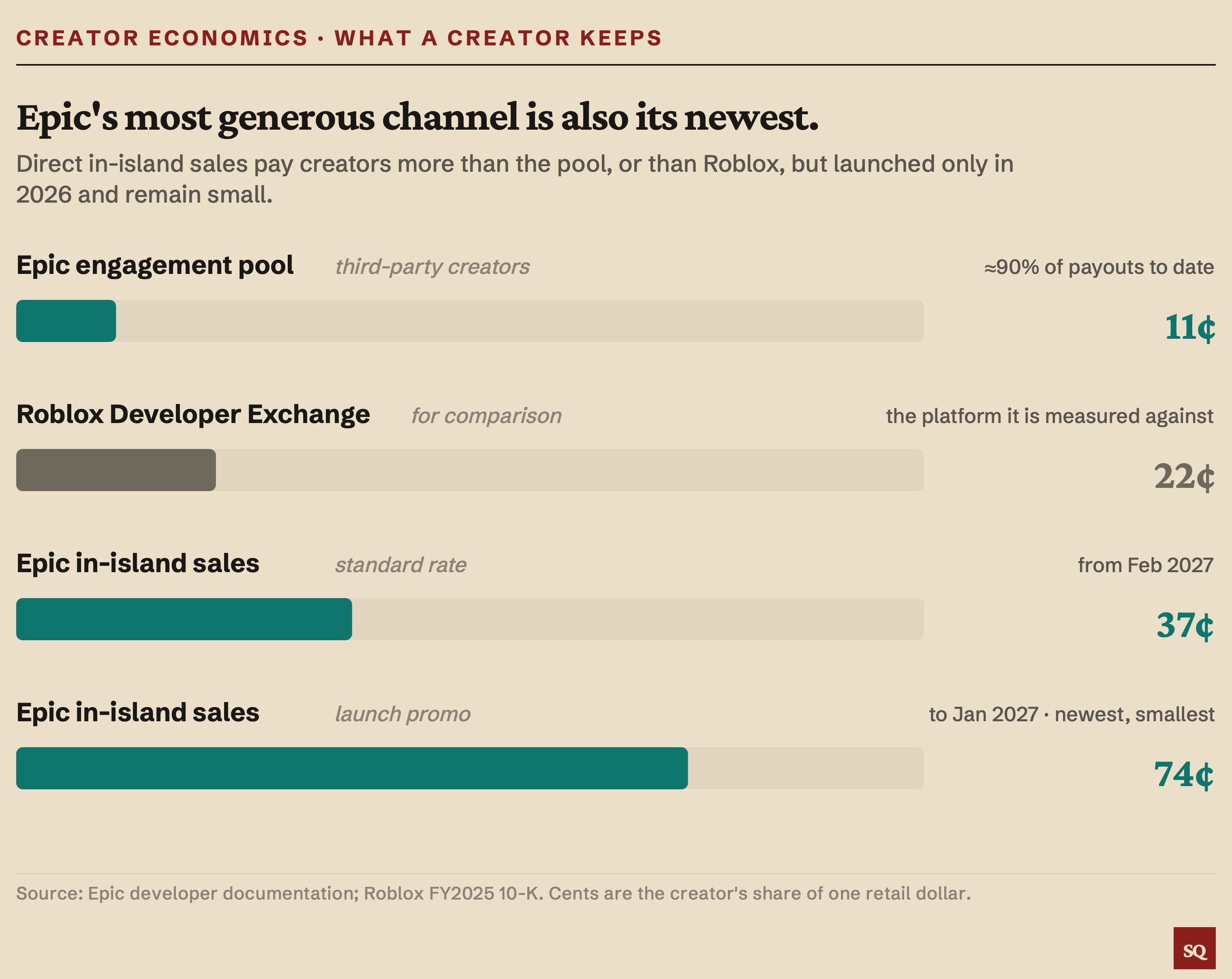
Roblox pays creators about 22 cents of the retail dollar and gets attacked for keeping the rest. Epic advertises 40% and pays about 11 cents, because the 40% is measured against net revenue after platform fees, not the retail dollar, and is then paid into a pool where Epic's own islands are the largest competitor.
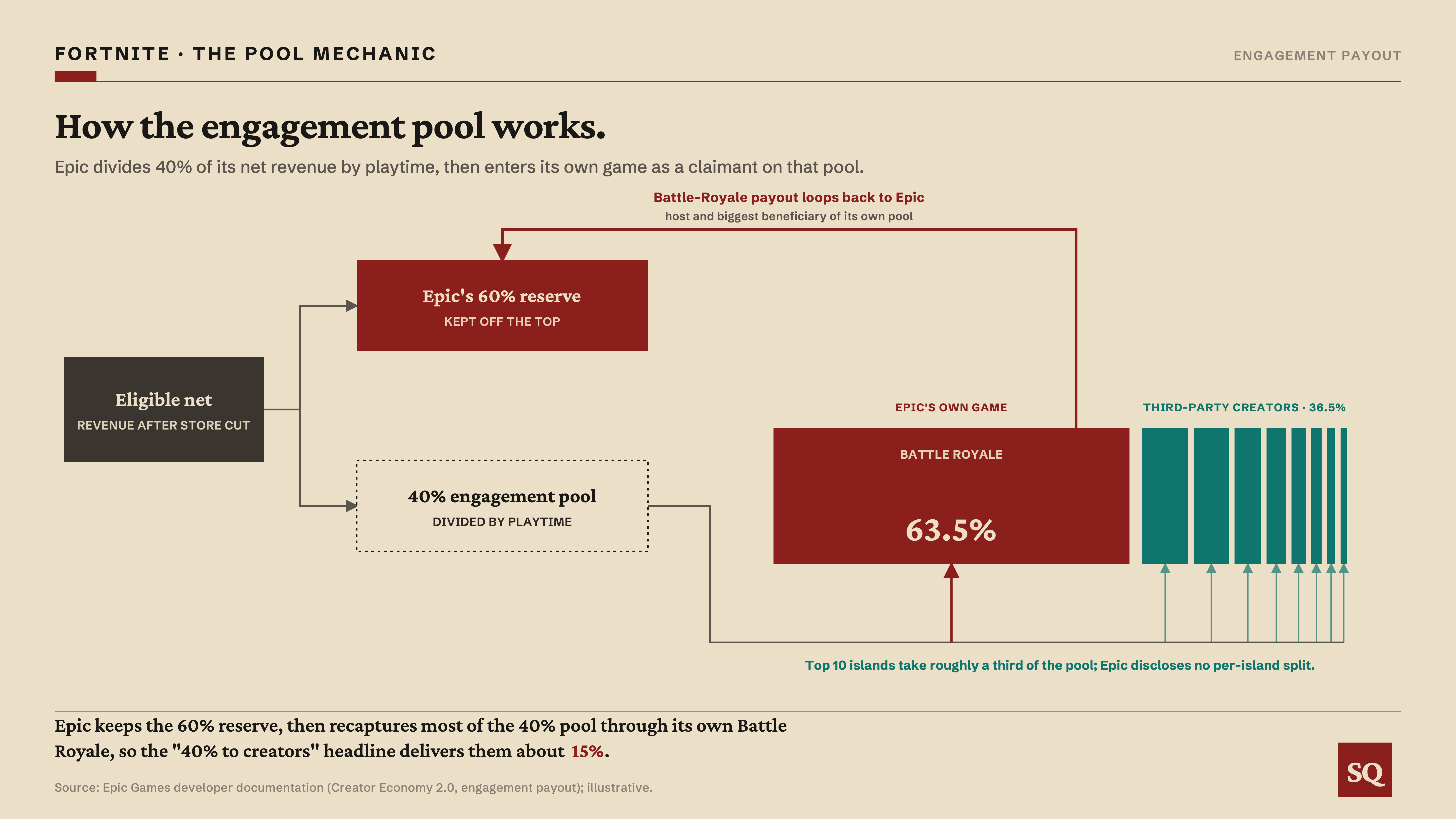
Inside that c $11, the split among creators is sharper still, and it is Epic’s own disclosure. Of roughly 70,000 paid creators in 2024, this is who the pool reached.
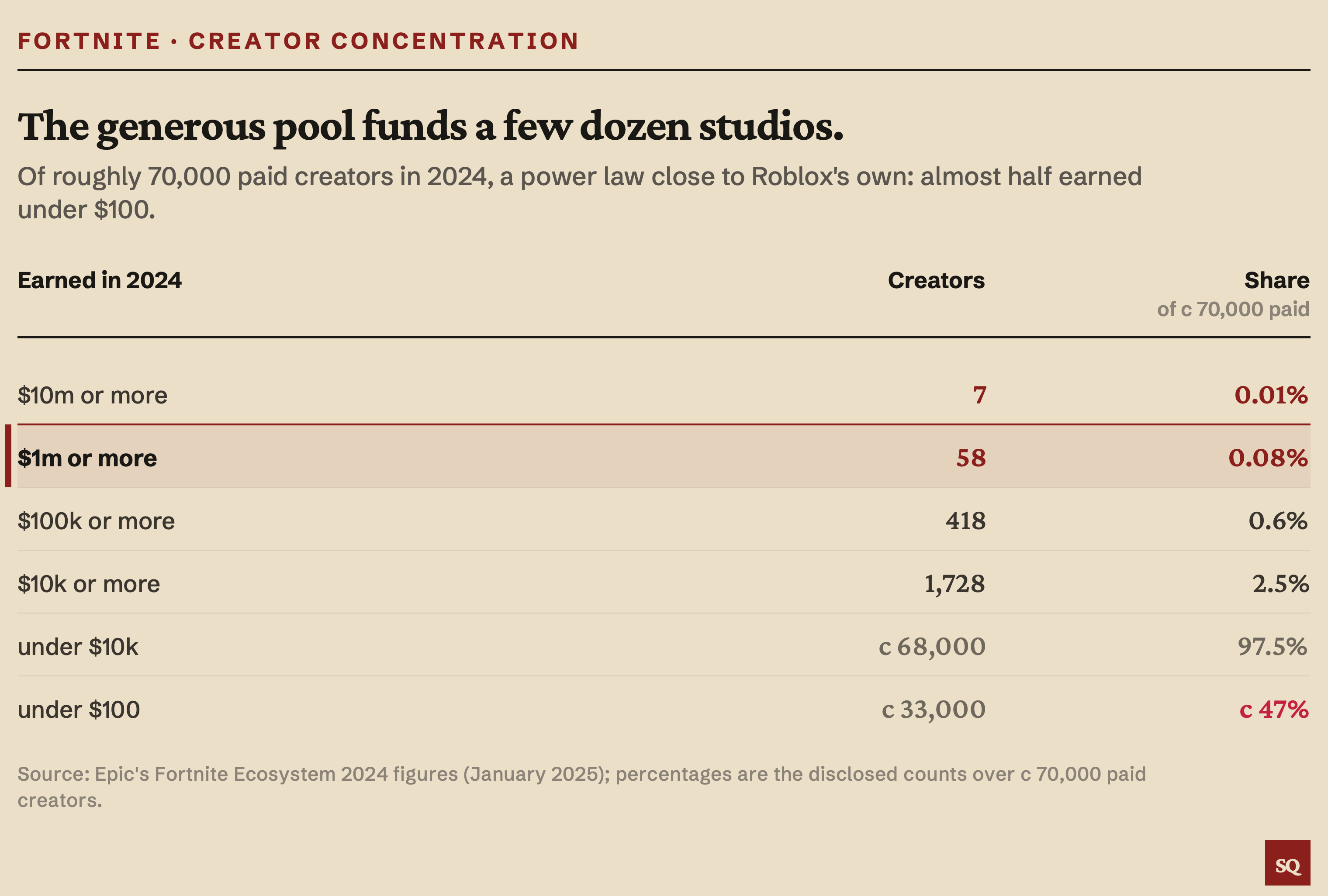
The distribution is a power law (which is close to identical to Roblox) where the top 1,000 creators take about 85% of the payout and roughly half earn under $100 for the year. The generous pool does not build a broad creator class on either platform and it funds a few dozen studios above a tail of tens of thousands earning small amounts of money.
The pool is skimmed once more whenever a creator builds on licensed IP, and here the value chain forks. An island using a partner’s brand hands a fixed share of its engagement payout to the IP holder, deducted before the creator is paid.
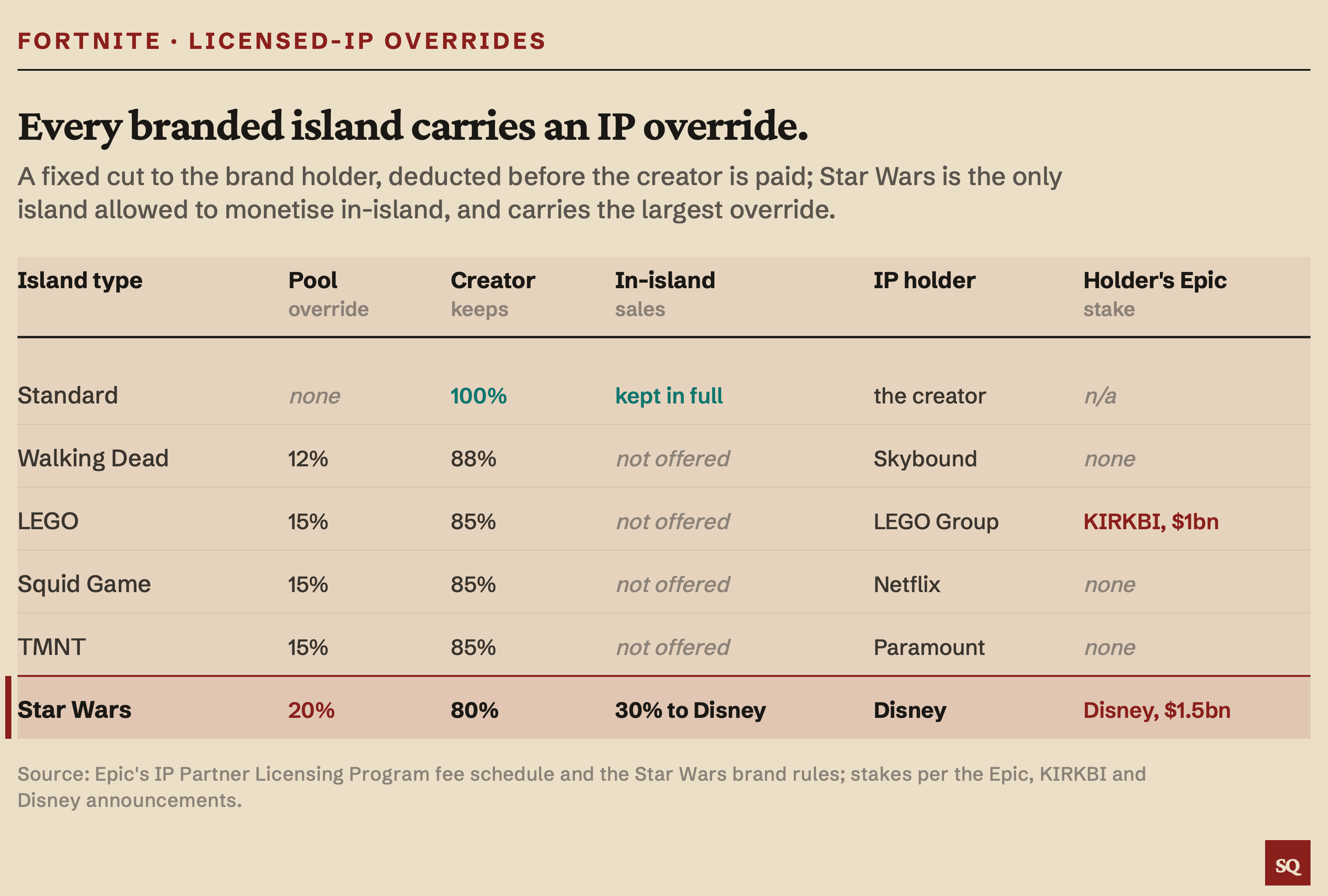
The steepest terms belong to the biggest investor. Disney put $1.5bn into Epic in 2024 and owns Star Wars, which carries the highest override (20%) and is the only brand allowed to monetise in-island at all, taking a further 30% there. The LEGO family’s holding company put in $1bn in 2022 and owns the LEGO Group, at 15%. So a creator building on either brand returns 1/5th or 1/6th of their pool earnings to a company that also owns a piece of Epic, on top of the reserve and recapture that already took most of the pool before it reached them.
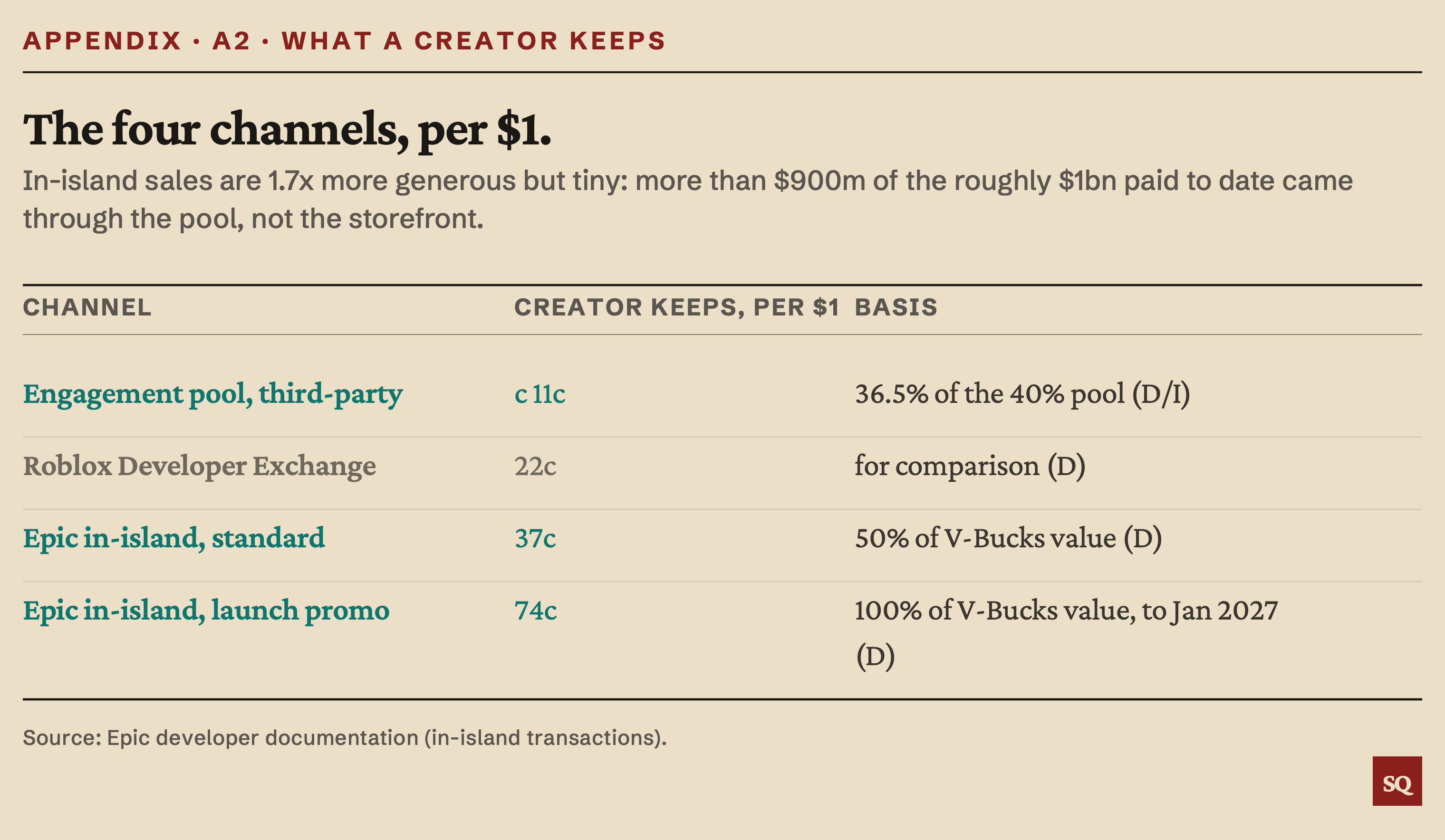
There is one channel where Epic is unambiguously generous. Since January 2026 creators have been able to sell items directly inside their islands, keeping about 37 cents of the retail dollar at the standard rate, and 74 during a launch promotion that runs to January 2027, against Roblox's 22. The catch is size. Direct sales launched only this year, and more than $900m of the roughly $1bn Epic has paid creators to date came from the pool, not the storefront. Epic's most generous channel is also its newest and smallest.
The pool is also only one of four subsidies, and the other three are what make Epic’s version of the platform bet more expensive than Roblox’s.
Unreal’s royalty applies only above $1m of lifetime revenue per title, is waived entirely for sales on Epic’s store, and drops to 3.5% everywhere for games that also ship there.
Epic Online Services has no revenue line by design.
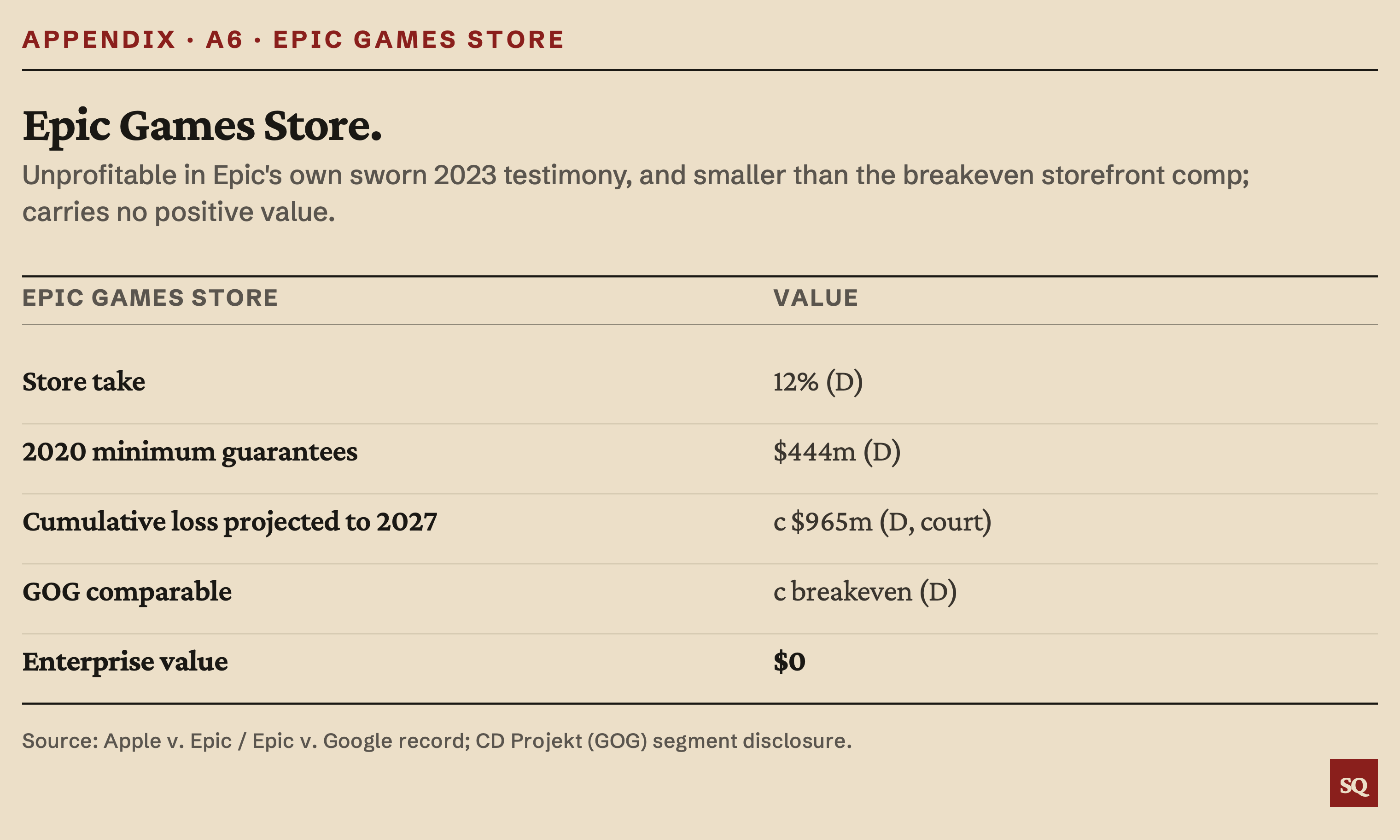
The store’s 12% take has never covered its costs: it was still unprofitable in Epic’s own sworn testimony in 2023, after $444m of exclusivity guarantees in 2020 alone.
Roblox gives its creators comparable things, free tools and free hosting, but inside its own walls, where every resulting transaction passes its checkout. Epic’s giveaways mostly stand outside any checkout at all.
3. Time vs money: Islands took 47% of hours, creators get about a tenth of the dollar.
Epic’s engagement disclosures are the best evidence the pivot has, and they are strong: creator islands took 47% of all Fortnite player hours in May 2026, and more than 75m monthly players touch creator content. Yet the financials are harder to prove out when we relate engagement against the money.
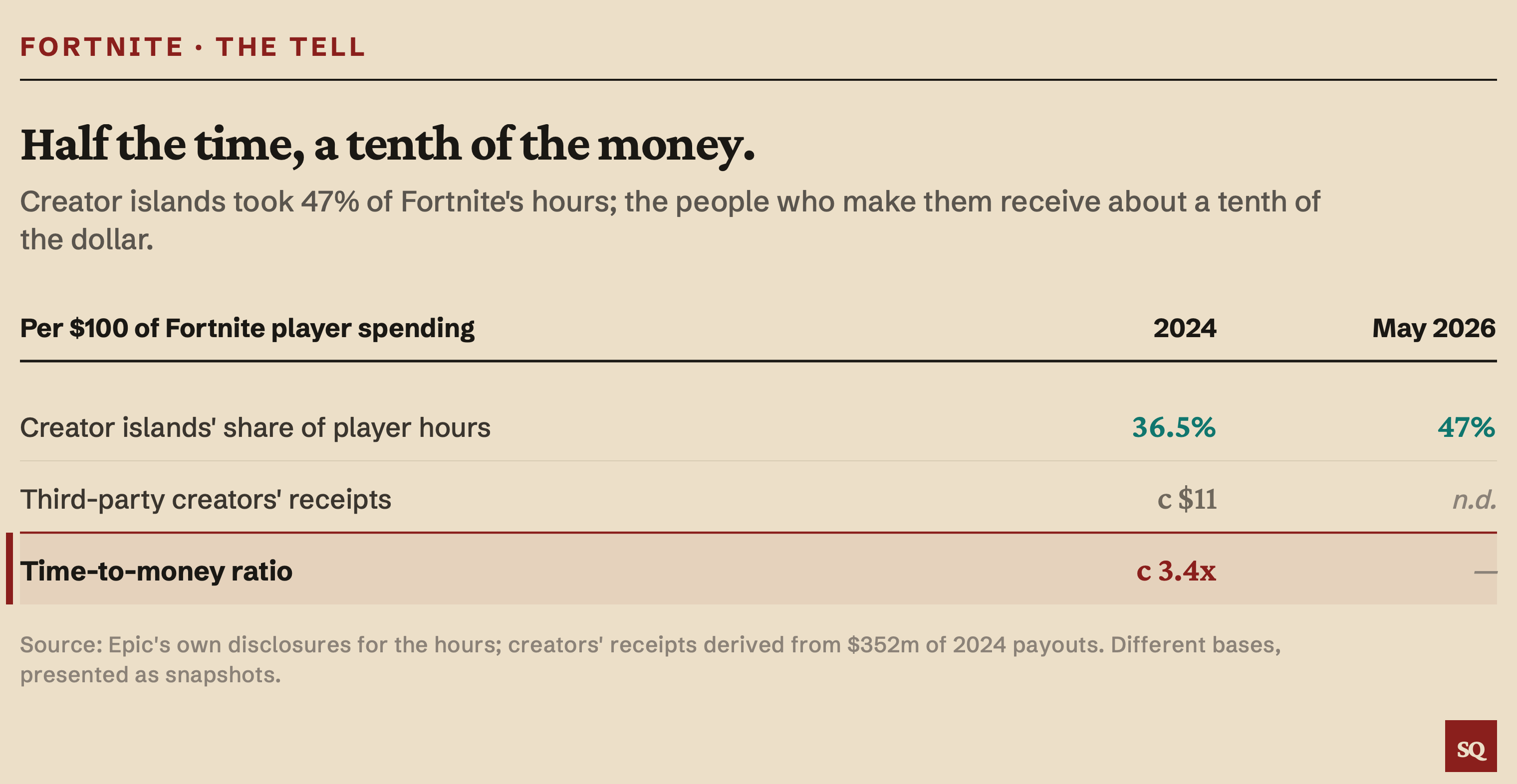
Half of Fortnite’s time now happens in creator islands, and roughly 1/10th of Fortnite’s money reaches the people who make them. The audience behind those hours is not new, though:
More than 70% of creator content players also play Battle Royale, on Epic’s own reporting.
The overall base has been flat at roughly 110m monthly players.
Roblox’s daily audience now outnumbers Fortnite’s monthly one.
On this basis, this is a platform gaining share inside its own shrinking game. This is not necessarily negative, as these are users who are retained in the Epic Games ecosystem rather than leaving Fortnite for a competitor.
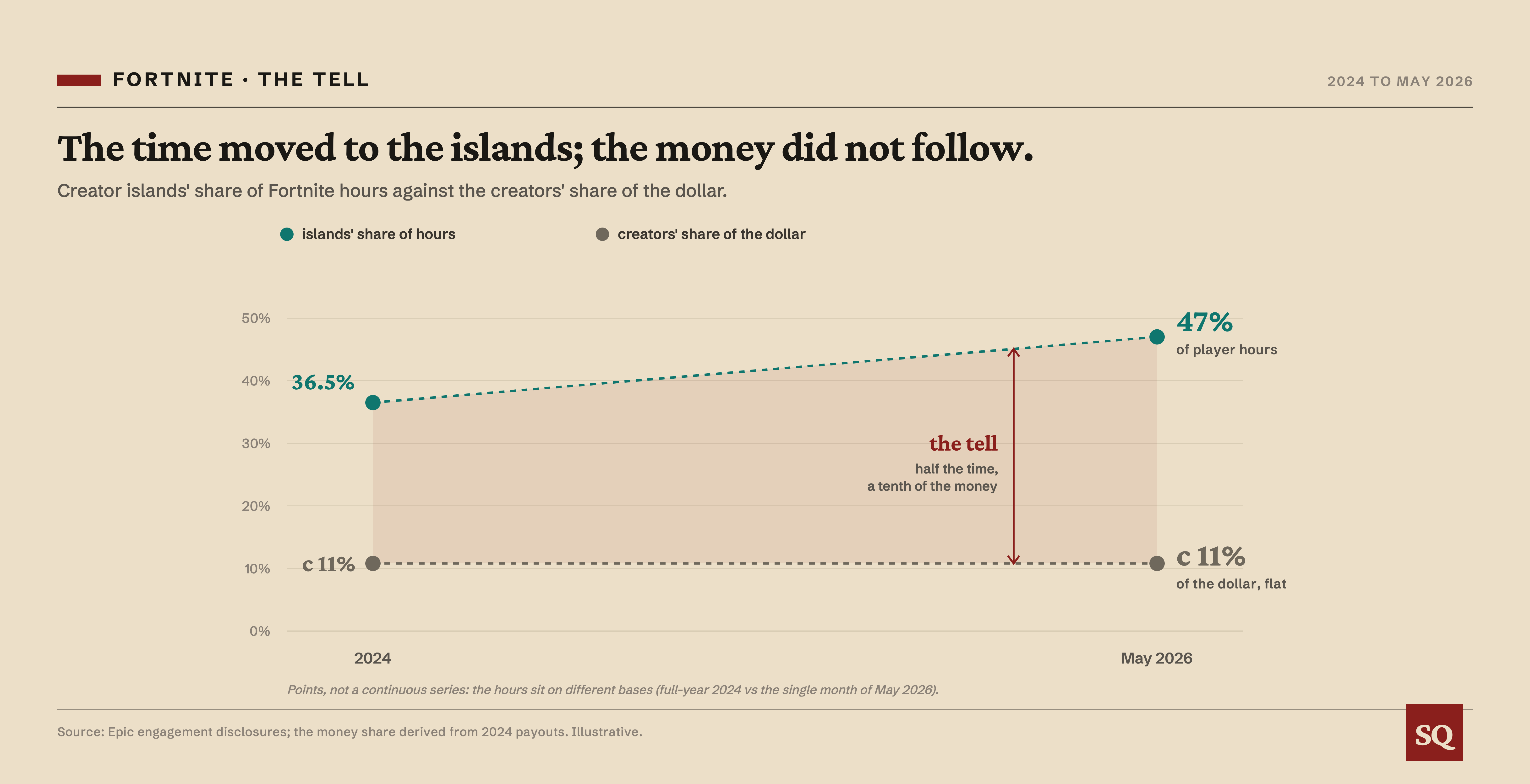
Epic’s behaviour over the past year suggests it reads the numbers the same way.
In November 2025 Epic reweighted the pool to pay creators partly on the V-Bucks players spend around their islands, not on hours alone, tilting it toward spending and player acquisition. Roblox had made the same shift in July 2025 and taken it further, retiring its time-based pool entirely for spend- and acquisition-linked rewards.
In March 2026 Epic raised the effective V-Bucks price by shrinking the packs, and its stated reason was blunt: “The cost of running Fortnite has gone up a lot and we’re raising prices to help pay the bills.”
Working fewer hours harder is a rational response. It is also not what a platform does when the pivot is producing new spending on its own.
For the valuation, this section sets two drivers: a flat player base of about 110m, and a creator-payout share that plateaus in the low 40s% of the pool as the re-weighting offsets the hours mix.
4. The P&L: Fortnite pays for all of it, and the accounts barely clear a profit
Epic files no accounts, so the profit and loss below is our reconstruction, not a disclosure. Forward bookings are built from Fortnite’s own drivers, store fees sit at Epic’s disclosed average, the creator payouts are the lines Epic does publish, and the cost base is rebuilt from a roughly 4,000-person headcount with sales, marketing and overhead grounded as shares of revenue. So treat this with a pinch of salt and read it as an estimate of the shape, not a filing.
The revenue is Fortnite and little else. Group revenue is four lines:
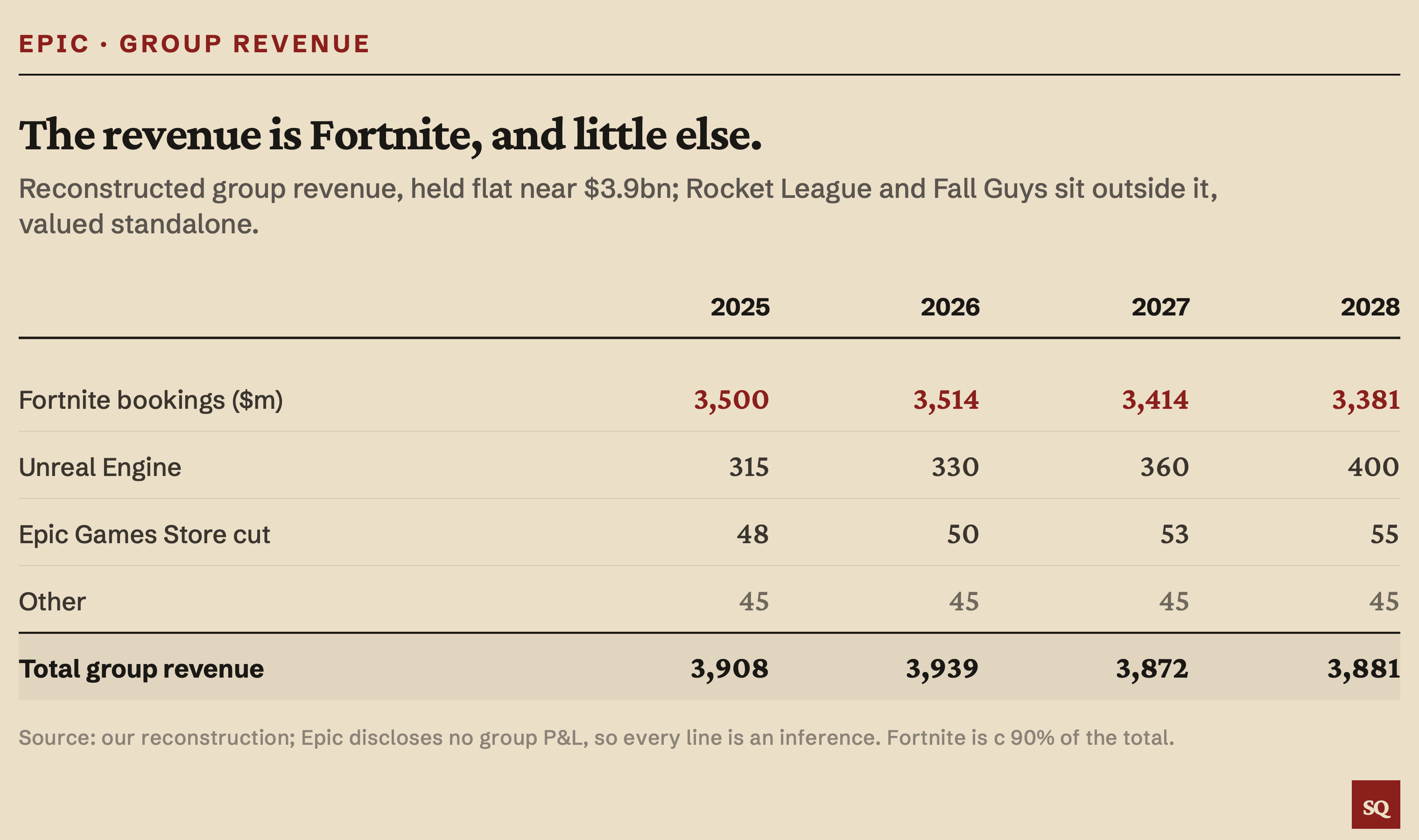
Fortnite bookings of about $3.5bn, modelled as roughly 110 million monthly players at about $32 of gross spend, held close to flat.
Unreal Engine royalties and enterprise seats rising from about $315m to $400m.
Epic’s 12% cut of third-party store spend, about $50m.
A small other line near $45m (e.g. ab marketplace fees, merchandise and licensing, not separately disclosed).
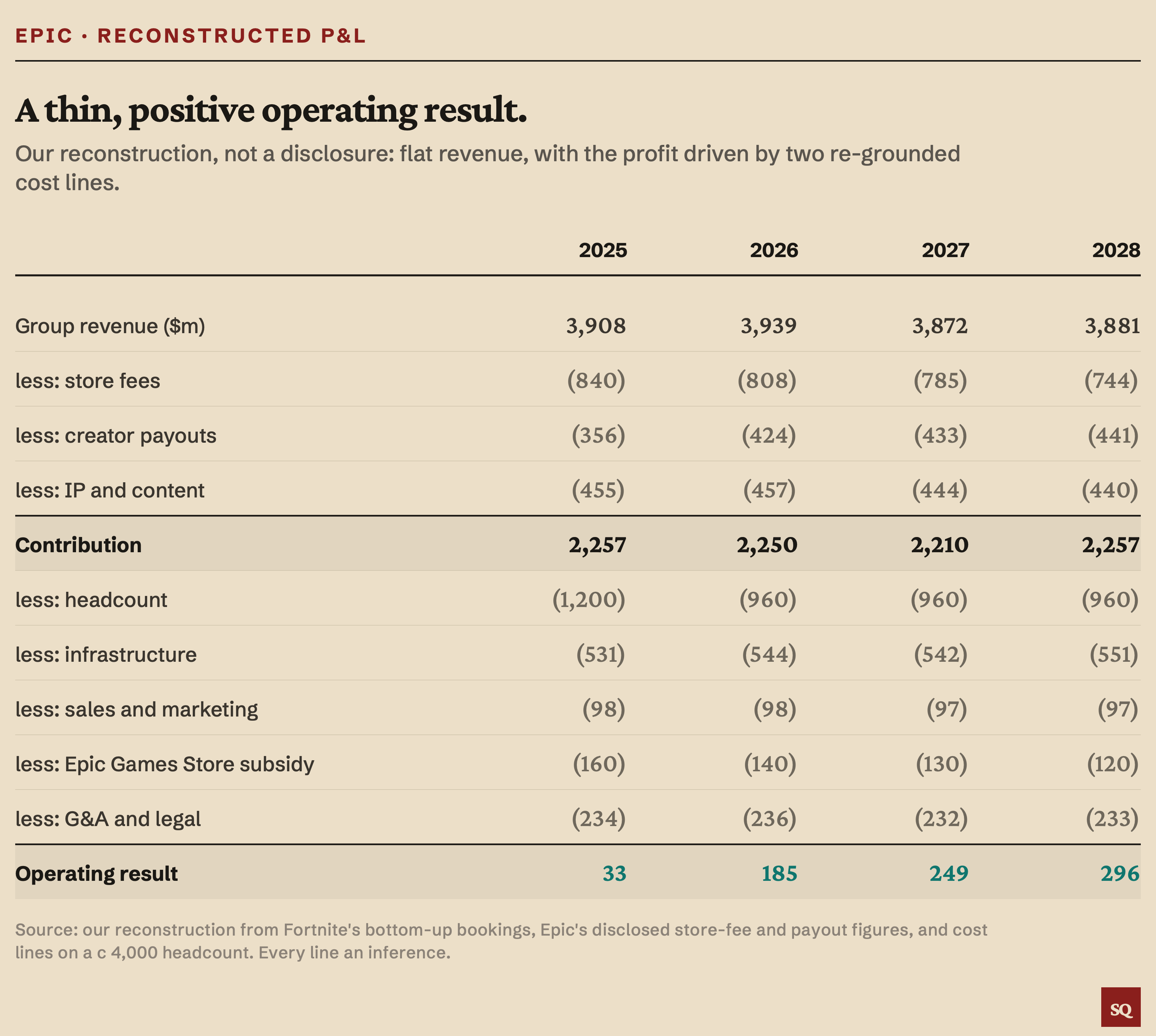
Three things actually drive the answer:
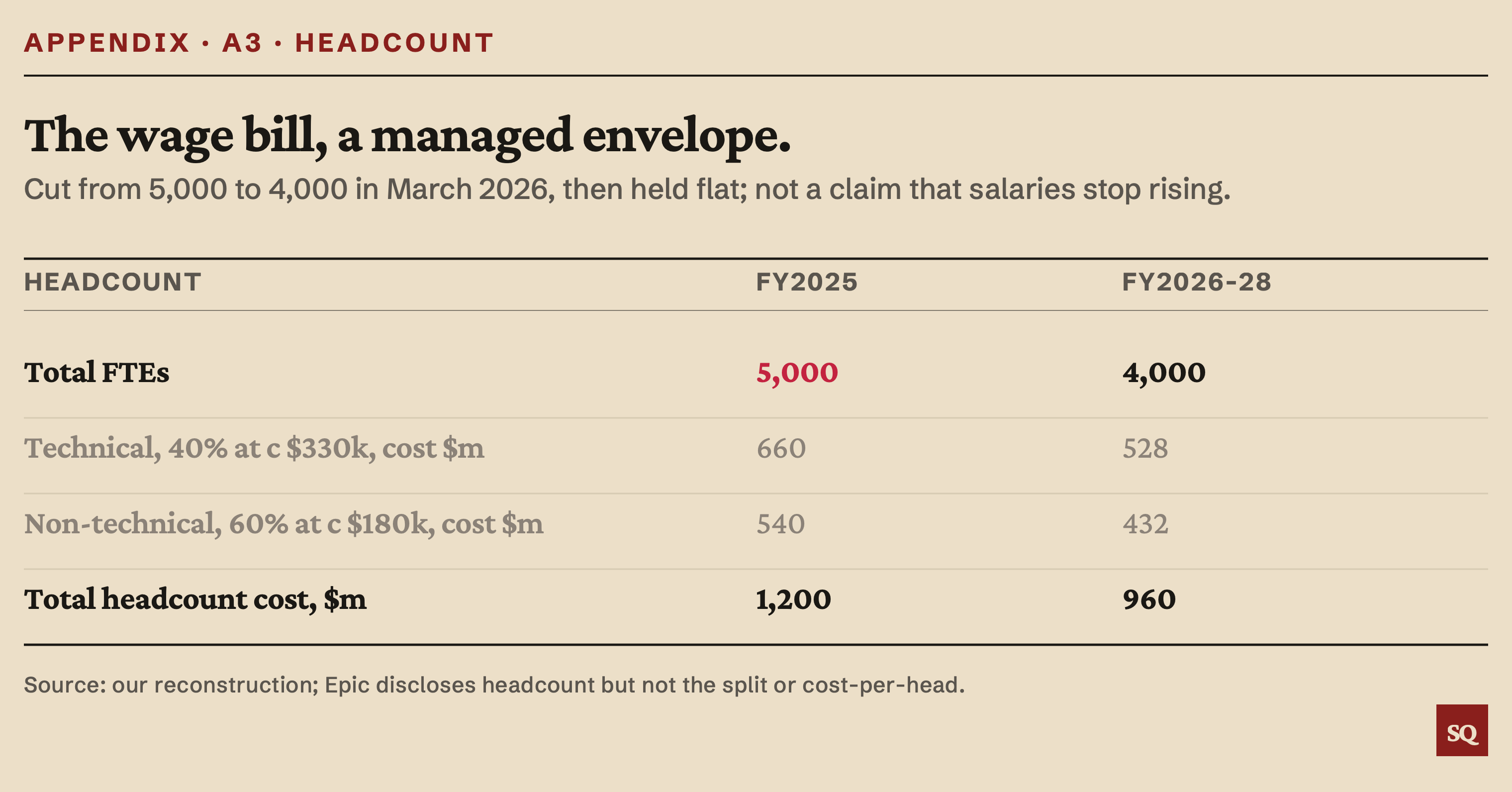
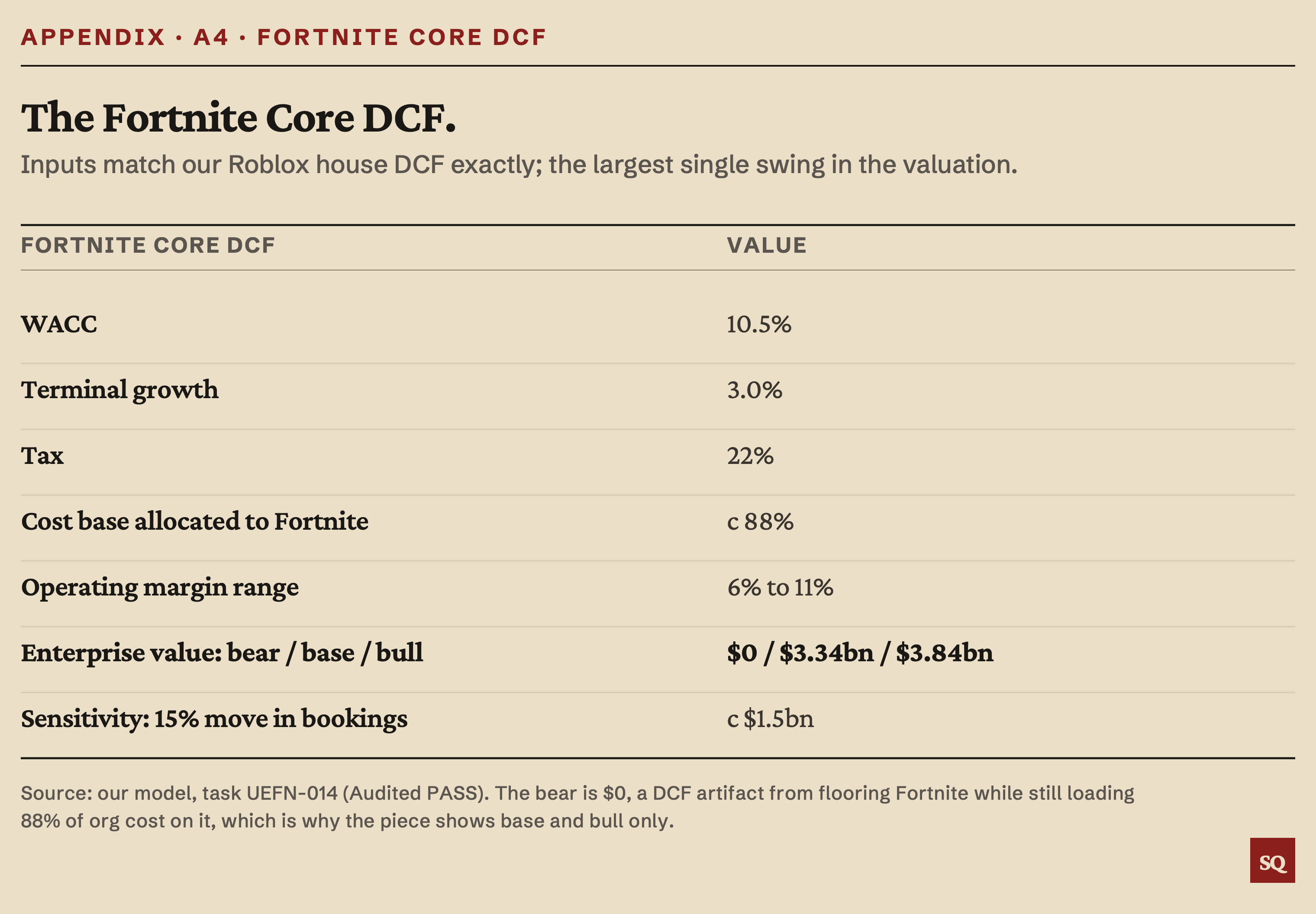
First, Fortnite’s decline/growth rate. At about 90% of revenue it is the largest swing in the valuation: a 15% move in bookings moves Fortnite Core by roughly $1.5bn. How fast the game fades/grows matters more than everything else in the model combined.
Second, the profit is thin and fragile, because it rests on those two re-grounded cost lines and on a heavy allocation. If marketing or overhead run materially above our 2.5% and 6% of revenue, the modest profit thins or vanishes, and both figures are our estimates, not Epic’s. Additionally, because Fortnite is the majority of the revenue, the model charges it about 88% of the entire cost base, so the industry’s biggest game earns operating margins of just 6-11%.
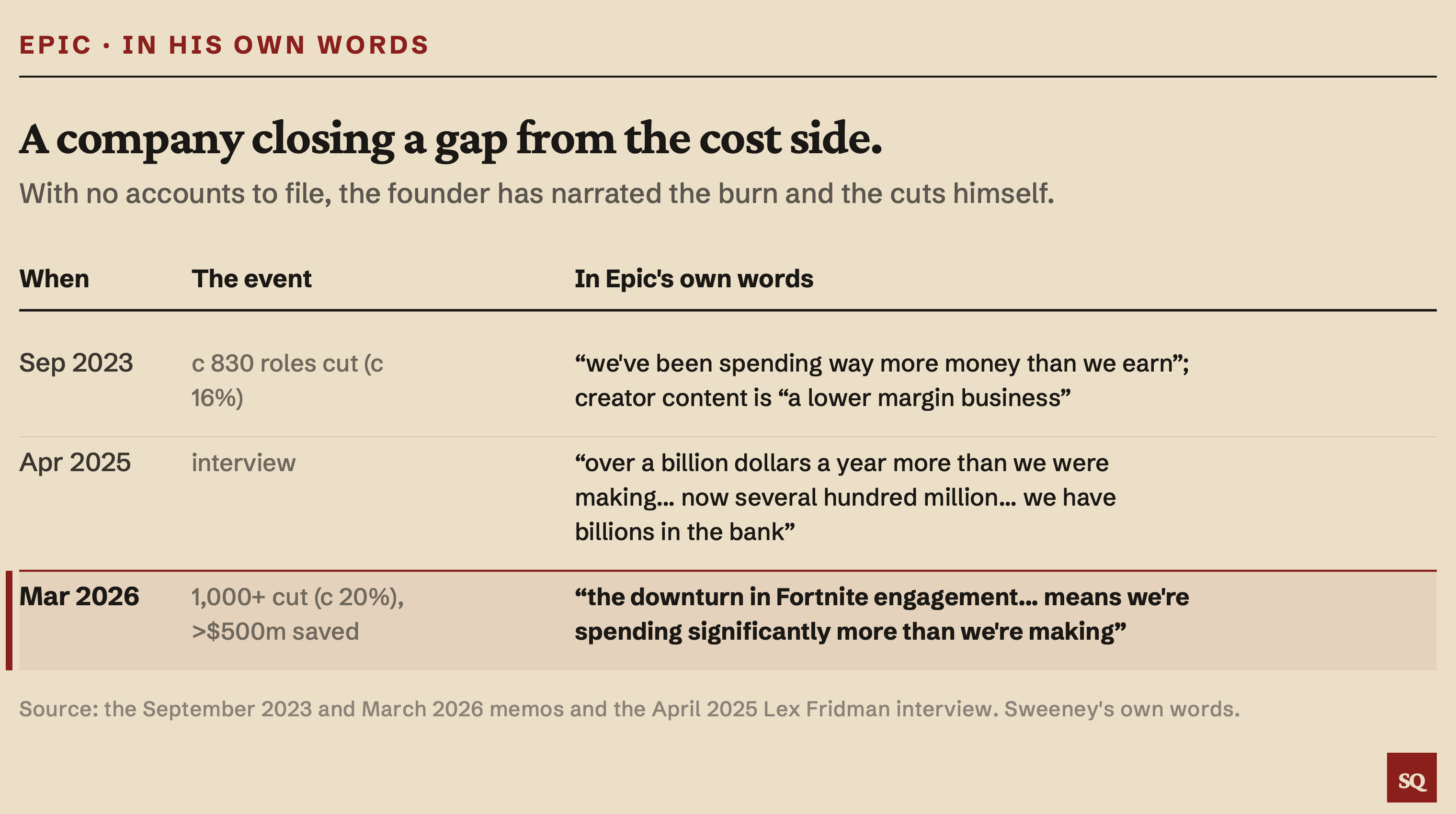
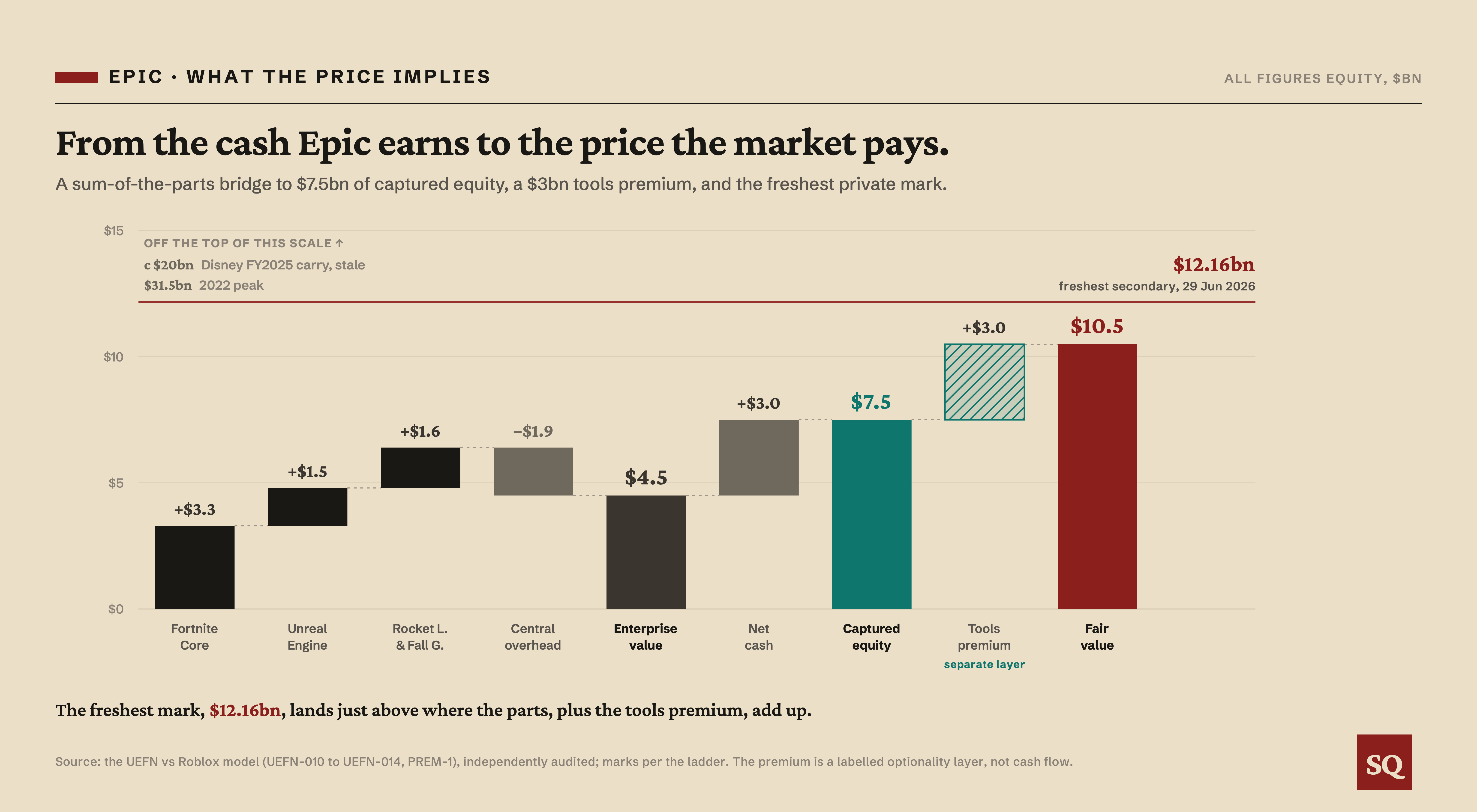
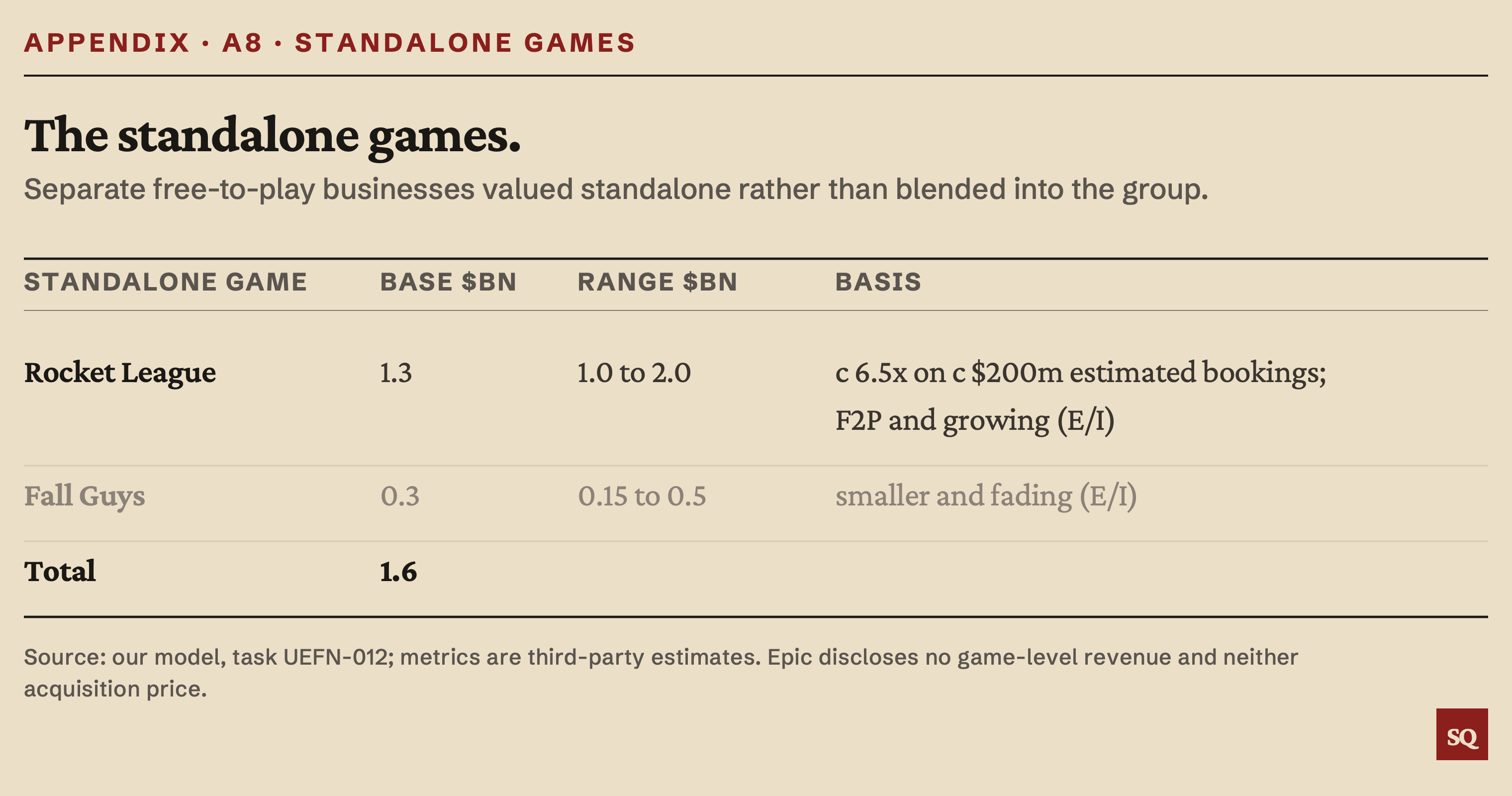
Third, and most telling, the platform bet is not where the value is. Fortnite Core at about $3.3bn is only 44% of the $7.5bn equity; net cash of about $3bn, Unreal at $1.5bn and the standalone games at $1.6bn make up the rest, net of the $1.9bn of overhead. More than half of Epic’s equity is cash and side assets, and the platform pivot the entire company is built around contributes approximately nothing. That is the finding section 5 cashes in.
The funding history shows how much the dream has cost. Epic has raised roughly $7.5bn since 2018 from Sony, KIRKBI and Disney among others, paid a $520m FTC settlement, dialled the store’s exclusivity programme down with Sweeney conceding many of those deals “were not good investments”, shut two side modes this year, and raised the V-Bucks price.
Solvency is not in question, since our bridge puts net cash between $2bn and $4bn. The picture is a company trimming everything peripheral, including its own game’s value for money.
5. The Valuation: What the sum of the parts add up to
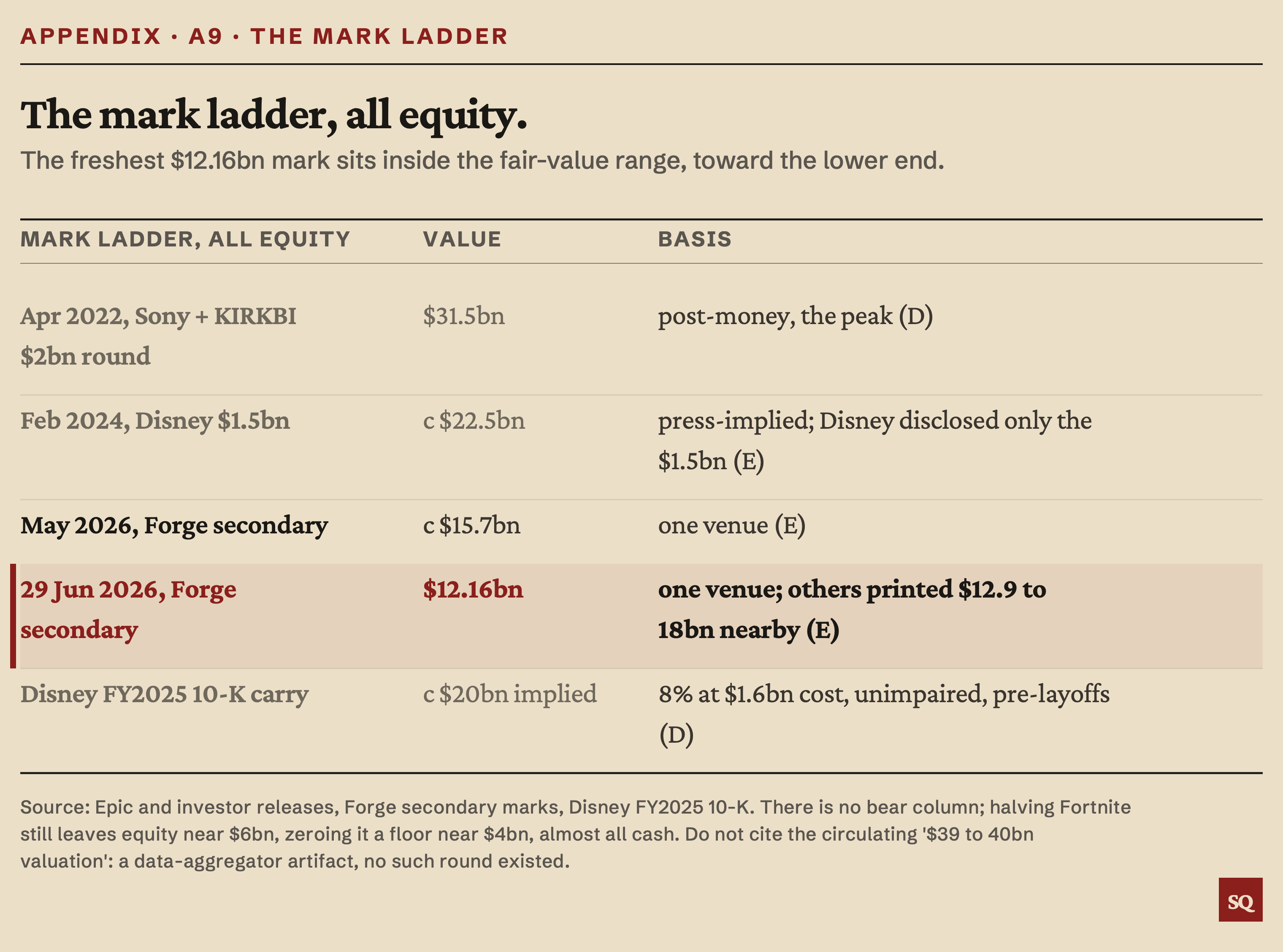
Private investors have been repricing this story for four years.
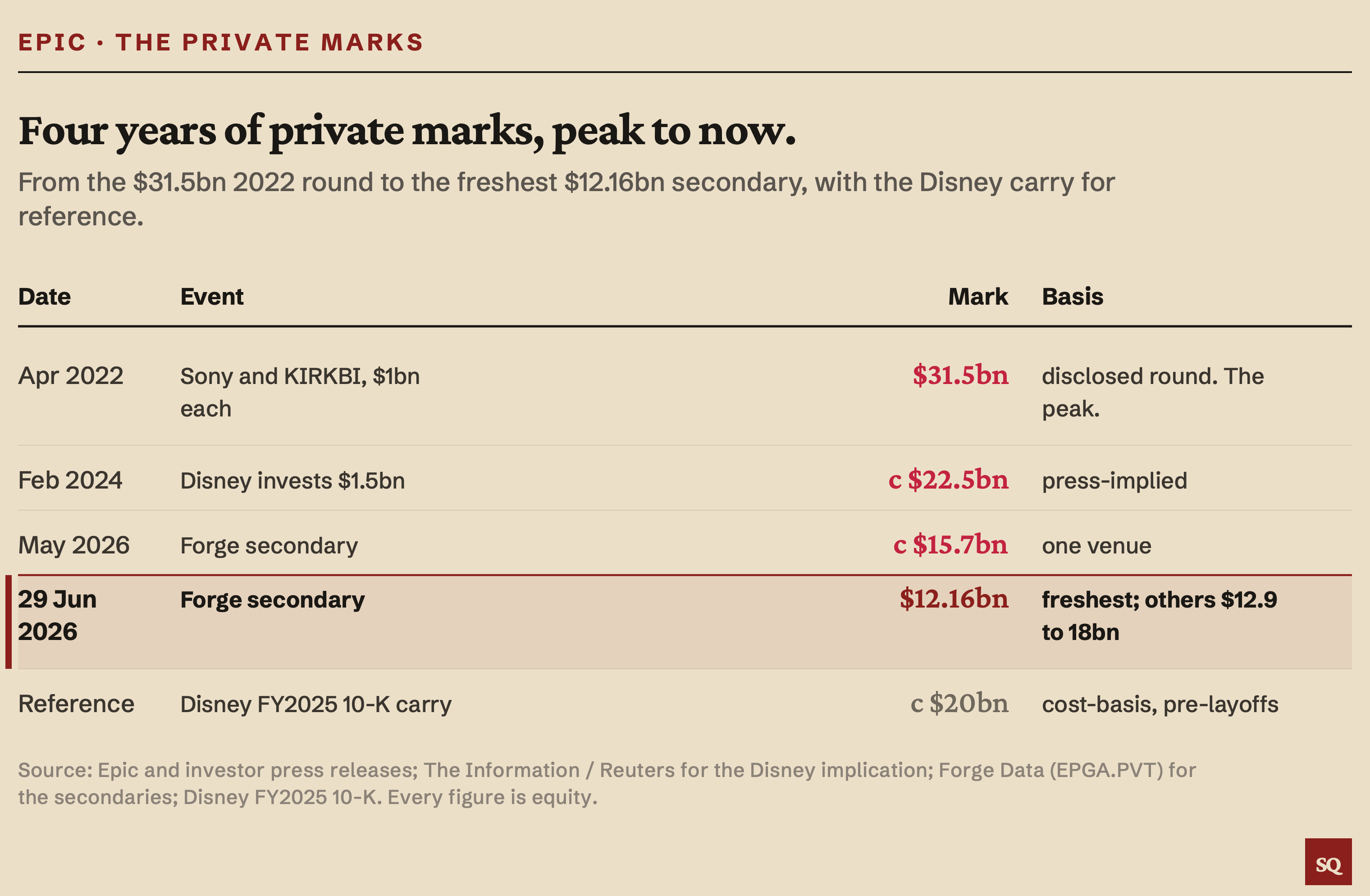
The freshest mark is 61% below the peak, and it was struck while the company was telling the world it is building the future of the medium. The question is what the number should be. Our answer is a sum of the parts (SOTP) , each piece on its own honest basis, built from the drivers assembled in sections 2 to 4 and independently re-derived from the inputs up.
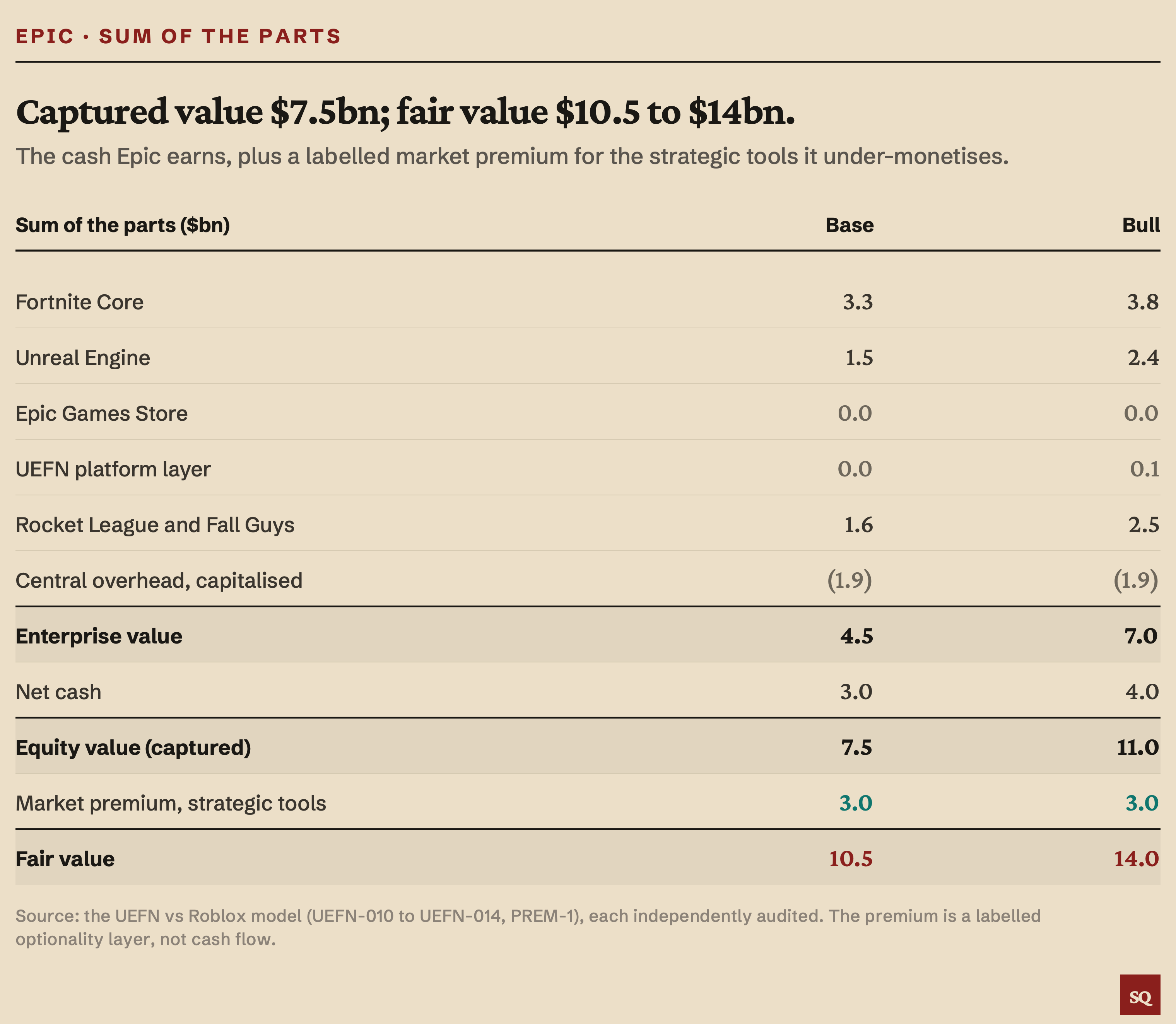
Fortnite Core is worth about $3.3bn because it bears roughly 88% of the group’s costs and so earns only single-digit margins on the industry’s biggest game.
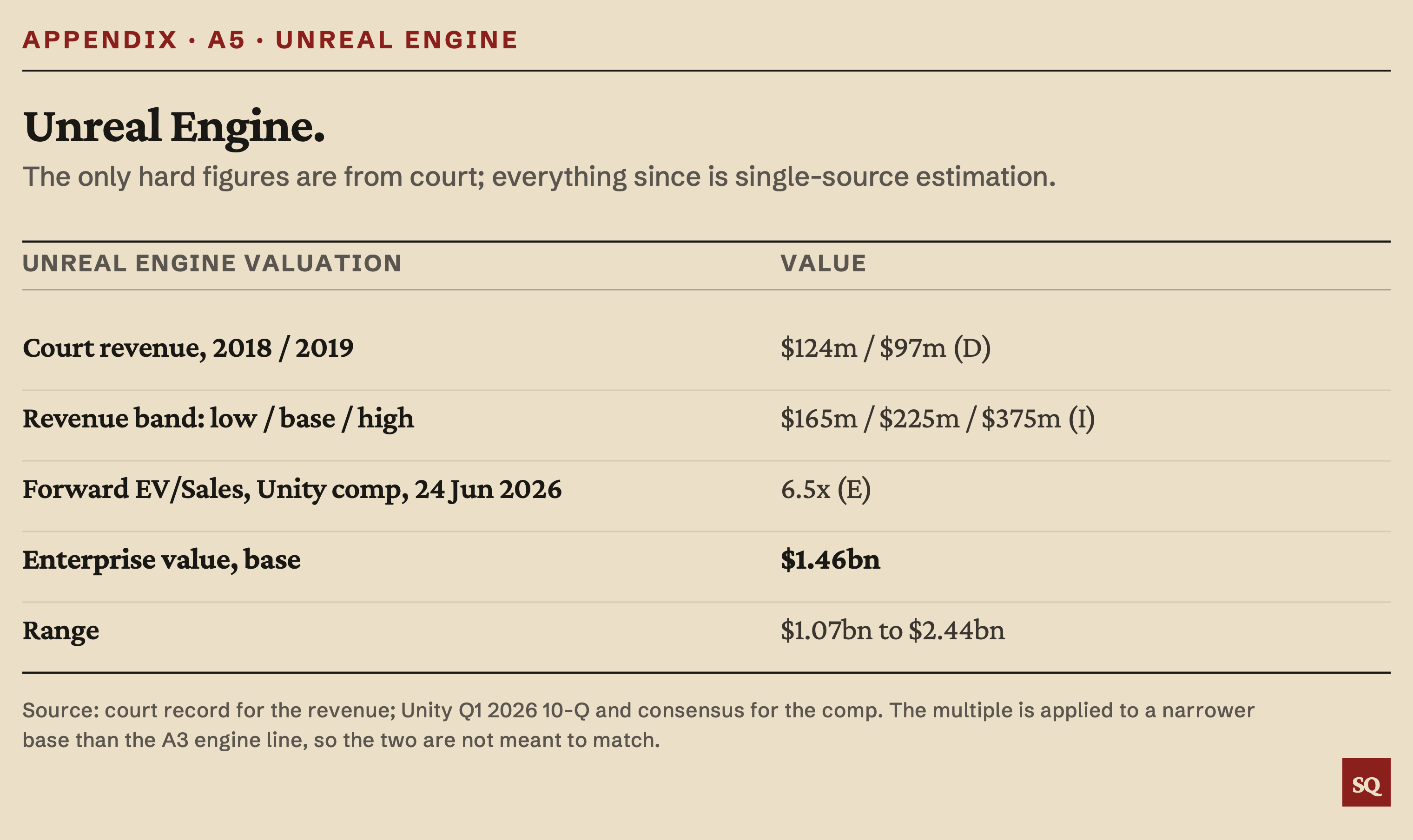
Unreal Engine gets a band rather than a point because the only hard revenue figures are from court, $124m in 2018 and $97m in 2019, and everything since is single-source estimation. At Unity’s forward multiple the engine is worth about $1.5bn, in a range of $1.1bn to $2.4bn. That $1.5bn multiplies a deliberately narrower base because the P&L includes enterprise seats and marketplace fees the comp should not.
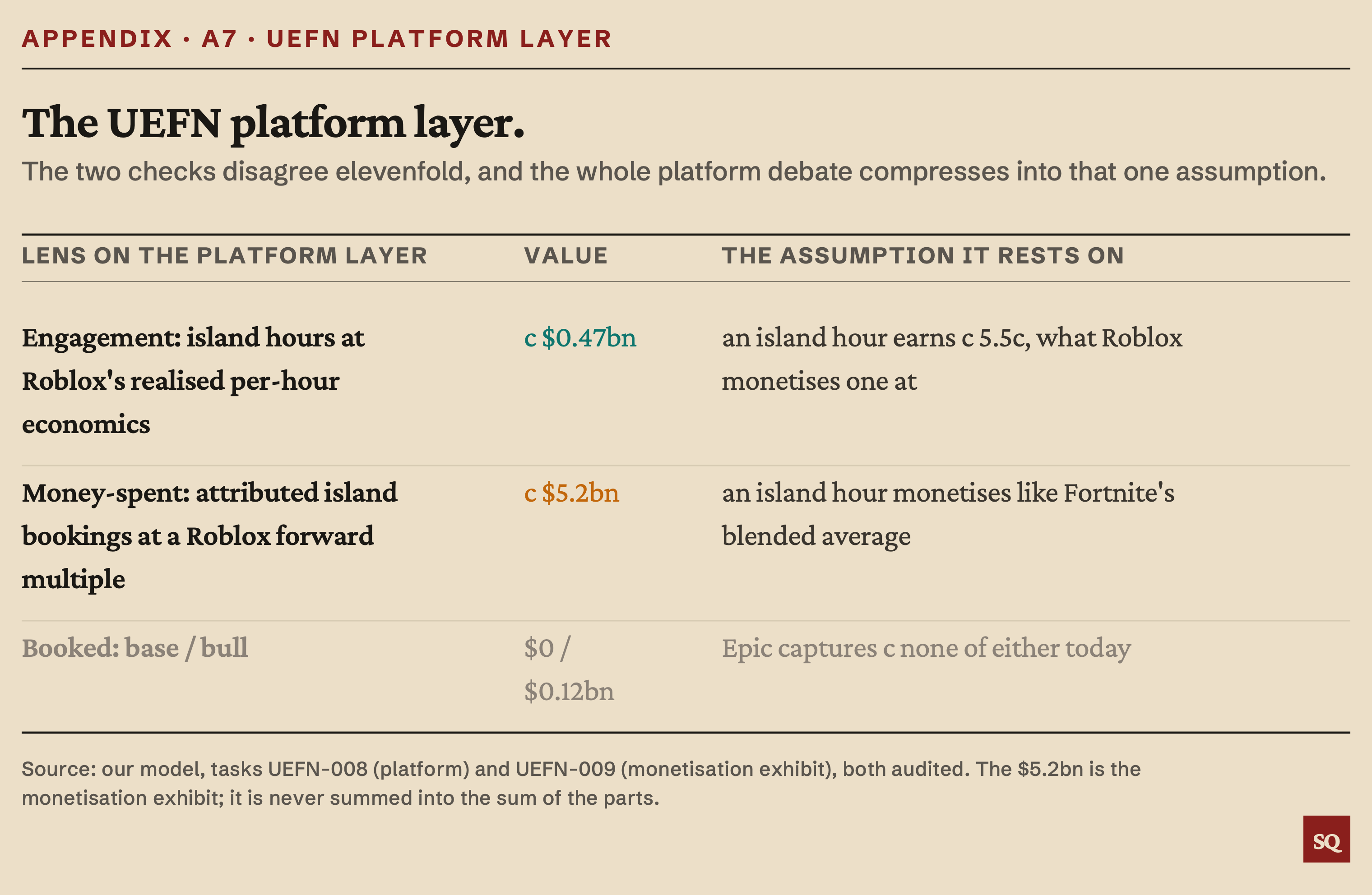
The platform layer is worth approximately zero, and the zero is the article’s argument expressed as a valuation.
The creator payout already sits inside Fortnite Core’s cost base, so the platform piece can only be worth what Epic captures beyond Fortnite, and its disclosed economics say that is nothing yet. What a third-party island earns is skimmed first by Epic’s reserve and recapture and then, on a branded island, by the IP holder, and none of those overrides reach Epic.
The entire platform debate compresses into that one assumption. If third-party islands can monetise like Fortnite’s average hour, the layer is worth billions. Epic’s own payout record, at roughly 45% of a Battle Royale hour’s value, sides with the small number, and we book the base case at zero, with the c $0.47bn shown as foregone value rather than Epic’s value.
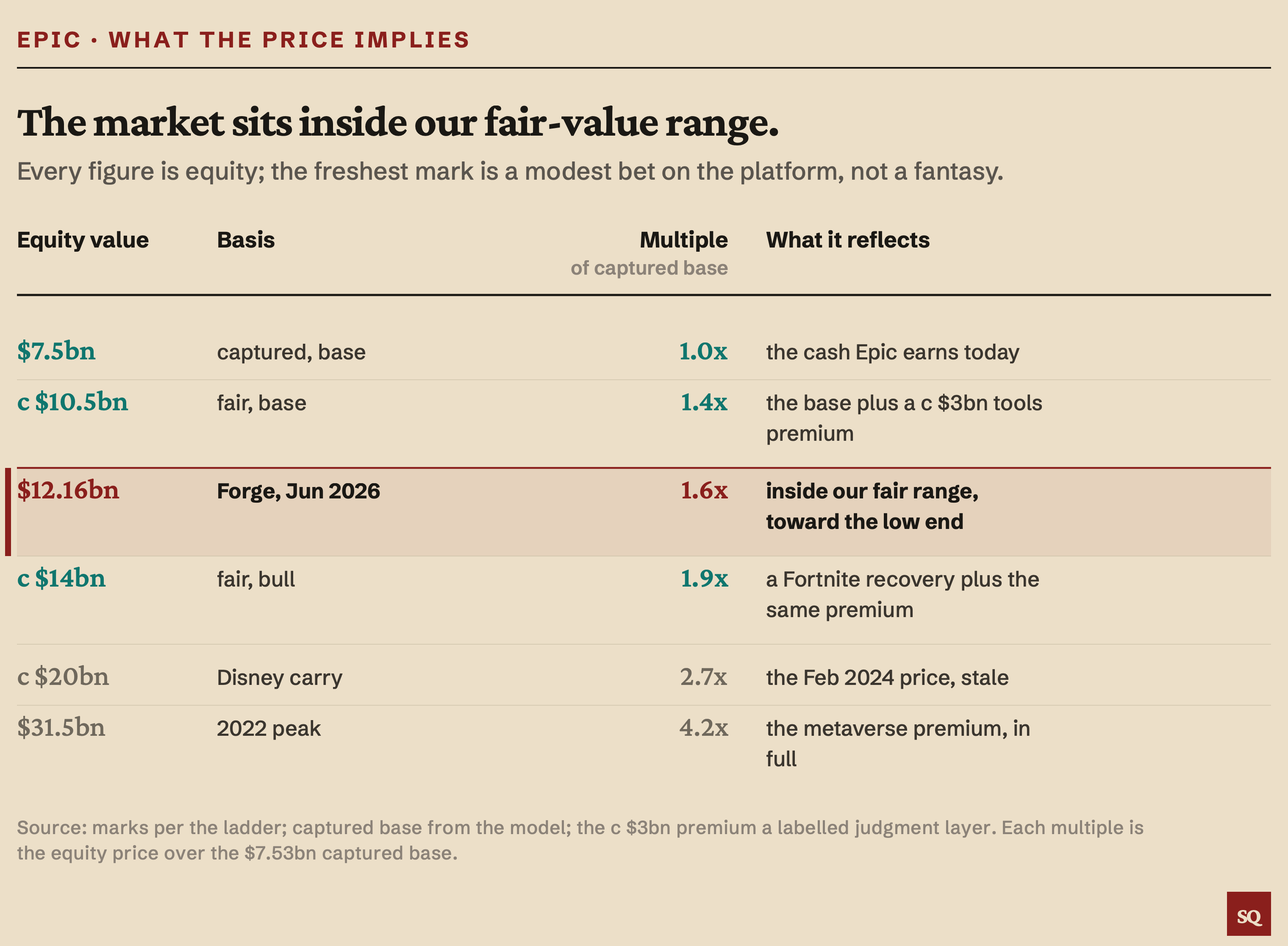
There is one thing the sum of the parts (SOTP) leaves out, and it is the strongest argument for a higher number. It values what Epic captures in cash, not what Epic owns.
Unreal is a top-two engine carried at $1.5bn on a 5% royalty that Epic waives on its own store and discounts everywhere else
Epic Online Services is a 972 million-account identity and anti-cheat graph carried at zero because it earns nothing.
Both are worth far more to the industry than Epic charges for them, and the market pays a premium for that. We credit it as a market premium of about $3bn, added to both the base and the bull, kept separate from the cash-flow pieces and labelled for what it is: not earnings, but the strategic worth of tools Epic under-monetises, value that becomes Epic’s only if it raises its prices or the position is paid for another way.
With the premium, fair value runs from about $10.5bn on the captured base to about $14bn if Fortnite also recovers. The tools are genuinely strategic; Epic simply gives most of that value away, which is the same generosity the rest of the piece describes, now seen from the asset side rather than the income statement.
What the generosity has bought
Epic set out to build a platform with generosity, and the attempt deserves the credit rarity earns: evolving a business model mid-flight is a risk most games companies never take. The accounts say what it has cost so far:
Two rounds of layoffs.
Roughly $7.5bn of outside capital consumed.
A store and a services layer that earn nothing by design.
A pool whose advertised 40% delivers about 11 cents of the dollar to the people it was named for.
Roblox, the company Epic is trying to become, pays creators 22c, and still posts an operating loss, but its losses buy share in a market it leads. Epic’s generosity buys a pool it mostly pays back to itself, inside a game that is working its audience harder.
For Epic’s shareholders the arithmetic is uncomfortable in a specific way:
Sony, KIRKBI and Disney bought in at marks between $22.5bn and $31.5bn.
Tencent's minority stake, once 40% and now reported at anywhere from a quarter to a third after years of dilution, is under a CFIUS review that could force a sale, though Sweeney retains control regardless.
The freshest price anyone has paid is $12.16bn, although that price was struck in a secondary market, on illiquid shares.
Our SOTP supports about $7.5bn of that in the cash Epic earns, and $10.5-14bn once the strategic value of the tools it under-monetises is credited.
The mark sits inside that range, a bet that the pool, the free engine and the free services convert into a business before Fortnite stops being able to pay for them.
At his June keynote, Sweeney described Roblox as a centralised platform with a single gatekeeper taking more than 70% of revenue, and pitched an open alliance as the alternative.
The accounting answer to his own pitch is in the waterfall above: the generous open model currently returns a smaller share of the consumer dollar to a third-party creator than the gatekeeper it is measured against, and the company offering it is the one making the cuts. The diagnosis of the industry may well be right. On its own numbers, the cure is not yet a business.
More from The Side Quest
Roblox: A great company lost on valuation - It owns the most complete stack in interactive entertainment yet profits from it the least, and rising costs are eating into what little is left.
Microsoft and Xbox: Too small to sell, too strategic to spin - On the numbers, Xbox is worth about $49bn, a rounding error to Microsoft. It won’t be sold, and any separation keeps a grip on the data its games generate.
AI in Video Games: Own the Loop - why a studio keeps its value only if it owns the content-generating learning loop, not the model. Uses Guild Wars 3 as a worked example.
AI won’t make AAA games materially cheaper to develop - the productivity gains are real, but two-thirds of the value leaves the P&L to the AI vendors before it reaches the bottom line.
Appendix
Epic files no accounts, so all of this is a reconstruction from three kinds of source: court disclosures from Apple v. Epic and Epic v. Google, Epic’s own developer documentation, and the prices investors have paid. Each input is tagged D disclosed, E third-party estimate, or I our inference. Figures are rounded and may not sum.
The disclosed lines (the store fee, the 40% pool, the 36.5% creator share, the court revenue figures, the investment marks) are Epic’s or the court’s. The forward paths, the cost base, and every valuation multiple are ours.
A1. Fortnite bookings: the revenue spine
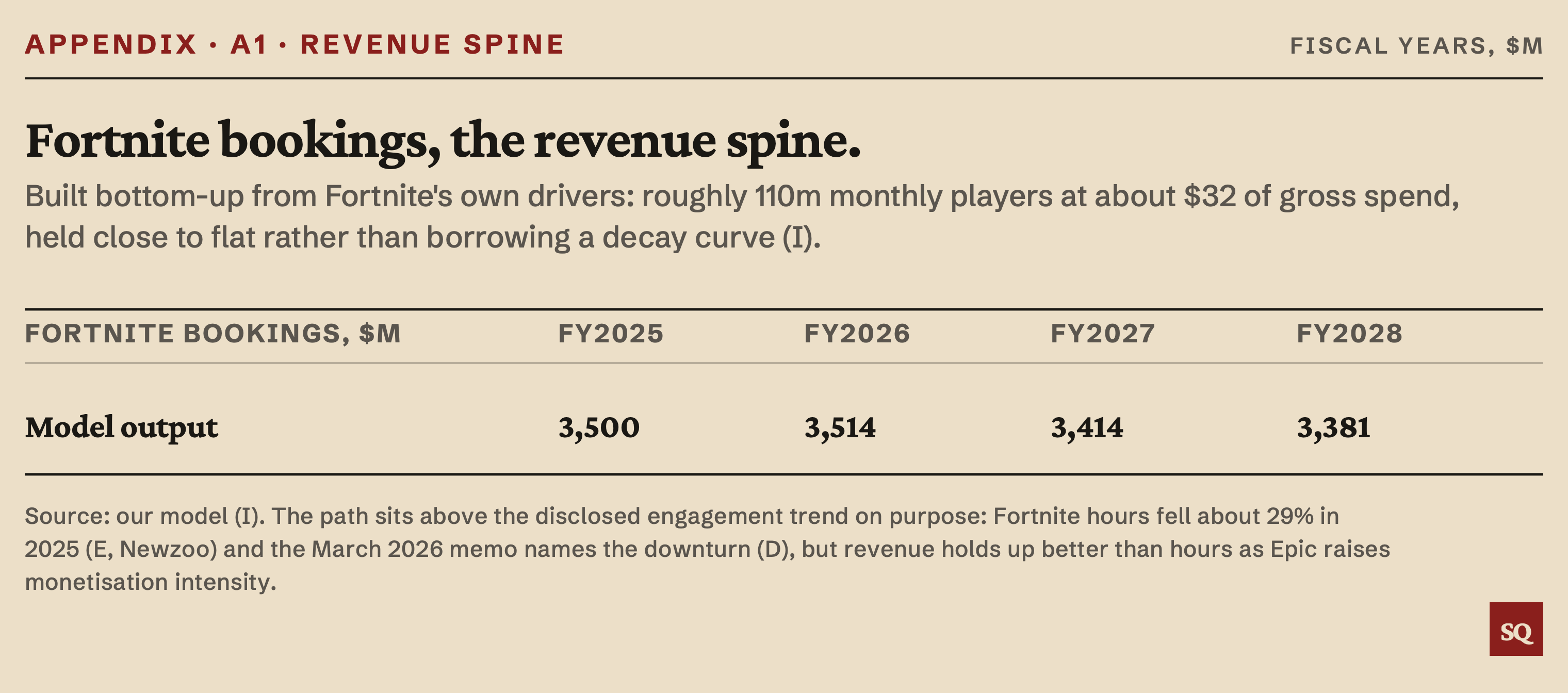
Built bottom-up from Fortnite’s own drivers, roughly 110m monthly players at about $32 of gross spend, held close to flat rather than borrowing a decay curve from other games (I). The path sits above the disclosed engagement trend on purpose: Fortnite hours fell about 29% in 2025 (E, Newzoo) and Sweeney’s March 2026 memo names “the downturn in Fortnite engagement that started in 2025” (D), but revenue holds up better than hours because Epic is raising monetisation intensity. The cross-check ties the model to Epic’s own disclosed payout within about 7%.
A2. The $100 pool waterfall
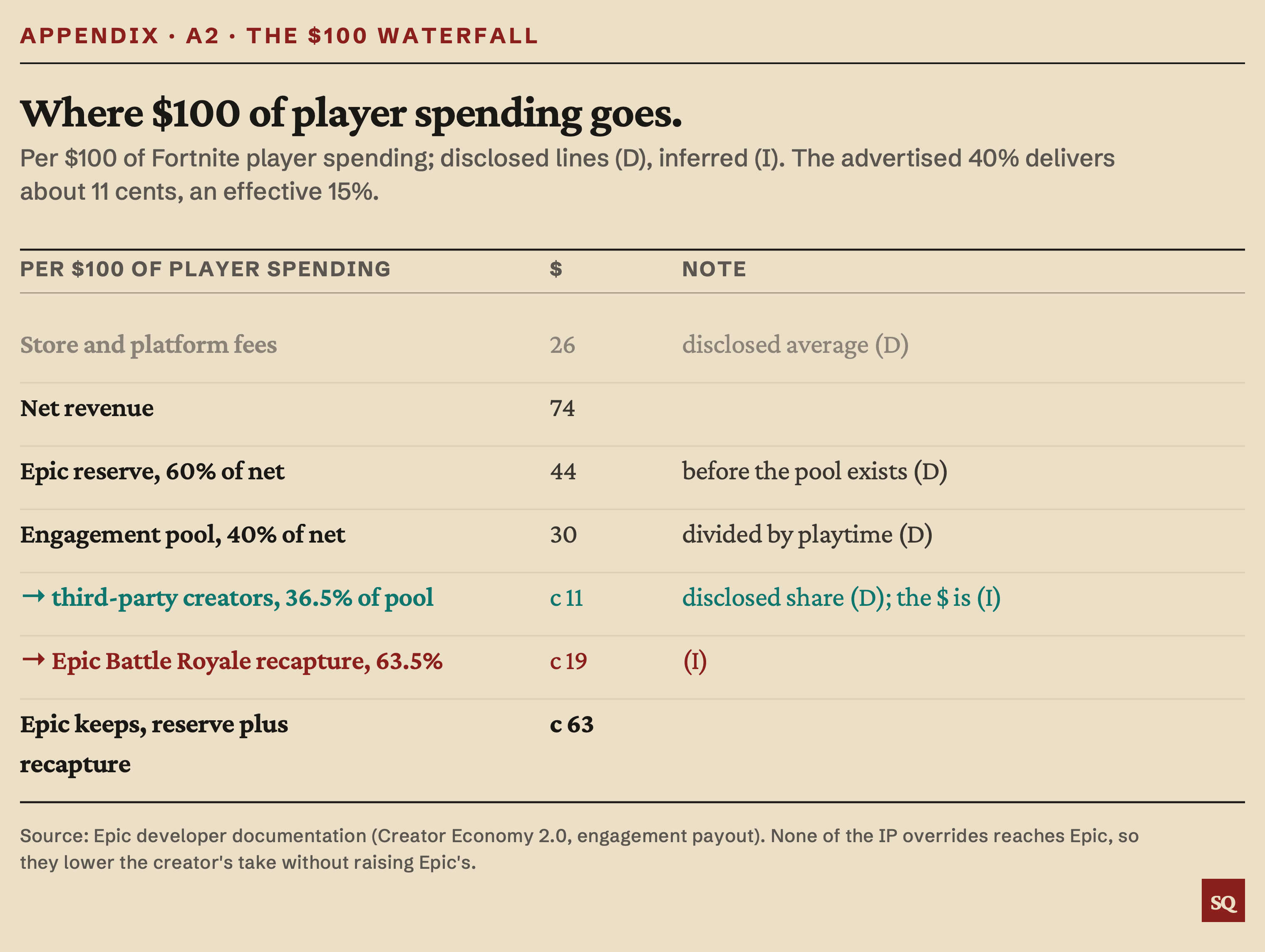
The advertised 40% delivers about 11 cents of the retail dollar, an effective 15%. In-island sales are 1.7x more generous but tiny: more than $900m of the roughly $1bn paid to date came through the pool, not the storefront. None of the IP overrides reaches Epic, so they lower the creator’s take without raising Epic’s.
A3. The reconstructed group P&L
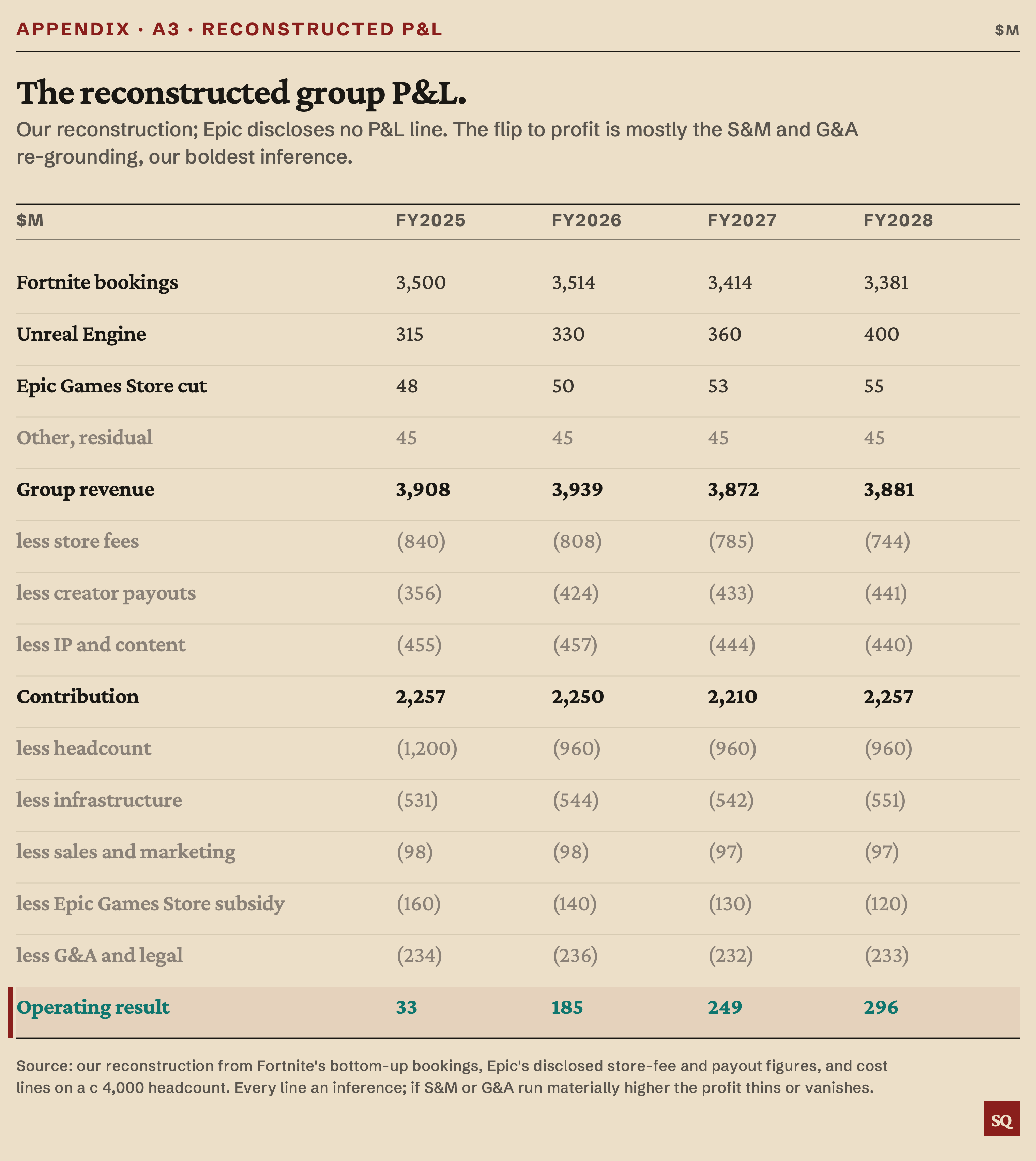
The flip from a large loss to a modest profit is mostly the sales-and-marketing and G&A re-grounding to 2.5% and 6% of revenue, not headcount. It is our boldest inference, not an Epic-confirmed figure, and if either line runs materially higher the profit thins or vanishes.
A4. Fortnite Core: the DCF
Inputs match our Roblox house DCF exactly. The bear is $0 because the freefall path floors Fortnite at nothing while still loading 88% of org cost on it, a DCF artifact rather than a credible value, which is why the piece shows base and bull only. It is the largest single swing in the valuation.
A5. Unreal Engine
The only hard figures are from court; everything since is single-source estimation. The multiple is deliberately applied to a narrower base than the A3 engine line ($315m rising to $400m), which includes enterprise seats and marketplace fees the comp should not, so the two are not meant to match.
A6. Epic Games Store
Unprofitable in Epic’s own sworn 2023 testimony, and smaller and more loss-making than the breakeven storefront comp, so it carries no positive value.
A7. The UEFN platform layer
The two checks disagree elevenfold, and the whole platform debate compresses into that one assumption. The creator payout already sits inside Fortnite Core’s cost base (A2), so the layer can only be worth what Epic captures beyond Fortnite, and its payout record, at roughly 45% of a Battle Royale hour’s value, sides with the small number. The $5.2bn figure is the monetisation exhibit; it is never summed into the sum of the parts.
A8. The standalone games
Separate free-to-play businesses with their own monetisation, valued standalone rather than blended into the group. Epic discloses no game-level revenue and neither acquisition price.
A9. Sum of the parts, the bridge, and the premium
The net-cash bridge: about $7.5bn raised since 2018, less M&A, the $520m FTC settlement, legal, and cumulative burn, leaving $2-4bn and no debt. The freshest $12.16bn mark sits inside the fair-value range, toward the lower end. There is no bear column, because the freefall path that floors Fortnite Core at $0 is not a credible enterprise value; halving Fortnite still leaves equity near $6bn, zeroing it leaves a floor near $4bn, almost all cash.