


TL;DR
A wave of project funds, Griffin, Outersloth, Kowloon and VGames among them, now backs premium games on cleaner terms than many publishers offered, but most of it reaches the game whose demand is already proven, and less the one still proving it.
Publishers came out of the pandemic glut able to wait for wishlists and trailers to tell them what felt safe, so developers now generate much of that evidence themselves before most funders will look at them.
The phase before that evidence exists is where Della Rocca sees the market failure, so who reaches it is often settled upstream by savings, a grant, consulting income, or an incubator place, long before the better game is judged.
Watch the full interview with Jason Della Rocca below.
A group of funds now finances games on terms developers have wanted for a long time. Griffin, Outersloth, Kowloon and VGames put up the money for a premium game, take a share of its revenue in return, leave the studio its IP, and do not ask for a say in how the game is made. Set against a full-service publishing deal, where the publisher may encumber the IP through broad rights and recoup its advance in return for running the marketing and distribution, the terms can be better for a studio that has already done part of that work itself.
Much of this money does not move, though, until a game has already shown that an audience wants it, through wishlists, a following on Discord, a trailer people have watched, viral TikTok posts and strong playtime or engagement in a playtest or demo build. By the time a fund commits, the game appears less risky, but that does not mean the studio no longer needs money or that the commercial risk has disappeared.
There are exceptions. Blue Ocean works at concept stage, Outersloth says a build or demo is optional, and WINGS, GameSeer and Phantom Friends can enter around prototype. The point is not that early money does not exist, but that it is scarce and highly selective, while many more options appear once the evidence is there.
The piece comes out of a long conversation with Jason Della Rocca, who has spent thirty years in games and now advises studios on how to raise money. He also works on one of the funds in question, Griffin’s Special Opportunities Fund: he sees where the money now goes, and he is candid about the gap it leaves at the start.
Why venture never fit premium games
How a game should be funded is decided by its business model, and games split cleanly into two in Della Rocca’s framework. This is his own starting point, and it has been for years. A studio building a game as a service, a free-to-play title, a live multiplayer game, anything with the shape of Fortnite or Roblox, runs on the economics of a software-as-a-service (SaaS) business: recurring revenue, a funnel, a cost of acquiring a player set against the value of keeping one. That is the shape venture capital is built to back, and on his account it is almost the only shape it has backed. “99% of all VC dollars that have gone into game studios has essentially gone into studios using some version of SaaS, GaaS, live service.”
A one-off premium game usually does none of that. The $20 title bought once on Steam and played to the end earns like a piece of content rather than a platform, and there is no funnel beneath it for a fund to compound over the years it would need to return several times its own size. So the studios making those games sat outside the venture category for years, and the money they went looking for was unlikely to arrive because equity was often the wrong instrument, even though rejection was usually read as a verdict on the game. “Venture is for GaaS,” as he puts it, “project funding is for premium games,” and the model, not the merit, decides the side a studio is on.
What that left was a whole class of viable games venture would not fund. A studio would pitch a fund, hear that “this is not the next Riot, this is not the next Supercell, we’re not interested,” and then, in his words, “they take a million bucks and they make 20 million, 50 million, 100 million.” A game that turns one million into fifty is a good business that venture could not back, because venture is not looking for a good return, it is looking for a rare and enormous one. The project funds are what grew into that gap, writing the deals venture was made to turn down.
How the money learned to wait
Before the pandemic, Della Rocca says, a studio could raise money on a strong prototype and a credible team, on how good an early build felt in the hands. What broke that was not a crash but a glut. The surge in players through lockdown pulled in a wave of investment, and when it receded it left an oversupply of games, and of the studios making them, all pitching at once. The people with money were suddenly seeing far more of everything and could still act on only the same few.
What changed was the ratio of pitches to deals, while the money behind the deals held roughly steady. “Maybe I got 1,000 pitches, and I did 2 or 3, 4 whatever deals,” he says. “Now I’m getting 5,000 pitches, and I’m still only doing 3, 4, 5 deals, because... I can only service so many games in a given time frame.” The number of deals barely moved and the number of rejections multiplied, so from the outside it looked like a market that had stopped funding anything, when the same money was simply turning away five times as many people.
Somewhere in that glut the people writing the cheques stopped trusting their own judgement. Too many bets had missed, playtime had softened after the lockdown highs, and in his words they “lost their confidence in their ability to pick winners.” A funder who no longer trusts it has an obvious way out, which is to let the market do the judging. The game that arrives with a hundred thousand wishlists will often beat the one that arrives with none, and waiting shifts much of the cost of generating that evidence onto the developer.
So the burden of proof moved onto the developer. Studios began doing the work a publisher was once meant to do, announcing early, cutting trailers, gathering wishlists, working festivals, viral TikTok posts and Discord, building the evidence of demand before approaching the people with money. Della Rocca calls it “inception publishing,” the point at which a developer has to run the marketing to prove the game is worth marketing. And once a studio has done that, a harder thought follows. It has found its own audience and validated its own product, so part of what a publisher was meant to provide has already been provided in-house, and the question becomes what the publisher is still for.
That question is the opening the project funds walked into. A studio that has done its own validation already has its players, and what it is missing is the money to finish the game, which is all the funds provide, along with none of what it no longer needs. “You did the marketing, you have your community, we don’t need to do that for you,” is how he frames their pitch, “but... you need more money to finish the game. Okay, here’s 500 [thousand], a million, whatever, and we just take a revshare with no IP rights, no derivative rights. It’s a very clean contract.” The publishers, by sitting back and waiting for proof, left the opening that now lets a studio pass them by.
The clean contract, and the equity on top
The developer-friendly language mostly survives into the contracts, on the evidence Della Rocca has seen. The contracts are short, the fund takes a share of revenue and little else, and the rights a publisher might fold in, sequels, merchandise, derivatives, a claim on the next game, tend not to be there.
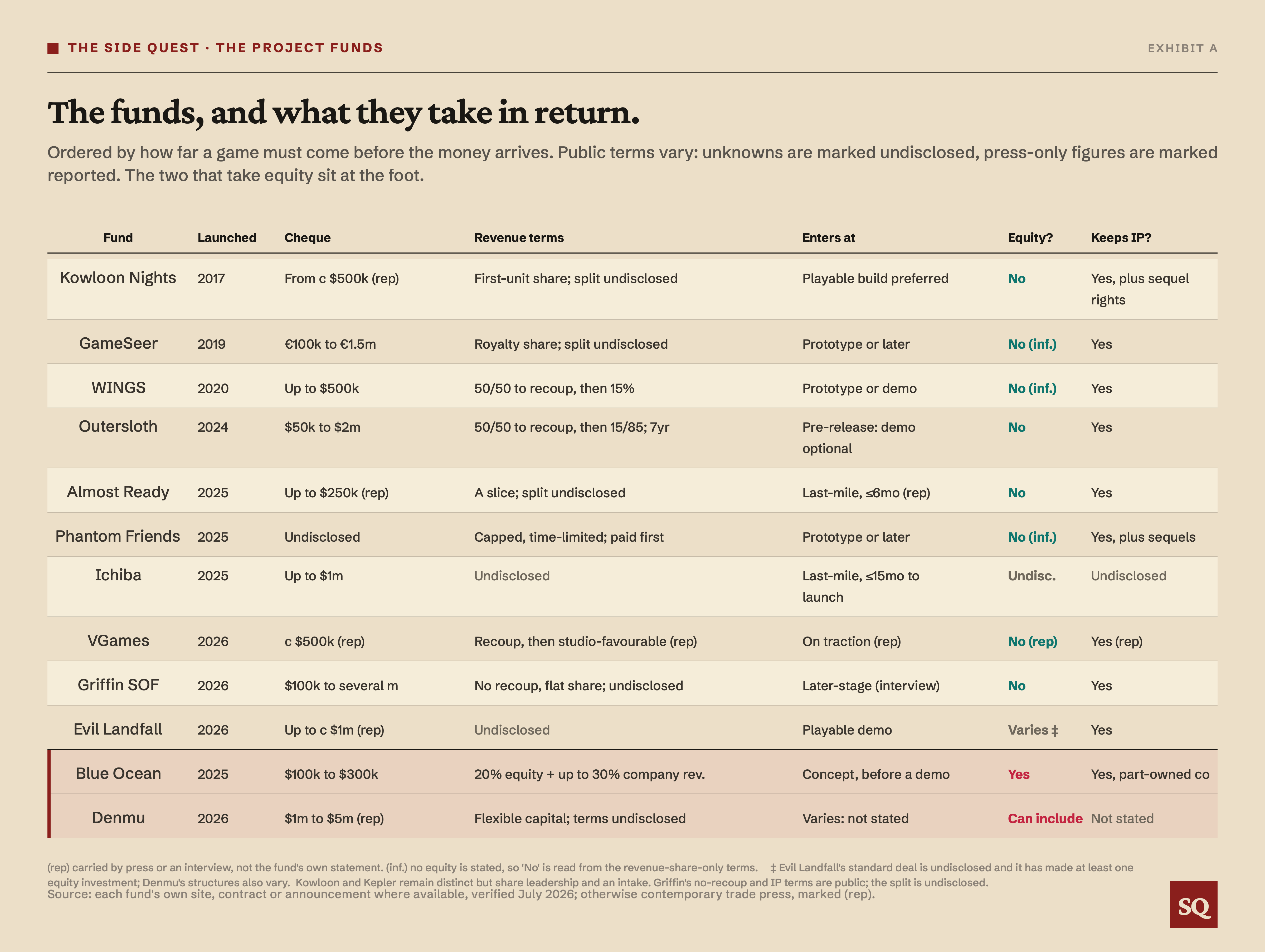
Outersloth, which publishes its contract, splits revenue 50/50 until its money is repaid and then 15/85 in the studio’s favour, with the agreement ending after seven years. Griffin, the fund Della Rocca works on, takes no repayment at all and shares from the first dollar. For a studio that needs capital rather than publishing services, those are cleaner deals than a recoup-heavy publishing agreement. They are not automatically better in every case because a publisher may also be paying for and doing work that the fund leaves with the developer.
Some of the funds do more than share project revenue. Blue Ocean takes 20% of the company plus up to 30% of company revenue, although the revenue share falls away if the studio completes a qualifying seed round within two years. Denmu describes itself as a flexible-capital investment house, and reporting indicates that it can use both project finance and equity, but it has not published one standard structure, entry stage or set of terms.
Della Rocca is uneasy about company equity in these deals - he grants that the deals are fair, since developers sign them with the terms in front of them, and he stresses that it is not a comment on the teams at either fund. His reservation is with the instrument, not the people using it. Project finance exists in the first place because equity often does not suit these games. A stake in a three-person premium studio assumes some path to an exit or a wider stream of products, and for many of these studios that outcome will not arrive.
There is a reason a fund might want it anyway - if the money turns a game into the next Balatro or Palworld and a buyer appears, a pure revenue share leaves the fund outside the deal. “[Hypothetically speaking, if'] it was my money that made Palworld a success,” as Della Rocca puts the objection, “but then I’m not getting any of the proceeds of the... multi-billion dollar acquisition.”
Grant it entirely, and his answer still holds: that upside can be caught with a buyout clause or a conversion right, without taking a stake on day one. The instinct to take it anyway, he thinks, is inherited rather than reasoned. “If you come from the venture side, it’s like you’re a fish that only knows how to breathe oxygen in water.” Shown there is another way to breathe above the water, the reflex holds: “I need my equity, it’s in my DNA, it’s all that I know.”
The gap before the evidence
The map sets out the timeline of a game from idea to live:
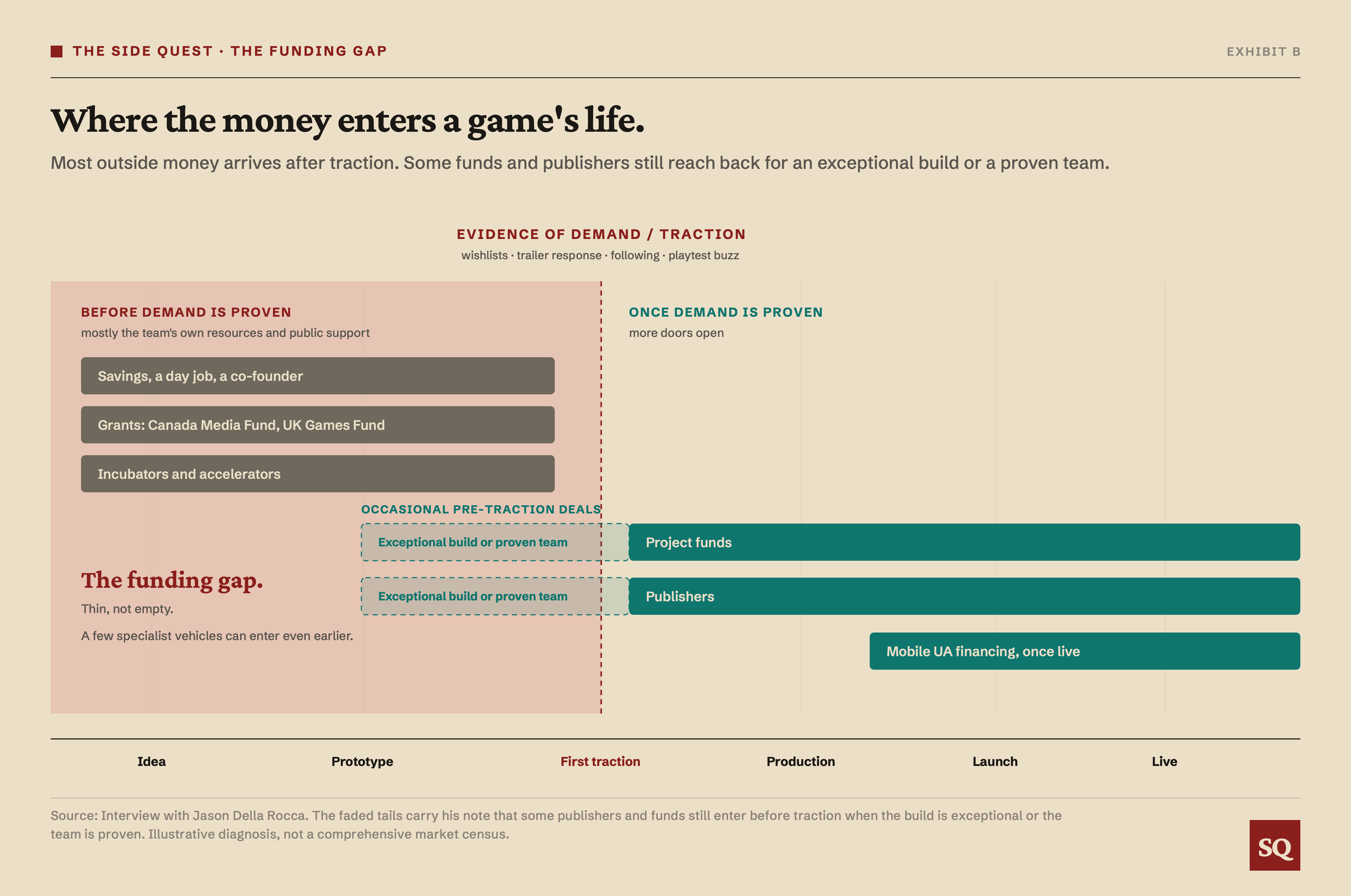
To the right of the evidence line (first traction) the money is more plentiful and takes several forms, and to the left of it there is comparatively little. Blue Ocean, Outersloth, WINGS, GameSeer and Phantom Friends are among the funds that can reach back towards concept or prototype, and some publishers still do pre-evidence deals for an exceptional build or a proven team. The early money is not absent, but it is scarce enough that most developers cannot plan around receiving it.
Della Rocca is clear that this suits the later-stage funds. They can hold off while a developer spends their own months and their own savings proving the audience is there, and put money in only once the uncertainty has narrowed. “They just wait for the developers to put all the blood, sweat, and tears to generate the evidence on their own time,” he says.
Some of the recent funds go later still. Almost Ready and Ichiba, both launched in 2025, put their money into games approaching release, once the build is nearly finished.
He does not leave it there - once the evidence exists, Della Rocca argues, it can overwhelm many of the things that used to decide a deal. A game with a million wishlists carries the same signal whether it was made in San Francisco or, in his example, at a school in Vietnam. “If you can produce the data, you’re gonna get a deal,” he says. “The traction overcomes all.” That is his claim about the levelling power of market data, not a guarantee that every team holding strong numbers receives the same access or terms.
That fairness begins only once the numbers exist, and getting to them is where the cost sits. Generating demand takes money, and it takes it before a game earns anything: art, a trailer, the months of work behind them, and a way to live through those months. A developer with savings, consulting income, a government grant, or a place in an incubator can pay that cost, and one without cannot, so the field is thinned by who can afford to reach the starting line long before it is thinned by who has made the better game. That is the gap on the left of the map, and Della Rocca is clear about where it leaves things.“The zero-to-evidence is where the market failure is.”
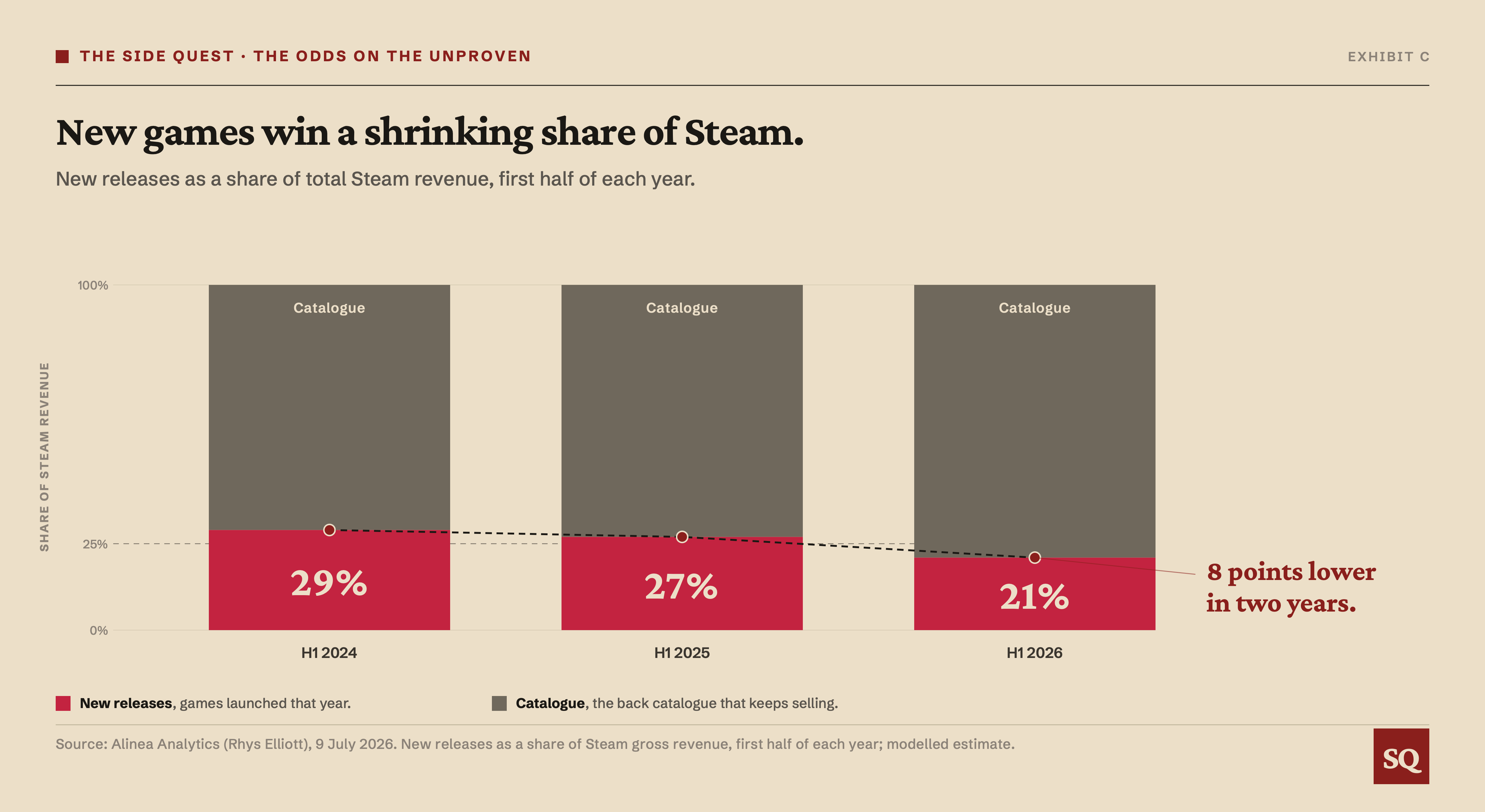
The funds are not wrong to wait, because the odds on anything unproven are poor. Alinea Analytics estimates that games released during the year captured 29% of Steam’s full-game revenue in the first half of 2024, 27% in the first half of 2025 and 21% in the first half of 2026. The back catalogue took the rest.
On mobile, by his account, it is harder again, with almost all of the money going to games that already exist and next to none to anything new. Waiting for proof is how a fund stays out of the games that will not work. It also means the money collects around the games that have already shown what they are, and never reaches the phase where showing it is the hard part.
The fund nobody will build
The fix Della Rocca has in mind is to pay for the missing phase directly, and to do it by buying an option rather than backing a game outright. A small amount goes to the developer, enough to hire an artist and a programmer, build a rough prototype, make a trailer and put up a Steam page. The fund then waits to see how the market responds. “If reaction’s good, okay, then we double down,” he says. “If reaction’s bad, or just flat, then... we don’t exercise our option to continue, and you owe us nothing.”
He would run it as two phases of a fund. The first is small and expected to lose money, since its whole purpose is to place those options on games a partner judges promising before there is data to confirm it. The second commits the real capital once a prototype has proven itself, on the clean revenue-share terms the funds already offer. The closest thing that exists is Polden Publishing, which improves a game’s store presentation, pushes it out through creators and signs games that reach its public threshold of 30,000 wishlists. But developers generally arrive with a build, so it does not finance the full journey from idea to evidence.
None of that solves the problem for a developer who cannot self-publish, which is the other half of what Della Rocca would add and the half his own fund does not provide. Some others do. WINGS explicitly helps teams self-publish, including release strategy, marketing execution, business development and platform relationships. Outersloth offers advice and introductions, though it makes clear that it is not a full-service publisher. Della Rocca’s version would combine that support with broad prototype finance, public market testing and a dedicated follow-on cheque for the projects that work.
No scaled vehicle he identified combines all of those pieces in exactly that form. It needs capital that will accept losing a fixed share of itself by design, and conventional investors are reluctant to do that. Della Rocca’s defence is that the losses are the method, that you need ninety-nine failures to reach the one game that pays for them all. It is an intentional failure machine, and what he has not worked out is how to sell that to the people with the money. “How do I make an [intentional] failure machine sound investable?”
The audience is the asset
What carries a studio from one game to the next, in Della Rocca’s telling, is the audience it keeps: its Discord, its mailing list, the following that turns up for whatever it makes next. That audience survives a hit and gives the game after it somewhere to start, so a studio that holds its fans is bigger by its third or fourth game than its headcount would suggest, and bigger again with each game that reaches an audience already waiting for it. The project funds sit easily with this. A fund that only supplies the money and takes a share of the result has no cause to get between a studio and its players.
The offer a publisher makes is a real relief to take, since it lifts the marketing and the streamers and the press and the launch off a developer who would rather be building the game, and a studio that accepts it is not being naive. Della Rocca argues that the trade-off is that the arrangement can build the publisher’s audience more visibly than the studio’s. He makes the case through the publisher he admires most, Devolver, whose terms he considers fair, whose studios he says are well looked after, and which is as good at its work as anyone in the business. That, he says, is exactly why he calls it the worst.“Because they’re so good, nobody knows who you are.”
He demonstrates it with a test that catches even the people who should know the answer. Cult of the Lamb is among the biggest games Devolver has released, and a room full of developers, asked who made it, may not be able to say. It was Massive Monster, in Melbourne. Della Rocca’s interpretation is that much of the recognition accrued to the game and publisher rather than to the studio brand, potentially leaving Massive Monster less able to carry that audience into its next release. It is an argument about where recognition accumulates, not a literal claim that Devolver owns the studio’s audience.
Hollow Knight came out of the same country, and most people who follow games can tell you Team Cherry made it. In Della Rocca’s telling, that name gives the Adelaide studio an audience the next game arrives already holding. Della Rocca is not against publishers. He is for the studio keeping the direct relationship with the players who may buy its next game.
What it comes to
The funds are a real expansion of the financing menu, and a developer taking one can often keep company ownership, IP and creative control while raising the money needed to finish a game. They have not solved the earliest funding problem at scale. Some vehicles do fund concepts and prototypes, but the period before a convincing build or audience signal remains thinly and selectively financed. A studio still bridges it with its own savings, consulting income, a grant if its country runs one, an incubator place if it can get one, revenue from an earlier game, or months of unpaid work.
For a developer, that puts a hard edge on the advice Della Rocca gives, which is to reach evidence as efficiently as possible and to hold on to the audience it brings. Reaching evidence means treating the trailer and the Steam page and the wishlist campaign as part of making the game, since much of the later money will not come until they exist. Holding the audience matters because it is one of the few assets that survives a game and carries into the next, and once the direct relationship has been handed to a publisher, it is slow and expensive to build again.
For the funders, the gap is a thin and under-served part of the market. The risk sits in the phase before a game has evidence, and a fund that moved there could back winners before the wishlists made them obvious. It would also lose money on most of what it backed by design, and conventional investors are reluctant to accept that. So the work keeps falling to grants, incubators, studios with consulting income, and developers able to fund themselves, and none of those reaches every creator or every country.
At the end of the day, Della Rocca continues to push developers to build sustainable studios that can create amazing games for adoring fans all over the world.
More from The Side Quest
Microsoft and Xbox: Separable, but still staying Microsoft has done everything you would do before selling Xbox. We priced seven ways of doing it, and every one it can execute itself is worth less than doing nothing.
AppLovin vs Unity: are two of the market’s favourite ad engines worth it? We read the job postings on both sides of this market, the ad networks and the studios that buy from them, to test whether AppLovin’s and Unity’s ad-engine growth is worth what the market pays.
Epic Games: what is it worth, and what did the generosity cost? Fortnite pays for four free layers. The cash Epic captures is worth about $7.5bn; the tools it under-monetises lift fair value toward $14bn, and the last mark sits in between.
Roblox: A great company lost on valuation - It owns the most complete stack in interactive entertainment yet profits from it the least, and rising costs are eating into what little is left.
Microsoft and Xbox: Too small to sell, too strategic to spin - On the numbers, Xbox is worth about $49bn, a rounding error to Microsoft. It won’t be sold, and any separation keeps a grip on the data its games generate.
AI in Video Games: Own the Loop - why a studio keeps its value only if it owns the content-generating learning loop, not the model. Uses Guild Wars 3 as a worked example.
AI won’t make AAA games materially cheaper to develop - the productivity gains are real, but two-thirds of the value leaves the P&L to the AI vendors before it reaches the bottom line.