


TL;DR
Jen MacLean has been in games since she tested Civilization II, and now runs the small studio Dragon Snacks Games. She describes an industry that “swings wildly from one extreme to another,” over-building when money flows and cutting in “panic” when it stops. The swing is structural to public video games companies, with leaders who have lived every cycle still over-hire into a rising share price and cut into a falling one, and the buybacks and dividends land in the same years as the layoffs.
The money that funds games has both shrunk and changed shape. Venture capital retreated to ‘completion funding’ that locks out anyone without personal runway, publishing terms hardened, and the equity that stayed re-narrated itself around AI. Inside games, the bankable use of AI is on the cost side, automating the work engineers hate, not the generative gameplay the money chased.
You cannot allocate your way to a hit, and you cannot reliably pick one, so the rational move is to minimise the capital at risk and outlast the swing. That is why the studios that last are small and private, off the share-price signal, and why a market that now prices a breakout at $50 or a viral hit at the cost of a coffee rewards spending little to find out what works.
Watch the full interview with Jen MacLean below.
The cost base always arrives a cycle late
MacLean’s first reference point for the games cycle is a supply-chain exercise she played in business school, where teams forecast orders without information and “swing wildly from one extreme to another.” That, she says, “is very much what’s happening in the games industry, and what has consistently happened.”
When money is good the industry moves to “overproduction” and “over-investment”; when it turns, the reaction is “almost in panic.” COVID was the most recent swing. Demand spiked as people locked down, studios scaled to meet it, and then demand normalised while the cost base kept climbing and had to be cut. She points to 2008 as the same shape a cycle earlier.
Part of why the cost base overshoots is that nobody can price the building. MacLean quotes an executive she worked with at Xbox who told her the industry is “used to production methodologies best suited for a two-story house” and now finds itself “making skyscrapers that are mixed use.” The methods that worked at one scale do not carry to the next, so budgets get set against a structure the studio has not built before and cannot fully estimate.
Why the public companies cannot stop
The leaders running the public companies have all been through this before. MacLean names Andrew Wilson at EA and Strauss Zelnick at Take-Two, and the overreaction comes anyway. “It is very difficult to avoid that overreaction,” she says, “when you have shareholders who are saying, hey, why isn’t your stock price up?”
Whilst a public company allocates against its share price, a private one can allocate against a set of accounts it controls, and MacLean reads the difference in who has built the studios that last. She points to Supergiant and Larian, run by people who have "gone through the ups and downs" and hold what she calls "a real sustainable studio mindset," without a listed company's shareholders, or its share price, to answer to.
The reflex is legible in the cash flow statement:
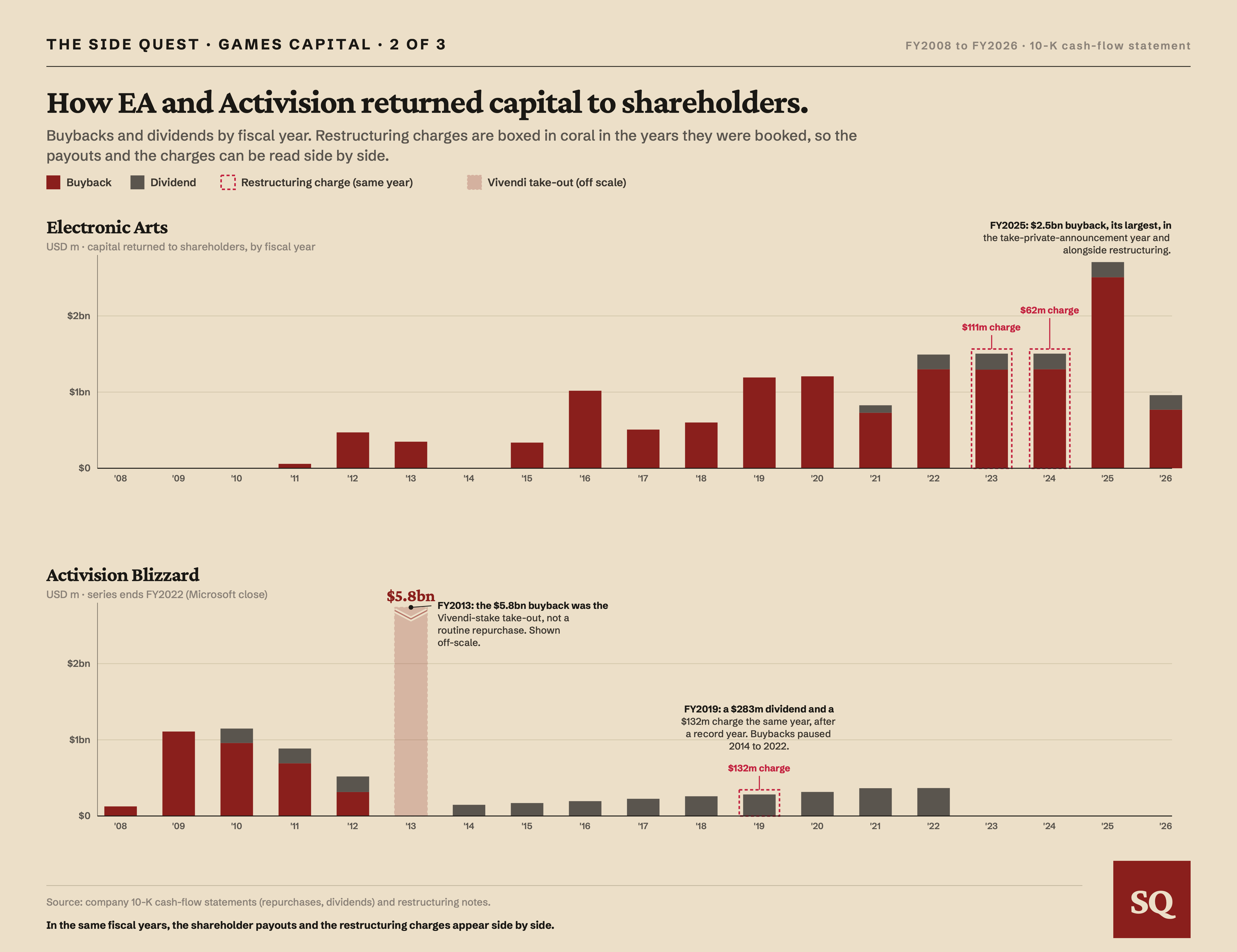
A buyback is management stating that its own shares are the best available use of the company's cash, and EA was making that statement across the same years it was cutting staff and booking restructuring charges, returning billions to shareholders through repurchases, including $2.5bn in FY2025. Activision returned its cash a different way and after reporting a record year it cut roughly 800 roles, about 8% of its staff, in February 2019, while paying a $283m dividend. Its one large buyback had come years earlier, in 2013, to buy out Vivendi's stake.
Who gets to start now
The money that used to fund new studios has not just shrunk, it has changed shape. MacLean describes venture investors pulling back from equity and moving to “completion funding,” which pays only once a game is 12 to 18 months from launch. She does not think that is a bad model in itself, and says that as an LP she would prefer it. But it constrains who can start. To reach the point where completion funding is available, a founder has to survive the first half of development on personal runway, which means being “independently wealthy” or building the game as “a second or third job.”
It has also repriced pedigree. In the 2020-21 boom, MacLean says, venture money would back someone on the strength of a marquee name on their CV, Riot, Blizzard, EA, even where they had been “one of many” rather than leading a project or delivering a game. She is blunt that “a credit on a game from Blizzard does not mean you are going to be a good entrepreneur,” and that leading a design team inside a big studio is a different discipline from setting one up. What has replaced that confidence is a rule she repeats: “it doesn’t mean a thing until the check hits the bank.” Dragon Snacks had a publisher that could not honour its term sheet once the publisher’s own funding fell through.
The terms on offer have hardened too. MacLean divides the work a publisher does into commodity tasks, localisation and compatibility testing, where “players only notice if it’s really, really bad,” and the parts that genuinely move a launch, chiefly marketing, which changes “month to month” as storefront algorithms shift. What worries her is the newer publishers who fund none of the development but still take a permanent cut. “If someone says, I’m gonna take 10% of net, and I don’t have a cap,” she says, a hit could mean “paying tens of millions of dollars for somebody doing marketing for a launch,” which she calls predatory.
The one input that has genuinely got cheaper is talent, because the map has widened. MacLean now looks to hire concept art and specialist work from Southeast Asia, Central Europe and Latin America, places a studio “never would have looked” five years ago. That is good for a small studio’s economics and hard on the people it used to hire; she notes that North American developers in high cost-of-living areas have been hit hardest by the cuts.
The money re-narrated itself as AI
Follow the venture money and it has not so much left games as relabelled itself. In February 2022 the London firm Hiro Capital sponsored a metaverse-themed blank-cheque company, Hiro Metaverse Acquisitions, and listed it in London. It never completed a deal, and was delisted two years later with its shares redeemed. Twenty-two months after that, Hiro re-emerged as an AI-first fund, with the former Meta executive Nick Clegg as a general partner and Yann LeCun advising, and gaming demoted to the fourth of its four themes.
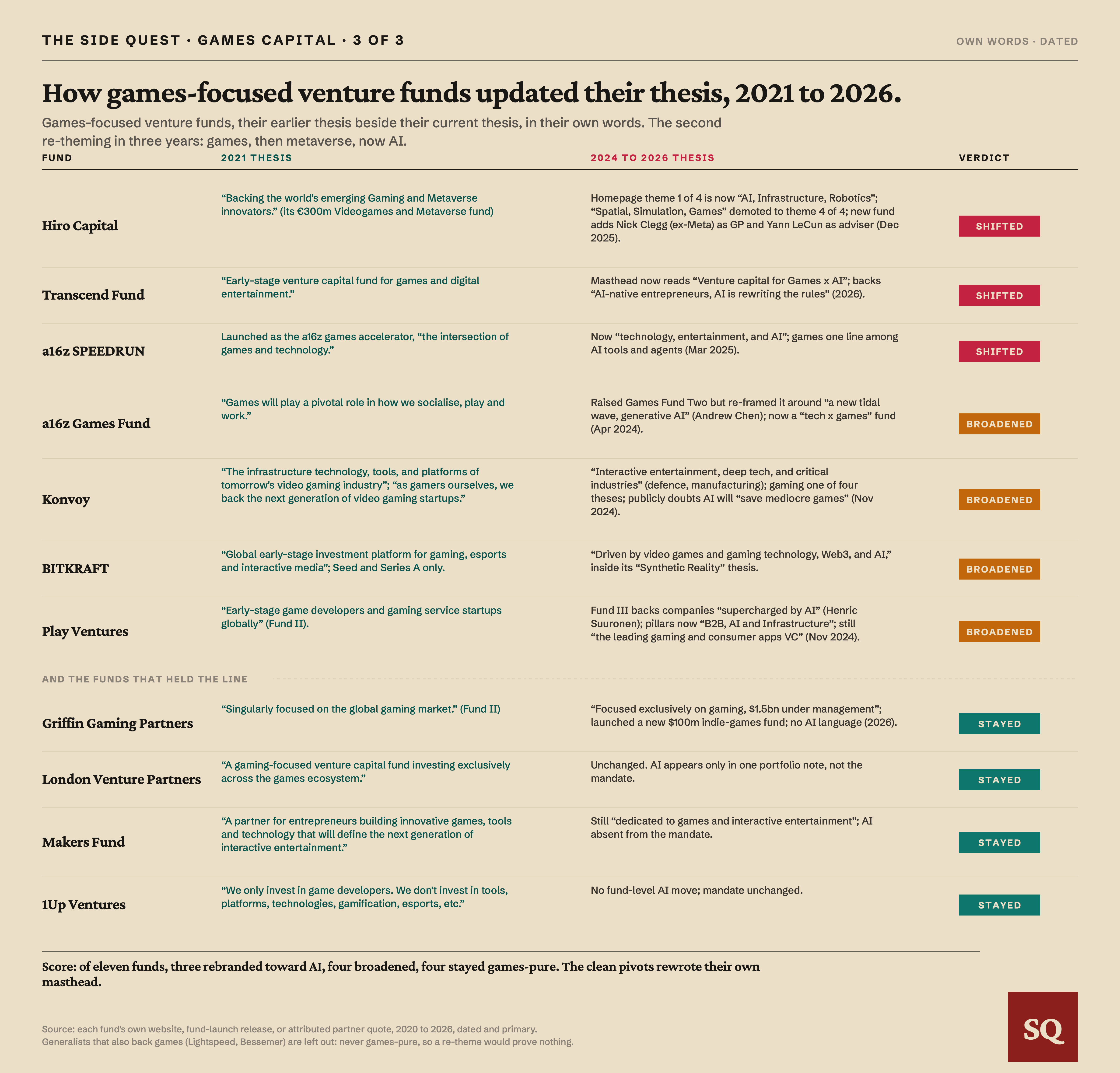
a16z’s games accelerator now bills itself around “tech, entertainment and AI”; generalists that ran gaming summits in 2022, such as Index Ventures, now say more than half of recent money goes to AI. The honest reading is not that these funds abandoned games. but rather, it is that games venture, like the studios it funds, chases the prevailing story, metaverse in 2021 and AI now, more than it backs a settled conviction. Konvoy, a gaming fund that publicly doubts AI will “save mediocre games,” is the reminder that the turn is not universal.
What the capital chased is not what has actually paid off inside games. MacLean has promised Dragon Snacks players they “will not see generative AI” in the game, and the studio keeps it entirely away from anything player-facing. Where it uses AI heavily is on the engineering side, on “the tasks that no one wants to do.” Automating the build process freed the studio’s lead engineer to build peer-to-peer networking for 16-player sessions that only has to store a world state rather than run a server for every game instance, which lowered cost and improved the experience at the same time. The generative gameplay that drew the funding she is wary of, calling it “so nascent” and warning that people “confuse environments with gameplay.” A model can generate a town to walk around, “but walking around a town is generally very not very fun” without the designers who make it worth the walk.
You don’t need to be big
MacLean’s own answer to the cost problem is to reject the premise. The question, she says, is not whether a studio should stay small but “do you need to be big?” Over the last year small teams have sold millions of copies of games that are nowhere near AAA polish and were never meant to be, to a generation that “grew up on Roblox” and “care if it’s fun,” not whether it is polished. She is careful about survivorship: the successes get talked about and the far larger number of failures do not, and “anytime your strategy is expecting something to go viral, it is deeply flawed.”
She is impatient with the annual story that Steam is drowning in new releases, because most of those games were never commercial in intent, someone deciding to “fool around in Godot” (the free open source game engine) and sell fifty copies to friends and family. The count of games built for commercial success has risen slowly, not at the rate the headline suggests. A studio “can absolutely hit a fluke out of the park,” she says; doing it “consistently” is “much, much harder.”
The constraints she expects over the next three years favour the small and the cheap. Hardware is expensive enough that more players will stay on the machines they already own, which suits a studio like hers with no photorealistic art style. Regulation aimed at how teenagers talk to strangers online, already moving in the UK, could reach the games industry, and she hopes it “holds a mirror up to us and forces us to prioritize people over profit,” while adding that she is “not confident it will.”
The market is repricing what a game is worth, and that sets the ceiling on what a studio can spend to make one. MacLean points to Clair Obscur: Expedition 33, priced just below the $70 tier at $50, which she thought “an incredible bet,” because to a player anchored on $70 it “sounds like a bargain.” The cheap co-op hits she calls “friendslop” sell for the price of “a coffee at Starbucks,” an impulse buy. A $70 game, she thinks, increasingly has to be a GTA to justify itself. Everything below that is now made, and priced, by studios that keep what they spend inside what the market will pay for it.
More from The Side Quest
Epic Games: what is it worth, and what did the generosity cost? Fortnite pays for four free layers. The cash Epic captures is worth about $7.5bn; the tools it under-monetises lift fair value toward $14bn, and the last mark sits in between.
Roblox: A great company lost on valuation - It owns the most complete stack in interactive entertainment yet profits from it the least, and rising costs are eating into what little is left.
Microsoft and Xbox: Too small to sell, too strategic to spin - On the numbers, Xbox is worth about $49bn, a rounding error to Microsoft. It won’t be sold, and any separation keeps a grip on the data its games generate.
AI in Video Games: Own the Loop - why a studio keeps its value only if it owns the content-generating learning loop, not the model. Uses Guild Wars 3 as a worked example.
AI won’t make AAA games materially cheaper to develop - the productivity gains are real, but two-thirds of the value leaves the P&L to the AI vendors before it reaches the bottom line.
Appendix:
The three exhibits are built from primary filings only: annual reports (Form 10-K for the US companies, universal registration documents for Ubisoft), results releases, and the venture funds’ own published statements. No third-party financial trackers are used as load-bearing sources. The full workbook is available on request.
A few conventions apply across the exhibits:
Demand is measured two ways: “Net bookings” is each company’s own non-GAAP or non-IFRS metric, roughly reported revenue adjusted for the movement in deferred revenue, which captures cash-basis sales including the deferred portion. Companies only began disclosing it around FY2018 to FY2020, so the deeper history runs on reported revenue instead. Both lines are shown, indexed to each company’s base year, so the comparison is of shape rather than absolute level.
The revenue-standard break: All four companies adopted the new revenue standard (ASC 606 in the US, IFRS 15 for Ubisoft) around FY2018 to FY2019, on a modified-retrospective basis, meaning they did not restate their earlier years. The demand line therefore steps at that point, and the exhibits mark it rather than splicing across it.
Currency: Ubisoft reports in euros; EA, Activision and Take-Two in US dollars. Figures are not converted, because each series is read for its own trajectory, indexed to its base year.
Filed versus reported: Where a figure is a company disclosure it is stated plainly. Where it is press-reported context, for example a round headcount-cut number the filing does not itself give, it is flagged as such below.
Exhibit 1: headcount against demand
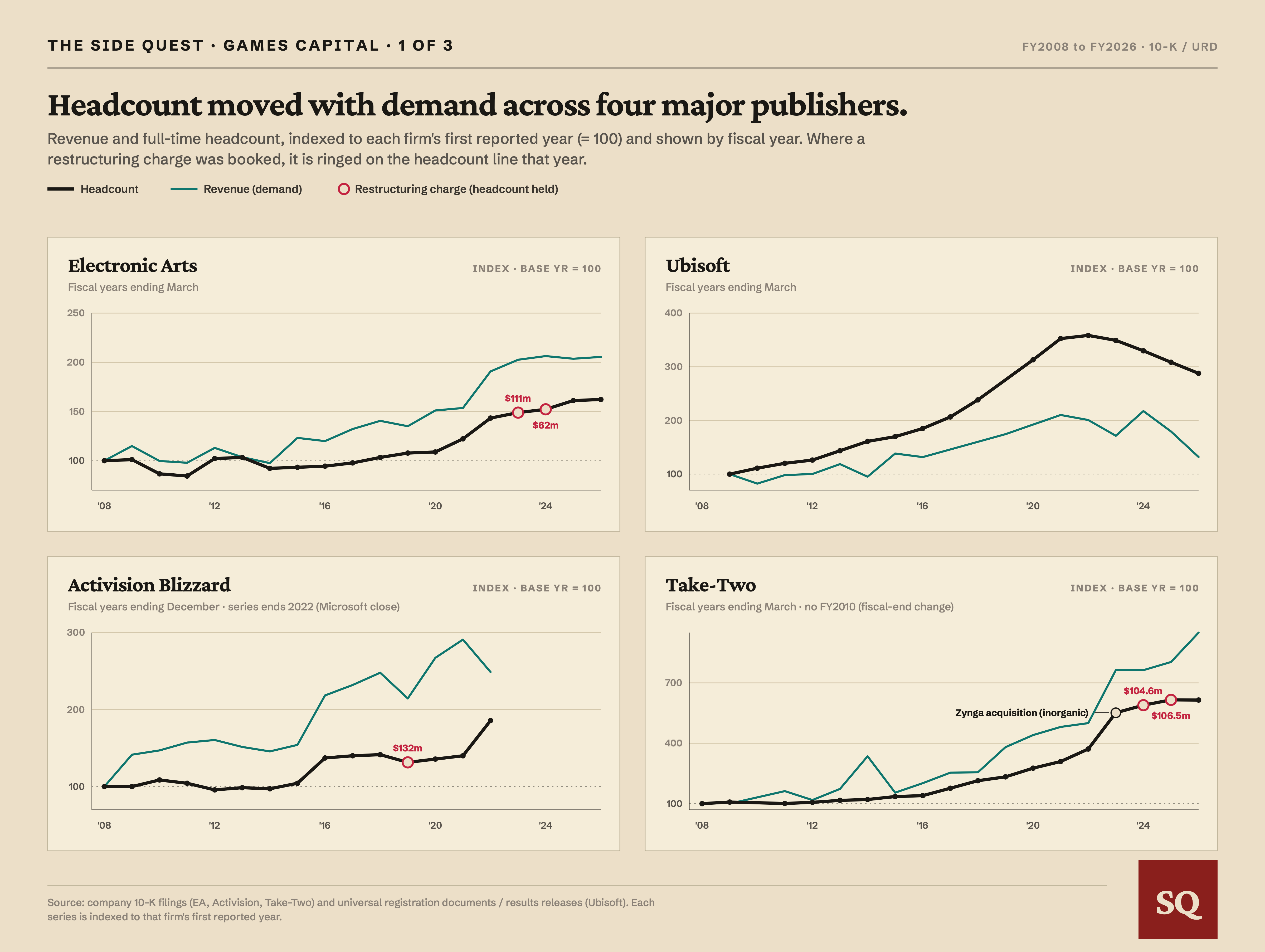
Headcount is period-end total employees as each company states it in its annual filing. The important caveat is that a rising headcount line is often a corporate action or a change of definition, not organic hiring, and this differs by company.
Activision Blizzard: Two of its steps are not organic growth. The 2016 rise, from about 7,300 to 9,600, is the acquisition of King. The 2022 rise, from about 9,800 to 13,000, is largely a reclassification: the FY2021 filing counts “approximately 9,800 full-time and part-time employees”, while the FY2022 filing counts “approximately 13,000 full-time and part-time non-temporary employees”. The word that appears is “non-temporary”. Through 2021 and 2022 the company converted temporary and contingent workers, chiefly quality-assurance testers, into permanent staff, and those converts enter the count. The FY2021 filing flagged the start of it, “the conversion of approximately 500 temporary workers to full-time employees at our Activision studios”, and the North American share of the workforce rising from 68% to 72% is consistent with US-based conversions. The two years are therefore not on a like-for-like basis, and the increase should not be read as 3,200 net new roles. The 2019 dip, from about 9,900 to 9,200, is the February 2019 reorganisation, roughly 800 roles, after a record year. The series ends at FY2022, the last full year before the Microsoft acquisition closed in October 2023.
Take-Two: The 2023 rise, from about 7,799 to 11,580, is the acquisition of Zynga, which closed in May 2022. It is an inorganic addition, not organic growth.
Electronic Arts: is the counter-case: its total headcount rose across the whole period, and reported revenue actually outgrew it. The workforce reductions of 2023 and 2024, a cut of about 6% announced in 2023, show up as restructuring charges, about $111m then $62m, rather than as a fall in the total, because they were offset by hiring elsewhere.
Ubisoft: Headcount is the period-end worldwide count reported in the annual report. Two notes apply. First, the definition was broadened in FY2013 to include game testers, so the figures on either side of 2013 are not strictly on the same basis, and the exhibit marks that break. The later change of label from “Effectif” to “Total headcount” is a translation, not a change of basis: the two carry the same period-end worldwide definition, and the FY2024 and FY2025 registration-document figures equal the results-release figures of 19,011 and 17,782 exactly. Second, the workforce climbed on real hiring, the 2019-20 document frames it as a “high volume of recruitment”, to a peak of 20,665 in FY2022, then fell to 16,590 by FY2026, a reduction of 4,075, or about 20%. Ubisoft is the one company of the four whose recent decline is a genuine net reduction in headcount rather than a corporate action or a change of definition.
Exhibit 2: capital returned to shareholders against layoffs
This exhibit sets what each company paid out to shareholders, share repurchases and dividends from the financing section of the cash-flow statement, against the years it was cutting staff, measured by restructuring charges and dated reductions. Two clarifications matter.
Activision Blizzard: In the reduction year of 2019 the company did not buy back stock at all; it had paused repurchases from 2014 to 2022. The capital it returned that year was a dividend of about $283m, paid alongside a restructuring charge of about $132m and the roughly 800-role cut, after a record year. Its one large buyback, about $5.8bn in 2013, was the repurchase of Vivendi’s majority stake, a one-off ownership transaction rather than a signal about the share price, and it is labelled separately.
Electronic Arts: EA is the clean case. In FY2025 it repurchased about $2.5bn of its own stock, its largest single-year buyback, and paid a dividend of about $199m, in the same year it booked restructuring charges. The step up followed a new $5.0bn repurchase authorisation in May 2024, which replaced the earlier $2.6bn programme; buybacks had run near $1.3bn a year before it. EA then suspended repurchases the following year in contemplation of the merger, which is why FY2026 falls to about $769m. The relevant cash-flow line is “repurchases and excise taxes paid”, so it bundles the buyback with its excise tax rather than being pure repurchases. The Saudi-led take-private was announced in September 2025 but had not closed as of the FY2026 annual report, so EA remained a listed company through the series.
Exhibit 3: the venture money
The table records how games-focused venture funds described their own investment thesis in 2020 to 2021 against how they describe it in 2024 to 2025, in each fund’s own words, taken from its website, a fund-launch release, or an attributed partner statement, each dated. Funds are sorted into three verdicts: “shifted” (rebranded toward AI), “broadened” (added AI as a pillar while keeping a games fund), and “stayed” (games-pure, unchanged).
Two points keep the exhibit honest. First, the pattern is not universal: for most funds that moved there is a same-scene peer that held the line, and the table shows both. Second, “AI” is the second re-theming in three years, not the first. Several of the same funds and portfolios were sold as “metaverse” or Web3 in 2021 before being sold as AI in 2024 to 2025, which supports reading this as capital following the prevailing narrative rather than a settled conviction.
Caveats: The two generalist firms in the table, Lightspeed and Bessemer, were never games-pure, so they represent a de-emphasis of gaming in their public content, not a fund-level pivot, and are marked as texture. Two individual cells, Konvoy’s 2020 to 2021 wording and a16z’s “generative AI tidal wave” line, are attributed to secondary or undated sources and should be read as such. Fund-size and portfolio-mix figures, where mentioned, come from third-party trackers and are not primary.
On figures and estimates
The following are press-reported or estimated context, not company disclosures, and are flagged where they appear: the roughly 800 Activision roles cut in February 2019; EA’s roughly 6% workforce reduction announced in 2023; and the roughly 1,100 quality-assurance testers Activision converted to full-time in 2022. The underlying charges, dividends, buybacks, headcount totals and net bookings are taken from the filings.