


TL;DR
Executives at listed games companies have said a great deal in public about artificial intelligence since the start of 2023, and almost none of it carries a figure for what the spending is or what it has returned. Luke Dicken, who ran the AI team at Take-Two until it was dissolved in April, points out that the same investors were asking about the metaverse before that, and about crypto before that. The question he thinks is going unasked is how much the generative tools multiply against how much they cost, since a tenfold gain does not survive a twentyfold price rise.
Nothing generative has yet been shown to make a player spend more or stay longer, so what the tools return comes down to what they save inside the studio, and on his account the studies that would settle that are not being run because conviction removes the reason to look. He also thinks the conduct of the firms selling these tools tells you more, since a production advantage that was real and durable would be hidden rather than marketed.
He does not expect today’s price for frontier models to be the one studios end up paying, since what is charged now is set while the model providers compete for position. What worries him is the studio that has built the tools into a pipeline by the time that changes, which is a version of something games has been through once already, when Unity changed its terms on developers with years of work sitting on the engine and then had to roll it back.
He puts the spending down to the market rather than to the evidence, since a listed company is expected to have an AI story whether or not AI has an impact on its result, and thinks the studios most free to decline are the private ones that owe no public shareholder an answer. His own estimate of the size of it is that the industry absorbs these tools roughly as it absorbed Maya, and what he would have an investor look for instead is the odd, unfashionable bet that consensus money will not take.
Watch the full interview with Luke Dicken here and highlights below:
Opening
Since the start of 2023 the executives running listed games companies have said a great deal in public about artificial intelligence, and the volume has risen every year since. What almost none of it carries is a figure, for what the spending is or for what it has returned.
Luke Dicken ran the AI team at Take-Two until April, when the group was dissolved. He had founded it at Zynga in 2019 as a research outfit working on the older and less fashionable kind of AI, the algorithms that have sat inside games for decades, and inherited responsibility for governing generative AI across the company when ChatGPT arrived and every large corporation on the planet suddenly needed a position on it. He works independently now. Much of what follows would have sounded contrarian to an investor two years ago and no longer does, which is a change in the audience rather than in him: “Pragmatically, AI is not something you get to just write off. But equally, it’s not the silver bullet that the headlines and the press releases want you to believe it is.”
What has not caught up is the arithmetic. The question he thinks is going unasked comes down to a ratio. “You need to know whether it’s 100x, or is it 10x? Because if your cost goes up 20x and it’s giving you a 10x impact, get rid of it. If it’s genuinely 100x and it goes up 20x, great, that’s still upside.”
Neither term of that ratio is currently known. The benefit has not been measured, and Dicken does not expect today’s price for frontier models to be the one studios end up paying.
The AI question replaced the metaverse question
Asked whether AI delivers the cost and time efficiencies it is credited with, Dicken quickly chimed in. “I’m jumping down your throat, and I don’t intend this as hostile as it’s maybe going to come across, but they’ve not always been asking you that. They’ve been asking you that for the last three, maybe four years. Before that, they were asking about metaverse. Before that, they were asking about crypto.” His objection is to where the question comes from. “It speaks to this kind of groupthink that has seized a lot of people... it’s easier to grab onto a trend than it is to actually think critically.”
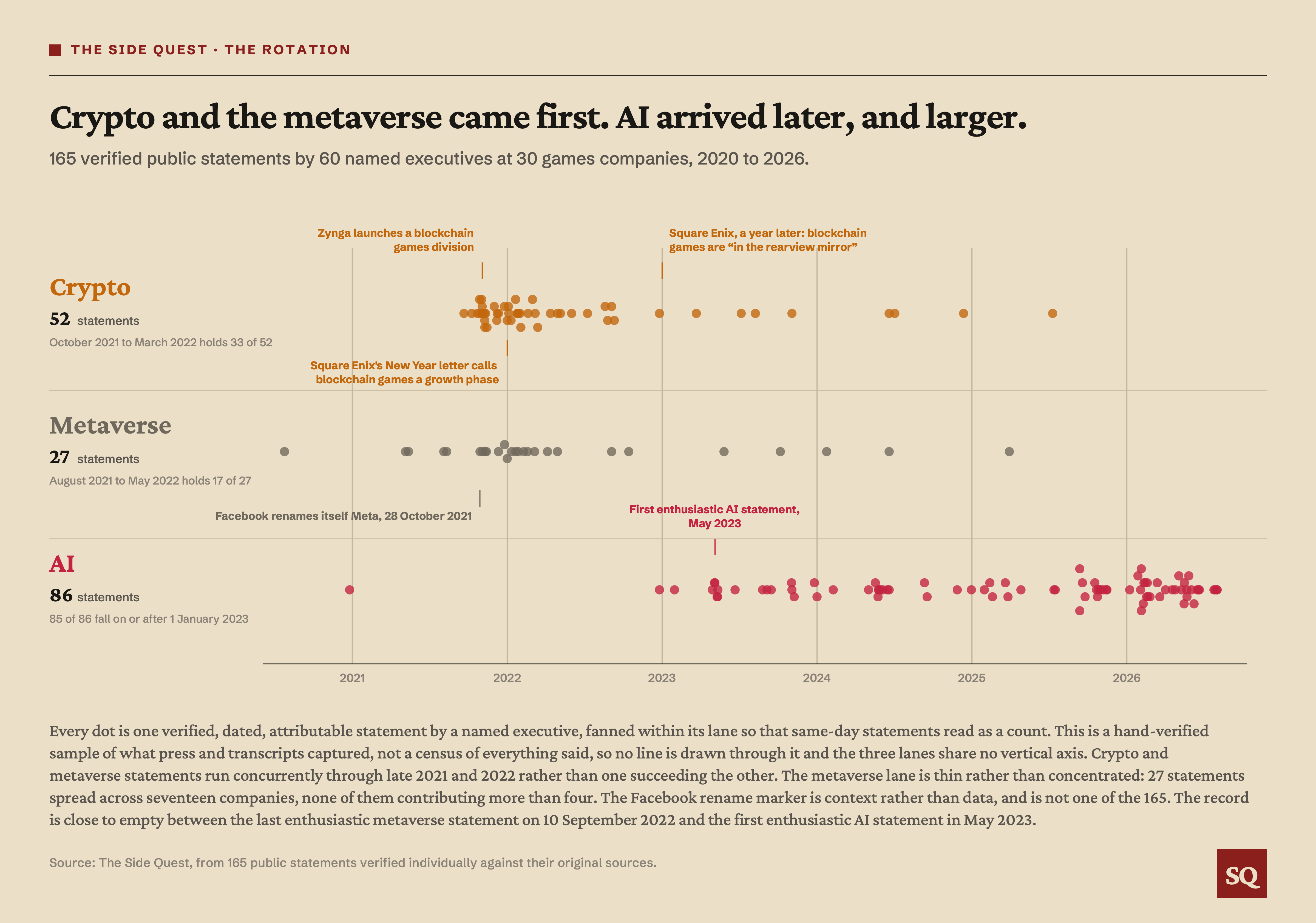
What carries across is the conversation rather than the technology, and the same people conduct it each time. In November 2021 Take-Two’s chief executive dealt with the metaverse by taking the word apart and then claiming the thing underneath it. “If you define metaverse as ‘everything we do in the world physically will become digital,’ then you’re talking to a skeptic... But if there is a metaverse company out there generating real revenue and real earnings, that would be us.” Fifteen months later, he opened on AI the same way. “There is no such thing as artificial intelligence. All that said, I’m really excited about what we’re seeing right now with ChatGPT.”
What Dicken objects to is what the question has displaced. “It’s not like, how is this defensible? How is this novel? What have these folks come up with that nobody else has come up with? It’s like, well, where did they crowbar an LLM into this thing?” A company can answer where its AI is without producing a number, and cannot answer what it has earned without one.
Nothing has shown up on the player side
There are two notable games that were found to have shipped with generative assets. The Alters, from 11 bit studios, left AI-written text visible on an in-game monitor and ran AI-translated subtitles without disclosing either. Clair Obscur: Expedition 33 had placeholder textures survive into the final build, and was stripped of two Indie Game Awards two days after winning them. Both reviewed well, both sold, and neither studio has reported a commercial consequence. “Did it impact performance from a business point of view? Arguably, not meaningfully.”
That is about as close to a test as the industry has run. In both cases the work shipped, the audience found out afterwards rather than objecting on sight, and the complaint that followed was that neither studio had disclosed it. Dicken reads the reaction as being about intent rather than quality, and thinks the players making that inference are frequently right. “They see the use of generative AI as an abdication of intentionality, as an abdication of authorial intent. And consequently they assume, in a lot of cases rightly, I’ll caveat the hell out of what I’m saying here, but in a lot of cases rightly, that’s a pervasive abdication of authorial intent.”
He does not think the objection is evenly spread across markets. “Western audiences, so North America, Europe, seem to be more strongly anti-generative. And anecdotally, what I’ve heard is that Asian audiences are more accepting and more tolerant of this stuff.” Dicken believes it’s possible the only evidence of the negative generative AI sentiment could be from a small group of people: “The internet’s not representative of the mass audience. So to what extent is the anti-GenAI sentiment mainstream versus vocal minority? I don’t have an answer to that.”
The revenue side has not been tested at all, because nothing has shipped that could test it. The most visible demonstrations have been Nvidia’s, built around characters a player can ask anything, and on Dicken’s reading they mistake what a game is for. “Games are curated experiences. When you look at a dialogue tree and there’s three options, yeah, you could make that 50, 100, we could have made it 100 options without generative AI... you’ve got 100 options, but only two of them get you to where you actually are trying to go. Adding more options is not the answer.” The companies that pursued it hardest have gone quiet, Inworld among them, and asked what the winning application looks like instead he declined to say. “Today, I can’t say, ‘this is the answer’, and if I did, wouldn’t say it out loud right now.”
So the commercial cost of being found out has been tested twice and came back at roughly nothing, and the revenue from a generative feature players actually pay for has never been tested because nobody has yet built the thing that would produce it. Neither direction has moved, which leaves the case for the spending resting on what it saves inside the building.
Nobody has measured what it does
Productivity claims about these tools arrive in round numbers, ten times faster, a hundred times faster, and almost never with a method attached. Establishing what a tool does to creative production means running the same work twice, once with it and once without, which no studio in the middle of a project can afford to do, so what reaches an executive team is generally somebody’s impression of their own week. “I often see people throwing around, like, oh, my engineers are 100x engineers because of Claude Code.”
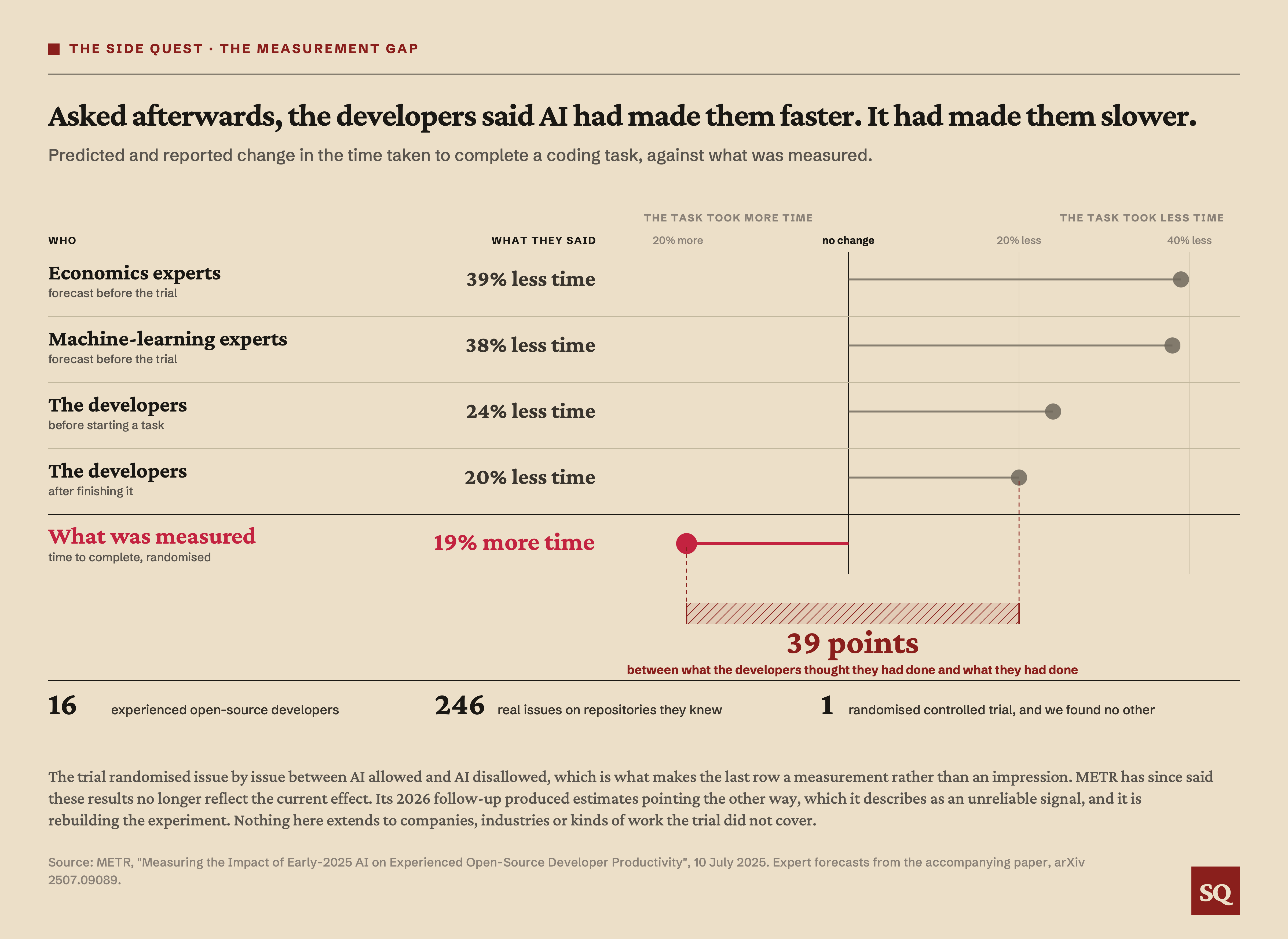
One team has tried to measure it properly, and found its developers slower with the tools and convinced they had been faster. It has since concluded that it cannot run the experiment at all, because the people it needs will not work without AI even for money. “Individuals are not necessarily reliable narrators of what the impact is,” Dicken says, “so you need to be quantifying objectively, and very few people want to run those case studies.”
His explanation for why better evidence has not arrived is that conviction removes the reason to look for it. “If you’re a true believer, it’s so obvious that it’s having this massive impact, that why would you run a case study? Why would you spend the time?”
There is a stronger reason to doubt the claims than the absence of measurement, and it comes from what the companies making them do rather than from what they say. A production advantage that was real and durable would be the most valuable thing a studio owned, and the ordinary way to hold one is quietly, letting the output make the argument on its own. “If any of this shit actually did what people are billing it as, they would not be talking about it,” Dicken says. “These would be protected like the crown jewels and Fort Knox combined.” What the market has instead is a large number of firms selling access to the advantage rather than compounding it themselves, which is a trade with a long history and a well-known shape. “It’s like the guy sat here telling you that there’s a gold rush going and you need to get in on the gold rush, buy my pickaxe. The guy should be selling you the gold if he’s actually got the gold.”
The price of frontier models is not the real price
The AI Dicken pays for himself came attached to something he was already buying. He wants his email handled by Google, and Gemini arrived inside the subscription that does it. “Gemini is bundled into that right now. They have jacked the price up on me because of all the AI capabilities. But I’m paying for it anyway. I’m cutting my nose off to spite my face if I don’t play with it.” He raises the standalone question himself and leaves it open. “Would I pay for that as an independent product? I’m not going to say definitely no, but I’m certainly not saying definitely yes.” For an individual that exposure is trivial, because leaving costs a cancelled subscription and the work does not sit inside the tool.
For a studio it is a different instrument. A subscription is an operating cost that can be stopped at the end of the month; a pipeline built around a particular model is a switching cost already incurred, and its size only becomes apparent when the price changes. Dicken draws the line in those terms. “Where you bake it into a pipeline, and that pipeline has now rigidity, and you are now vendor-locked to something that you know is going to get its price jacked up.”
Games has run this experiment once. When Unity changed its terms, the developers with years of work on the engine were the ones who could not simply leave, and the campaign they ran forced Unity to withdraw the change. “We’re sleepwalking into that same situation,” Dicken says, and what he points to as different this time is that more people can see the repricing coming.
His reason for expecting it is that today’s price is not covering what the service costs to run, a reading he takes largely from Ed Zitron’s work on the model providers’ economics. He reaches for the obvious parallel while noting that Zitron himself objects to it. “Ed Zitron rails against using this as an analogy, but Uber used their VC funding to acquire market share, undercut taxis, displaced taxis, and once they’d got that market lock-in they started jacking the prices up.” The clearest instance he reaches for is one where the provider stopped rather than repriced. “OpenAI killed off their Sora product, I don’t think they actually disclosed the reason, but the prevailing wisdom is just how unprofitable it was.”
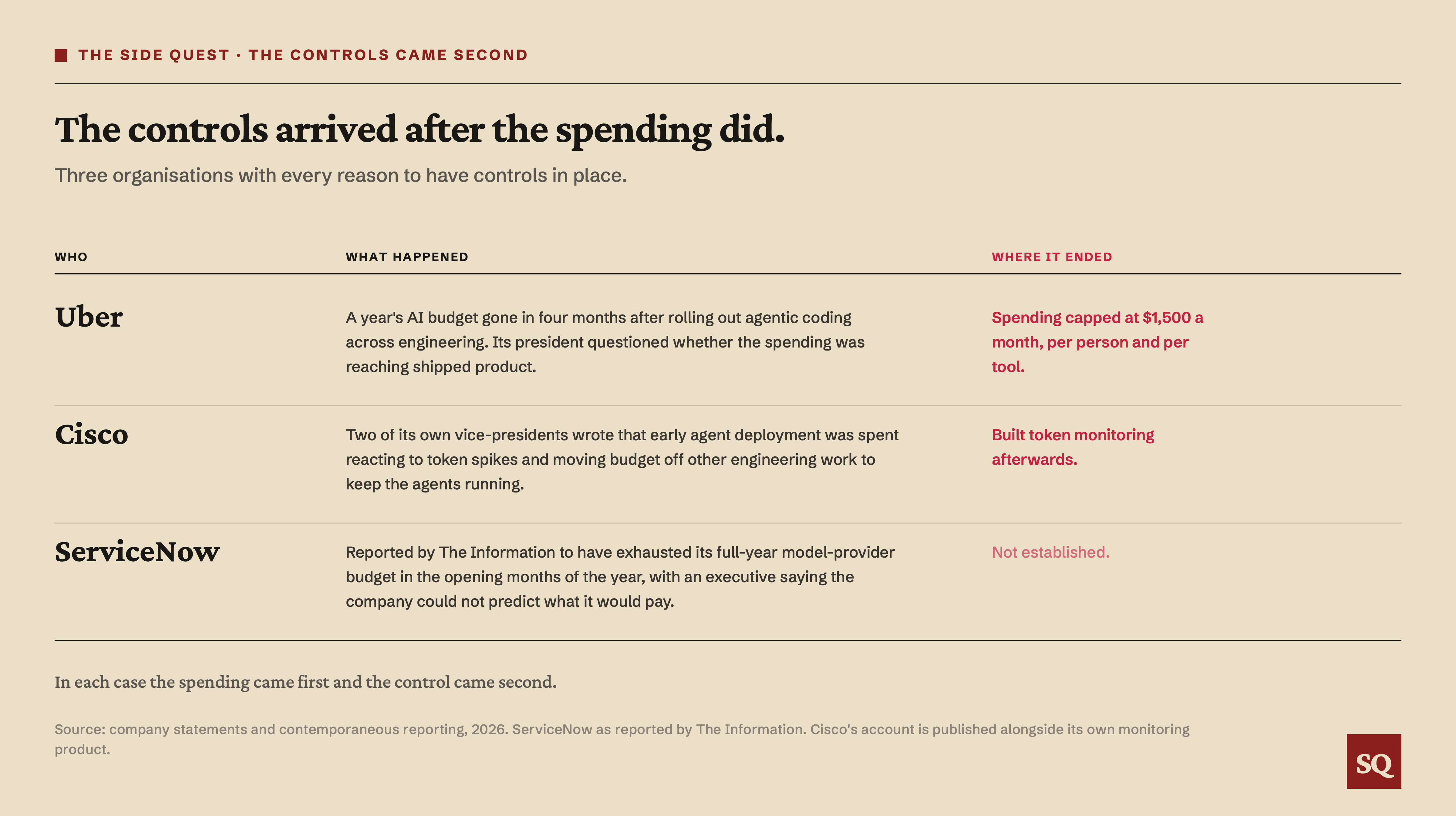
The bill has begun arriving, and not only at companies that were careless with it. In each case the spending ran ahead and the control followed, which is the part Dicken points at. “These are organizations that are supposed to be serious organizations that you would imagine would have guardrails against this stuff.” His explanation is not that any of them is badly run, but that nobody can get the controls up quickly enough. “The FOMO and the newness and the velocity and all of these things are contributing to an environment where you can’t get the guardrails down fast enough to actually prevent some of the crazy.”
That is not an argument for staying away, and Dicken does not make one. What he argues for is knowing the terms before they change. “If you look at it today and say, hey, I’m going to use all this stuff because it’s cheap, and when it gets expensive I know what my ROI is, and I know that I’ve built these pipelines modularly enough that without having to do a whole bunch of rework that I won’t have runway for, I can just sub stuff around, that’s what sustainability has to look like. Because otherwise you just get held hostage.”
What a studio’s data is worth
A studio that has run a live game for a decade holds years of player telemetry, and Dicken’s answer on whether that is worth anything to anyone is yes. “I think the answer is yes, but not for generative. And the conversation is so exclusively around generative.”
The value sits in the older work, the analytics and machine learning that ran on player data long before anything generative existed, and Zynga recruited him in 2014 on precisely that pitch. “Hey, you like all this AI machine learning stuff. We have the biggest data set on the planet... Zynga had been logging telemetry on Facebook before most game studios knew what telemetry was.” That was data science, unglamorous and effective, and on his account it is still where the value is.
The difficulty is one he met doing due diligence on acquisitions. “Even something that you would imagine would be fairly straightforward, installs, let’s say. Somebody installs the app, that’s an install. Later on they’ve left, they’ve gone off, and then they reinstall the app. Is that an install?” Two teams inside one company answer differently, and a buyer acquiring both inherits the disagreement. “Consistency and actually just having a harmonised data set is difficult... somebody’s got to actually sit and harmonise that.” Whoever ends up holding the data pays to make it usable.
Where a provider does offer money for it, he would take the cash and nothing contingent. “I wouldn’t structure it in any way, like, as a rev share. You’re going to give me a check for a thing, and 18 months from now, that thing’s probably going to blow up in your face. Sure, like, I’ll take your money.”
The one deal of that shape in games is Google taking a minority stake in Fenris Creations, the studio that came out of CCP Games, alongside a research partnership with Google DeepMind. What the parties have described wanting is not the years of logs at all. It is Eve Frontier, a persistent single-shard world in which outcomes do not reverse, as somewhere to watch autonomous agents operate over long horizons. A live economy that complex costs more to build than to buy into.
Private studios can decline the conversation
If neither term of the ratio is available, the spending needs some other explanation, and Dicken’s has nothing to do with the technology. “Public companies have to play to market narrative. Private companies don’t.”
If the obligation is to have the answer rather than the result, the pressure runs in one direction only, towards spending. A company that spends and gets nothing back is unlikely to be asked about it, because the spending was itself what the market wanted to see, while one that declines has to defend a position nobody on the call is being paid to find reasonable. “There is an expectation that you are saying the things about the thing that a bunch of young lads on Wall Street who’ve never built a damn thing in their life want you to be talking about.”
What he describes next is corporate behaviour rather than anything to do with AI. “This is where the short-termism and the quarterly finance report optimisation really starts to fall apart... Can we delay a cost, even if it’s just the cost of the invoice showing up, into next fiscal.”
Private ownership is supposed to remove that pressure, though he was careful about which kind of private he meant. “It’s always been the case that if you are a privately held group, particularly if you’re privately held by people. Not privately held as EA now is. Privately held and not in service to $1.8 billion in debt a year.” A studio owned by the people running it and a studio owned through a leveraged buyout are different propositions, and only the first of them is free in the way he is describing.
The same clock runs longer in hiring. The reasoning Dicken hears is that the tools have absorbed the role, since a model does roughly what a junior was hired to do, and his objection is that the role was never only about the output. “You don’t just hire juniors for the output. You hire juniors for the cultivation.” Cultivation takes years, since a studio’s seniors are the juniors it hired a decade earlier, and one that stops hiring them books the saving immediately and discovers the cost only when the seniors are not there. “We are creating a world where we will not have seniors, because we’re not hiring juniors.” The margin arrives this quarter and the shortage arrives in a decade, and the shortage is not being measured either.
What it comes to
Put to him that this amounts to a bubble, Dicken said yes. He expects some change, at about the scale on which the industry absorbed Maya, the 3D authoring tool that changed how art was made without changing what a game was. “I think that there will be an amount of long-term changes. But in the way that the industry had to figure out how to adopt 3D tools like Maya, it’s not going to be the seismic shift. That’s my sense. Could be wrong.” His comments are about the size of the business rather than about the technology. “I think that they are not a trillion dollar business that’s going to revolutionise everything. But as a piece of technology, I want to figure out what these things could do for games.”
The test he would apply in the meantime is about the game rather than the tooling. “Games are trying to deliver on a player fantasy. Whether that is the fantasy of swinging a sword and killing a dragon, or the fantasy of running an ancient civilisation and growing it from 600 BC to the space age. There is a fundamental thesis to a game, and what you put into that game needs to align with that thesis.” Anything that passes it is worth building whether or not an algorithm is involved, and anything that fails it was commissioned for somebody other than the player. “That is just shoving stuff in to tick the finance earnings call investor box, rather than trying to build the best damn thing you can build that’s going to earn the most money, because it’s building something that people want.”
The same consensus that put the AI question on every call has a cost, and he places it at the other end of the industry, where new games come from. Money that moves as a bloc has trouble taking a small, odd bet. “It allows you to write off the things that are a little bit weird, and it allows you to not take a punt on a flyer. If we think about the heyday of innovation and the heyday of Sand Hill Road, it was never everybody getting together and deciding which technology we’re all going to invest in, which is about where we are today... this consensus-driven thing, I think it is sanding a lot of the sharp edges that are where the interesting stuff happens.”
What he would do instead is not complicated. “Look for the weird stuff. Look for the stuff that is kind of odd, but seems like actually it might work.”
More from The Side Quest
Sony: When do you switch off physical distribution? Sony is ending PlayStation disc production in January 2028. A platform switches physical off when demand for the object falls below the cost of the channel that carries it.
Jason Della Rocca (Griffin, Execution Labs, ex-IGDA): “Zero-to-evidence is where the market failure is” Most funds now wait for proof that players want a game, and reaching that proof often runs on savings, a grant if your country has one, or an incubator place if you can get one.
Microsoft and Xbox: Separable, but still staying Microsoft has done everything you would do before selling Xbox. We priced seven ways of doing it, and every one it can execute itself is worth less than doing nothing.
AppLovin vs Unity: are two of the market’s favourite ad engines worth it? We read the job postings on both sides of this market, the ad networks and the studios that buy from them, to test whether AppLovin’s and Unity’s ad-engine growth is worth what the market pays.
Epic Games: what is it worth, and what did the generosity cost? Fortnite pays for four free layers. The cash Epic captures is worth about $7.5bn; the tools it under-monetises lift fair value toward $14bn, and the last mark sits in between.
Roblox: A great company lost on valuation - It owns the most complete stack in interactive entertainment yet profits from it the least, and rising costs are eating into what little is left.
AI won’t make AAA games materially cheaper to develop - the productivity gains are real, but two-thirds of the value leaves the P&L to the AI vendors before it reaches the bottom line.
Appendix
A1. Quotes
Dicken was recorded on 6 August 2026. Quotes were verified against the recording. Quotes are otherwise lightly edited for fillers and joined speech is marked with an ellipsis.
A2. The measurement study.
The study is METR’s “Measuring the Impact of Early-2025 AI on Experienced Open-Source Developer Productivity”, published 10 July 2025. Sixteen experienced open-source developers completed 246 real issues on repositories they had contributed to for years, randomised issue by issue between AI allowed and AI disallowed, paid $150 an hour, between February and June 2025. Dicken attributes it to MIT.
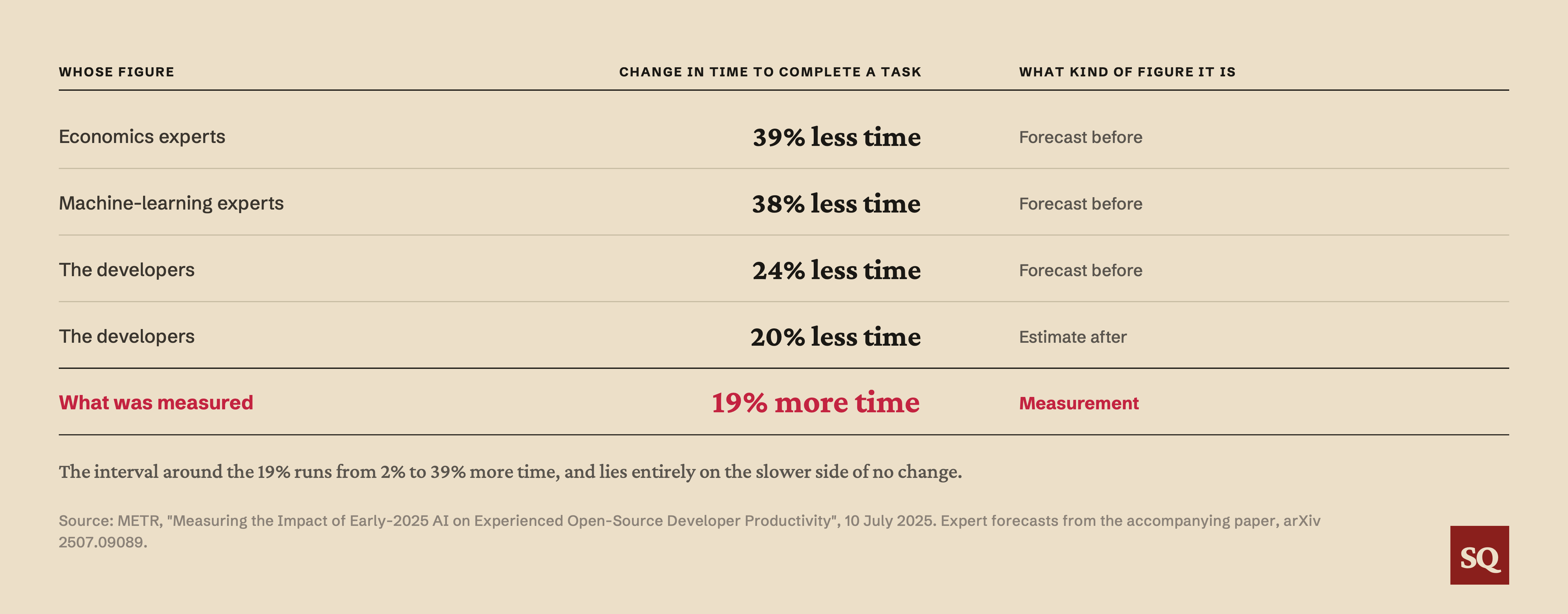
The interval around the 19% runs from 2% to 39% more time, and lies entirely on the slower side of no change. That interval appears on METR’s February 2026 page rather than in the original post, which published none, and the two expert forecasts appear in the accompanying paper rather than on the blog.
METR has since placed a notice on the study saying the results are out of date. A second experiment from August 2025, covering 57 developers across 143 repositories and more than 800 tasks at $50 an hour, produced estimates in the opposite direction, neither distinguishable from no change, which METR calls “an unreliable signal” and “likely a bad proxy”. It attributes that to selection: developers increasingly declined to take part because taking part meant working without AI, and between 30% and 50% of those who did withheld particular tasks for the same reason. Because every effect it identifies pushes the measured speedup downwards, METR treats its own estimate as a lower bound, and says it believes developers are probably helped more by these tools now than in early 2025. That belief rests on interviews rather than on measurement.
A3. What executives said in public.
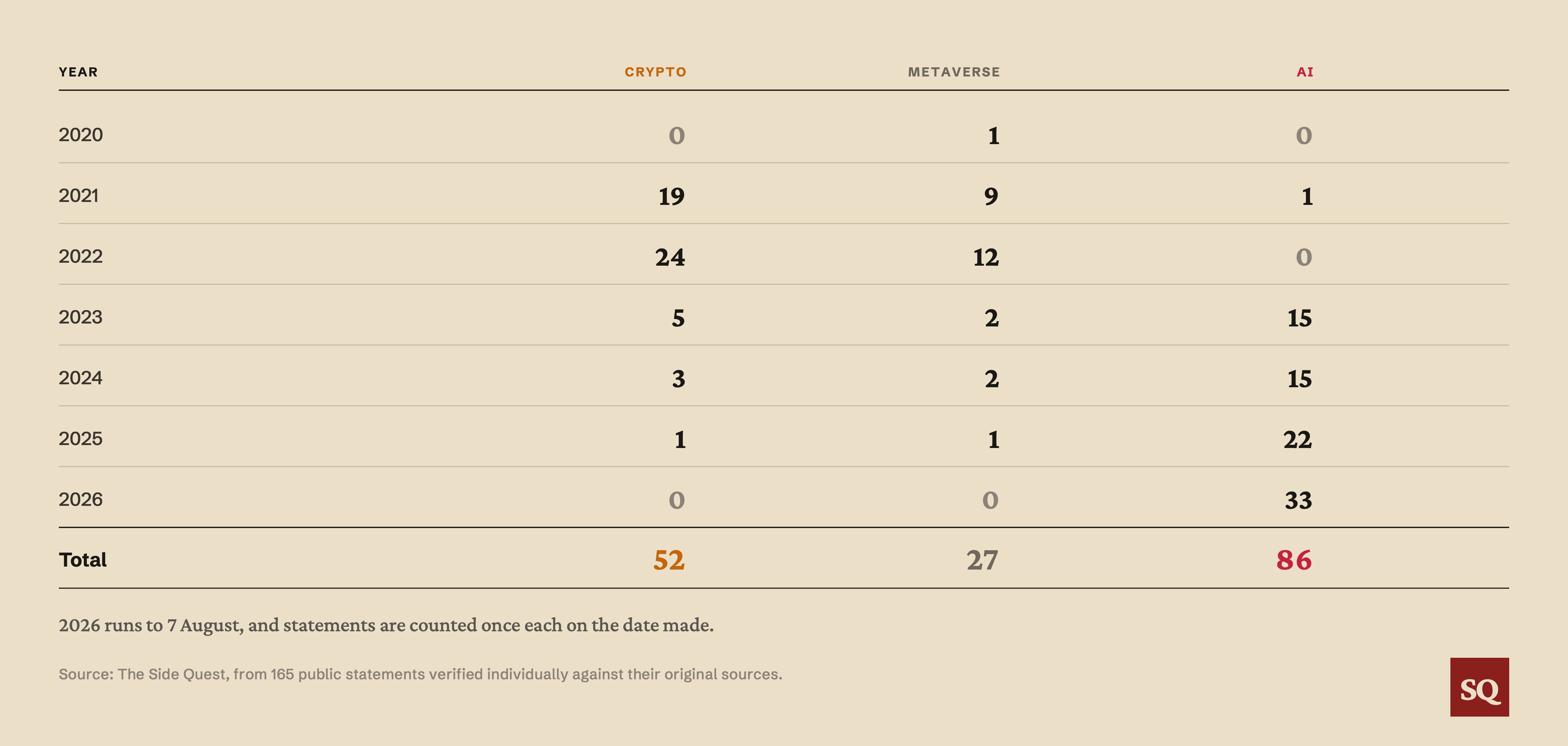
The dating of the three themes comes from 165 public statements by 60 named executives at 30 games companies between 2020 and 2026, each verified individually against its original source. Candidates that could not be traced to a retrievable source were discarded rather than included.
A4. The cost cases.
Uber exhausted its full-year 2026 budget for agentic coding tools by April and now caps spending at $1,500 a month per employee per tool, reported by Fortune and TechCrunch. The budget disclosure came from its chief technology officer; the separate doubt about whether the spending reached shipped product came from its president. Cisco’s account is its own, written by two of its vice-presidents, and discloses no spending figure; it is published alongside the monitoring product Cisco built in response, which readers should weigh. ServiceNow’s case rests entirely on reporting by The Information, which sits behind a paywall and has not been read for this piece.
A5. The EVE Online deal.
Google took a minority stake in Fenris Creations, the studio that transitioned out of CCP Games, and the studio holds a research partnership with Google DeepMind. The size of the investment is undisclosed beyond the studio’s chief executive describing it as in the millions.
The vehicle is Eve Frontier, not EVE Online, which are different games from the same lineage, and earlier versions of this note had the wrong one. Fenris has appointed Áslaug Arna Sigurbjörnsdóttir, formerly Iceland’s minister of justice and later its minister of higher education, science and innovation, as senior director for AI partnerships to lead the research programme. Her account of what makes the game useful is that it does not reset. She describes it to GamesIndustry.biz as persistent and single-shard, “one universe, one economy, one social graph”, so that prices aggregate and reputation is global, while “task horizons are long and outcomes are irreversible: mistakes stay made, debts stay owed”.
She contrasts that with the environments DeepMind used before, Atari, AlphaGo and StarCraft II, on the grounds that all of them reset. She also says the programme is intended to extend past DeepMind to other laboratories, universities and policy institutions, since “if one company owns the proving ground, the evidence is worth less to everyone”.
A6. Ken Levine on AI
Dicken cites Ken Levine of Ghost Story Games as having ruled out anything player-facing being generative. Levine set that out in an interview with GamesIndustry.biz in January 2025, and his scope is wider than the player-facing part. “We’ve not used any generative AI in the development of the product outside of things like bug databases, clearing our analytics database... We haven’t used it for [concept art] because there’s some legal issues around [sourcing images].” He is not dismissive of the technology. “I don’t want to underestimate it. I think it’s very powerful.”
A7. The Riccitiello pitch
John Riccitiello described it on the Growth Masterminds podcast, written up by John Koetsier for Singular on 6 July 2023, three months before he left Unity. “You could walk from the pitch to the stadium in FIFA and talk to the fans.”