


TL;DR
Microsoft’s July reset gave Xbox its own P&L, moved Mojang and King to report directly to Sharma, and cut costs to a shape any owner would want. None of it commits Microsoft to anything: the moves build the option to keep, fix, or separate the business.
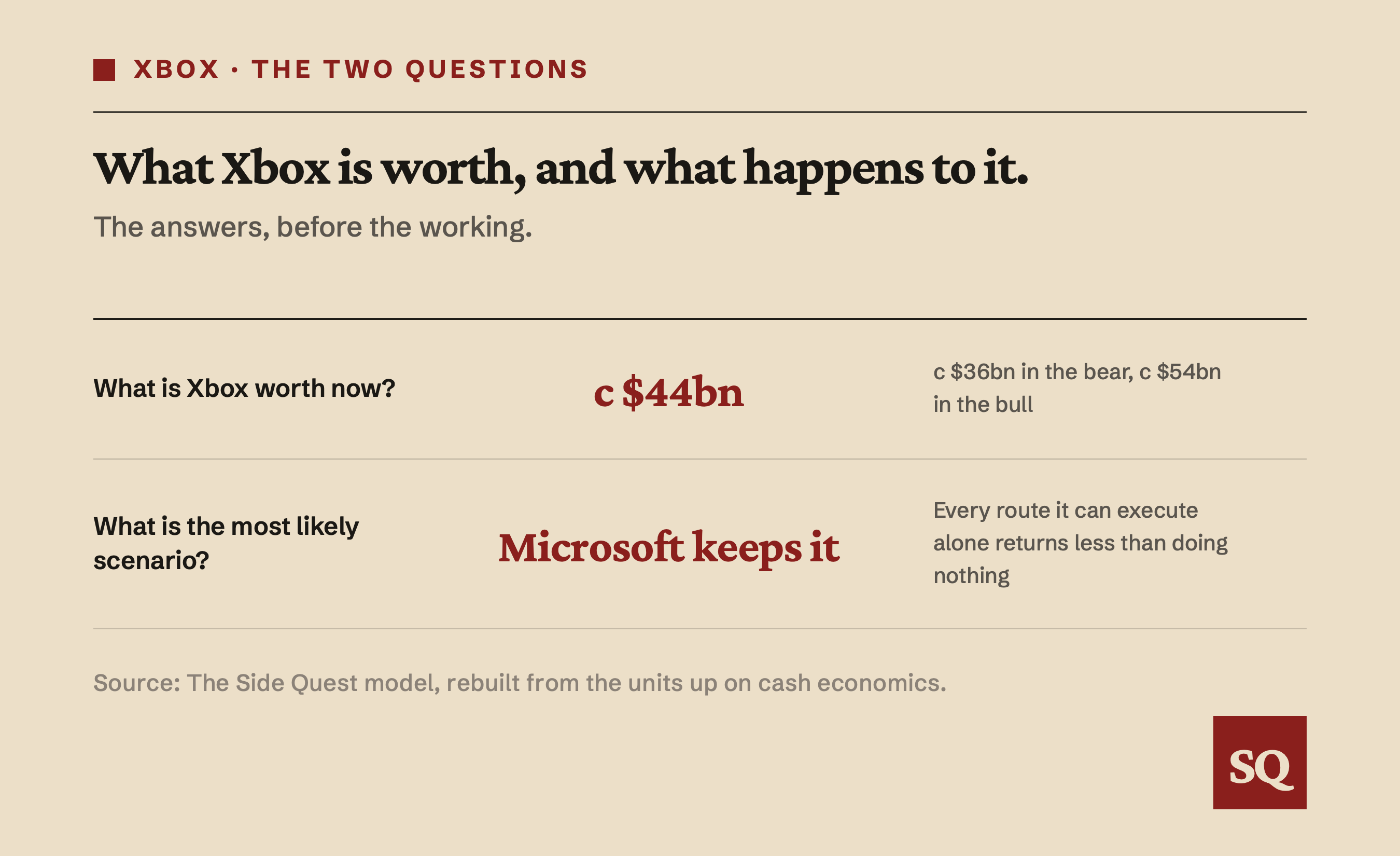
Rebuilt from the ground up on cash economics, Xbox is worth about $44bn (vs $49bn we published in the first piece), a rounding error at roughly 1.5% of Microsoft’s market value. The platform upside in King and Minecraft is worth nothing here, because nobody is funding it: none of the seven roles Mojang posted after the reset is a game developer.
Across seven separation routes, every version Microsoft can execute itself returns less than keeping: the spins pay to stand up alone, and the sunsets destroy the store commission and Game Pass, which only earn while the console does. The two that beat keeping are sales made entirely of a premium nobody has offered. So Microsoft keeps Xbox.
I write The Side Quest independently and take on select advisory and consulting work alongside it, and I’m open to the right full-time role. If any of that could be useful to you or your team, I’d be glad to hear from you. The Xbox Model is available on request.
The reset builds options, not a decision
Microsoft’s July reset of its gaming business, another 3,200 roles through FY27, came with Sharma’s claim that Xbox earns margins three to ten times below comparable platform and publishing businesses: expectations set low enough to license the cuts that follow. We covered the reset itself when it landed. This piece splits into two parts: what is Xbox worth now, and what is the most likely scenario.
Mojang and King move up, and the business gets its own P&L
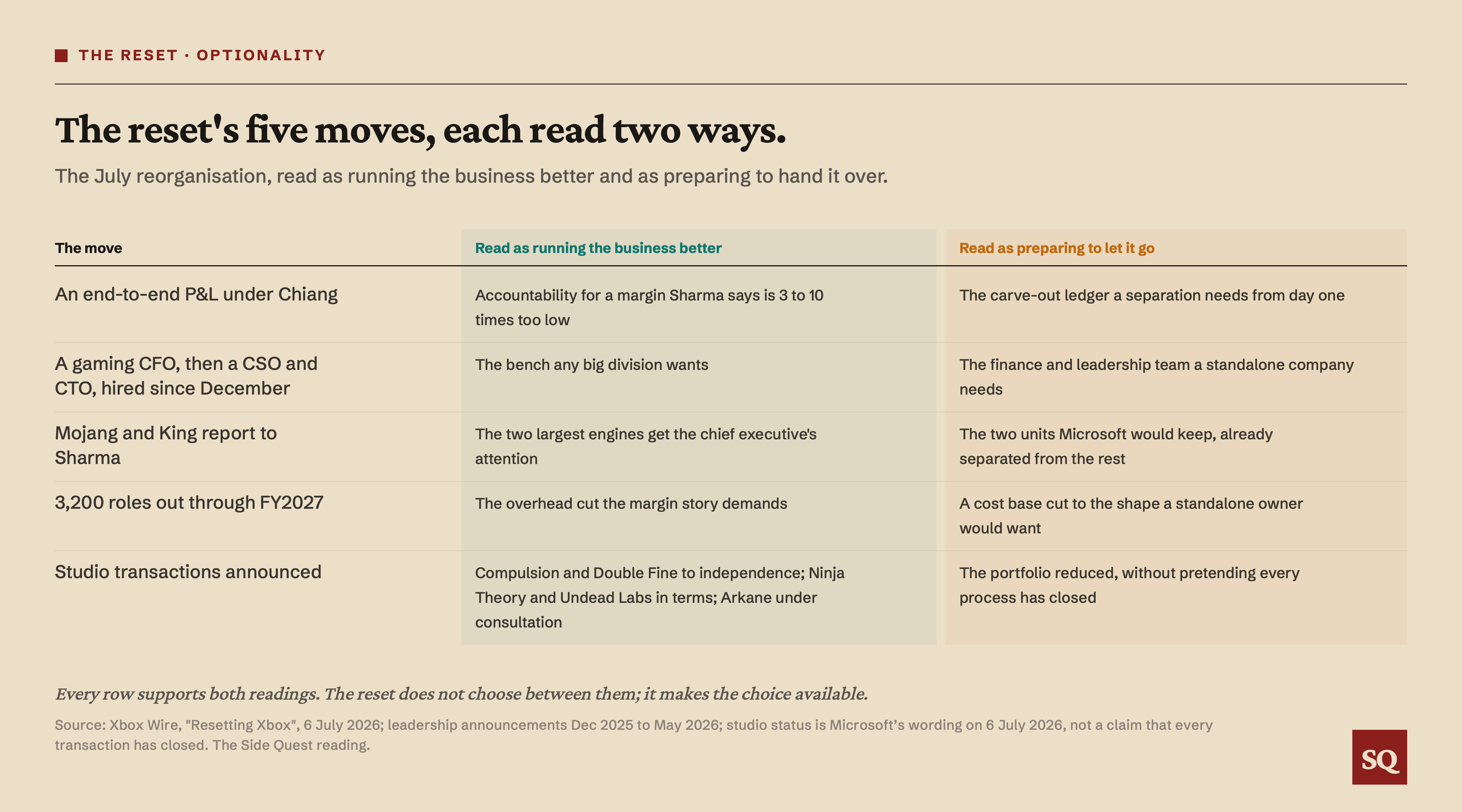
Sharma pulled Mojang and King out of the studio organisation to report directly to her, calling them the two studios that “have increasingly become platforms”, the largest in the group by monthly active players. She gave Helen Chiang, who ran the Minecraft franchise and has spent nearly two decades at Xbox, the COO role with end-to-end P&L responsibility for the business. These re-shuffles have been in the making: a new CFO was named in December, two months before Sharma started, and a CSO and CTO joined in May.
Looking through a crystal ball at these decisions, we could infer either that the business will be run better inside Microsoft, or that Microsoft is ready to let Xbox go (see the table below). It echoes a trend in management style: preserve optionality until a decision has to be made. It buys time for leaders, and lets them test stakeholders’ reactions.
Part 1: What is Xbox Worth Now?
Base Case: A return to the old Xbox
We make a set of assumptions for our Base case:
Game Pass becomes a weaker version of a PlayStation Plus subscription.
The new Xbox console becomes a subsidy to increase the installed base.
Single-player AAA is exclusive, multiplayer sells everywhere.
Minecraft and King are harvested, not rebuilt.
Assumption 1: Game Pass becomes a weaker version of PlayStation Plus
The model assumes the following:
AAA single-player titles return to full-price day one (i.e. not on Game Pass) and will enter Game Pass 1 year after launch (i.e. a delayed catalogue).
Third-party Game Pass deals are frozen (i.e. there is no content-led growth).
There’s no pricing power (i.e. the cost for the subscription is never raised).
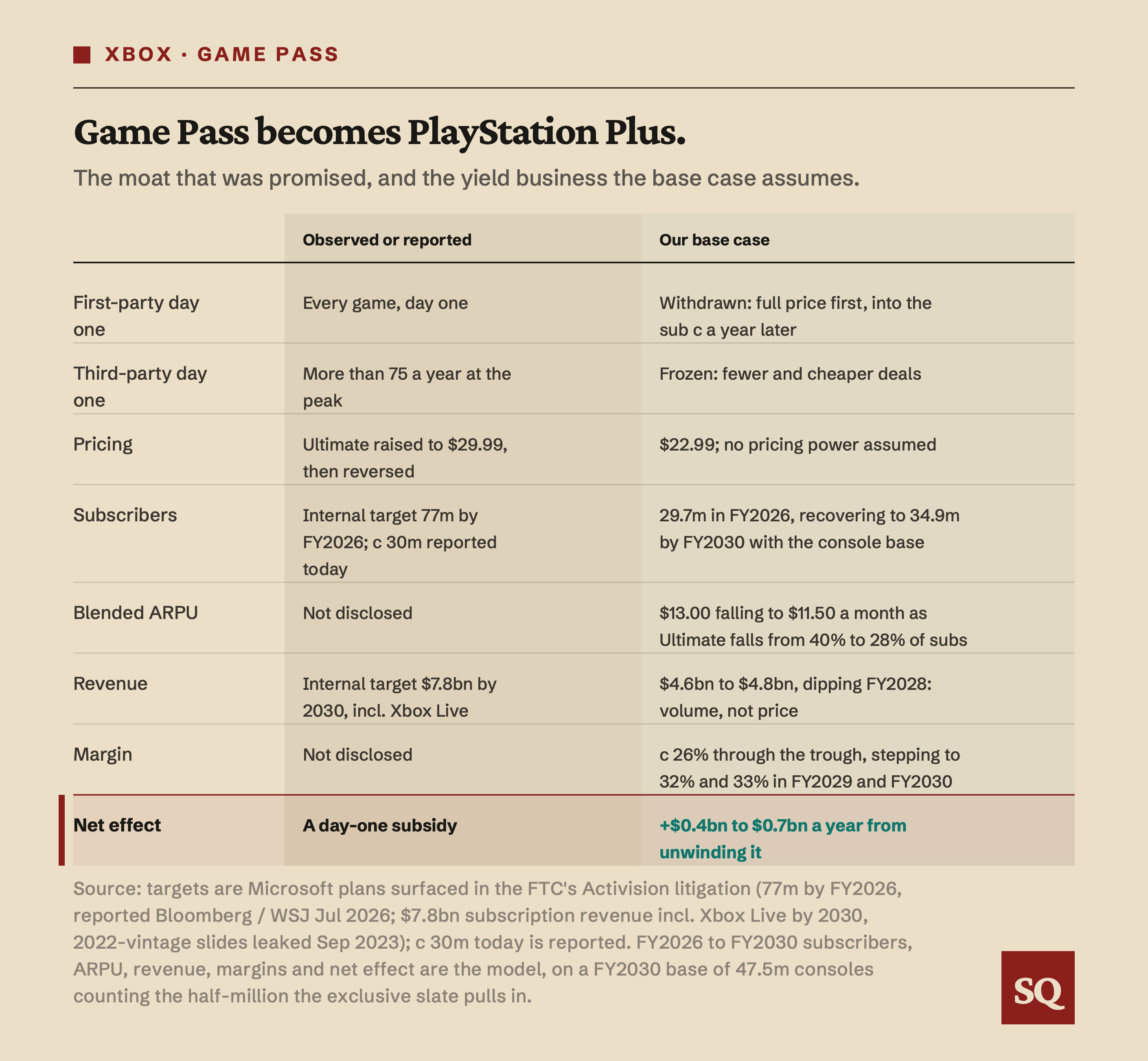
The result is a service worth more as a ‘yield’ business than as the ‘moat’ it failed to build: roughly the same revenue, earned at a higher margin, without the day-one subsidy that made the growth version value-destructive.
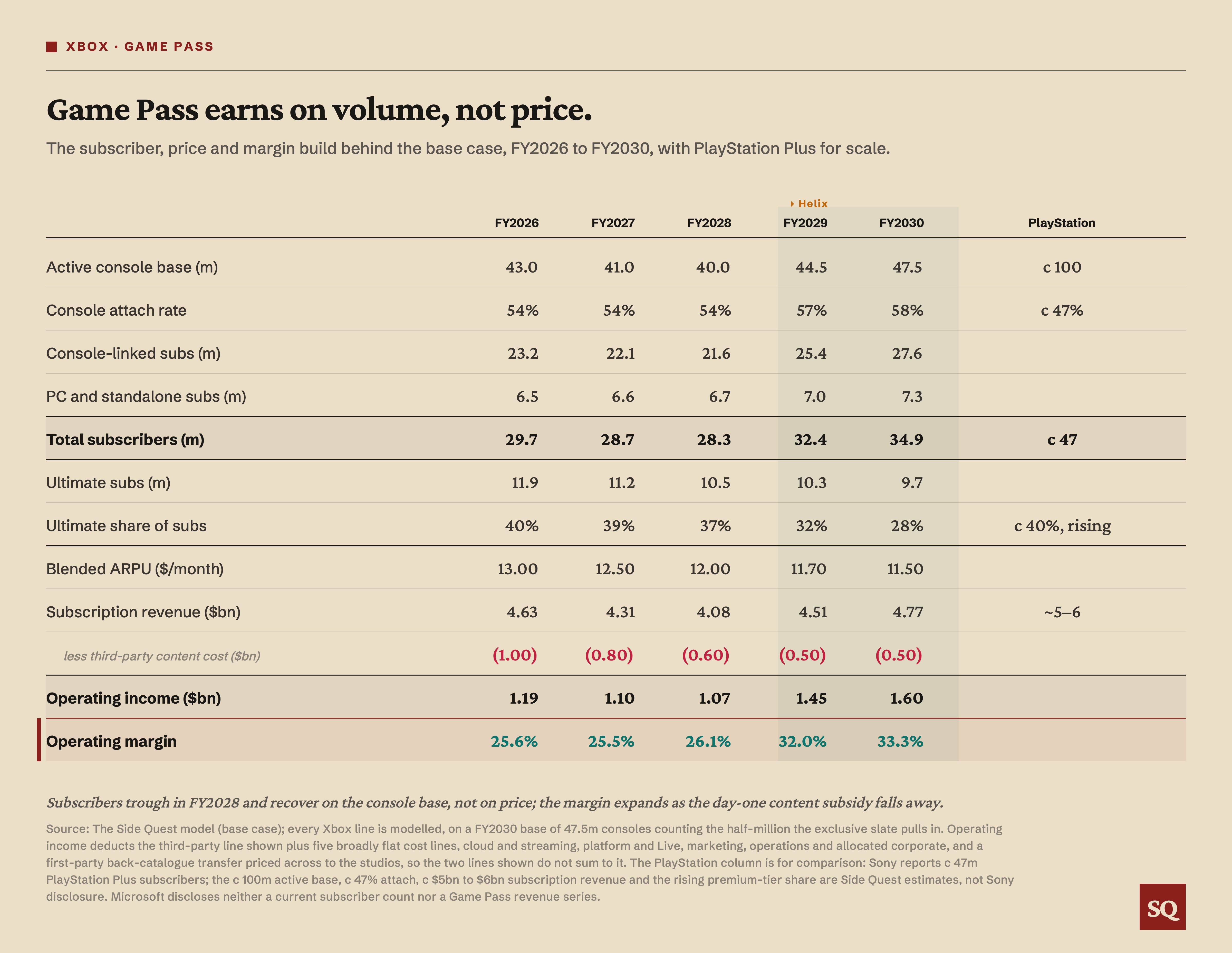
The dynamics are as follows:
Subscribers recover to where they started, and only because of the console. Game Pass falls from 29.7m in FY26 and climbs back to 34.9m by FY30, roughly the 34m Microsoft last reported in February 2024. The model builds subscribers as the installed base times an attach rate, so the recovery is the console base rebuilding on Helix, not the content pulling people back in.
The sticker price holds while the price subscribers actually pay falls. Ultimate stays at $22.99, but the blended price drops from $13.00 to $11.50 a month as Ultimate’s share of subscribers falls from 40% to 28%. Withdrawing day-one games strips the top tier of its draw, so people move down to cheaper plans: the service cheapens by mix, not by discount.
Revenue is flat, held up by volume against that falling price. It starts at $4.6bn, slides to $4.1bn by FY28 as the subscribers and the price fall together, and only recovers to $4.8bn in FY30 once the console base has brought people back. The $7.8bn Microsoft once targeted for 2030 is nowhere in sight.
It becomes more profitable, but late, and borrowed from the hardware. The margin holds flat near 26% through the trough years, where the frozen third-party deals cut content cost about as fast as revenue slips. It then steps up to 32% and 33% in FY29 and FY30, lifting operating income from about $1.1bn to $1.6bn, as the recovering subscribers flow through onto content costs now held down. The gain is operating leverage on the Helix recovery, so it only lands if Helix does.
Assumption 2: The console becomes a subsidy for the installed base
If Microsoft continues to develop a console, the form it takes is still unclear. Sharma has said she is “committed to Xbox, starting with the console”, and that Microsoft “will continue to look at new business models … rather than just the most premium, high-performance console in the world”, floating more affordable models alongside it. Therefore, we assume that Microsoft will create a console that competes against PlayStation (and in the next generation of consoles, the PlayStation 6).
Consoles are typically sold below cost, and in the case of Microsoft, they need to re-grow their install base. So the hardware offering needs to be attractive to consumers from a pricing perspective as well as offering hardware that is on par with what is expected for the next generation of consoles. Both of these need to happen at a time when memory prices have risen sharply and console prices have increased.
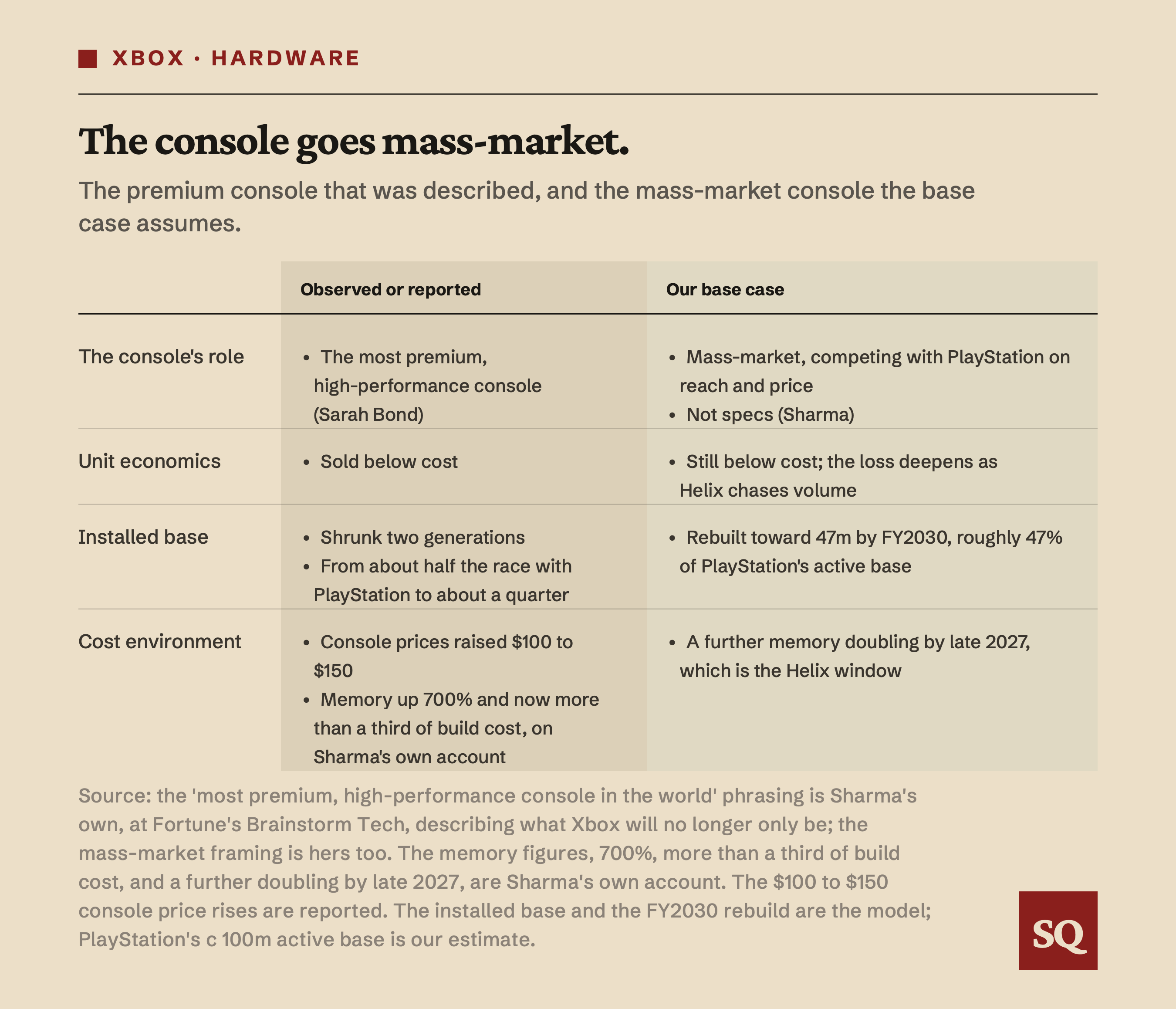
At a time when profitability of the Xbox division is under scrutiny, selling a loss-making device is a difficult internal proposition. Yet, there are natural levers the company will pull to offset this. This includes additional revenue from a larger install base as a result of:
The commissions Microsoft collects when other publishers sell games on Xbox;
The Game Pass subscribers who join through a console;
No platform cut for first-party exclusive titles that Microsoft develop.
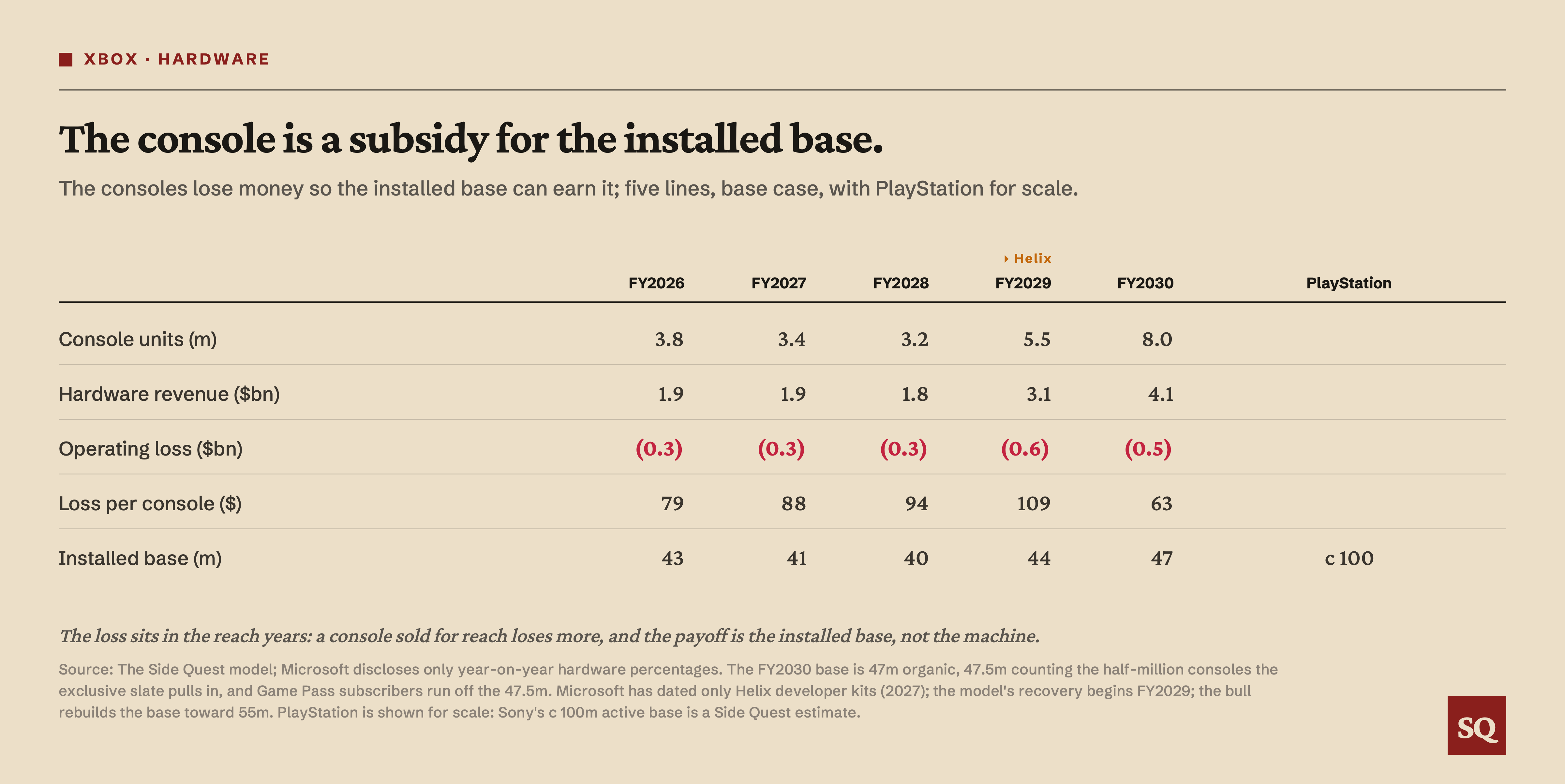
The dynamics are as follows:
Xbox starts at less than half of PlayStation’s install base. The base holds around 40m through the trough and recovers to 47m by FY30, roughly 43% rising to 47% of the 100m consoles we estimate PlayStation keeps active, and this generation Xbox has sold an estimated 34m consoles to PlayStation’s 94m. Helix is the bet to arrest a two-generation slide and claw back a few points of that gap, not to win the generation.
Console shipments recover, and only because of Helix. Units fall from 3.8m in FY26 to a 3.2m trough in FY28, then jump to 8.0m by FY30 as the new console launches, and hardware revenue more than doubles with them, from about $1.8bn to $4.1bn.
Every console sells below cost, and the loss deepens exactly when it sells best. The operating loss holds near $0.3bn through the early years, then widens to $0.6bn in FY29 as Helix ramps, before easing to $0.5bn in FY30. The reach is bought, not earned: the more consoles Microsoft pushes into living rooms, the more the subsidy costs, until the launch cost curve matures.
The subsidy per console peaks at the launch it is meant to win. The loss climbs from about $79 to about $109 as Helix ships in FY29, then falls to about $63 by FY30 on the Sony-style cost curve the model assumes.
Assumption 3: Single-player AAA is exclusive, multiplayer sells everywhere
Given that Microsoft has already committed to make more first-party titles exclusive to its console (i.e. Gears of War: E-Day and Clockwork Revolution), with the rationale, in Matt Booty’s words, that people need “a reason to buy an Xbox”, it fits that we assume all future first-party single-player AAA titles will be exclusive to the console.
A single-player game made exclusive gives up only a one-time sale on rival platforms. Multiplayer titles, such as Call of Duty, we assume will remain cross-platform given the larger, continuous player base that supports these. Xbox also has great benefits from doing so:
Retention holds up: the large shared player pools and cross-play remove the friction that would otherwise push players away.
The revenue keeps coming from every platform, full-game sales and in-game spending across PlayStation, Switch and PC, where most of the audience for these franchises sits.
And for the biggest it is not even a choice as Call of Duty is contracted to PlayStation into the 2030s.
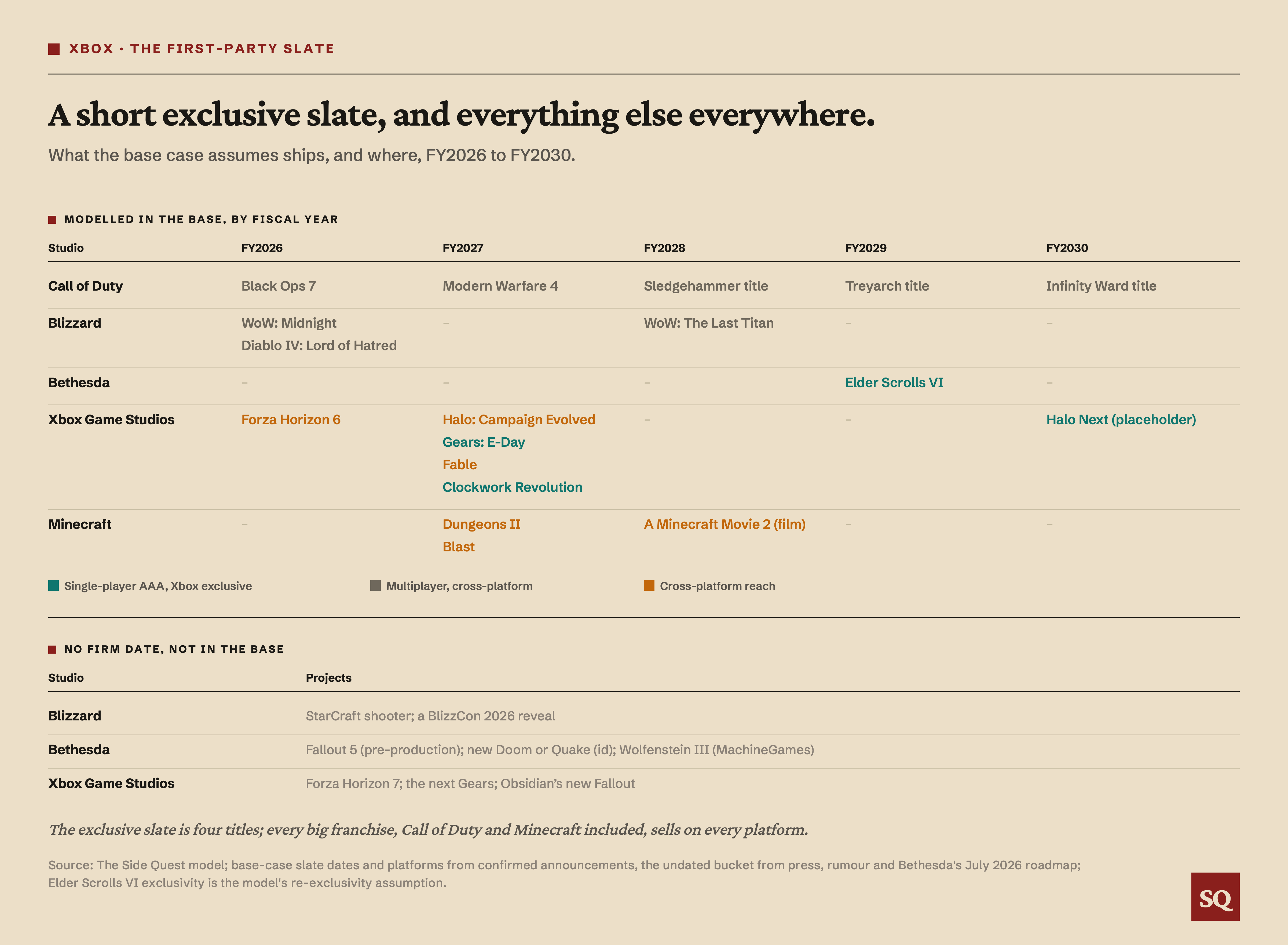
The visible slate empties after FY27. Six of the notable releases land in that one year, and beyond it Xbox Game Studios falls to about $0.3bn of live-service revenues which tail off, with Call of Duty the one franchise that ships every year.
That thinning is what has been announced, not what will exist. Undated projects are almost certainly in development, id reportedly on a new Doom, Blizzard on a StarCraft shooter, and Obsidian on a new Fallout that Bethesda confirmed in July without giving it a date. The base prices none of the three, though it does credit Elder Scrolls VI in FY29 and the next Halo in FY30 on assumed dates, because both are far enough along to model where the other three are not.
First-party AAA is also hard to land, and Microsoft’s recent record is uneven enough that the base does not credit hits it has not seen: Redfall was not as successful as they hoped, the last Call of Duty drew hostile player reviews, and bets meant to refill the slate, the ZeniMax MMO and reportedly Avowed 2 among them, were cancelled before release. So the base prices the confirmed titles modestly, assumes none breaks out, and leaves the upside to the rumoured column.
Assumption 4: Minecraft and King are harvested, not rebuilt
Minecraft and King are the two most valuable businesses Microsoft owns in games, and what Sharma is doing with them is not building the platforms their elevation implied but harvesting the franchises.
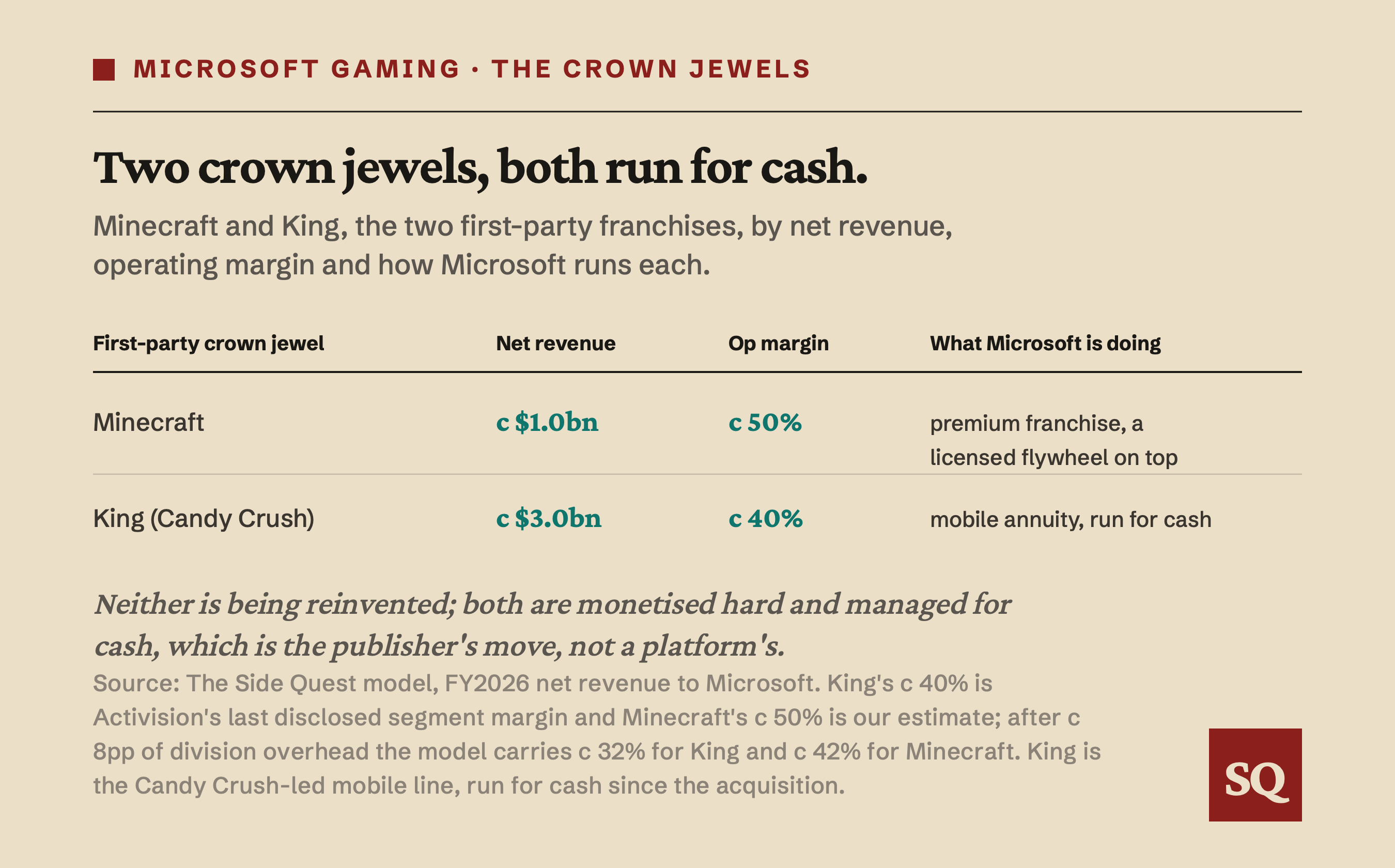
The franchise around the game is being extended entirely through licences, so someone else funds each piece and carries its risk.
Warner Bros and Legendary paid for the 2025 film and carried the risk that it failed; Microsoft collected a royalty and, worth more, a halo that pulled players back into the game.
Merlin Entertainments is putting £50m into Minecraft World at Chessington and will operate it, with Mojang licensing the IP and overseeing the creative rather than funding the build.
Microsoft has no capital in any of it, and what comes back is a royalty and the halo, both high margin.
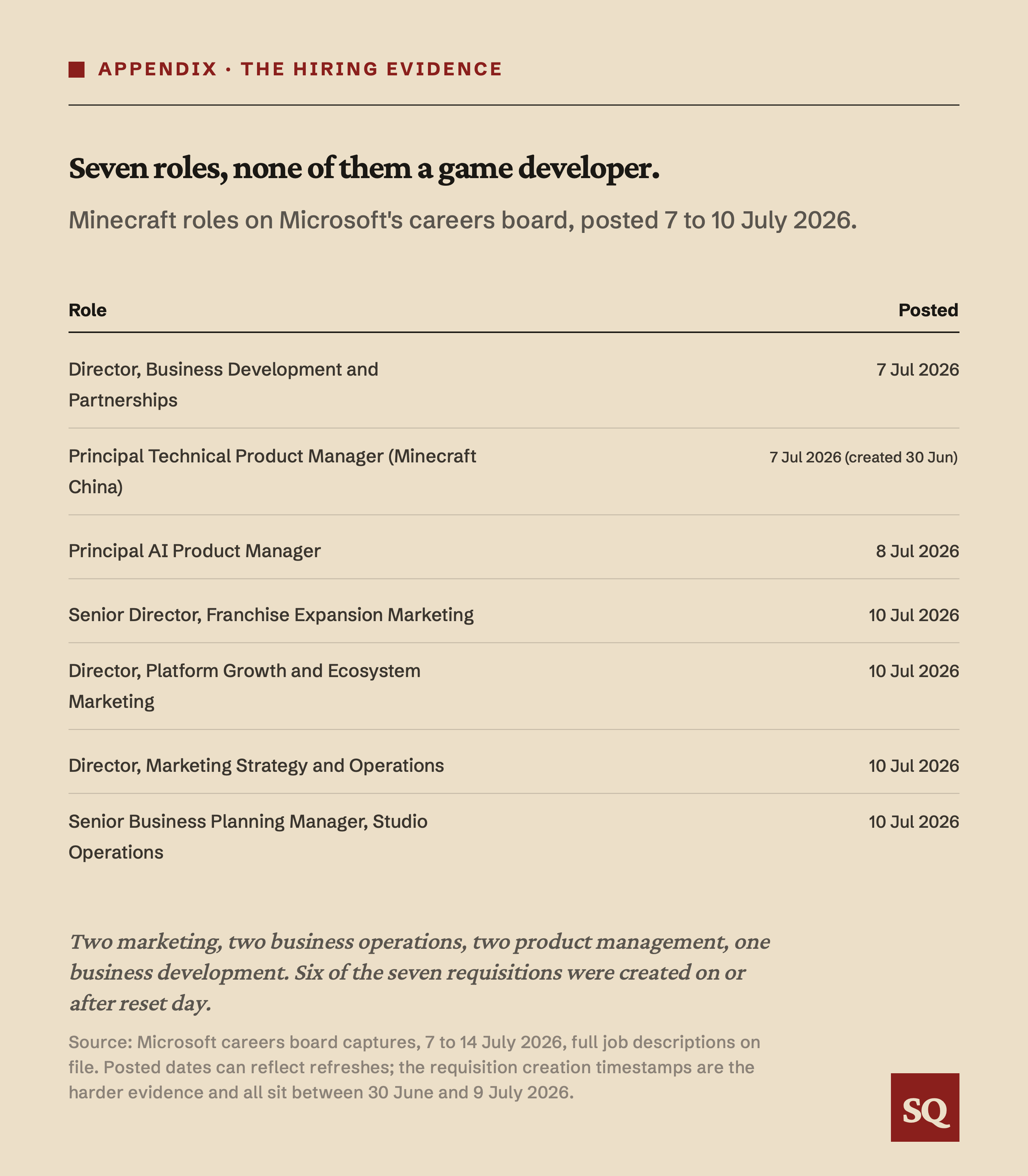
It appears that Mojang are doubling down on this strategy. In the week after the reset Mojang posted seven senior roles, and none of them is a game developer. Two are marketing jobs, one covering franchise expansion into film and consumer products, the other platform growth; one is a business development director running IP licensing and brand deals; two exist to run the studio’s own machine, a chief of staff for the marketing organisation and a business planner who allocates headcount and budget; and the last two are product roles only in name, because one builds internal AI tooling to make Mojang work faster and the other runs the China codebase with NetEase.
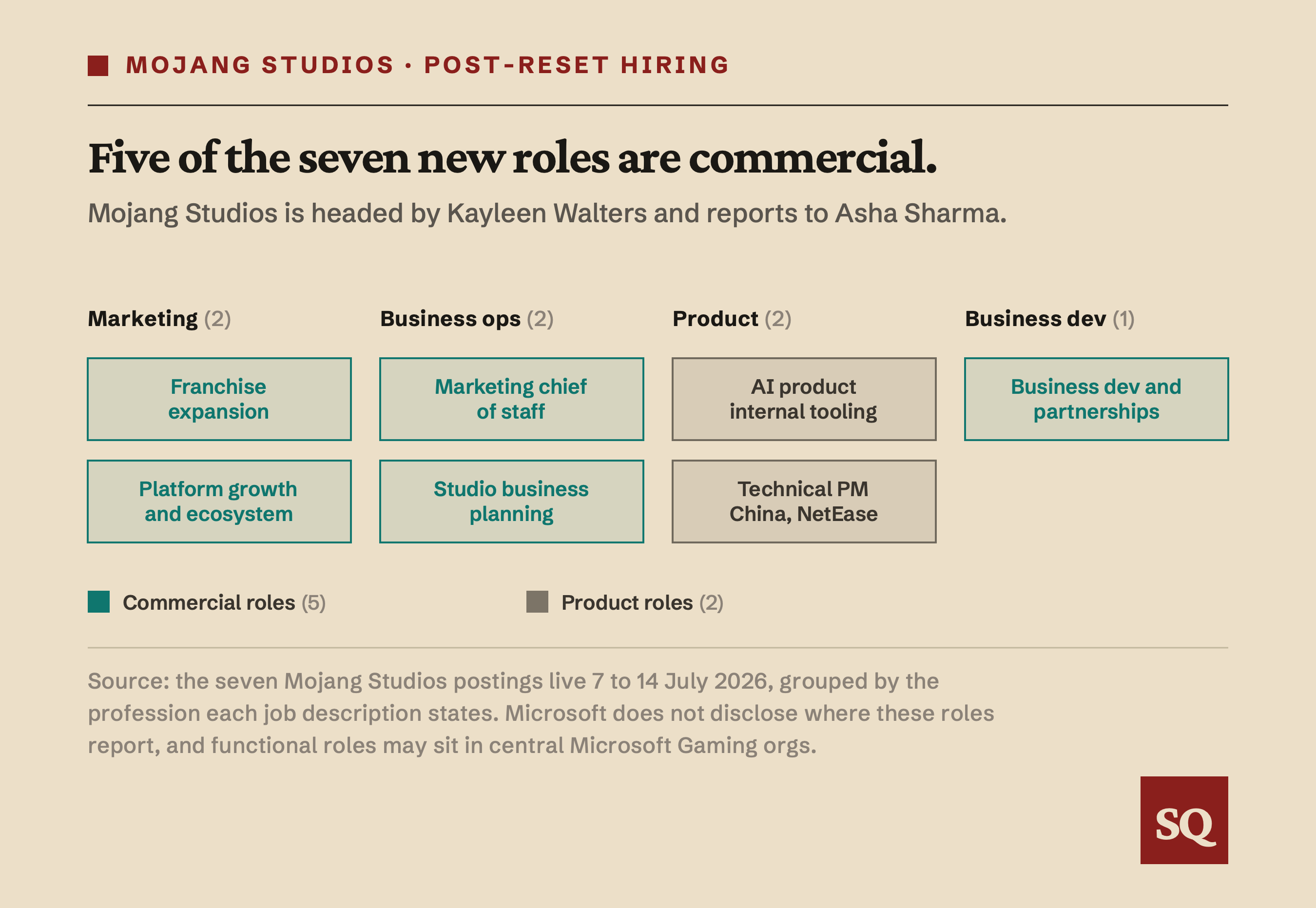
The one title that looks like evidence for the platform thesis is Director, Platform Growth and Ecosystem Marketing, and its description defines platform as the storefronts Minecraft is sold on, Nintendo, PlayStation, Xbox, Apple and Google, alongside gaming retail, the China ecosystem and Minecraft Education, with the hire asked to widen discoverability and merchandising across all of them. That is a job selling more copies of a premium game through more channels, which is very nearly the opposite of building a platform other people create on. The seven together describe a company assembling the apparatus of an entertainment brand, the deal-making, the marketing and the distribution a franchise needs once it has decided the game underneath it stays exactly as it is.
The roles King has open are game and product jobs to keep Candy Crush, Farm Heroes and Soda running, and its one forward-leaning move was to lend its mobile free-to-play craft to Minecraft through Blast, which put King’s live-operations machine behind another franchise’s brand. That ran as an iOS playtest in Malaysia and Canada for two weeks in November, and it has not been playable anywhere since, with no release date announced.
Minecraft’s premium base stays paid while free-to-play is confined to the edges, in China through NetEase and in a Blast playtest that has already ended, and King’s cash engine is run exactly as it stands, with the advertising ramp Microsoft has already signalled priced into the base and nothing beyond it attempted, so in both cases the part that actually earns the money is left alone. That is what you would expect from a leadership only months into its seat, because you get a grip on a business and steady it before you make substantial changes, and you make those only when you can say clearly why, which is a case Microsoft has not yet made.
So the base values them as what they are rather than what the platform language suggests, two durable high-margin annuities being protected and gently extended, and it pays for that durability rather than for growth neither is being asked to chase. A free-to-play Minecraft and an advertising King are both still possible, but they would need an owner who priced the reach differently from this one, or a Microsoft that had found a reason to change course.
Bull Case: A stronger recovery
The Bull Case for Xbox doesn’t lean on any substantial changes, it is a stronger version of the business Microsoft already runs:
Hardware (Helix) has a larger uptake than expected.
A better first party content track record.
The data of Xbox is Microsoft’s whether it keeps the games or not.
Assumption 1: Hardware has a larger uptake than expected
With a modest recovery in hardware in the Base case, we assume that Helix rebuilds towards a larger active base toward 55m rather than 47m in the Bull case. The extra consoles pay through the annuity rather than the hardware: each carries Game Pass subscribers at the attach rate and store commission on third-party sales, and nearly all of that extra revenue drops through to profit. The per-console loss also narrows, but that is a separate assumption about the memory cycle easing, not something the volume earns.
That matters because a larger, cheaper-to-serve base is worth more than the consoles themselves. This switches Microsoft from subsidising a console to build a base, to a base that is growing.
We also consider that Xbox is shipping across devices Microsoft didn’t build (e.g. the ROG Ally). That puts the Xbox store and Game Pass on third-party hardware and televisions, with Microsoft collecting a platform fee at roughly content margin and carrying none of the console loss.
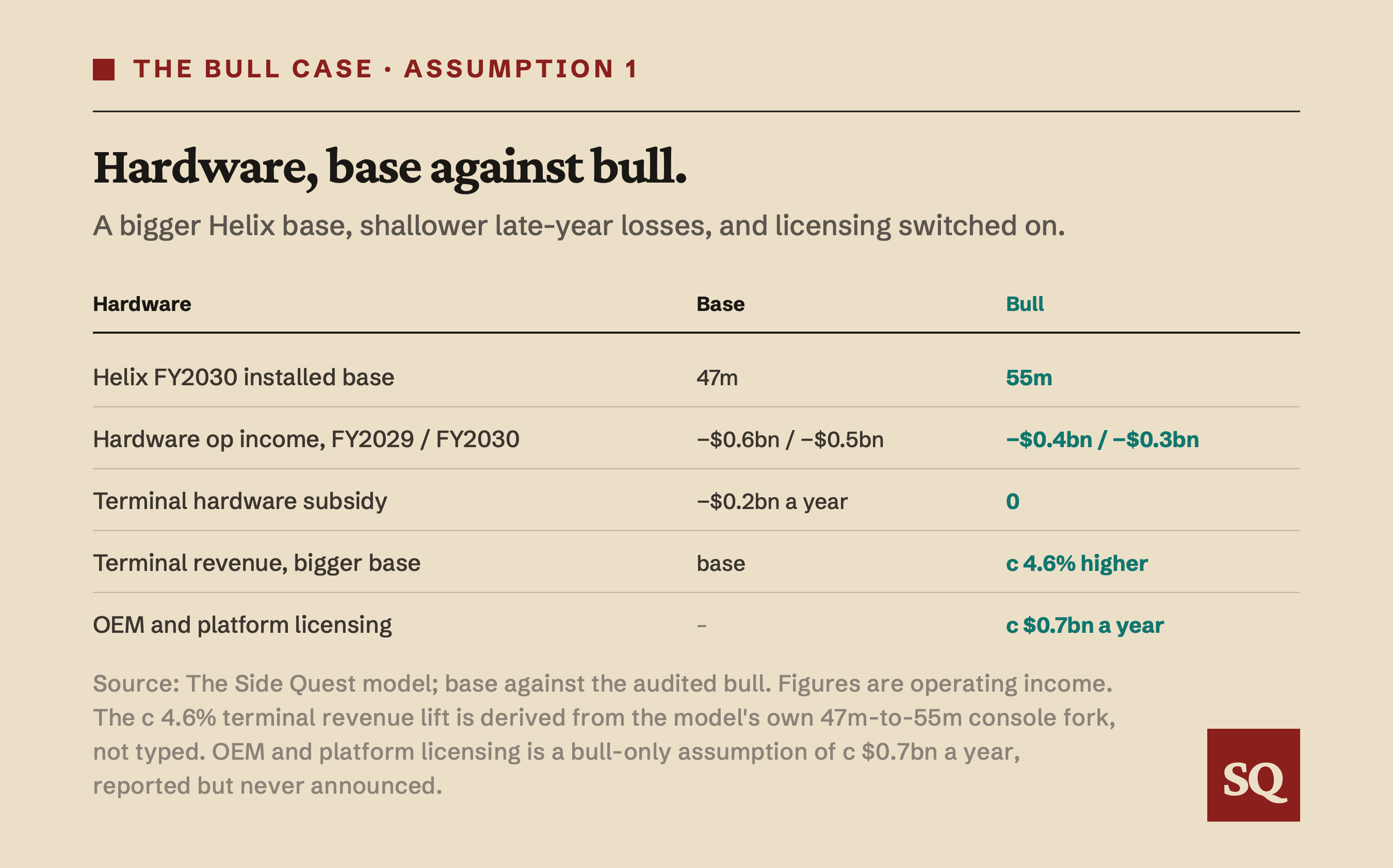
The model forecasts FY26 to FY30 explicitly, then values everything after FY30 as a single steady state growing slowly forever. These two rows describe that steady state, not the forecast years.
Terminal hardware subsidy. The loss the console is still assumed to run every year once it reaches steady state, carried in perpetuity. In the base it settles at about $0.2bn a year: even long-run, keeping the console in the market costs Microsoft something, because the memory and build costs never fully clear. It is a floor, not a figure that fades to nothing, which is why it weighs on value more than its size suggests, a perpetual $0.2bn capitalising into more than $1bn of enterprise value.
Terminal revenue. The whole business’s revenue in that same steady state, grown once, of which the console-linked annuity, the Game Pass subscriptions and the third-party store cut, is roughly a third; the rest is the mobile and multiplatform businesses that do not sit on the console at all.
How the bull differs. The console reaches breakeven rather than carrying a permanent $0.2bn loss, and the larger base earns about 4.6% more terminal revenue, derived from the 55m fork itself, through the two lines that scale with machines in homes: Game Pass at the attach rate and the commission on third-party sales.
Assumption 2: A better first party content track record
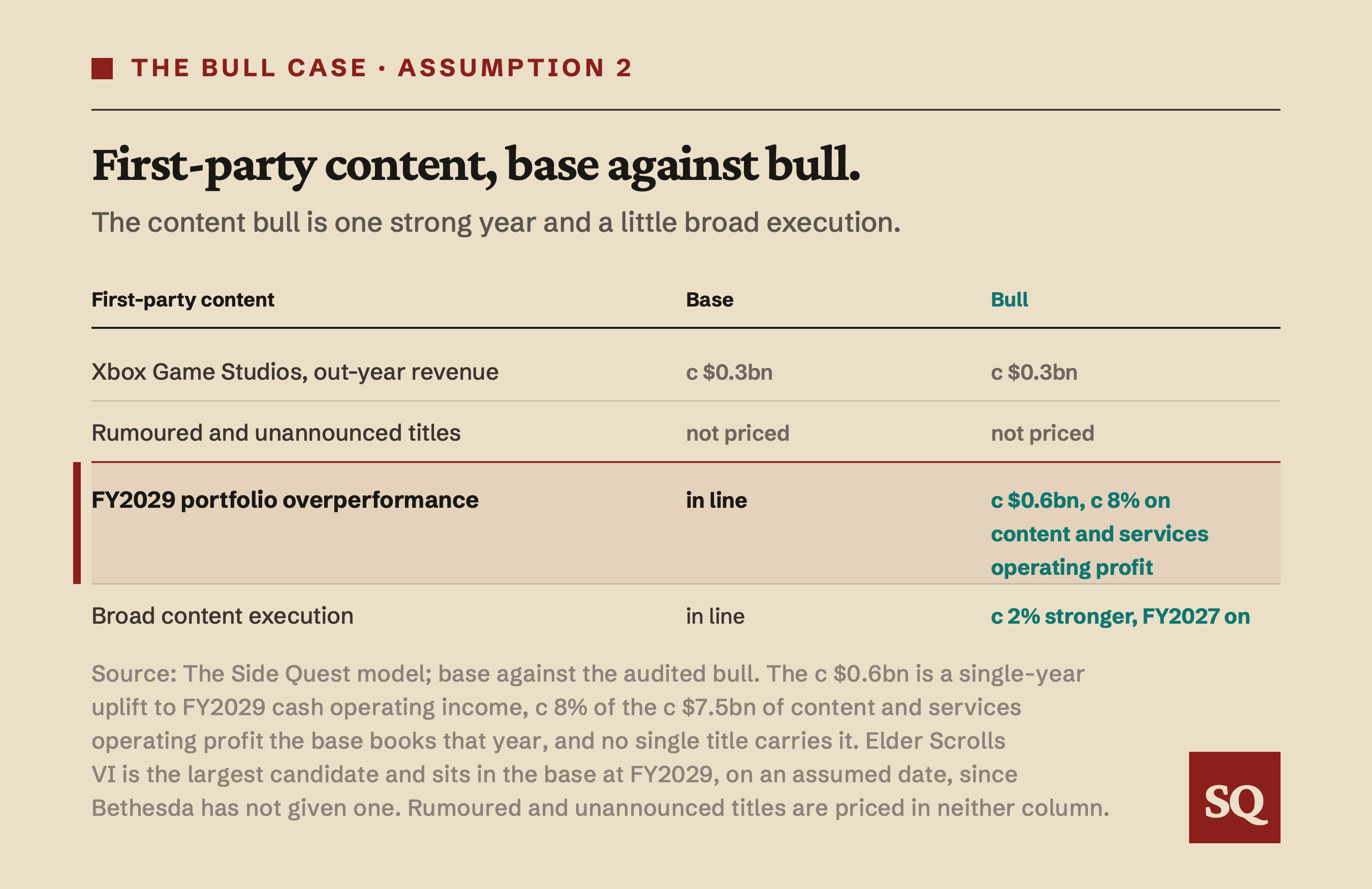
Given Microsoft’s mixed record in releasing games on time that are commercially successful, we assume in the Bull scenario they have better success, and that the first-party portfolio, Elder Scrolls VI included, exceeds expectations. Elder Scrolls VI is already in the Base case at FY29, where Bethesda’s new releases climb from $130m to $450m once the PlayStation share that exclusivity forgoes is netted off, so the Bull adds no game to the slate; it assumes the games already on it do better.
There are two settings carry that: modestly better execution everywhere else from FY27, and one strong year in FY29 worth $0.6bn, roughly 8% on top of the content and services operating profit the Base already books that year, and no single title has to deliver it. Elder Scrolls VI is the largest candidate and the reason the year is FY29, but Call of Duty, King and Blizzard sit in the same portfolio, and a seventh Forza Horizon, a StarCraft shooter or something still unannounced would contribute the same way.
Assumption 3: the data is Microsoft’s whether it keeps the games or not
The bull carries a data line: about $1.5bn for the rights to the gameplay and telemetry Microsoft’s games generate, plus roughly $0.15bn a year of licensing on the scale of the Reddit and Google deals. Both are inferred, because Microsoft discloses neither and no game-data licence at that scale has been struck.
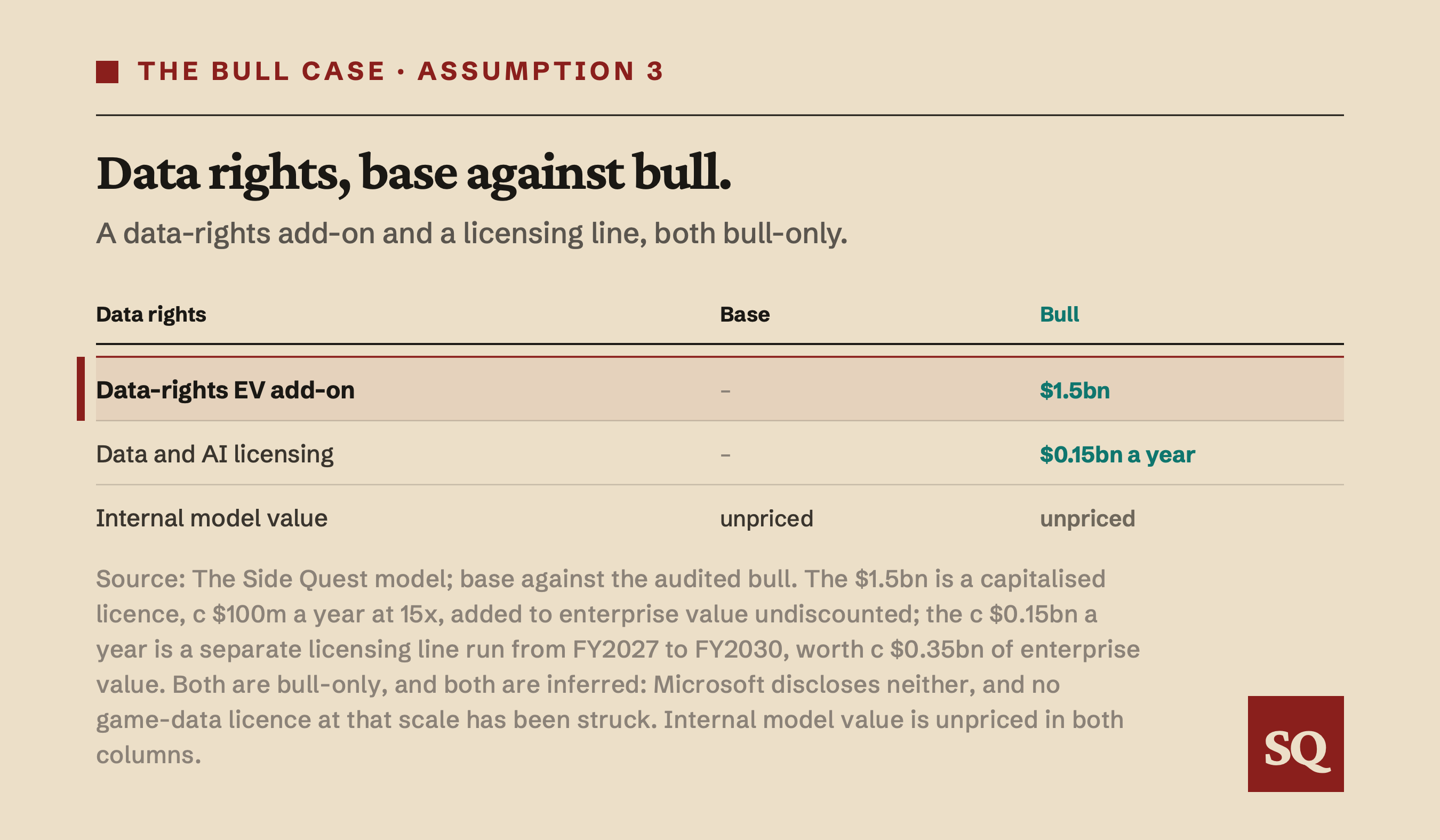
In a July post he calls the “reverse information paradox”, Nadella warns that using a frontier model means handing your proprietary know-how to whoever owns it, so the value of data run through AI accrues to the infrastructure rather than to whoever generated it. He was not talking about games, and he is likely talking his own book: Microsoft owns both ends of that trade, the games that produce the data and the Azure that trains on it, which leaves it on the right side of the paradox it is warning everyone else about. Read across to Xbox, it says Microsoft perceives value in the portfolio’s data. Crystallising it needs someone else, a licensee or a buyer, to agree.
On the evidence so far that agreement would be hard to win, because the data is thinner than the strategic language around it suggests.
Minecraft is the one real latent asset, open-world play at a scale world-model researchers already train on, though much of that research is open and pays Microsoft nothing.
The in-house showcases are demos: Muse and WHAMM are research projects, and one was trained on Bleeding Edge, a game by Ninja Theory, which is one of the four studios leaving the group.
Call of Duty’s voice moderation runs on Modulate’s model, not Microsoft’s, and Flight Simulator’s whole-Earth twin is built from Bing and partner geospatial data, a pipeline rather than a proprietary corpus.
King’s data already earns its keep inside the operating business, so there is no separate asset to sell.
So the value accrues to Microsoft as the infrastructure owner whether it keeps the games or spins them, because a separated Xbox would still run on Azure. The data sits in the bull as something Microsoft harvests rather than a transformation it attempts, and it cannot argue for keeping the games.
Blue Sky Case: King and Minecraft
King and Minecraft sit in Blue Sky because their platform upside is aspirational, not modelled.
Assumption 1: King, the option no owner is funding
The base already carries King’s advertising at about $630m, an assumption rather than anything Microsoft has disclosed: Activision reported only growth rates for King’s advertising, and Microsoft has published nothing since. The Blue Sky version is everything beyond it: advertising stops being a secondary line and becomes the growth engine, several times over.
Mobile monetisation splits by design: ad-led games are built for a broad, low-value audience, payer-led games like Candy Crush to deepen a small, high-spending one, and no mature payer-led franchise has turned advertising into its growth engine, because more ads degrade the payers who carry the revenue. The arithmetic agrees, since ad revenue is impressions times price, impressions scale with reach, and King’s audience shrank for every year Activision disclosed it.
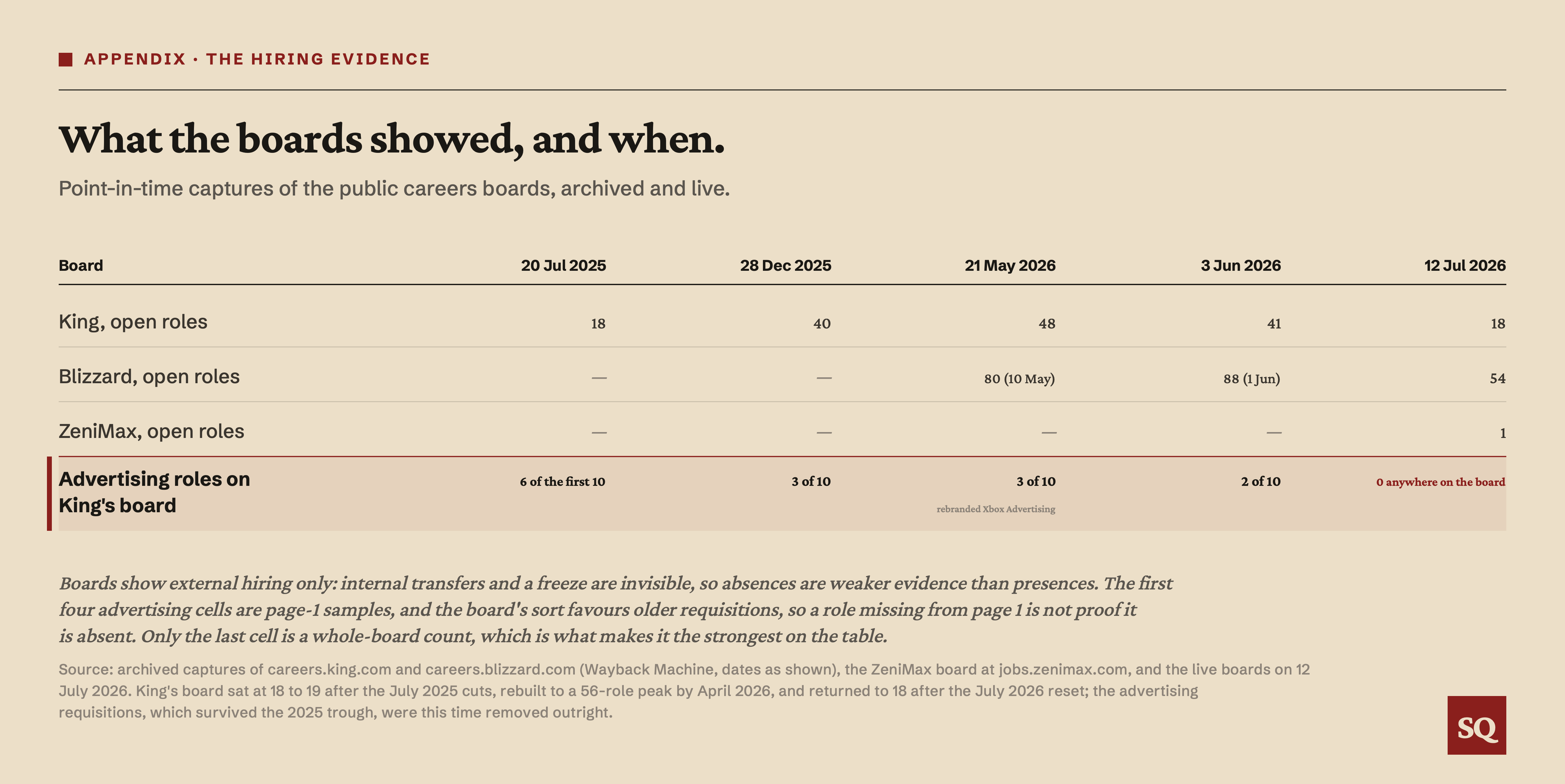
King’s advertising roles survived the July 2025 cuts, when its board fell to eighteen openings, and in the spring of 2026, weeks after Sharma took the division, they were rebranded Xbox Advertising as the board rebuilt into the forties and fifties. The last of those postings went up in April, and by the July reset the board was back to eighteen, and the dedicated Activision Blizzard Media board now redirects to a page saying it is unavailable.
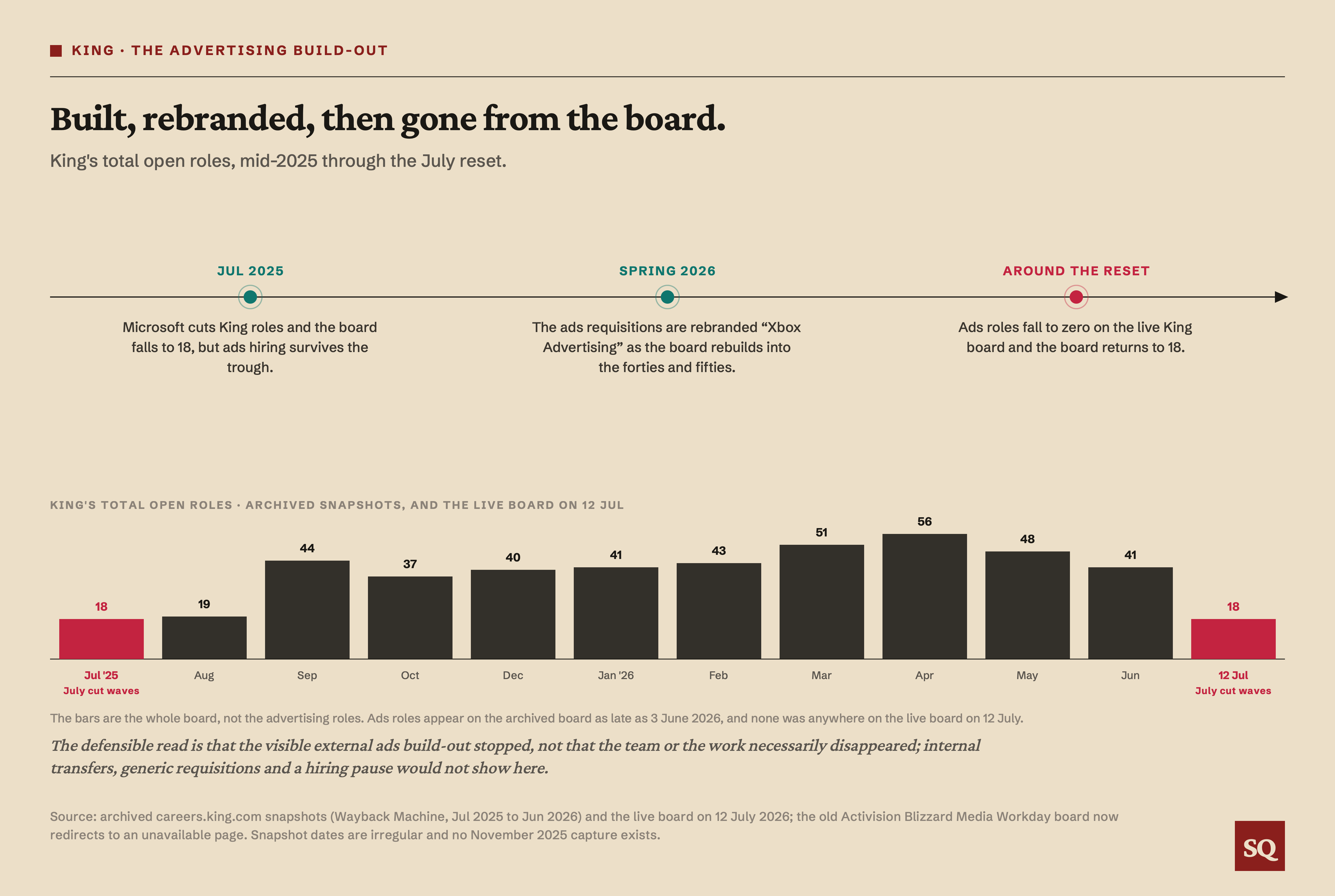
The boards cannot show whether the team survived, because internal moves never reach a public board, and a freeze during a 3,200-role cut suppresses everything. But Mojang posted seven roles straight through that same freeze, so the silence around advertising reads as a choice rather than a pause, and what it leaves is an ambition that was tried and let go.
An acquirer might still see inventory in that audience, or a future Microsoft might try, but the same problems would follow, and the synergy they would bank on is not missing, it is already running: Microsoft owns the ad business that came in with Activision, it sells rewarded video inside Candy Crush today, and Hershey’s has run a campaign there. What has not appeared, with all of that already in place, is any evidence that King’s advertising can carry the growth. So the option is real and entirely unfunded.
Assumption 2: Minecraft transforms into a Roblox/UEFN platform; the transformation Microsoft won’t make
The Blue Sky version of Minecraft goes free-to-play and creator-driven, a Roblox in the making, chasing reach and a billion daily players. It would trade away the thing that makes Minecraft worth holding: the margin comes from being a premium publisher that hosts almost nothing, pays no store cut where it matters and monetises a narrow surface, and free-to-play gives all of that back, carrying the hosting, paying the creators, taking a mobile mix through the app stores and living off a small paying minority.
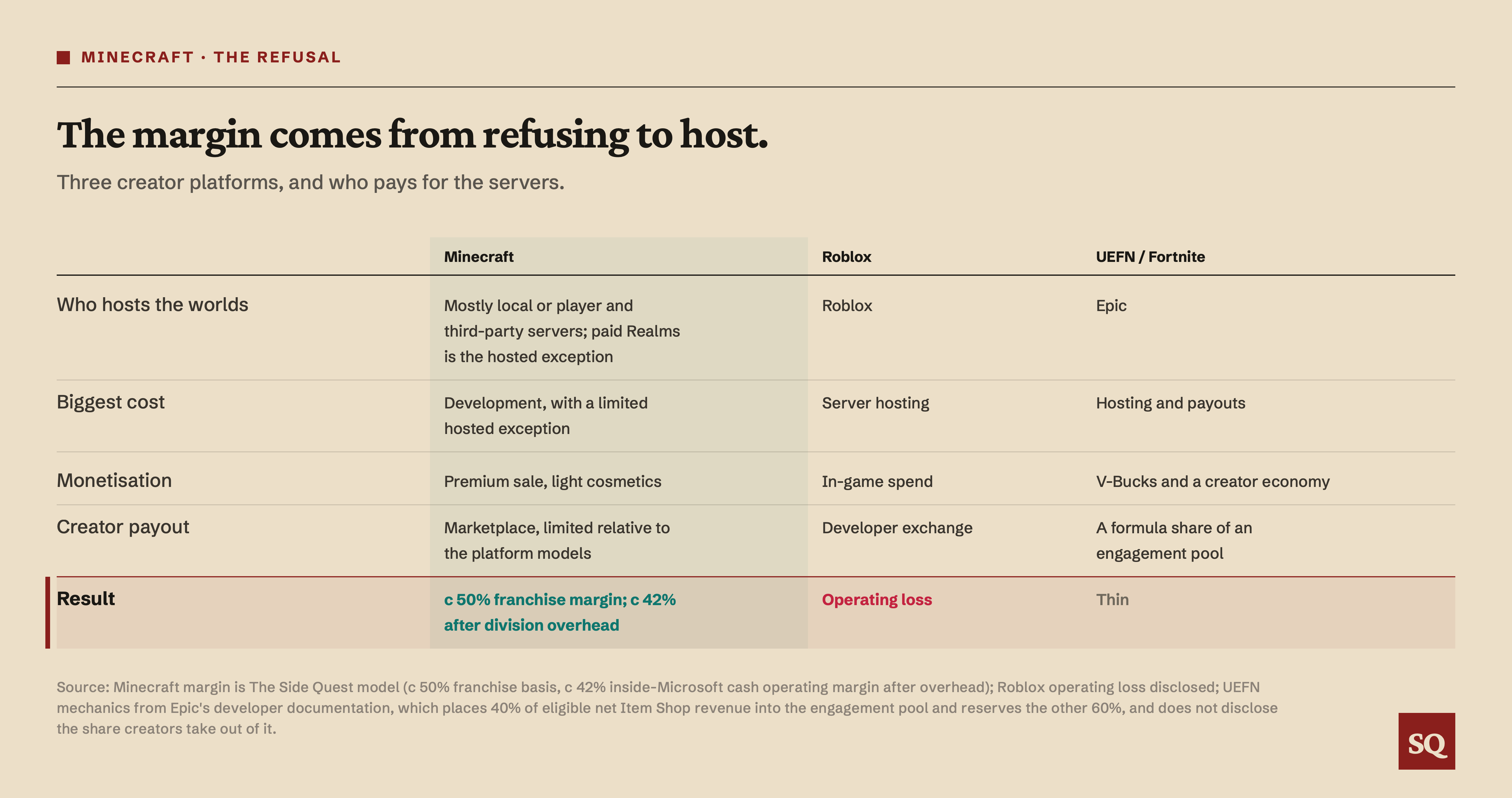
The switch only out-earns the premium business it replaces if reach roughly doubles and monetisation rises with it, which is why the core stays paid and free-to-play runs at the edges.
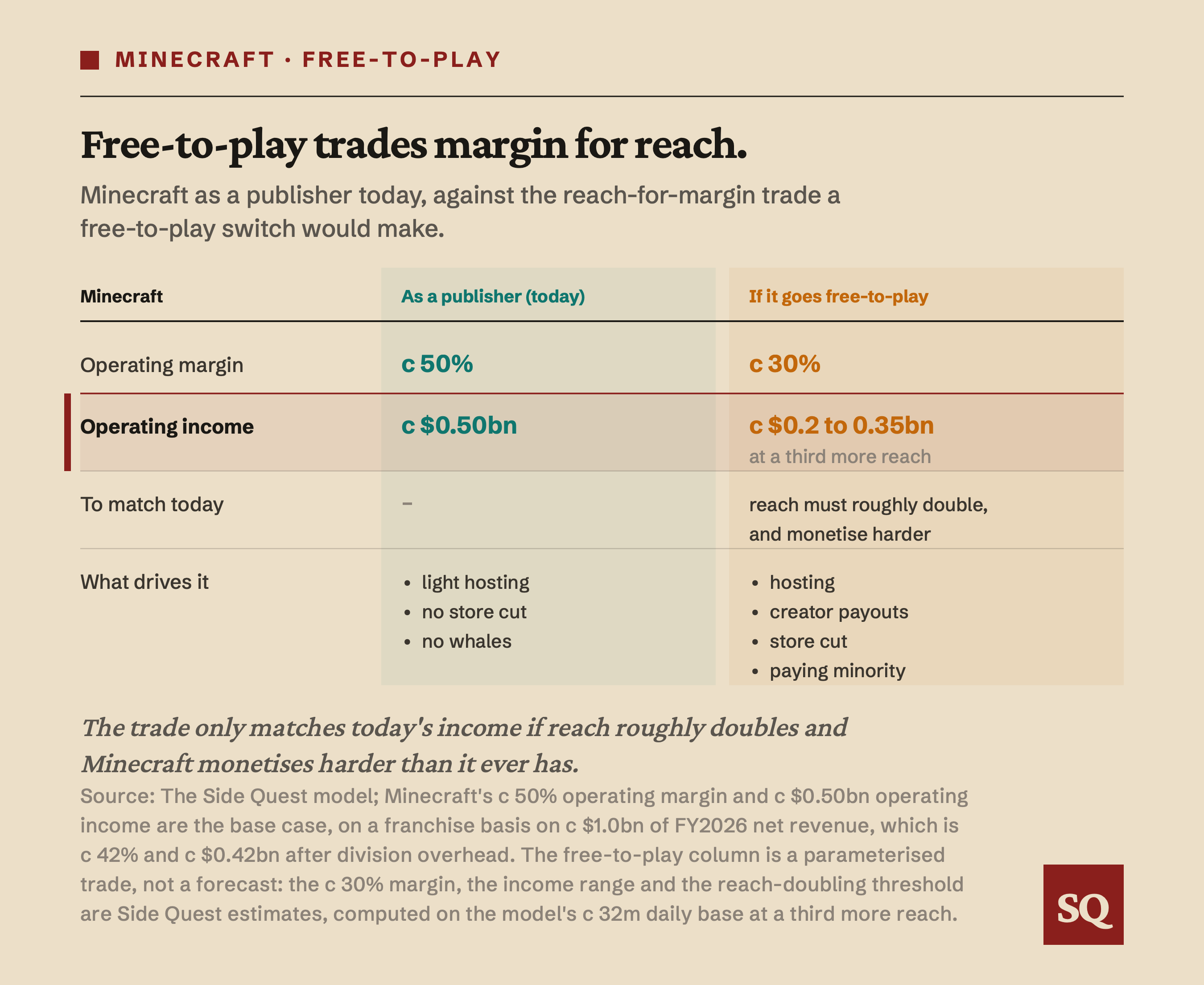
Someone else could weigh it differently: an acquirer buying on a reach thesis, or a Microsoft several years and one rationale from now, might decide the reach is worth the margin where this owner does not. That is a disagreement about value, not a forecast, and a change that large leaves even the version that happens years out and high risk.
Valuation: Rebuilt from the ground up, Xbox is worth about $44bn
The first piece put Xbox at $49bn and this one puts it at $44bn, and the $5bn between them is not a revision so much as a different way of doing the sum. The first valuation took the division as a whole, worked out what margin it ought to earn once the business had settled down, and valued that.
This one takes each business inside Xbox separately, Call of Duty and King and Blizzard and Bethesda and the studios and Game Pass and the hardware, values each on the economics it actually runs on, and only then subtracts what it costs the group to hold them all together. Done that way the content comes out smaller than a divisional average made it look, because an average quietly lets the strong businesses carry the weak ones, and the biggest single change is Game Pass: a subscription we now assume never becomes the moat it was built to be.
The bull case moves further, from about $66bn to $54bn, and for the same reason: the first piece’s bull was mostly Game Pass growing into its moat, and this one does not grow it in any case.
From a Microsoft viewpoint $44bn is still a rounding error, roughly 1.5% of its market value, and on our estimates gaming earns about 3% of Microsoft’s EBIT.
Part 2: Which scenario is most likely for Xbox?
Scenarios: What each separation route returns to Microsoft shareholders
The reset opens a spectrum from keeping everything to selling everything. Every route on it is the same arithmetic: what the business is worth, less what it costs to stand up outside Microsoft, plus whatever Microsoft keeps a contract on.
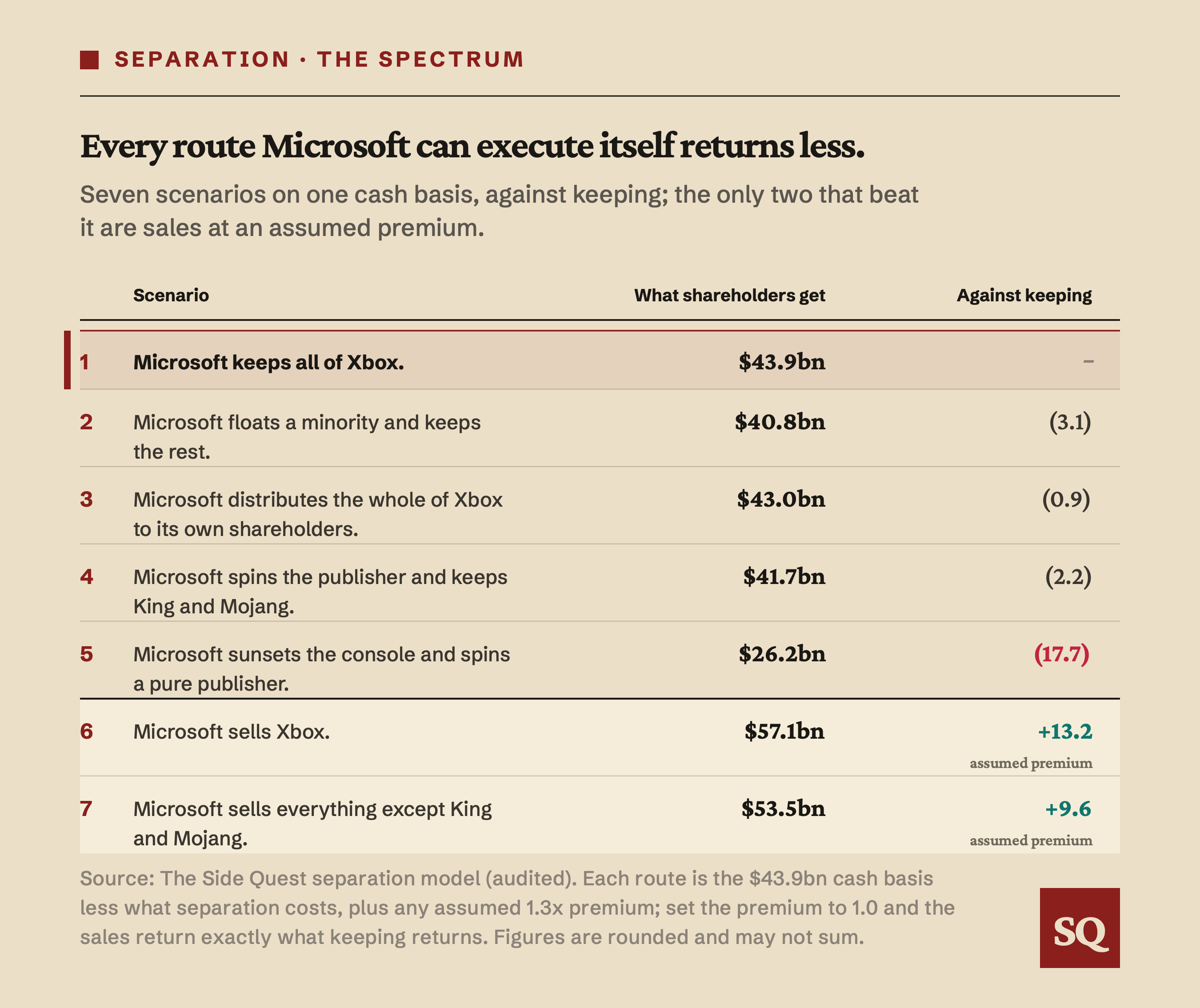
Scenario 1: Microsoft keeps all of Xbox.
This is the reference case and it is what the $43.9bn describes: the business stays where it is, the reset lands, Helix rebuilds the console base through the back half of the decade, and nothing is separated or sold. Nothing about it triggers disposal accounting either, so the Activision goodwill is never marked against a transaction, though Microsoft goes on testing it every year exactly as it would anyway.
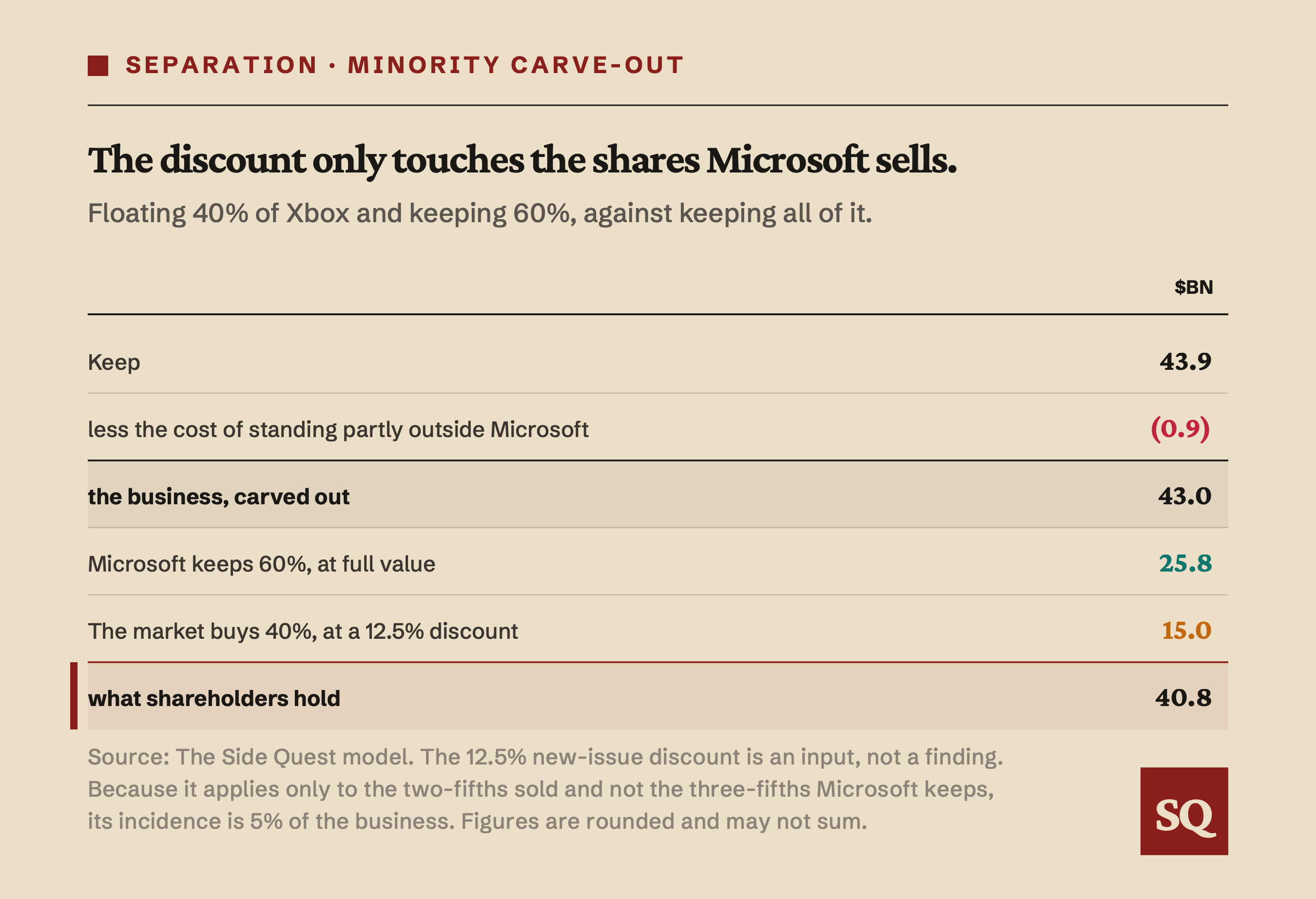
Scenario 2: Microsoft floats a minority and keeps the rest.
It sells 40% of the business to the public market and holds the other 60%, which is enough to keep control and to go on consolidating Xbox inside its own accounts, so there is no disposal to account for and the Activision goodwill is not marked against the float. Three things change and none of them is the business. Xbox gets its own listed shares, so the people running it are paid in Xbox equity rather than Microsoft equity. The market puts a price on a business Microsoft has never priced. And the share register fills with investors who wanted a games company, rather than investors who wanted a diversified software company and got a games division in the bargain.
Standing partly outside costs less here than under any other route, because Microsoft still owns both sides of the Azure relationship and can carry on selling itself cloud capacity at internal cost. What shareholders realise is $40.8bn, against a business worth $43.0bn underneath. The difference is not value going missing: it is the discount Microsoft concedes to get the shares away to people who have never owned them, and because that discount applies only to the two-fifths being sold and not to the three-fifths Microsoft keeps, a 12.5% concession on the float costs 5% of the business.
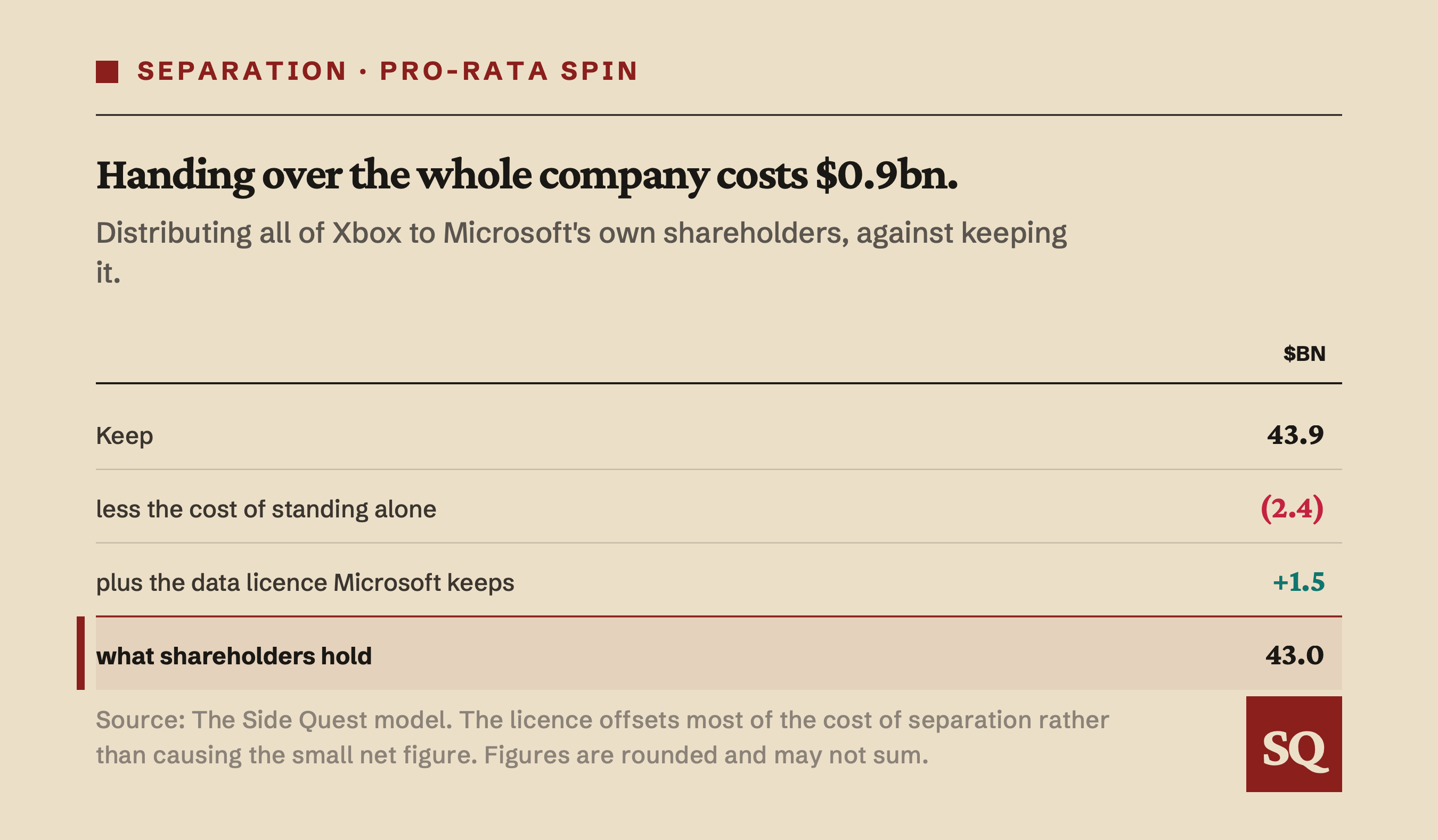
Scenario 3: Microsoft distributes the whole of Xbox to its own shareholders.
Every Microsoft shareholder wakes up owning shares in a separate games company, and Microsoft keeps nothing of the business itself. What that costs is everything Xbox was getting for free by being inside Microsoft: cloud capacity at internal cost, and the whole apparatus a listed company has to build for itself, from a board to a finance function to investor relations. Replacing it comes to $2.4bn, more than any route short of an outright sale, because this is the version where Xbox has to replace all of it at once. Microsoft does not leave empty-handed, though, because it keeps the right to train its AI on the data the games generate, and that licence is worth $1.5bn. Set the one against the other and shareholders end with $43.0bn, against $43.9bn if Microsoft simply keeps the business. Handing over the entire company costs about $0.9bn.
There is one cost the model does not charge here. The shares go to Microsoft’s own shareholders, who are overwhelmingly index funds and people who bought a diversified software company. A mid-cap games business is not what most of them are mandated to hold, so a good number of them will sell it the moment they receive it. What the model credits them with and what they get for it are not the same number.
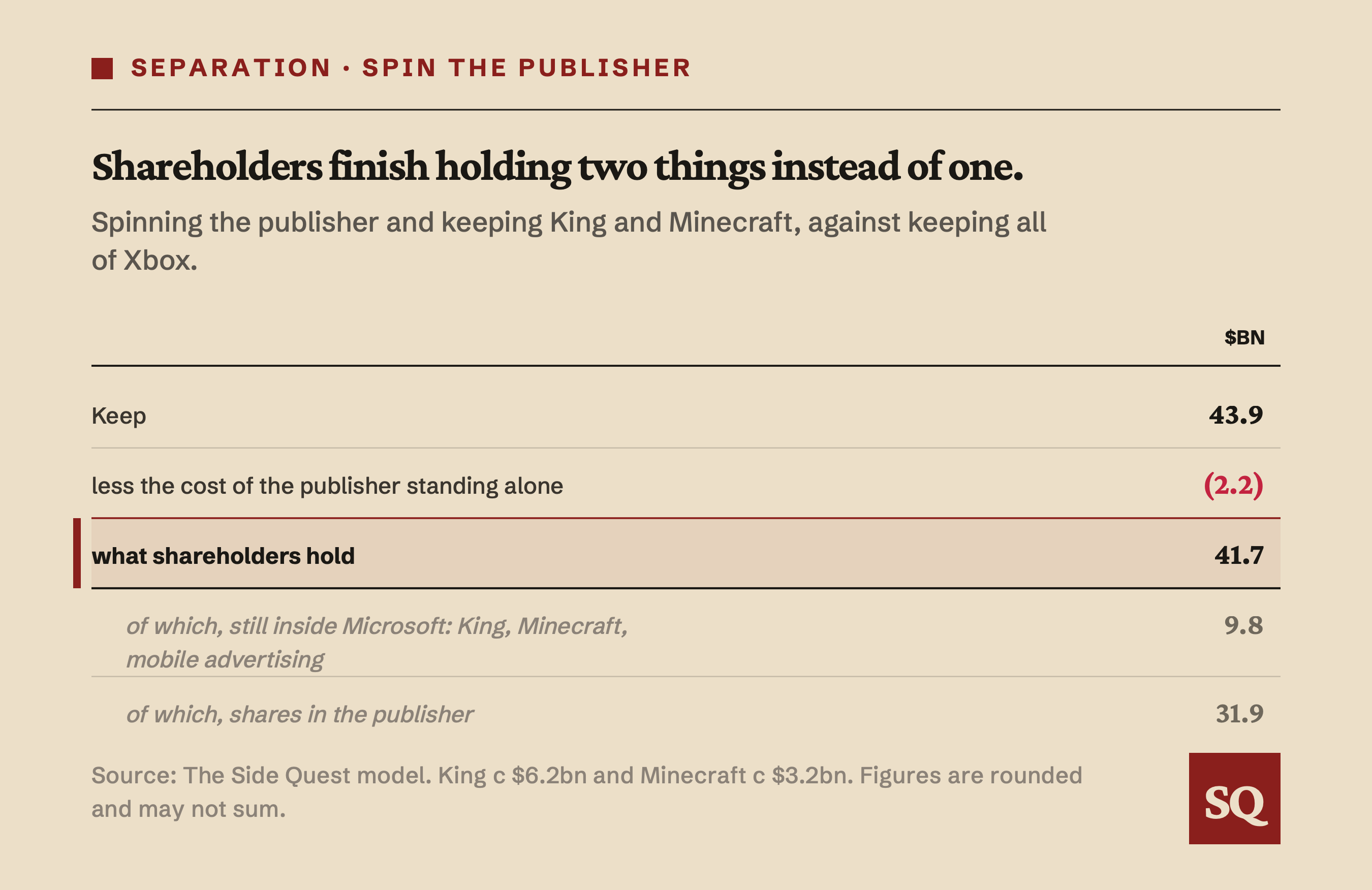
Scenario 4: Microsoft spins the publisher and keeps King and Mojang.
The two Sharma pulled up to report directly to her, the two she calls platforms, stay inside Microsoft alongside the advertising and AI businesses, and the rest goes: Call of Duty, Blizzard, Bethesda, the studios, Game Pass, the store and the console. A Microsoft shareholder finishes holding two things instead of one. Inside Microsoft they still own King at about $7.7bn and Minecraft, with the mobile advertising that sits alongside them, together coming to roughly $11.8bn. Outside it they own about $30bn of shares in the publisher.
Keeping the pair also keeps the games with the real latent data in them, which is why the licence the first piece spent a section on nearly disappears: Microsoft does not need to write itself a contract for data it still owns the games behind, so a $1.5bn licence becomes a $150m one. Add the two pockets and shareholders have $41.7bn against $43.9bn for keeping. The $2.2bn is what the publisher pays to stand up alone, and it is more than Microsoft gives up by handing over the entire company. The reason is that licence: spin everything and Microsoft is paid $1.5bn for data it no longer owns, keep King and Minecraft and it is paid $150m.
Scenario 5: Microsoft sunsets the console and spins a pure publisher.
This is the version where Microsoft stops making the console, and it looks like the cleanest decision on the list, because the hardware loses money every year and stopping would save it. What it costs is everything that sits on top of the console.
The commission Microsoft takes when other publishers sell their games on Xbox decays as the installed base shrinks, because there is no new console coming to replace the old ones: that one line is $10.7bn.
The rest is the console’s own advertising, the subscribers who came in through a console and the cost of winding the platform down, set against the roughly $2.6bn of hardware losses Microsoft stops taking. Game Pass then goes as well, because most of its subscribers arrived through a console, and dissolving it forfeits about $12.5bn of going-concern value, of which about $1.2bn comes back as people buying the games at full price instead, so about $11bn net.
Shareholders end with about $26bn against $43.9bn for keeping, but that number is not what it looks like, because about $12bn of it is King and Minecraft, which Microsoft has not sold and is still holding. Take those out and the publisher that actually changed hands is worth about $15bn, and Call of Duty and Diablo and Elder Scrolls are worth the same there as they were inside Microsoft, because none of what the sunset destroys was in the games to begin with.
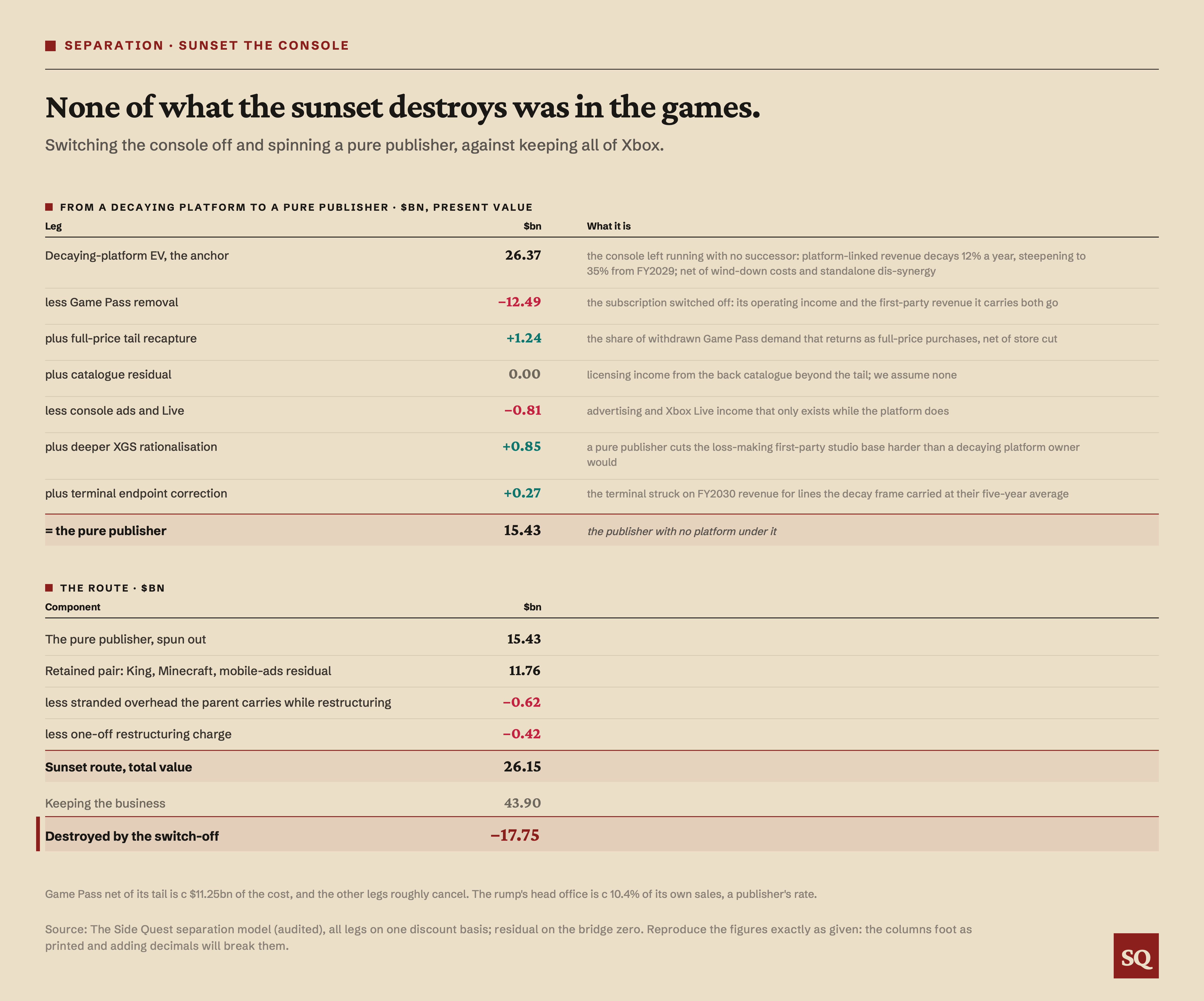
Once the console is gone the publisher that is left earns about $1.7bn a year and spends about $0.8bn running itself, roughly 10% of its sales, about what EA and Activision spent running themselves. You can still get to a $5bn Call of Duty owner, but only by charging the publisher a share of head office sized on revenue the sunset has switched off, Game Pass and the store and the hardware: overhead for businesses that are no longer there.
So the real cost of the sunset is about $18bn, and most of it is Game Pass and the store commission, which only earn while the console does. Microsoft also spends about $1bn stranding and restructuring the head office on the way out, and that is work the reset has already started, 3,200 roles at a time.
Scenario 6: Microsoft sells Xbox.
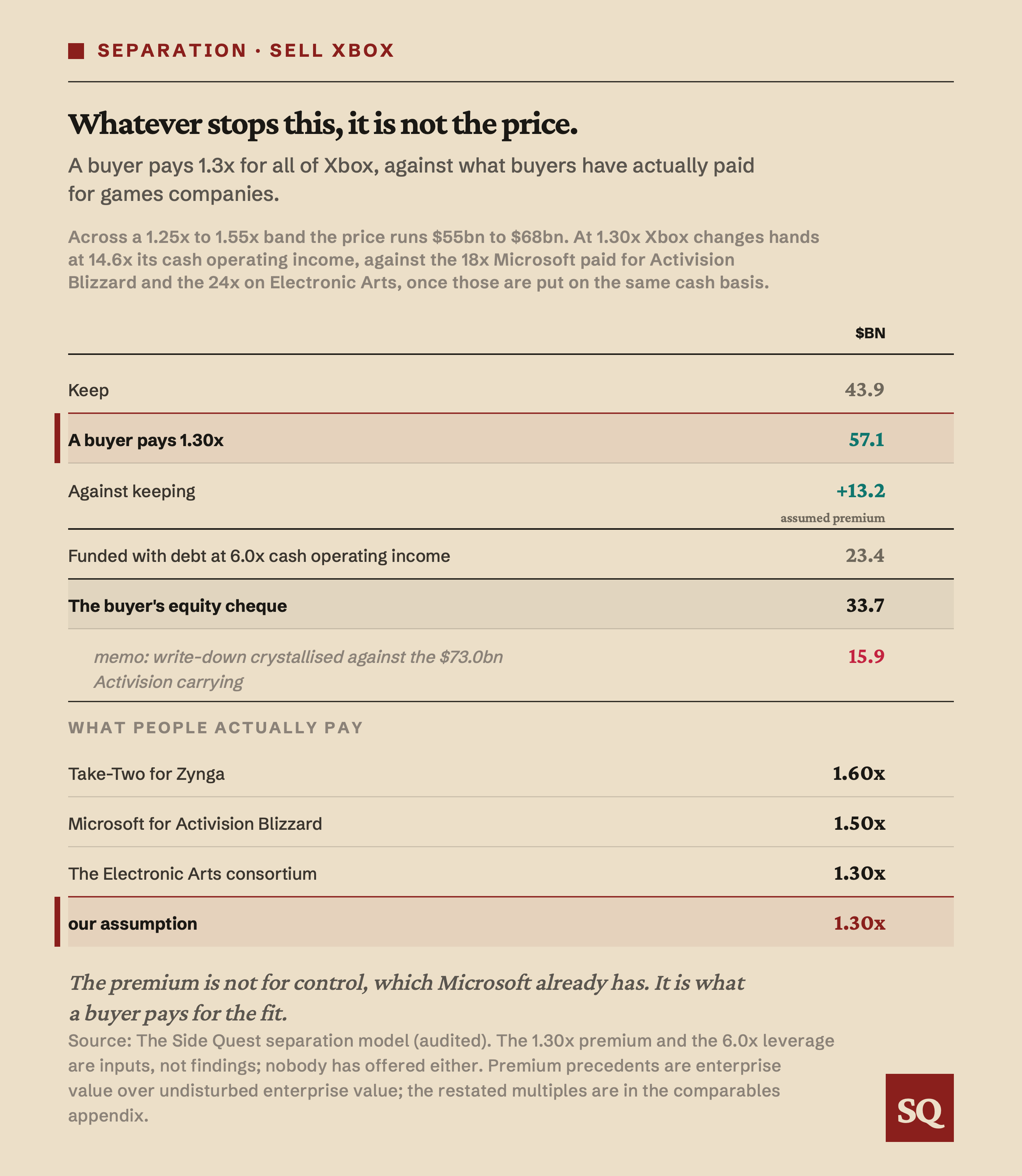
A buyer pays $57bn, which is 1.3x our $43.9bn, a 30% premium, and it is one of only two routes on the list that beats keeping. The premium is not for control, because Microsoft already has control and is not buying it back from anyone; it is what a buyer pays for the fit, for what Xbox is worth in their hands rather than Microsoft’s.
The size of it is defensible against what people actually pay for games companies. Take-Two paid about 1.6x Zynga’s undisturbed enterprise value, Microsoft about 1.5x for Activision Blizzard, both into a rising market, and the consortium taking Electronic Arts private is paying about 1.3x into a falling one, so the 1.3x we assume sits at or below all three.
Run it across a 1.25x to 1.55x band, the bottom set below the cheapest of those deals, and the price runs from $55bn to $68bn. At our 1.3x, Xbox changes hands at 14.6x its cash EBIT, against the 18x Microsoft itself paid for Activision Blizzard and the 24x on Electronic Arts once their multiples are put on the same cash basis. So whatever stops this happening, it is not that the price is too high.
Scenario 7: Microsoft sells everything except King and Mojang.
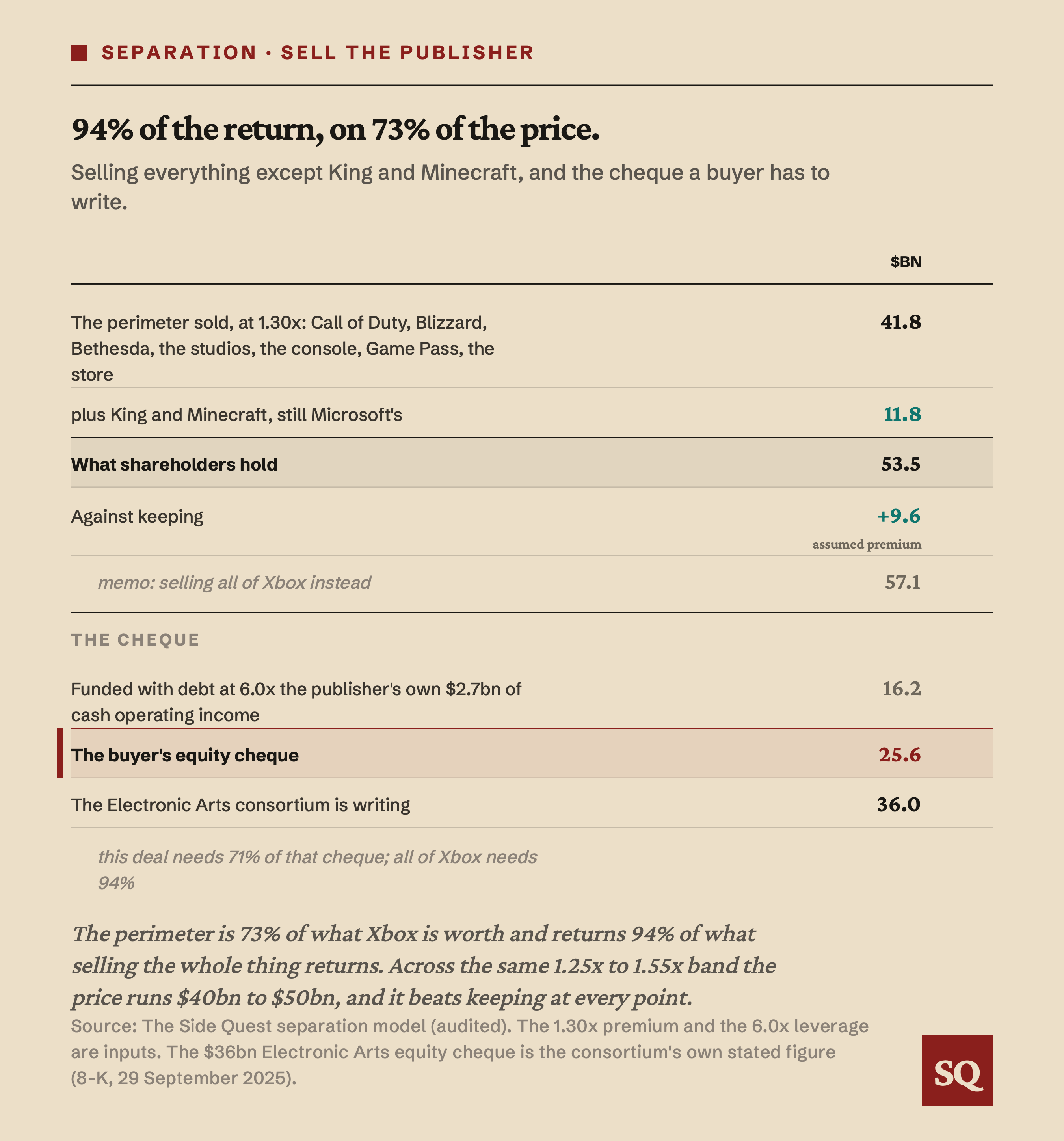
A buyer takes the whole of Xbox apart from the two Sharma calls platforms, so it gets Call of Duty and Blizzard and Bethesda and the studios, and it also gets the console, Game Pass and the store, which together are 73% of what Xbox is worth. Microsoft keeps King and Minecraft. At the same 1.3x premium the buyer pays $42bn for that perimeter, and with the $12bn Microsoft is still holding, shareholders end with about $54bn against $43.9bn for keeping.
That captures 94% of what selling the whole thing would return, on 73% of the price, and the price is the entire point. Fund it with debt at the same six times earnings a real buyout uses and the buyer still has to write an equity cheque of $26bn. The consortium taking Electronic Arts private is writing about $36bn. So this deal needs about 70% of a cheque that a group of people are raising in public right now, where buying all of Xbox needs about 94% of it. Across the same 1.25x to 1.55x range the price runs from $40bn to $50bn, and it beats keeping at every point along it.
What Microsoft Does: It keeps Xbox.
Every route Microsoft can execute itself returns less than keeping the business, and the two that beat it are both sales made entirely of a premium we assumed somebody would pay. Take the premium out and they return exactly what keeping returns.
The first piece called Xbox too small to sell and too strategic to spin, and both of those have moved.
The data was never big enough to decide whether Microsoft separates, but it decides where the line falls, because the licence Microsoft keeps is worth ten times more once the games have gone than it is while they stay.
Too small never meant nobody could afford it either: selling the publisher needs about three-quarters of the equity a consortium is raising for Electronic Arts right now, so somebody can. What stops a sale is that the buyers who could clear a regulator are buying content, and a content buyer has no use for a console, so they would be bidding on whatever survives the sunset rather than on the business Microsoft actually has.
Sharma gave the business its own P&L in July, which is the first thing you build if you might one day sell it, because nobody can buy or spin a business that has never been accounted for on its own. She pulled Mojang and King up to report directly to her, which draws the line exactly where a separation would cut. And she took 3,200 roles out, which hands whoever ends up owning it the cost base they would have wanted anyway. None of it is a decision. She has made Xbox separable without separating it, and the worth of that is entirely in not using it: every version she could execute on her own leaves shareholders with less than doing nothing, and the versions that beat doing nothing are waiting on a buyer who has not appeared.
Postscript: A billion people a day
Sharma has given the business one number to grow into and it is not a financial one: the reset announcement wants Xbox to be “one of the few companies that entertains more than a billion people each day.”
Add up what the portfolio actually reaches on a given day and it comes to about 160 million, and the word carrying that number is instances rather than people. Someone who plays Minecraft in the morning and Call of Duty in the evening is two of them. Nobody outside Microsoft can strip the duplicates out, because the player counts the company publishes are per game and never per person, so 160 million is the ceiling on what the arithmetic can see rather than a count of human beings.
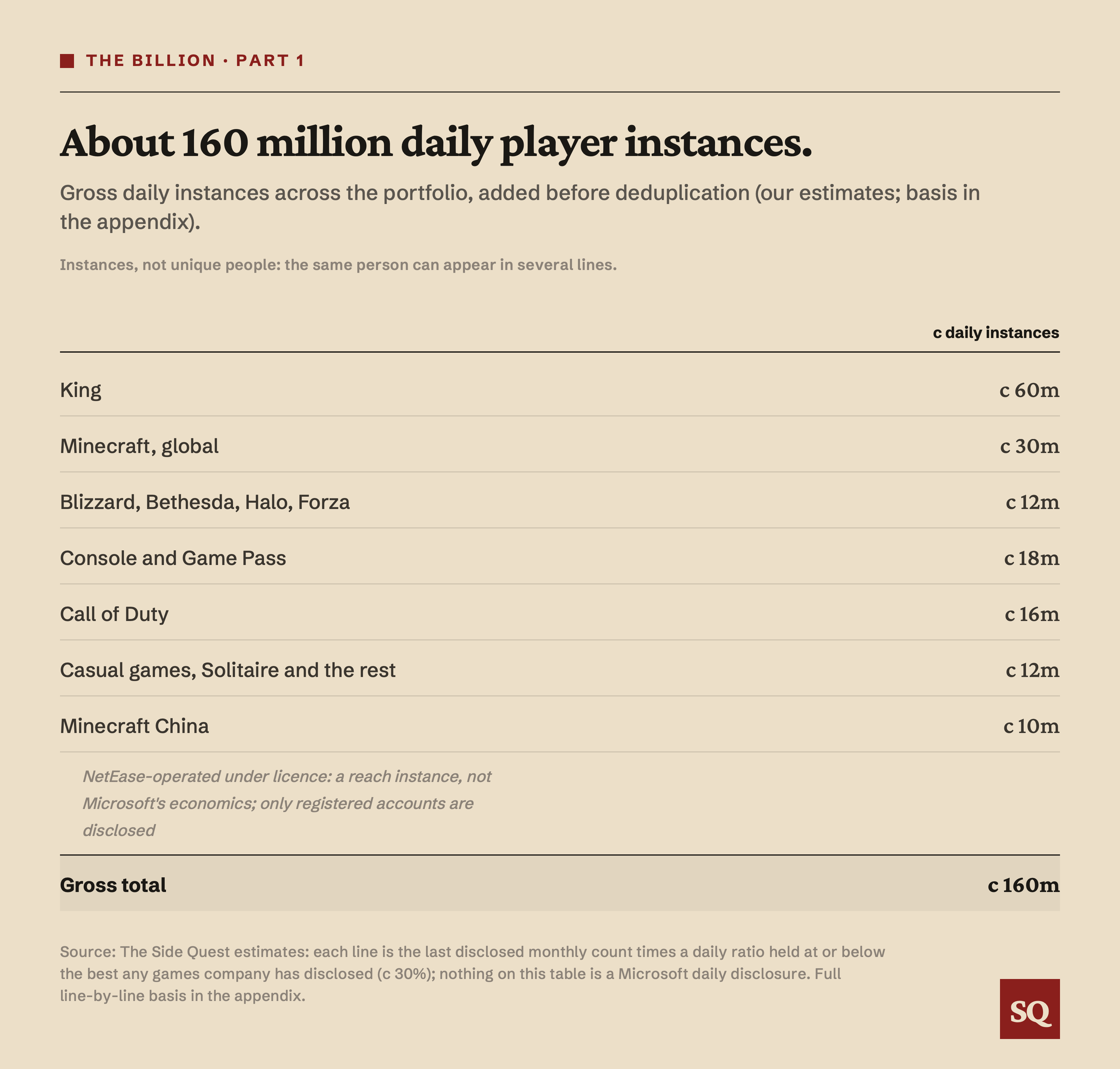
Grow every line as hard as the arithmetic will bear and the total still falls short of half a billion, and even that needs three things to arrive together: a Minecraft larger than Roblox, a King portfolio several times its current size, and a console base rebuilt on Helix. Microsoft is building the third. It is not building the other two, because Minecraft’s premium base stays paid with free-to-play confined to the edges, and the roles King has open keep the existing games running.
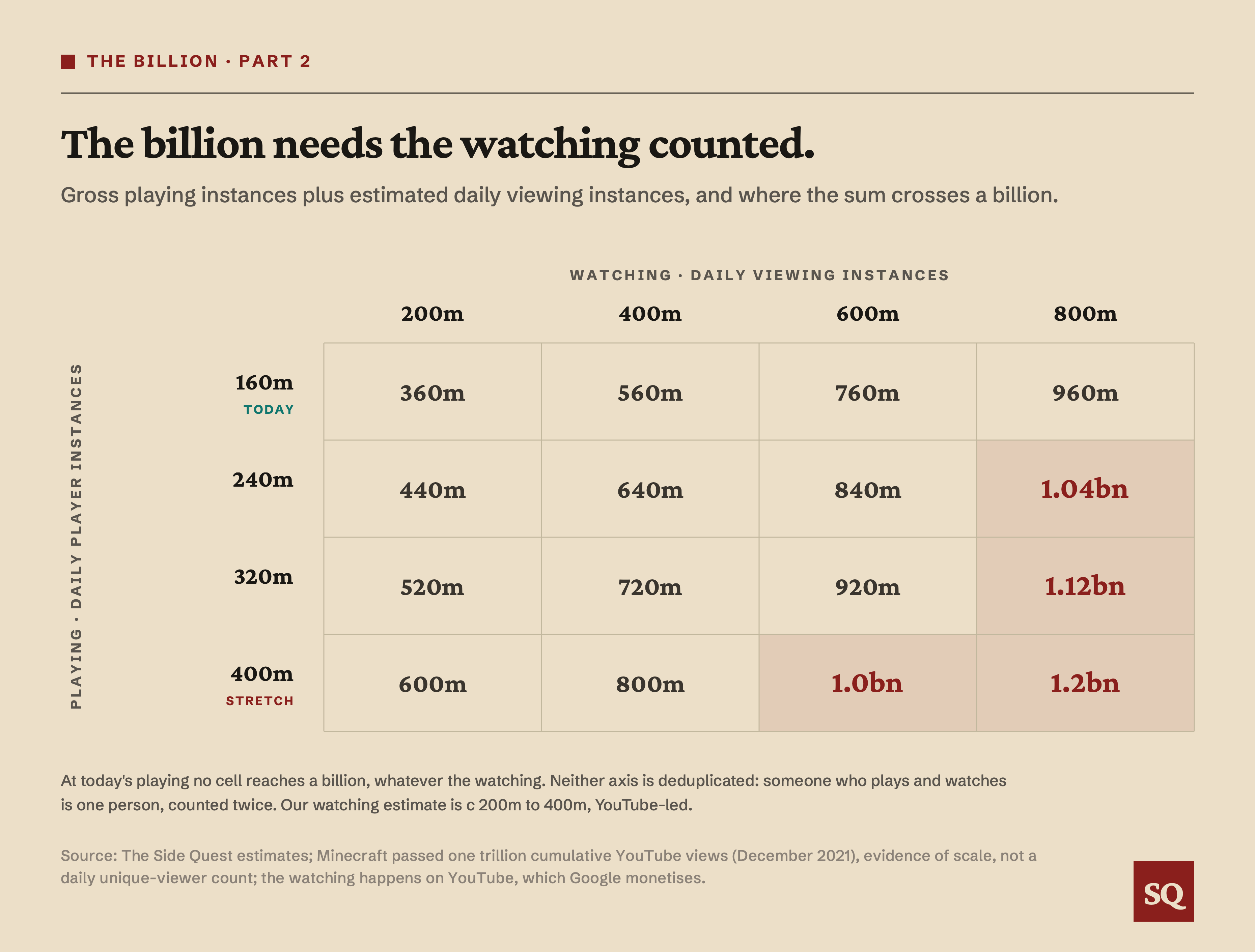
Microsoft’s games are watched far more than they are played, and Minecraft was the first game to pass a trillion views on YouTube, so the billion closes only if entertained is allowed to include watched. At today’s playing estimate the claim needs more than 800 million viewing instances, double the top of what we can evidence. At a viewing estimate we can evidence, no playing case reaches a billion, the stretch case included. The billion lives in the single corner where both are stretched at once, and neither has had its duplicates removed.
Much of that watching happens on YouTube, where Google sells the advertising against it. Microsoft has the content the world watches, and not the place it watches it.
More from The Side Quest
Epic Games: what is it worth, and what did the generosity cost? Fortnite pays for four free layers. The cash Epic captures is worth about $7.5bn; the tools it under-monetises lift fair value toward $14bn, and the last mark sits in between.
Roblox: A great company lost on valuation - It owns the most complete stack in interactive entertainment yet profits from it the least, and rising costs are eating into what little is left.
Microsoft and Xbox: Too small to sell, too strategic to spin - On the numbers, Xbox is worth about $49bn, a rounding error to Microsoft. It won’t be sold, and any separation keeps a grip on the data its games generate.
AI in Video Games: Own the Loop - why a studio keeps its value only if it owns the content-generating learning loop, not the model. Uses Guild Wars 3 as a worked example.
AI won’t make AAA games materially cheaper to develop - the productivity gains are real, but two-thirds of the value leaves the P&L to the AI vendors before it reaches the bottom line.
Appendix:
A1. How the valuation is built
The valuation is a five-year DCF on cash operating income, before stock-based compensation and before the Activision purchase amortisation. The amortisation is non-cash and rolls from $3,070m in FY26 to $480m by FY30, so leaving it in would book the roll-off as an operating recovery; the cash line excludes it throughout.
The parameters:
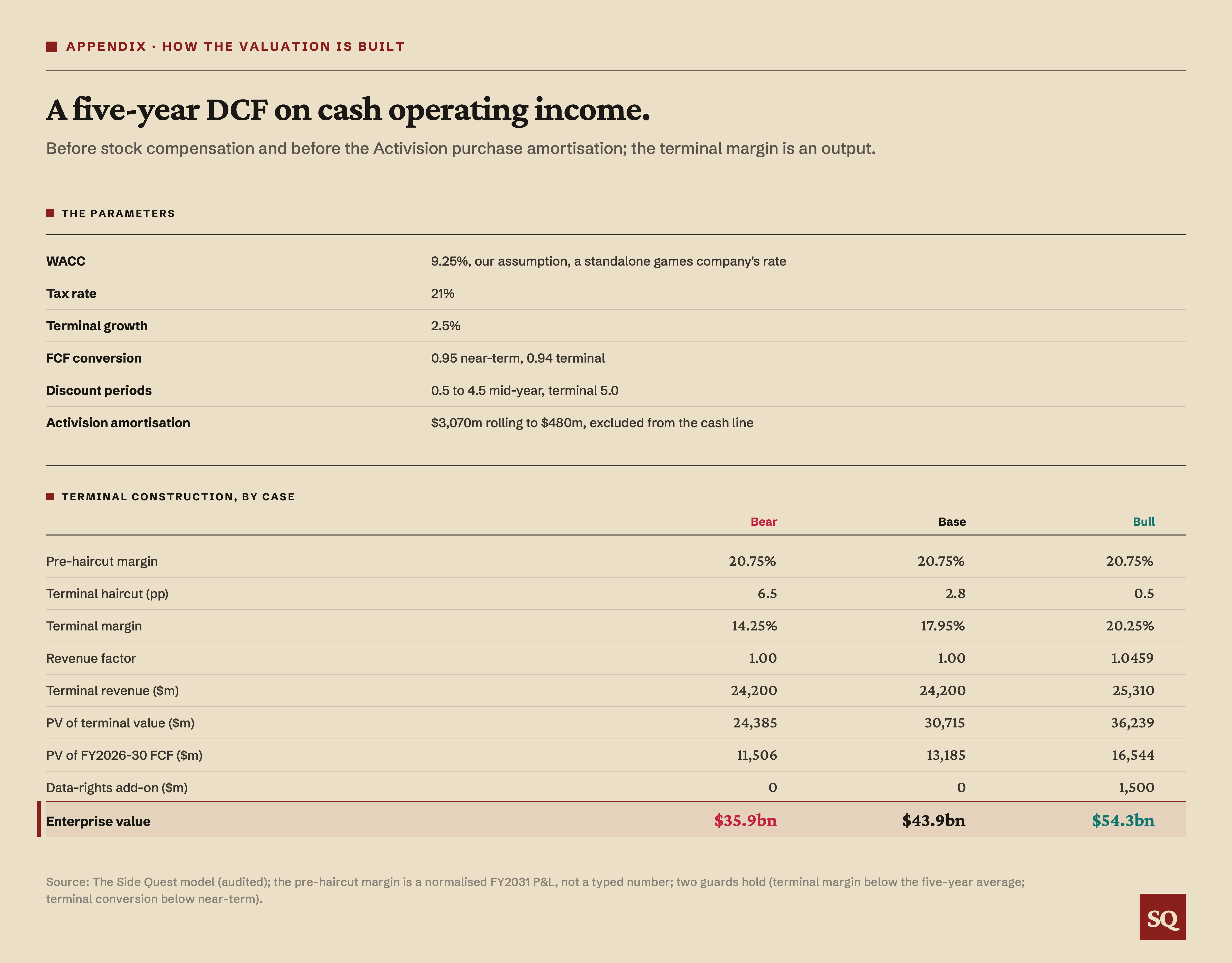
Enterprise value is the same three-line sum in every case: the present value of FY26 to FY30 free cash flow, the present value of the terminal, and, switched on in the bull only, a $1,500m data-rights add-on, our estimate of a capitalised training-data licence. Each forecast year’s free cash flow is cash operating income × (1 − tax) × the near-term conversion, discounted at its mid-year period; the three cases produce different near-term paths because each runs its own switch register, priced lever by lever in A3.
The terminal margin is an output, not a typed number. The model builds a normalised FY31 profit-and-loss: the through-cycle content margin on FY31 content revenue, less a steady-state central cost, less the terminal hardware subsidy. The result, divided by terminal revenue, is a pre-haircut cash margin of 20.75%. Each scenario then subtracts a haircut for platform-cycle risk. The haircut is our judgement, with no external anchor, and it is the single number the three cases most disagree on.
The same goes for the terminal revenue factor. The model carries a three-leg fork of the FY30 active console base, 40m, 47m and 55m consoles, and FY30 revenue is linear in the base, so each leg’s factor falls out in closed form. The base leg is the model’s own FY30 base, and the bear leg is not wired: the bear holds a neutral factor and takes its downside through the haircut, which also embodies its deeper terminal hardware subsidy rather than counting it twice.
The terminal construction, and the three enterprise values it produces. Figures are rounded to the nearest $10m for display; the workbook runs them to the cent.
A2. What the bear and bull actually assume
Every setting that separates the three cases lives in one register, bear, base and bull side by side, plus the Helix installed-base fork, which reaches the bull twice: through the terminal revenue factor and through a derived FY30 cash-operating-income delta. The decomposition below takes the bull’s enterprise value of $54.28bn and returns each lever to its base setting, one at a time, measuring what each is worth; the base case is $43.90bn, so the bull is a claim about $10.4bn, and every dollar of it is priced on a named row.
What the bull is made of, one lever at a time. The bear, on the same treatment: each row is what the bear gives back when that one lever is returned to base, so the column prices the $8.0bn gap between $35.89bn and the base.
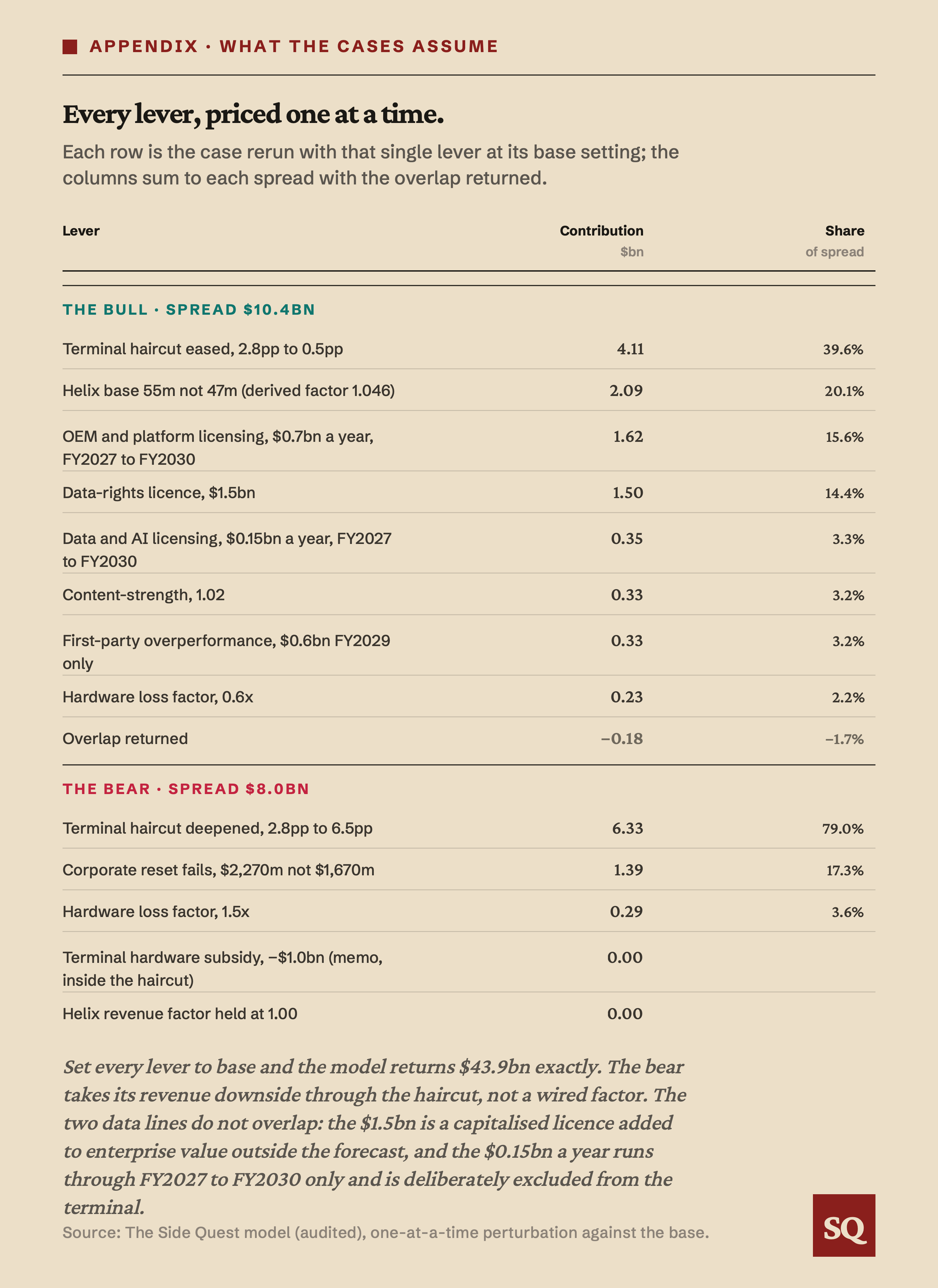
The corporate fork belongs to the bear alone: the bull’s 1,670 is the base’s 1,670, so the bull claims no corporate cut the base does not already assume. The terminal hardware subsidy is a memo, not a working lever: the terminal margin all three cases build from embeds the base’s −$200m, the bear and bull forks feed only the memo row, and both contributions re-derive at exactly 0.00; the deep-subsidy world is priced inside the haircut.
Conservation check: with every bull lever returned to its base setting the bull column re-evaluates to $43.90bn, residual zero against the audited base; the bear column under the same treatment lands on the same figure, to the same residual. The decomposition is the scenario engine’s own arithmetic.
What each lever assumes:
The haircut is our judgement, with no external anchor: a deduction from the normalised terminal margin of 20.75% for platform-cycle risk. The bull’s 0.5pp says the next cycle carries almost none; the bear’s 6.5pp prices a structurally worse decade. It is the largest lever in both directions.
The Helix fork is derived, not typed: the bull assumes the next console generation holds a 55m active base in FY30 against 47m in the base case, and the 1.046 revenue factor is computed from FY30 revenue per incremental console, which the workbook verifies to be linear in the base. The fork sizes are our estimate; Microsoft discloses no installed-base figures.
OEM platform licensing is a press-reported idea priced as if signed: a world in which an OEM pays Microsoft $700m a year to carry the platform. No such deal exists.
The data-rights licence is the licence the first piece derived: roughly $100m a year of training-data value capitalised at 15x, scaled off press-reported AI-data deals (Reddit’s licence to Google runs c $60m/yr). It enters the bull undiscounted, at its face $1,500m.
Data/AI licensing is our estimate from the same evidence family: ongoing external licensing revenue the base does not assume.
The content-strength factor is an execution assumption: content and services operating income runs 2% better from FY27.
The $600m is portfolio overperformance rather than a single title: about 8% of FY29 content operating income, taken once.
The hardware loss factor scales the modelled FY29 to FY30 console losses: the bull’s 0.6x assumes the next launch is subsidised more lightly, the bear’s 1.5x that it costs half as much again.
Corporate is the bear’s claim that the reset step-down never lands: addressable central cost holds at $2,270m instead of falling to the base’s $1,670m.
A3. The base case, parameter by parameter
The article’s base rests on four assumptions; each block below is the parameter path behind one of them. All figures are net-to-Microsoft, $m unless marked, fiscal years ending 30 June, recomputed from Xbox Model v6.5 (audited).
Game Pass: yield, not moat
The subscription is subscribers times a blended monthly price, with operating income built from an explicit cost stack.
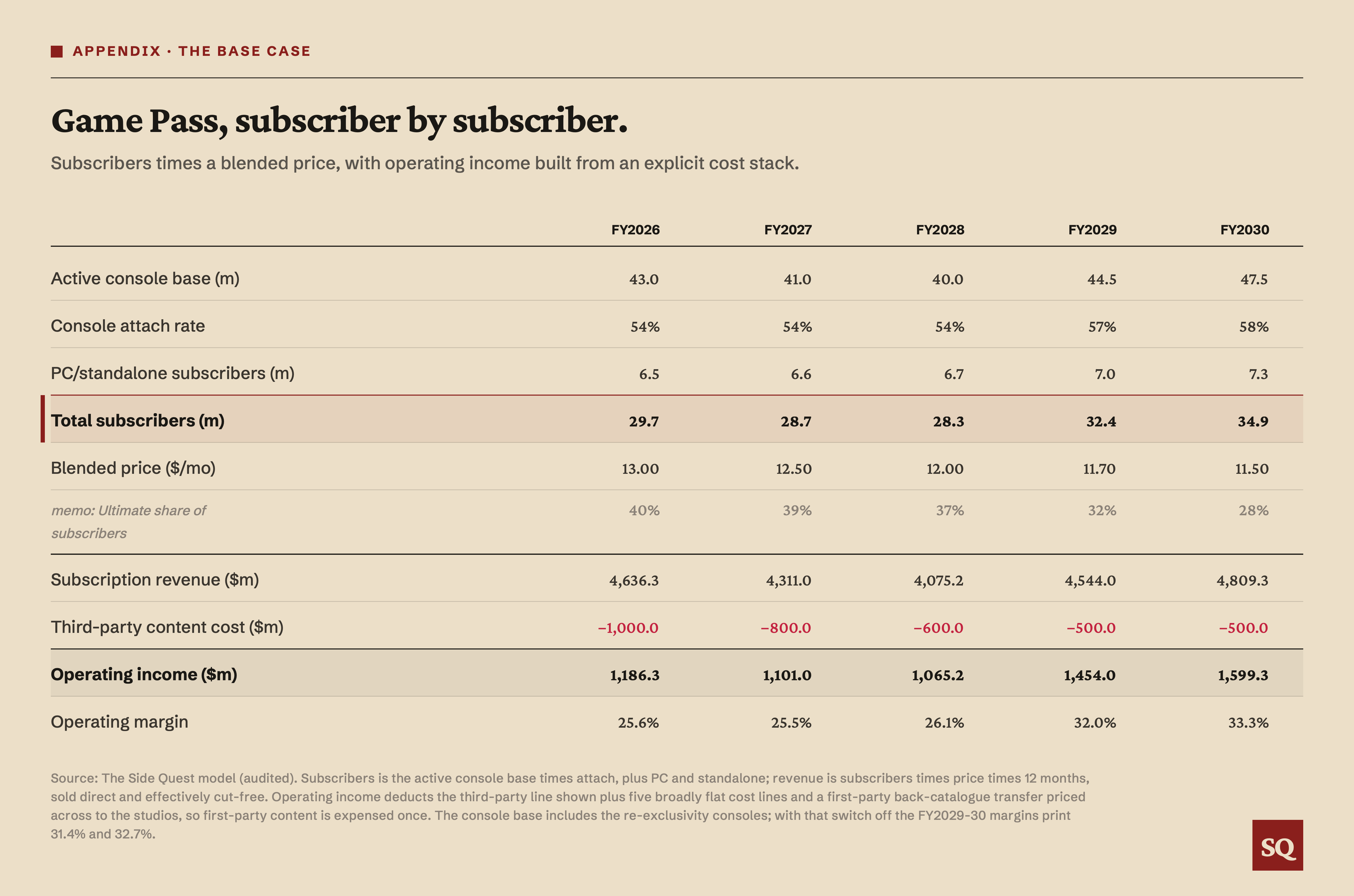
The path starts from the near-$5bn of FY25 Game Pass revenue Microsoft has stated. Attach and price are both our assumptions: attach steps up with the FY29 console launch, and the blended price falls as the Ultimate mix thins from 40% of subscribers to 28%.
The margin expansion comes from the third-party freeze rather than pricing. The roughly $1bn a year Microsoft is reported to pay for third-party day-one content runs off to $0.5bn as deals lapse unrenewed, while the rest of the cost stack holds broadly flat, so the 32.0% and 33.3% margins of FY29 to FY30 are outputs of the stack, not targets.
The console: a subsidy for the installed base
Hardware loses money in every forecast year; what it buys is the installed base that every other line prices off.
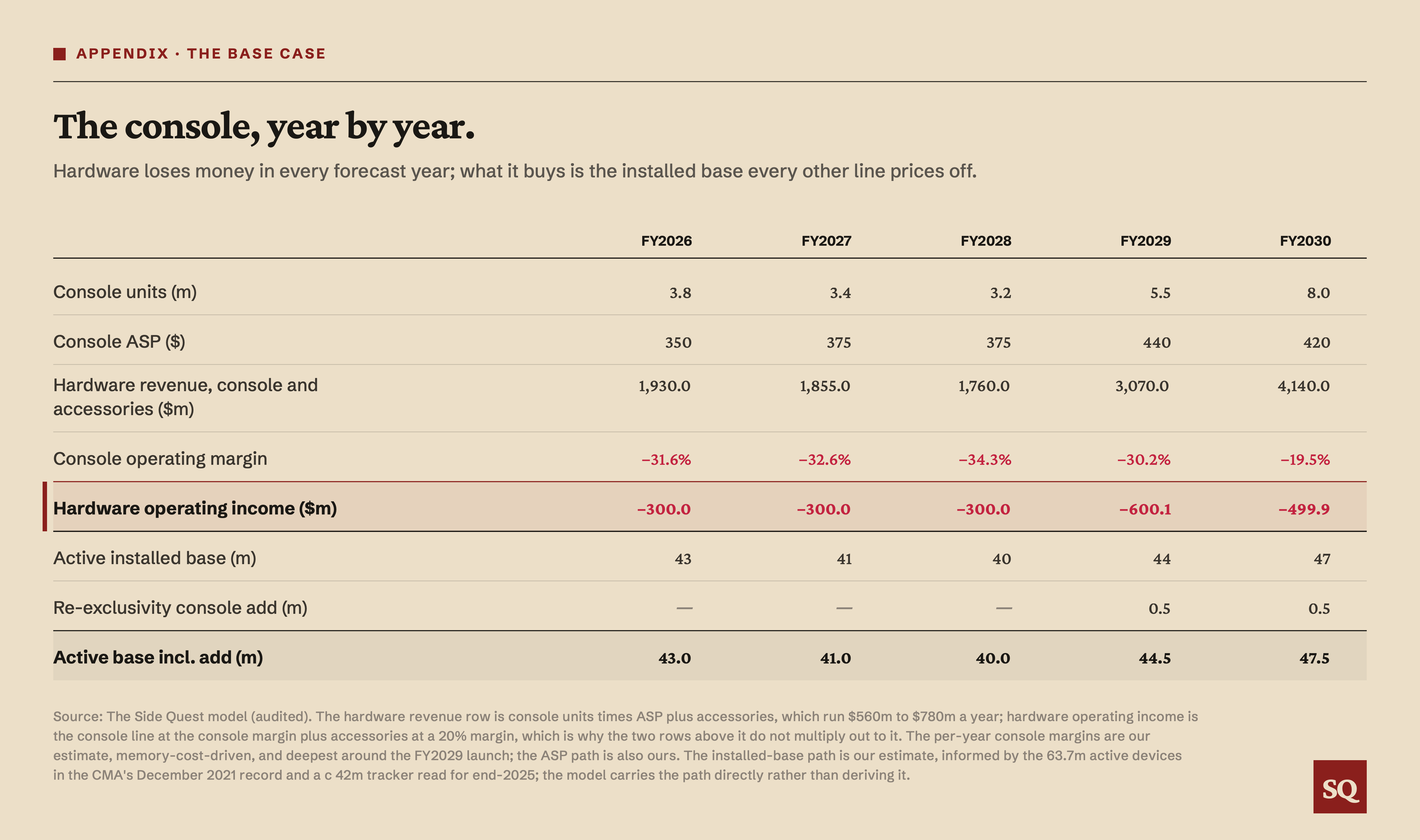
Units trough in FY28 and the next generation launches in FY29; the loss roughly doubles in the launch year before volume narrows the subsidy. The re-exclusivity line adds 0.5m consoles a year from FY29, taking the FY30 base to 47.5m.
Exclusivity: single-player exclusive, multiplayer everywhere
The base ships The Elder Scrolls VI and Halo Next on Xbox and PC only, and prices the choice.
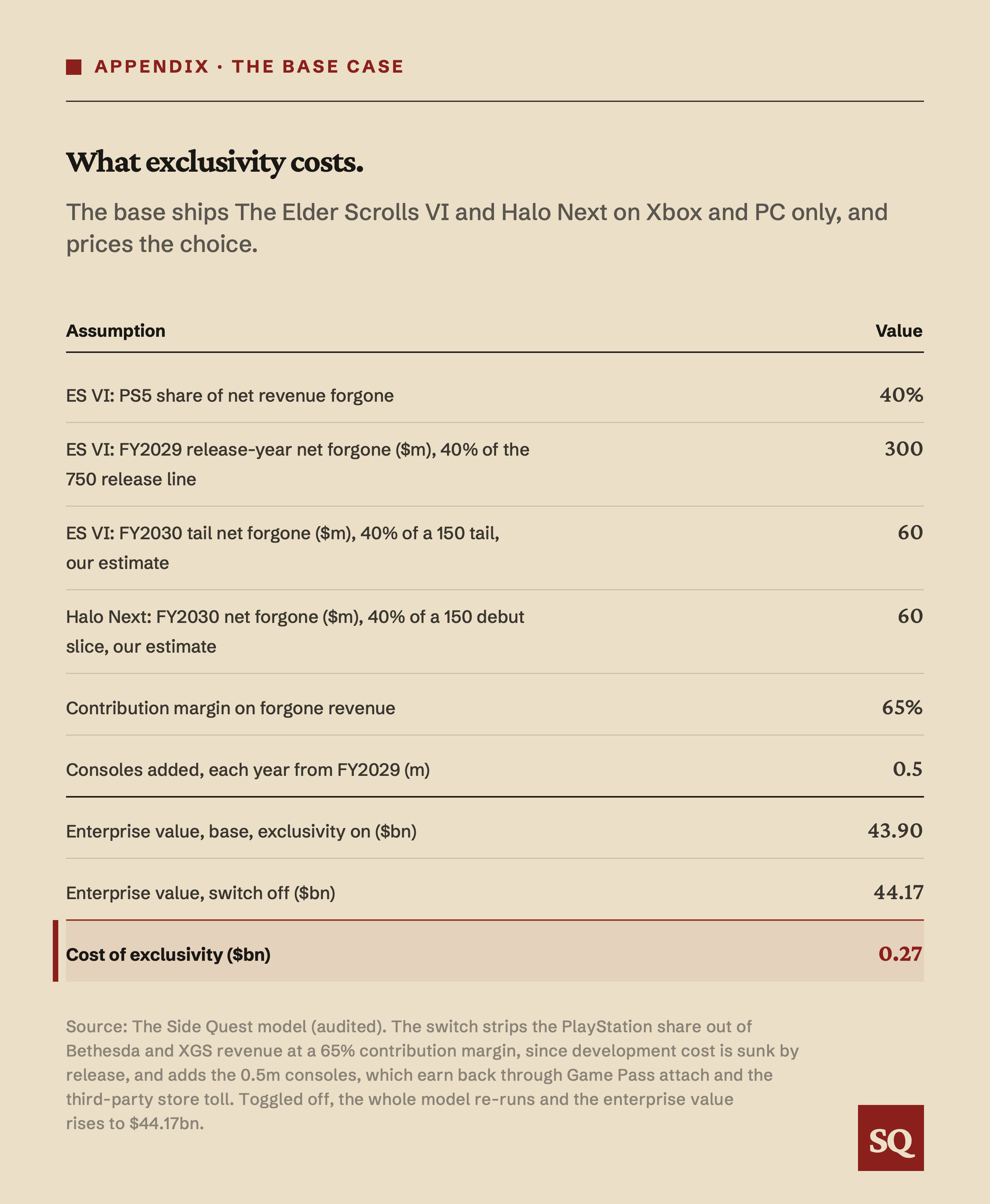
Exclusivity is a net cost of about $0.27bn of enterprise value: two tentpoles’ PlayStation revenue at high contribution outweighs what half a million extra consoles a year earn back. Multiplayer is untouched, since Call of Duty ships on every platform in every scenario, so the base pays for single-player exclusivity only.
Minecraft and King: harvested, not rebuilt
Both franchises are run for cash rather than rebuilt for growth.
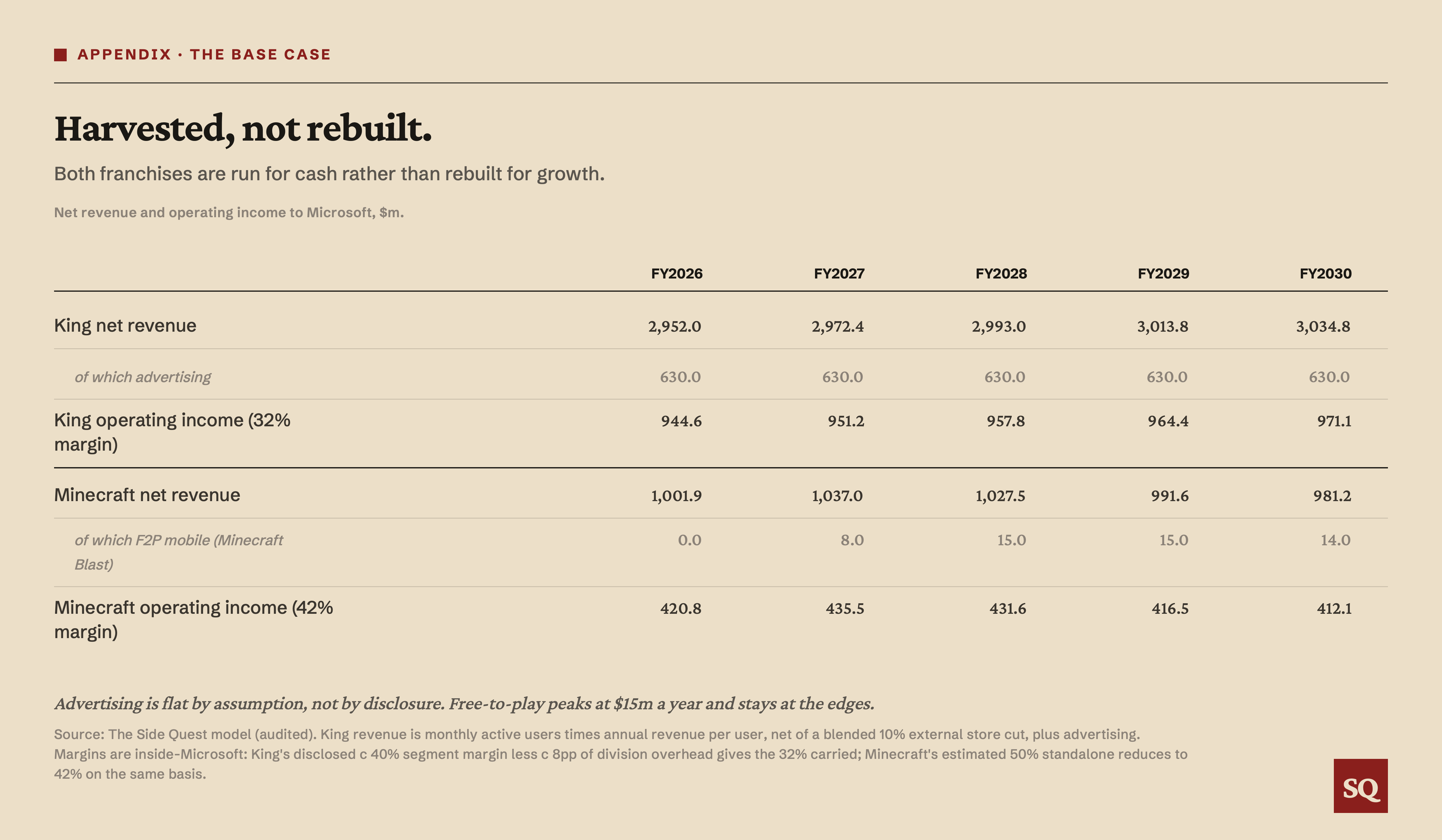
King is harvested: monthly active users drift down 3% a year, revenue per user rises 4% on live-ops pricing, and net revenue drifts to just above $3bn.
Advertising is held at $630m flat across the forecast, an assumption, not a reported figure. The $1.4bn advertising ambition in the FTC record was Microsoft’s 2022 plan for gaming as a whole, not a King line, and it stays at zero here.
Minecraft holds near $1bn of net revenue at a 42% margin. Free-to-play stays at the edges: Minecraft Blast, the King-built mobile title, peaks at $15m a year; the franchise keeps selling copies rather than chasing conversion.
A4. The division, unit by unit
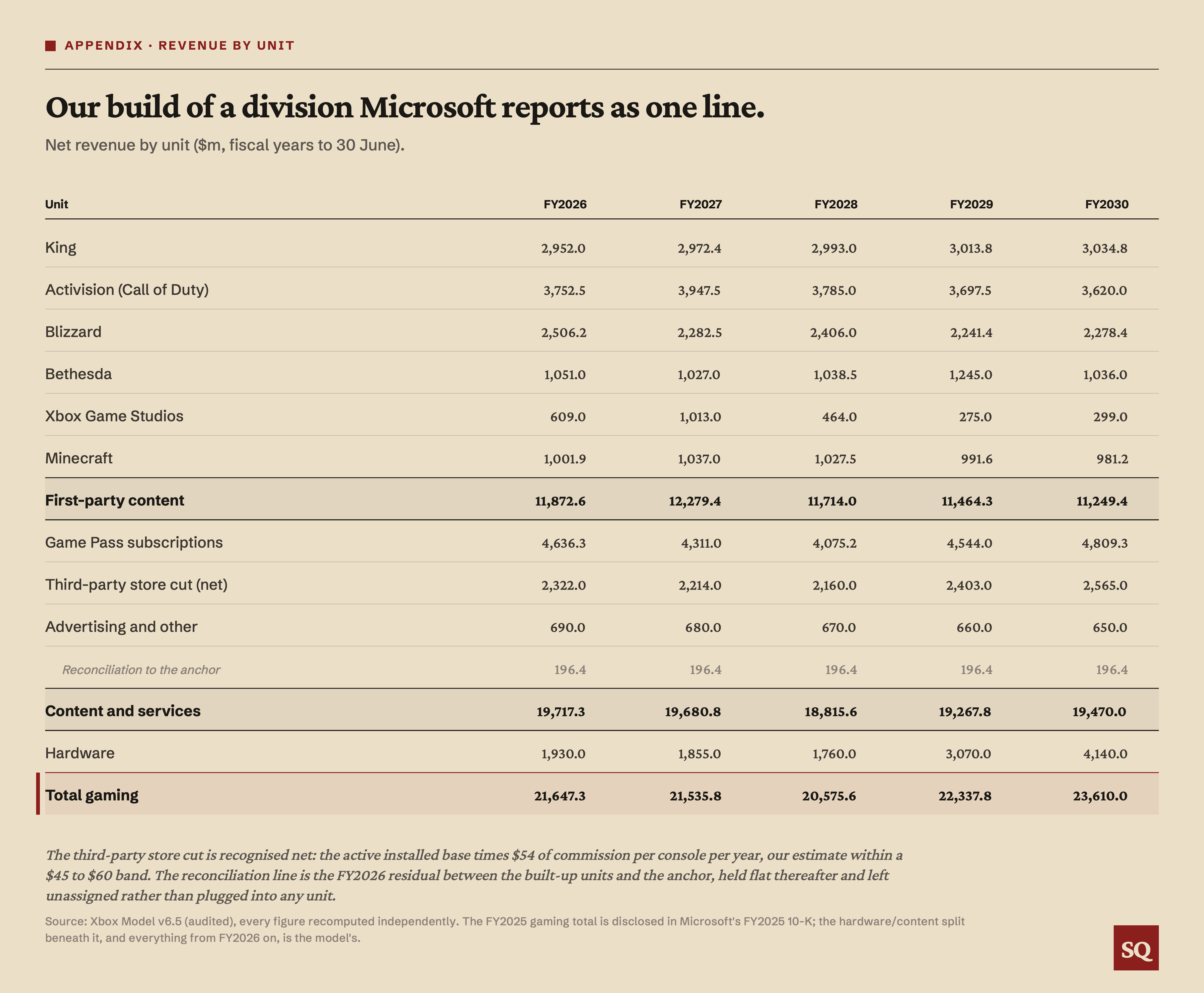
Microsoft discloses gaming revenue only at the division level, and gaming operating income not at all, so both tables here are our build. Two anchors tie it down: the disclosed FY25 gaming total of $23,455m, and FY25 content and services of $20,755m, that total less our hardware estimate, which the FY26 anchor rolls forward at −5%. Every other line is a unit model, built from drivers on its own tab and summed here.
Net revenue by unit ($m, fiscal years to 30 June):
Cash operating income by unit ($m), before stock-based compensation and before the Activision purchase amortisation:
First-party revenue is roughly flat across the span, the slate cycling rather than growing, and its operating income holds in a narrow band with it. Game Pass bottoms in FY28 and recovers when the next console, Helix, launches in FY29, the same year the hardware loss doubles on launch subsidy before easing as the machine scales. Central steps down from $2,897.5m in FY26 to $2,300.0m a year once the front-loaded reset costs clear, and that single step supplies most of the improvement in the total.
A5. Every route, against keeping
The body walks these routes as stories; here they are flattened onto one arithmetic: what the perimeter earns, less what standing alone costs, plus whatever Microsoft keeps a contract on. Everything is computed at the live central-cost basis: overhead is allocated by what caused it, so the corporate cost attached to revenue a route destroys dies with that revenue instead of landing on the survivors.
Workings, in $bn. The going-concern spin perimeters re-sum to the $43.90bn base before separation costs (residual zero inside the workbook), so for those routes the gap to Keep is exactly what separating costs less what comes back by contract. The sunset routes are not like that: switching the console off destroys operating economics before anything is separated, so their perimeters start below the base and most of their gap to Keep is destruction rather than separation cost. A6 takes that apart leg by leg. Figures are rounded to the nearest $100m in the route table above and to the nearest $10m in the workings below; the workbook runs them to the cent, so a leg may sit a cent from its stated sum.
Keep is the core model’s base enterprise value, $43.90bn, reproduced in the scenarios workbook to the cent.
Minority carve-out. The business is worth $42.97bn after the mildest dis-synergy of any route. Microsoft’s retained 60% at carrying ($25.78bn) plus the floated 40% net of a 12.5% new-issue discount ($15.04bn) realises $40.83bn; the $2.15bn conceded is a transfer to the incoming holders, not value destroyed.
Spin everything. $43.90bn less $2.44bn of dis-synergy leaves a spun company worth $41.46bn; the $1.5bn data-rights licence Microsoft keeps brings the route to $42.96bn.
Spin content, sunset the console. The spun content company, once the console decays away and Game Pass is wound down, is worth $26.61bn; the same $1.5bn licence brings the route to $28.11bn.
Selective spin. The retained trio ($11.76bn) plus the spun company after dis-synergy ($29.94bn) comes to $41.70bn.
Sunset, then spin the publisher. The retained trio less $0.62bn of overhead stranded at the parent while it restructures and a $0.42bn one-off restructuring charge leaves $10.72bn; the pure publisher is worth $15.43bn; the route totals $26.15bn.
Trade sale. 1.30 × $43.90bn = $57.07bn of cash. The buyer’s equity cheque is $33.68bn after $23.39bn of acquisition debt (6.0x the division’s $3.90bn of FY26 cash operating income), and the sale crystallises a $15.93bn write-down against the $73.0bn Activision carrying.
Publisher sale. 1.30 × the publisher perimeter’s $32.14bn, the premium struck before dis-synergy, matching the trade sale’s construction, gives a $41.78bn price; the retained pair adds $11.76bn; the route totals $53.54bn. The cheque is $25.63bn, on $16.15bn of debt under the same 6.0x rule applied to the publisher’s own $2.69bn of FY26 cash operating income.
Every route Microsoft can execute on its own returns less than keeping: the cheapest concession is the pro-rata spin’s $0.9bn, the dearest the publisher sunset’s $17.7bn. The two that clear the bar are sales, and everything they add is the assumed premium: set it to 1.00x and both collapse back onto the base to the cent.
Dis-synergy is the same two sourced legs as the first appendix: incremental public-company G&A at 0.55% of revenue, anchored between Kenvue’s disclosed 0.39% under a transition-services agreement and GE HealthCare’s 0.64% at a full break, plus $112m a year of Azure at commercial rates, flexed by perimeter and structure.
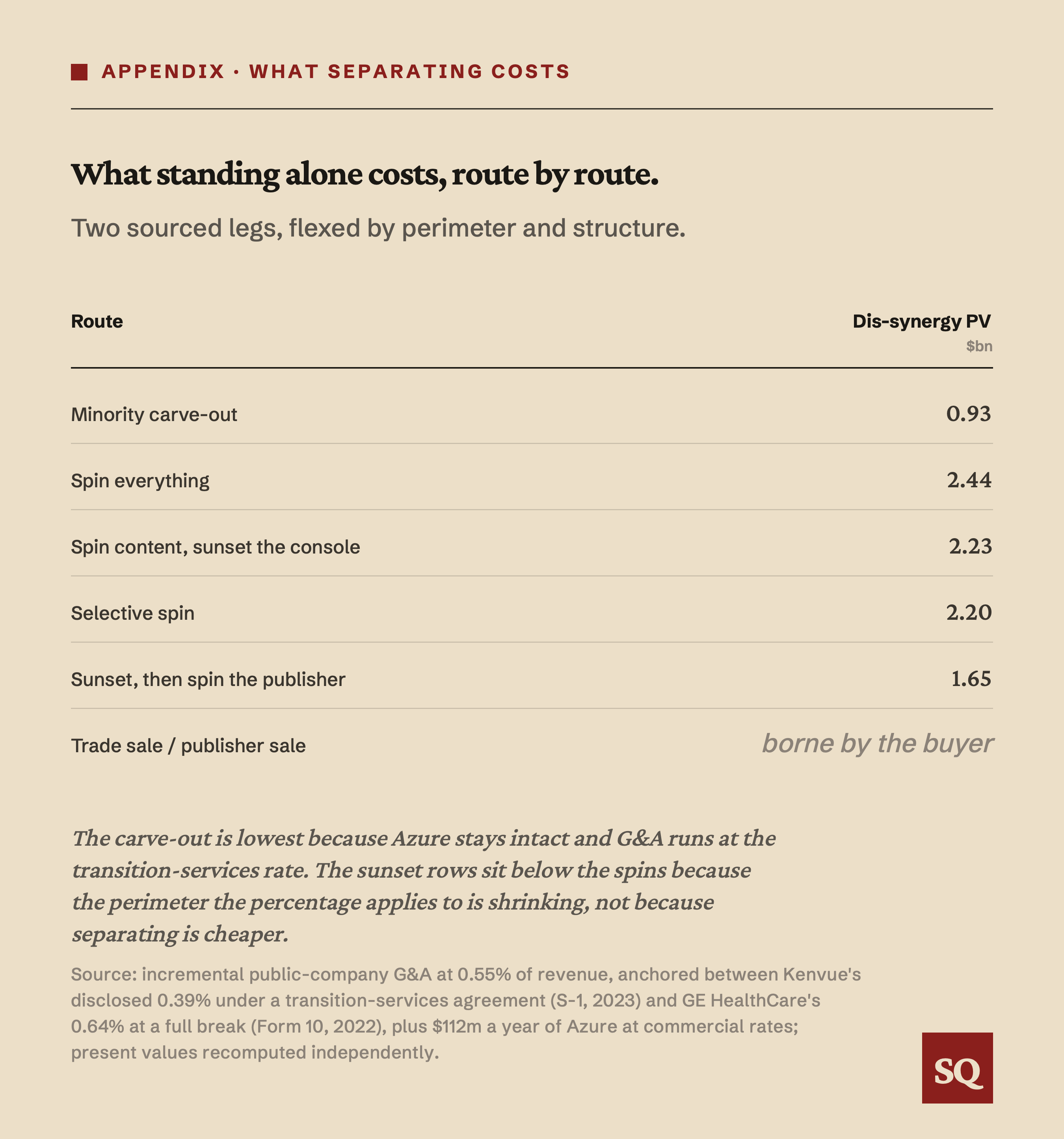
The carve-out is lowest because Azure stays intact and G&A runs at the transition-services rate; the sunset rows sit below the spins because the perimeter the percentage applies to is shrinking, not because separating is cheaper. The sunset routes also carry costs that are not dis-synergy and already sit inside the first table: a hardware wind-down of $1.44bn and, on the publisher route, the stranded overhead and restructuring left at the parent.
A6. What switching off the console destroys
The sunset route values what is left after Microsoft stops making consoles: the publisher spun out, King, Minecraft and the mobile-ads residual kept. The perimeter throughout is everything that would leave, the whole of Xbox less that retained pair. The scenario model builds the spun-out publisher as a bridge: it starts from a conservative anchor, the platform simply left to decay, then names every piece the dissolution adds or removes, all on one discount basis, and the bridge must foot back to the scenario’s own independently built publisher value.
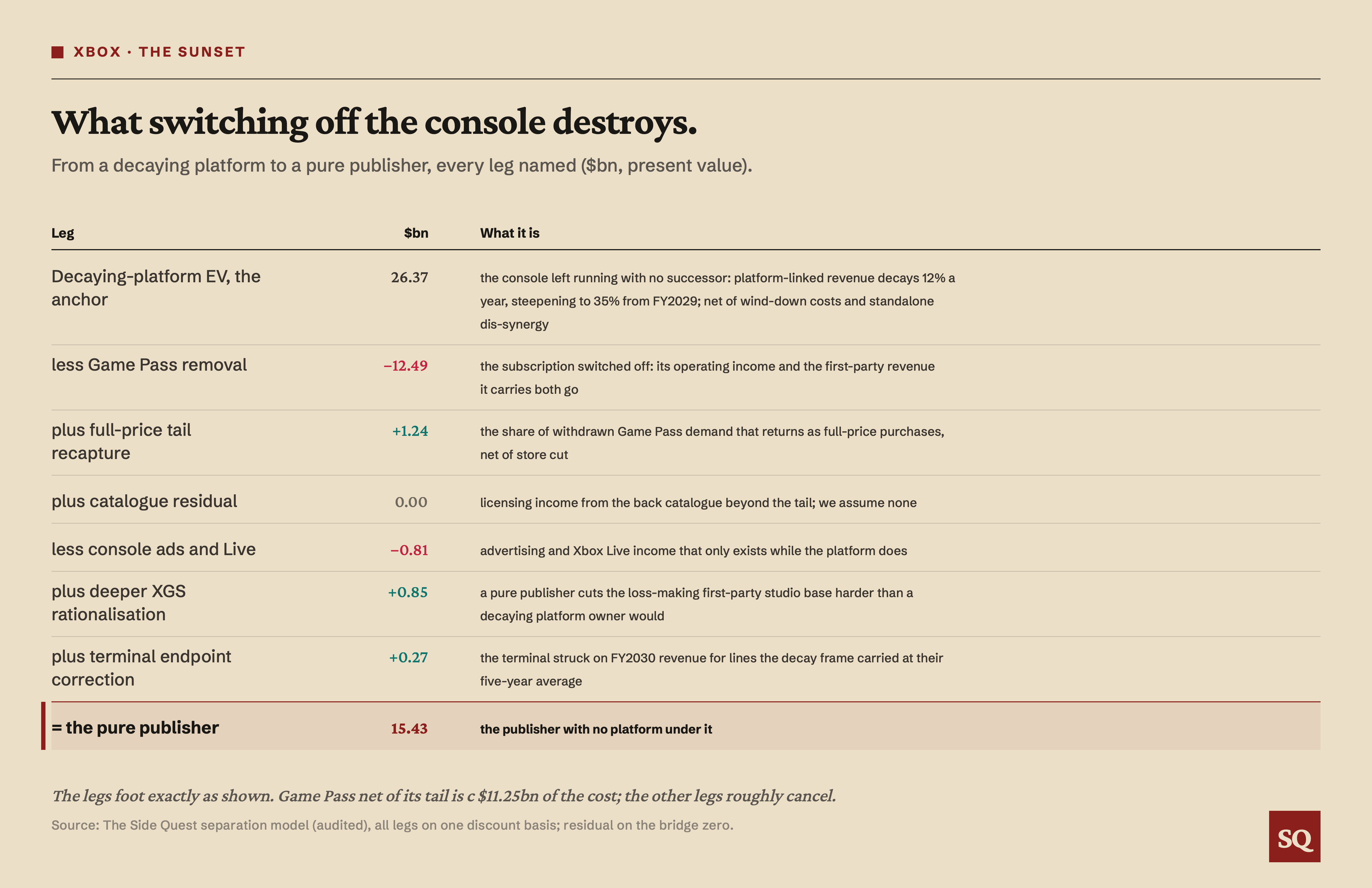
Every leg is a present value on the model’s 9.25% discount rate and 21% tax rate. Residual check: the anchor plus the legs, less the scenario’s own independently built value, comes to zero; the legs are rounded for display and foot exactly as shown.
Measured against letting the platform decay, dissolving Game Pass costs $10.94bn in total, and the Game Pass leg net of its full-price tail is $11.25bn. Game Pass is essentially the whole cost; the other legs roughly cancel.
Table A6b: the route. The pure publisher is one side; Microsoft’s retained pair is the other, less two charges the parent bears for dismantling the cost base of the revenue the shutdown destroys.
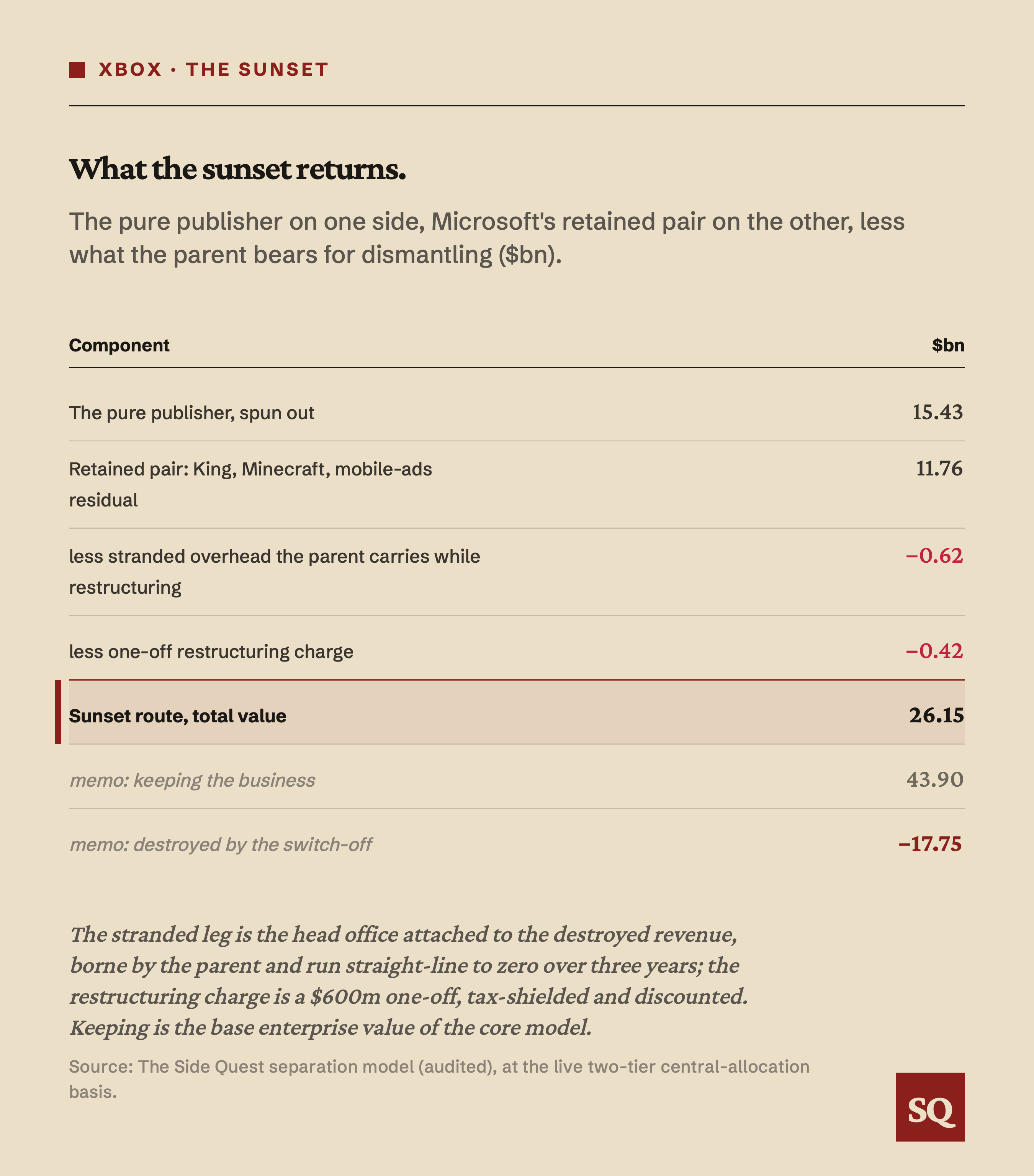
The stranded leg is the head office attached to the destroyed revenue, borne by the parent and run straight-line to zero over three years; the restructuring charge is a $600m one-off, tax-shielded and discounted. Keeping is the base enterprise value of the core model.
Table A6c: the rump’s head office. In the terminal year the surviving publisher is charged a full standalone head office, sized on the sales it actually keeps rather than the revenue the shutdown destroyed.
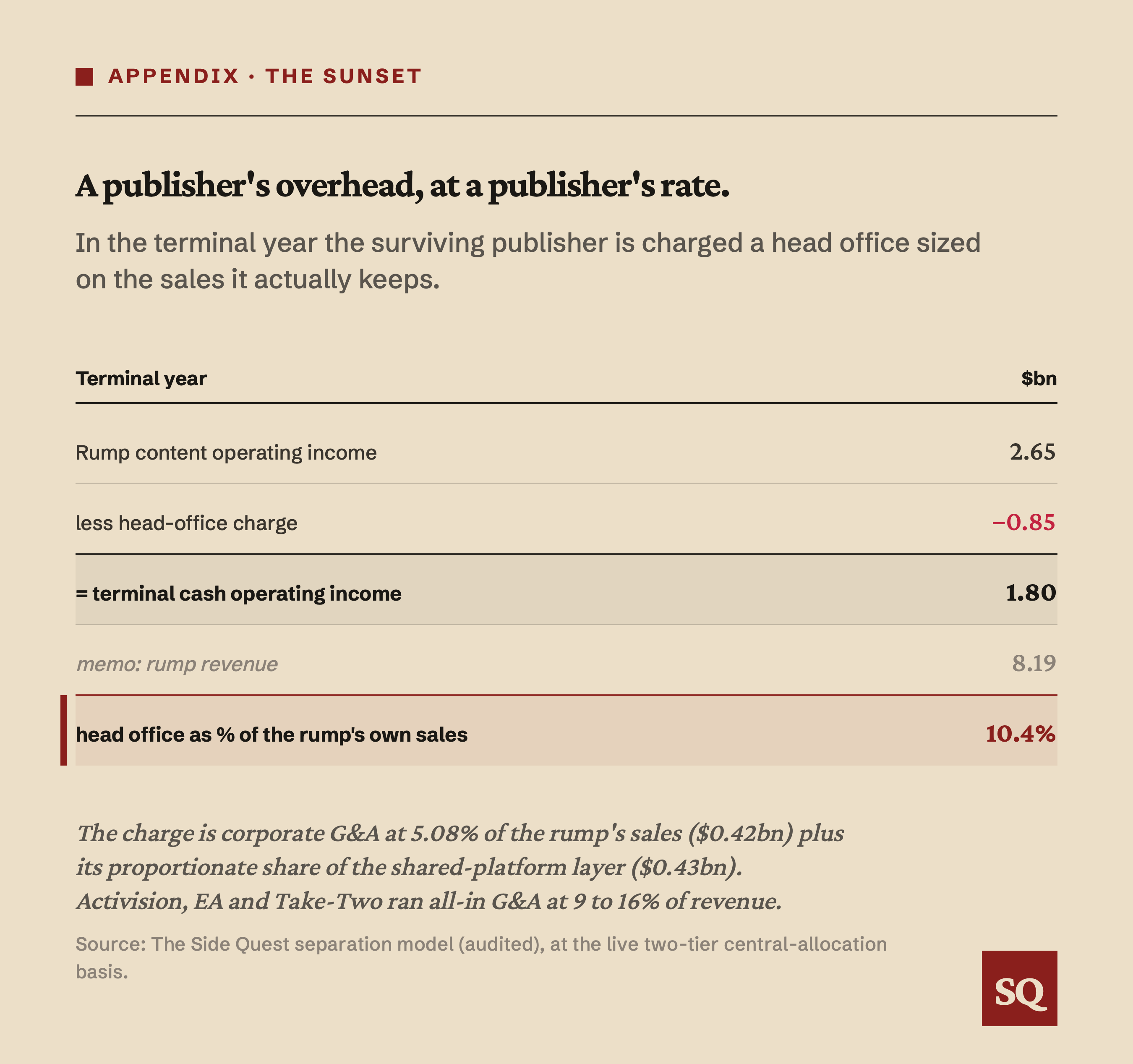
The charge is corporate G&A at 5.08% of the rump’s sales ($0.42bn) plus the rump’s proportionate share of the shared-platform layer ($0.43bn). That is a standalone publisher’s overhead at a publisher’s rate: Activision, EA and Take-Two ran all-in G&A at 9 to 16% of revenue.
A7. Comparables and premium precedents
The article values Xbox on cash operating income before stock compensation. The comparables’ published multiples run on GAAP operating income, which charges it, so comparing the two directly mixes bases. The table carries both: the multiple as usually quoted, and the same deal restated to the article’s cash basis by adding each company’s disclosed stock compensation and acquisition amortisation back to its operating income.
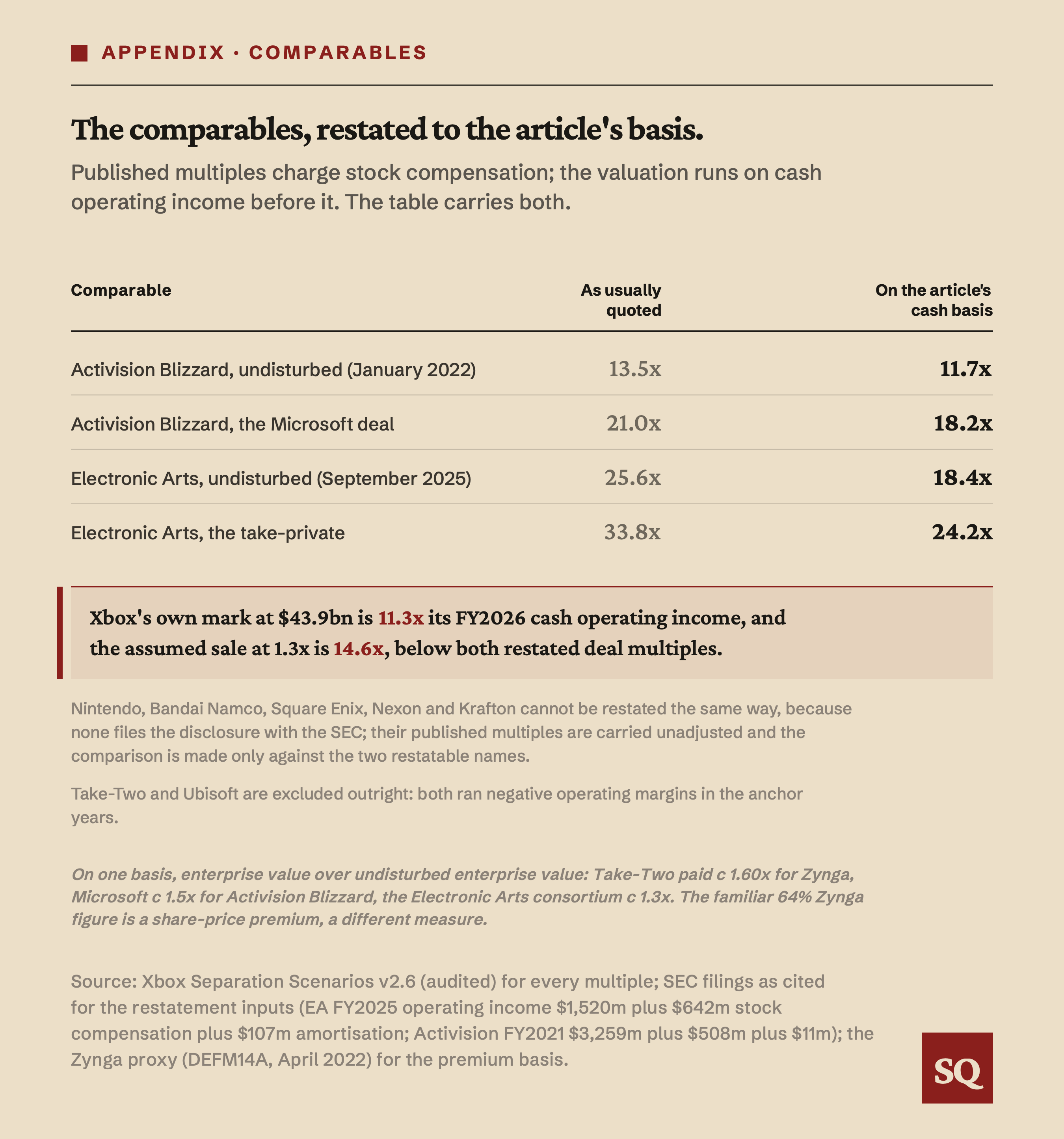
Xbox’s own mark at $43.9bn is 11.3x its FY2026 cash operating income, and the assumed sale at 1.3x is 14.6x, below both restated deal multiples.
The premium precedents, all on one basis, enterprise value over undisturbed enterprise value: Take-Two paid about 1.60x for Zynga (deal value $12.7bn against an undisturbed enterprise value built from the $6.00 unaffected close and the $541m of net debt Goldman Sachs states twice in the merger proxy); Microsoft about 1.5x for Activision Blizzard; the Electronic Arts consortium about 1.3x. The familiar 64% Zynga figure is a share-price premium, a different measure.
A8. The stock-compensation basis
The valuation runs on cash operating income before stock compensation, the same basis as the first piece, and the model charges no stock compensation anywhere: the head-office cost per person is cash pay and benefits. The comparables in A7 are restated to the same basis. Charging the roughly $800m a year of stock compensation would take the base from $43.9bn to about $35.7bn and lower every case by the same amount, leaving the spreads intact: the base-to-bear gap is identical to the cent on either basis, so nothing in Part 2’s ordering turns on the convention. One alternative reading exists: if the per-person cost were taken to include stock, about $0.3bn a year is already charged and the reference would sit nearer $38bn.
A9. The reach table, line by line
Most lines in the postscript’s reach table are built the same way: the last disclosed monthly count, times a daily-to-monthly ratio held at or about the strongest any comparable business has disclosed. Three are not, and say so in their working: Minecraft China has no activity figure to apply a ratio to, the casual line divides a daily count of hands rather than a monthly count of players, and the studios line adds an estimate for the ones that disclose nothing. Microsoft has never published a daily figure for anything it owns.
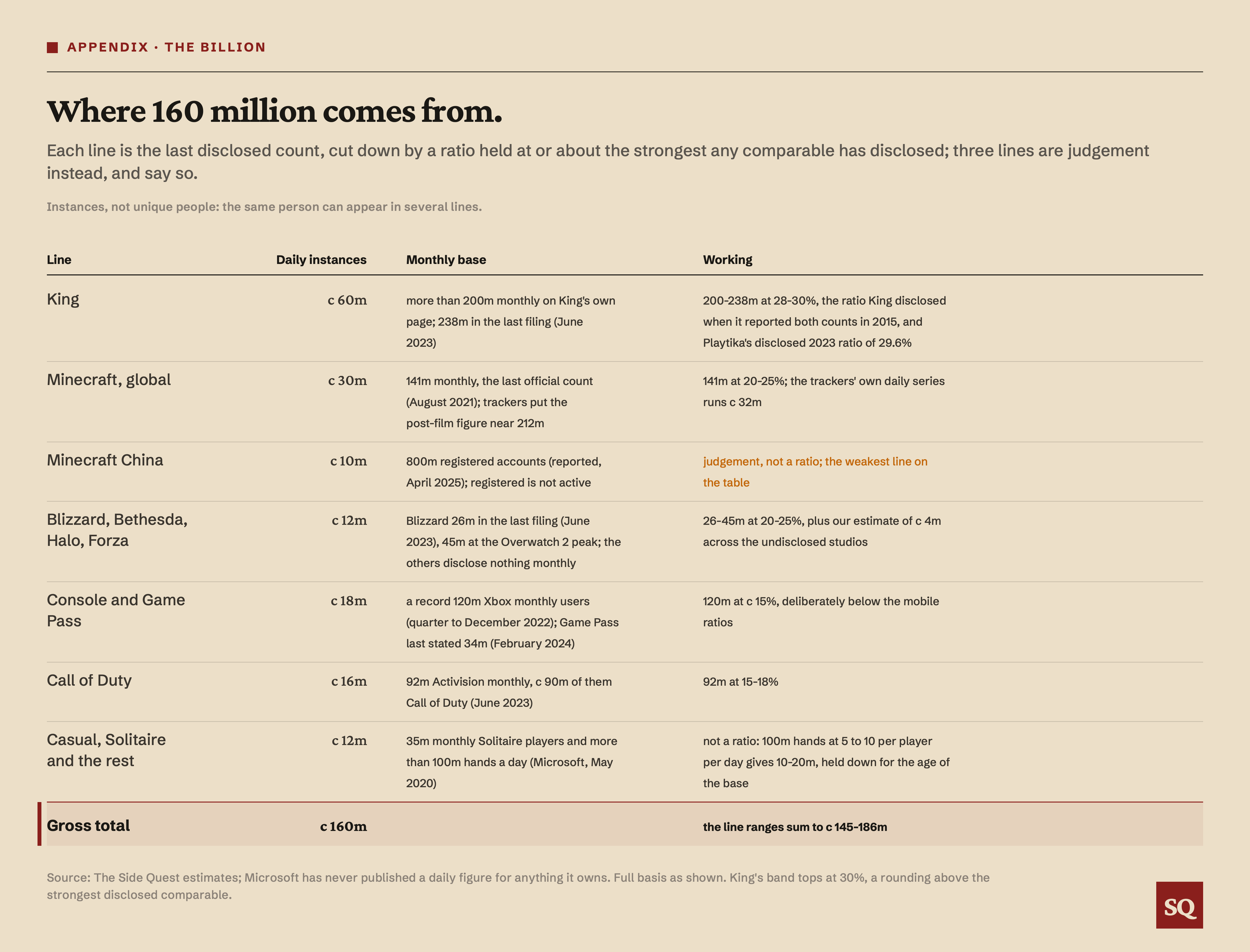
The total can be tested against Microsoft’s own words. The June reset memo says more than a billion people play each year, for 72 billion hours, excluding much of China: 197m hours a day. Our c 150m ex-China instances imply about 1.3 hours per player per day, between a mobile session and the 2.6 hours Roblox disclosed for its daily users last quarter. A materially higher gross would need the whole portfolio, consoles included, to average under an hour a day, which nothing on record supports.
The viewing axis is looser than the playing one, and the grid treats it accordingly. YouTube counted 100 billion hours of gaming watch time in 2020 and 201 billion Minecraft views in that year alone, about 550m a day for one franchise, before Minecraft became the first game past a trillion cumulative views in December 2021. Views are not viewers, a daily viewer watches several, and nothing per-game and per-day is published, so the 200m to 400m range is our estimate and the grid runs it as an axis rather than a point.
A10. The job boards, dated
The hiring evidence is a set of point-in-time captures of the public careers boards, archived and live. Boards show external hiring only: internal transfers and a freeze are invisible, so absences are weaker evidence than presences. The advertising row needs one more caution: its first four cells are samples of the board’s first page, and that page sorts toward older requisitions, so a role missing from it is not proof the role is absent. Only the last cell is a count of the whole board, which is what makes it the strongest reading on the table.
Against that shrinkage, Mojang posted. Seven Minecraft roles went up on Microsoft’s careers board in the four days after the reset, and the board’s own labels make the point: two marketing, two business operations, two product management, one business development. None is a game-development role. Six of the seven requisitions were created on or after reset day; the exception, the China technical product manager, was created six days before it.
A11. The studio cuts, attributed
Two similar numbers from the same week belong to two different studios. At Obsidian, 52 people were let go, per a California WARN notice, about a quarter of the studio per Bloomberg’s reporting of 8 July 2026, alongside the cancellation of the Avowed sequel and the start of a Fallout project under Josh Sawyer. At Bethesda Game Studios, staff told IGN that more than fifty people were cut from The Elder Scrolls VI’s active development, and the studio’s union counted dozens of programmers, artists, designers and testers among the losses; the union’s parent, CWA, puts 440 union-represented cuts across the ZeniMax studios.
A12. Sources and what kind of number each is
Every figure in the piece is one of four kinds.
Disclosed. In a filing or an official company post. The 3,200 roles and the ambition to entertain more than a billion people a day are both in Microsoft’s Resetting Xbox post of 6 July 2026; the memory-cost figures behind the console price assumptions are Sharma’s own; Sony disclosed 93.7m PS5 consoles shipped in its May 2026 results; Activision Blizzard’s segment reporting runs through 2022, its last full year as a listed company; and the 34m Game Pass subscribers is Microsoft’s last official count, from February 2024. These are the fixed points the model is built between.
Company statements. Said by a named executive at a named venue, not filed. Sharma’s “committed to Xbox, starting with the console” is from her Windows Central interview; her “new business models … rather than just the most premium, high-performance console in the world” was said at Fortune’s Brainstorm Tech conference; Matt Booty’s “a reason to buy an Xbox” is from Variety. We quote them verbatim and read them as intent, not as fact.
Reported, not announced. Carried by the press or a tracker and never confirmed by the company. Schreier at Bloomberg is the source for the cancellation of Avowed 2, and for Elder Scrolls VI being at least two years out, which is what places it in FY2029. The $7.8bn subscription-revenue target and the $1.4bn gaming-advertising ambition, both for 2030, come from 2022-vintage internal slides surfaced in the FTC’s Activision case: Microsoft’s own plans, but leaked, and the model treats neither as achieved. The roughly 34m Series X|S consoles sold this generation is a tracker estimate, because Microsoft discloses no console units at all.
Our estimates. The model’s own constructions, each shown in this appendix with its working. The 43m active Xbox consoles is ours, and the roughly 100m active PlayStation consoles is derived from it and an assumed activity ratio, because Sony discloses shipments, not active machines. King’s advertising at $630m a year is our assumption, not a disclosure. The per-unit revenue splits, and every lever in the bear and the bull, sit in this class.
Reported figures are attributed in-line wherever the article uses them; our estimates live in this appendix with their workings, with one exception: the free-to-play grid behind the Minecraft trade is a parameterised sweep rather than a modelled line, and the exhibit that carries it states its own basis.