


TLDR
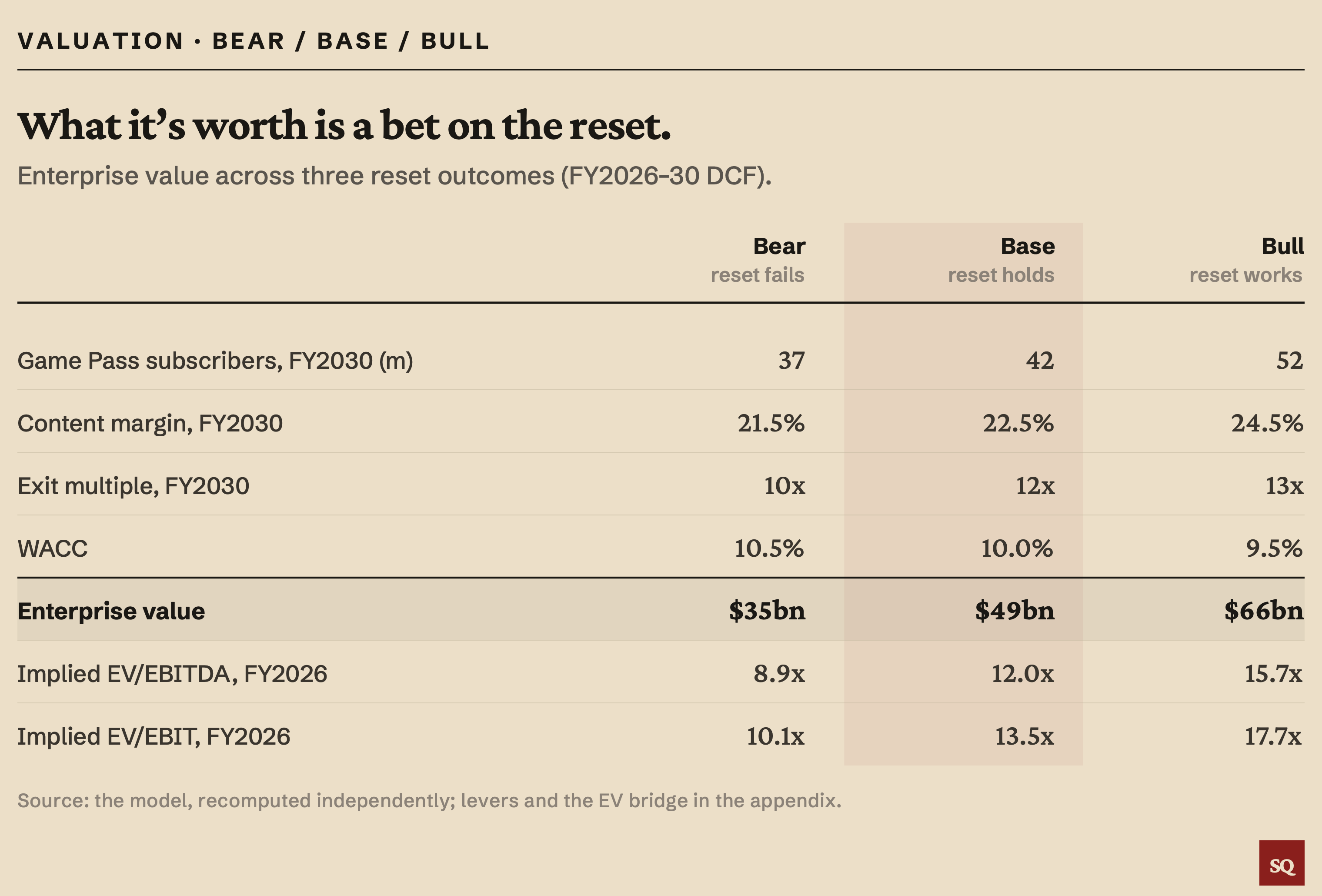
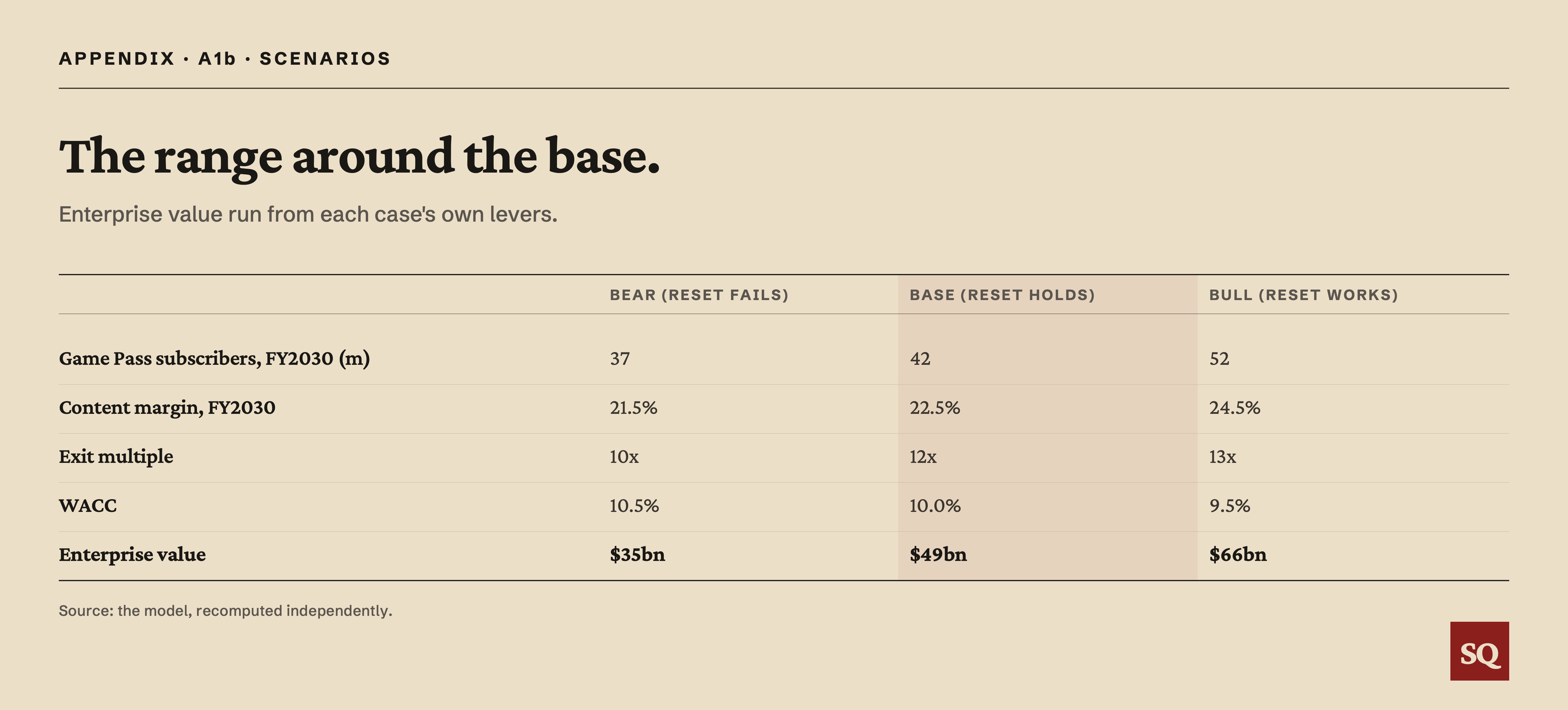
Xbox today is effectively a content business with a break-even hardware business attached. On a DCF basis the math points to about $49bn, or 13x operating profit. That sits below where Nintendo trades (16x) and well below the 21x Microsoft itself paid for Activision. If the reset fails, the bear case is about $35bn; if it works, the bull case is about $66bn. The business earns about 3% today, and the value is a bet on lifting that, so small changes in the assumptions move the answer a long way.
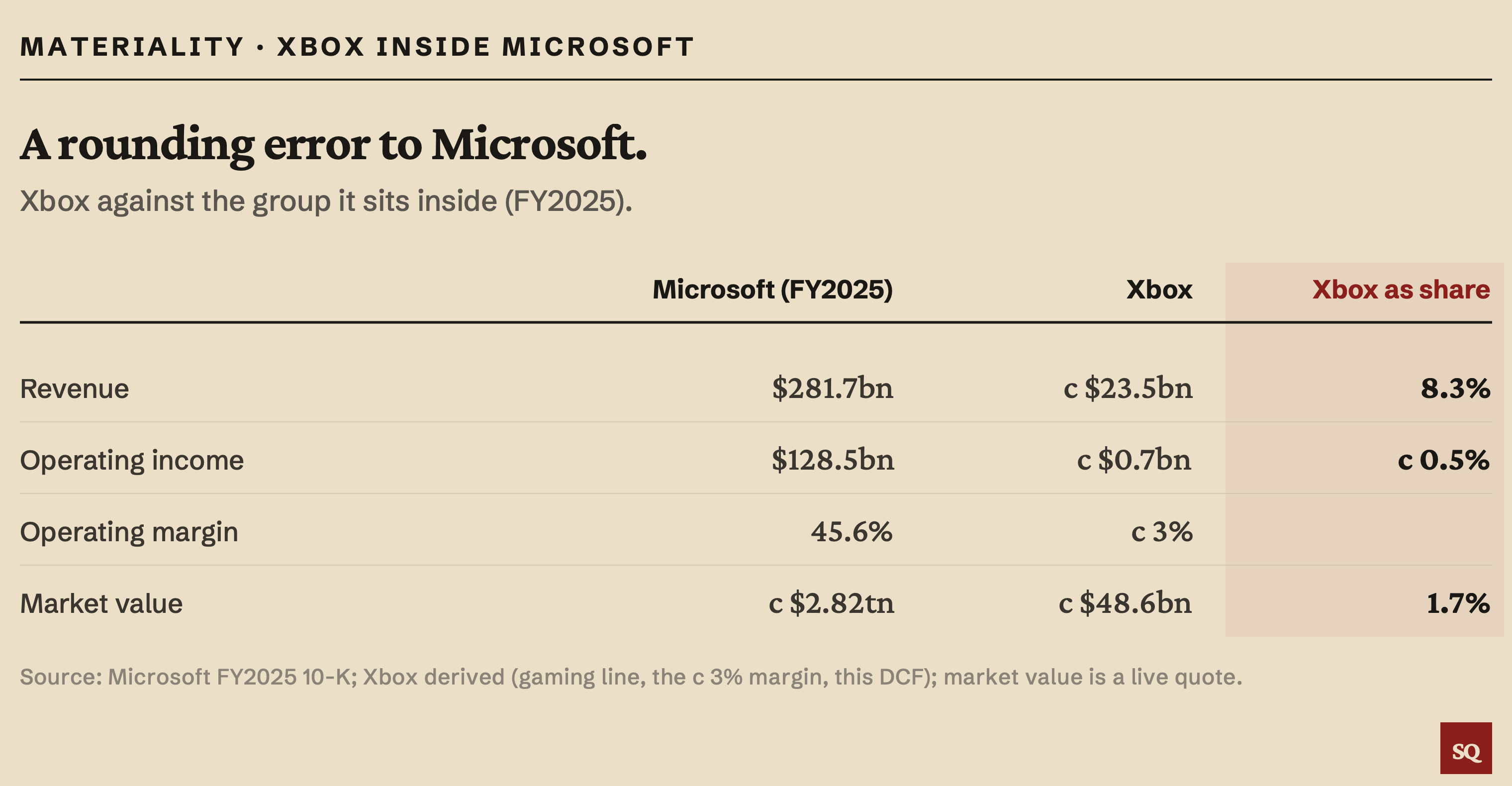
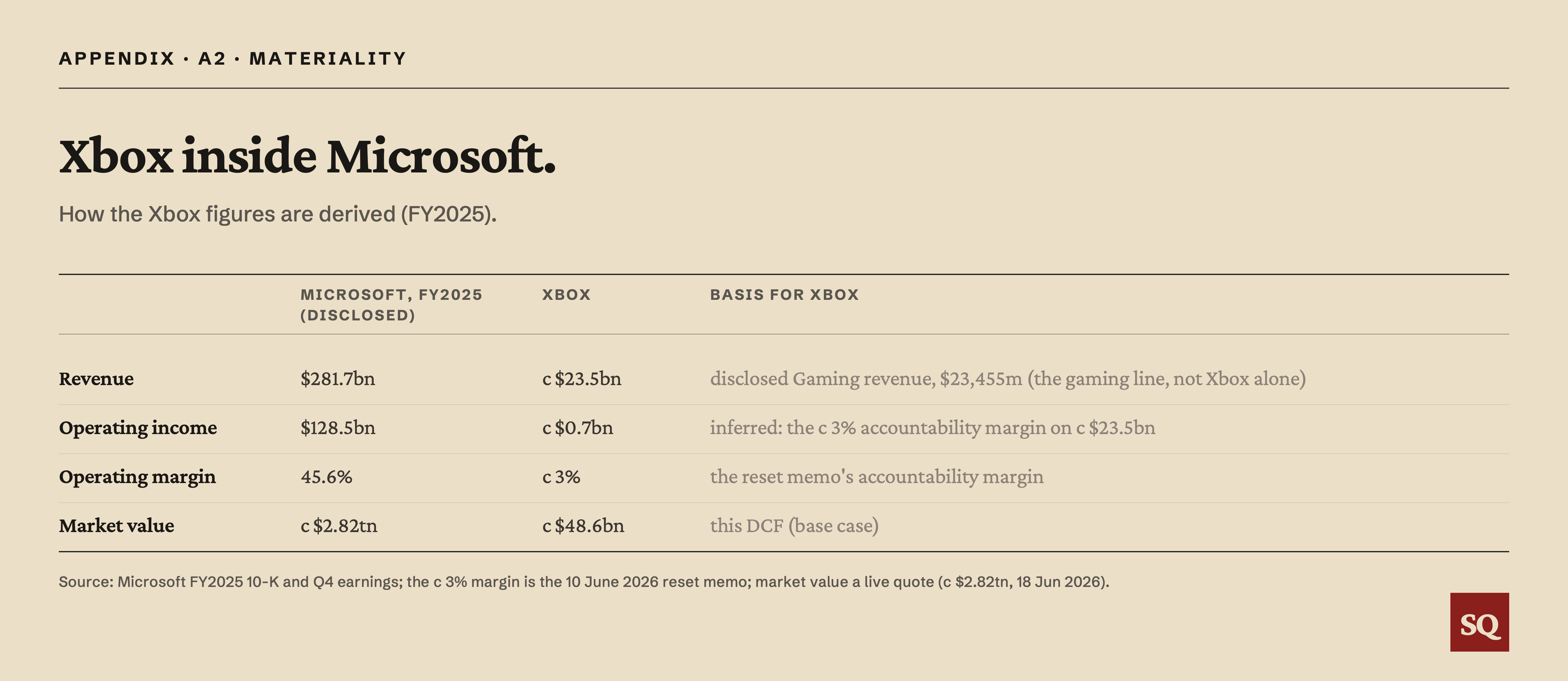
To Microsoft, $49bn is about half a year’s profit, 1.7% of market value, and a 3% margin against the group’s 46%. Selling Xbox has little to do with the money. It is about focus, about capital for the AI build-out that does move the stock, and about making a subsidised business pay its way.
Across every scenario, the data is what Microsoft cannot afford to let go. The base case is that it keeps the whole business and fixes it; if it ever restructures, its instinct points to keeping a strategic handle on the data, a minority carve-out or a strategic partner, rather than a clean spin or a sale. That data is where Xbox’s real long-term value to Microsoft lies.
On 10 June the executives now running Xbox put three numbers into a staff memo titled “Next 100 Days: Xbox Reset.”
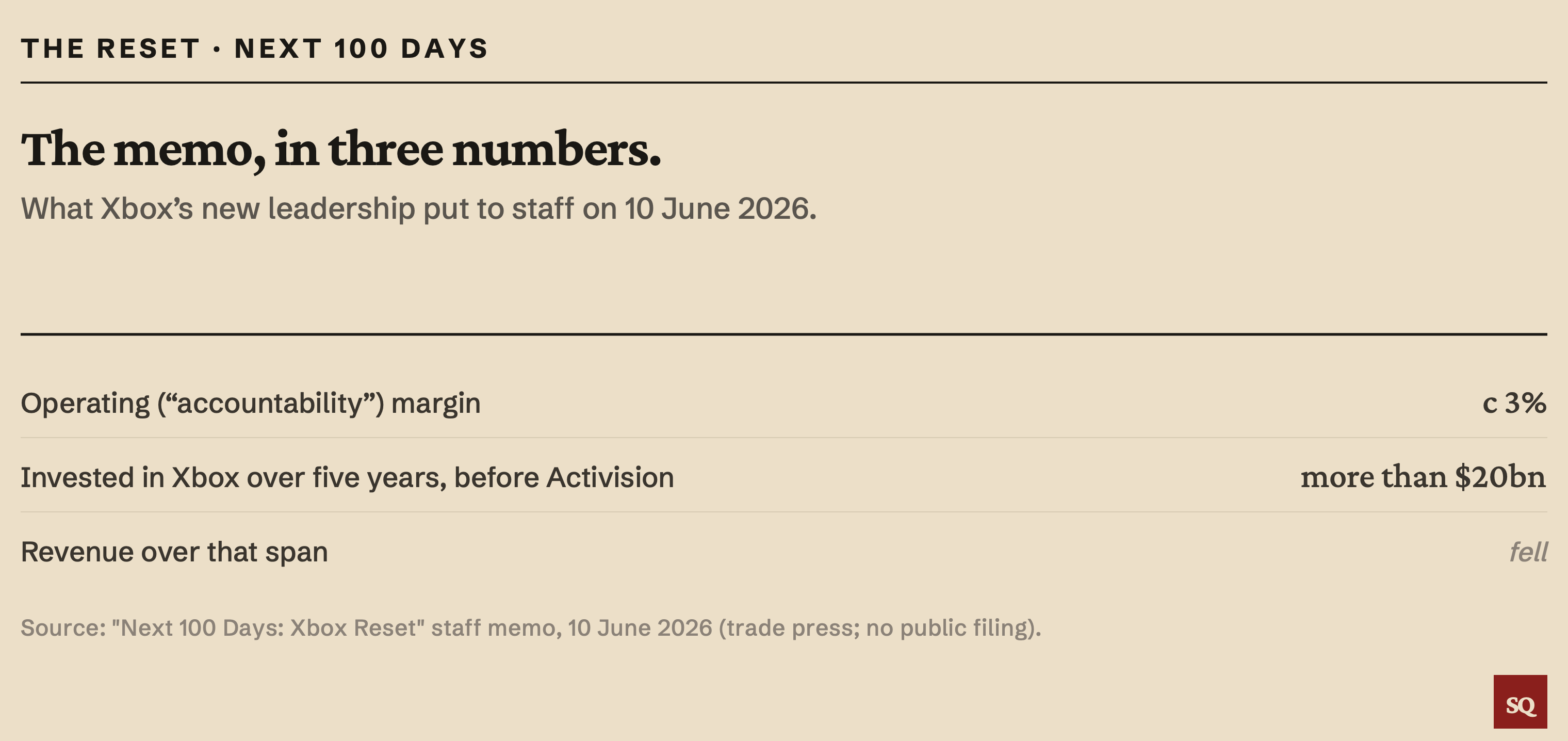
The picture is of a business in poor health, and the people at the top say as much. Satya Nadella has described Microsoft as having “been subsidizing that entertainment” rather than monetising it and the reset arrived with a change of guard: Phil Spencer retired and Xbox president Sarah Bond left. Asha Sharma now runs the division, with Matthew Ball as chief strategy officer and Scott Van Vliet as chief technology officer.
Reports days later that Microsoft was weighing its options, a spin-off, a wholly-owned subsidiary, a joint venture or an outright sale, followed from there. They leave two questions:
What is Xbox worth?
Does Microsoft gain anything by separating from it?
What is Xbox worth today?
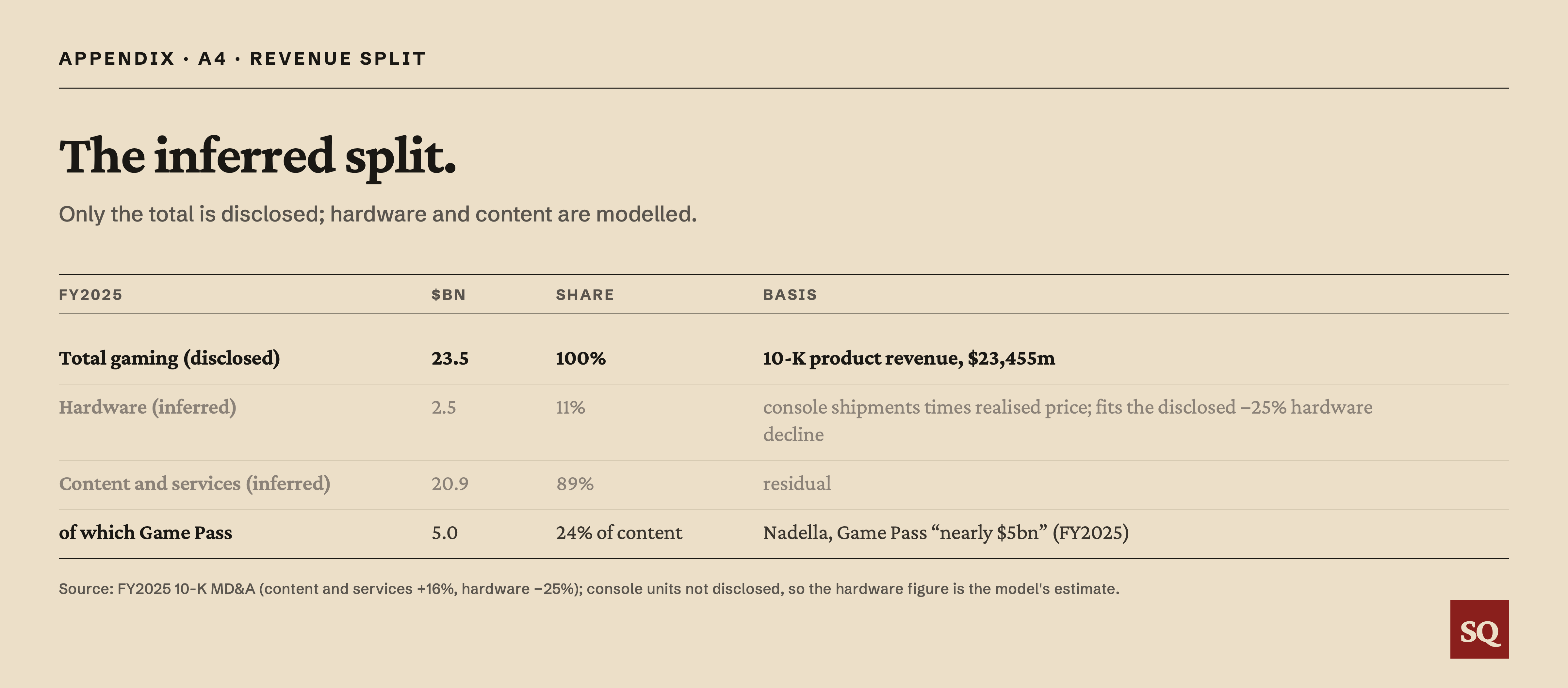
Xbox is two businesses with opposite economics: a publisher, and the console it runs on. It has lost this console generation to PlayStation, outsold by roughly two and a half to one on installed base, and having lost it Microsoft has stopped fighting on hardware terms: it now ships its biggest franchises on PlayStation and leads with Game Pass rather than the box. Layered on top are years of content acquisitions, Activision Blizzard King the largest of them. What remains is a business that is roughly 10% hardware and 90% content.
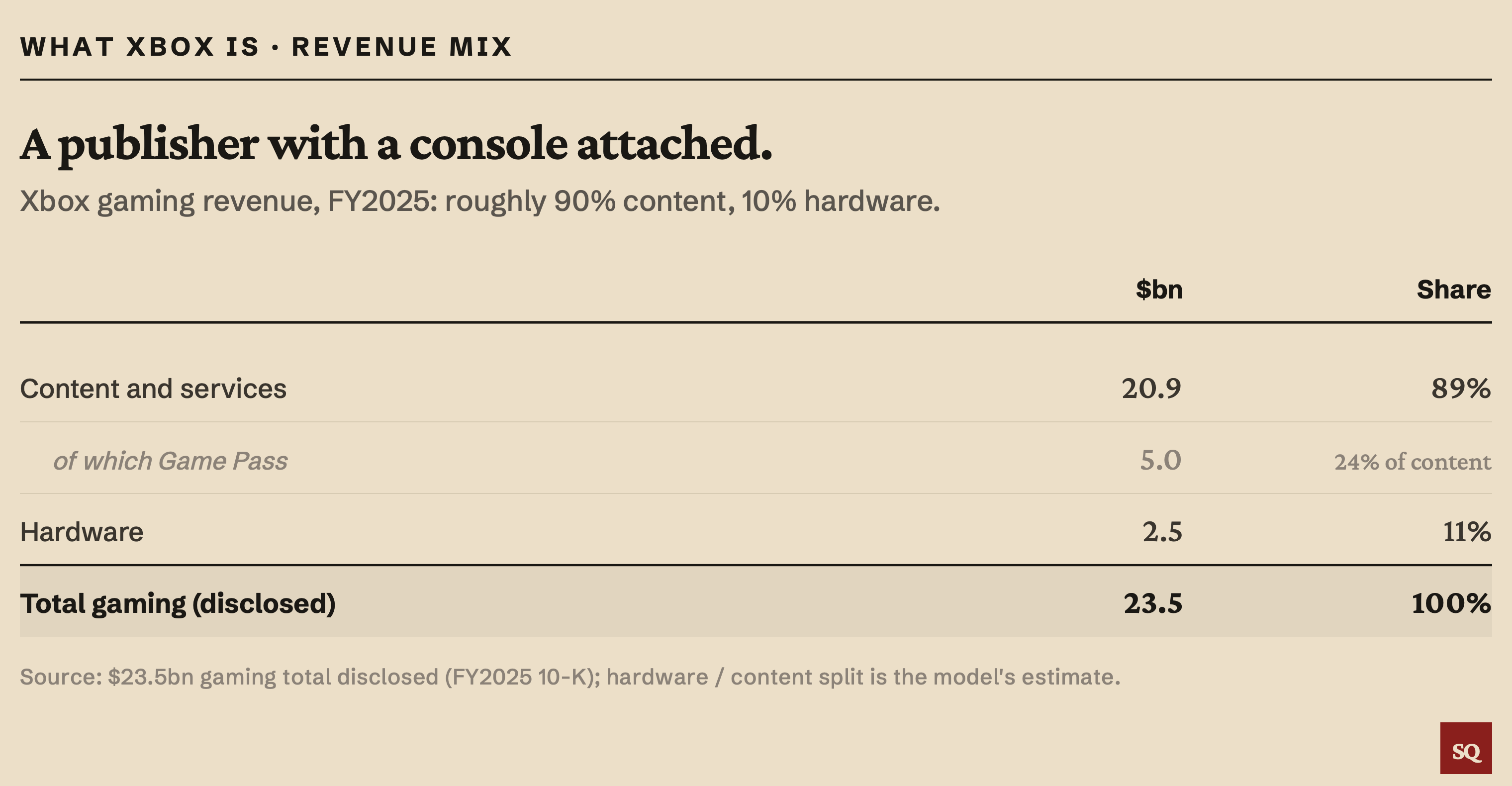
Valued as a games publisher that gives away a console, a DCF puts Xbox at about $49bn, or 13.5x operating profit. The multiple is struck on operating profit before the non-cash amortisation of the Activision purchase price, which a DCF ignores because it is not cash. Against Nintendo at 16x, that is a real discount, and it is well short of what the content cost: Microsoft paid about 21x for Activision alone.
Put another way, a standalone Xbox would be worth about 30% less than the price Microsoft paid for Activision by itself.
What it is worth is a bet on the reset
Two things swing the valuation: whether the turnaround the management team is betting on lands, and the multiple the business would command. The base case assumes:
The reset returns Xbox to a stable state, not a full recovery.
Owned franchises such as Elder Scrolls and Fallout become Xbox-first.
A new console, Project Helix in whatever form it takes, widens the installed base but earns nothing in the valuation, because it is sold at or near break-even.
Game Pass subscriber volume recovers, pricing settles, and a clearer value proposition holds the base.
Cost cutting continues, though the model banks only the first wave and leaves the rest to a broader round still to come
The bear and bull cases move those levers in each direction.
$49bn is a rounding error to Microsoft
Before weighing the effort a transformation would take, financially the decision means very little to Microsoft. A sale would convert about half a year of earnings into cash, once, and remove a business contributing roughly half a percent of operating income that Microsoft has been subsidising.
If the proceeds do not matter, the case for separating rests on two things:
Focus. Gaming consumes leadership attention for a 3% margin business that has only just returned to growth, while the $168bn Microsoft Cloud business grows at 23%.
Capital. The more than $20bn Xbox absorbed over five years is real money for a company spending about $65bn a year on capital expenditure, most of it the AI build-out. It is immaterial to the balance sheet and still an ineffective use of capital.
So why separate, and how?
The incentives point one way. Inside Microsoft, Sharma, Ball and Booty run a unit worth half a percent of operating income that will never command the chief executive’s time or capital. Spun out, they would run a roughly $49bn public company with their own board and equity. A separation serves them, serves the shareholders who receive the stock, and serves Microsoft, which keeps a handle on the data. A sale serves none of them.
There are five ways to separate, and they differ less in what Xbox is worth, close to $49bn in all of them, than in who ends up holding it and what happens to the Activision goodwill.
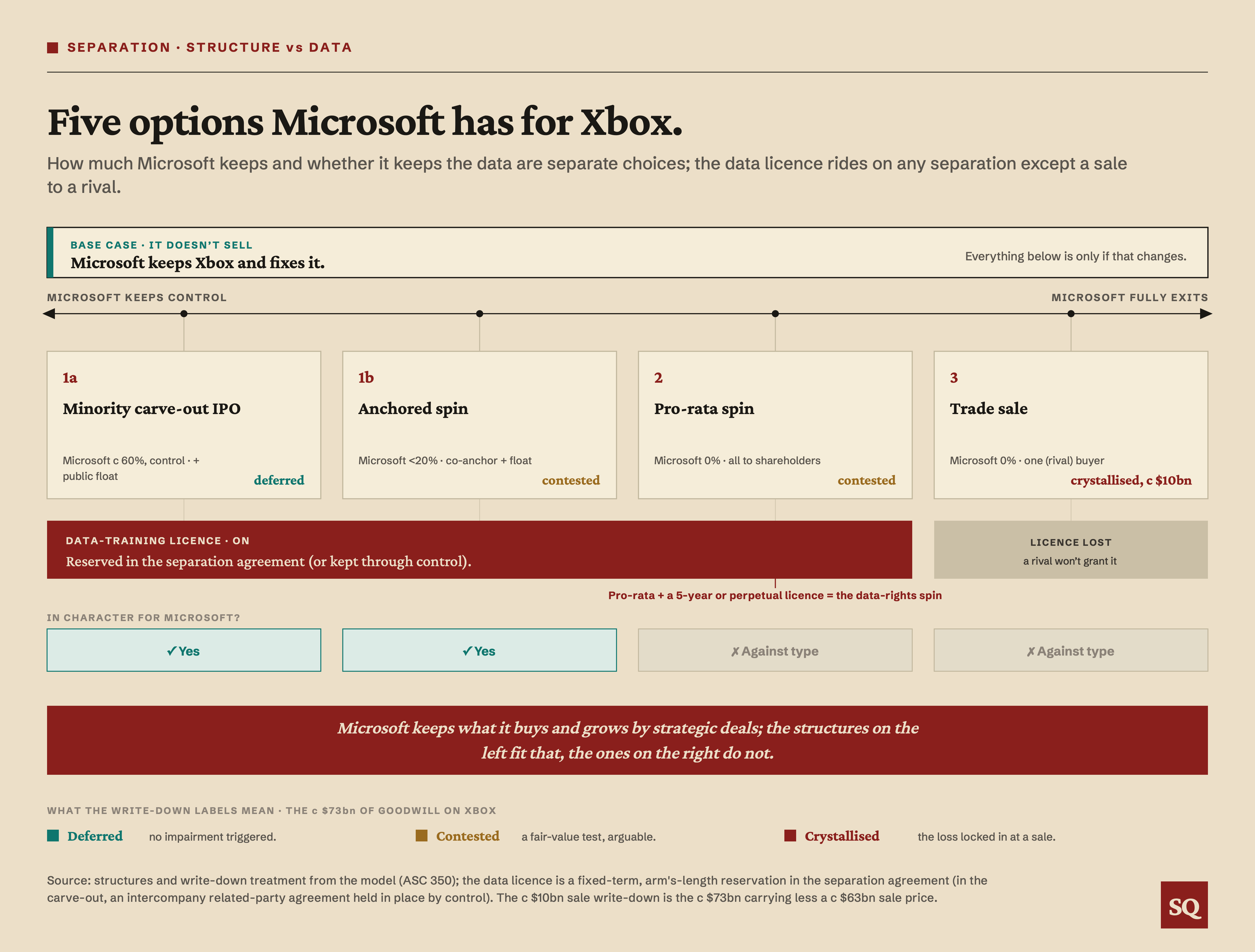
It’s worth examining these options against how Microsoft actually behaves, as it typically does not divest: LinkedIn, GitHub and Activision are all still inside it, kept and run from within. And when it reshapes a business it does so by striking strategic deals, the OpenAI partnership and the run of compute and data-centre agreements being the recent template, rather than by handing assets back to shareholders. On that record the five read less as exits than as degrees of a strategic handle Microsoft would keep on the data.
The two that fit its instincts keep a real handle: a minority carve-out that holds on to control and the data, or a strategic partner brought in to accelerate the AI and distribution play it cares about.
A clean pro-rata spin, even one that reserves the data licence, keeps only a contract and does nothing strategic for the parent.
A clean sale keeps nothing, and in any case has no buyer.
1) The strategic routes: keep control, or bring in a partner
a) Minority carve-out IPO
Microsoft floats a minority of Xbox on the public market and keeps the rest. Because it still owns more than half, it keeps control and keeps consolidating the business inside the ‘More Personal Computing’ segment, so the Activision carrying does not move and no write-down is triggered. The float does three smaller things:
It gives the business its own listed shares, so the people running it are paid in Xbox equity rather than Microsoft equity.
It puts a public price on the unit, and it raises some cash.
The Azure relationship and the data arrangements carry on unchanged.
What it does not do is fully separate, which on the strategic logic is the point: Microsoft keeps the majority, the consolidation and the data, and goes on answering for the margin. It is the gentlest of the options and the most in character. Selling a minority for cash is taxable, but at this size the tax is a detail.
b) Anchored spin, with a co-investor
Microsoft distributes most of Xbox to its own shareholders as a stock dividend, keeps a stake below 20%, and brings in one large outside investor to anchor the new company.
The sub-20% retention is what makes the distribution tax-free: the rule rewards handing over control, not keeping it, so the parent has to give up the majority to avoid the tax. The anchor, a strategic partner brought in to accelerate the AI and distribution play rather than a platform rival, takes a block the public market would not absorb in one go, puts a price on the business, and gives the new board a committed backer.
This is the structure that answers the problem that kills a clean sale, because no single party has to buy the whole thing. The cost sits on two lines. Giving up control deconsolidates the business, which is exactly where the write-down question opens, since a spin can be required to mark the Activision carrying at the distribution date. And it depends on finding a willing anchor from a short list, after the one fund large enough to lead it went to Electronic Arts.
2) The minimal route: the data-rights spin
For Nadella, the value of the data that Gaming generates is important to his AI strategy; he argues that the value of token capital will only increase over time (See AI in Video Games: Own the Loop).
Nadella has described the same data two ways inside sixteen months. In early 2025 he called it Microsoft’s version of YouTube, the feedstock for what he termed “a general action model and a world model.” By June 2026 he was calling the business that produces it a subsidy to switch off. Both can be true at once: the data is strategic and the operation that generates it loses money. This structure takes him at both words, keeping the part he calls strategic and letting go of the part he calls a drag. It is the cleanest expression of the idea, even if, on the logic above, not the most likely route for a company that prefers a firmer grip.
The strategic half is worth reading with one eye open, because the man making the case owns the data, the models and the cloud. Owning the games is an edge, not a necessity: the labs leading the world-model race train on public video and simulation without owning a studio, and one of them rebuilt Minecraft without a licence. What Microsoft holds is the cleanest version of a useful input, scarce, consented and already feeding its own model, alongside Minecraft, the environment much of the field runs its experiments in. It is worth keeping cheaply, and not worth contorting the company to hold.
a) A 5-year data license
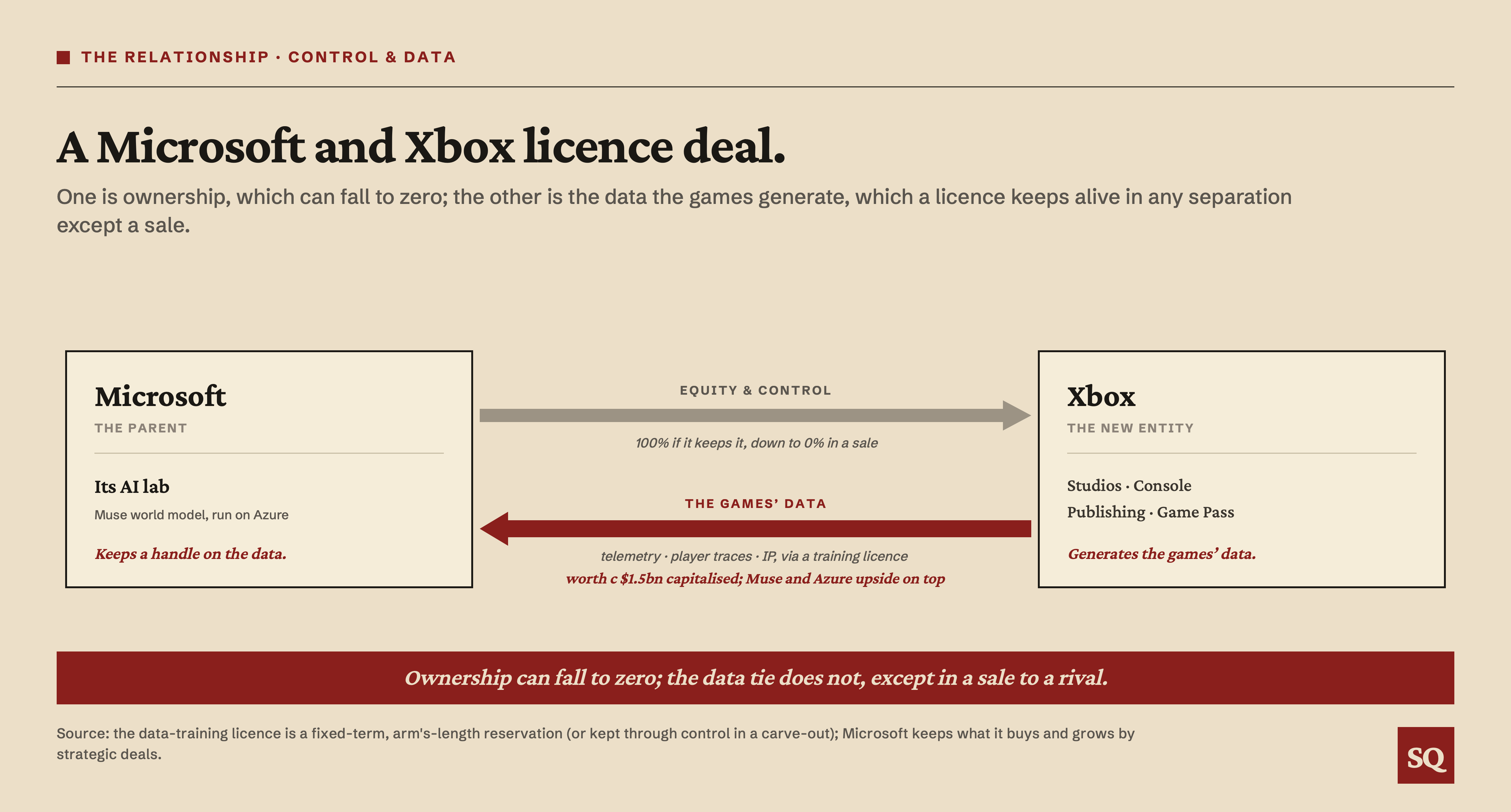
Microsoft does not need to own the operating business to keep what it wants from it, which is the right to train its AI on the data the games generate. That right is a contract, not a function of how much equity Microsoft holds: it can be reserved in the separation agreement of any spin, or kept through control in a carve-out, and is forfeited only in a clean sale, where the buyer is a rival with no reason to grant it. The data-rights spin is simply the pro-rata spin with that licence reserved. In practice it spins the operating company to its shareholders and, in the separation agreement, takes a fixed-term licence, five years and renewable, priced at arm's length, to keep training it’s world models, Muse among them, on that data: the gameplay telemetry, the player traces, the content corpus. A licence of this kind is worth about $1.5bn capitalised, with the strategic Muse and Azure upside unpriced on top.
Microsoft does not need to own the operating business to keep what it wants from it, which is the right to train its AI on the data the games generate. That right is a contract, not a function of how much equity Microsoft holds: it can be reserved in the separation agreement of any spin, or kept through control in a carve-out, and is forfeited only in a clean sale, where the buyer is a rival with no reason to grant it. The data-rights spin is simply the pro-rata spin with that licence reserved. It can spin the operating company to its shareholders and, in the separation agreement, take a fixed-term licence, five years and renewable, priced at arm's length, to keep training its Muse game model and its Azure systems on that data: the gameplay telemetry, the player traces, the content corpus.
That is an ordinary parent-to-spinoff arrangement a new board can sign, which is what makes it the version that holds up. This is an event that has happened in the past: when eBay spun off PayPal in 2015 the two signed a five-year operating agreement that kept PayPal as eBay’s payments engine, priced and set to taper as the relationship loosened, with eBay still running about a quarter of PayPal’s payment volume at the split and a tenth of it three years on. A fixed-term priced contract between a parent and the company it lets go is plausible, and here the data runs the other way down it. Microsoft ends as the lab still learning from the company it span out, while the studios, the console and the publishing go to shareholders who want them.
b) A perpetual data licence
The maximal version, a perpetual royalty-free claim on everything XBOX spin-out ever produces, is very unlikely. Handing a newly public company’s data to its former parent for nothing transfers value from its new shareholders, and a board and the courts would read it as exactly that. It is also unnecessary, since Microsoft does not need a standing claim on all of it. A bounded licence on the data that matters, Minecraft and Call of Duty (or games with large training datasets) before anything else, secures the prize without the fight. This is similar to the arrangement that I wrote about earlier between Google DeepMind and EVE Online (See AI in Video Games: Own the Loop) which I would argue against for as the spin-out company’s shareholders.
However if they did go down this route, the nearest comparables, text and image deals, run tens of millions of dollars a year, with Reddit’s deal with Google at about $60m, so a games-data licence capitalises to a low-single-digit billions at most.
3) Trade sale
The opposite case for Xbox’s fate deserves stating at its strongest. Nadella’s own words, a business Microsoft has been subsidising and monetises better on YouTube than at home, are how executives describe something they mean to exit.
The reset, with its layoffs, studio closures and a named 3% accountability margin, is the clean-up that tends to precede a sale.
The write-down of ABK’s goodwill is non-cash and modest, so won’t be as significant than the coverage assumes.
The EA deal proves a sovereign-scale buyer can be assembled. Together those make a real case that Microsoft is dressing Xbox for sale.
Together those make a real case that Microsoft is dressing Xbox for sale. The trouble is the price. Xbox is worth about $48.6bn standalone, a buyer would pay an acquisition premium on top, and the Activision deal is carried at about $73bn; a sale books the difference, and that gap closes only as the multiple a buyer pays climbs toward what the deal cost.
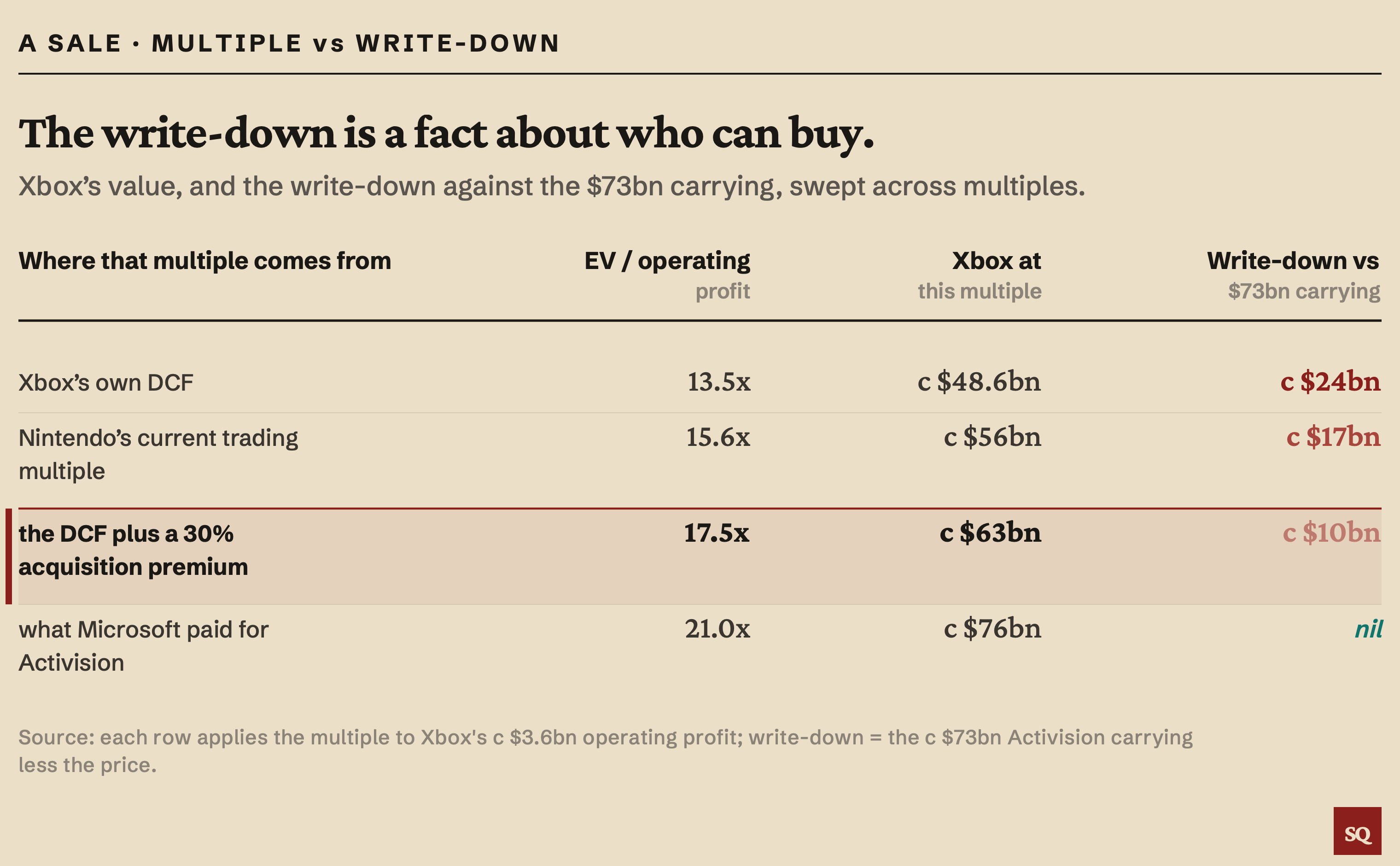
A sale clears the carrying only at about 20x, essentially the multiple Microsoft itself paid for Activision, and the only buyers who pay a strategic price like that are the rivals who could fold Xbox into their own platform, exactly the ones a sale is barred from reaching. Yet even getting that far assumes a buyer, and the likelihood of one is low:
The real constraint on a sale is the buyer, and the usual reading of it is backwards. Antitrust does not block Microsoft from selling the No. 3 console, because offloading it reduces concentration, which is the remedy regulators reach for rather than the harm they prevent. The buyers it would likely stop are Sony, Valve or Nintendo.
The constraints that bite are the size of the cheque, about $41bn of equity beyond the debt, more than any single fund commits, and a national-security review of a business holding hundreds of millions of players’ data, which gates foreign and sovereign buyers without flatly barring them.
The one pocket deep enough has just been spent: the $55bn take-private of Electronic Arts, an enterprise value led by a consortium around Saudi Arabia’s Public Investment Fund, shows a sovereign-scale gaming buyout is bankable, and uses up the single buyer shape that works. With that fund committed to EA, the cleared and affordable buyer for Xbox does not currently exist.
So the write-down on a sale is not a verdict on the business; it is a fact about who is allowed to buy it. A clean sale is dominated by any of the routes that keep a handle on the data and trigger nothing extra, a closer call than a confident telling would allow, but it resolves the same way.
Microsoft will most likely keep Xbox
Microsoft most likely keeps Xbox, fixes the margin, and never sells the business, because keeping is what Microsoft does. If it does restructure, the same instinct points to a strategic handle rather than a clean break, a carve-out that holds control and the data, or a strategic partner brought in to accelerate, long before a passive spin and nowhere near a sale. The reports of a separation were never about raising $49bn, a sum Microsoft earns back in a couple of quarters. They are about which part of the business it no longer needs to own outright, the studios, the console and the publishing, and which part it should not let go, the data underneath them. The reset is the first move on either path, and the write-down everyone is waiting for turns out to be the smallest term in the decision.
More from The Side Quest
AI in Video Games: Own the Loop - why a studio keeps its value only if it owns the content-generating learning loop, not the model. Uses Guild Wars 3 as a worked example.
AI won’t make AAA games materially cheaper to develop - the productivity gains are real, but two-thirds of the value leaves the P&L to the AI vendors before it reaches the bottom line.
Hyperscalers: The debt that doesn’t look like debt - how Microsoft, Amazon, Alphabet, Oracle and Meta are funding the AI capex boom, and why their reported leverage understates what they actually owe.
Why Roblox really left Delaware - reading the Delaware-to-Nevada reincorporation as a move to shield management amid active litigation.
Appendix
The figures behind the article, each tied to its source and its working. “Disclosed” marks figures from filings or company statements; “inferred” marks the model’s own estimates. Market-linked figures (market capitalisations, peer enterprise values, the goodwill carrying) move over time and are as of mid-June 2026; refresh them at publication. In the tables, c is circa.
A1. The valuation
The DCF is driver-based. Revenue is built from drivers, Game Pass subscribers times ARPU plus other content, and console units times realised price, while costs come from peer-anchored ratios, so the operating margin is an output rather than a typed input. The base case holds the business roughly flat, anchored to the pro-forma c. $23–24bn of gaming revenue, with a modest margin lift as the reset trims marketing and overhead.
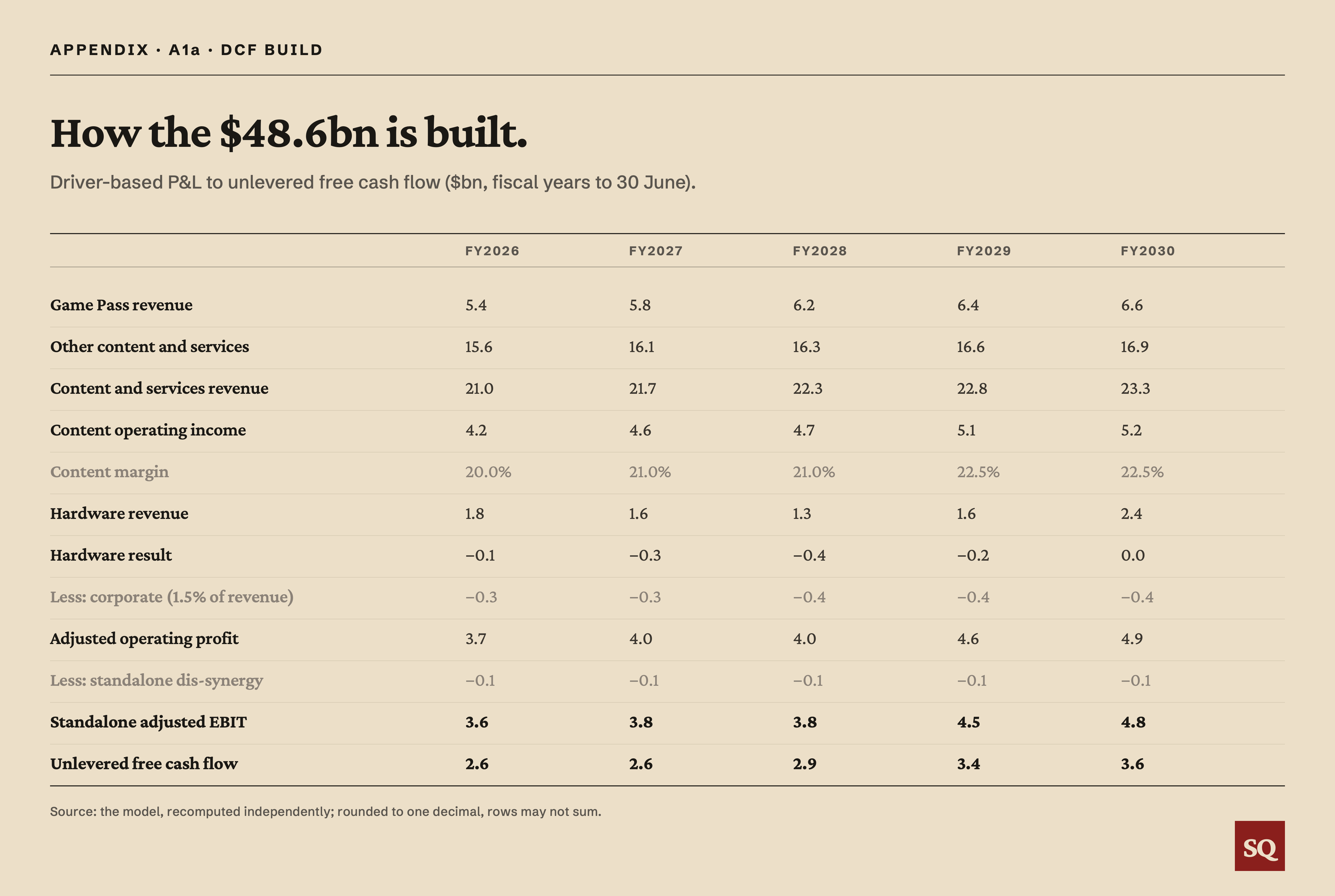
Enterprise value = the present value of FY2027–30 free cash flow (c. $9.7bn) plus the present value of the terminal value (a 12x exit multiple on the FY2030 standalone adjusted EBIT, c. $57bn undiscounted, discounted four years at a 10% WACC to c. $38.9bn) = c. $48.6bn (base)
The multiple is struck on adjusted operating profit, before the c. $3.07bn/yr non-cash Activision amortisation; on a GAAP basis the FY2026 operating margin is c. 2.3%, which reconciles to the disclosed c. 3% “accountability margin” rather than being forced to it.
Standalone adjusted EBIT is adjusted operating profit less the standalone dis-synergy (A5); the FY2027 free cash flow also carries the one-time severance (A7).
Scenario range (each case run from its own levers):
A2. Xbox as a share of Microsoft
Microsoft’s figures are disclosed (FY2025 10-K and Q4 earnings); Xbox’s are derived, as shown.
A3. The comparables
One calculation on every row: enterprise value over operating profit before acquisition-related amortisation, so a company carrying heavy fresh purchase-price amortisation (Xbox, after Activision) is measured like one built organically (Nintendo). Each add-back is the company’s own disclosed acquisition-intangible amortisation.
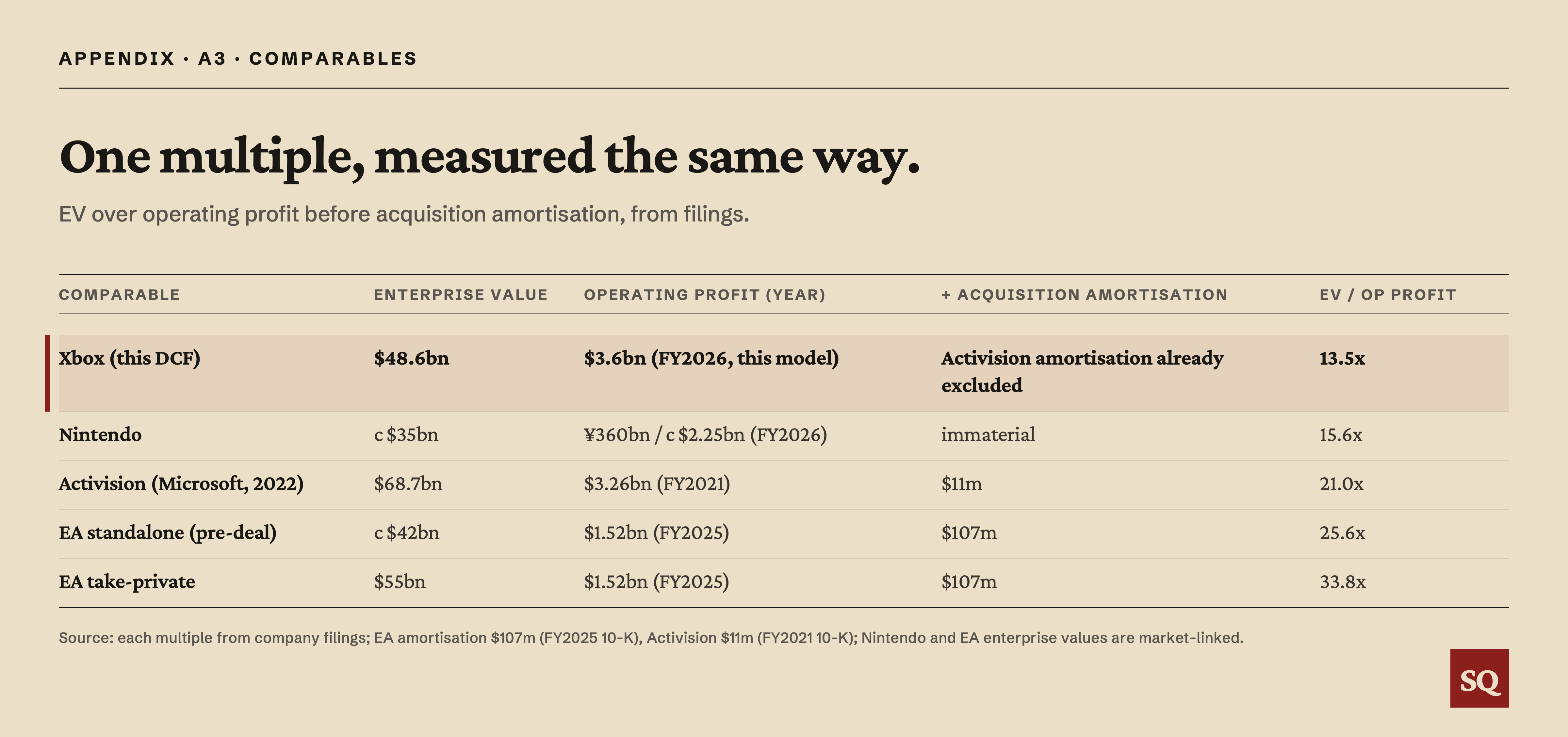
Workings: Activision $68.7bn ÷ ($3.26bn + $0.011bn) = 21.0x. EA standalone $41.7bn ÷ $1.627bn = 25.6x; the take-private $55bn ÷ $1.627bn = 33.8x. Nintendo’s EV is market cap (¥8.26tn / c. $51.6bn) less net cash (c. ¥2.6tn), c. $35bn, over ¥360bn of FY2026 operating profit. EA’s standalone EV uses the undisturbed $168.32 close of 25 September 2025.
EV/sales cross-check (why EA’s 34x is not what it looks). The operating-profit lens magnifies thin margins. EA runs a c. 20% operating margin ($1.52bn on $7.46bn of FY2025 revenue) against Activision’s c. 37% ($3.26bn on $8.80bn in FY2021), so a given EV buys less operating profit at EA and the multiple reads higher. On EV over sales, which strips margin out, the two deals converge: Microsoft/Activision is c. 7.8x ($68.7bn ÷ $8.80bn), the EA take-private c. 7.4x ($55bn ÷ $7.46bn). EA did not sell richer than Activision; its 33.8x is the arithmetic of a lower-margin business. The lens cuts the other way for Xbox, whose c. 2x EV/sales reflects the c. 3% margin, which is why the body anchors on operating profit, not sales.
A4. Hardware versus content
Microsoft discloses the gaming total and the year-on-year growth rates, but not the dollar split. The split is inferred.
A5. The five ways to separate
Enterprise value is close to $48.6bn in all five; they differ in who holds the company, the dis-synergy a standalone business carries, and the treatment of the Activision goodwill.
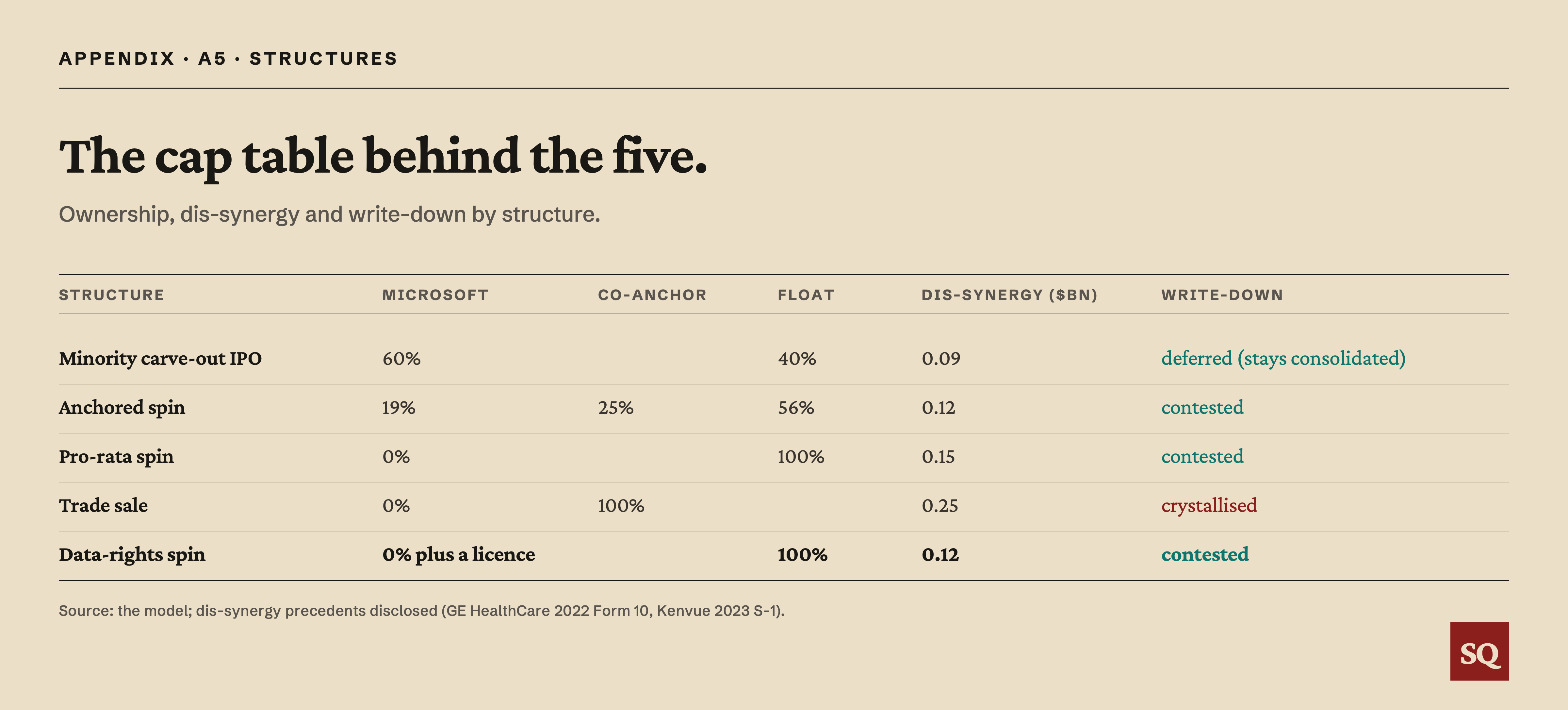
Trade-sale economics: EV $48.6bn times a 1.30 acquisition premium (for synergies and strategic fit, not control, since Microsoft already owns the business) = c. $63.2bn; less c. $22bn of buyout debt (6x the c. $3.7bn FY2026 adjusted operating profit) = c. $41bn of equity. The write-down is the c. $73bn carrying (A8) less the $63.2bn price = c. $10bn. A minority IPO or spin, at a 12.5% new-issue discount, is c. $42.5bn.
Dis-synergy has two sourced legs that flex by structure: Azure-at-internal-cost lost on cloud gaming (1.7bn xCloud hours times c. $0.11/hr times the margin given up), and incremental standalone public-company G&A, anchored to disclosed carve-outs (GE HealthCare 0.64% of revenue at a full break, Kenvue 0.39% under a transition-services agreement). The result runs c. $0.09bn (carve-out, Azure intact) to c. $0.25bn (clean sale), immaterial to the enterprise value.
A6. The data-rights licence
The reserved training right is valued small, deliberately, because the point is that keeping it does not strip the spun-out company.
Value: AI training-data licences run in the tens of millions a year: Reddit’s licence to Google is c. $60m/yr, reported OpenAI publisher deals c. $13–50m/yr (News Corp the largest, c. $250m over five years). Capitalising c. $100m/yr at 15x gives c. $1.5bn, with the Muse and Azure upside unpriced on top. A games-data licence is worth a low single-digit billions at most, though richer multimodal action data could argue for more.
The five-year template: When eBay spun off PayPal in 2015 the two signed a five-year operating agreement, priced and tapering; eBay still ran c. a quarter of PayPal’s volume at the split and c. a tenth three years on. The Xbox licence runs the other way down the contract (the parent takes data from the spinco), but the fixed-term, arm’s-length, tapering form transfers.
The tax rule (IRC §355): A tax-free spin requires the parent to distribute control (80% of the vote), so it can keep at most just under 20% (19.9% is the safe convention). This is why the anchored spin keeps Microsoft below 20%, why a majority carve-out is taxable but stays consolidated, and why the two cannot be had at once.
A7. The reset and the restructuring
The 10 June 2026 memo: a c. 3% accountability margin; more than $20bn of spend over five years (excluding Activision Blizzard King); revenue down c. half a billion dollars over that span.
Layoffs: 1,900 roles (25 January 2024) plus 650 (12 September 2024) = c. 2,550. The model carries a one-time severance of c. $0.40bn in FY2027 (c. 2,500 heads times c. $160k loaded cost), in net income and free cash flow but not adjusted EBIT.
Closures (Arkane Austin, Tango Gameworks, Alpha Dog; Tango and Hi-Fi Rush later sold to Krafton) are immaterial; lost revenue from closures and spin-offs is modelled at c. $0.15bn/yr from FY2027, netted into content.
Source: the reset memo (trade press); layoff figures (Microsoft / Spencer memos, Jan and Sep 2024); closures (Booty memo, May 2024; Krafton release, Aug 2024).
A8. The Activision write-down
At acquisition the deal created goodwill of $51.0bn and intangibles of $22.0bn, c. $73bn of carrying value (Microsoft FY2025 10-K; total purchase price $75.4bn). The intangibles amortise (c. $3.07bn/yr, 15-year weighted life), so the live carrying falls and the write-down a sale would crystallise shrinks with it.
Goodwill is tested annually, on 1 May, at the reporting-unit level. Microsoft discloses that the Activision goodwill sits in the More Personal Computing segment and that no impairment has been recorded, but not whether gaming is tested as its own unit or pooled, nor the headroom between fair value and carrying amount. So the structure decides whether a write-down ever surfaces: a sale forces it open, consolidation (keeping it, or a majority carve-out) defers it, and a deconsolidating spin is the contested case, where whether the carrying must be marked at the distribution date is a question for an auditor. The $11.3bn of accumulated goodwill impairment on the balance sheet is legacy, pre-Activision (Nokia and aQuantive), and is not an Activision write-down.
Source: Microsoft FY2025 10-K (Notes 7 and 8). The deconsolidation treatment is genuinely contested and wants an accountant’s read.
A9. The deal record
Microsoft’s gaming acquisitions, and the deals around them, share a pattern: the cheap, patiently run bet over-delivered, while the premium-priced growth or transformation deals mostly disappointed or were written down. Every figure is from the company’s own filings or announcements.
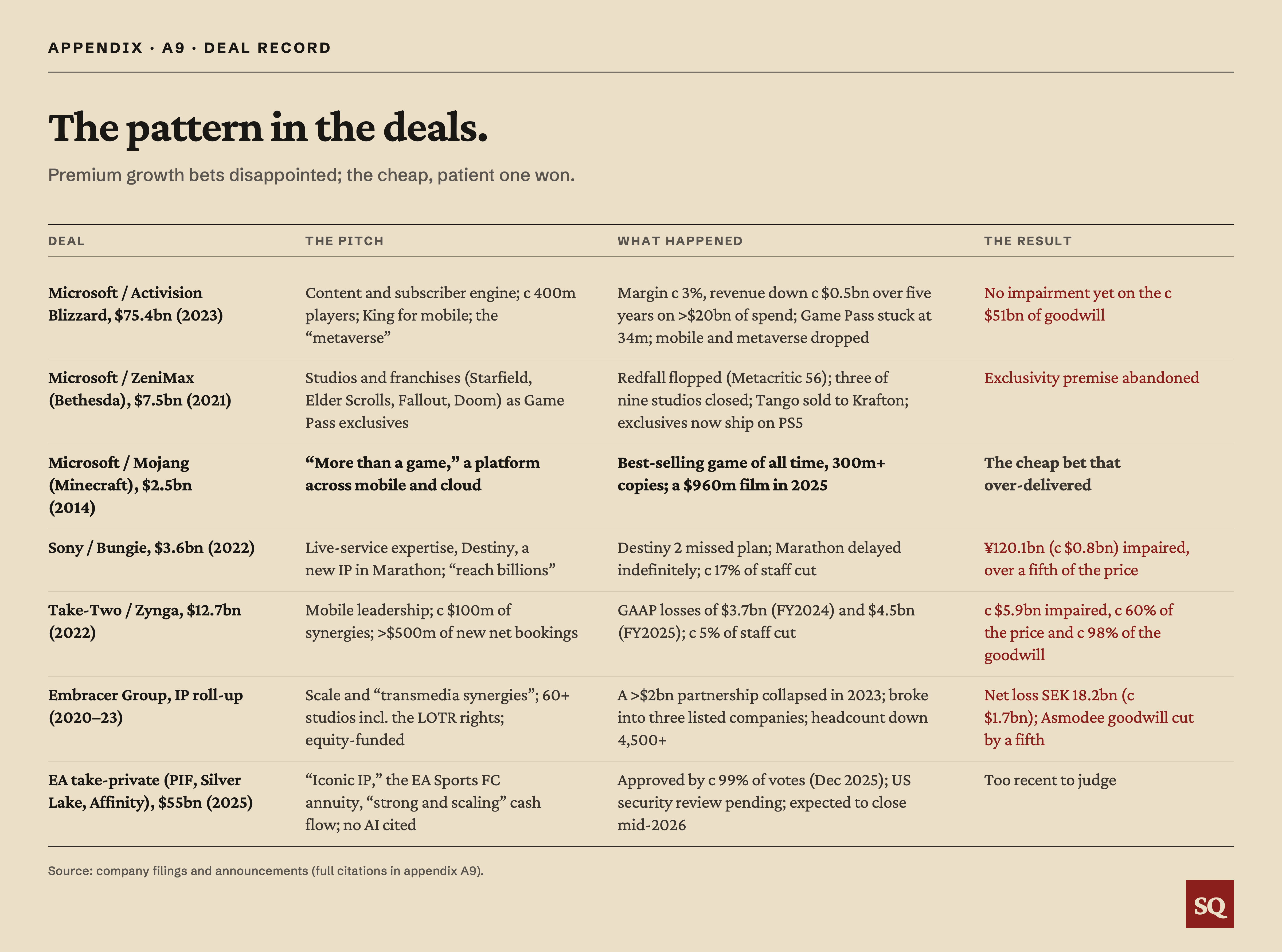
The lesson for Xbox is not that game IP is worthless, Minecraft is proof of the opposite, but that a premium paid on a growth or transformation story is a bet, and the bet often loses. That is the discipline behind valuing Xbox on the cash it generates rather than on what a buyer might hope to do with it.
Sources and notes: Microsoft FY2025 10-K (Activision purchase price $75.4bn; announcement EV $68.7bn at $95.00 a share; goodwill $51,001m in More Personal Computing, no impairment in the May 2023, 2024 and 2025 tests; the $11.3bn of accumulated goodwill impairment is legacy, pre-Activision). Reset figures from the 10 June 2026 memo (trade press). Sony FY2025 Q4, 8 May 2026 (Bungie ¥120.1bn, excluding goodwill). Take-Two FY2024 and FY2025 10-Ks (Zynga goodwill $5,994m; impairments $2,342m plus $3,545m = $5,887m; announced EV $12.7bn against $9.52bn of GAAP consideration at close). Embracer Annual Report 2023/24 (net loss SEK 18,177m; Asmodee impairment SEK 6,770m on the SEK 34.4bn paid). EA press release 29 September 2025 ($210.00 a share, a 25% premium) and Form 8-K, 22 December 2025 (vote 201.5m for / 1.9m against). Metacritic as of 20 June 2026.
A10. Conventions
Units: $bn, FY2026, CY2026. Non-dollar figures carry the reported amount, a dollar conversion and the rate used (Sony in yen, Embracer in krona).
Disclosed vs inferred: filings and company statements are disclosed; the model’s estimates (the hardware/content split, the 3%-margin operating income, console units, the dis-synergy legs) are inferred and labelled.
Refresh at publication: market caps and peer enterprise values move daily, and the goodwill carrying amortises down; live figures are as of mid-June 2026.
The deal record (A9) sets out the comparable transactions in a single table, with sources beneath it.
The one contested point: whether a deconsolidating spin must recognise the Activision carrying at the distribution date is an accounting question, not settled here.
A11. What the model does not do
A register of the figures a reader should interrogate, and the judgement behind them.
The hardware/content split is inferred. Microsoft discloses the gaming total and the growth rates, not the dollar split; the c. 11% hardware share is the model’s estimate (A4).
Console units are not disclosed. Microsoft stopped reporting Xbox console sales, so “lost this generation” rests on third-party estimates: c. 80m PS5 against c. 30m Xbox Series consoles by mid-2025 (VGChartz), roughly two and a half to one, and wider than ten to one in Japan.
Game Pass subscribers were last disclosed at 34m (February 2024). Later figures, including the c. $5bn revenue line, are estimates or single statements, not a filed series.
The c. 3% margin is the reset memo’s “accountability margin,” an internal, non-GAAP figure quoted in trade press, not a disclosed GAAP segment result; whether it is struck before or after acquisition amortisation is the single biggest swing in the valuation.
The dis-synergy is built from precedent carve-out ratios (GE HealthCare, Kenvue), not Xbox-specific disclosure (A5).
The spin-versus-sale write-down treatment is genuinely contested and wants an accountant’s read, not an analyst’s (A8).
Market-linked figures move. The market cap, the peer enterprise values and the Activision carrying are as of mid-June 2026 and should be refreshed at publication.