


TL;DR
Sadly, the cuts we expected in June have landed: 3,200 roles through FY27 and five studios divested. Those cuts, and a tighter process for funding games, are aimed at a margin that runs far below the rest of Microsoft.
Xbox is focusing on its platforms, Minecraft and King, now reporting to the CEO, and its biggest AAA franchises, while shedding the smaller studios it bought to feed Game Pass.
The value sits in a few big franchises and the cut Microsoft takes on other publishers' games, not the console or the divested studios.
In June, we valued Xbox on the news that the division might be spun out (See Microsoft and Xbox: Too small to sell, too strategic to spin) and concluded Microsoft would most likely keep it. In our base case we left a door open in the headcount assumptions banking “only the first wave and leaving the rest to a broader round still to come.” Sadly, that has now come to pass, with Microsoft and Xbox announcing cuts to the division, reducing headcount by 3,200 through FY27.
1. What we learnt about the new Xbox strategy
Going back to the original thesis (See Microsoft and Xbox: Too small to sell, too strategic to spin), there were two reasons we looked at why Microsoft was turning its attention to change at Xbox:
Focus. Gaming consumes leadership attention for a 3% margin business that has only just returned to growth, while the $168bn Microsoft Cloud business grows at 23%.
Capital. The more than $20bn Xbox absorbed over five years is real money for a company spending about $65bn a year on capital expenditure, most of it the AI build-out. It is immaterial to the balance sheet and still an ineffective use of capital.
The announcement by the CEO of Xbox acts on the set-up laid out above, and on Microsoft's previous communication.
Focus: Xbox will become focused on both platform and AAA first-party titles
Mojang and King now reporting to the CEO of Xbox is perhaps the most interesting part of this strategy. The two are doing different jobs:
Minecraft is the platform play: a user-generated creation platform that competes directly with Roblox and Fortnite’s UEFN, and the clearest case of Sharma’s “increasingly become platforms.” King is the profitability play: a mobile free-to-play business with a very large audience and high margins, whose value is the profit it throws off rather than any creation platform. The reporting change aligns management attention with where the margin actually is.
The promotion of Helen Chiang, who ran Minecraft, into the COO role, replacing Dave McCarthy, though hers is the first such role given end-to-end P&L, points to the greater weight platforms will carry.
Mojang and King also have a very large number of monthly active players, plausibly rivalling the rest of the portfolio combined, which (Mojang and King) have probably not commanded management attention proportionate to the profit they generate.
Microsoft will also provide “open development tools” to help independent creators. That is the other half of the same platform pivot: rather than owning every studio, it wants creators building on its platforms, Minecraft’s marketplace the clearest existing example.
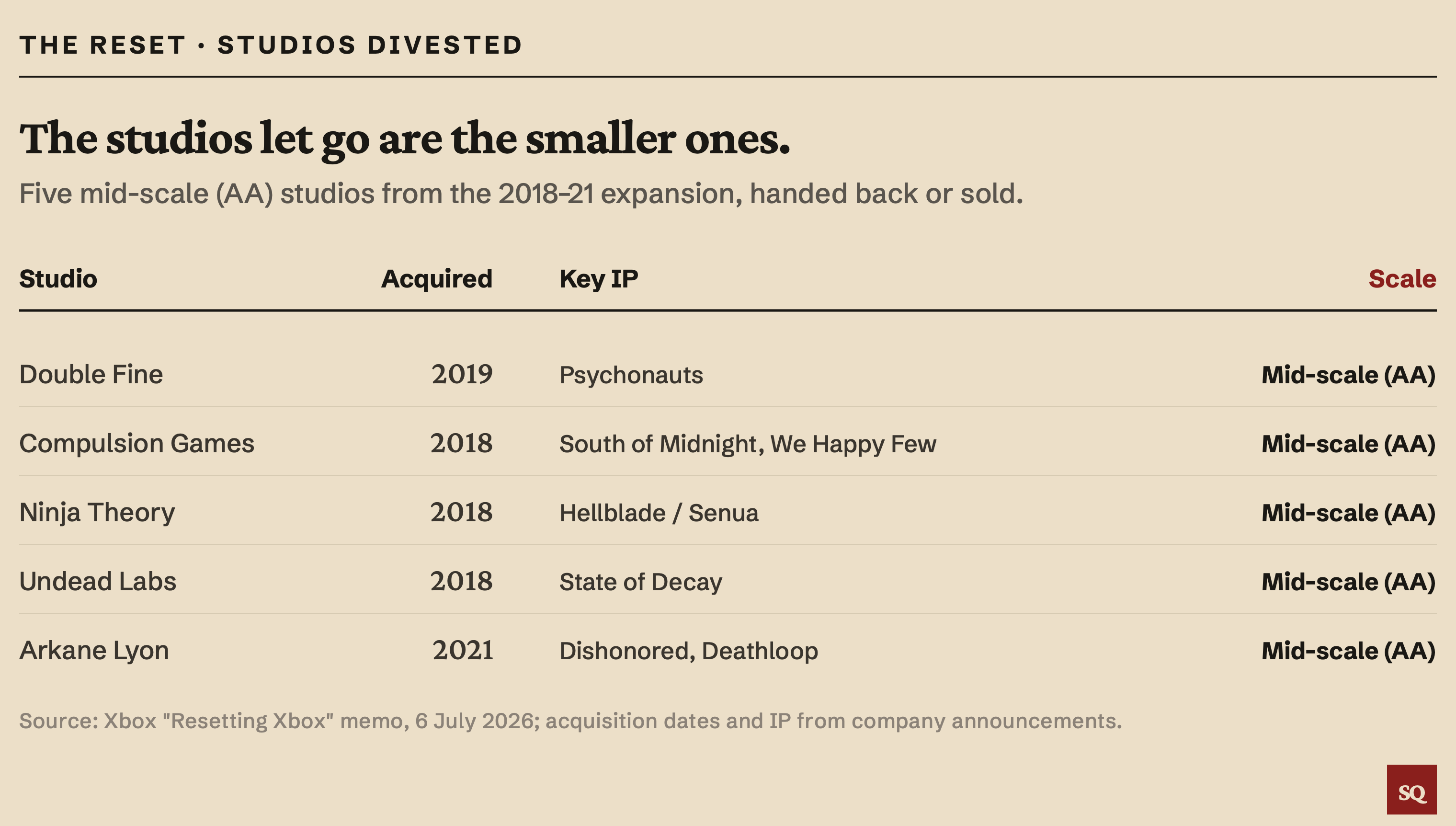
The sale of the studios helps focus management time too. In the CEO’s own words, “we now find ourselves competing not only with the largest publishers, but also with smaller independent studios.” For illustration purposes, the studios being let go share a profile: mid-scale, AA studios picked up in the 2018–2021 expansion, none anchoring a franchise at the scale Xbox now wants to concentrate on.
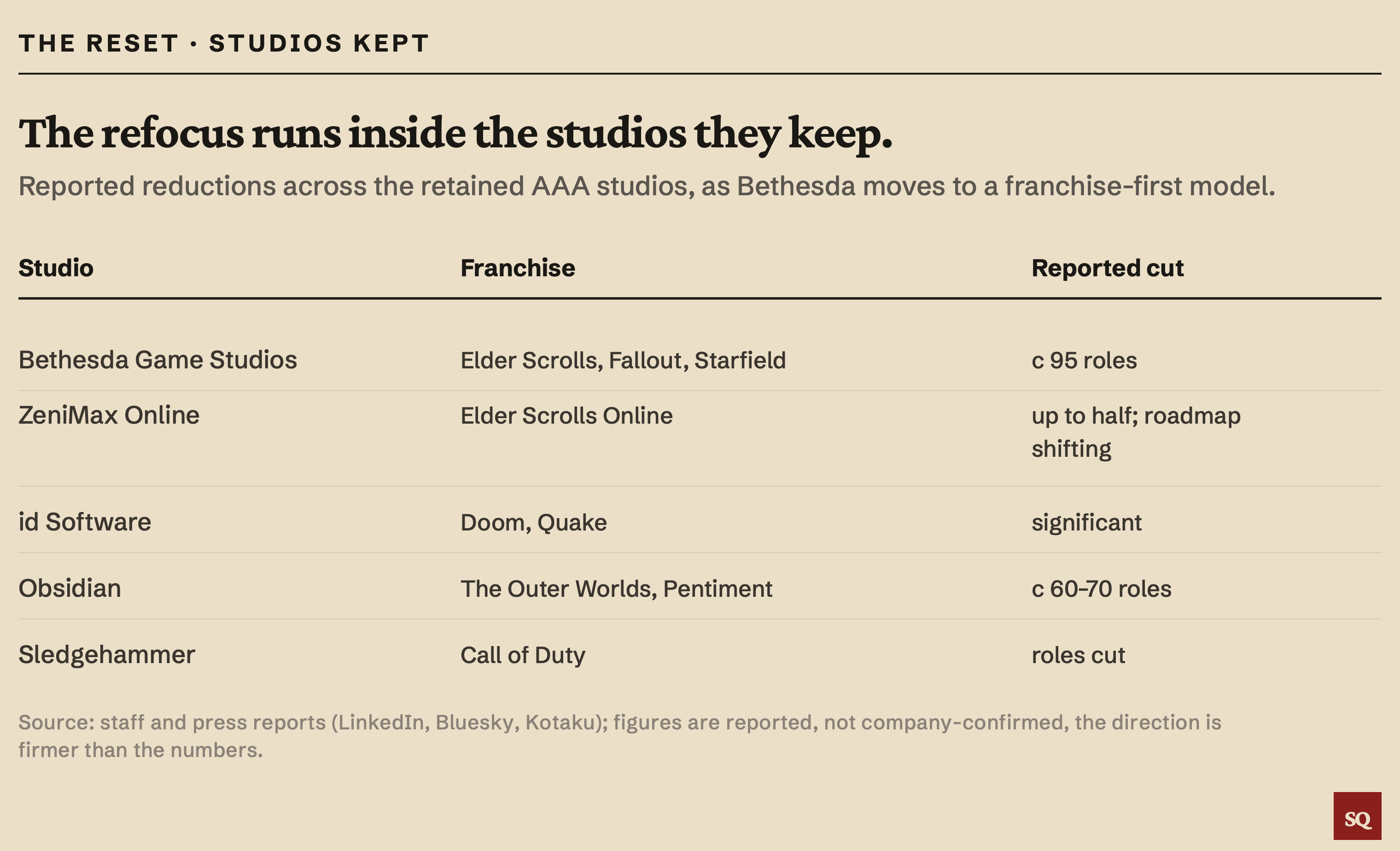
The refocus runs inside the studios they are keeping, too. Bethesda is moving to a franchise-first model, concentrating on Elder Scrolls, Fallout and Doom over experimental bets like Starfield, and the reported cuts land across the AAA studios. This reads as reallocating investment within the AAA tier rather than retreating from it. Where a live game like Elder Scrolls Online loses headcount, the more likely read is a shift to running it for its annuity, harvesting the recurring revenue with less new-content investment, rather than a franchise being cut.
Tying this back to Microsoft, alongside the Xbox memo the group’s Chief People Officer said the “business is changing because the world around it is changing. The way technology is built, deployed, and used is transforming faster than at any point in my time here.” Microsoft’s strategy as a whole is tilting harder to AI, and that speed of change in the core business accelerates the need to reshape a mature division like Xbox. This is about where the company is putting its resources and attention, not about AI taking these particular jobs.
Capital: Xbox is working towards its group management margins
Capital is now being tied to focus, which likely means further investment into established, profitable franchises and a more concentrated portfolio of bets:
The four to five studios handed back or made independent will likely lift the division’s margin: most were in development, spending cost against little current revenue, so removing them takes out near-pure cost. Sharma framed the studio economics as loss-making (“in a typical year, we lost 64 cents for every dollar we invested”), though that figure depends heavily on the period and the mix of in-development versus launched titles, so it reads more as a snapshot of front-loaded spend than a settled loss rate.
Helen Chiang’s promotion to COO also creates an investment committee (IC) approach to capital allocation within Xbox: she will “bring our businesses together under one operating model, making sure we make clear investment decisions, learn from our successes and failures, and hold ourselves accountable for results.”
With that, games likely have to clear a set of hurdles for investment to continue, inferred from the statement that Xbox is “also making reductions across other units, and in some cases, shifting investment to focus on higher priority projects,” to various degrees across Activision, Bethesda/ZeniMax, Blizzard, King, Mojang, and XBOX Game Studios.
There will be “50% reduced vendor spend,” a standard variable cost line most businesses pull when restructuring.
2. What does this all mean?
For the future, the CEO of Xbox has stated two ambitions:
Xbox “entertains more than a billion people each day.” That is an aspirational scale ambition, not a quantified target, and the portfolio is a long way from it today, a few hundred million monthly players across Candy Crush, Minecraft, Game Pass and the console, reaching different audiences. A billion daily is a very high bar.
Returning to growth in 2027. Sharma has said that since the April 2026 price cut, Game Pass has seen “acquisitions grow, and retention improve,” early signs on what she calls the “path to restore durable growth” rather than a return already achieved. With that, resources concentrated on the biggest platforms and most profitable franchises, and a tighter capital process, there are levers to pull.
For the valuation, there’s another way to think about it. Instead of valuing Xbox as one blended business, look at where the value actually sits and what each part is worth:
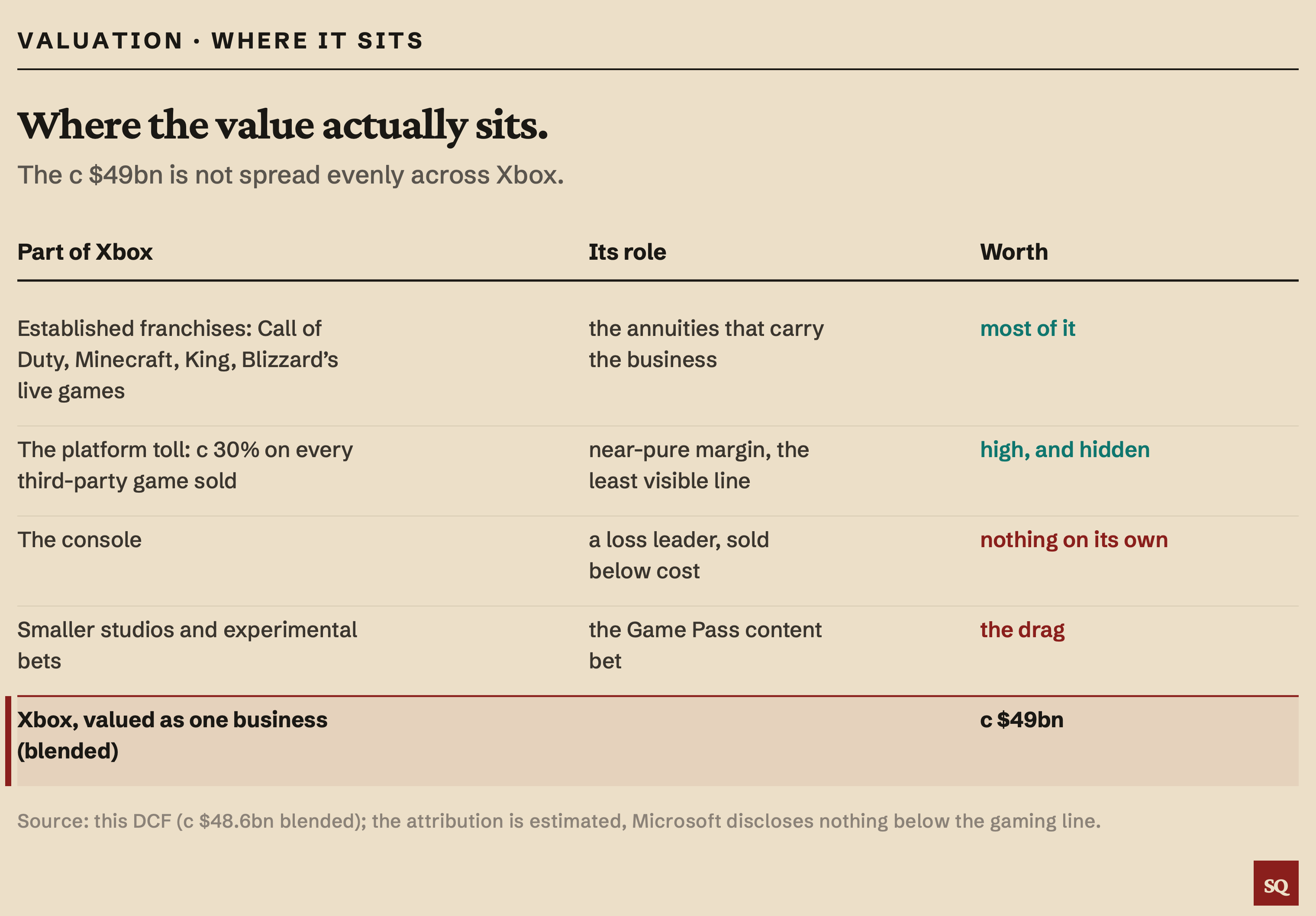
The value was never evenly spread and it sits in a handful of established franchises and in the toll Microsoft takes on everyone else’s games. The drag is the console and the studios it bought to feed Game Pass, a content bet that never grew the subscription enough to justify it. The reset is Microsoft narrowing Xbox to the parts that were carrying it all along.
More from The Side Quest
Epic Games: what is it worth, and what did the generosity cost? Fortnite pays for four free layers. The cash Epic captures is worth about $7.5bn; the tools it under-monetises lift fair value toward $14bn, and the last mark sits in between.
Roblox: A great company lost on valuation - It owns the most complete stack in interactive entertainment yet profits from it the least, and rising costs are eating into what little is left.
Microsoft and Xbox: Too small to sell, too strategic to spin - On the numbers, Xbox is worth about $49bn, a rounding error to Microsoft. It won’t be sold, and any separation keeps a grip on the data its games generate.
AI in Video Games: Own the Loop - why a studio keeps its value only if it owns the content-generating learning loop, not the model. Uses Guild Wars 3 as a worked example.
AI won’t make AAA games materially cheaper to develop - the productivity gains are real, but two-thirds of the value leaves the P&L to the AI vendors before it reaches the bottom line.