


TL;DR
Guild Wars 2’s Commander’s Compendium is a 300-gold in-game item, a meaningful investment by player economy standards, that lets any committed player lead a public squad of up to 50 others. The mechanic has compounded over fourteen years of iteration between ArenaNet’s design choices and what players actually do with them.
I interviewed five commanders across five game modes to understand why they choose to give up their time to lead as a Commander. Their reasons converged on community service, the discipline of doing the work well, and the social texture each of them keeps alive in the game mode they run.
No other major MMO sells public player leadership as an in-game item like this. An illustrative model puts the Commander’s layer’s contribution at roughly 2.5-6.5% of NCsoft’s $60-63M annual Guild Wars 2 revenue.
This article could not have been written without the support of the Guild Wars 2 community - the five commanders who gave up their time to talk to me: Velvet on the open-world meta in Dragonfall, Kasa on raids, fractals and strikes, Menhors on jumping puzzle taxi services, Catnoids on scheduled world boss runs and Pleomir on rift hunts.
At 9am on most working days, Menhors logs into Guild Wars 2, walks his character to the chest at the end of whatever jumping puzzle is the Weekly objective that week, and posts a notice in the game’s looking-for-group (LFG) menu. He then leaves the character standing there. Between meetings and tasks at his actual job, he pops back into the game to open portals so other players can teleport directly to the chest, skipping the puzzle and collecting the reward.
He does this for about eight hours a day, five days a week, which is roughly a full-time job. He is paid in tips, sometimes, by the players who use his portal with about one in ten people giving to him. The largest tip he has ever received was 50 gold, sent by a player who went by Santa Claus and ran his own portal taxi service in the winter. The most common tip is 1 gold. The item that lets Menhors run this service in the first place cost him 300 gold.
Menhors is one of five Guild Wars 2 commanders I spoke to. The other four, Velvet, Kasa, Catnoids and Pleomir, do versions of the same work in different parts of the game.
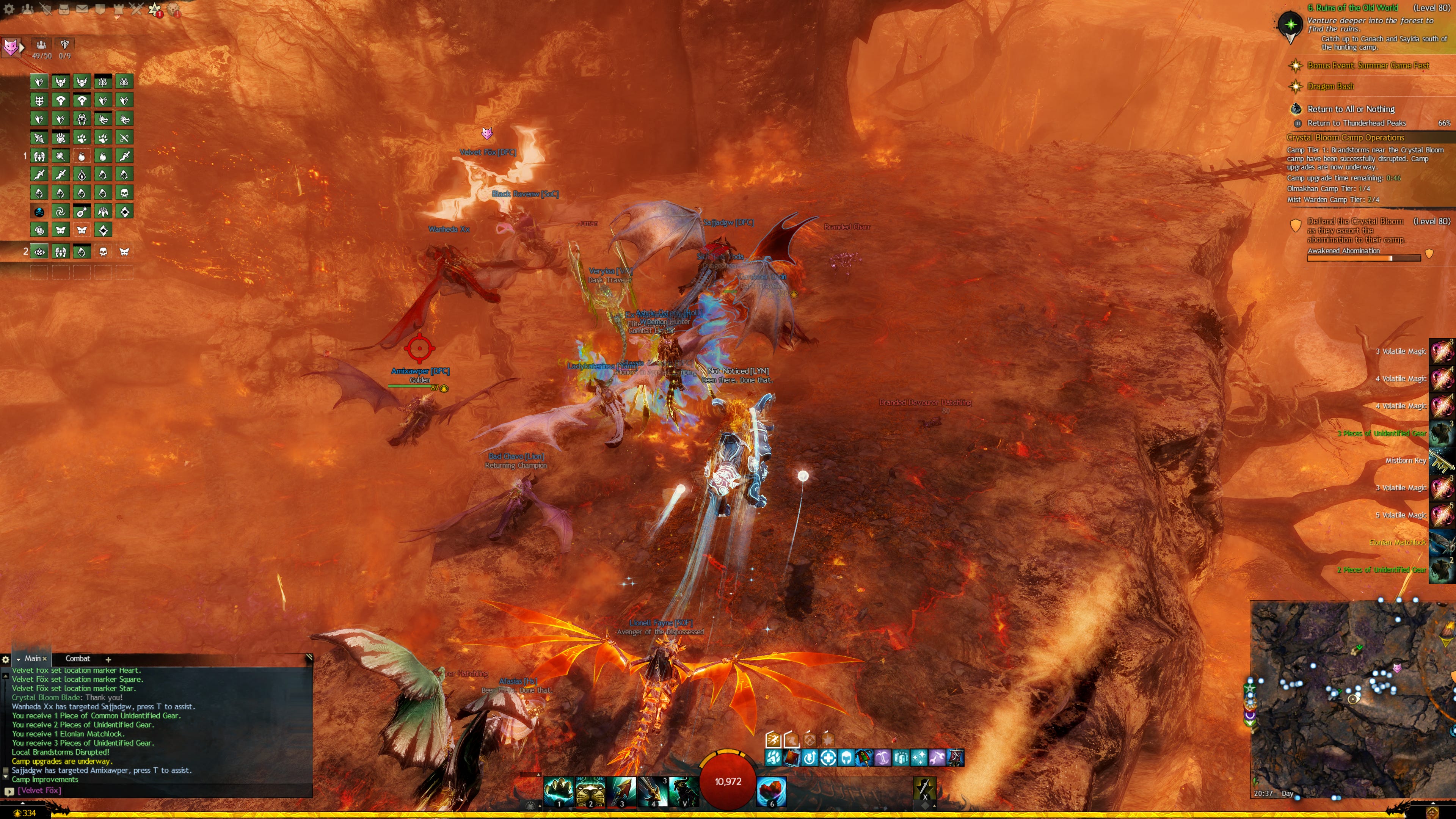
Velvet runs a 50-player squad through Dragonfall, a high-traffic event map, every day as part of the Dragonfall Farming Community (DFC) that has over 3k members on their Discord channel.
Kasa commands raids, fractals and strikes for his guild and for groups he finds in the looking-for-group menu.
Catnoids leads scheduled world boss runs that the regulars treat as a chatroom as much as a fight.
Pleomir leads rift hunts, multi-map runs for the essences that feed legendary armour crafting, having bought his tag last year after twelve years of playing without one.
All five bought a 300-gold in-game item called the Commander’s Compendium for their own reasons, and chose to keep doing the work every day after. This article is about that work, the system that made it possible, and how much value commanders create for GW2.
Part 1: The Commander’s Compendium
What is it, and why is it important
Mechanically, a commander is a player who has bought the Commander’s Compendium and “tagged up”. The tag puts a marker above their character that other players can see on the world map and from a distance in-game. With the tag active they can build a squad of up to 50 players, organise them into sub-groups of five, send on-screen messages, and drop ground markers. The game gives the commander no special powers beyond visibility and coordination tools, so the leadership is entirely driven by the player and how they use these tools.
The system that exists today is not the system ArenaNet shipped at launch. In August 2012, the company released a simple tag designed for World versus World (the game’s large-scale player-versus-player mode where coordinating dozens of players across a battlefield matters). Players took the tag and used it for cooperative open-world content instead, the kind with no fixed group, where dozens of strangers showing up together to fight a dragon or run a scheduled event could come together.
ArenaNet noticed and made the following changes:
In September 2014, the company made the tag unlock account-wide rather than character-only, added colours so multiple commanders could co-lead the same map, and raised the price from 100 to 300 gold.
In November 2015, alongside the Heart of Thorns expansion, ArenaNet rebuilt the system in earnest with the Enhanced Squad UI, which added 50-player squads, sub-groups of five, ready checks, on-screen broadcasts, and the supply tracking that makes WvW commanding possible. The system as commanders use it today shipped in those two updates, eighteen months apart.
These changes were important for the commanders I interviewed: “I learned a lot from good ole WvW Coms... that did the first 2-3 years here in GW2” as Catnoids put it. The commander culture was carried from one mode (WvW) to another by the people who had led, and as time went by, by the people who learned to lead from them.
Why the tag worked: two design choices other MMOs did not make
The commander tag worked due to two product decisions that lay at the heart of Guild Wars 2:
The first is that GW2 is an open-world that scales with participation. Dragonfall, the map Velvet leads daily, is designed to host squads of up to 50 players. The events scale in difficulty as more players join. Additionally, there are no diminishing returns to the loot as the number of players increases, so players are not competing with each other for loot and is part of why Dragonfall is one of the busiest farming destinations, as with a Commander like Velvet, the efficiency of gaining loot is high. Catnoids’ world boss runs, which spawn on fixed timers across the day and pull together whichever players happen to be online, are another expression of the same design principle. The content is built to welcome a crowd. World of Warcraft’s open world is largely solo or small-group. Final Fantasy XIV’s open events are smaller in scale and less central to the game.
The second is the absence of a monthly subscription and is a clear intentional design that dates back to when the original Guild Wars was launched. As players are not spending monthly, and feeling any need to justify the cost of their subscription by playing regularly, casual players will coexist with daily players in a way they do not in subscription games. In World of Warcraft or Final Fantasy XIV, the people with the most time tend to dominate the culture. In Guild Wars 2, the people with the most time, the commanders, are providing a service to the people with the least.
The idea of a Commander system is one that is unique to GW2 - other MMOs do not sell public player leadership as an in-game item.
World of Warcraft has player leadership inside private guilds.
Final Fantasy XIV has ad-hoc hunt trains organised in the moment, with no underlying system.
EVE Online has fleet commanders embedded in corporations and alliances.
Part 2: The five commanders’ duty of care, and what they each get from the role
The interviews span across five commanders who are doing five different kinds of work in five different parts of Guild Wars 2. Commanders do not often communicate with each other, and they tell the story of why they choose to commit time to learning how to be good at the role, often without people teaching them.
Commanders possess a strong duty to their squad
Let’s remind ourselves that the duty of being a commander is self-imposed and unenforced, yet they behave as if they have professional standards and have a strong duty of care to the people they lead.
Kasa tells of a time where one player in his group wasn’t communicating, which led him to replacing them; “when you replace those people the atmosphere actually change by itself, because you took a decision that people secretly wanted but thought their opinion wasn’t worth it, because troublemakers afflict other people mood, leading to more leavers and the end of the squad possibly”. Kasa takes his role seriously enough to put the benefit of the squad over one individual.
This trait is a theme that Velvet, who runs the Dragonfall map, also shows. He practised for a month before ‘tagging up’ because he “wanted to avoid any mistakes”, and on fragile events he will make sure everyone in his squad is in place before beginning; “in events like Cull, which are delicate, we just tag and wait for everyone to arrive on time”.
Whilst there is little communication between Commanders themselves, there is almost an invisible code of conduct. Menhors, who runs Jumping Puzzles (JPs), will do the JP himself, rather than use a taxi from another Commander who’s already completed it as a sign of respect to the time and effort they took to complete it. When with other commanders at the puzzle, Menhors talks about how they assist each other rather than compete by “defending each other from mobs that have aggroed”.
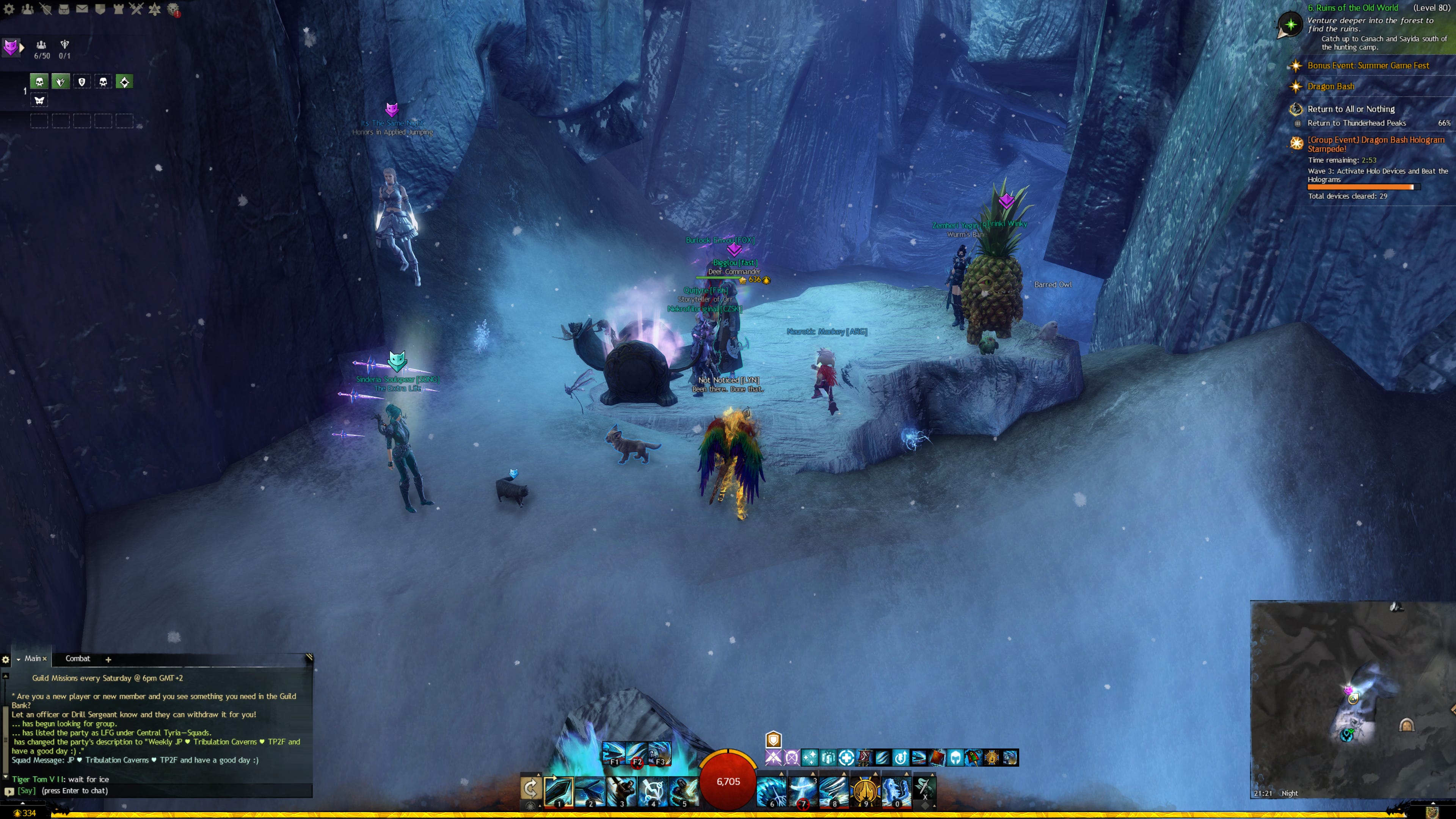
Catnoids, who has played GW2 for many years and runs World Bosses, organises the run around the social element; “be funny, nice and have a good time” and he treats being a Commander as a place where he can meet new people and others can also do the same. Pleomir feels accountable to a promise he made in guild chat: because I put a message in the guild chat about my run, I feel obligated to follow through with the promise.
What each one gets from the role
So what do Commanders get from the role? The answers vary from person to person, including improving themselves, an in-game identity, the feeling of giving back to the community, or the social element.
Kasa gets quality control, and a forcing function for his own improvement; “I like organized and well done runs, if I cannot find them with other people I’d rather do them myself, so it forces me to be better than if I was just joining someone else’s run.” The tag is how he practises.
Velvet gets an identity inside a game whose other content has burned him out. He is blunt about it: I’m burned out on the other content GW2 has. Dragonfall and being a commander there keeps me in this game. Without the role, he says he would not be playing GW2 at all.
Menhors originally started for the money and stayed for something else. He bought the tag for 300 gold, was left with about 100 gold afterwards, and ran his first JP taxi to start recouping the cost. Within a month, the tag had paid for itself, but by then the reason had shifted; “the tome paid for itself in about a month, but by that point I had come to enjoy both the income and the feeling of being useful to people”.
Catnoids builds relationships with others who play the game; “GW2 is my chatroom”, transforming his role into one that puts the social space first above gameplay. Pleomir gets a new way to engage with a game he has played for over a decade; “After 12 years I finally buy the tag. I was excited.”.
Why this matters
The role generates two-sided retention as it retains the players the commanders lead, and it retains the commanders themselves. Commanders provide a duty of care to the squad which keeps players coming back, and the Commanders keep coming back for the reasons mentioned above.
Commanders have a community of practice but without a community for themselves
What surprised me throughout these conversations was how little Commanders talk to each other and there is no group that binds them together with Menhors saying; “Commanders don’t communicate with each other at all. There’s no internal community among them. Or at least I was never invited into one.”
Despite all of this, they hold a strong sense of etiquette between them. Menhors notices during his JPs that commanders don’t stand too close to each other when running services in the same spot. They don’t stand right at the chest itself. They defend each other from monsters that have aggroed onto an AFK commander.
So there is an unwritten code that binds them, and this likely emerges because the role of a Commander naturally demands it, which in turn the players have unspokenly agreed is the right way of doing it. Even when I have played the role of a commander, it surprises me how often players will speak up to aid your leadership, saying “listen to the comm” or “wait for the comm’s instructions”.
New commanders come to replace those who leave
Given the lifespan of Guild Wars 2 (over 14 years), the commanders running this work do not last forever. Some run a route for years and step away or some communities could last a season and end. The Tyrian Education Association (TEA), a teaching guild that for years organised runs of Triple Trouble (a World Boss event that requires three commanders coordinating in real time), is a great example of where new Commanders can learn the system and create a lifecycle to keep these events running. TEA has over 800 members as part of its Discord.
Part 3: Commanders are part of the acquisition and retention loop
Without commanders, the game thins out in places NCsoft can measure
Velvet, Kasa, Menhors, Catnoids and Pleomir are part of what people mean when they describe Guild Wars 2 as one of the most welcoming MMO communities. The phrase, when it shows up in press coverage, is not about the developers’ tone in patch notes and typically always about how new players feel when they pick up the game for the first time. There’s usually a Commander leading, who will help out and teach new players the ropes.
Without commanders, the on-ramp for new players gets steeper. A new player wandering into Dragonfall in the evening with no commander tag in sight is a new player who tries the meta event once, fails, and logs out. For a Live Services team, this would show up in player count metrics.
Without commanders, the social texture lapsed players remember coming back to gets thinner. Many MMO players cycle in and out of the games they love and they come back when an expansion ships or there is a major update. Catnoids, a long-time Guild Wars 2 player who treats the game as his chatroom, is exactly the kind of player whose absence would be felt by the friends who come back to find their familiar runs ended.
Without commanders, the activity density on the map at 9pm on a Tuesday gets sparser, the map looks emptier than it is and other players make the decision to leave too, because the texture of a populated MMO is part of what an MMO is.
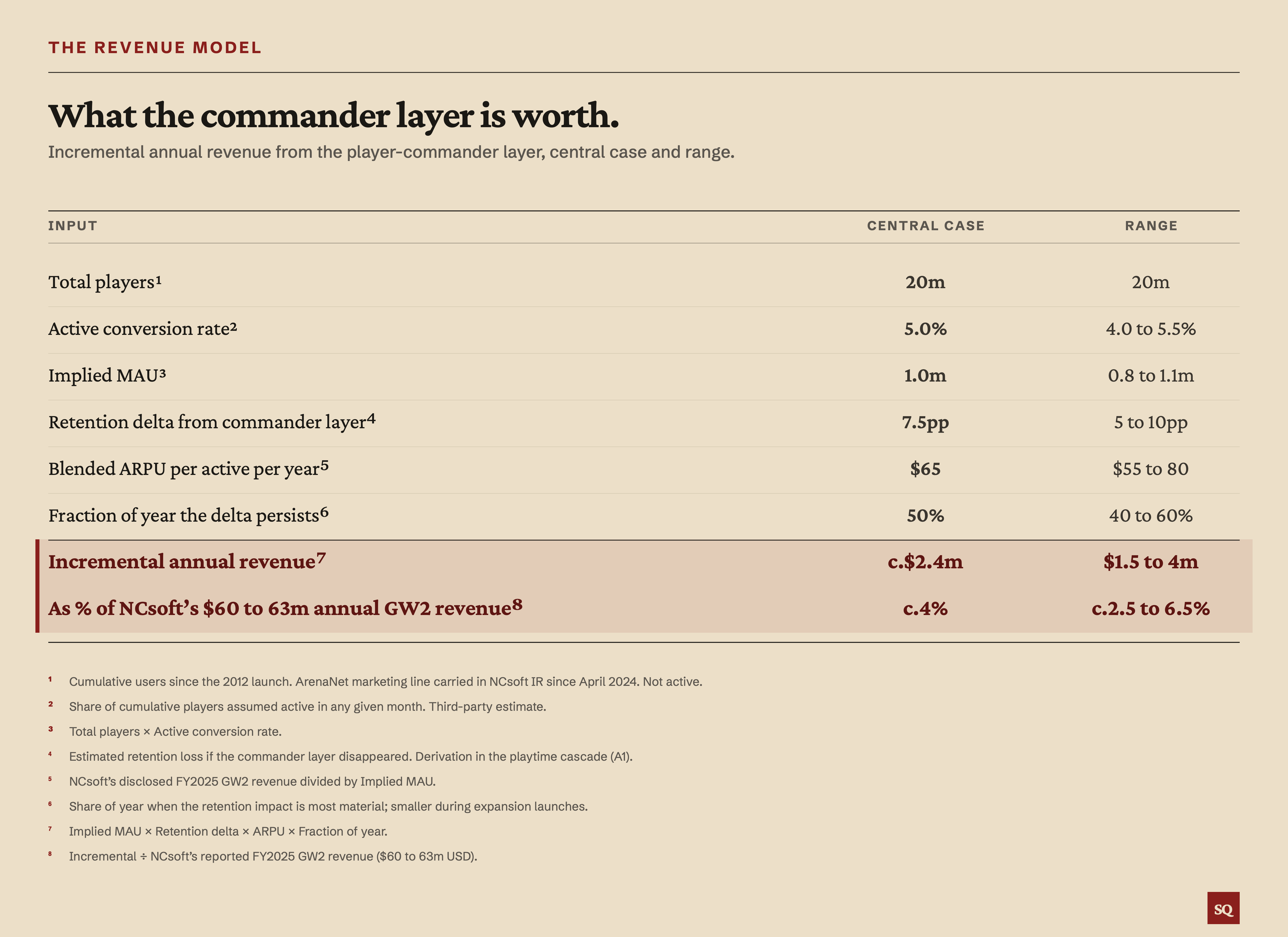
The Commander system could be contributing 2.5-6.5% of GW2 annual revenue
Illustrating this in product terms, Commanders are an important part of the ecosystem that drives player acquisition and retention. Based on analysis of available data, I believe it could be contributing between 2.5-6.5% of annual revenue for Guild Wars 2.
Will Guild Wars 3 have a Commander system?
ArenaNet announced Guild Wars 3 in June 2026 for an autumn 2027 beta. In a 16 June philosophy post, game director Colin Johanson committed to preserving the buy-to-play, no-subscription model, and said that Guild Wars 3 doesn’t try to replicate the large-scale gameplay pillars that so uniquely define Guild Wars 2. So the question of whether commander culture has a place in Guild Wars 3 is genuinely open.
Closing
Becoming a Commander is a very conscious choice that costs 300 gold in-game. This article (if you’re a Guild Wars 2 player) is for those people you already know, whether it’s following Velvet into Dragonfall in the evening, Kasa who runs your weekly raid, Menhors who helps you complete your weekly JP or Catnoids who creates a social World Boss event. The cycle continues with Pleomir, the newer commander who is tagged up after twelve years of playing and makes the cycle continue.
The system that lets them do that is in Guild Wars 2. Whether it will also be in Guild Wars 3 is now a question with a partial answer, and the rest of the answer will be visible in the design choices of the next two years. As Pleomir puts it, after a year of running his own squads: “every commander is a normal player and started out just like you”.
More from The Side Quest
AI in Video Games: Own the Loop - why a studio keeps its value only if it owns the content-generating learning loop, not the model. Uses Guild Wars 3 as a worked example.
AI won’t make AAA games materially cheaper to develop - the productivity gains are real, but two-thirds of the value leaves the P&L to the AI vendors before it reaches the bottom line.
Hyperscalers: The debt that doesn’t look like debt - how Microsoft, Amazon, Alphabet, Oracle and Meta are funding the AI capex boom, and why their reported leverage understates what they actually owe.
Why Roblox really left Delaware - reading the Delaware-to-Nevada reincorporation as a move to shield management amid active litigation.
Appendix
A1. The Commander layer revenue model
The model counts followers who keep playing because a commander is tagged up. It does not count the commanders themselves, who are retained by the role: Velvet is explicit (Dragonfall and being a commander there keeps me in this game), and Kasa, Menhors and Pleomir describe the same pull. This sits on top of the follower figure, not inside it, and because commanders are a small but high-engagement, high-spending population, folding it in pushes the central case a little higher than the table shows.
How the 42% commander-dependent playtime figure was built
The figure is illustrative. Judgement columns are author estimates, anchored on the qualitative argument in the article.
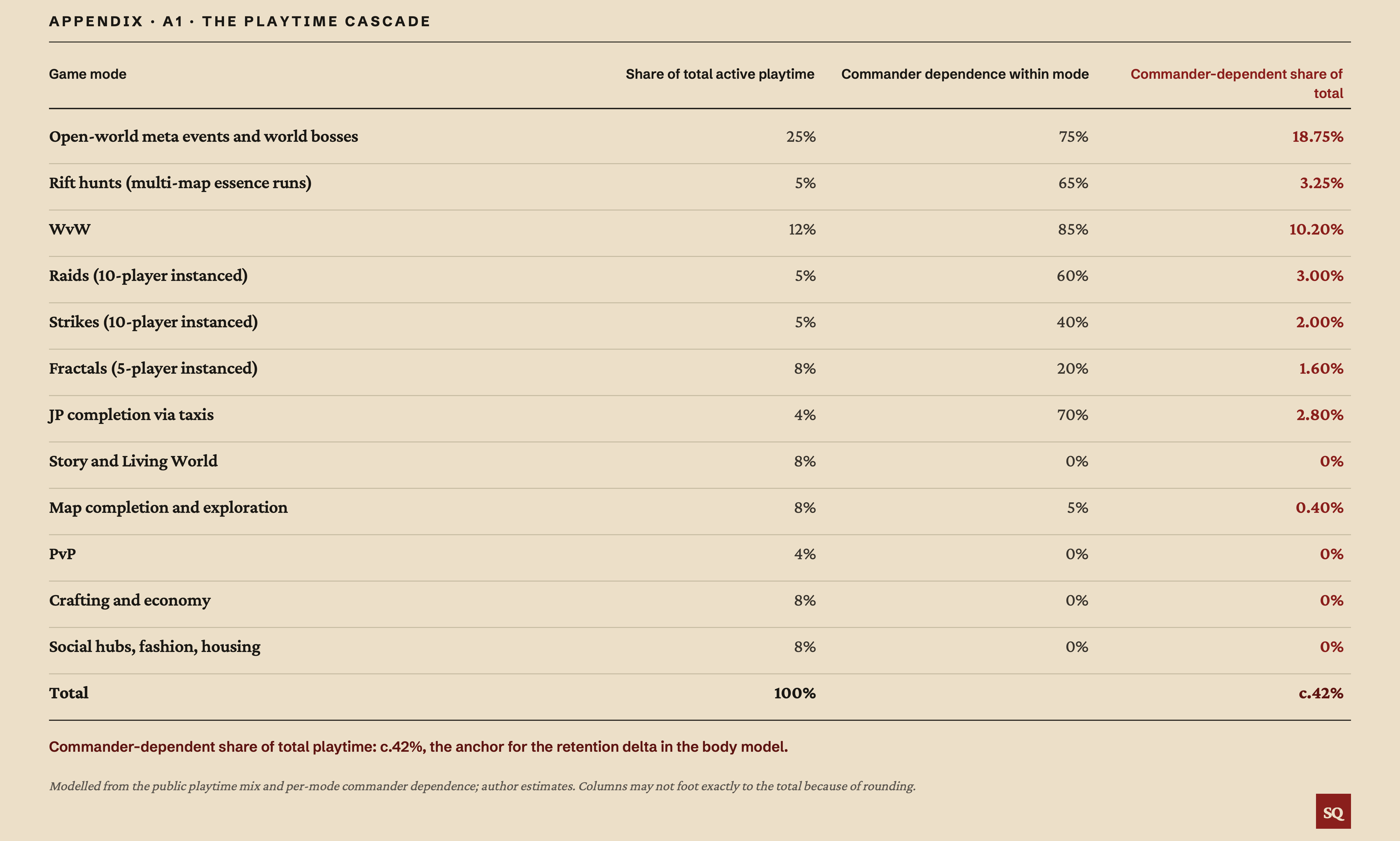
From cascade to retention delta: roughly 42% of playtime is commander-dependent. Assume that, if the layer vanished, about half of that becomes effectively unavailable or substantially degraded, giving c.21% engagement loss across the active base. Apply an engagement-loss-to-retention-loss translation factor of 0.5 (range 0.4-0.6, the midpoint of Park, Cha, Kwak and Chen, 2017), giving c.10.5pp, rounded to a 5-10pp range with a 7.5pp central case.
A2. The MAU-to-ARPU derivation
NCsoft’s FY2025 GW2 revenue (c.$60-63m USD, from a disclosed KRW 82-86bn divided at the c1,365 KRW/USD 2025 average) divided by the third-party MAU range gives the implied blended revenue per active player.
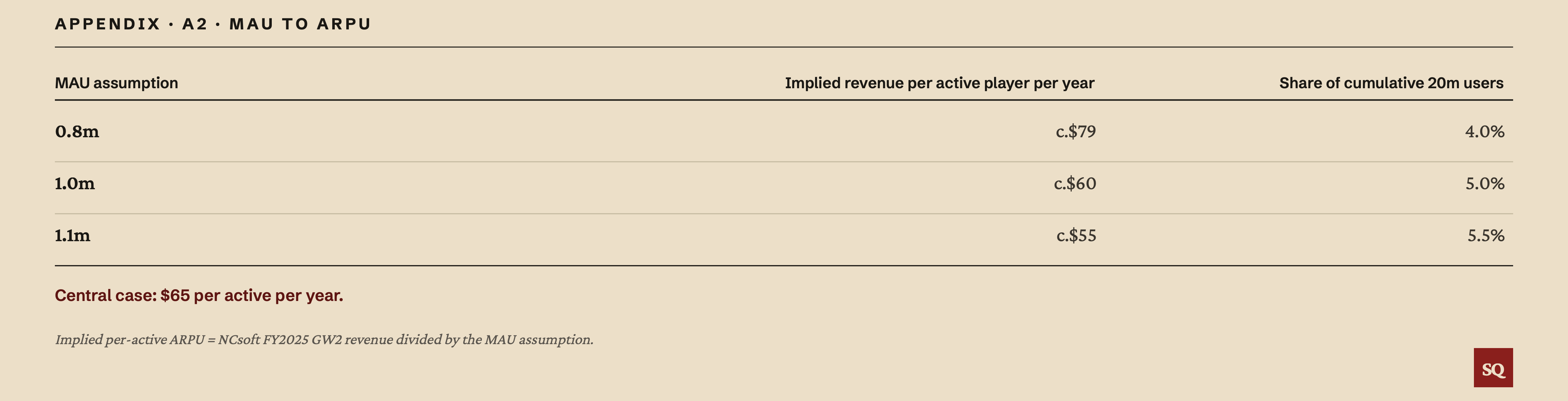
Central case: $65 per active per year, set as an illustrative central within the $55-80 band rather than read mechanically off a single MAU point.
A3 - A6. ARPU decomposition sanity check
The $65 per-active per-year figure cannot be split into its underlying revenue lines from NCsoft’s disclosure. The decomposition below is inferred from measured expansion SKU pricing and assumed adoption rates. It is a sanity check on the blended $65, not a measurement of how the revenue actually splits.
SKU pricing (measured). The Standard / Deluxe / Ultimate split has been consistent at $24.99 / $49.99 / $74.99 for every Guild Wars 2 expansion since Secrets of the Obscure in August 2023. Deluxe sits at exactly 2.0x Standard, Ultimate at 3.0x.
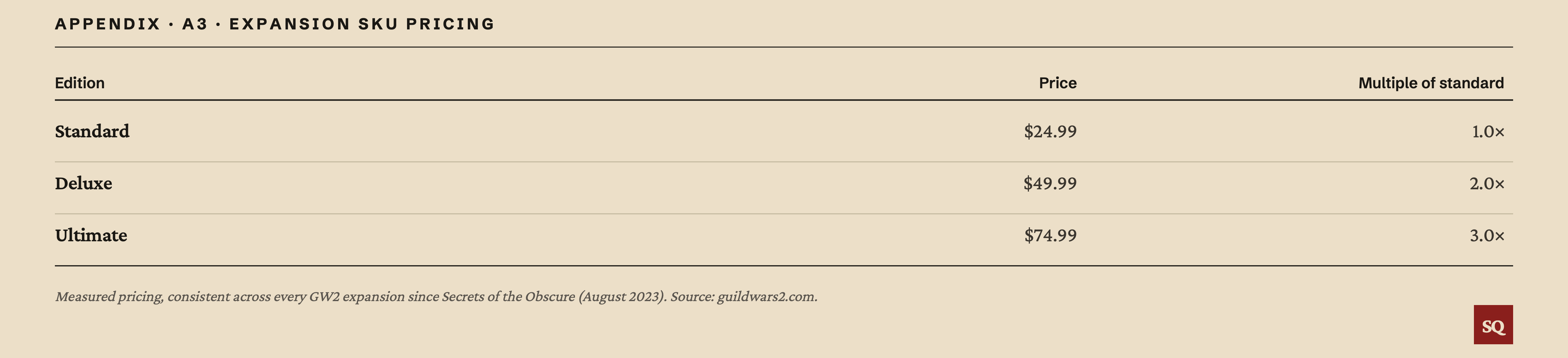
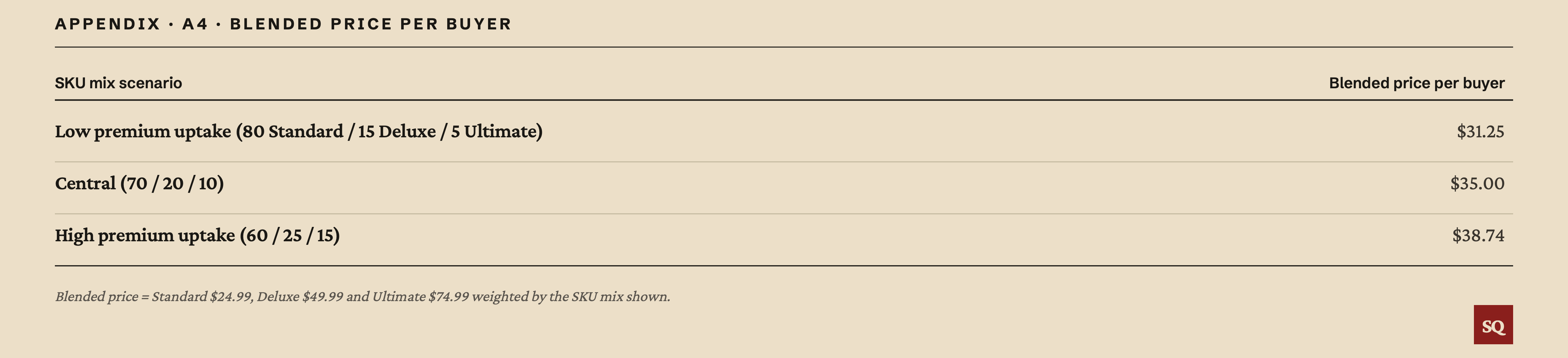
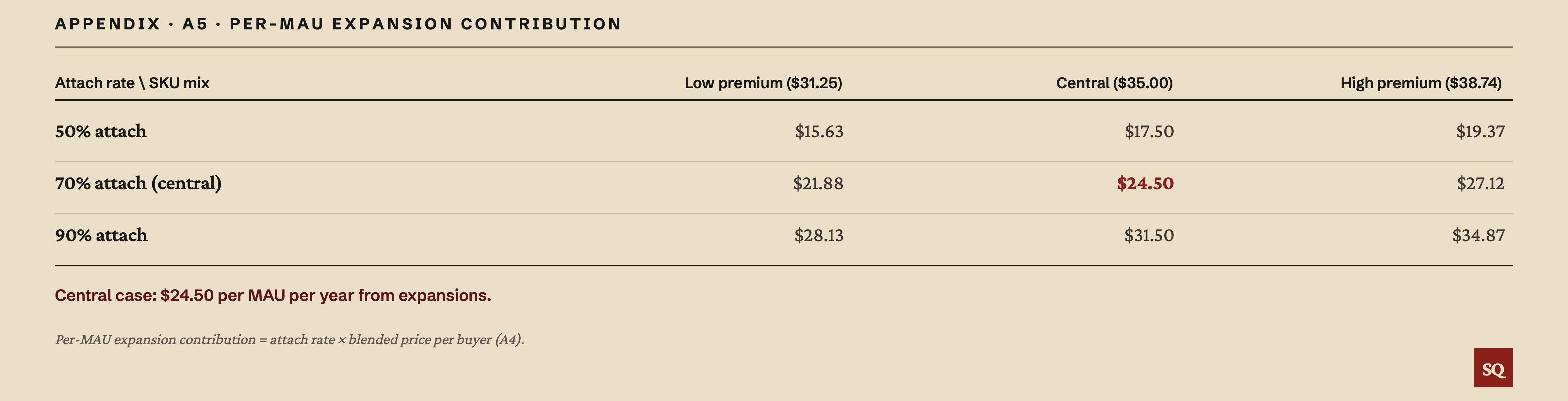
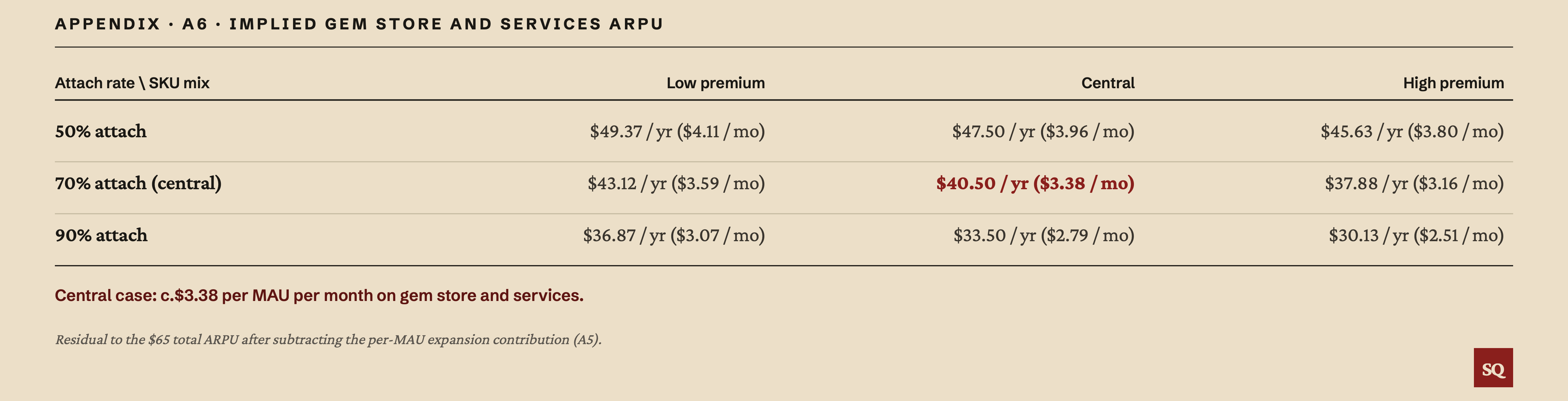
Central case: roughly $3.38 per MAU per month on gem store and services. That is plausible for a buy-to-play MMO with cosmetic-led monetisation and no subscription.
The communicating-vessels caveat. The Ultimate edition includes a 4,000-gem credit (about $50 of in-game currency). An Ultimate sale therefore reclassifies what would otherwise be a separate gem store purchase as expansion revenue. The expansion bucket and the gem bucket are not independent draws; they leak into each other through the premium SKU’s gem credit. The central $40.50 of implied gem ARPU is the residual after the Ultimate edition’s gem credit has already been counted as expansion revenue. The total $65 is the right top-line figure; the split between buckets is fuzzier than the tables make it look.
A7. What the model deliberately does not do
It does not assume a steady-state population multiplier compounding the retention delta into a structural population shift. The retention impact is presented as a within-year effect on average active players.
It does not decompose ARPU into gem store, expansion sales, or other revenue lines as part of the headline calculation. NCsoft does not break that down. The decomposition above is an inferred sanity check, not a measurement.
It does not treat the MAU estimate as a measurement. The 0.8-1.1m range is third-party and the methodology is not disclosed.
It does not claim a retention number from data. The 5-10pp range is author judgement, argued through the cascade and the engagement-loss step above.
A8. Uncertainty register
The 20m users figure in NCsoft’s IR materials is two-year-old marketing copy carried over from the June 2024 Janthir Wilds press release. It is cumulative since launch, not active, and should be read as such, not as a current disclosure.
FY2025 GW2 revenue has a roughly 4% vintage gap between the Q4 2025 and Q1 2026 IR releases, and both are read from stacked-bar charts rather than tabular disclosure. The $60-63m figure is therefore a range, not a single audited number. The Korean DART audited filing is the authoritative source and has not yet been pulled.
MAU is not measured anywhere in primary disclosures. The 0.8-1.1m range is third-party tracker estimates with undisclosed methodology and a weak Steam signal, because Guild Wars 2 is launcher-sold.
ARPU is modelled (a measured numerator divided by an estimated denominator), not measured. The decomposition into gem store versus expansion versus other is an inferred sanity check.
The retention delta is author judgement, not a primary or third-party measurement. The cascade-to-engagement-loss path is one way to argue for the 5-10pp range; a reader who disagrees with the cascade should disagree with the conclusion.
The whole model is illustrative and sensitive to its inputs. The point is the order of magnitude, a low-to-mid single-digit share of revenue, not the second decimal place.
A9. Sources
NCsoft Q4 2025 Earnings Release (10 February 2026): https://ncsoft-brand-web.s3.ap-northeast-2.amazonaws.com/ncsoft/invest/result/20260210/report/4Q25_PT_ENG.pdf
NCsoft Q1 2026 Earnings Release (13 May 2026): https://ncsoft-brand-web.s3.ap-northeast-2.amazonaws.com/ncsoft/invest/result/20260513/report/1Q26_PT_ENG.pdf
NCsoft Q3 2025 Earnings Release (11 November 2025): https://irsvc.teletogether.com/ncsoft/pdf/ncsoft2025Q3_eng.pdf
NCsoft Q4 2024 / FY2024 Earnings Release (12 February 2025): https://ncsoft-brand-web.s3.ap-northeast-2.amazonaws.com/ncsoft/invest/result/20250212/report/4Q24_PT_ENG.pdf
NCsoft May 2026 IR Presentation (the 20 million users line, slide 18)
ArenaNet Janthir Wilds press release (PR Newswire, 4 June 2024)
Guild Wars 3 announcement (PR Newswire, 5 June 2026) and the official guildwars3.com site
Colin Johanson, Our Guild Wars Philosophy (guildwars3.com, 16 June 2026)
Colin Johanson interview (PC Gamer, June 2026)
Seung-Uk Baek interview on Guild Wars 3 vs Aion 2 (PC Gamer, June 2026)
Massively Overpowered coverage of the announcement (5 June 2026)
Guild Wars 2 forums thread, is GW3 focussed on small groups? no big open world events? quote from ncsoft exec
Park, Cha, Kwak, Chen, Achievement and Friends: Key Factors of Player Retention Vary Across Player Levels in Online Multiplayer Games (WWW Companion 2017): https://arxiv.org/abs/1702.08005
Guild Wars 2 Wiki history pages for the Commander tag and Commander’s Compendium
ActivePlayer.io and mmo-population.com MAU estimates (third-party, methodology undisclosed)
Guild Wars 2 expansion SKU pricing pages on guildwars2.com (for the ARPU decomposition sanity check)