


TLDR
A great business that captures little of its own economy: Roblox owns the only full create-to-distribute stack in gaming, but of every $100 booked only about $10 is left once the app stores, its creators and its own costs are paid, and its rising cost base is eroding even that.
Cost inflation is the bear case: That cost base (infrastructure, AI compute, R&D, trust and safety) keeps climbing toward 96% of bookings, and the things meant to outrun it don’t as (a) spend per user has been flat near $53 for three years despite the aging-up and (b) AI adds content volume only by adding cost. With few clean levers left, Roblox is even reaching into its own creators, a new toll on their brand deals and a cut of their licensing, to claw back value it cannot earn from the platform itself.
The price is the problem, not the business: A DCF, on headline cash flow, comes to about $28 a share against a market price near $48. So the price sits above even the generous case, and the new buyback uses cash without moving the per share numbers. Not a buy here, but it could become one only if per-user spend lifts or the cost floor breaks.
Thank you to everyone who has supported me in the first month of The Side Quest. I am truly grateful. If you know someone who might benefit from these articles, please do forward on.
The Roblox model is available on request.
I’ve had this comment from multiple readers who run money; “Chirag, what is going on with Roblox here? It’s the only name with the full create-to-distribute stack and real platform economics, the aging-up debate cuts against it but they’re now publishing that 40% of users are 16+ and it’s their fastest-growing cohort, and surely AI is a tailwind that lifts both game quality and content volume, so with the stock where it is, is this actually a buy?”
With UGC platforms looking like they’re becoming an increasingly important strategic focus with Tencent pivoting towards UGC experiences and Epic also kicking up the dust on the economics of the model itself, it’s definitely worth a look.
There are four claims, and every one of them is defensible on the surface:
Roblox does own the whole stack (from the creation tools to the distribution).
It is aging up.
AI does help.
And the stock has fallen hard from its 2025 highs.
So let us take the four pillars one at a time and read the accounts against each. The answer falls out at the end, on the valuation, and it is not the one the price is implying.
1. “Real platform economics” is the problem, not the moat
a) The platform economics leaves Roblox with hardly any cash left
Everyone knows Apple and Google take 30% of in-app purchases on their app-stores, and Roblox has been successful in pushing people towards their web store with a +25% Robux bonus. So if we follow $100 of bookings, and start to track where that leads, the blended platform fee is closer to $16 (16%, nearly half of the 30% headline rate).
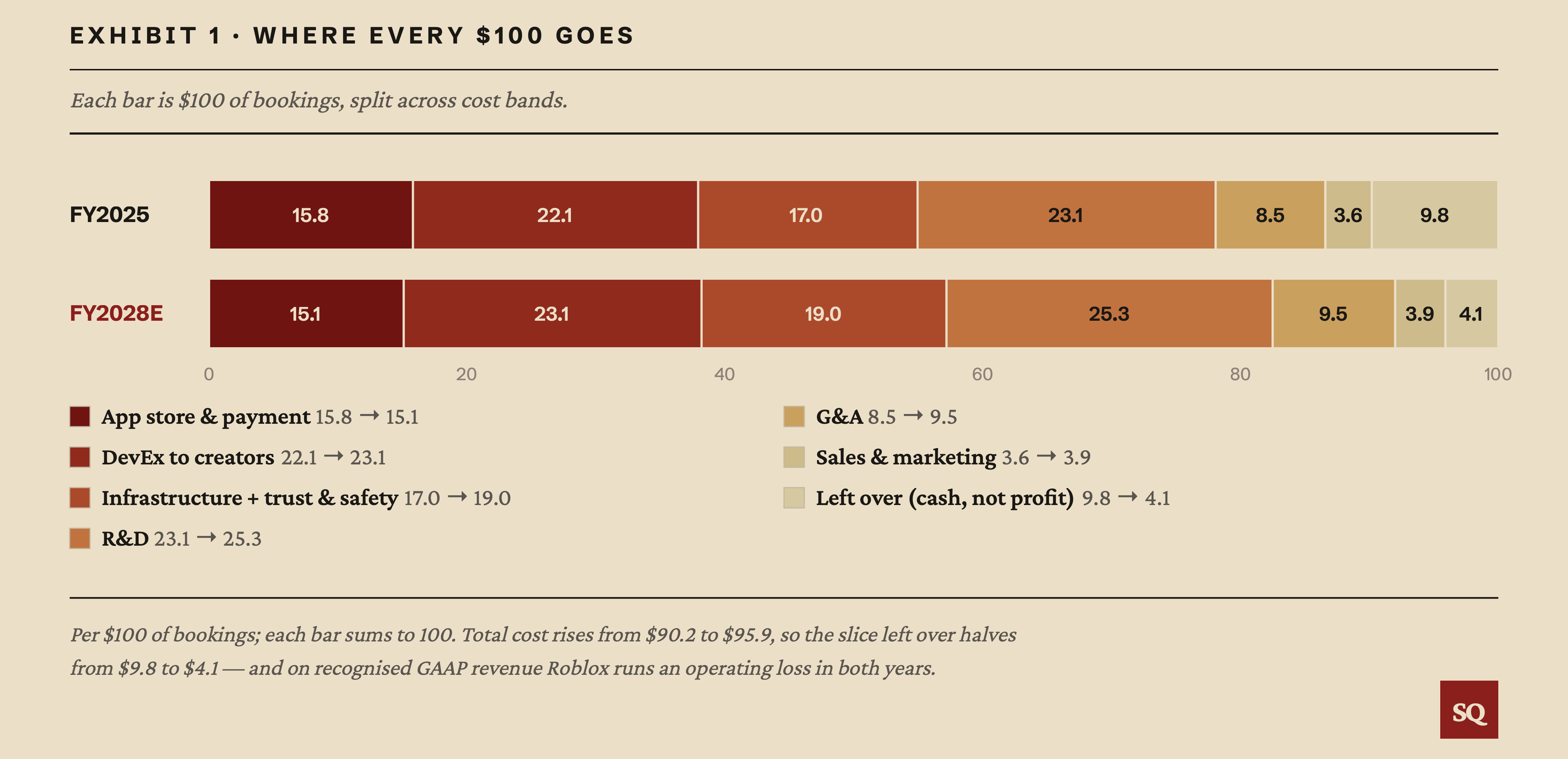
Of the $84 that survive the app store, creators receive about 22 through the Developer Exchange, the program that converts the Robux earned inside an experience into cash leaving Roblox itself with roughly $62 of the $100.
It is easy to call that “real platform economics,” and Tim Sweeney, on stage in Chicago, called Roblox “a single keeper that takes more than 70%.” But that only holds if you count the app stores’ slice as Roblox’s own, so it is really two keepers, not one; the only place Roblox alone nears 70% is its web store, where there is no app-store fee to share. It is the most bullish thing you can say about the economics, because once Roblox covers its own costs barely $10 of that $100 is left, and almost none of it is cash that reaches shareholders; on the revenue it actually recognises, the platform runs an operating loss. So why say it? It is a sales pitch for Team Open and their competitor to Roblox, UEFN. Epic pays creators 40% of net (and 100% of V-Bucks in a promo window running to January 2027).
The $62 Roblox keeps is increasingly eaten by its own rising costs:
R&D from about $23 to $25 by 2028E,
Infrastructure and Trust & Safety from $17 to $19 by 2028E
The cost floor is climbing into the retained cut faster than the company can leverage it, and it actually leaves little room to give back more to creators.
b) The creator economics can be highly lucrative for top titles
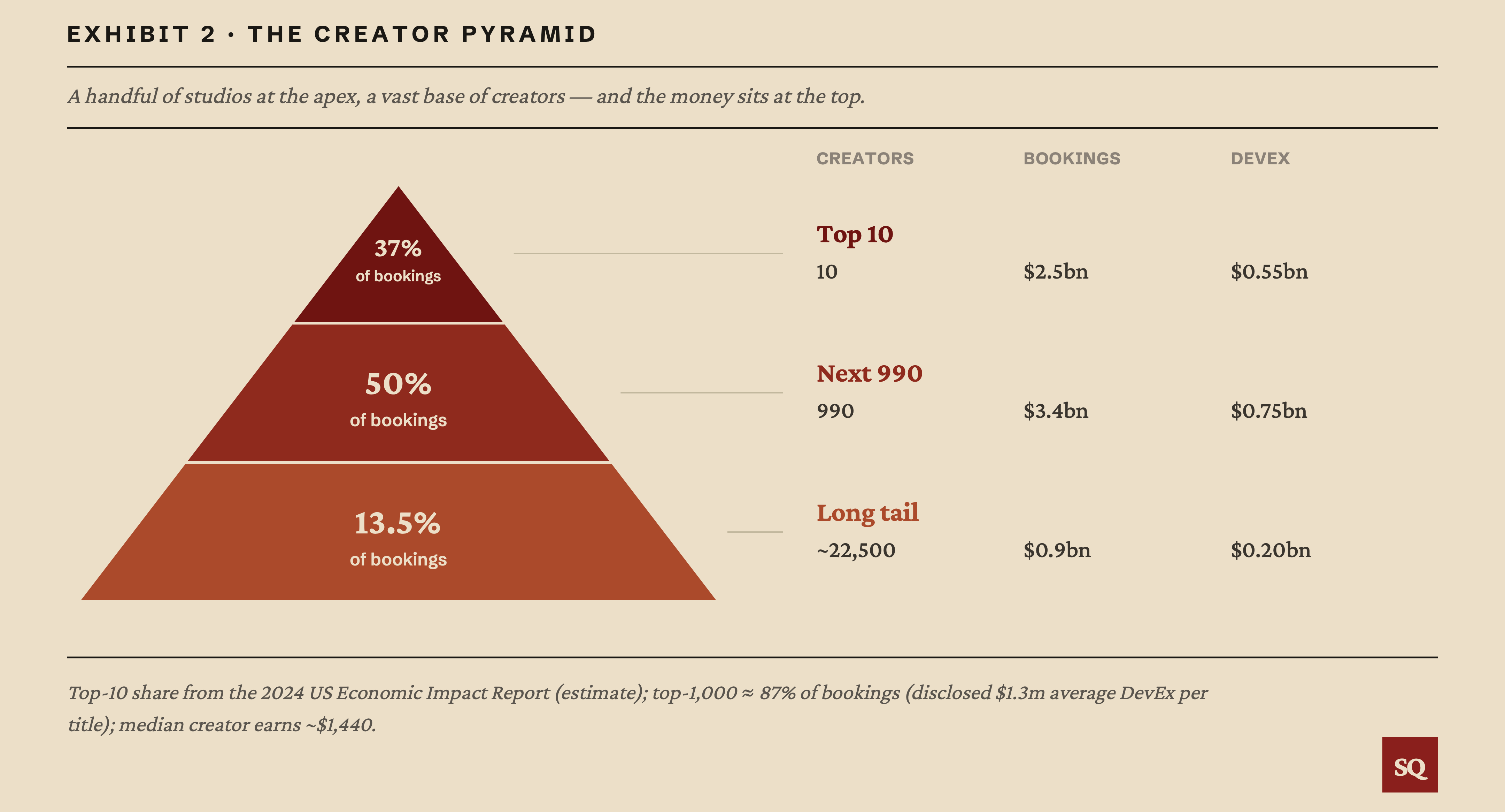
So for the money that does go to the creators, Roblox bands them into three: The Top 10, Top 1000 and the long-tail. It’s worth understanding the economics of this, to see the broader picture if ‘real platform economics’ exist in (a) the broader understanding Epic Games within this universe and (b) how growth/decline across these number of these studios impact the platform economics.
So in conclusion:
We estimate the Top 10 generate over a third of Roblox bookings
The next 990 generate about half Roblox bookings
The remaining 22,500 creators generate just 13.5% of bookings.
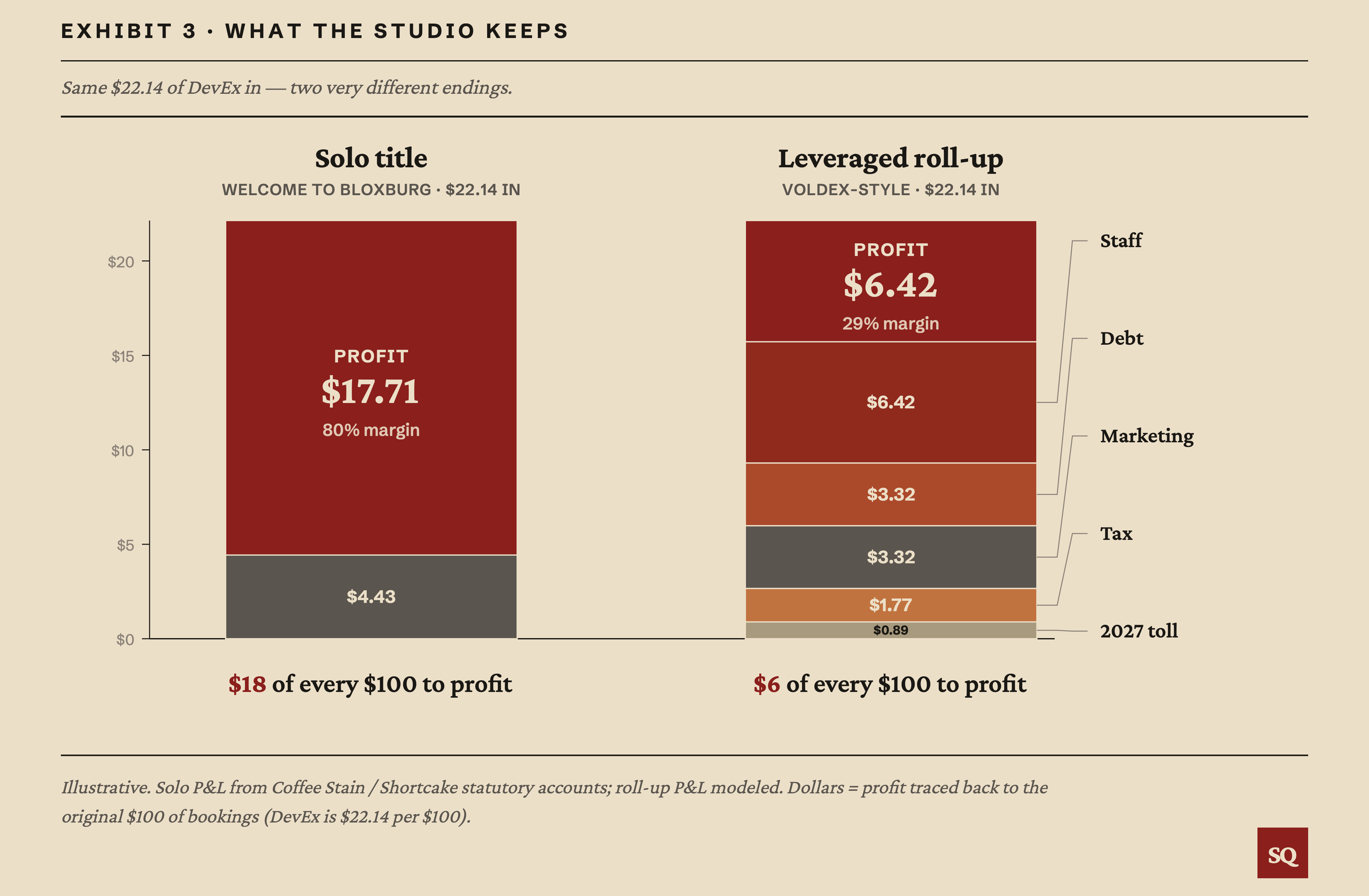
Within this, the business models of each studio also vary in their own right and there are two typical types of studios that sit within experiences played on Roblox:
A solo annuity studio, one durable hit lived off for years, optically keeps almost everything. Bloxburg (acquired by Embracer) runs about an 80% margin on what it actually receives from Roblox, its DevEx, which is roughly 20% of the gross a player spends. There is almost no cost structure, a tiny team and no marketing line, because Roblox’s own discovery does user acquisition for free.
A levered roll-up, the private-equity operator that buys hits and runs them centrally, keeps far less, we estimate around 29% after tax (Voldex is private, so this is modelled), once you load on payroll, marketing, interest on acquisition debt, and the new brand-deal fee.
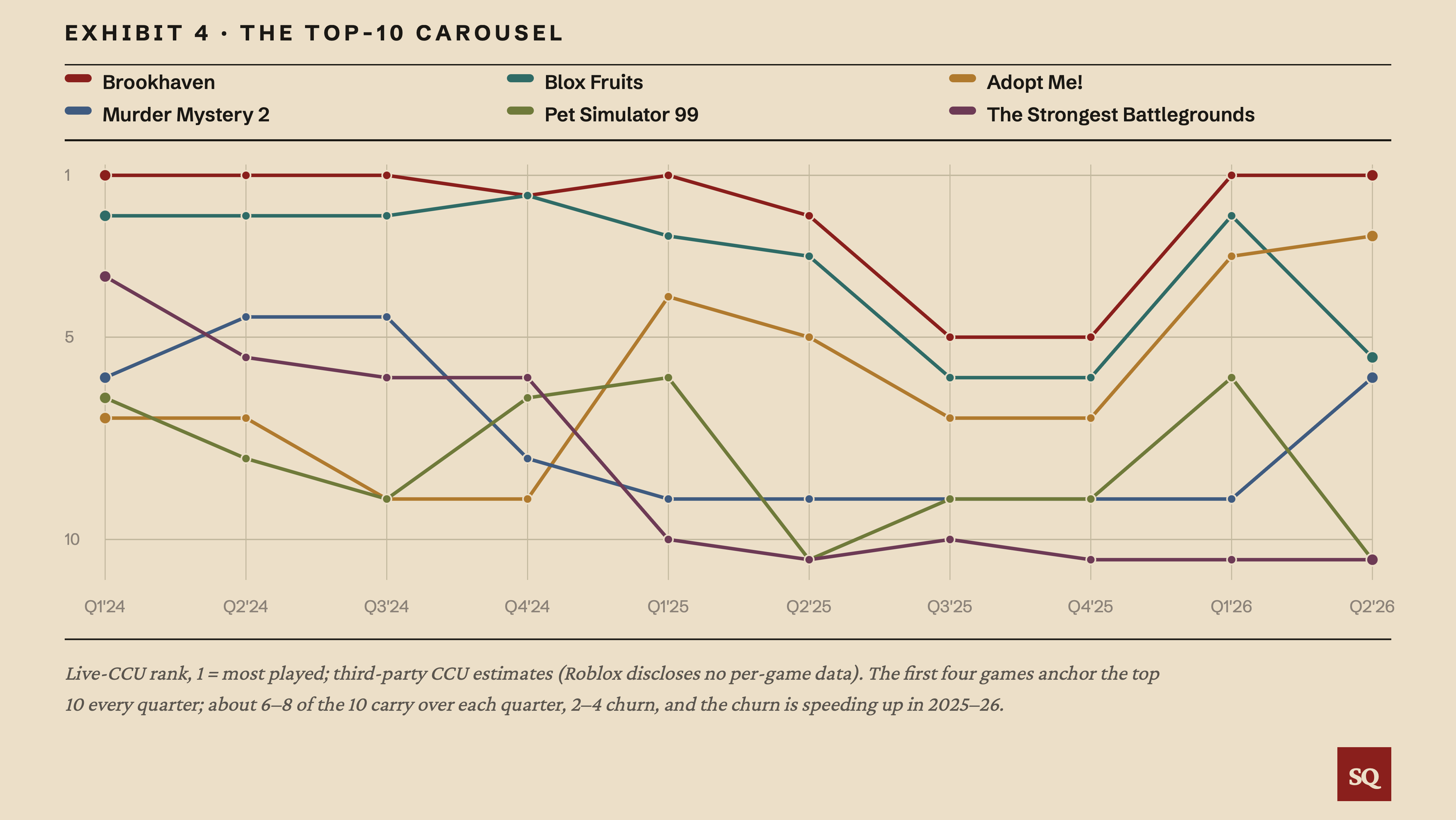
Breaking into the top 10 is hard, and a small core, led by Brookhaven and Blox Fruits, has anchored it for the whole period, with Adopt Me and Murder Mystery 2 cycling in and out, while the rest of the slots churn, because of new hits that spike and fade within a quarter or two.
The concentration reported as a feel-good story, the top 1,000 developers averaging $1.3m a year in DevEx (creator earnings, not bookings), is real, but the median creator earns about $1,440. The money is concentrated, and it concentrates in the studios, not with Roblox.
So Roblox built the most complete stack in interactive entertainment and, while perceived to take the largest cut, is the least profitable participant in its own economy.
The new cut of brand-deal money is a tension within Roblox’s own ecosystem
Roblox is also increasingly looking towards their own creators to see if they’re able to take parts of the value chain they haven’t been able to in the past, as seen with the new introduction of a brand-deal toll.
When a brand wants a presence on Roblox, a Nike space, a Gucci world, a Chipotle giveaway, it usually pays the studio directly, with no need for Roblox. Roblox has earned nothing from it beyond whatever extra engagement the activation throws off in its own platform. From 2027 that changes, as Roblox will require branded content to be registered and will charge a fee on it based on visits, not player spend or what the brand paid the creator. This fee is charged per thousand visits, from about $1.50 in the United States down to a few cents across most of the world, falling to a flat $0.10 per thousand after the first month.
The choice of the metric that Roblox is using here to charge creators (visits, not spend) makes sense to them as Roblox's costs scale with how many people show up. So it charges on visits, not on what a creator earns, to cover its own per-user costs. The bill is set by Roblox's costs, not the creator's, so it bites hardest where reach beats revenue. A loss-making platform, taxing profitable creators, on the one number that drives its own costs.
Creators will likely adjust their habits that drive spend over views. They’ll want the brand to sell, not just draw a crowd and build experiences to push towards monetisation, so the traffic that incurs the toll also pays for it. Although not all brands may want this. So the creator is caught between a toll that demands monetisation and a brand that resents it, and the easy exits, charge the brand more or run the activation on UEFN instead, both cost Roblox.
And the brand-deal toll is not the only time Roblox has sought to cut into the value chain. In July 2025 Roblox also launched a licensing platform that sits between creators and the IP owners whose characters and brands they want to build with, and takes a cut of those deals too.
This type of deal is what drives tension in the value chain between creators and the platform. Roblox is looking for another slice of the value, but the only lever it can enforce, a charge on visits, is the one least aligned with how creators earn (the sums are small, a few million a year even for a large roll-up, not a revenue line). A revenue share would align them but Roblox cannot levy one on a private off-platform deal, so it taxes what it can measure instead and reaching for a lever this small and this misaligned shows how few clean ones it has left: a bigger cut or a lower DevEx is exactly what Sweeney attacks it for, and its ad platform is still unproven at scale.
2. The aging-up is real, but spend per user hasn’t shifted
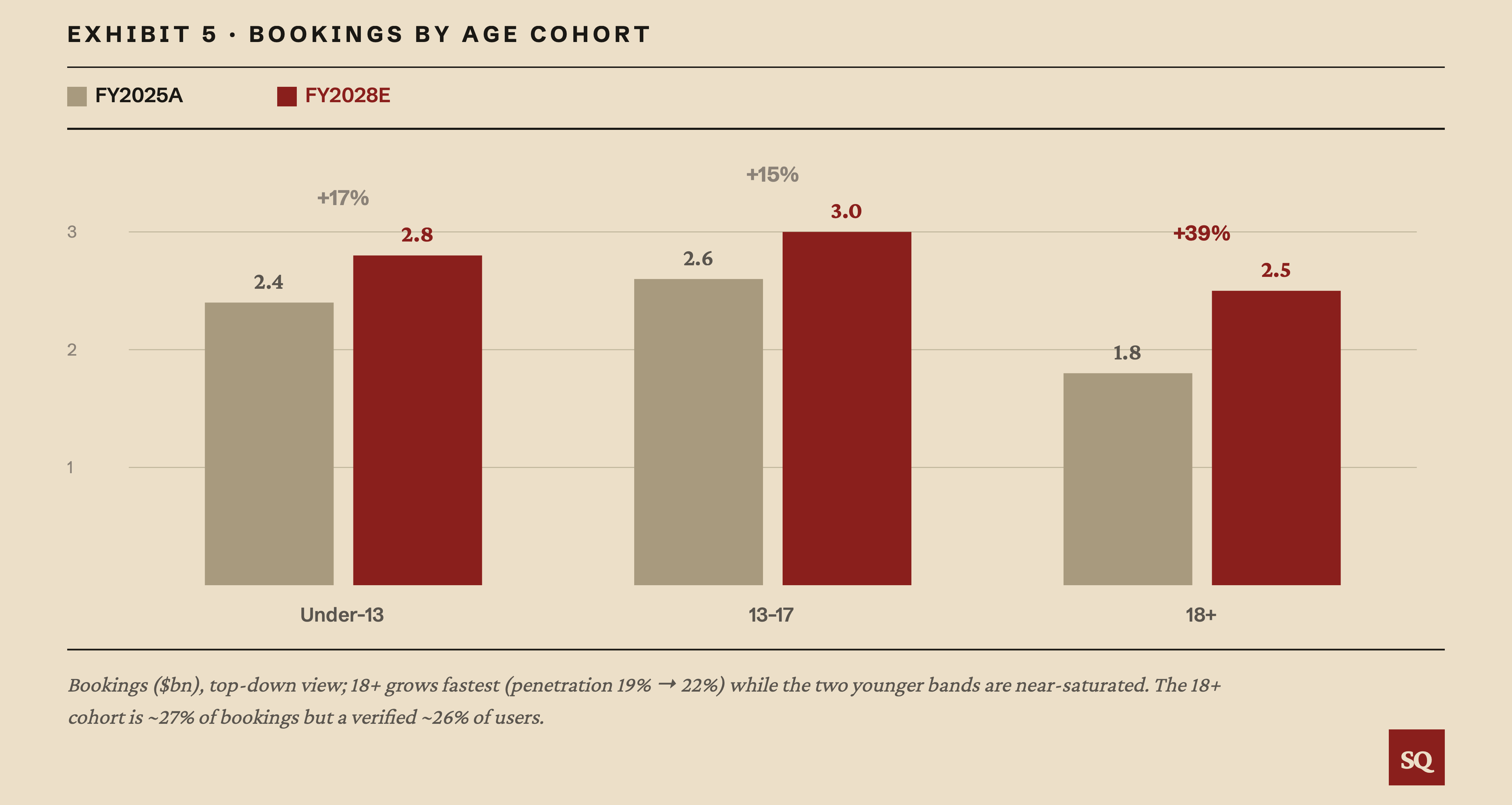
“40% of users are 16+, and it is the fastest-growing cohort.” The growth part is true with the 18+ cohort growing faster than the platform as a whole and drives incremental bookings.
a) The adult base is lower than originally stated
The “40% 16+” is a self-reported figure, and the real self-reported number is closer to 42-44% who say they are 17+ and Roblox has never published a verified “40% 16+” and that figure always skewed old, because a child who wants chat or age-gated content simply enters an older birthdate and nothing checked it.
Roblox is now rolling out actual age verification, a facial-estimation scan, and publishing the verified mix. On the verified base, adults (18+) are only about 26-27%, and that share has ticked down, not up, as more under 13s get checked. Much of what the headline counts as “older” is teenagers, not adults.
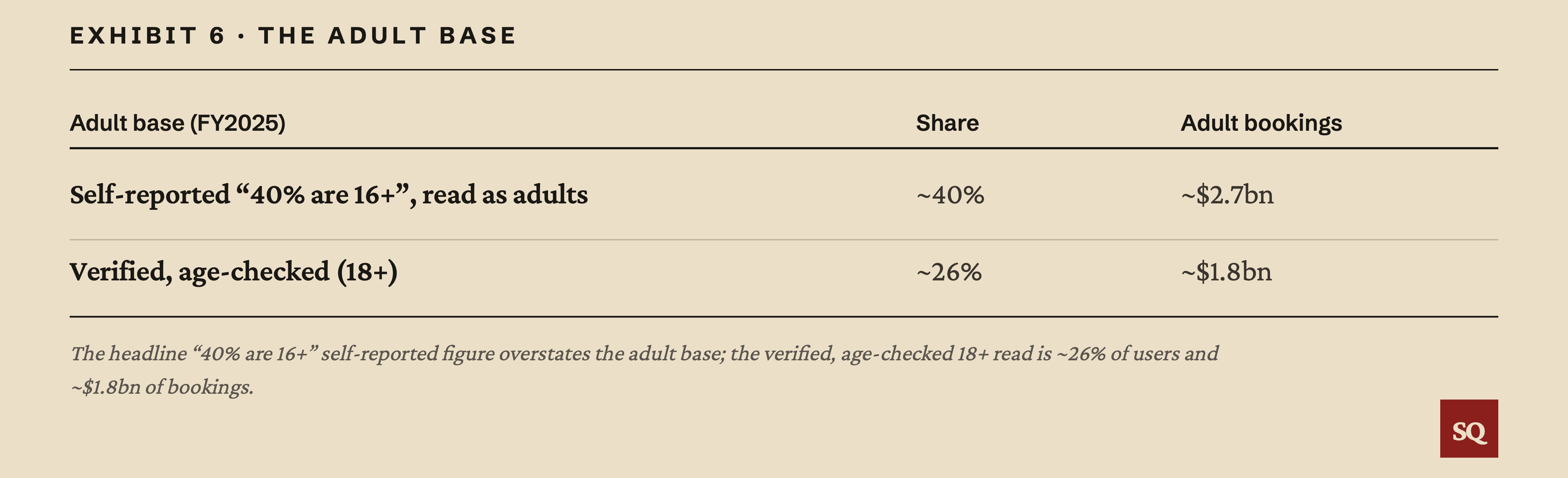
So the adult head-count is about a third smaller than the self-reported figure implies. On the dollars, applying the higher spend adults do generate, the adult business is nearer $2.2 to $2.3bn than the $2.7bn a flat 40% read implies. It’s real, and still growing, but smaller than advertised.
b) Roblox’s growth is coming from lower-spending international markets
Bookings per daily user has been essentially flat, around $53, for three years, while daily users nearly doubled.
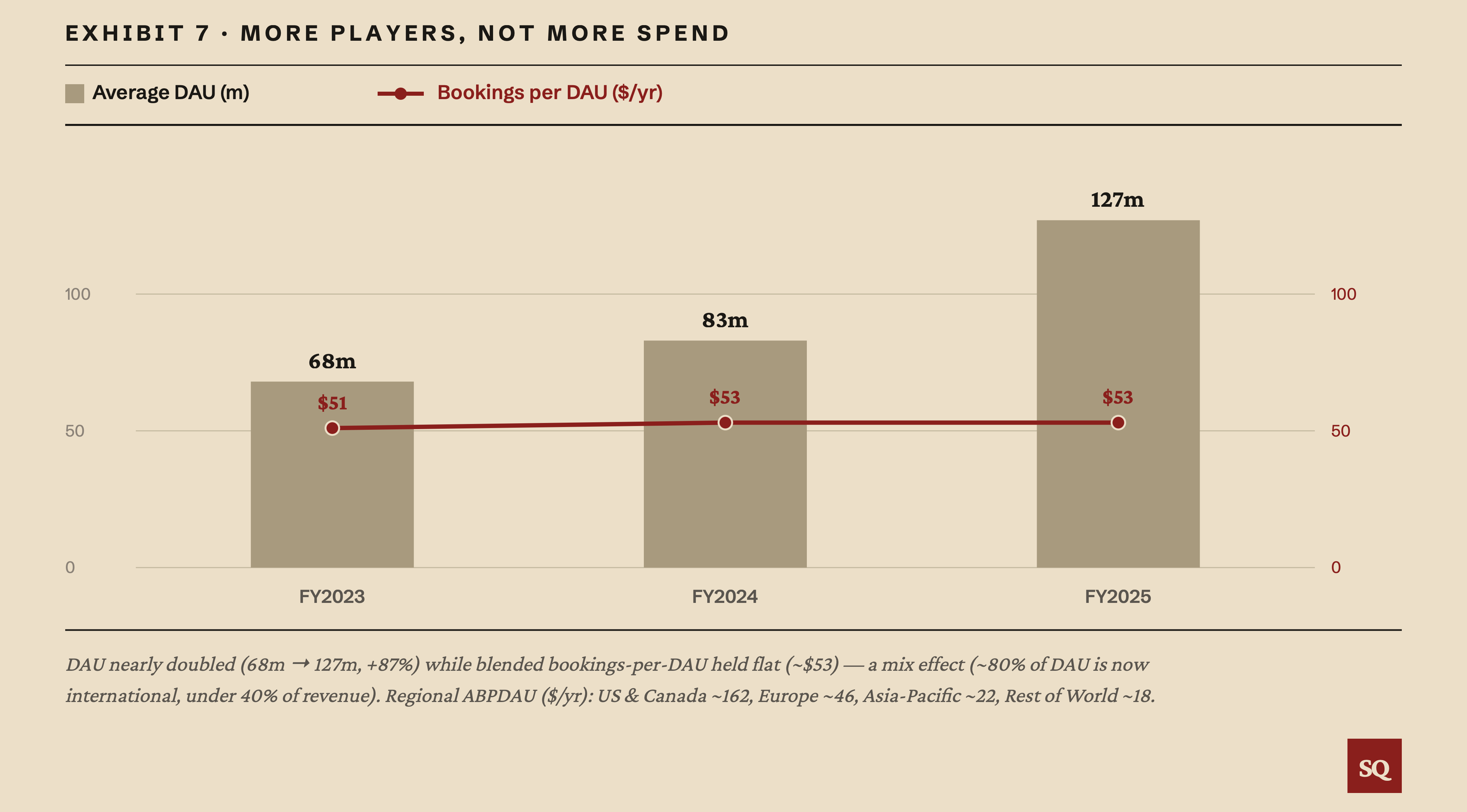
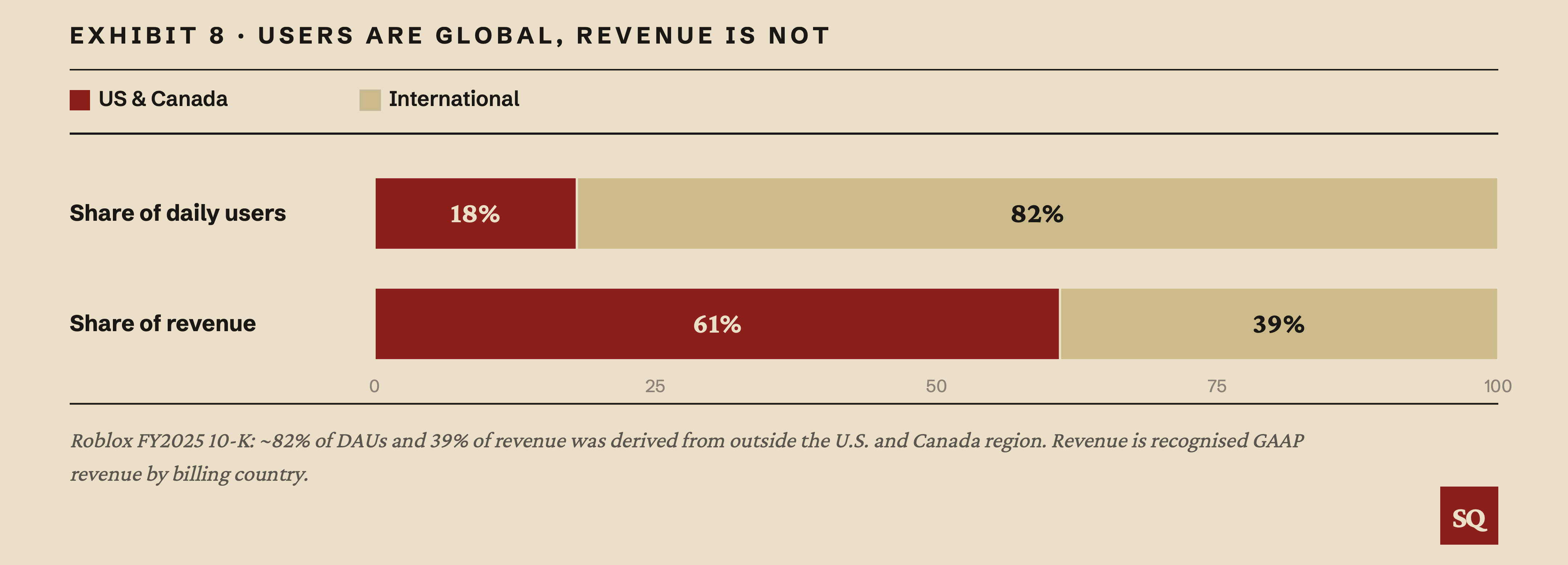
Roblox reports per-user spend rising in every region (e.g. up about 45% in Europe last quarter, and more of its users are paying, with monthly payers up more than 50% year on year). The bookings per user blend stays flat because the mix keeps shifting to lower-spending international users with about 80% of daily users now sit outside the US and Canada (which generate under 40% of revenue) and that dilution has so far offset the regional gains. The open question is whether the mix eventually drags the blended average higher, or whether international growth keeps capping it.
c) Age verification drives trust
The move to verified age, a facial-estimation scan that Roblox turned on globally in January 2026 to replace a typed-in birthday, does two genuinely valuable things. It earns trust, with parents and with regulators, in a category where trust is the licence to operate. It also gives the company real data: for the first time it knows, rather than guesses, who is on the platform, which is what lets it gate content and communication by age at all.
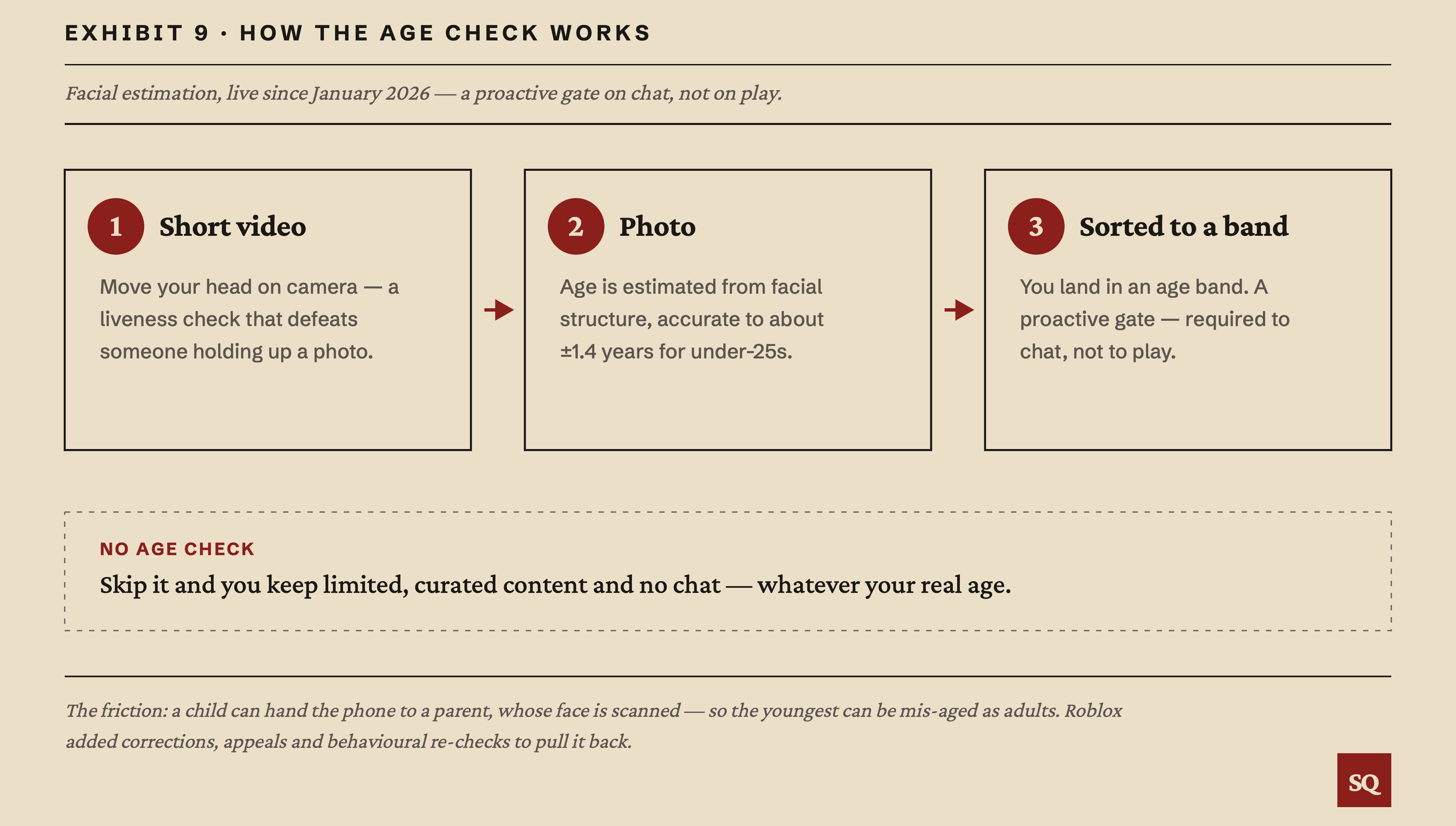
That gating is why different users now get genuinely different versions of Roblox. From June 2026 the platform splits into tiers: Roblox Kids for ages five to eight, Roblox Select for nine to fifteen, and the full catalogue for age-checked users sixteen and over. The youngest are walled into a curated set of vetted experiences with little or no chat, and access widens as a verified user gets older.
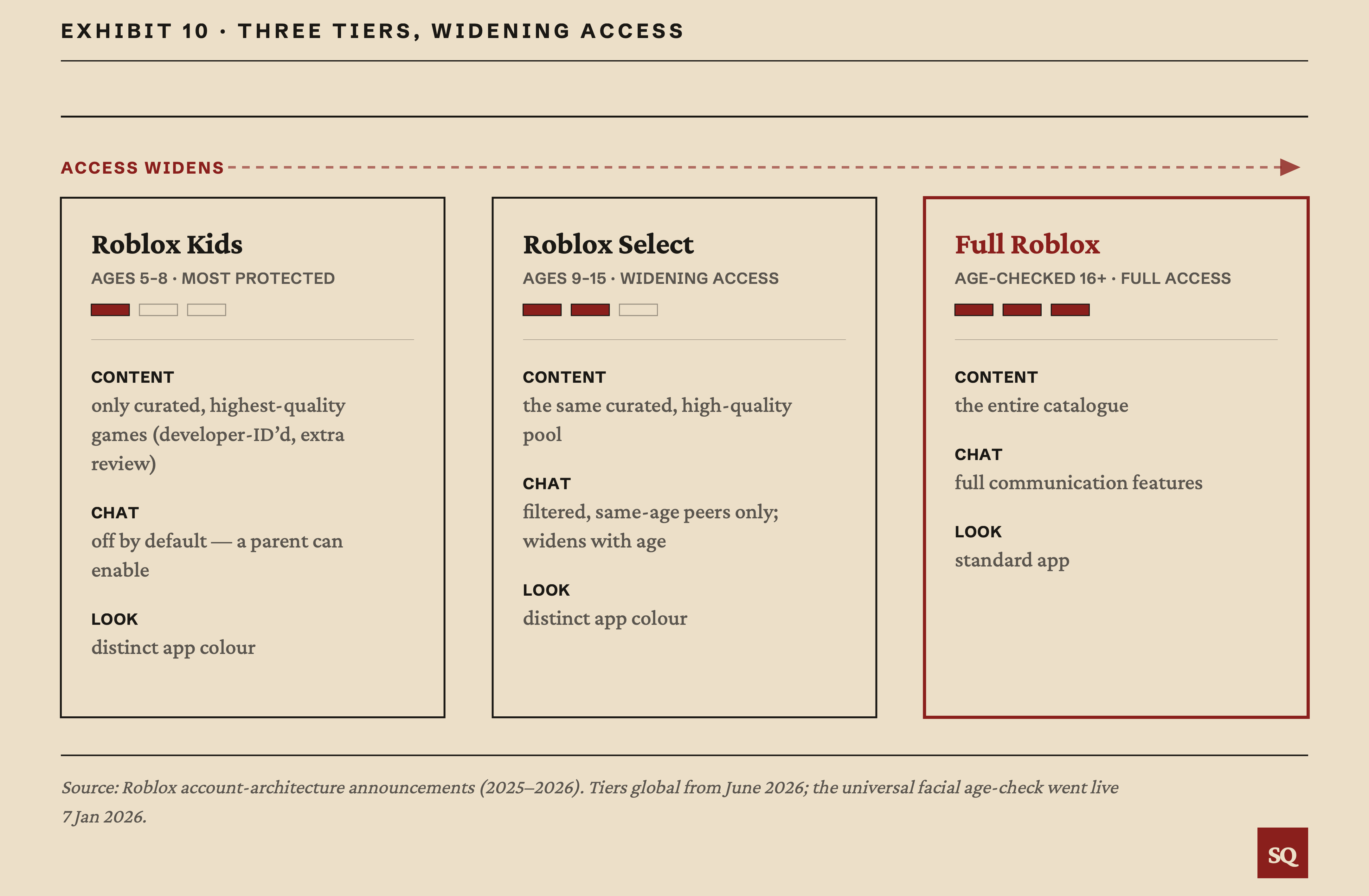
The cost of all this is friction, and friction slows growth. A verification step is one a user can decline, and the tiers give the unverified and the youngest a smaller experience with less to do, so the very top of the funnel the growth story depends on gets a brake on it.
It is not only new sign-ups, either as existing users are re-sorted too, and anyone who declines the check, or is verified younger than the age they had claimed, can find features they used to have, chat above all, taken away. Roblox has already guided daily users to a sequential decline.
The honest counter is that adoption is running well above half of all daily users, so this is a headwind rather than a wall, and the friction may even lift the quality of who remains: verified, age-appropriate, better retained, cleaner with regulators. Fewer but better is not necessarily worse.
Verifying faces, moderating chat by age band, building and policing the Kids and Select tiers, and staffing the appeals behind them is a permanent operating cost, and it sits in the rising Trust & Safety line we have been tracking rather than leveraging away. So age verification is best read as a trade Roblox is making on purpose: a near-term cost and a growth drag, paid for a trust moat and a higher-quality base that, if it works, shows up later.
3. AI could increase content volume, but it will increase the cost floor with it
“Surely AI is a tailwind that lifts both game quality and content volume”. Yes, AI lifts content and generative tools let creators build faster and build more, and more content is, all else equal, good for a platform whose product is content. However, there are two cost mechanisms to this that need to be considered, and one long-term question.
a) Inference for generative tools is a cost Roblox is paying
Roblox’s AI build tools, Cube, the 4D generator and the agentic Studio, are all impacting the supply of games. For an individual creator that is a real gift, a lower bar and a shorter build. But the same tools flood the catalogue with cheap, similar, quickly-made content, which is exactly what shortens the life of any one hit. They help you build and commoditise what you build at the same time.
The problem is that the cost of the tooling and the inference of them, mean Roblox turns from enabling people to generate their own content for the platform to directly funding the content. If you type in ‘make a red sports car’, Roblox is eating that inference cost, which weighs on their Infrastructure cost line.
This only no longer becomes a problem, if the revenue generated by further lowering the barriers to entry outpaces the cost of inference and the R&D costs to train them. However (a) as discussed above, the long-tail of games is high in volume but poor in monetisation (b) as we’ll see below, ongoing hardware inflation makes this equation harder to prove.
b) Global hardware cost increases also impact its training
Roblox doesn’t only eat the cost of inference, it also trains its own models which cost as well. Whilst Roblox has called out there is some pressure as a result of inference costs, and is moving its compute onto owned data centres and its own GPUs, they still face the same hardware inflation costs that the rest of the market does across.
Owning the compute is only relocating the cost from a third-party cloud bill onto Roblox’s own balance sheet, and they’ll still need access to hardware (e.g. memory, GPUs) that the rest of the industry does too, and will also need to pay the 2-6x increase in prices, further increasing Capex forecasts.
c) Cube presents a long-term question
Points (a) and (b) are short-term in nature, and point to scale problems, but there is real value in their tooling (See AI in Video Games: Own the Loop) . Cube (which generates 3D/4D assets) is trained on licensed data, public data (e.g. Objaverse) and the Creator Store assets where people opted-in and is a mid-sized model (273m parameter shape tokeniser on 1.5m objects). It’s also open-sourced, so people can use it on an inference basis with their own frontier models.
The key phrase in the above, is those who have opted-in. Roblox does not simply own the creations on its platform to do with as it likes; the creators do, and Roblox holds a licence to host and run them, not a blanket right to train a generative model on them. Hoovering up the whole catalogue to build a tool that then lets anyone generate similar assets for free would be both a rights problem and a betrayal of the exact people the platform depends on.
So if/how Cube could be trained using the community’s assets, remains an open and complex question.
4. So, is it a buy? Nope
So looking at the four pillars:
Roblox owns the whole stack, and it is the least profitable thing in its own economy.
It is aging up, but onto a base a third smaller than advertised, and spend per user has not moved in three years, even as it rises in every region.
AI lifts the content and the cost floor together.
So the stock has fallen, but not far enough.
What does valuation look like? First we must start with the cash side of the business. Roblox throws off about $1.4bn of FCF against an operating loss (GAAP) of >$1bn.
Bookings are cash collected today for Robux that is recognised as revenue over the roughly 27 months a player keeps playing, so a growing deferred-revenue float flatters the cash long before it reaches the income statement. It’s also worth understanding that in the good times, this is positive, but in the bad times it hits the business harder. It only flatters cash while bookings grow, and turns into a drag the moment they stall, which is precisely what the cut to 8 to 12% bookings growth puts in play.
About 84% of that FCF is stock based compensation added back, a real cost to shareholders that simply is not a cash one. Strip it out and owner FCF, the cash actually left for shareholders, is about $224m, not $1.4bn. This isn’t a new argument, so both valuations are presented here.
Roblox authorised its first ever buyback (May 2026), up to $1bn/year. The company is spending roughly a billion a year repurchasing stock while owner FCF is barely positive, and on our numbers slightly negative in 2026, so the buyback is funded out of the deferred-revenue float and the cash pile, not out of earnings. It draws the net-cash cushion down from about $5bn toward under $2.5bn over three years, turns book equity negative, and only offsets about a third of the dilution from stock compensation, so the share count still climbs. And at $48 against an intrinsic value nearer $8.65, buying the stock back supports the count but transfers value away from the holders who stay. It is dilution management, not value creation.
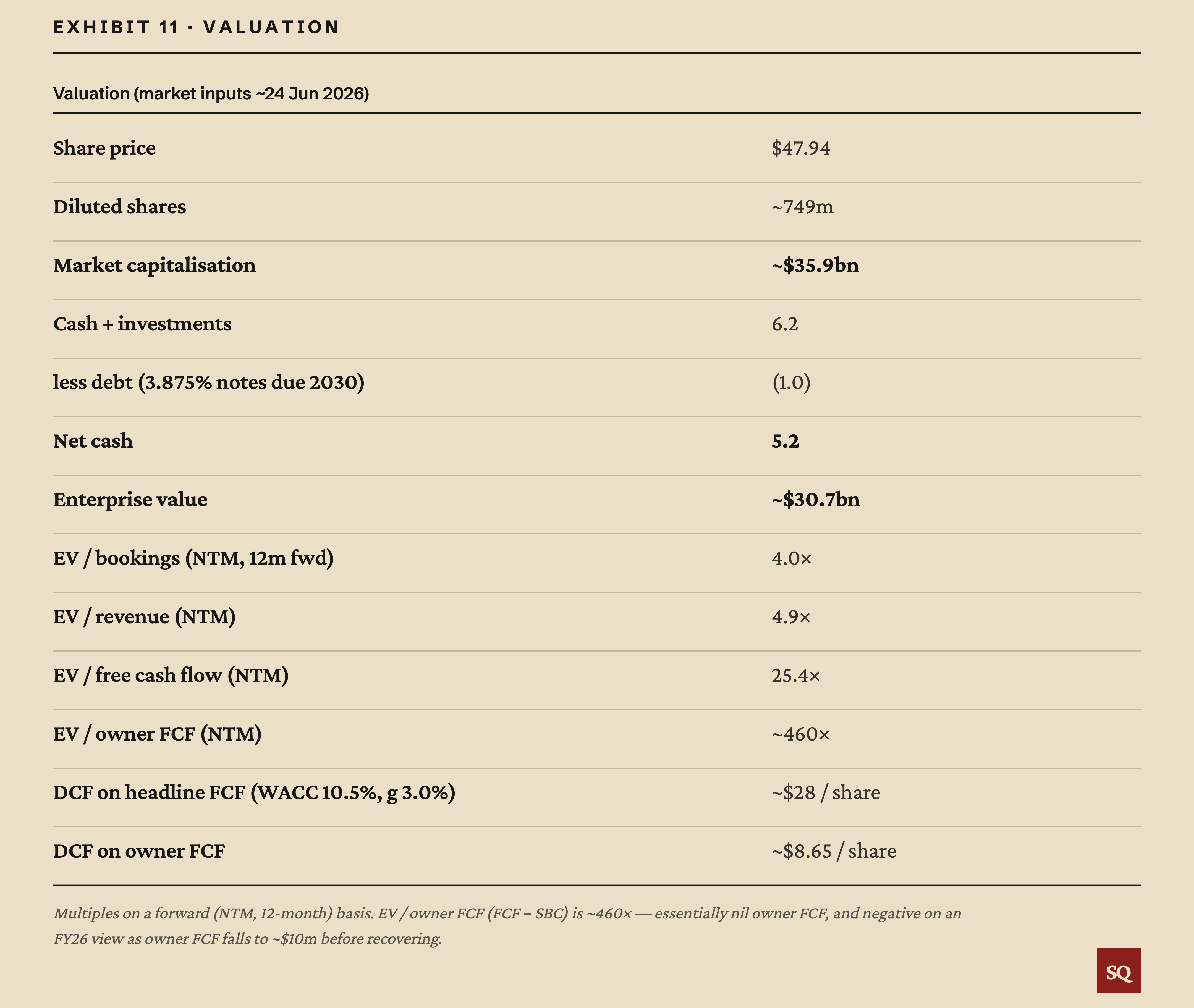
At roughly $30.7bn EV, the stock trades at 4x Bookings, 25x headline FCF, and close to nil owner FCF. On a discounted cash flow at a 10.5% cost of capital, headline cash flow is worth about $28 a share and owner cash flow about $8.65, against a market price near $48. As with most DCFs, the majority of the value is being prescribed to the terminal value. The price sits above even the generous version and at more than 5x the conservative one.
For that to be right, one of three things has to happen:
Either spend per user finally rises, the aging-up monetising instead of being cancelled by international dilution
The cost floor finally leverages.
or advertising, which the model holds at zero, becomes a real revenue line.
Yet Bookings per user has been flat at about $53 for three years, and total cost runs near 90% of bookings today, stepping up to about 96% from 2026 as infrastructure, R&D, trust-and-safety and now AI inference climb into the retained cut. Advertising is a higher-margin payer that sits on the same fixed cost base, which is the upside the bull case leans on. The appendix sets out why we hold it at zero; in short, Roblox still calls it an insignificant share of bookings, and even a generous ramp does not move an operating line. The first operating profit, on our model, does not arrive until about 2030, by which point the deferral cushion flattering the cash has thinned.
The child-safety litigation (the private multi district litigation) sits outside these numbers entirely (See: Why Roblox really left Delaware). Roblox carries no provision against it, because it says it cannot reasonably estimate the loss, so the valuation does not price it either.
To be clear, none of this makes the company weak as it owns the complete stack in interactive entertainment, a net-cash balance sheet, and it is still growing. The price is the problem, not the business. At about $48 you are paying a transformation multiple for a company that, on every number it files, has not yet transformed. So the honest answer to the question we were asked is the one the price is not implying - a remarkable company, and, on the numbers, not a buy here. It becomes one if spend per user inflects or the cost floor breaks, and the things to watch are the bookings-to-revenue catch-up and the first sign of the platform fee dropping to the bottom line.
More from The Side Quest
Microsoft and Xbox: Too small to sell, too strategic to spin - On the numbers, Xbox is worth about $49bn, a rounding error to Microsoft. It won’t be sold, and any separation keeps a grip on the data its games generate.
AI in Video Games: Own the Loop - why a studio keeps its value only if it owns the content-generating learning loop, not the model. Uses Guild Wars 3 as a worked example.
AI won’t make AAA games materially cheaper to develop - the productivity gains are real, but two-thirds of the value leaves the P&L to the AI vendors before it reaches the bottom line.
Why Roblox really left Delaware - reading the Delaware-to-Nevada reincorporation as a move to shield management amid active litigation.
Appendix
All figures from our Roblox model. FY2025A is tied to the FY2025 10-K; FY2026–28E are modelled. $m unless noted; components are rounded and may not sum to totals. Refresh the share price before publication ($47.94 is ~24 Jun 2026).
A1. Cohort TAM Build
The market is built bottom-up as a user-spend (bookings) market, not a slice of “the games industry.” For each of twenty-two countries and seven age cohorts, we start with the connected population (UN World Population Prospects), keep only the engageable share (the proportion of that age realistically reachable by a UGC platform), and reduce it by an accessibility factor that captures the country’s regulatory friction; that gives the reachable audience. Reachable audience times a per-country ARPU (anchored to ITU connectivity and tilted for purchasing power) times a cohort age-index gives the TAM for each cell, which we sum.
The first table shows that build collapsed to three age bands at the global level - the gross addressable market, c$40.2bn. The second bridges it to the number the model actually uses. Two deductions do the heavy lifting. China is stripped entirely (the Tencent joint venture launched and shut its servers in 2021 and never relaunched, so it is structurally non-addressable, c$5.7bn). An accessibility-friction haircut (c$2.3bn) then reduces the open-but-gated markets - Indonesia’s under-16 gate, Vietnam’s forced local build, the Gulf chat blackout, Russia and Turkey’s conditional re-admissions, and the UK/EU/India age-verification overhang.
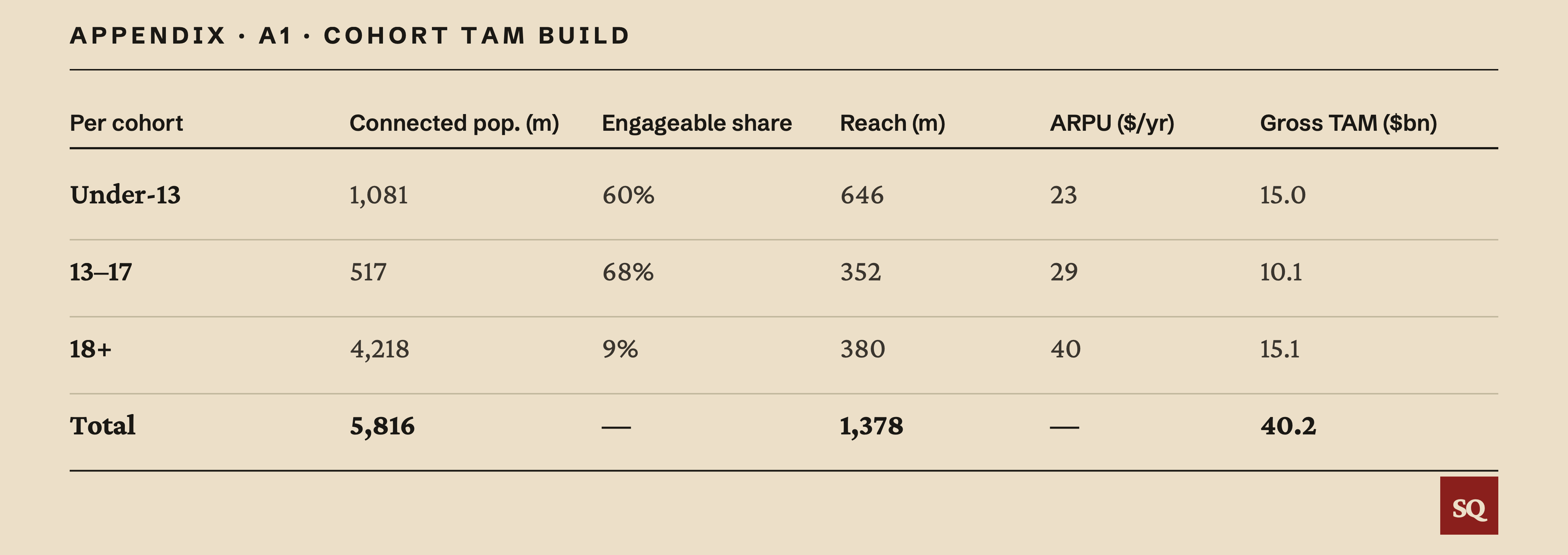
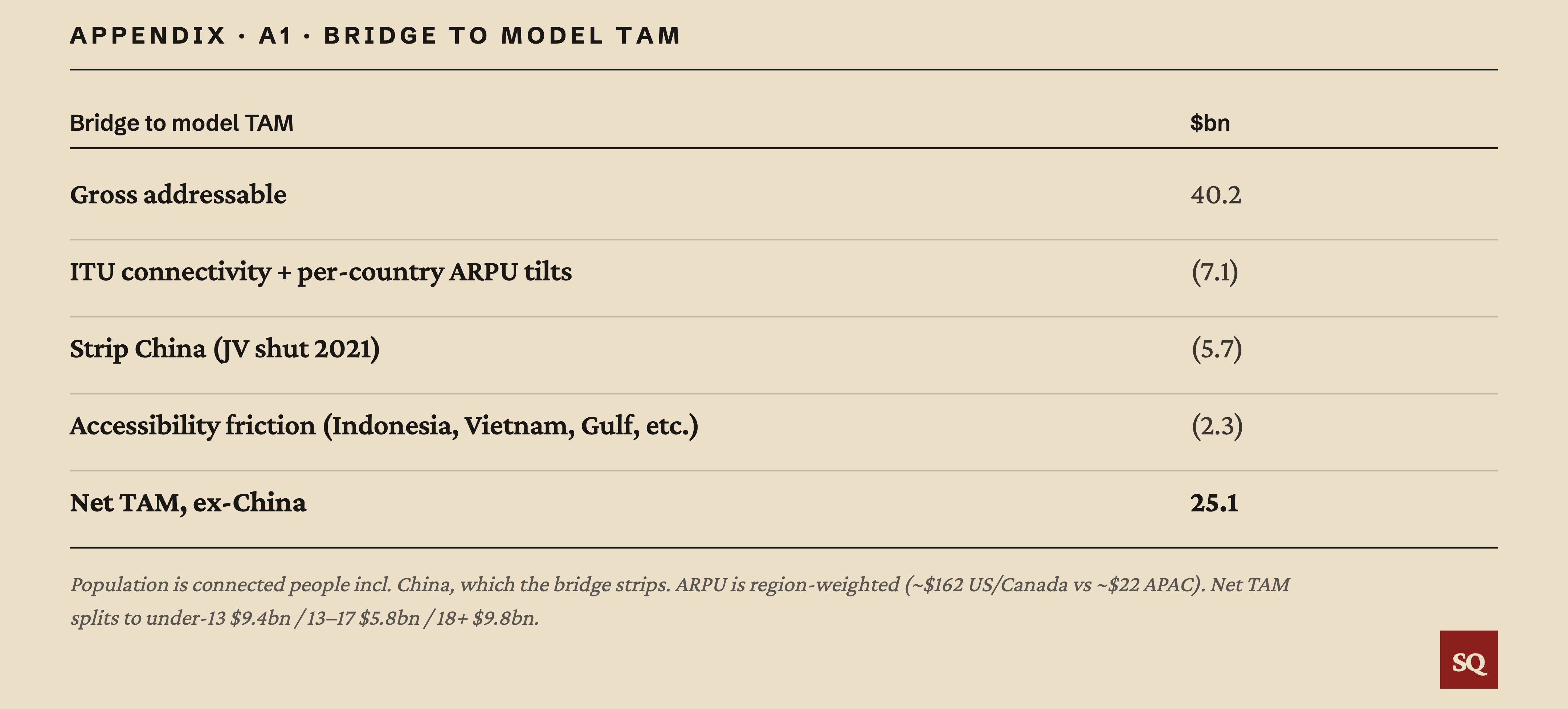
The result is c$25bn of addressable user spend ex-China (range $23–26bn on the friction sensitivity). Against FY2025 bookings of $6.8bn, Roblox is c27% penetrated. The net $25bn splits to the three bands (under-13 $9.4bn, 13–17 $5.8bn, 18+ $9.8bn) by applying Roblox’s disclosed US age mix (36 / 38 / 26) to bookings as the cohort anchor. This is deliberately a user-spend TAM: advertising, real-world commerce and any “metaverse” reframing are additive layers on the same audience, excluded from the headline.
Source: UN WPP population; ITU connectivity; per-country ARPU and accessibility factors are the model’s estimates (friction magnitudes are the softest input, carried as the $23–26bn band). The cohort split anchors to the disclosed US age mix.
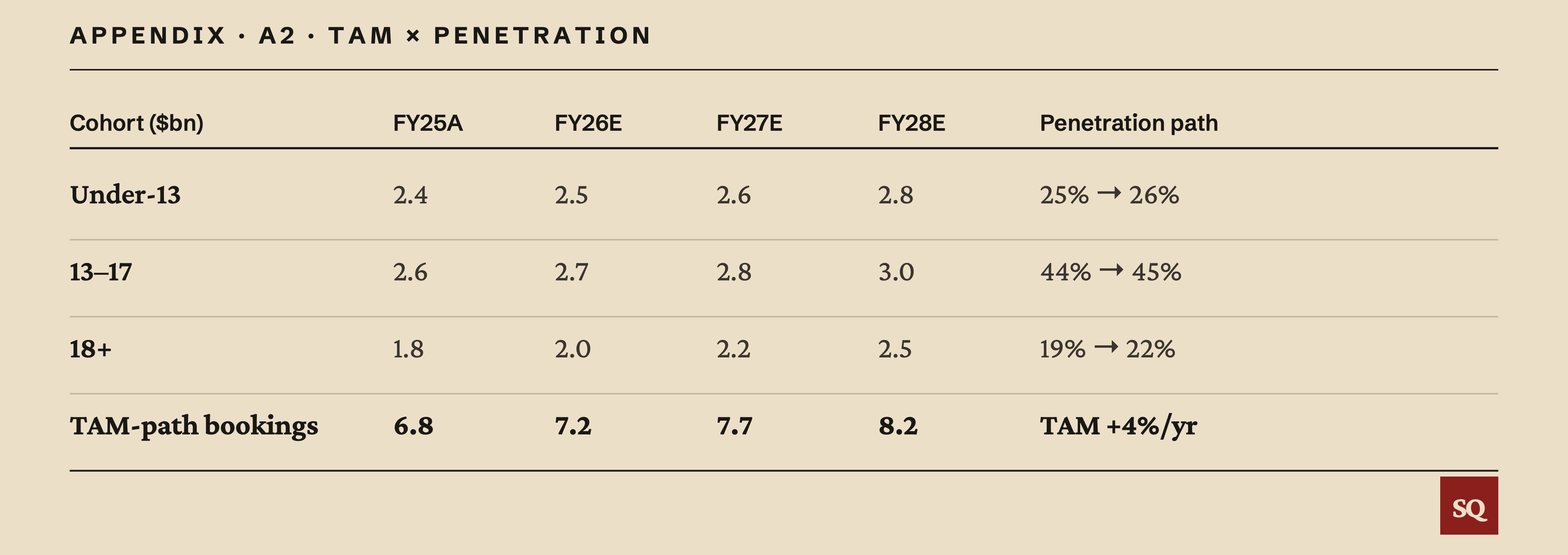
A2. Cohort TAM
The TAM path turns that market into a bookings forecast by applying a penetration rate to each cohort’s TAM and growing the TAM itself ~4%/yr. The penetration assumptions are the levers, and they say something specific: the two younger bands are already well-penetrated and near saturation, so they grow roughly with the market; the 18+ band is lightly penetrated and is the one cohort with real headroom, so its penetration is the only one rising materially. This is the demand-side view of bookings.
A3. Studio Tiers
The studio path builds the same bookings total from the supply side - the creators who make the experiences - as a cross-check on the demand-side view. Bookings are split into three tiers (the top 10 titles, the next 990, and the long tail of ~22,500 paid creators) and each tier grows at its own rate: the top 10 barely move (mature franchises, +4%/yr), the next 990 are the engine (+18% fading to +6%), and the long tail grows fastest off a small base. The tier shares are anchored to the one hard number Roblox discloses - that the top 1,000 creators averaged $1.3m in DevEx - grossed up by the blended creator take to imply each tier’s bookings.
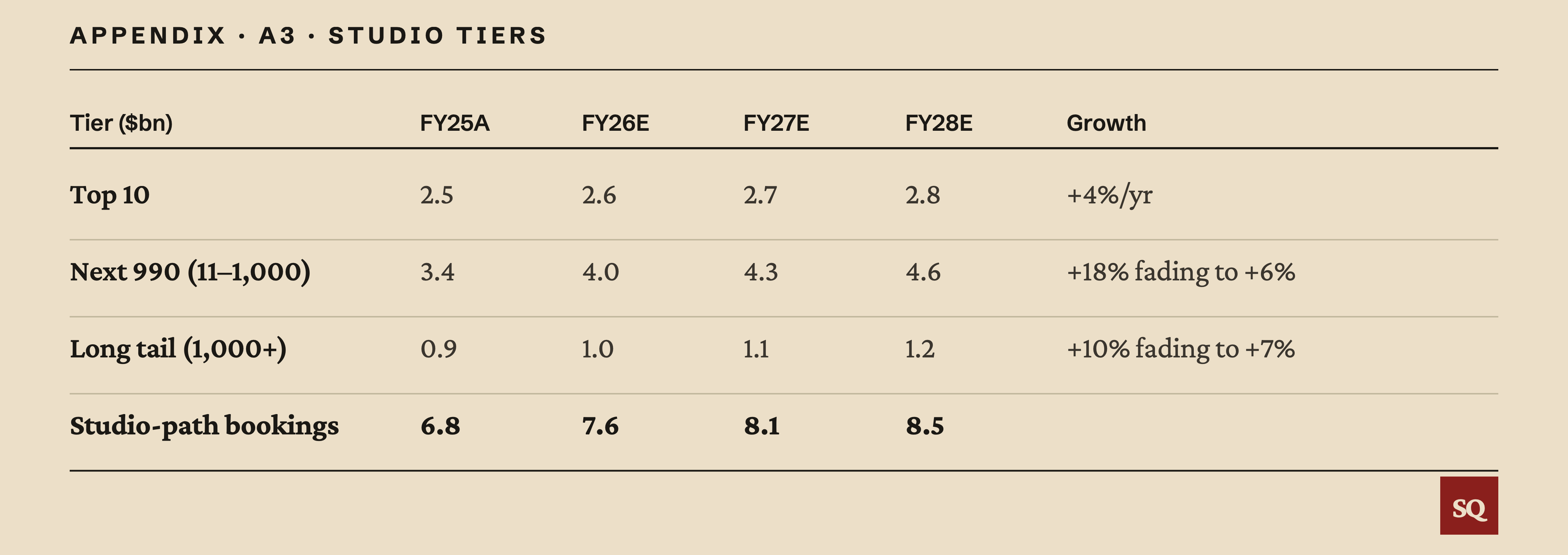
The shares this implies — top 10 ≈ 37% of bookings, top 1,000 ≈ 87%, long tail ≈ 13% - are the concentration figures the article cites.
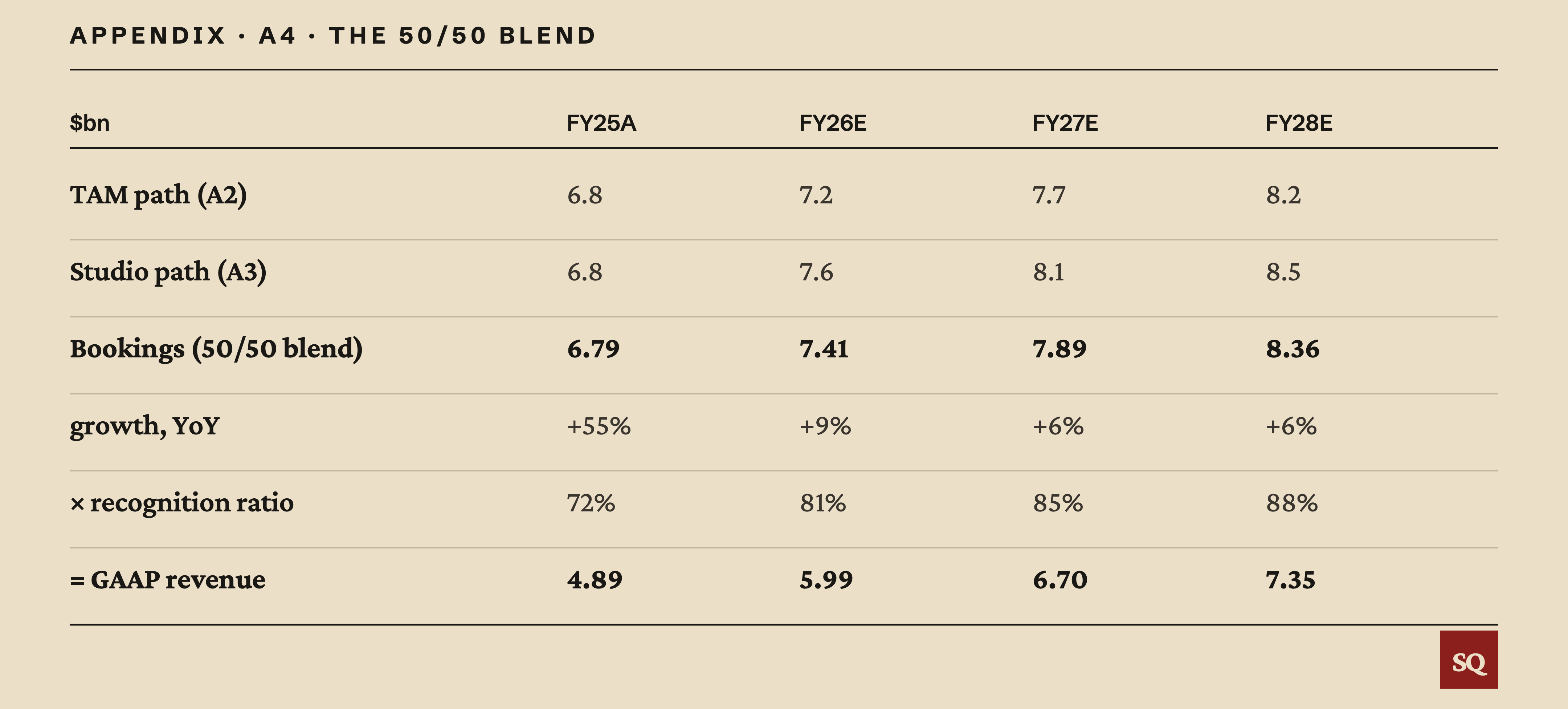
A4. 50/50 Blend for Bookings
The demand-side (A2) and supply-side (A3) builds are independent estimates of the same number, so the model uses a 50/50 blend of the two as the bookings it actually runs on - neither view is privileged, and the blend is the single bookings driver feeding everything downstream. Bookings are then converted to GAAP revenue by a recognition ratio that rises from 72% to 88%. That ratio is the deferral story: because a player’s spend is recognised over roughly 27 months, reported revenue lags the cash collected, and the ratio climbing toward 88% is reported revenue catching up to bookings booked in earlier periods.
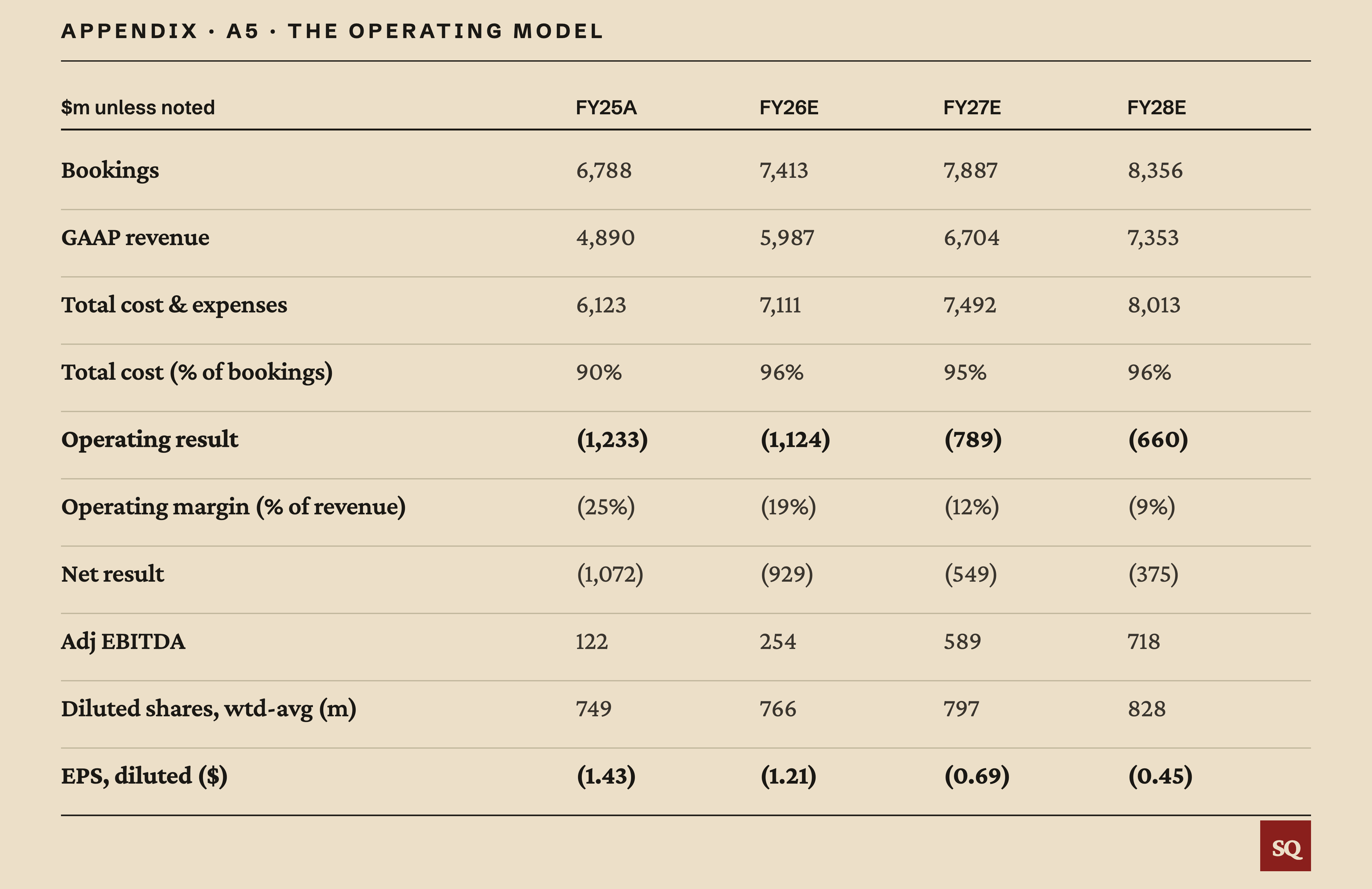
A5. The operating model
This is the consolidated forecast. Bookings come from the blend in A4; each cost line is a percentage-of-bookings driver (A6); the operating result is revenue less total costs, so the margin is an output, not a typed input. The row that carries the argument is the third: total cost runs at c90% of bookings in FY25 and steps up toward c96%, so even as revenue catches up to bookings, the operating loss only narrows - it does not clear the cost floor inside the window. First GAAP operating profit on this model arrives c2030; that date is a function of the rising cost-floor dials on the Drivers tab, not a disclosure. EPS is the net loss over the fully-diluted share count (A8) - a loss per share in every year.
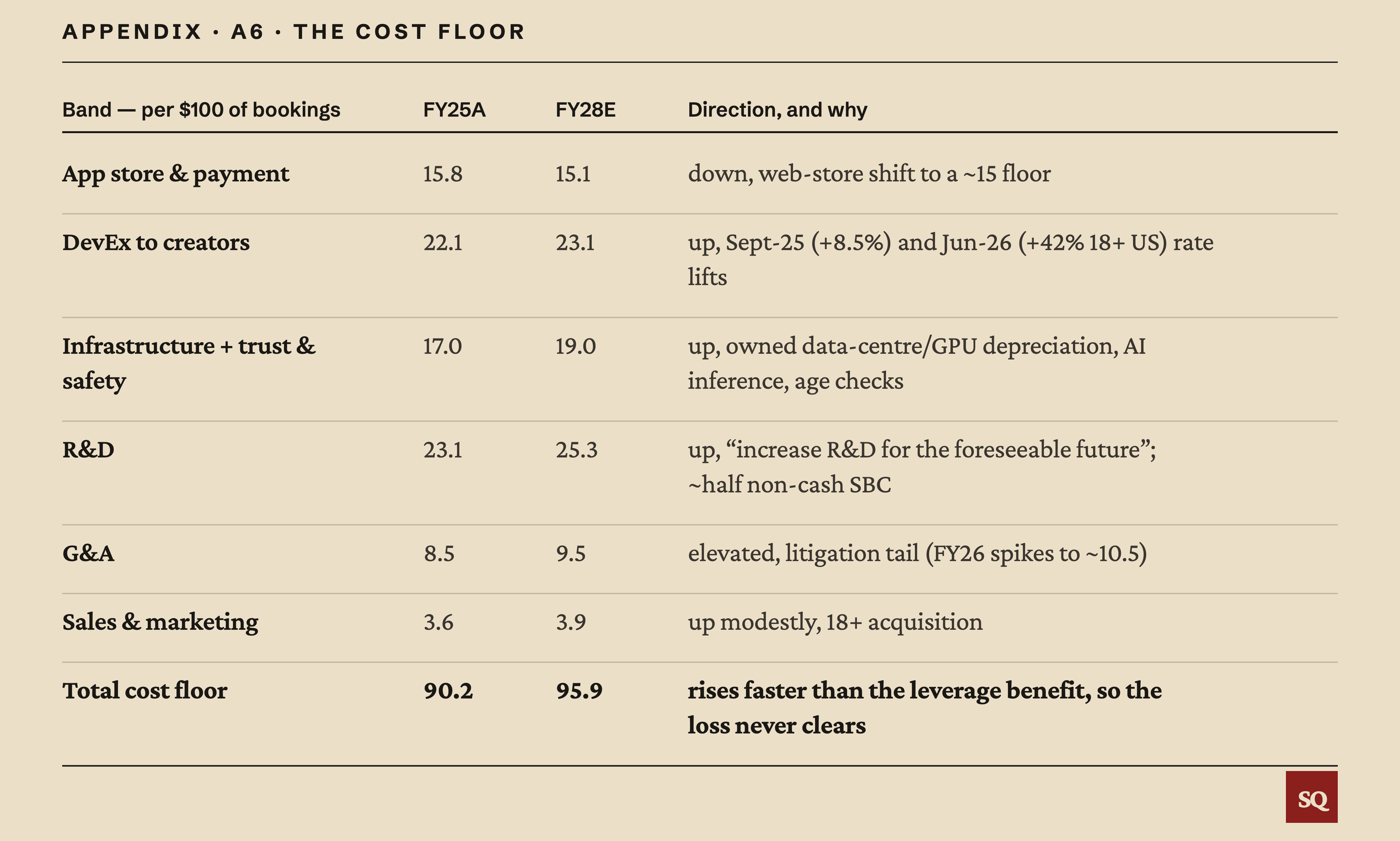
A6. The cost floor, band by band (per $100 of bookings)
This decomposes where every $100 of bookings goes, and which way each band is moving - it is the heart of the bear case.
Of $100 booked, the app stores take c$16 and creators c$22, leaving Roblox c$62; but its own four lines (infrastructure and trust-and-safety, R&D, G&A, sales and marketing) consume c$52, and four of the six bands are rising as a share of bookings
The DevEx rate lifts, the owned-compute and AI-inference build, and the litigation tail in G&A. So the c$10 “left over” on a bookings basis in FY25 compresses to c$4 by FY28, and on recognised revenue the platform runs an operating loss in both years. The 10-K does not publish these percentages; they are the model’s allocation of the disclosed cost totals across the bookings base.
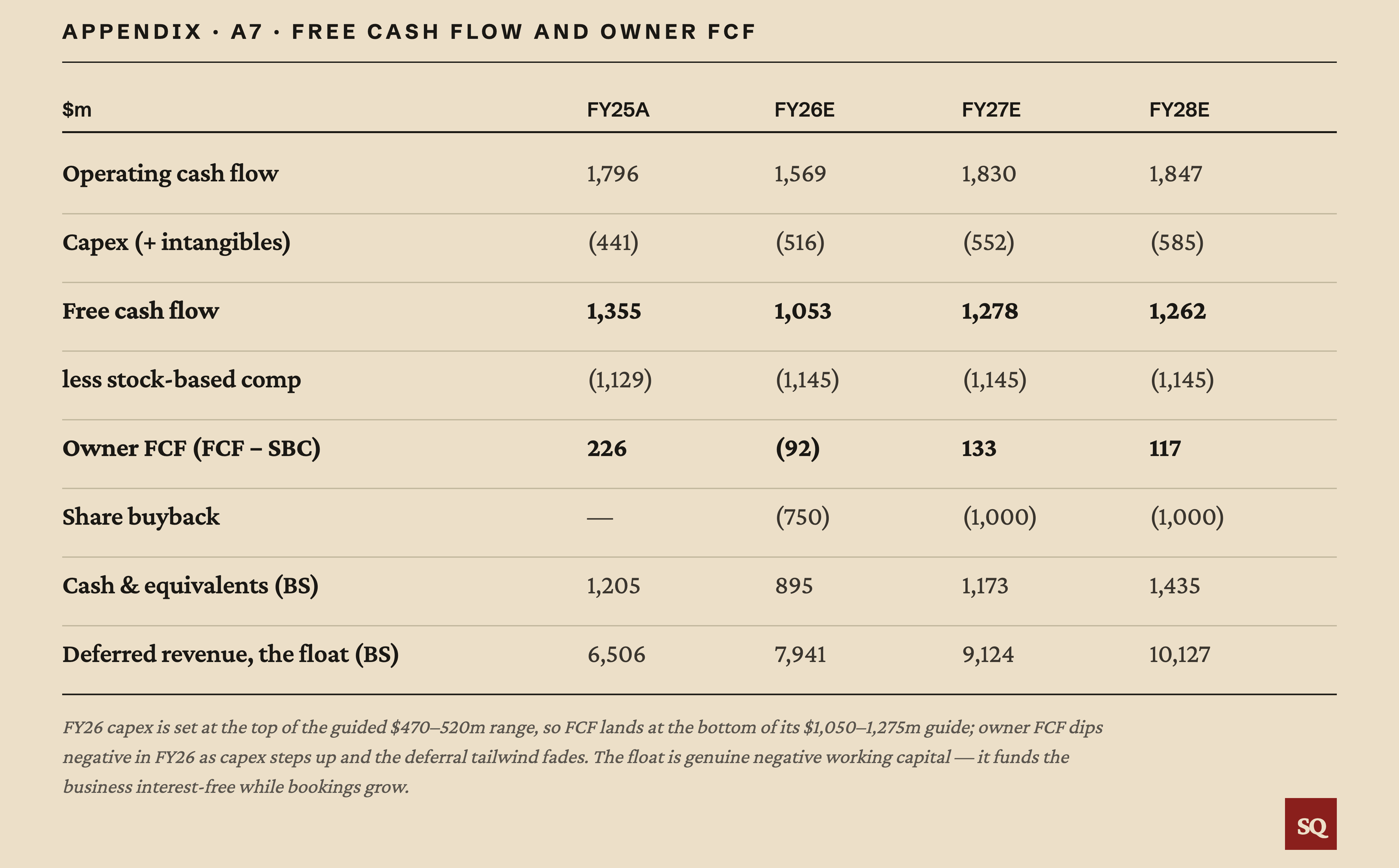
A7. Free cash flow and owner FCF
Free cash flow looks healthy at c$1.3bn, but two adjustments strip it back to what the article calls owner cash.
First, capex steps up to the top of the guided $470-520m range as Roblox builds its own data centres and buys its own GPUs, so FCF falls even as the business grows.
Second, and more important, c$1.1bn of that cash flow is stock-based compensation added back, a real cost to shareholders that simply is not a cash one. Strip it out and owner free cash flow - the cash actually left for shareholders - is a fraction of the headline, and dips negative in FY26 as capex peaks. The deferred-revenue float, meanwhile, is genuine negative working capital: players prepay for Robux recognised over c27 months, so a growing bookings book funds the business interest-free - a real edge, but one that flatters cash only while bookings grow.
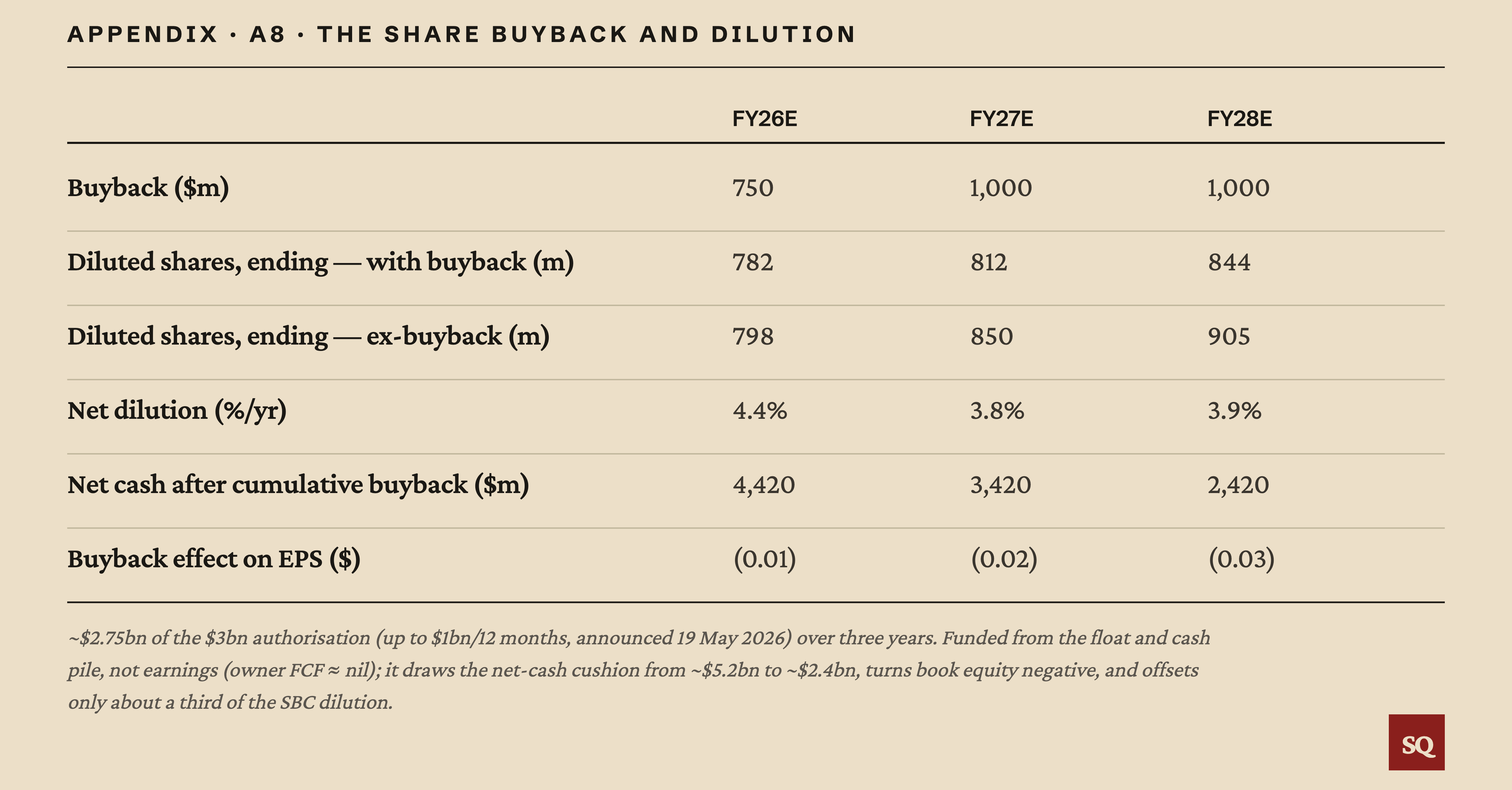
A8. The share buyback and dilution
The buyback is modelled explicitly through all three statements.
Roblox authorised up to $1bn a year (a $3bn programme); we run c$2.75bn over three years. The roll-forward shows what it does. It offsets only about a third of the dilution from stock compensation, so the share count still climbs, just more slowly. It is funded from the cash pile rather than earnings (owner FCF is nil) so it draws the net-cash cushion from c$5.2bn toward c$2.4bn and turns book equity negative.
Because the company is loss-making, retiring shares spreads the loss over fewer of them, so the buyback slightly increases the loss per share. Its payoff is deferred anti-dilution, for if and when profit arrives — not value creation today.
A9. Valuation
The valuation is presented two ways, because the whole question is the quality of the cash flow. Multiples are struck on a 12-month-forward basis.
On bookings and revenue Roblox looks cheaper forward, because those lines are growing; on free cash flow it looks dearer, because forward FCF falls; and on owner FCF there is barely a multiple to quote, because forward owner cash flow is close to nil.
The DCF is then run on both headline and owner free cash flow, and the gap between them (about $28 a share versus about $8.65) is the thesis in a single number.
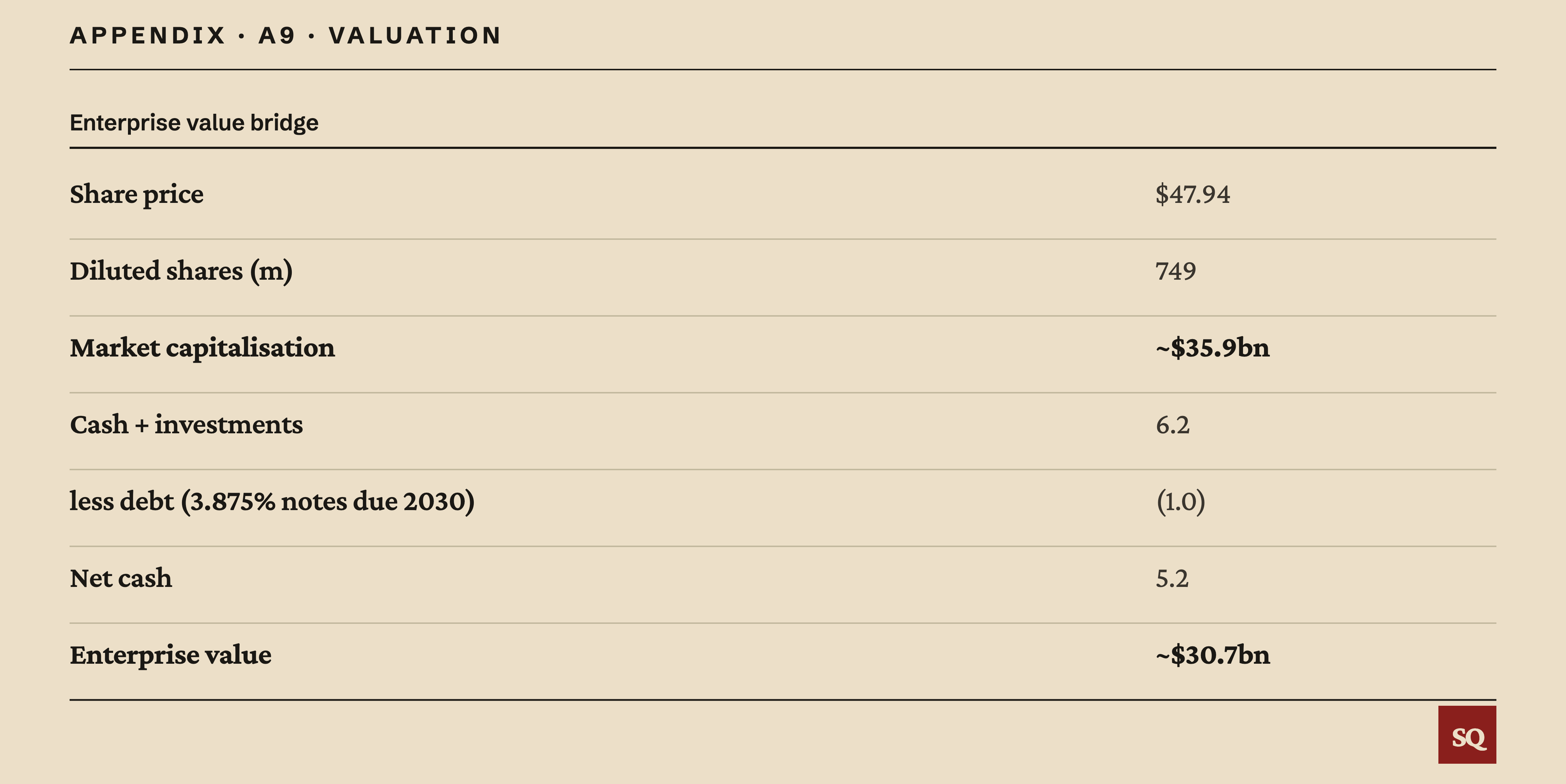
The DCF is largely terminal value (no GAAP operating profit until c2030), so the multiples carry more weight; the market enterprise value is reached only at a WACC of 9% or below and terminal growth of 5% or above.
The DCF per share uses the current fully-diluted count: the owner-FCF version already charges 100% of the stock-comp, so the dilution is captured in the cash flow and is not double-counted in the share count.
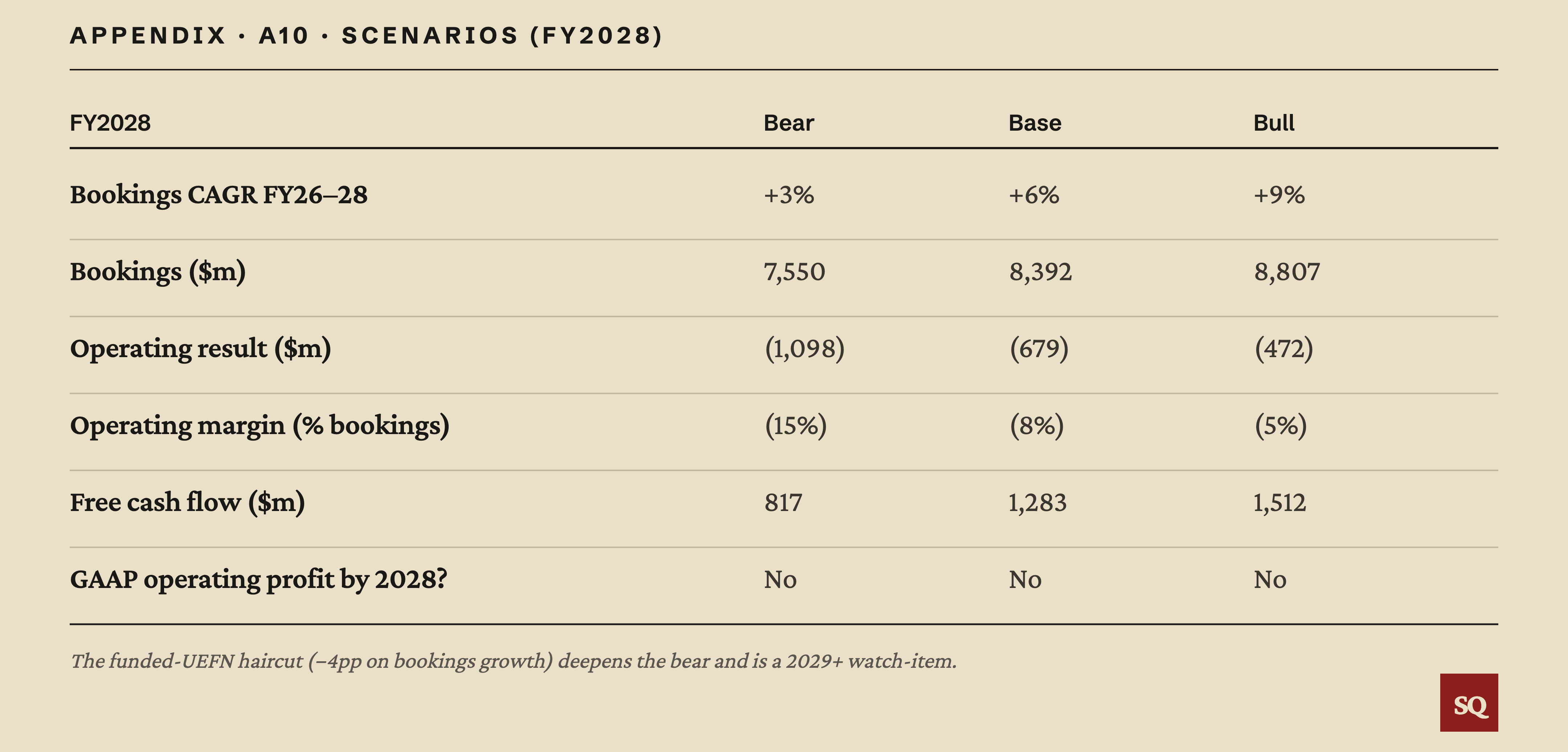
A10. Scenarios (FY2028)
The scenarios are a deliberately simple overlay (i.e. round bookings CAGRs run against a held fixed-cost floor) to test how sensitive the verdict is to the demand path. They do not tie to the dollar with the base model, and are not meant to; they are a stress-test, not the base case. The point they make is robustness: across bear, base and bull, the operating line stays in the red through 2028 and free cash flow stays positive everywhere, and even the bull only approaches break-even. So “not a buy on the numbers” does not hinge on a single bookings forecast.
A11. Advertising and commerce
Roblox has built an advertising business without yet earning much from it. It runs immersive and video ads, rewarded video in limited release since Q3 2025, a self-serve Ads Manager, and a programmatic deal with Google Ad Manager signed in April 2025; on commerce, it has a Shopify integration and physical-goods APIs. The machinery exists, but a number the company will stand behind does not. Its filings still describe advertising as an “insignificant amount” of bookings, management calls it a long-term opportunity rather than a near-term contributor, and it has guided no ad revenue, ad load or ARPU. The billion-dollar figures in circulation are analyst estimates, not company guidance.
We hold advertising at zero in the base case for that reason: the company does not yet count it, and putting a figure on a stream it calls insignificant would model an expectation rather than the accounts. The economics are attractive if it scales, because brand budgets are a higher-margin payer that sits outside the bookings take-rate, with no app-store cut and no DevEx. The audience caps how fast it can get there. Roughly three-quarters of verified users are under 18 and about 80% sit outside the US and Canada, and child-privacy rules bar behaviourally-targeted advertising to under-13s, so the high-CPM, addressable share is a fraction of the headline user count. Even a generous ramp does not move an operating line running near 96% of bookings within this window. If the company begins to guide ad revenue, this is the assumption to revisit.
A12. Litigation
The child-safety claims against Roblox are consolidated as a multidistrict litigation (MDL No. 3166), about 150 actions and growing. Against them the company carries a $0 provision: it states it is unable to reasonably estimate the loss, so it accrues nothing. The $57m it did reserve in Q1 2026 is for state-Attorney-General cash settlements, where the obligating event has occurred, and four states have settled for around $50m. The number on the balance sheet therefore covers the settled state cases, not the open private MDL, which is the larger unknown.
This is why the litigation sits outside the model. The company cannot estimate the loss, so any figure we inserted would be invented, and an unestimable number should not drive a valuation. It is a genuine tail rather than a base-case cost, and it points the same way as the rest of the analysis: an adverse resolution would draw on the same net-cash cushion the buyback is already running down, and the compliance obligations that follow a settlement are themselves unbudgeted. The case count and the accrual move each quarter, and both are stated as of the latest filing.
A13. Conventions and Inference Register
Disclosed (10-K / 8-K / newsroom): Bookings, revenue, operating and net result, SBC, OCF, capex, deferred revenue, DAU (127m FY25), the age-checked mix (36% U13 / 38% 13–17 / 26% 18+), the DevEx pool ($1.5bn) and top-1,000 average ($1.3m), FY2026 guidance, the $3bn buyback authorisation, and the brand-deal CPM toll.
Modelled: The per-$100 value-chain split (the 10-K gives no percentages), the tier split (37 / 50 / 13.5), the studio P&Ls (Voldex is private), the cohort TAM build, the cost-floor path, the share-count roll-forward, and the DCF.
Inferred / soft: The top-10 ≈ 37% bookings share (2024 US Economic Impact Report basis), the ~$1,440 median creator, and the device mix (Konvoy estimate; Roblox discloses none).
Conventions: $m unless noted; FY columns = sum of the four quarters (flows) or Q4 (balances); cash is the balance-sheet plug; the per-$100 split is on a bookings denominator; multiples are on a 12-month-forward (NTM) basis with trailing shown for reference; owner FCF = FCF less 100% of SBC; EPS is on fully-diluted shares (a pro-forma, not GAAP weighted-average basic, which uses fewer shares and so shows a modestly larger loss per share).
Uncertainty register: First GAAP operating profit (~2030) is an output of the rising-cost-floor dials, not a disclosure; advertising, commerce and the IP-licensing toll are left at zero in the base case (real optionality, not yet sized); the Scenarios tab is a stylised overlay that does not tie to the base model by design.