


TL;DR
Sony will stop producing discs for every new PlayStation game from January 2028. New releases remain available digitally through retailers as well as the PlayStation Store, and pre-2028 discs are unaffected.
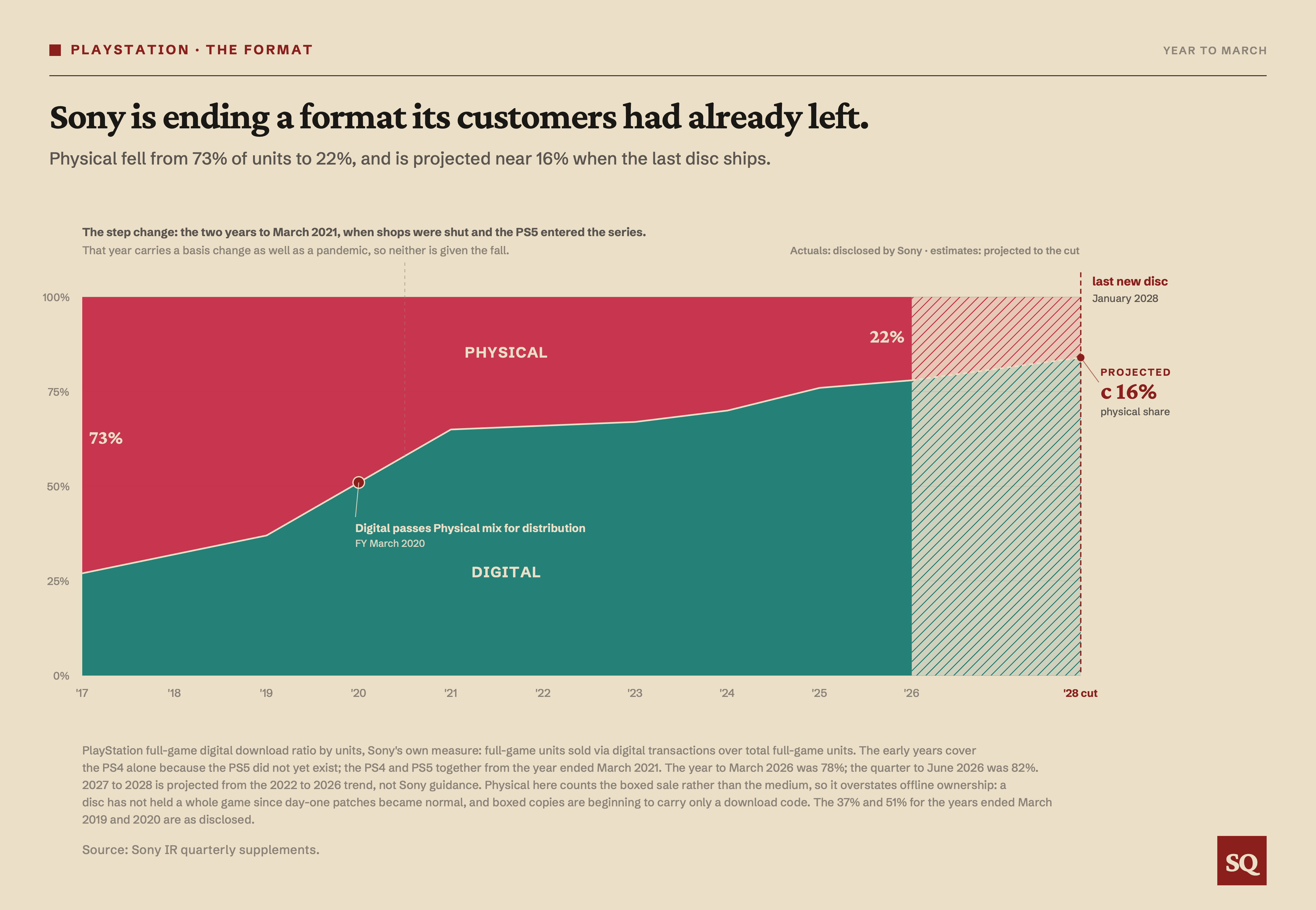
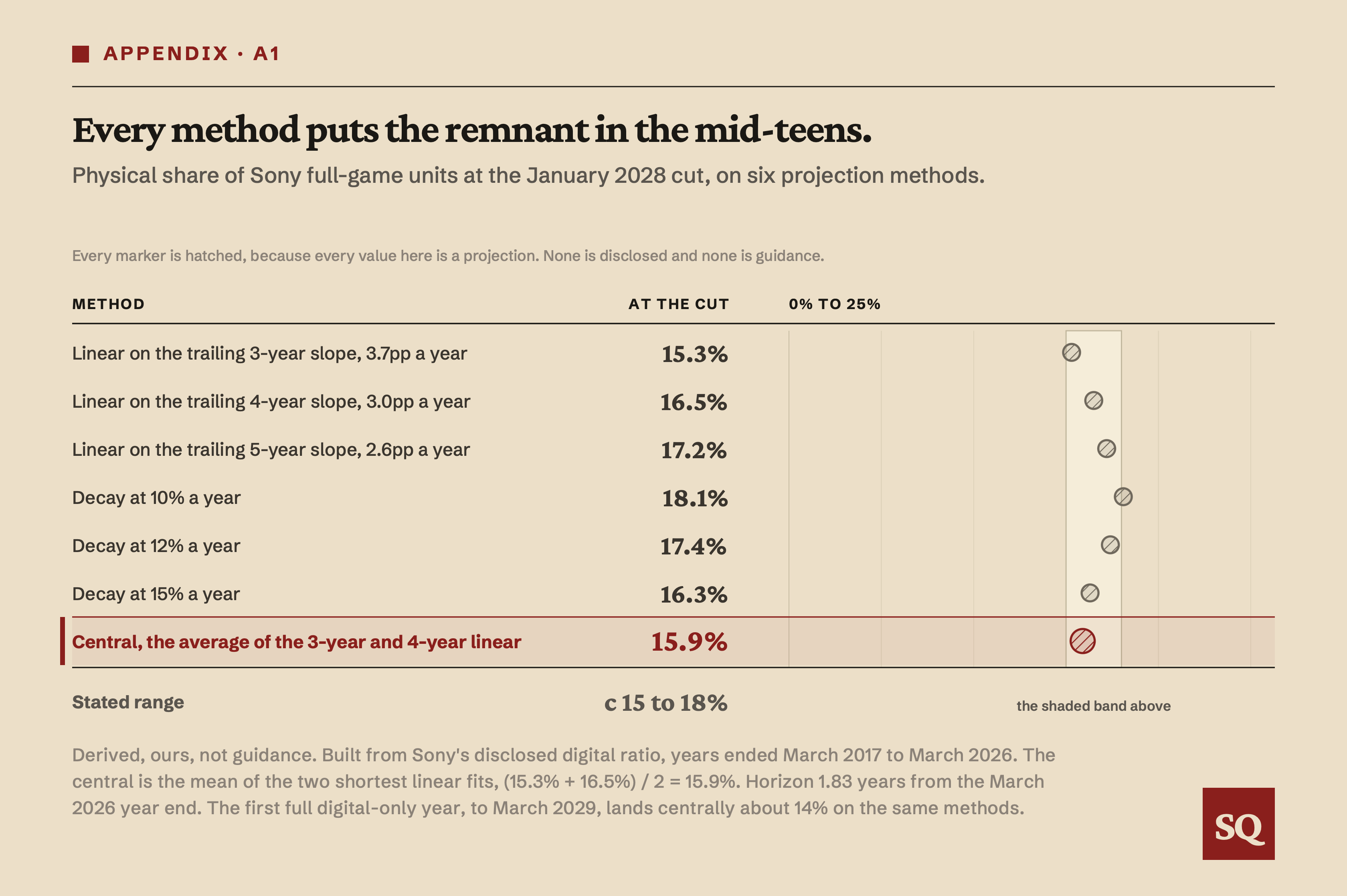
Physical was 22% of full-game units in the year to March 2026, and on the recent pace it reaches about 16% by the deadline.
A platform switches physical off when demand for it falls below the cost of the channel that carries it.
On 1 July 2026 Sony said that physical disc production for all new games releasing on PlayStation consoles would end from January 2028. New titles will still be sold at retail, but only in digital formats, and games released before the deadline, discs included, are unaffected.
Sony’s stated reason was consumer preference: players had moved to digital, which it called the natural direction of the industry. Its own results support that, with downloads at 78% of full-game units at their last fiscal-end and 82% in the latest quarter (Q1’26 CY).
A retailer-led petition against the change passed 213,000 signatures within a week, players called the move a loss, and Sony’s shares rose.
The argument runs that discs have grown expensive to make, so Sony was shedding a costly channel and keeping its customers on the digital one, where it keeps far more of each sale. It is true that Sony does keep more of a download, and switching the disc off moves the spending onto the digital storefront it controls, but a disc costs about a dollar to press, and the maker of the most expensive format, Nintendo, whose cartridge costs many times more, still has a significant physical distribution. If the price of the medium decided this, then the most expensive format would be the first to go - yet it’s the other way round due to the nuances of each company.
So the question is not whether physical dies, which it has been doing on its own, but when a platform decides to stop making it. Sony is switching off well after the format stopped carrying most of its sales.
Sony’s customers had already left
Sony’s full-game digital download ratio rose from 27% (FY’17) to 78% (FY’26) and physical fell the other way, from 73% to 22% across the same time period. If we assume that the trend from physical to digital continues, Sony would likely have a 16% physical share by January 2028, when the last new disc would be pressed.
In the United States, 73% of the PlayStation 5s sold since launch came with a disc drive, Circana reported through June 2026. Sony's own software mix moved to downloads anyway.
What they show is two parts of the same market moving at different speeds: most PS5 hardware kept the option to use discs while most PlayStation games moved to downloads. If the PS6 arrives without a drive, Sony is removing from the hardware an option about 73% of the PS5s sold across the generation in the US still had, even after physical stopped accounting for most game sales.
The maker with the most expensive format is the one keeping it
Microsoft sells the same two consoles Sony does, one with a drive and one without, but its buyers have gone further from the disc, with about two-thirds of the Xboxes sold in the United States last year carrying no drive, against about half of PlayStation 5s on the same annual basis. Microsoft has also sold fewer consoles than Sony, having focused on building its Game Pass offering in the past (See: Microsoft and Xbox: Separable, but still staying).
Nintendo is the other way, still selling close to half its games on cartridges and, from May 2026, pricing the download below the boxed copy rather than level with it, even though a cartridge costs it many times what a disc costs Sony.
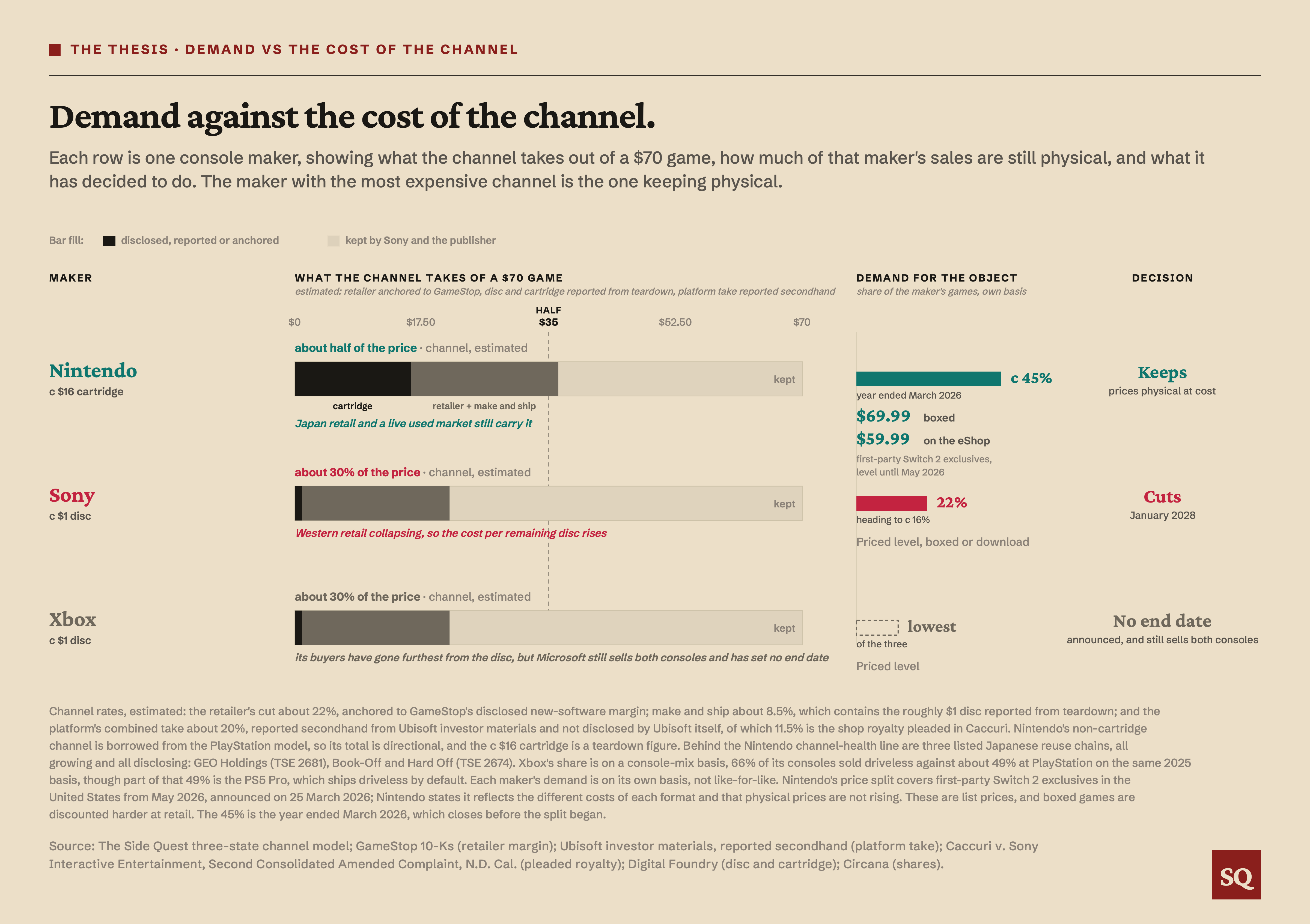
Nintendo keeps the expensive physical format because its buyers still want the physical cartridge, to lend, hand on and sell again, and above all in Japan, where a used game holds its value and listed chains make a business of reselling it.
Digital distribution for Nintendo also arrived later than for its peers. A PlayStation owner could buy a new release as a download from 2007 and an Xbox owner from 2009, while a Nintendo owner waited until 2012, so Nintendo spent the years its rivals used to build a download habit still selling cartridges, and digital has only just passed half of its software sales.
Physical distribution channels are already failing
The physical distribution channel; the disc pressing, freight and retailers and the standing organisation behind them, is mostly fixed cost, built over decades. Those costs do not fall as the volume through them falls, so each remaining disc carries a larger share of them and creates negative operating leverage.
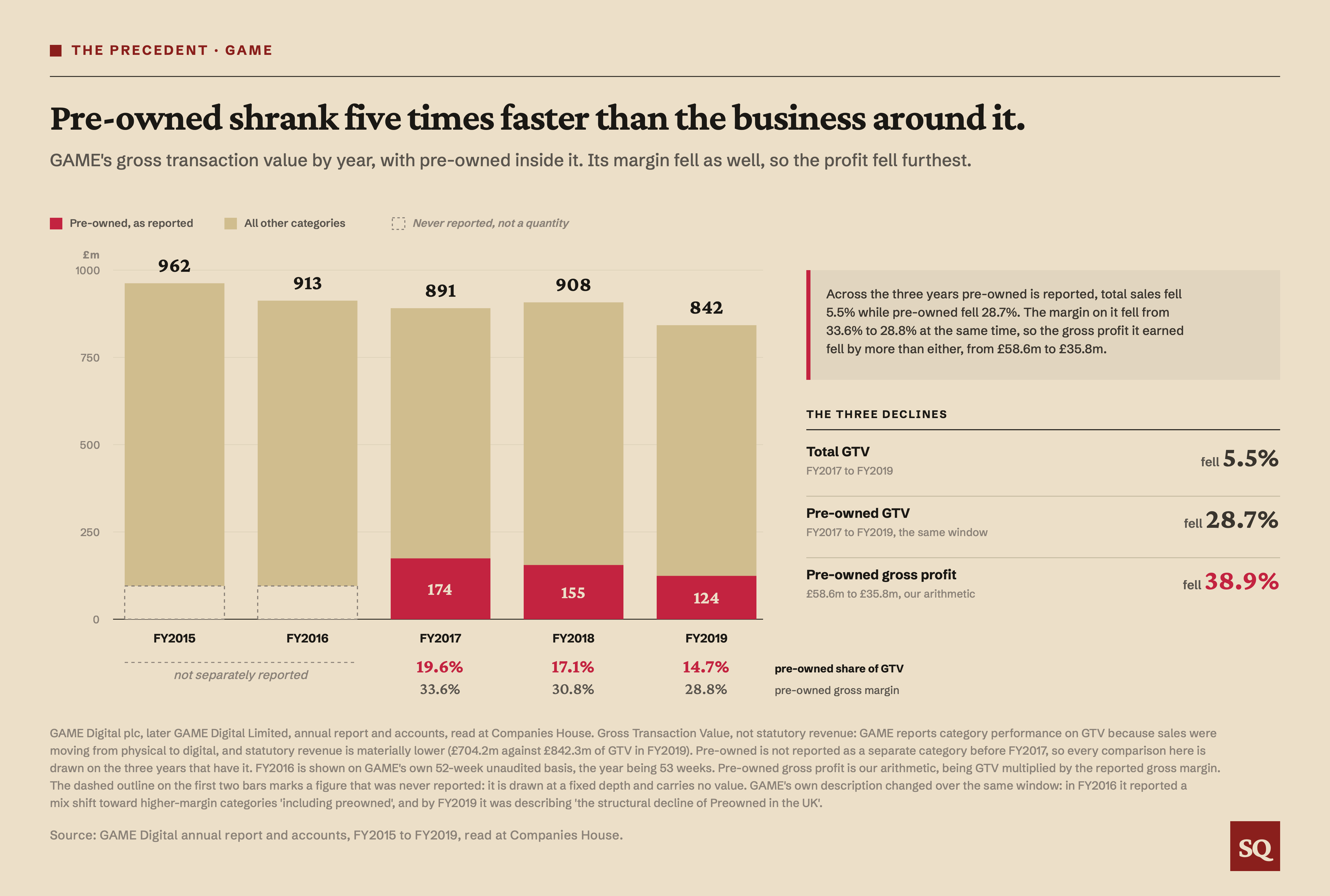
GAME, the UK’s specialist, went into administration in 2012 as an over-expanded, indebted chain that could not cover its rents once its banks and suppliers pulled credit. It was sold out of administration for a nominal sum, floated again, and returned to administration in 2026, its administrators this time blaming the shift to digital downloads and the absence of a major console launch in its final quarter. GameStop has leant on the equity its 2021 share rally let it raise.. The retailer works on the thinnest margin in the chain, so it is the first to go. A platform watching its specialists fail can read the channel as finished well before its own sales say so.
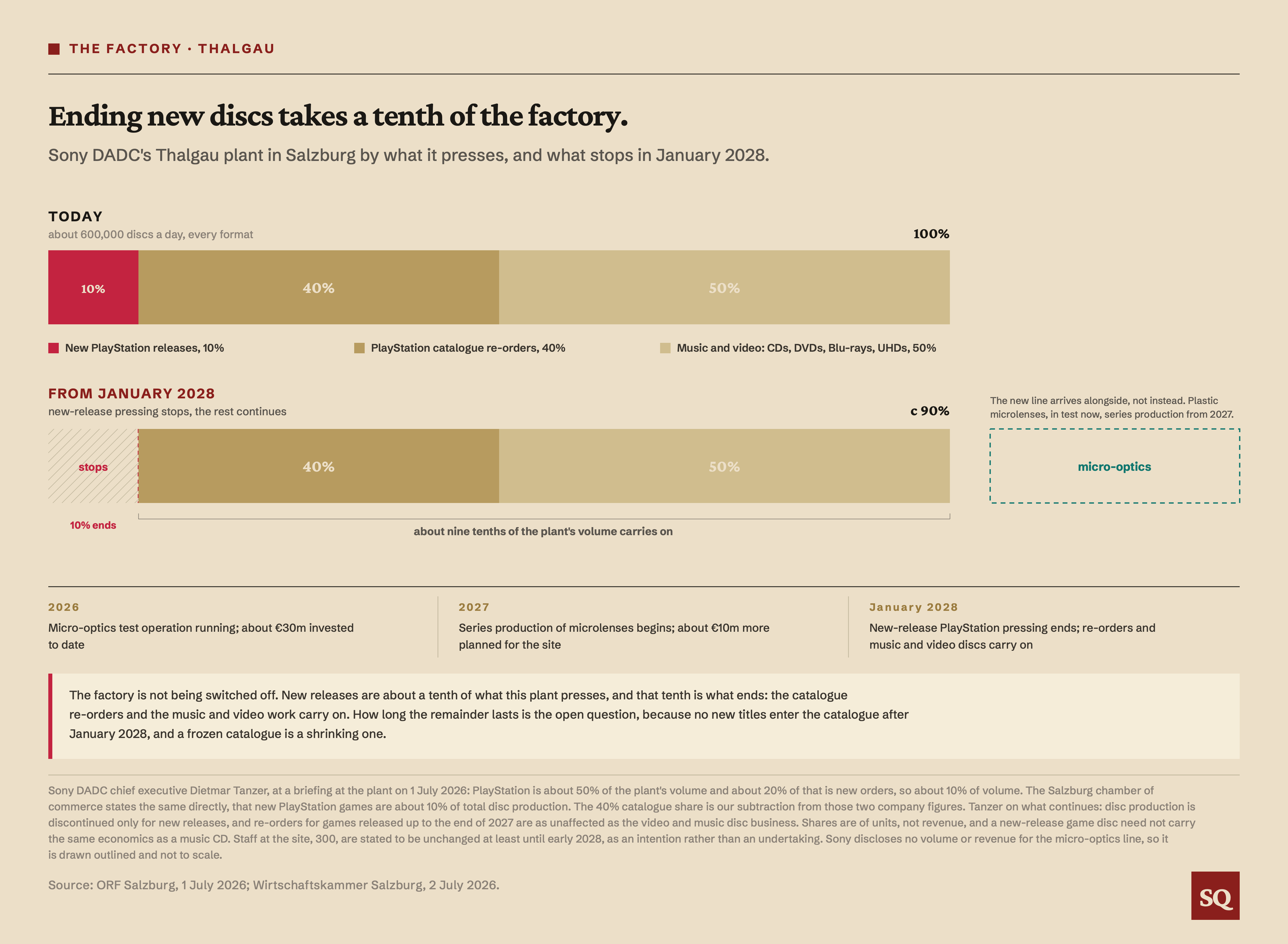
Sony’s own side of the channel is not failing the same way. Thalgau in Austria, which presses the discs, keeps about nine tenths of its volume after the January 2028 impact, because only new releases stop and the catalogue re-orders and the music and video work carry on. The plant has been building a second business in plastic microlenses since before the disc decision was announced, and it means to carry its workforce across to the new business rather than let them go. The catalogue re-orders are for games that came out before the cut, and nothing released afterwards joins as additional demand for that part of the business. The pool the plant works from stops being topped up, and Sony has not said how long it lasts.
Publishers have already shifted their own sales
The same fall shows up in five large publishers’ own accounts, physical dropping over the past decade to single digits for most of them, with only Nintendo, still on cartridges, anywhere near half.
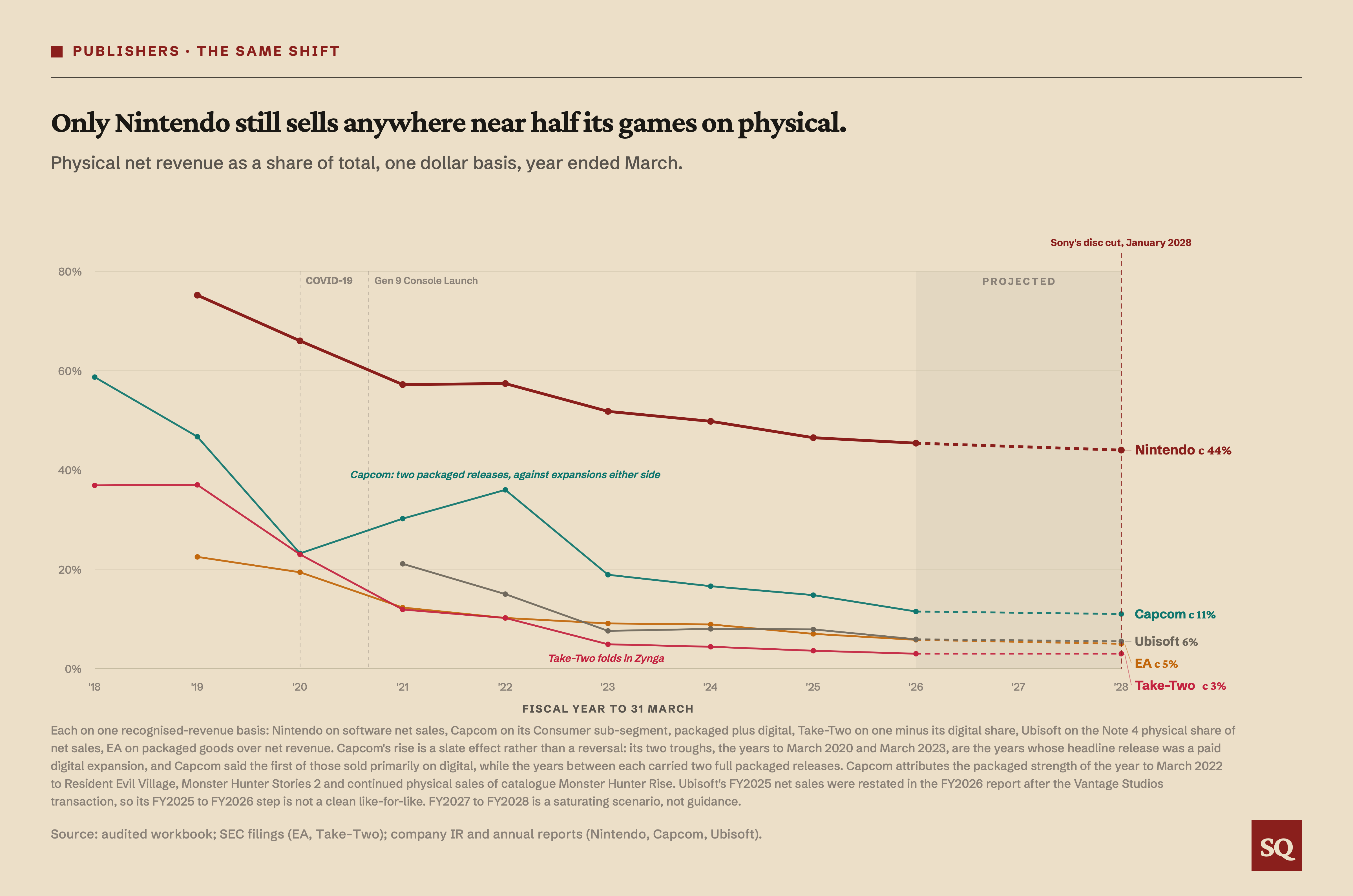
Any publisher can move its own releases towards digital, but none can end the disc, because that decision sits with the platform that presses and distributes across the ecosystem.
What Sony keeps depends on the channel, not the disc
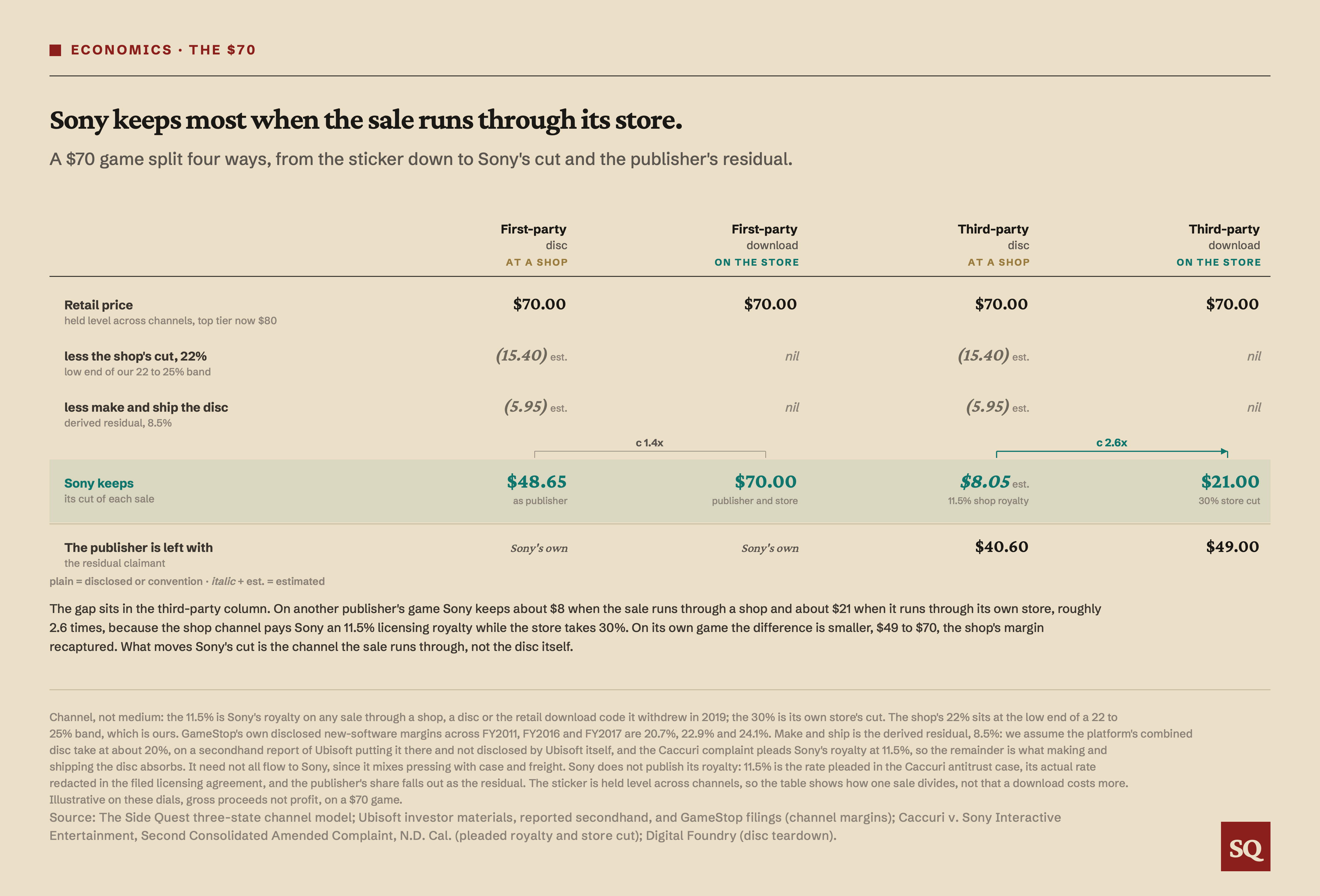
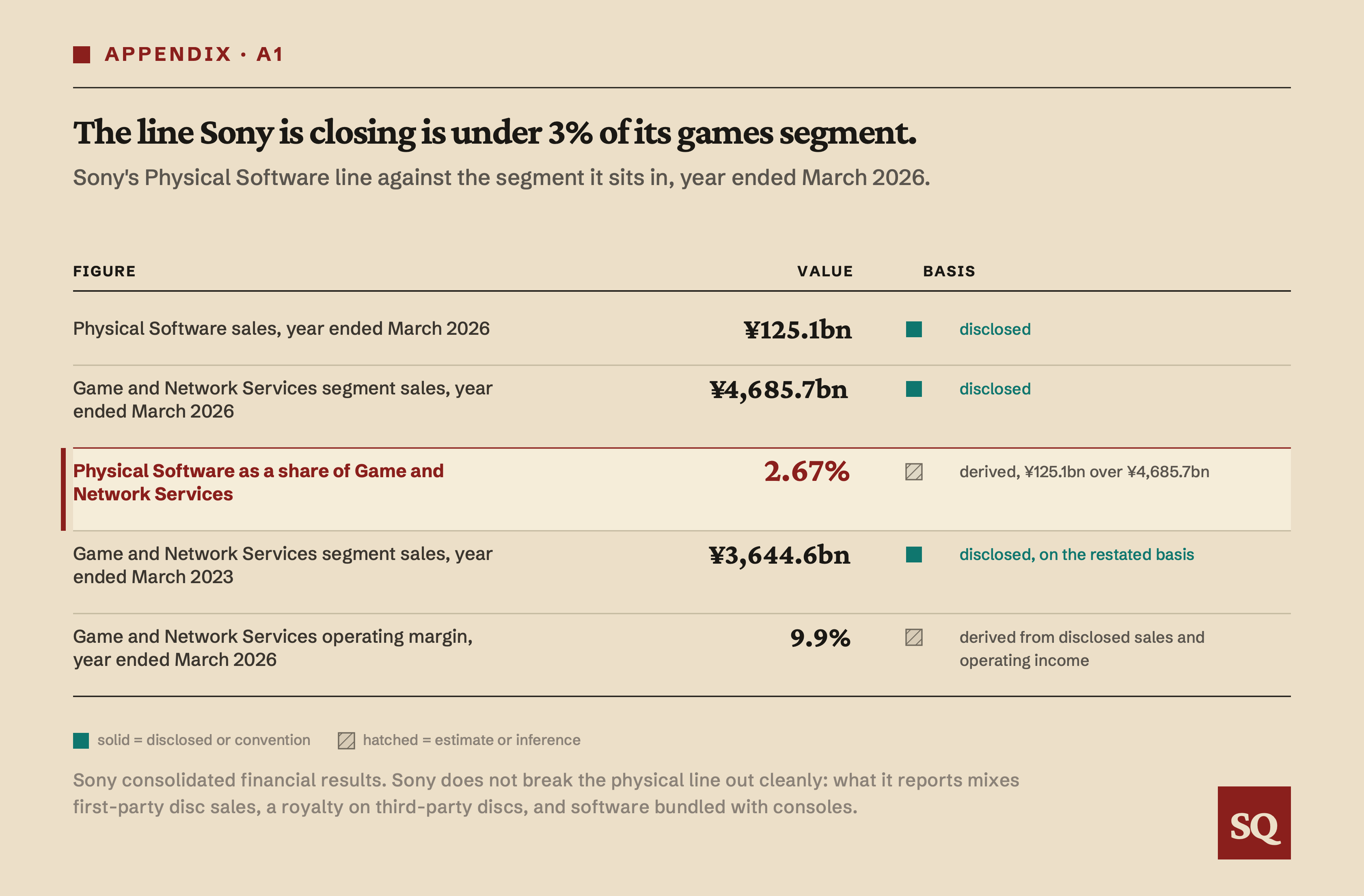
Physical software is under 3% of Sony’s games segment, and what Sony keeps of a $70 game is our triangulation from what the retailer and the publisher disclose. A download saves the retailer’s cut on Sony’s own games and replaces a small disc royalty with a larger store cut on everyone else’s, so ending the disc moves the spending to a channel Sony keeps more of, on the buyers who follow. That makes the buyers who won’t follow cheap to lose, which is what lets Sony act on a shift its customers had already made.
Music and film were the first to switch to digital
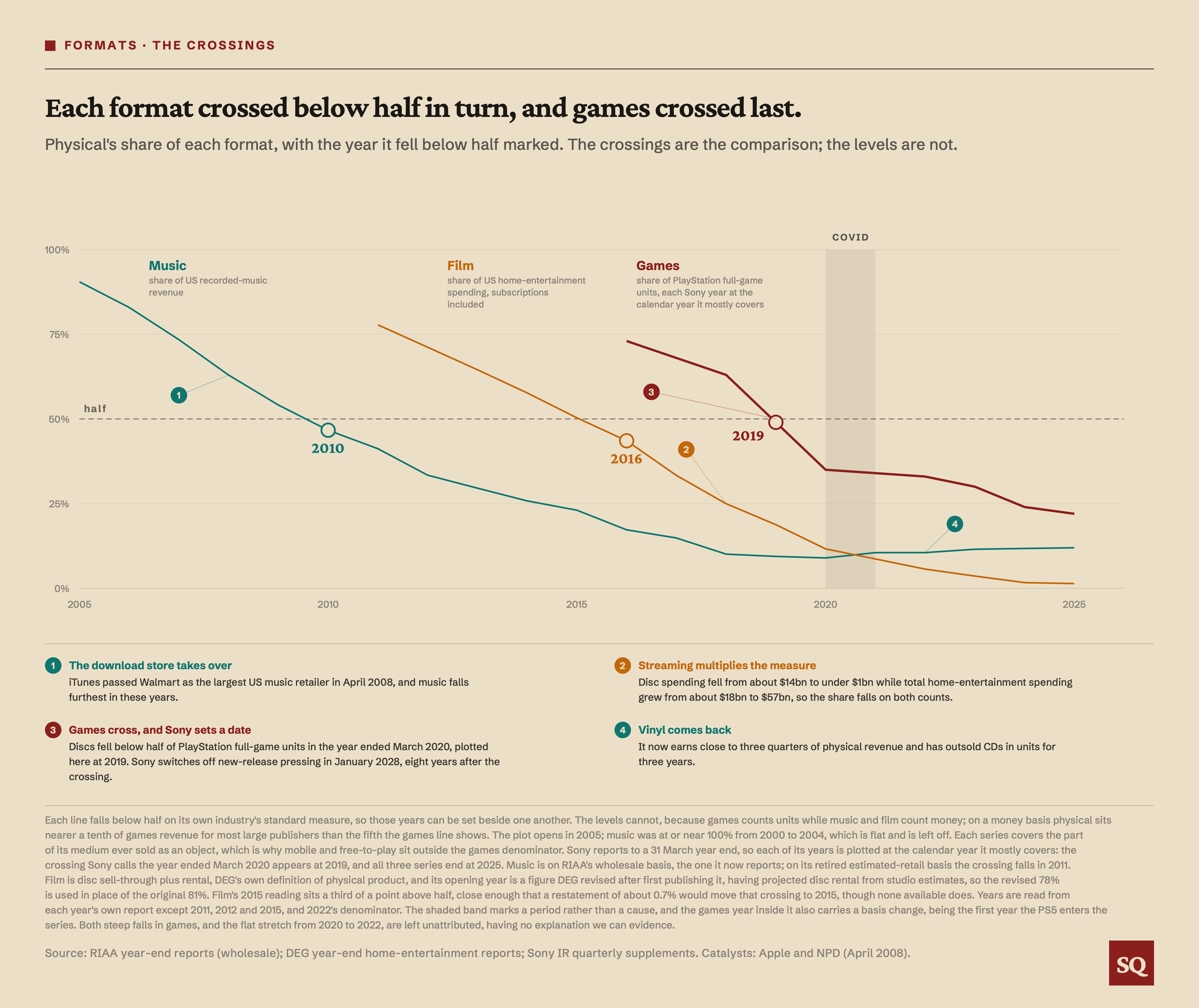
Physical media has been through this twice before, in music and then in film. Games held on longest, keeping a new-release shelf in shops years after the other two had lost theirs, and it is the last of the three to fall below 50% of the mix.
Other companies have switched a format off before, and the four we looked at turn on whether the replacement was already paying for itself. Netflix ended DVD-by-mail from half a percent of revenue, against a streaming business that had become the whole company. The two that went badly sit either side of that: Newsweek cut print before the digital title could carry itself, and Kodak held on until the market decided for it. Music never switched anything off, letting the CD go while vinyl held as a small profitable niche.
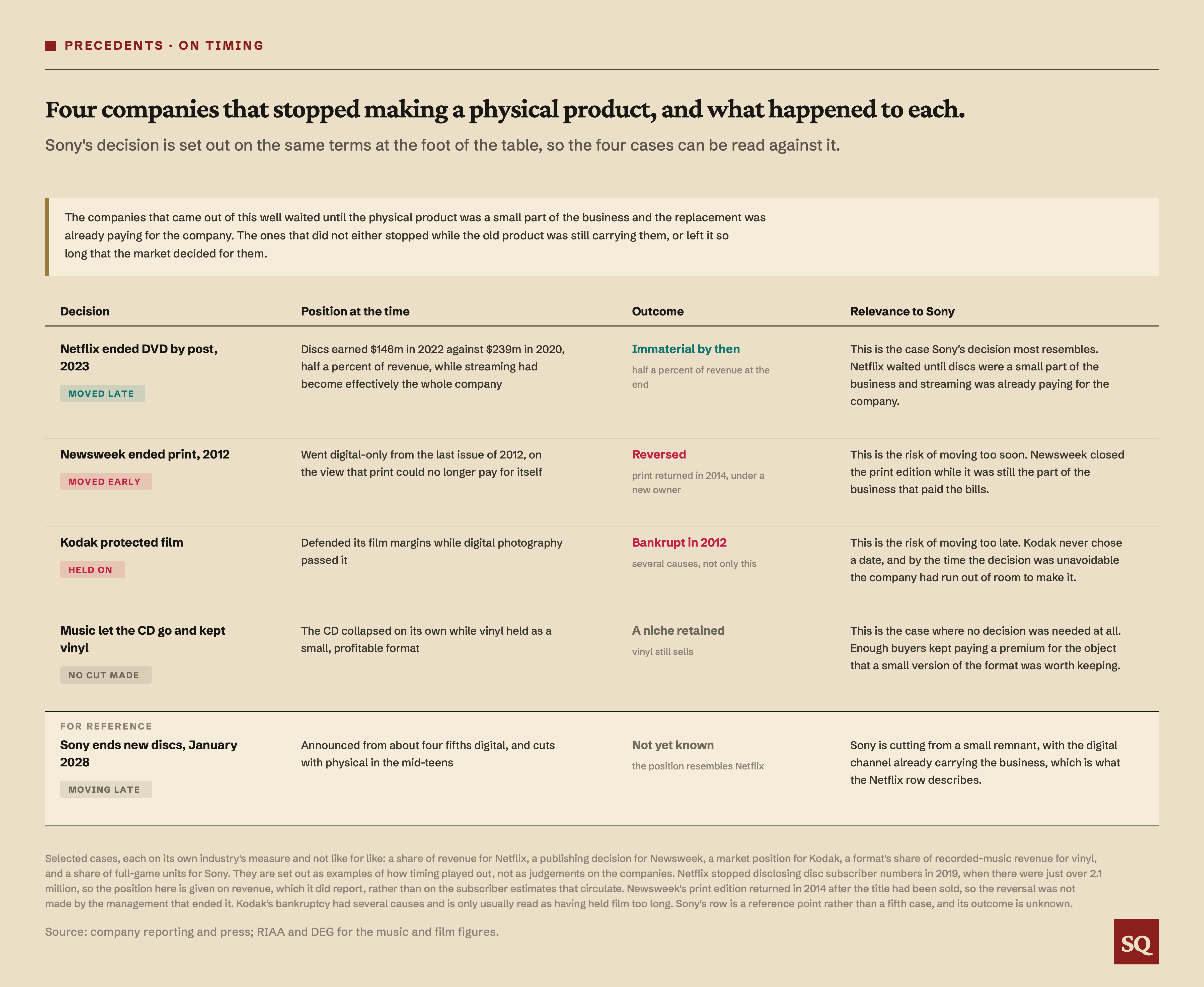
Sony announced with digital already about 80% of its units, and it switches the disc off with physical down in the mid-teens, far down its own curve and where the risk of cutting is lowest. That measures what the decision costs Sony, and not what it costs the people losing the disc.
The same logic points to a disc-less PS6
Sony already sells the PS5 Pro without a drive and sells the drive on its own, so the disc is an option the buyer pays for rather than a cost carried in every console. That add-on does everything a built-in drive does, playing PS5 games on disc, the PS4 back catalogue and 4K films.
A console needs a built-in drive only while new games ship on disc, and from January 2028 none will. We assume the PS6 arrives without one, and that the add-on carries the back catalogue for the buyers who still want it. Sony has said nothing about the next console, and it could keep the drive anyway, for the 4K film player or for Japan, where the object still sells, though neither of those is a reason that comes from the games business.
The buyer loses something the accounts do not carry
A disc could be lent, resold and handed on, without an account and without anyone’s permission, and a licence cannot be. Day-one patches became normal around 2013, so a disc often stopped holding the whole game, but the disc stayed transferable, and that is the part the switch ends.
Nothing in the move to digital requires that. Nintendo’s Game-Key Card holds no game, only the right to download one, and it has to stay in the console to play, so what the buyer owns is still an object: it is not tied to an account, and it can be lent or resold like a cartridge. Sony’s boxed code is spent on the first download and tied to one account, so nobody can pass it on. Grand Theft Auto VI is due to ship its physical edition as a code in November, the first blockbuster to do it, and from January 2028 it is how a boxed PlayStation game works.
Sony’s shares rose, on a reading that a small, low-margin line closes and most of the spending that ran through it stays. That reading covers one side of the decision, and what a buyer could do with the object they bought has never been a line in anyone’s accounts.
More from The Side Quest
Jason Della Rocca (Griffin, Execution Labs, ex-IGDA): “Zero-to-evidence is where the market failure is” Most funds now wait for proof that players want a game, and reaching that proof often runs on savings, a grant if your country has one, or an incubator place if you can get one.
Microsoft and Xbox: Separable, but still staying Microsoft has done everything you would do before selling Xbox. We priced seven ways of doing it, and every one it can execute itself is worth less than doing nothing.
AppLovin vs Unity: are two of the market’s favourite ad engines worth it? We read the job postings on both sides of this market, the ad networks and the studios that buy from them, to test whether AppLovin’s and Unity’s ad-engine growth is worth what the market pays.
Epic Games: what is it worth, and what did the generosity cost? Fortnite pays for four free layers. The cash Epic captures is worth about $7.5bn; the tools it under-monetises lift fair value toward $14bn, and the last mark sits in between.
Roblox: A great company lost on valuation - It owns the most complete stack in interactive entertainment yet profits from it the least, and rising costs are eating into what little is left.
AI in Video Games: Own the Loop - why a studio keeps its value only if it owns the content-generating learning loop, not the model. Uses Guild Wars 3 as a worked example.
AI won’t make AAA games materially cheaper to develop - the productivity gains are real, but two-thirds of the value leaves the P&L to the AI vendors before it reaches the bottom line.
Appendix
Every figure the article uses, with what it rests on. The article keeps precise numbers out of the prose and points here instead, so this is where the sourcing, the dating and the caveats live.
How to read the basis column. Disclosed means the company published it. Reported means a named outlet or a filing of another party published it. Pleaded means it appears in a court filing as an allegation, not as a finding. Convention means an industry rate that is widely used and not company-specific. Derived means we computed it from figures in the rows above. Ours means it is our reading, and the article says so wherever it appears.
Fiscal years run to 31 March unless stated. Sony’s “year ended March 2026” is written FY2026 throughout, which is Sony’s FY2025 in its own naming, so the year end is always given.
A1. Sony’s own mix, and the remnant at the cut
Sony publishes one number that carries most of this article: the share of full-game software units sold as digital downloads. Its own definition is full-game units sold via digital transactions over total full-game units.
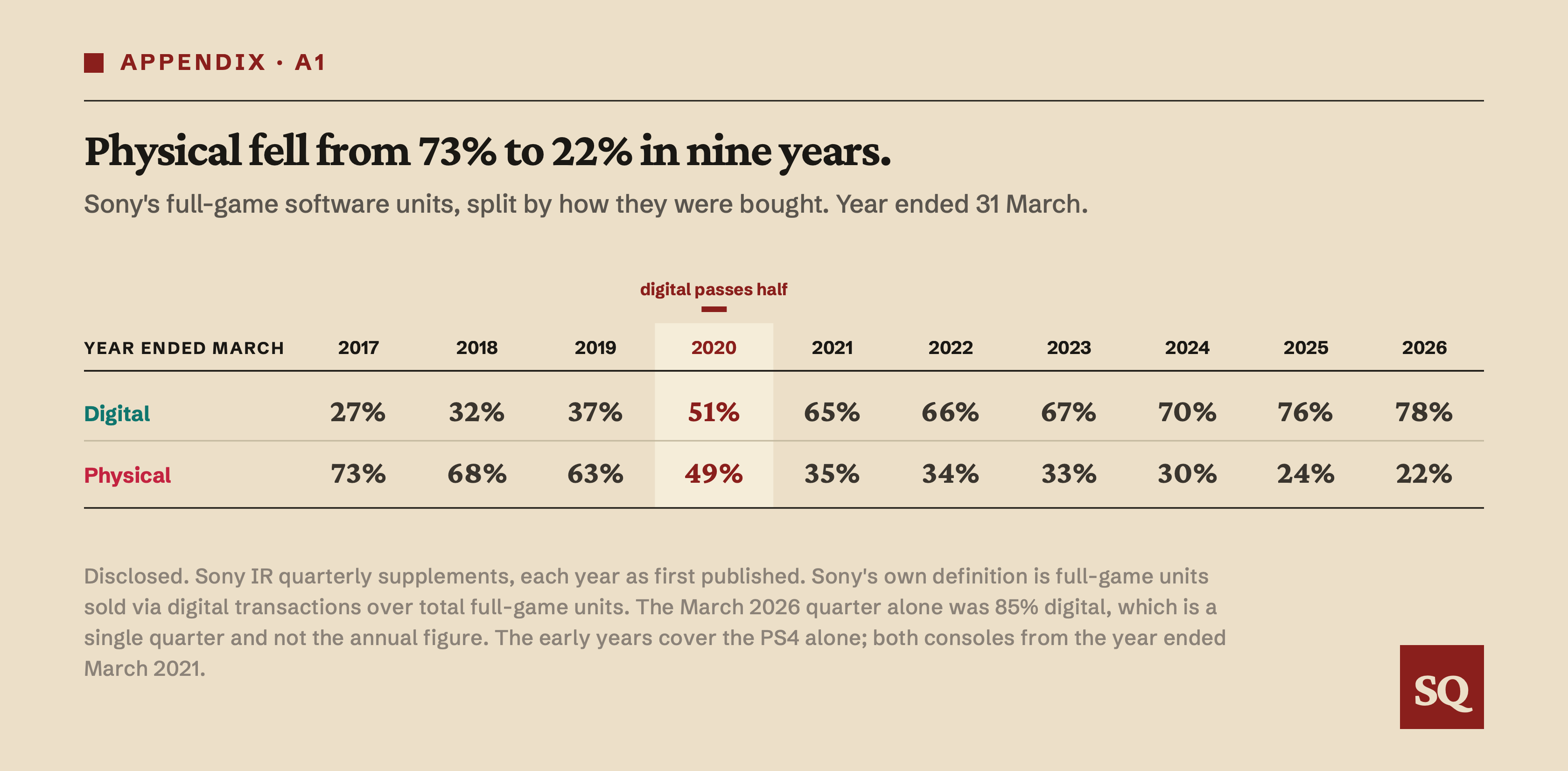
The early years cover the PS4 alone, because the PS5 did not exist, and the two consoles together from the year ended March 2021. A restatement of the 2019 and 2020 figures to 43% and 53% also circulates; we investigated it in July 2026 and could not tie it to source as full-year figures, they appear to be single quarters, and a PS4-plus-PS5 restatement is not possible for years before the PS5 shipped. The series here is as first disclosed, and those two values are not used.
Physical counts the boxed sale, not the medium. Sony’s split is on the transaction, so a game bought in a shop counts as non-digital whether the box holds a disc or a download code. The share therefore overstates offline ownership, and by a margin nobody discloses. A disc has not held a complete game since day-one patches became normal around 2013, and boxed copies have begun to carry only a code, with Grand Theft Auto VI’s physical edition, due in November 2026, the first blockbuster to ship that way.
The remnant at the cut
The article says physical reaches about 16% when the last disc ships. That is a projection, not guidance, and it is built from the disclosed series above.
The line the announcement affects
The other two console makers
The article says digital has only just passed half of Nintendo’s software sales, and leaves Sony’s 78% on the other side of the sentence. The two figures are not measured the same way, so both are set out here rather than differenced anywhere.
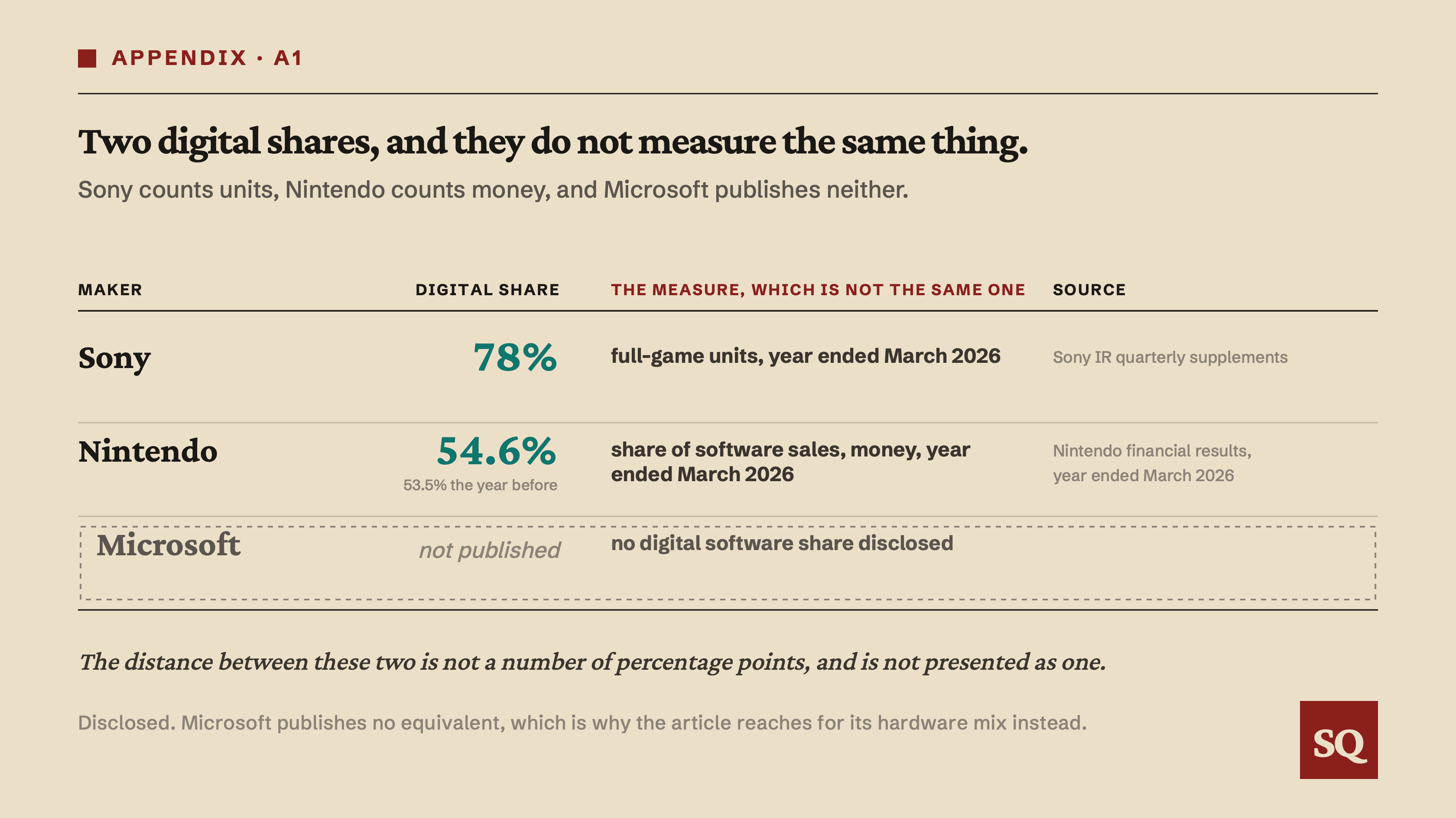
Nintendo’s prior year was 53.5%. Sony counts units and Nintendo counts money, so the distance between the two is not a number of percentage points and is not presented as one. Microsoft publishes no digital software share at all, which is why the article reaches for its hardware mix instead.
Nintendo’s price split cuts the download rather than raising the boxed copy. Nintendo announced on 25 March 2026 that its own Switch 2 titles would carry a lower digital price from May 2026, the first being Yoshi and the Mysterious Book. In the United States the split is $59.99 for the download against $69.99 boxed. The two had been level before it: Mario Kart World launched at $79.99 either way. The scope is first-party Switch 2 exclusives, and it is separate from the Switch 2 hardware price, which rises from $449.99 to $499.99 on 1 September 2026 and is a genuine increase. Basis: disclosed, Nintendo announcement, 25 March 2026.
When each store opened. The stores did not arrive together, and the gap covers the years in which buying a download became normal on the other two platforms.
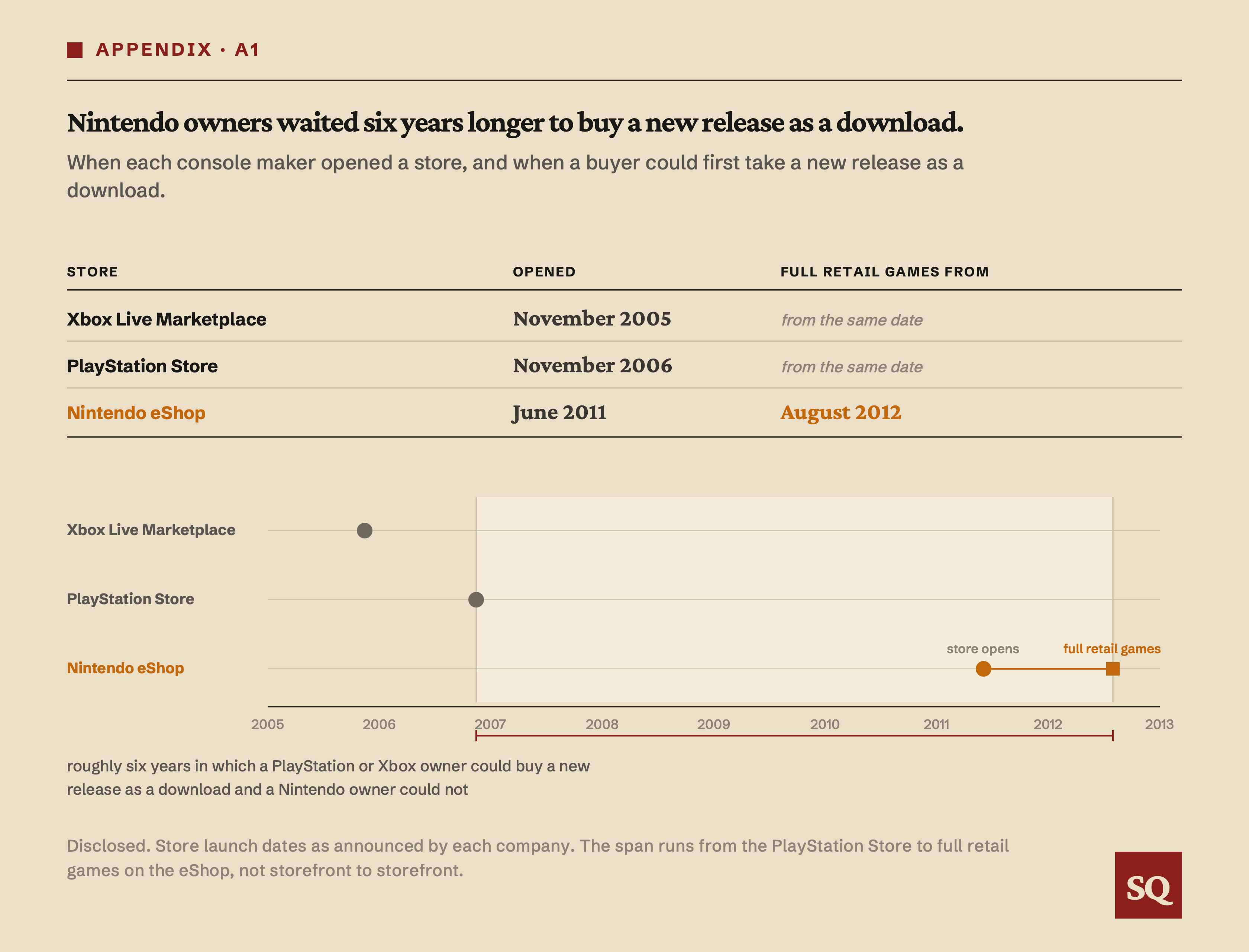
Nintendo’s storefront opened about five years after Microsoft’s and did not carry full retail games until the year after that, so roughly six years separate the point at which a PlayStation or Xbox owner could buy a new release as a download from the point a Nintendo owner could.
Consoles sold without a drive. About two-thirds of the Xboxes sold in the United States in the last year carried no drive, against about half of PlayStation 5s, both on the same annual basis and both from Circana. A figure of roughly a quarter also circulates for the PlayStation 5 and is Circana’s life-to-date measure, which covers every unit since launch rather than the last year, so the two are not interchangeable. Part of PlayStation’s annual share is the PS5 Pro, which ships without a drive by default, so the figure reflects what was on sale as well as what buyers chose.
A2. The publishers
Physical net revenue as a share of total recognised net revenue, one dollar basis, so that live-services and mobile revenue sit in the denominator rather than being stripped out. That is a deliberate choice: it means the ratio falls both because physical declines and because a publisher’s other businesses grow, and both are part of the same shift.
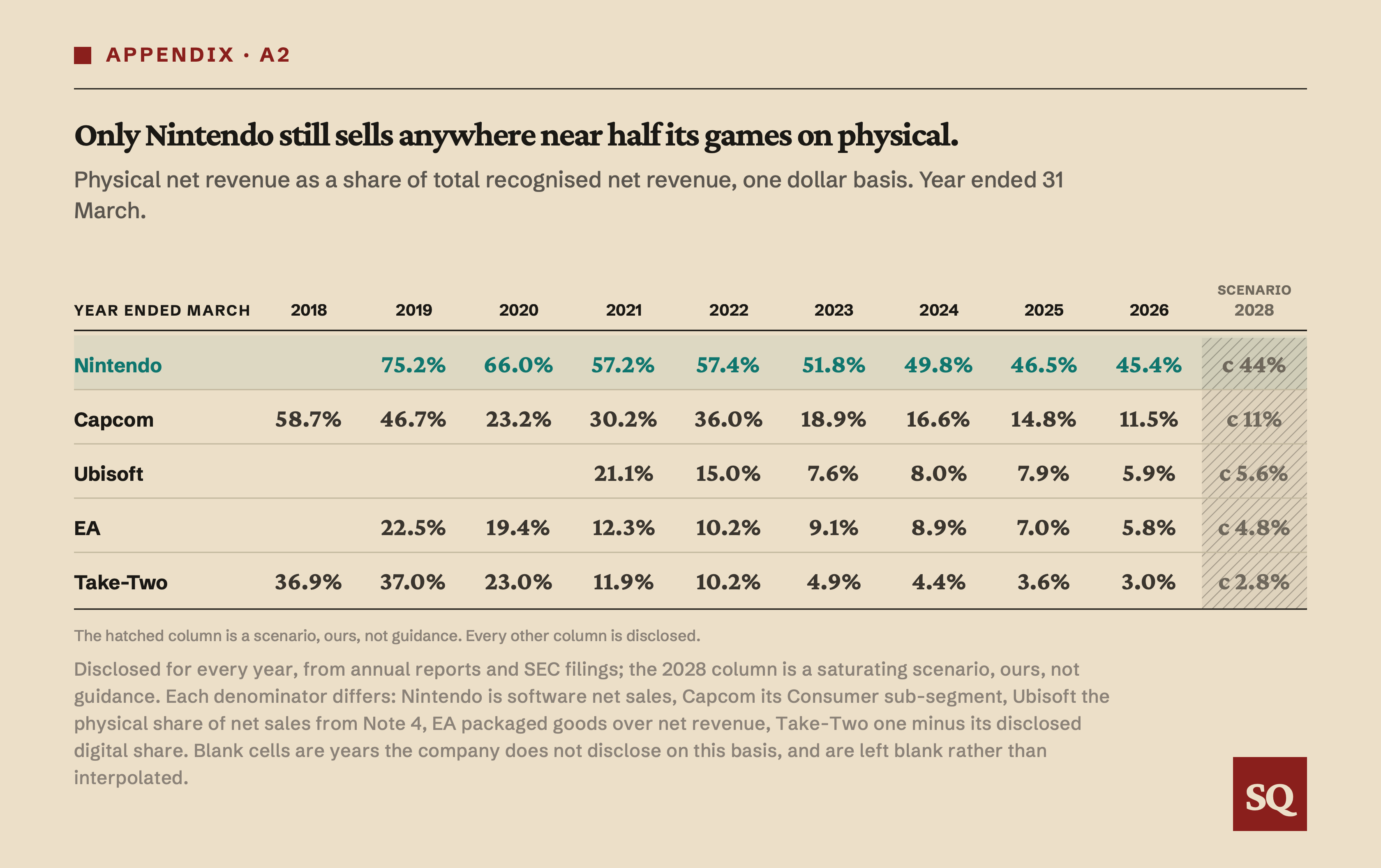
Each publisher’s denominator, because they are not the same thing. Nintendo is on software net sales, so hardware sits outside it. Capcom is on its Consumer sub-segment, packaged plus digital, so its Mobile business sits outside it; on the wider Digital Contents segment the 2022 peak reads 34.3% rather than 36.0%. Ubisoft is the physical share of net sales from Note 4 of its accounts. EA is packaged goods over net revenue. Take-Two is one minus its disclosed digital share.
Basis: disclosed for every year, from annual reports and SEC filings. The 2028 column is a saturating scenario, ours, not guidance.
Capcom’s rise is a slate effect rather than a reversal. Its two troughs, the years to March 2020 and March 2023, are the years whose headline release was a paid digital expansion, Monster Hunter World: Iceborne and Monster Hunter Rise: Sunbreak, and Capcom described the first as selling primarily on digital. The years between each carried two full packaged releases. Capcom attributes the packaged strength of the year to March 2022 to Resident Evil Village, Monster Hunter Stories 2 and continued physical sales of catalogue Monster Hunter Rise. Physical was about a quarter of its units that year but over a third of its value, because packaged sales are new-release and near full price while digital volume is mostly discounted catalogue.
Take-Two’s fall from 2022 is partly arithmetic, because folding in Zynga brought a large all-digital mobile business into the denominator. Ubisoft’s 2025 to 2026 step is not a clean like-for-like either, because its 2025 net sales were restated in the 2026 report after the Vantage Studios transaction.
A3. The three formats
Physical’s share of each format over time, and the year each fell below half. The crossing years can be compared; the levels cannot. Games is counted in units while music and film are counted in money, and on a money basis physical sits nearer a tenth of games revenue for most large publishers than the fifth the games series shows.
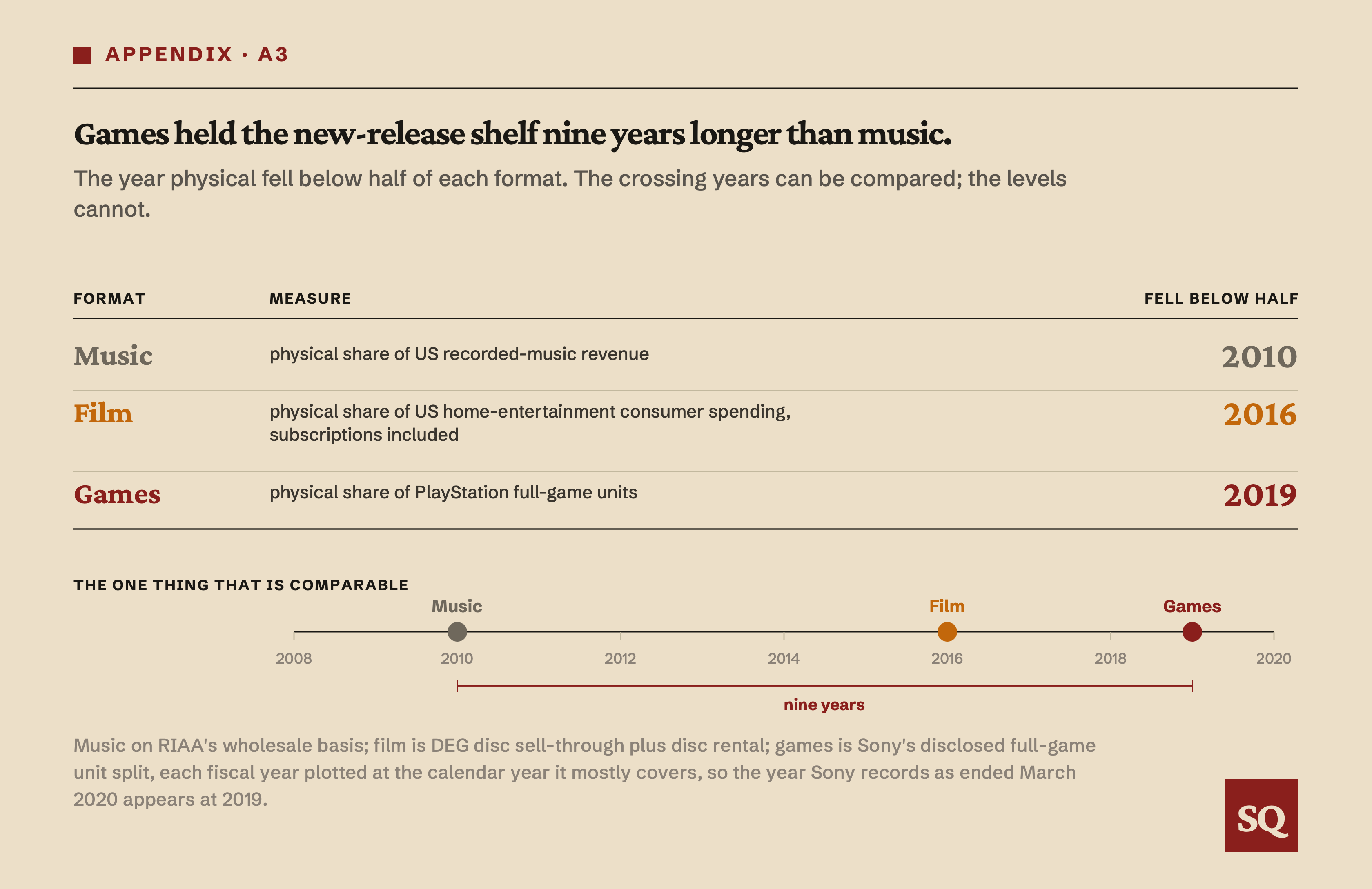
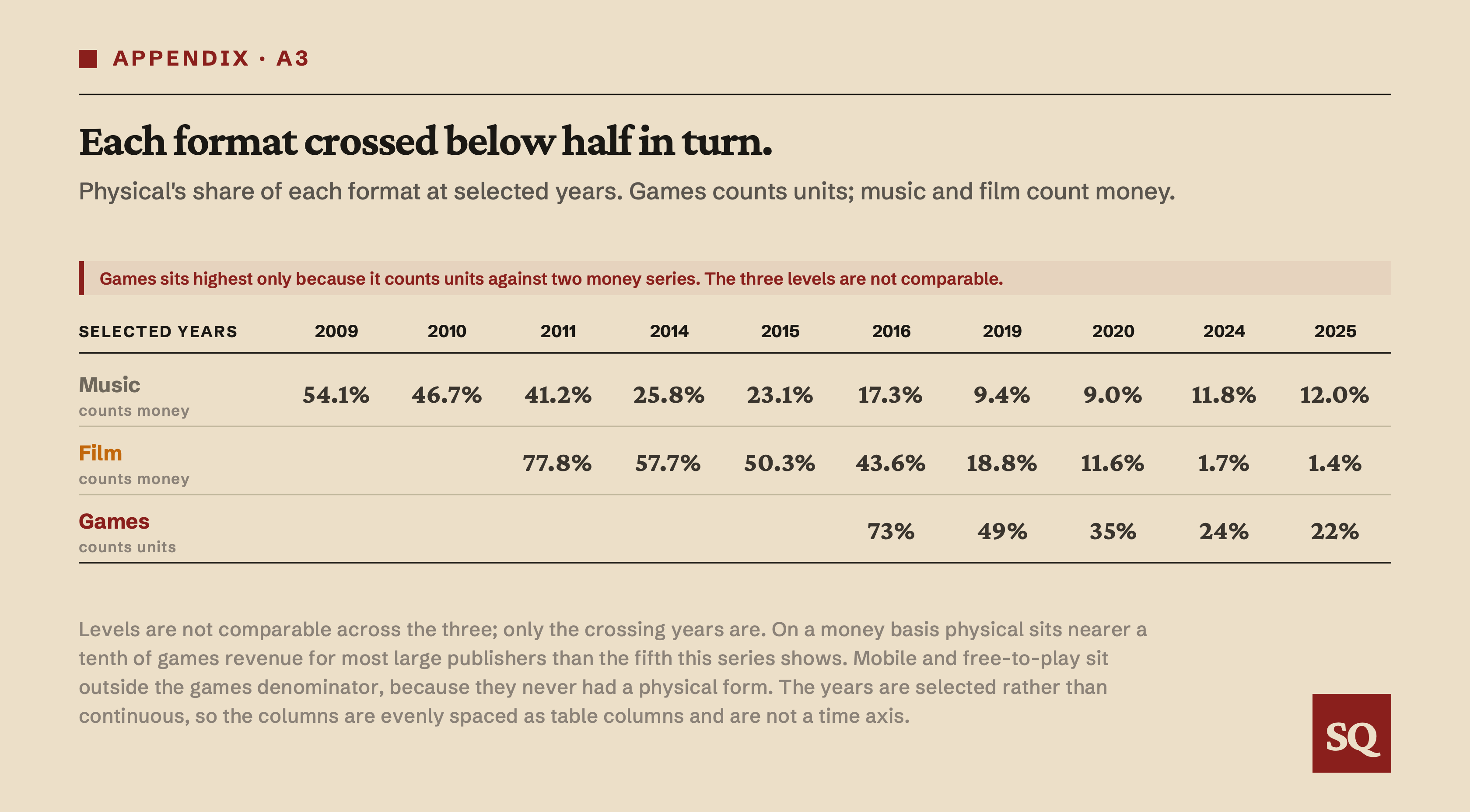
Sony reports to a 31 March year end, so each of its years is plotted at the calendar year it mostly covers. The crossing Sony records as the year ended March 2020 therefore appears here at 2019. The workbook holds it as 2020, on the fiscal-year-end basis. Same event, two conventions.
Each series covers the part of its medium that was ever sold as an object. Mobile and free-to-play games sit outside the games denominator, because they never had a physical form; including them would put physical in single digits by the mid-2010s and reverse the order.
Basis notes. Music is on RIAA’s wholesale basis, which is what RIAA now reports, having retired estimated retail value; on the retired basis the crossing falls in 2011 instead, and that series cannot be completed because RIAA does not publish it for 2025. Film is disc sell-through plus disc rental, which is DEG’s own definition of physical product; on sell-through alone the crossing moves before 2012 and the order of the three reverses. Film’s 2011 opening figure is one DEG revised after first publishing it, its original rental having been projected from studio estimates, so the revised 77.8% is used in place of the original 81.1%. Film’s 2015 reading sits a third of a point above half, close enough that a restatement of about 0.7% would move that crossing to 2015, though no available vintage does. Film years are read from each year’s own year-end report except 2011, 2012 and 2015, and the denominator for 2022.
The one period all three move together is 2020, and all three move away from physical. The games year inside it also carries a basis change, being the first year the PS5 enters the series.
A4. What a $70 game splits into
Sony publishes none of this. What follows is built from one rate we assume and one a court filing pleads, with a third derived between them, and it is presented as gross proceeds rather than profit.
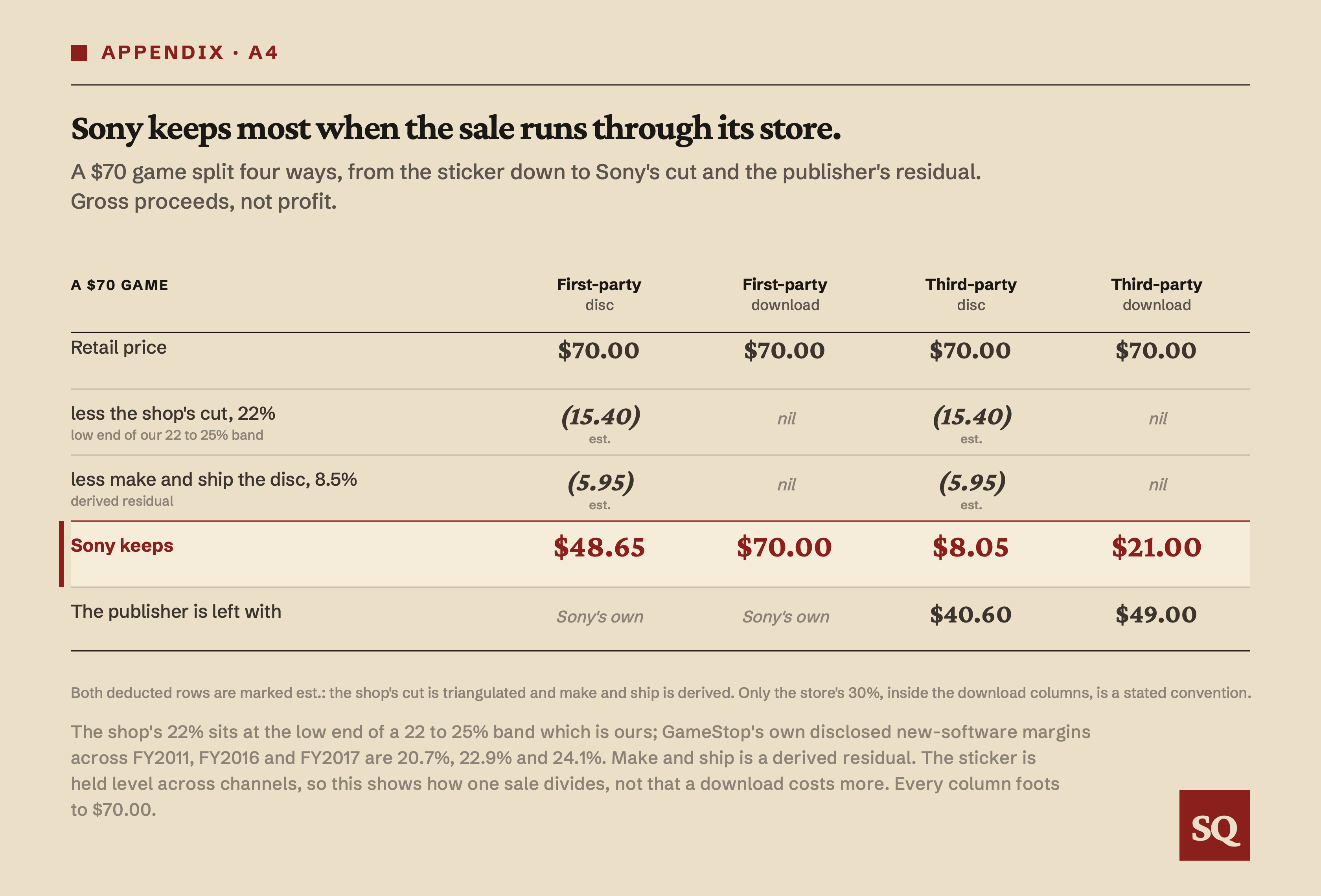
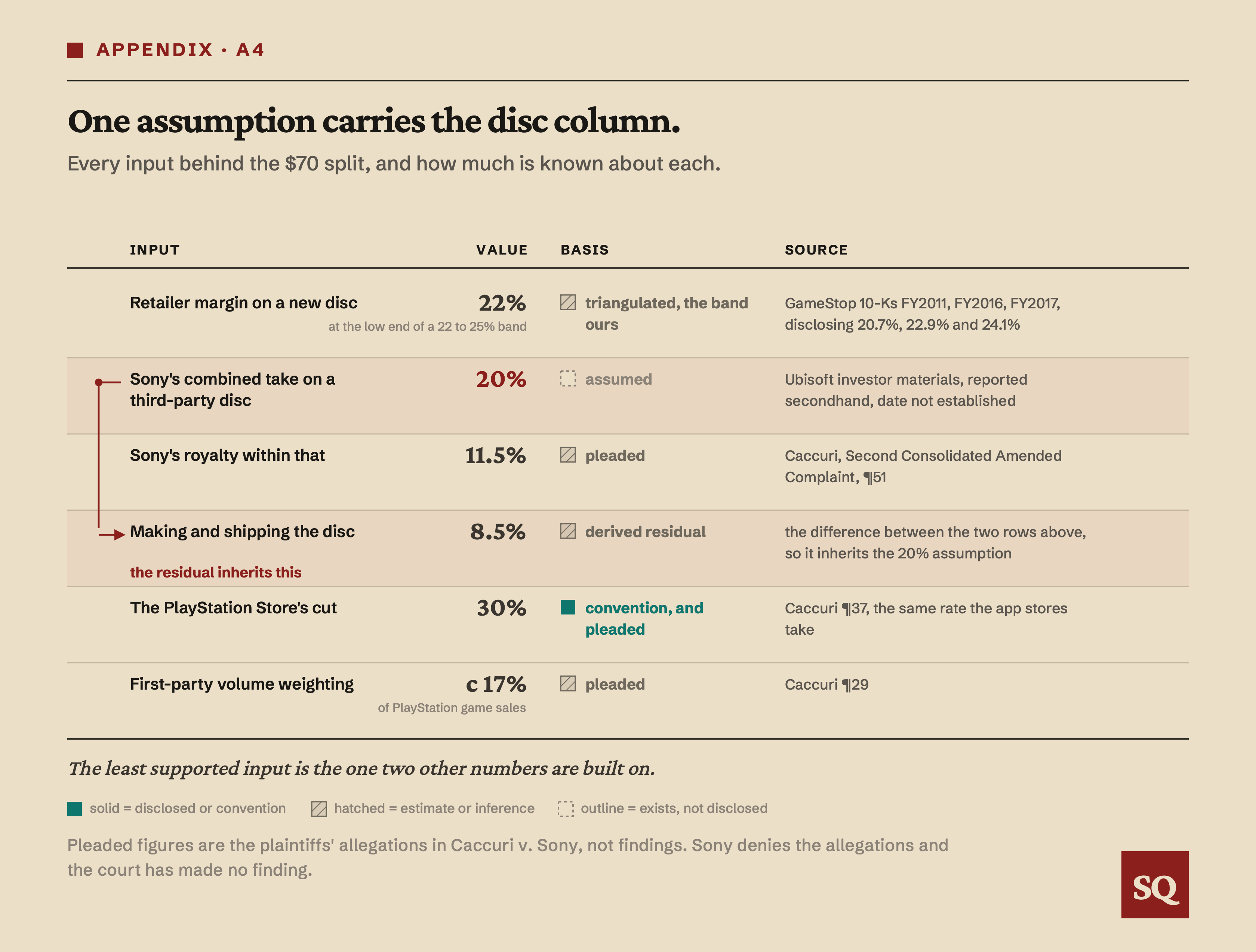
The 22 to 25% band is ours, not GameStop’s. Its disclosed new-software margins across those three years are 20.7%, 22.9% and 24.1%, so the band sits a little above what the filings show, and the 22% we use sits at the bottom of it.
The residual is derived rather than sourced, and that is deliberate. We assume the platform takes a fifth of a disc sale, on a secondhand report of Ubisoft putting it there, and the complaint pleads Sony’s royalty at 11.5%, so what is left is what making and shipping the disc absorbs, being 20% less 11.5% and so 8.5%. Holding one assumption and one pleaded figure, and deriving the third from them, is a choice; the alternative, taking a 15% royalty convention so the arithmetic lands on Ubisoft’s 20% exactly, uses a rate that is not Sony-specific.
The residual sits above Sony’s line rather than inside it, because it mixes Sony’s own pressing with case and freight that need not reach Sony. The plant is Sony’s, so some of it does, but not demonstrably all, and the table does not claim otherwise.
The 11.5% is a channel royalty, not a disc royalty. The complaint scopes it to physical and digital games sold at external retailers, so a download code bought in a shop paid the same rate as a disc. Sony withdrew those codes on 1 April 2019, which is the first day of its own fiscal year, and from then a third-party download could only mean a store sale at 30%.
The cross-check, and where it differs
Bloomberg’s Jason Schreier gives $45.50 for a first-party disc, against $48.65 here, and $35 against $49 for a third-party game physical and digital.
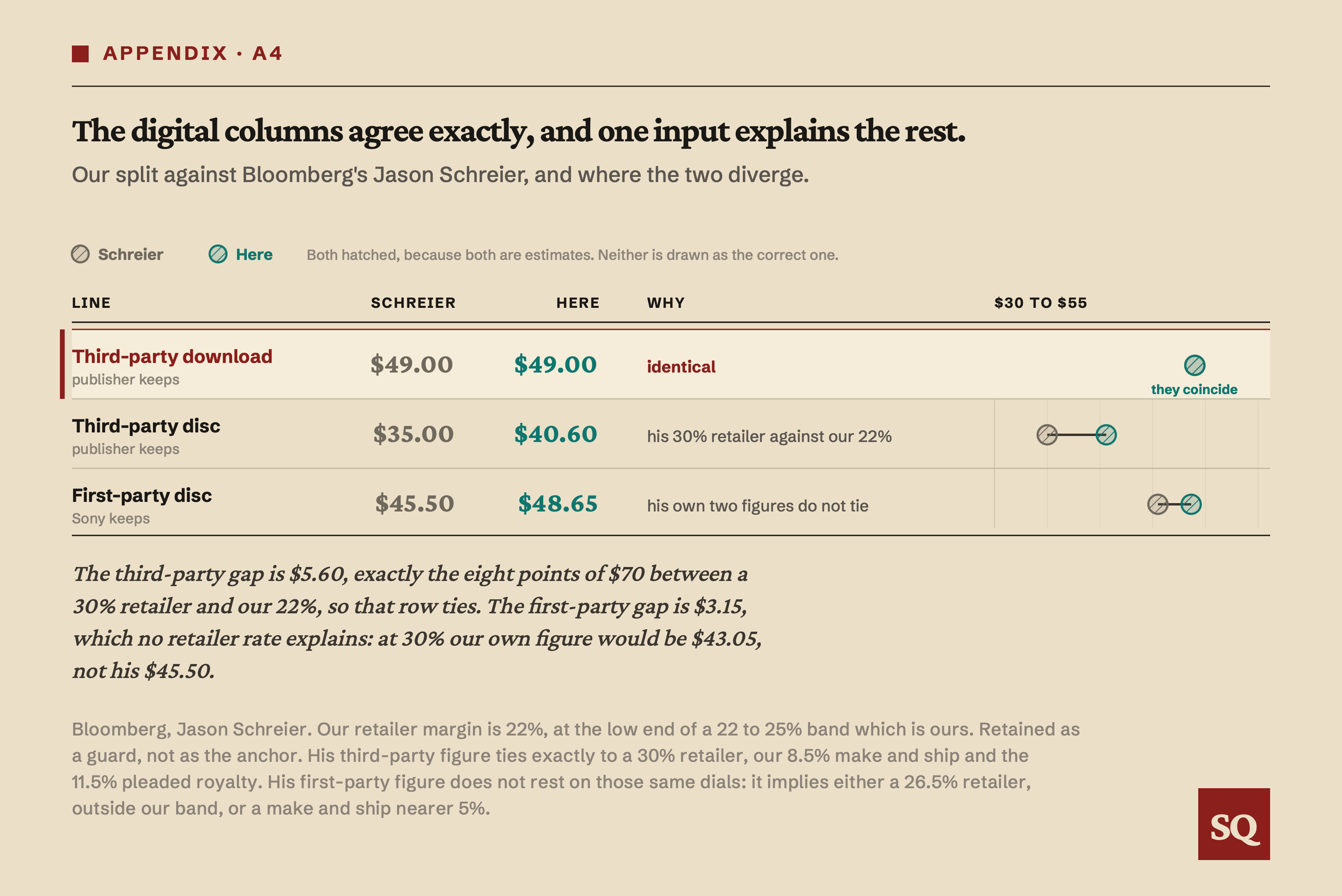
The digital columns agree exactly, which is a useful check on the 30% store cut. Every divergence on the physical side comes from one input, the retailer’s cut, where Schreier uses the round 30% convention and we anchor to GameStop’s own new-software margins. Schreier’s figure is retained as a guard, with the $3.15 variance stated, rather than used as the anchor: reaching it would require a 26.5% retailer, outside the band we use, or a 24.5% platform take, which breaks the 20% we assume.
The boxed code, which is where this is heading
From January 2028 a boxed PlayStation game carries a code rather than a disc, and the split for that state is the least disclosed of the three.
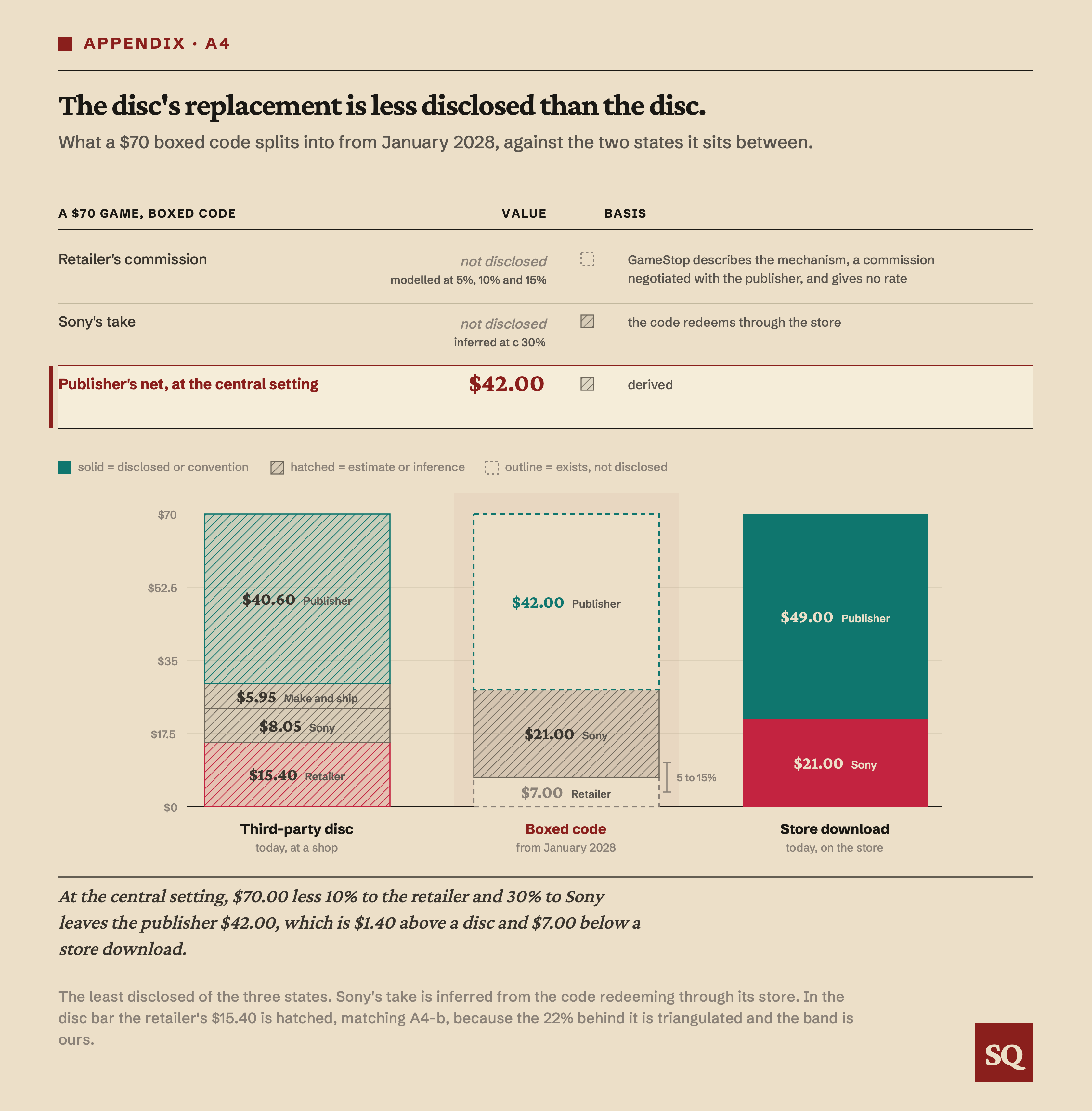
At the central setting the walk is $70.00 less 10% to the retailer and 30% to Sony, so $70.00 − $7.00 − $21.00 = $42.00. Against $40.60 on a disc and $49.00 on a store download, the boxed code sits between the two, and the step up from the disc is $1.40. In the exhibits this column renders almost entirely as outline and hatch, because the disc’s successor format is less disclosed than the disc it replaces.
A5. Margins, and the channel that carried the disc
Sony discloses no margin on its physical line, no per-disc royalty and no store commission. What can be shown is what other companies in the same chain disclose, which bounds the shape without pretending to the amount.
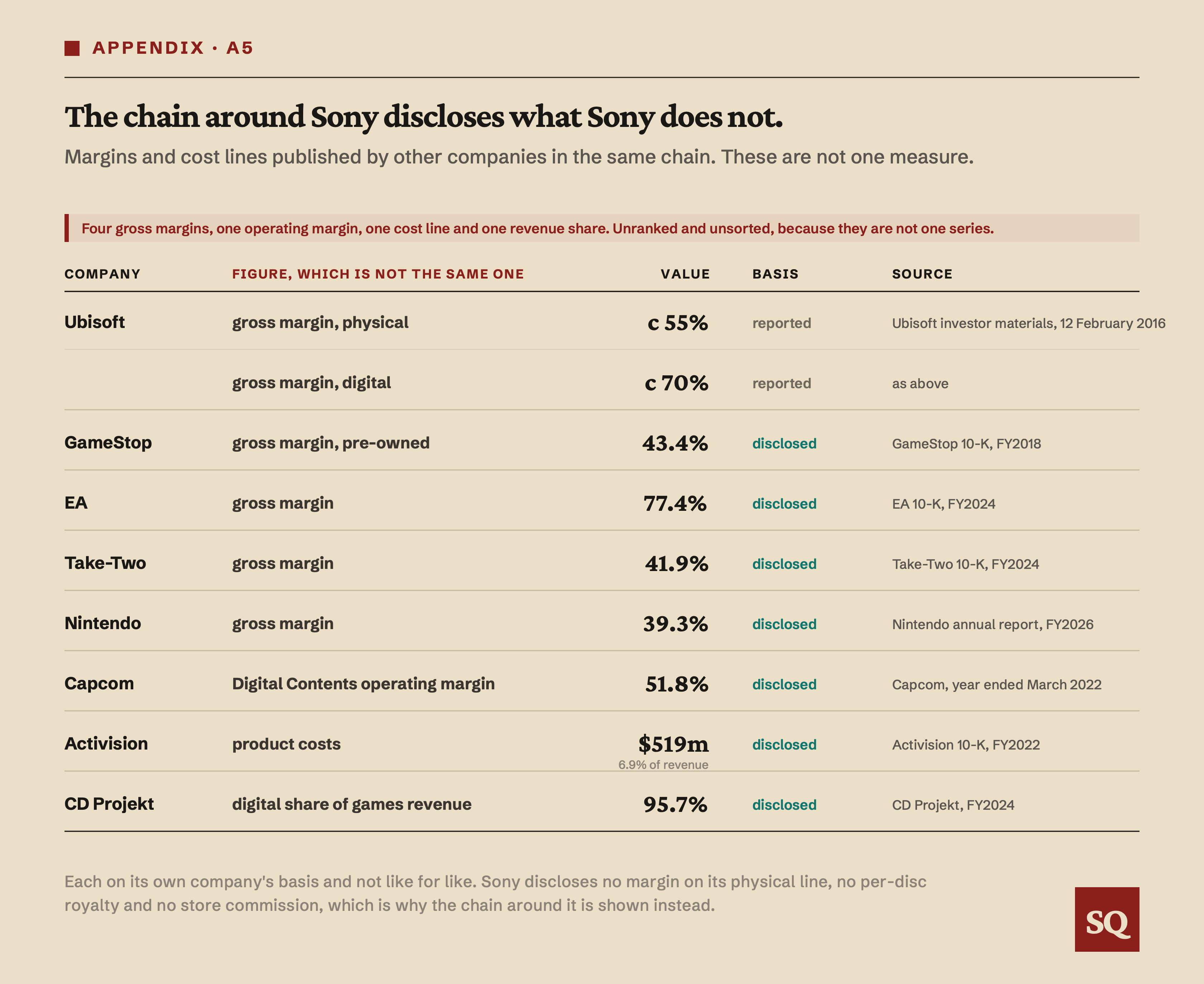
These are not one measure. Four are gross margins, one is an operating margin, one is a cost line and one is a revenue share, so the column reads as a set of separate disclosures about the same chain rather than as a ranking, and it is not charted anywhere.
The plant
Sony DADC’s site at Thalgau in Salzburg presses about 600,000 discs a day across every optical format, for games, music and film. Of that volume, PlayStation is about half, and of the PlayStation half about a fifth is new releases, so new-release PlayStation pressing is about a tenth of the plant’s total output, and that tenth is what stops in January 2028. Catalogue re-orders for games released up to the end of 2027 continue, as does the music and video disc business. The plant is converting part of its capacity to plastic microlenses under a Micro Optics division, with about €30m invested and about €10m more planned for 2027, series production from 2027, and its roughly 300 staff stated to be unchanged at least until early 2028.
Basis: Sony DADC chief executive Dietmar Tanzer, at a briefing at the plant on 1 July 2026, reported by ORF Salzburg the same day and by the Salzburg chamber of commerce on 2 July. The two-fifths catalogue share is our subtraction from those company figures. Shares are of units, not revenue.
Two figures that circulate against this plant are wrong and are not used here. A lifetime total of 24 billion discs matches no real figure; Sony’s own 23bn-plus belongs to the Terre Haute plant in Indiana across 1983 to 2022, and Sony publishes no lifetime total for Thalgau. And the plant’s output does not fall to a tenth, which inverts the figure above.
The retailers
GAME, the United Kingdom’s specialist, entered administration in 2012, was sold out of it for a nominal sum, floated again, and entered administration a second time in February 2026 owing about £16m. Its administrators cited the move to digital downloads alongside Brexit, sharper competition, and the withdrawal of its secured creditor’s support. GameStop’s survival rests on the equity its 2021 share rally allowed it to raise.
Japan is the exception, and it is a listed one. Three reuse chains selling used games and consoles disclose and are growing: GEO Holdings, Book-Off and Hard Off.
A6. What Sony does not disclose
Each gap below sits under a figure the article uses, so each is named rather than worked around.
The margin on the physical line. Not published, and not derivable from the segment.
The per-disc royalty on third-party games. Not published. The 11.5% used here is pleaded in the Caccuri complaint, and Sony’s actual rate is redacted in its filed licensing agreement.
The commission the PlayStation Store charges. Not published. The 30% used here is the platform convention, which the same complaint applies to Sony.
What the retailer earns on a boxed download code. Not published by anyone. GameStop describes the mechanism, a commission negotiated with the publisher, without giving a rate.
How much of the physical share is a disc rather than a box. Not broken out.
The size of the micro-optics business. No volume and no revenue.
How long catalogue re-orders last after January 2028. Not forecast.
A7. Method and conventions
One basis per series. Where a comparison spans companies or formats, each series is stated on its own industry’s standard measure and the measures are named, because they are not interchangeable. Where that makes levels non-comparable, as with the three formats, the appendix says so and the comparison rests on timing instead.
Estimates are marked. In the exhibits, a solid fill means disclosed or a stated convention, a hatch means an estimate or a projection, and an outline means the thing exists but its size is not disclosed. Nothing inferred is drawn as though it were reported.
Coincidence is not cause. Where an event sits alongside a turn in a series, the exhibits mark it as a coincidence rather than an explanation, and where no explanation can be evidenced the turn is left unmarked and the appendix says why. Two candidate explanations for the steep falls in the games series were tested and dropped, one because the arithmetic could not carry it and one because the channel involved was too small.
Court filings are allegations. Figures from the Caccuri complaint are the plaintiffs’ pleaded case, not findings. Sony denies the allegations and the court has made no finding. Paragraph references are to the Second Consolidated Amended Complaint, filed 13 December 2024, which supersedes the earlier versions and renumbers them.
The price-gap evidence in that case is not used. The complaint pleads that PlayStation Store prices ran well above retail. The case’s own record undercuts it: plaintiffs’ expert found that in over 99% of sales the retail price was the same as or higher than the store price, and the damages theory fell from billions a year to a ceiling of about $29.6m. The article’s economics rest on what Sony keeps, not on what buyers pay.