


TL;DR
To pay for AI, the five US hyperscalers have turned to debt, funding a nearly 6x rise in capital spending to roughly $760bn in 2026, and now, at Alphabet, to selling stock for the first time in more than twenty years, with Meta reported to be weighing the same.
A growing amount of the debt that is being raised also never reaches the balance sheet. Oracle and Meta route the most debt through private-credit vehicles, Amazon and Alphabet fund the buildout on their own books, and Microsoft sits in between.
Therefore, reported leverage understates the true obligation: the off-balance-sheet debt prices about a percentage point wide of what the parent could borrow directly, and more than $800bn of leases not yet commenced will land on these balance sheets as the data centres come online.
The cash-return machine has gone into reverse
In the years before the AI buildout, four of these five were returning tens of billions of dollars a year to shareholders through buybacks and, more recently, modest dividends. Amazon was the exception, having always reinvested almost everything it earned. What the buildout has done, in barely two years, is turn the other four into Amazon, and turn Amazon into something without precedent.
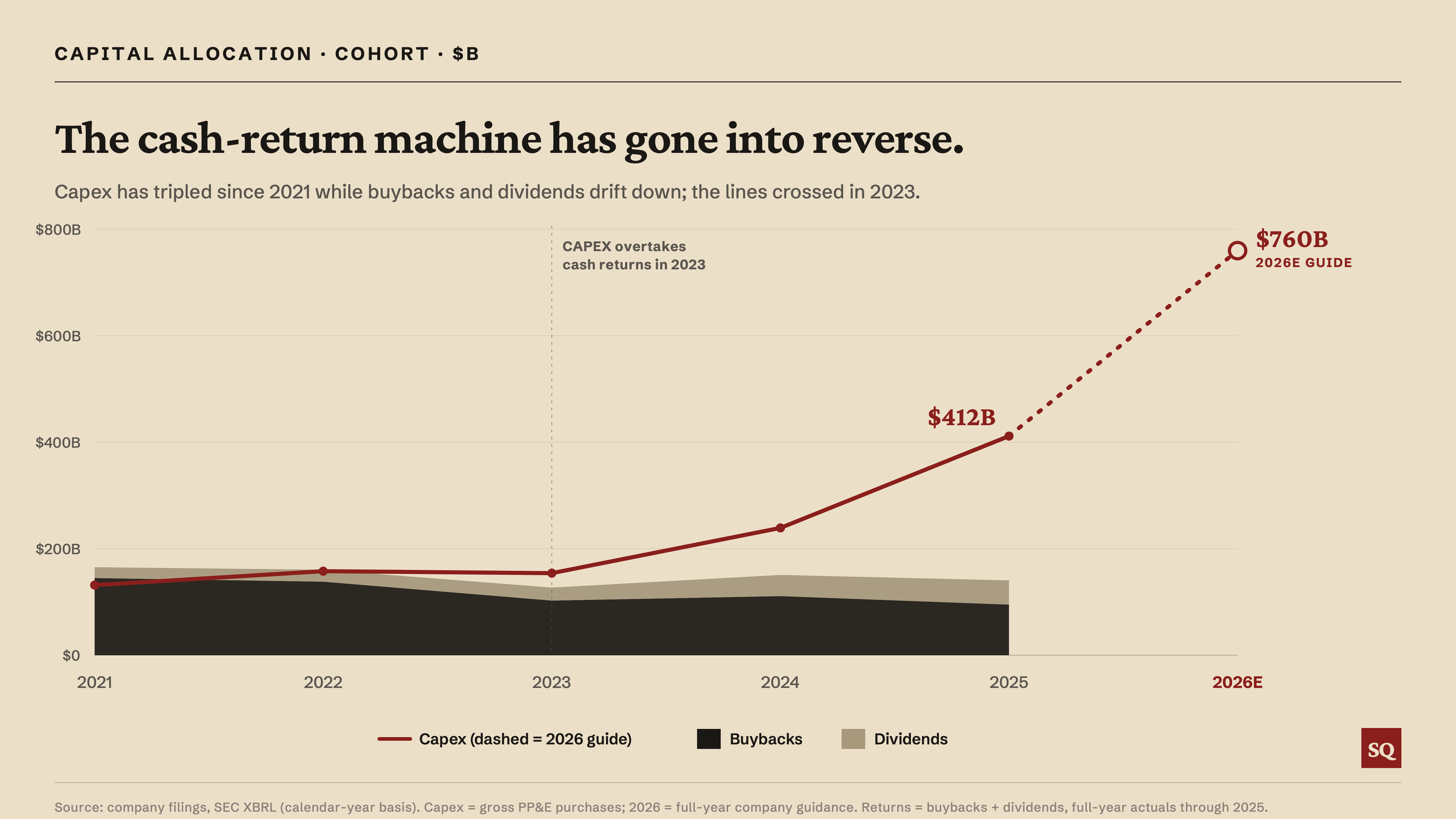
The spending is the first half of the shift, which is widely reported. Combined Capex across the five has increased nearly sixfold in five years ($132bn in 2021 to >$760bn in 2026). Nothing in these companies’ histories (i.e. the original cloud buildout), looks like this. Yet, how they are paying for this has substantially changed as a result of just the sheer size of funding required to build this.
The second half of this is how capital allocation has changed as a result. Share buy-backs (SBB), their main instrument for returning cash, has been switched off across most of the group: Alphabet and Meta both repurchased nothing in the CYQ1’26, Amazon has not bought back in years, and Oracle, who used to have a large SBB programme has dwindled to almost nothing. Only Microsoft is still buying back in size. Cohort SBBs fell from $145bn in 2021 to $95bn in 2025, while dividends, even after Alphabet and Meta initiated them haven’t moved substantially as a proportion of Capex.
Re-investing in growth has always been a priority for these companies, so there has always been an expectation that capex would take priority over returning capital to shareholders. By 2025 every one of them was pouring far more into the buildout than it handed back, close to three dollars of capex for every dollar returned. All of that cash will be poured into land, power and silicon and because their own internal cash flow generation is no longer enough, they have turned to the bond market.
A cohort that barely borrowed is now among the market’s largest issuers
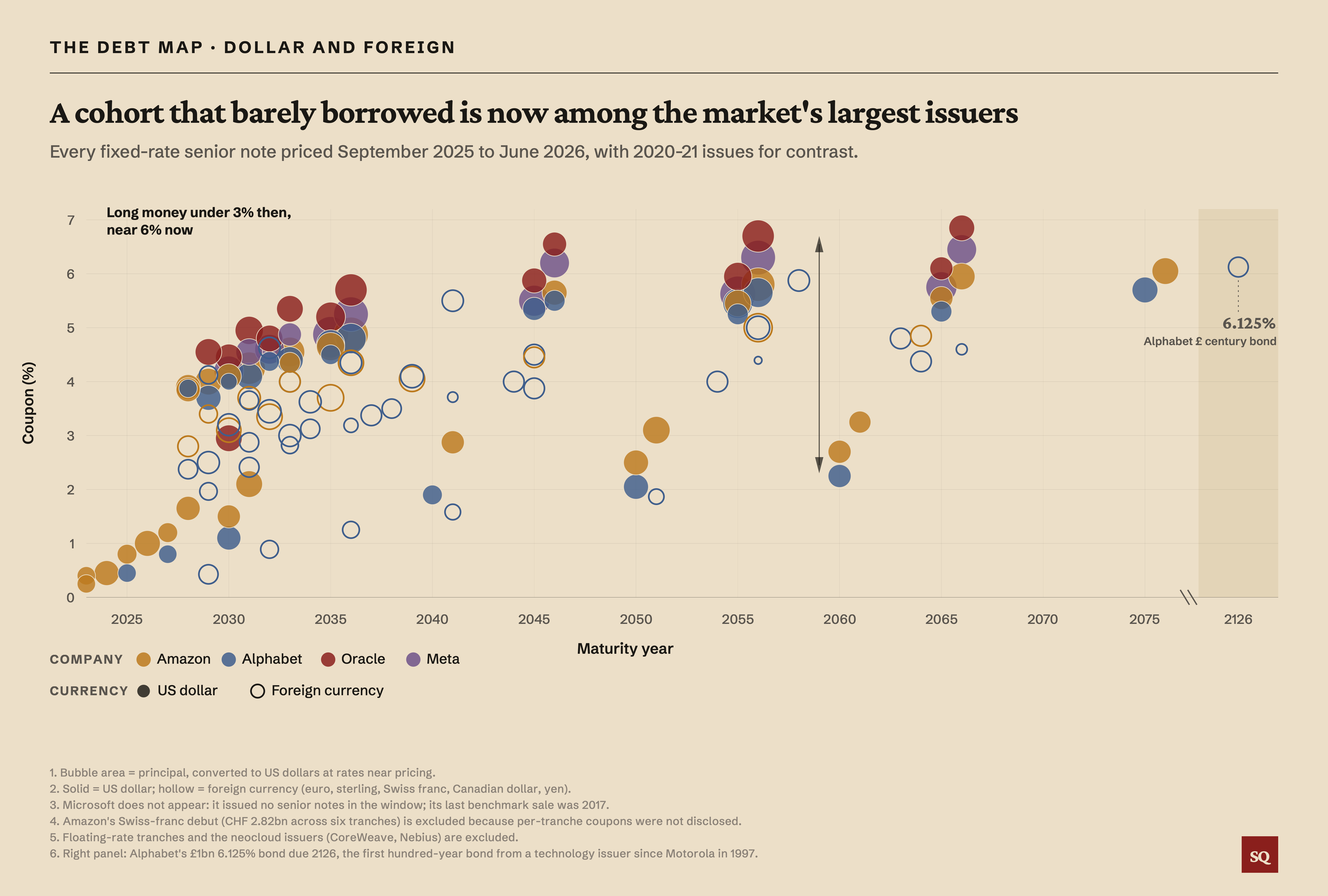
Since the end of 2024 the five have added more than $290bn of bonds and finance leases, and the new bonds are now being issued across multiple different currencies globally. Alphabet alone has issued in all six, dollars, euros, sterling, Swiss francs, Canadian dollars and yen, inside a year, including the technology industry’s first hundred-year bond since Motorola sold one in 1997; Amazon made its own Swiss-franc debut alongside its dollar and euro deals, then sold C$14bn of Canadian paper in June 2026, reported as the largest Canadian-dollar corporate bond on record. Meta and Oracle have stayed in dollars, and Microsoft is the instructive outlier, letting its own bonds run down while taking on finance leases instead.
However, the cost of capital has increased sharply since the low-interest era, and also varies according to how the hyperscalers are choosing to build vehicles to fund the build-out (e.g. on/off balance sheet).
When these companies last borrowed in size, in 2020/21, their long bonds priced under 3% and the shortest well under 1% yet the notes sold in 2026 carry coupons near 6% at the long end. It’s even higher still for Oracle which is roughly double the old long-end cost, stretched across maturities that in Alphabet’s case run all the way to 2126. Meta’s own forty-year money tells the story in miniature: it priced at 5.75% in November 2025 and at 6.45% when Meta returned to the market in April 2026, seven-tenths of a point higher half a year later.
The biggest borrowings are increasingly being kept off the balance sheet
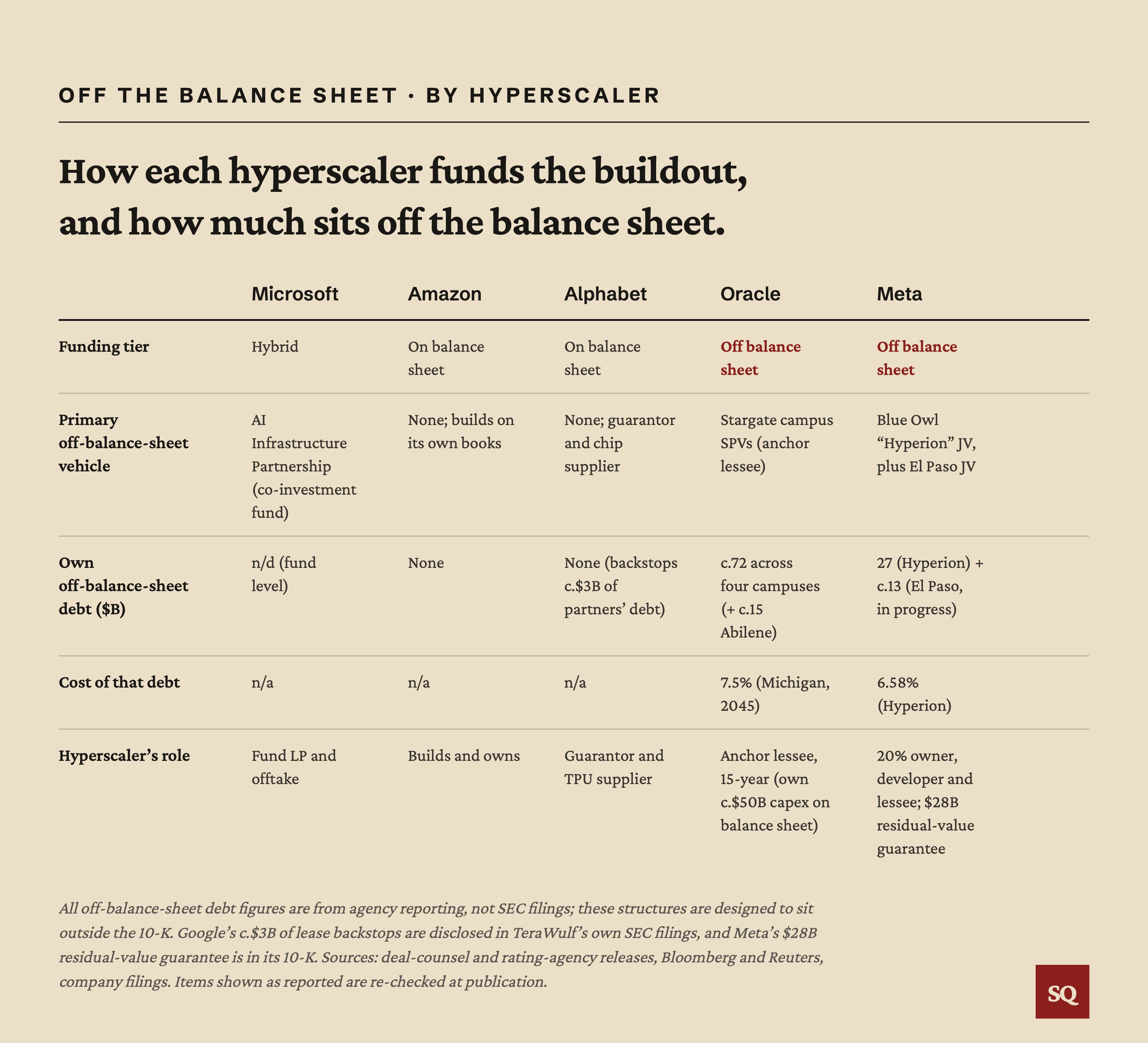
Alongside their own bonds, some of these companies have begun financing infrastructure through a structure that does not show up as debt (on/off balance sheet), and how far each has gone is becoming a real divide in the cohort.
The mechanics in which they choose to fund Capex off balance sheet is consistent: a separate vehicle, usually a joint venture (JV) or special purpose vehicle (SPV), owns or develops the data centre, is capitalised with equity from a consortium of sponsors, and raises the bulk of its funding as debt placed privately with credit funds and insurers. The hyperscaler takes a minority stake, signs a long-term lease or capacity agreement for the finished site, and often provides guarantees. Economically it has committed to years of payments that service a pile of debt, but because it neither owns the vehicle outright nor issues the bonds, almost none of that debt appears on its own accounts.
Meta set the template in October 2025 with a joint venture alongside Blue Owl Capital to build its Hyperion campus in Louisiana, a roughly $30bn project in which the vehicle raised about $27bn of debt, anchored by Pimco, while Meta took a 20% equity stake, agreed to lease the finished site, and provided a residual value guarantee worth around $28bn (reported). Within weeks Meta went on to raise a further $30bn in conventional bonds (with Meta’s bond rating untouched). It has since repeated the structure, assembling a roughly $13bn package, again mostly debt, for a second campus in El Paso in May 2026 (reported), which makes the vehicle its standard answer for new sites rather than a one-off. In early June, days after Alphabet’s equity raise, Meta was reported to be weighing tens of billions in fresh equity as well and if it proceeds, it would be the second of the five to fund the buildout with stock.
Microsoft sits in the middle, and its case is the subtlest. It is not building Meta-style lease-back vehicles. Instead it is an equity sponsor in the AI Infrastructure Partnership it formed in September 2024 with BlackRock and its infrastructure arm Global Infrastructure Partners, alongside the Abu Dhabi state fund MGX, a co-investment fund that aims to mobilise up to $100bn once debt is included and whose first deployment was the $40bn purchase of Aligned Data Centers in October 2025 (reported). That fund’s borrowing is not Microsoft’s, but Microsoft’s offtake helps underwrite it, and the same holds for the neocloud operators it leans on, CoreWeave and IREN among them, which raise debt against their Microsoft contracts.
On its own books Microsoft has actually let its bonds run down while piling on finance leases. Microsoft is avoiding the bond market rather than the obligations, but it does so through leases and partnerships rather than the dedicated lease-back vehicles Meta and Oracle use.
Oracle has gone furthest of all, and it has done so as a tenant rather than an owner. The capacity it has promised the Stargate venture, announced in January 2025 with SoftBank, OpenAI and MGX, is being built by outside developers who finance each campus through its own special purpose vehicle and then lease it to Oracle on long contracts. The reported debt across these vehicles now runs to roughly $72bn, spread over campuses in Michigan, Texas, Wisconsin and New Mexico, with the Abilene flagship adding perhaps $15bn more.
The Michigan deal is an example of how costly it can be for a company in Oracle’s shoes: $14bn of bonds, anchored by Pimco after US banks stepped back, priced at 7.5% and maturing in 2045, a rate well wide of anything Oracle pays in its own name (reported). None of this debt is Oracle’s and stays off its own financial statements.
Its own builds sit on its $135bn of on balance sheet borrowing but the leased campuses, and the years of payments that service their debt, do not.
Amazon and Alphabet sit at the other end. Amazon is building its largest AI clusters itself, on its own balance sheet (its Project Rainier cluster for Anthropic ramped up through 2025), and holds its Anthropic relationship as an equity stake and a multi-year cloud commitment rather than a financing vehicle.
Alphabet funds its own buildout through its bonds and, in June 2026, a large equity raise as well; where it touches private credit it does so at the edges, as a guarantor backstopping about $3bn of a partner’s data centre leases, the TeraWulf arrangements of 2025 disclosed in that company’s own filings, and as the chip supplier to a roughly $35bn deal, reported to have closed in early June 2026, that lets Anthropic lease Google’s own TPUs and neither of these deals puts borrowing on Google’s books.
As we can see, the cohort’s way of fundraising isn’t black and white, but more like a spectrum: Oracle and Meta at the off balance sheet end, Amazon and Alphabet at the on balance sheet end, and Microsoft in between.
Keeping the debt off the books is not free. For the private credit deals that Meta and Oracle are doing, they are, to no surprise, more expensive than if they were to raise debt for themselves for ‘general corporate’ purposes. The price for these deals is typically a percentage point (Meta’s JV borrowed at 6.58% in October 2025 against Meta’s own thirty/forty-year bonds near 5.7%, and Oracle’s Stargate financing came at 7.5% against its own long bonds, which had themselves repriced into the high sixes by early 2026).
Part of that is a private-credit markup and part is that the borrower is a weaker, project-level vehicle rather than the parent. A percentage point is not a doubling, but these are investment-grade companies choosing to pay up so the debt lands on someone else’s balance sheet rather than their own.
What they actually owe, and what covers it
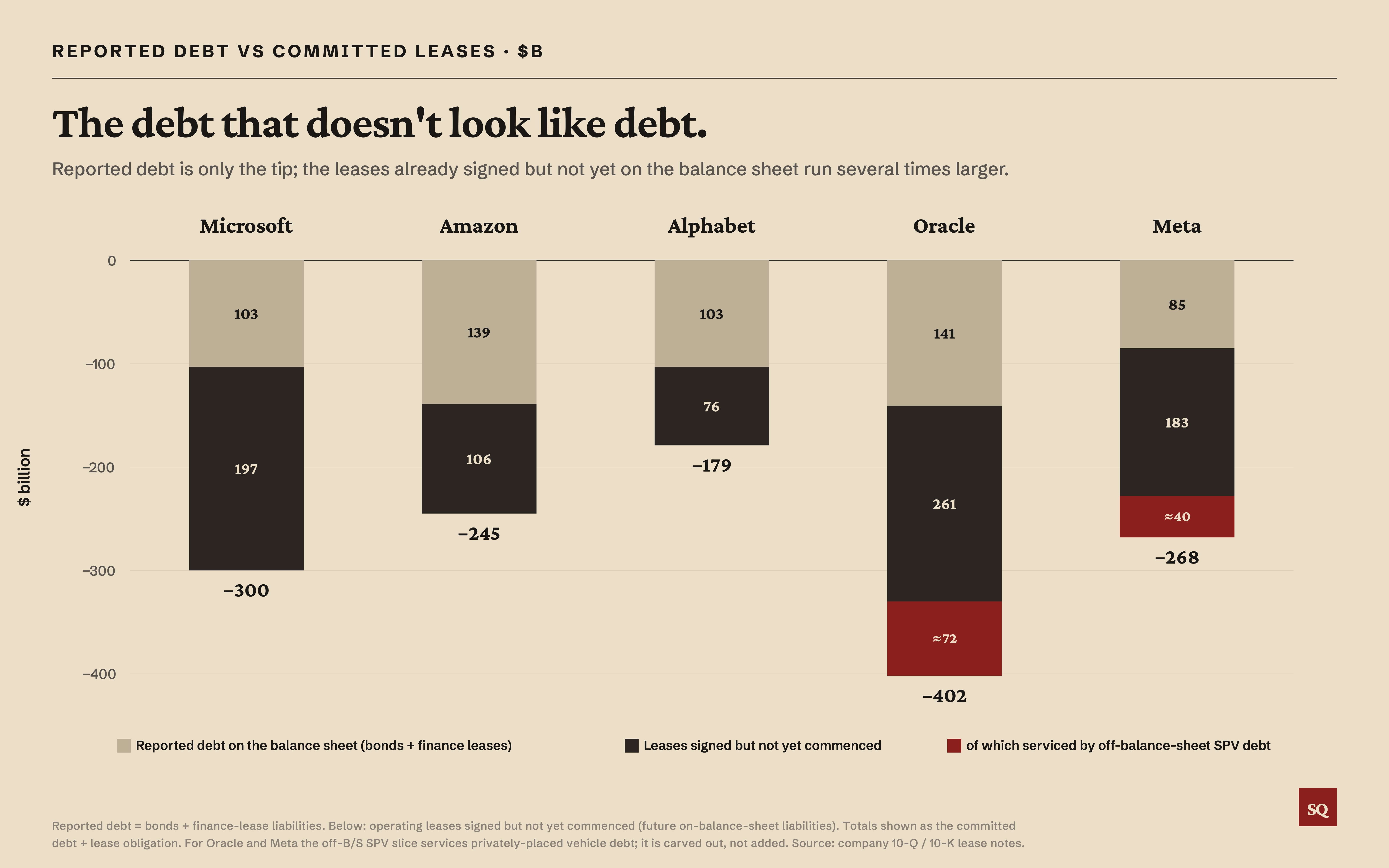
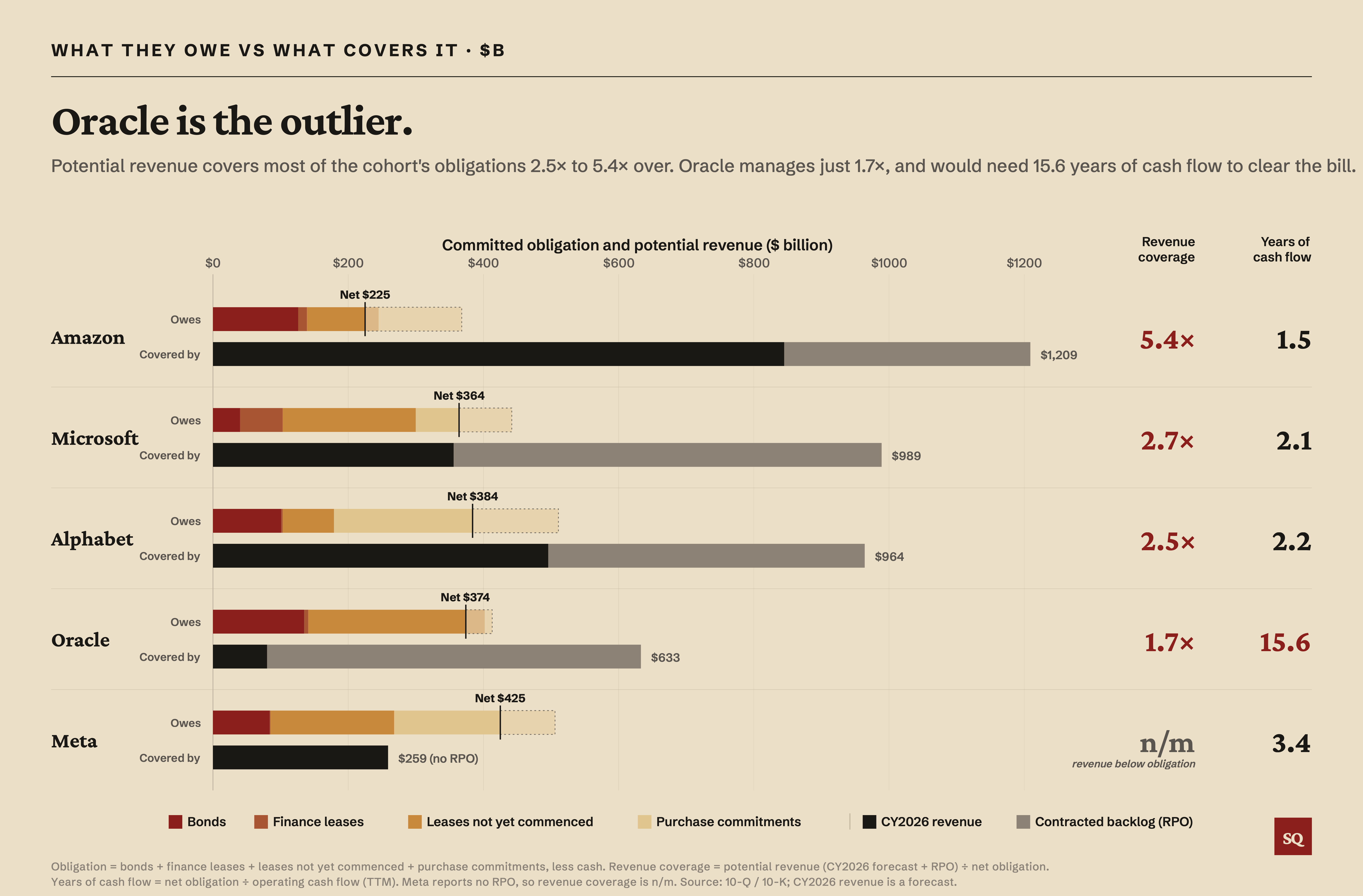
What we need to consider at this stage, is adjusting debt metrics to include the obligation the hyperscalers have for all of their off-balance sheet investments and consider how long these obligations last for. Across the group, the not-yet-commenced leases alone come to more than $800bn, and at Microsoft they more than doubled in nine months.
This isn’t alarming by any means, as these deals are done on the basis of a contracted backlog of future revenues or RPOs (Remaining Performance Obligations) that the clients of the data centres are expected to pay.
The exception is Oracle. Its revenue is $67bn a year, a fraction of its peers', yet it has the largest backlog in the group, $638bn. Measured against everything it owes, its cover is the thinnest of the five and there’s customer concentration as nearly half of that backlog reportedly comes from one customer, OpenAI, on a contract reported at $300bn.
Meta is the company the backlog frame does not fit. Alone among the five it does not rent capacity to outside customers, so it reports no backlog at all; it builds for its own apps and advertising, a business that earns more than $200bn a year, and that, rather than a contracted book, is what stands behind its obligation. At its May shareholder meeting Mark Zuckerberg said entering the cloud market was “definitely on the table” if Meta found itself with spare capacity, which would in time give it a backlog of its own.
So the reported balance sheet understates what these companies owe, in places several times over, and the difference is real obligation that has simply not surfaced yet. What keeps that from being a solvency question is the cover behind it, of two kinds: the revenue they have contracted, and the cash flow they already generate. On both measures only Oracle is short.
Conclusion
None of this stays off the books forever. As each data centre comes online, the lease behind it turns into reported debt, and the guarantees turn into real costs if the assets end up worth less than promised. The official measures, though, take years to catch up. S&P, for example, will not count Meta’s joint venture in Meta’s leverage until the leases start in 2029, and only then adds those lease payments to its debt. But the obligation is real today, not in 2029. The risk sits in the years in between, when the company is already on the hook for lease payments that rank ahead of its shareholders, but its reported leverage and credit rating still don’t show them.
Duration mismatch is also part of this equation too with borrowing lengths at 30/40 years and extending up to 100 years, whilst the silicon it’s all funding is being written off on a 5 or 6 year period. So the borrowing will still be outstanding long after the chips it paid for have been retired and replaced. This isn’t uncommon, but notable given that technology moves at such a fast pace.
For now, the funding mix is a more honest account of where each company stands than its earnings release.
If you read this as a shareholder then the question is whether the revenue contracted against the buildout actually arrives, because the claim on residual profits now sits behind a deep and growing stack of senior and quasi-senior commitments, and, at Alphabet, has just been spread thinner by a fresh issue of stock.
If you read it as a creditor the question changes: these companies are now wired into the private-credit and insurance markets through vehicles and guarantees that their own ratings only partly capture. Apollo’s Marc Rowan, among the largest providers of that credit, puts it this way: the hyperscalers “are lending their credit in the form of guarantees and in the form of leases.”
The borrower with the thinnest cover, Oracle, is the one whose obligations lean hardest on a single customer. Its own bondholders have already taken that gap to court, in a suit filed in January 2026 alleging that Oracle’s September bond prospectus called further borrowing something it “may” do when the next $38bn was already being lined up. The debt that does not look like debt is still debt. It has only not arrived yet.
Appendix
Figures are in $bn and rounded to the nearest billion unless shown otherwise, so rows and columns may not foot exactly. "(reported)" marks a figure drawn from press, agency, deal-counsel or rating-agency sources rather than an SEC filing, because the structure sits outside the parent's 10-K.
A1. Capital expenditure and committed obligations
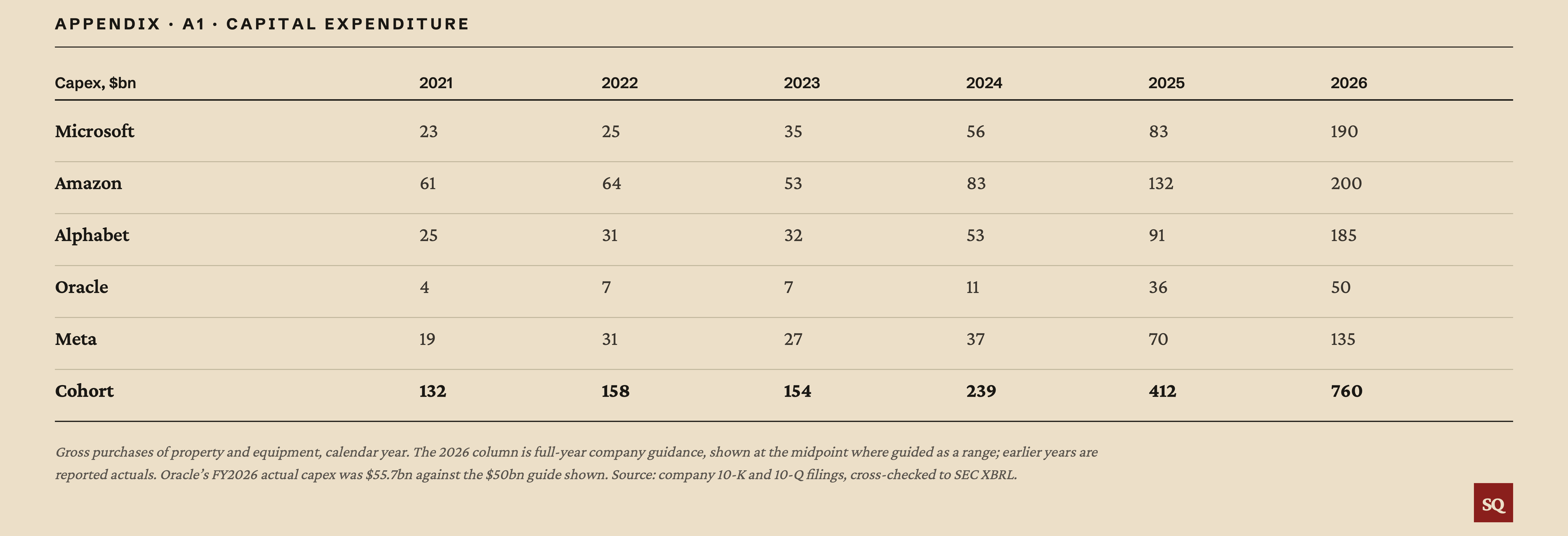
The cohort is the five US hyperscalers driving the build: Microsoft, Amazon, Alphabet, Oracle and Meta. Two figures frame everything that follows: what each spends, and what each has committed to.
Capital expenditure, gross purchases of property and equipment, calendar year. The 2026 column is full-year company guidance; all others are reported actuals. Oracle’s FY2026 ended on 31 May 2026, just before publication: its actual capital expenditure was $55.7bn against the $50bn guide shown. For FY2027 it guides to around $70bn of capex net of customer prepayments and supplier financing, a measure it introduced with these results, or $90bn to $95bn as reported; its CY2026 spending will therefore run above the guide-basis figure shown.
Total committed obligation, net of cash, as of 31 March 2026 (28 February 2026 for Oracle, reflecting its fiscal year):

These are different in kind: the first is annual spending, the second a stock of commitments at a point in time, so they cannot be added together. The build behind the second is set out in A5.
A2. The capital-allocation reversal
Against that capex, the cash the cohort returned to shareholders, through buybacks and dividends, has gone into reverse. Cohort totals, calendar year:
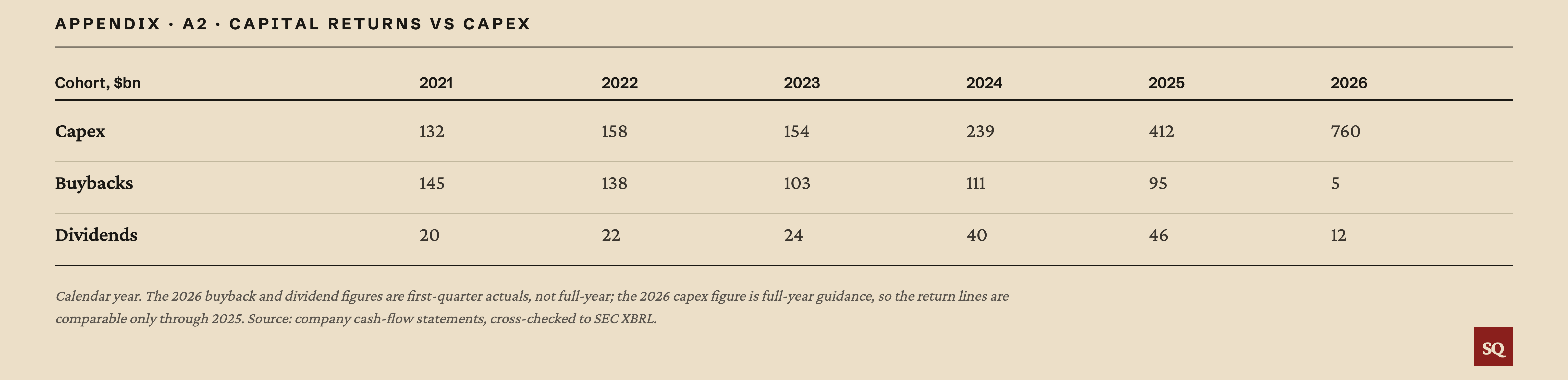
The 2026 buyback and dividend figures are first-quarter actuals, not full-year, because none of the five guides its capital returns; the 2026 capex figure, by contrast, is full-year guidance. The cross-year comparison on the return lines should therefore stop at 2025. Buybacks in particular run off board authorisations, which set a ceiling but commit nothing: Amazon’s $10bn authorisation still had $6.1bn unused at 31 March 2026.
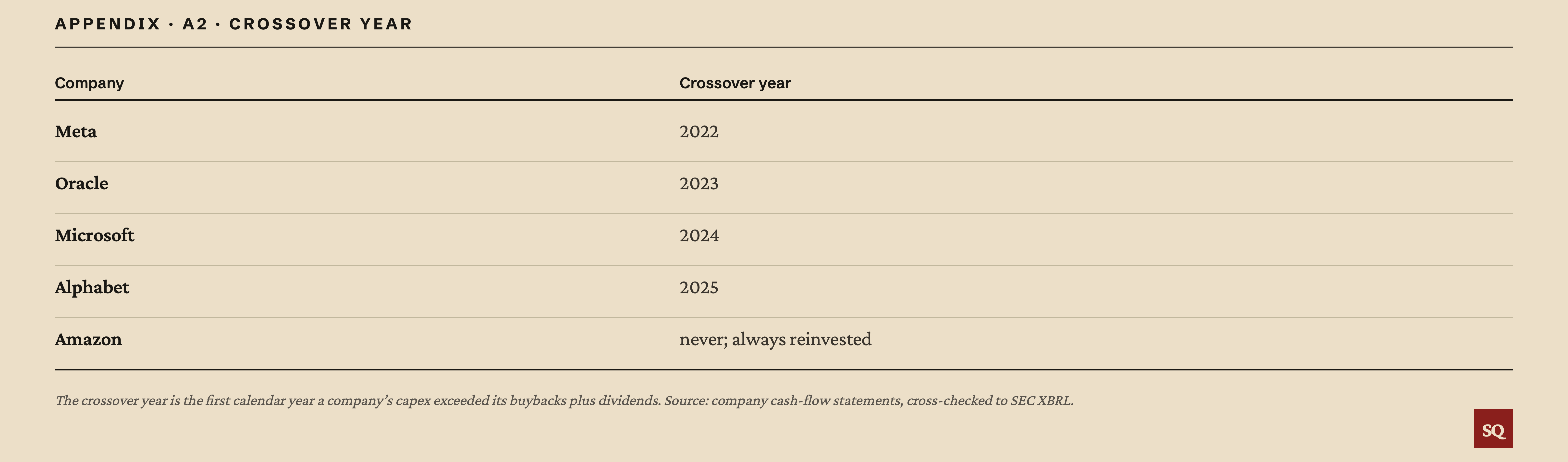
The reversal is staggered. The crossover year is the first in which a company’s capex exceeded its buybacks plus dividends:
In June 2026 Alphabet went past merely halting returns and raised equity, the first of the five to fund the buildout that way and its own first equity sale in more than two decades. The headline figure, $84.75bn, flatters the cash actually raised: it was struck before the underwriters’ over-allotment options were exercised and counts $40bn of at-the-market capacity that Alphabet expects to use mainly to cover the tax on vesting employee shares, about $30bn of it in 2026.
The new money raised in early June came to about $50bn: roughly $20.7bn of Class A and Class C common stock, a $19.25bn 6.25% mandatory convertible preferred, and a $10bn private placement to Berkshire Hathaway, for general corporate purposes including AI compute.
Oracle reached for equity earlier and more quietly, with a $5bn mandatory convertible in February 2026; with its fourth-quarter results on 10 June it went further, guiding to approximately $40bn of debt and equity in FY2027, including its full $20bn at-the-market equity programme, and no further debt in CY2026. Meta is reported to be weighing a raise of its own; Microsoft and Amazon have not. There is a pattern in the instrument, too. Each leaned on the same vehicle: cash now, a fixed coupon in the meantime (6.25% at Alphabet, 6.5% at Oracle), a claim ranking ahead of the common, and the new shares deferred until 2029, a structure the rating agencies treat largely as equity from day one.
Alphabet alone wrapped its issue in privately negotiated capped calls that curb the eventual dilution up to a share price about 50% above where the stock was sold, the sort of hedge usually attached to convertible bonds. Even the equity, then, has been engineered to behave, for its first three years, like debt.
What the two convertibles cost, and what their conversion would dilute:
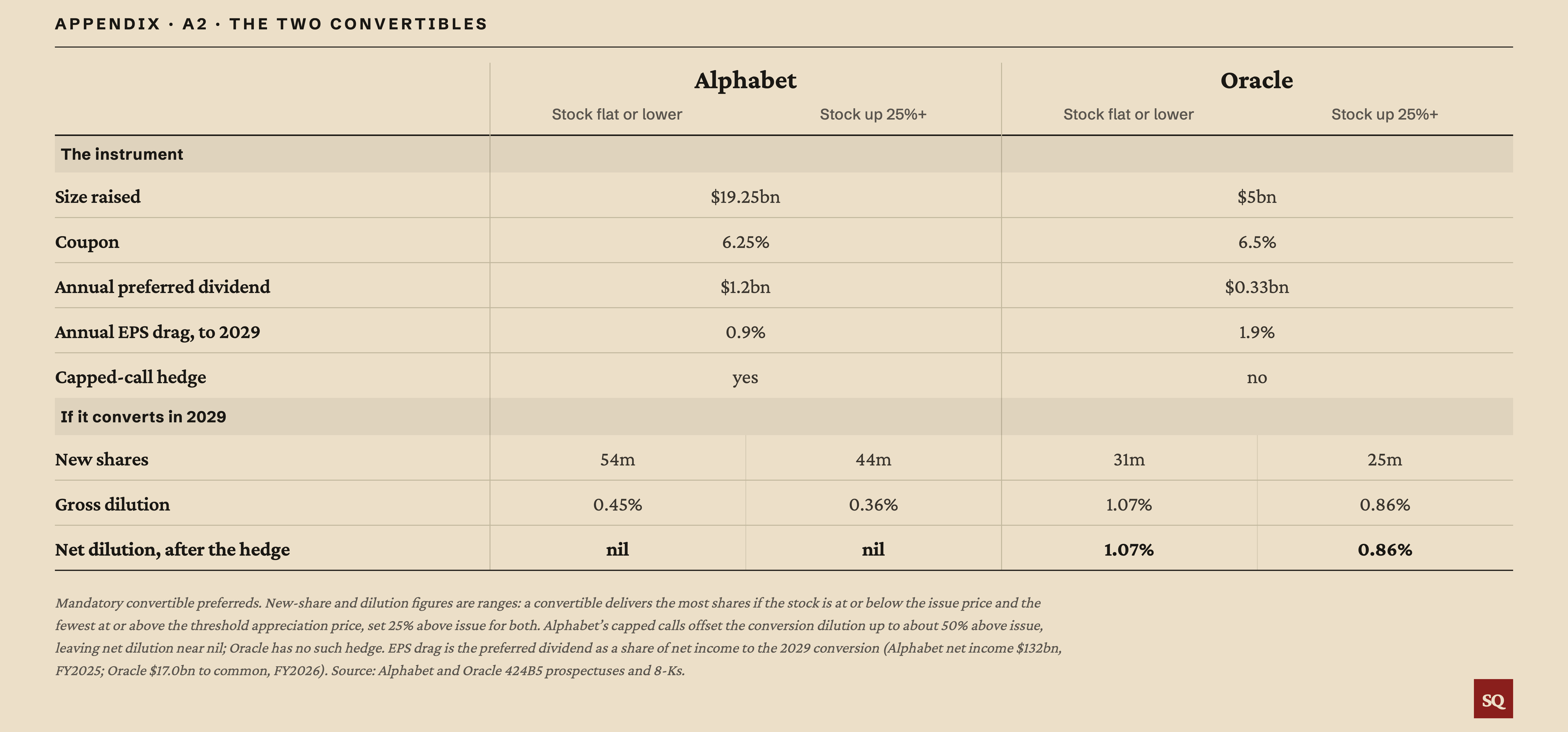
A mandatory convertible delivers the most shares when the stock is at or below the issue price and the fewest at or above the threshold appreciation price, set 25% above issue for both, so the share and dilution figures are shown as ranges. Alphabet's capped calls offset the conversion dilution up to a share price about 50% above issue, leaving its net dilution near nil in any realistic case; Oracle has no such hedge, so its net equals its gross. The annual EPS drag is the preferred dividend measured against net income, a charge borne every year until the 2029 conversion. Source: Alphabet and Oracle 8-K and 424B5 filings; net income from the companies' 2025 and FY2026 results (Alphabet $132bn; Oracle $17.0bn to common); Meta per Financial Times reporting, 5 June 2026.
A3. The bond-issuance dataset
The debt map plots the fixed-rate senior notes the cohort issued from September 2025 to June 2026, by maturity, coupon, principal and currency, with the 2020-21 issuance shown for contrast. Six currencies appear: US dollar, euro, sterling, Swiss franc, Canadian dollar and yen.
The standout instrument is the first hundred-year bond from a technology issuer since Motorola in 1997:

One reported deal is not disclosed at tranche level, so it is noted but not plotted in full: Amazon’s debut Swiss-franc issue (CHF 2.82bn across six tranches, per-tranche coupons undisclosed). Alphabet’s yen deal is SEC-registered and fully disclosed: ¥576.5bn across seven tranches, coupons from 1.965% to 4.599% (three to forty year). Floating-rate tranches and the neocloud issuers, CoreWeave and Nebius, are excluded. Microsoft does not appear: it issued no senior notes in the window, its last benchmark sale having been in 2017.
A4. The off-balance-sheet vehicles
Every figure here is reported, not filed, with two exceptions noted below: the structures are built to sit outside the parent’s 10-K, so each number comes from a counterparty’s disclosure rather than the issuer’s.
Oracle finances the Stargate campuses it leases through special purpose vehicles, about $72bn of debt across four of them:
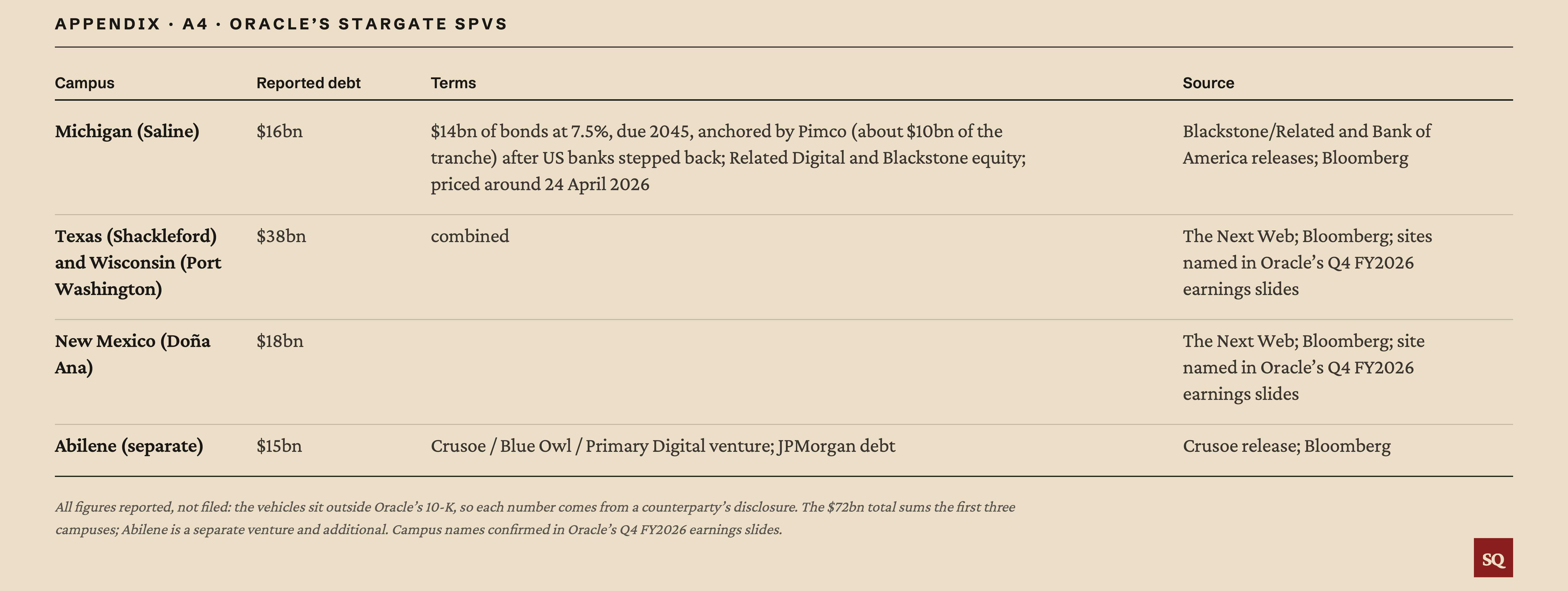
The $72bn sums the first three; the Abilene flagship is a separate venture and is additional. Because the figures are struck on different dates by different sources, the total is indicative rather than exact.
Meta uses two vehicles, about $40bn in all. The Hyperion campus in Louisiana carries about $27bn of debt at 6.58% (rated A+), with Meta holding 20% and providing a roughly $28bn residual-value guarantee, the one item here disclosed in Meta’s own 10-K. The El Paso vehicle, about $13bn that Meta tapped Morgan Stanley and JPMorgan to arrange, was reported in early May 2026 and is still being put together. The Hyperion guarantee, at $28bn, is larger than the $27bn of debt it backstops, so Meta’s contingent exposure there exceeds the debt itself. Source: S&P research update, 21 October 2025 (Hyperion); Reuters and Bloomberg (El Paso).
Microsoft is the sponsor of the AI Infrastructure Partnership, formed in September 2024 with BlackRock, Global Infrastructure Partners and MGX. It targets up to $100bn of capacity once debt is included, a ceiling rather than committed capital; its one deployment so far is the $40bn purchase of Aligned Data Centers in October 2025. Source: partner releases; Bloomberg.
Alphabet touches private credit only at the edges. It provides about $3bn of lease backstops for TeraWulf, disclosed in TeraWulf’s own SEC 8-Ks, the second filed item. And it is the chip supplier to a roughly $35bn private-credit financing from Apollo and Blackstone that buys Google TPUs for Anthropic to lease, surfaced on 28 May 2026 and reported to have closed in early June; as a lease financing it would not appear as Alphabet debt even once funded. Source: TeraWulf 8-Ks; Bloomberg and Reuters.
A5. The committed-obligation and coverage build
The total obligation in A1 is built from four layers, net of cash, as of Q1 2026:
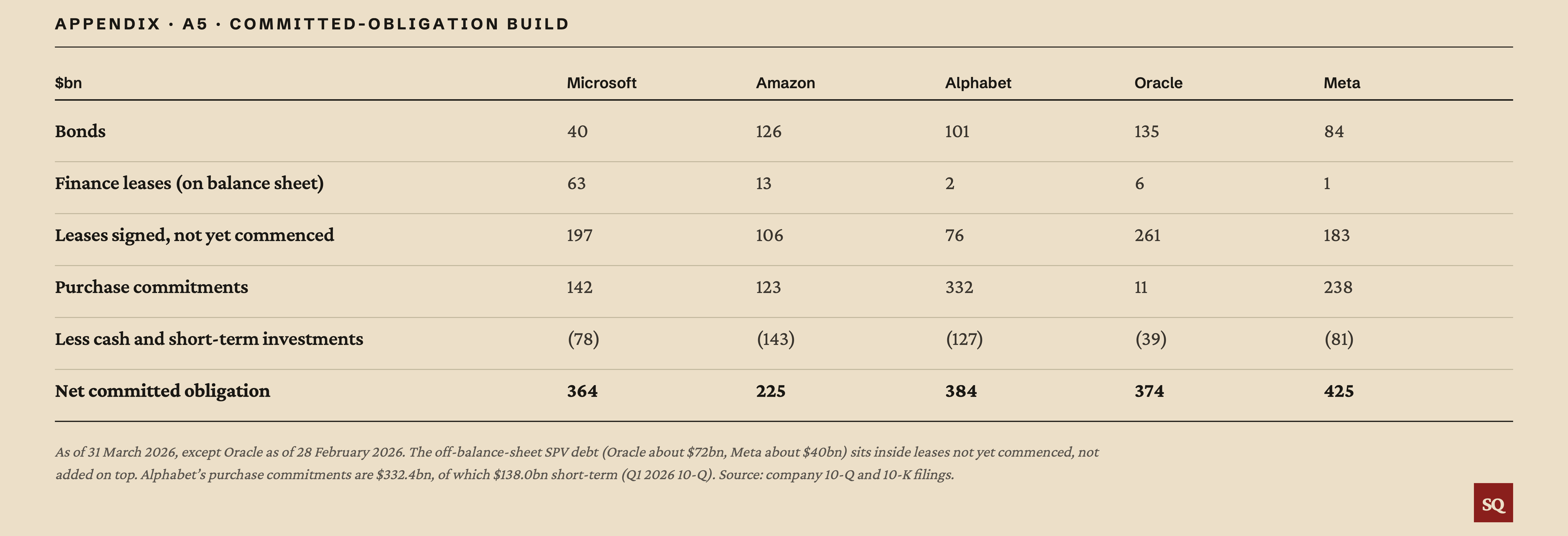
The leases-not-yet-commenced line totals about $822bn across the five. One memo adjustment avoids a double count: the off-balance-sheet SPV debt from A4 (Oracle about $72bn, Meta about $40bn) sits inside this line, not on top of it, because the lease payments are what service that debt. Alphabet’s purchase commitments are the one cleanly disclosed component: $332.4bn, of which $138.0bn is short-term (Q1 2026 10-Q).
Two coverage measures sit beside the obligation, and they answer different questions. Revenue coverage tests whether contracted demand stands behind the spend; cash-flow coverage tests whether the company can fund it from operations.
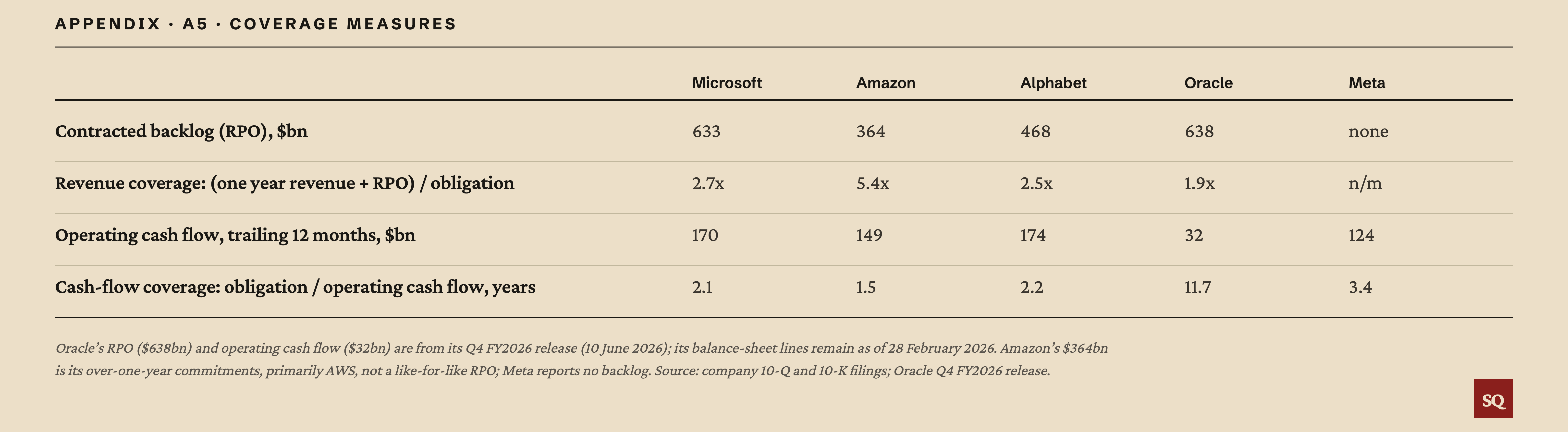
Amazon does not report remaining performance obligations on the same basis as the others: its $364bn is the company's contractual commitments with original terms over one year, which it attributes primarily to AWS, rather than a like-for-like total backlog. Revenue coverage is not meaningful for Meta, which reports no backlog. Oracle is the outlier on both measures, and its free cash flow is negative, so even its 11.7-year cash-flow figure overstates the cash actually available once capex is taken out.
A6. The cost premium
The premium is measured like-for-like: each off-balance-sheet deal's coupon against the same parent's own long-dated bonds priced at about the same time, not against its blended cost of debt.
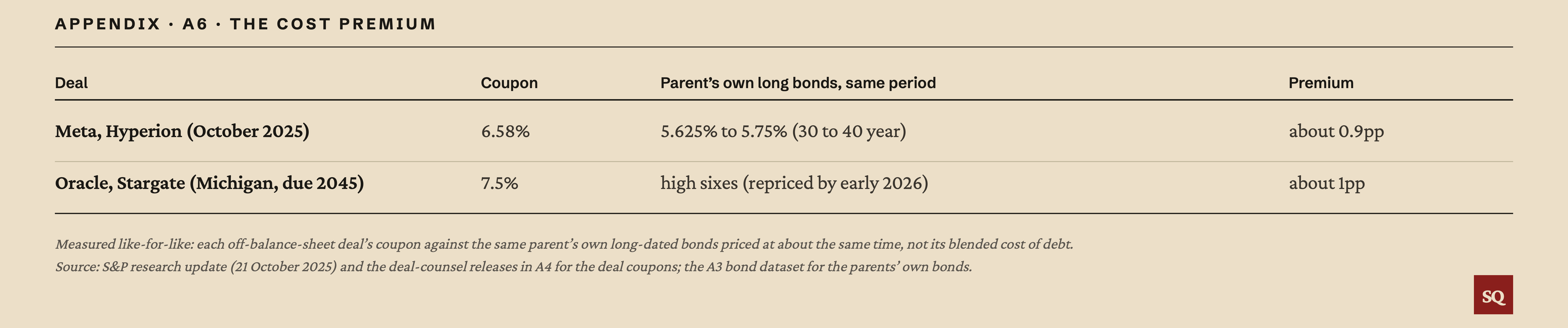
Measured instead against a blended cost of debt, say about 4% for Oracle against 7.5%, the comparison mixes short-dated averages with long-dated issuance and overstates the gap to roughly a doubling; it is not used here. The like-for-like premium is itself a floor, because the coupon captures the priced spread but not the value of the structural features described in A4.
A7. Conventions
Period basis. Balance-sheet figures are as of 31 March 2026, except Oracle’s, which are as of 28 February 2026, the last quarter it had filed before publication; Oracle’s RPO, revenue and operating cash flow are from its fourth-quarter release for the year ended 31 May 2026, published on 10 June 2026. Capital expenditure and shareholder returns are stated on a calendar-year basis; for Microsoft and Oracle, whose fiscal years end mid-calendar, the calendar figures are built from quarterly data.
Guidance basis. The 2026 capex figure is full-year company guidance, shown at the midpoint where the company guides a range: Alphabet’s $180bn to $190bn appears as $185bn, Meta’s $125bn to $145bn as $135bn. The 2026 buyback and dividend figures are first-quarter actuals, because none of the five issues capital-return guidance. CY2026 revenue is a forecast; Oracle’s, about $80bn, blends its FY2026 actual ($67.4bn) and its FY2027 guidance ($90bn, reaffirmed on 10 June 2026).
Currency. Non-dollar bond principals are converted to US dollars at rates near pricing and are not marked to current spot.
Reported versus filed. Figures marked “(reported)” were re-checked against the latest reporting before publication, and any deal still being arranged rather than closed is flagged as such. All filing-based figures are taken from the companies’ filings on SEC EDGAR.