
TLDR
Assassin’s Creed, Far Cry and Rainbow Six are now operated by Vantage under licence, Tencent paid €1.16bn for a quarter of it, and every euro of Ubisoft’s debt sits outside with the listed parent.
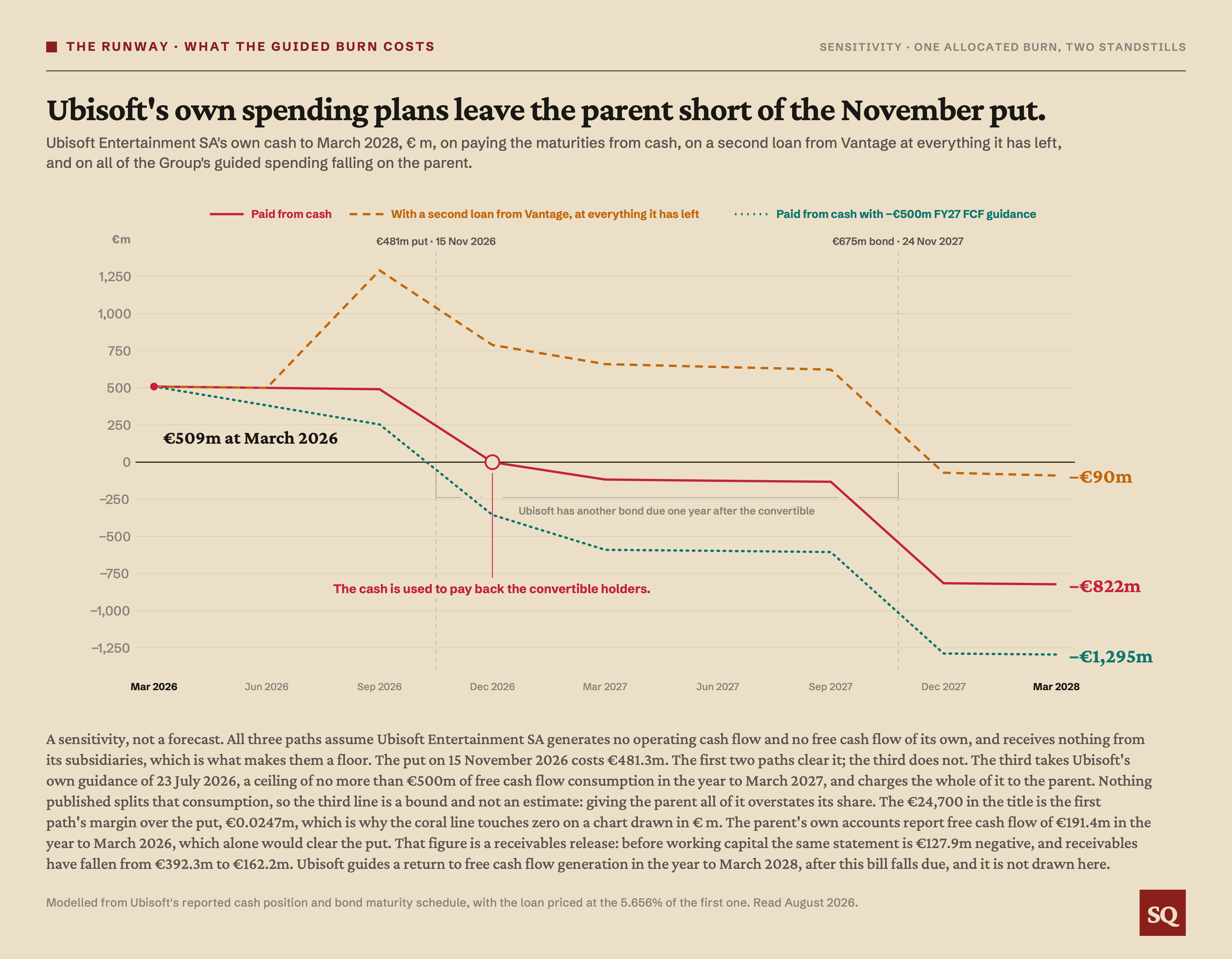
The parent holds enough to meet the €481m its convertible holders can hand back in November, and it has to fund a year in which Ubisoft guides to no more than €500m of cash consumption out of the same account.
There are six ways through, and each costs cash, future earnings, ownership or control. Selling everything outside Vantage would have to cover both bond bills out of assets the market prices below zero, a rights issue at either size we model would not clear them, and refinancing adds €75m a year to the interest even on the generous assumption.
At €5 a share the market pays about 38 cents in the euro for what stands behind the debt, and almost every instrument Tencent holds points at more of Vantage.
It’s been a few years since I covered Ubisoft as an equity analyst, and a lot has changed since then. Discussions on the shares have always ended up at opposite ends of the spectrum, either as a major bull or a major bear.
Hence, I believe it is worth walking through (1) the financial structure of Ubisoft (2) what the share price implies today (3) the immediate question of the options Ubisoft has to pay down their bond due in November and (4) what can change the story.
The financial structuring of Ubisoft
2015 - 18: Ubisoft successfully fends off a hostile takeover from Vivendi
This story begins back in October 2015, when Vivendi crossed the 5% threshold of ownership of Ubisoft, spending the next two years, increasing their stake to 27%, but never filing an offer for the company. Given that Vivendi succeeded in a hostile takeover for Gameloft, the other video games company the brothers founded, in nine months, there was a market perception that the same fate could occur at Ubisoft.
The Guillemot family, who founded Ubisoft, answered by buying shares, most of them financed through prepaid forwards with J.P. Morgan and Crédit Agricole. Those contracts pay the cash up front against shares handed over years later, so the votes stayed on the register in the family's name while the economics went to the banks. So the family’s votes ran ahead of the capital underneath them, which was the same strategy they took with Gameloft when defending themselves against Vivendi. The family concert, which is the wider group, held 12.4% of the capital and 18.9% of the votes at March 2026. One of the two contracts settled in March 2026 and the other was extended again in May, running to April 2027, so the gap has been closing.
The hostile takeover for Ubisoft never came and Vivendi sold its stake at €66 in March 2018, which they originally acquired for €26/share (assuming an average cost), netting a 2.5x profit of €1.2bn. As part of the Vivendi stake being sold, Tencent acquired 5% of the shares of Ubisoft from them, and agreed not to go above 5% for five years. Given that Tencent operated in the large video gaming market of China, companies were looking for ways to expand into this region with local partners and to grow their franchises across platforms such as mobile, where Tencent has considerable expertise in. Tencent also has a history of taking minority stakes in Western games companies.
2018 - Now: Ubisoft and Tencent becomes closer
Over time, the relationship between these two companies has become closer, with Tencent investing in the family company behind Ubisoft, Guillemot Brothers Ltd in September 2022. This put to bed the speculation of an acquisition of Ubisoft by Tencent with shares falling 17% the next day as this topic was of substantial market debate at the time. As part of this agreement:
Tencent takes its exposure from 4.45% to about 11% of the register on the day, or nearer 8% of the economics, because Ubisoft’s own release valued only the 8m shares Guillemot Brothers owned outright and excluded the 9.1m held through bank contracts, and swaps its 5% ceiling for one at 9.99%, which it fills within four months of signing.
The Guillemot family sells half the money in its stake to keep all of the votes, and takes €300m for it, two thirds going to the brothers personally rather than into the vehicle. An eight-year loan at 1% clears £112m of margin-called bank debt, and the board is reserved to family nominees in the articles.
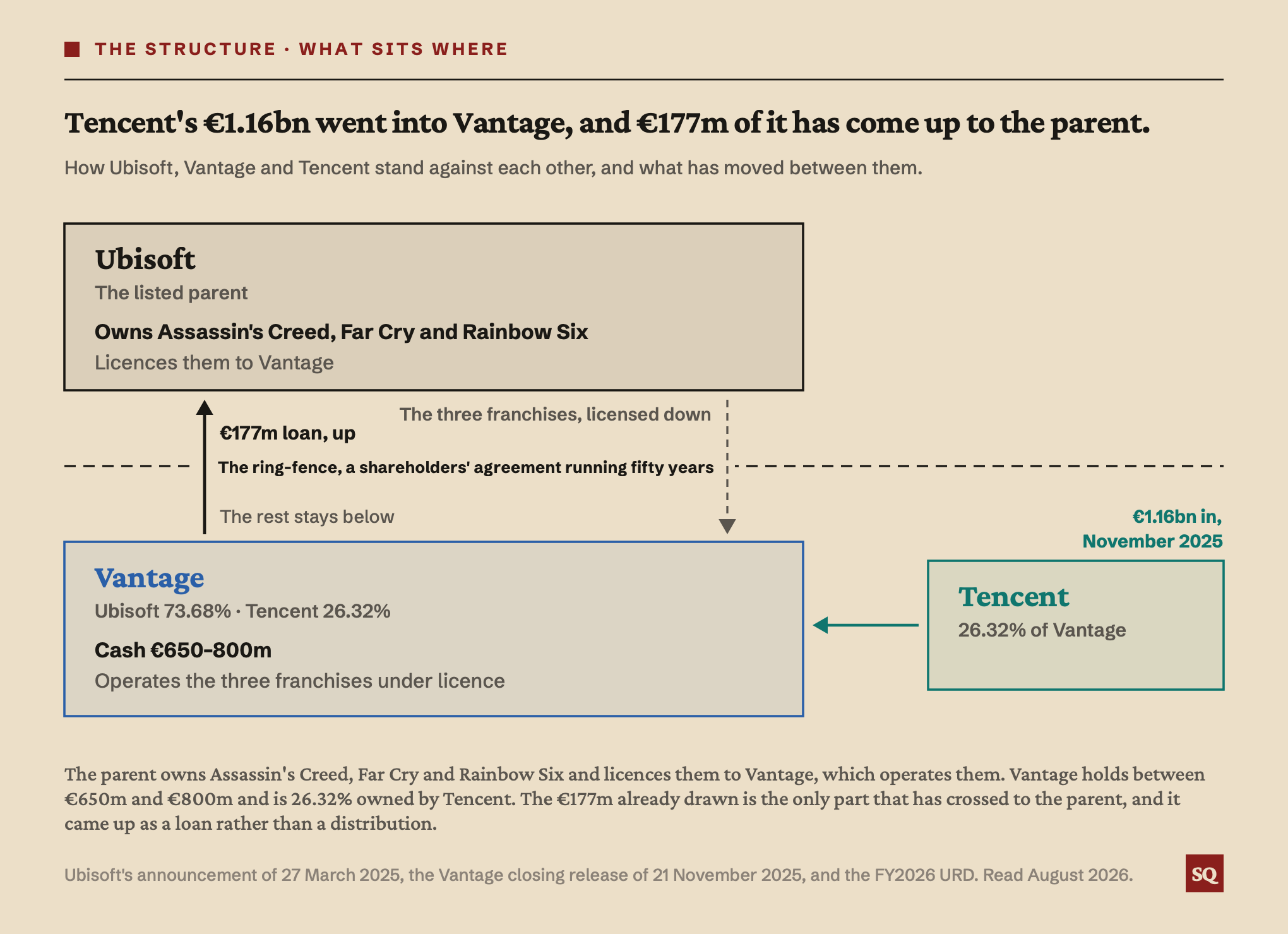
Fast forwarding again, and in September 2024 Ubisoft cut its guidance to around break-even EBIT, delaying Assassin’s Creed Shadows and conceding that Star Wars Outlaws had sold softly. In the same release the company announced a review of its execution. By March 2025, Ubisoft announced the outcome, with Tencent investing €1.16bn for a 26.32% share in a new entity, called Vantage which licenses the crown jewels (Assassin’s Creed, Far Cry, Rainbow Six) from the parent company of Ubisoft into perpetuity with the agreement in place for 50 years. The highlights of the agreement are:
Tencent receives:
A share in the biggest franchises that Ubisoft make (AC, FC and R6), which are licensed down from the parent company of Ubisoft into Vantage.
An option over the film, TV and theme-park rights to these three franchises that belongs to Vantage Studios, which Ubisoft controls, and which Tencent may exercise on Vantage's behalf. The price is the higher of what Ubisoft has spent running them since closing and €1, in thirty-day windows at the fourth, fifth and sixth anniversaries.
Consent over the €1.16bn of cash that sits in Vantage, which cannot be used by the Ubisoft parent company without their permission.
Structural seniority (i.e. above common equity holders), which comes from owning shares in a subsidiary rather than from anything the agreement grants, so in the case of insolvency for the parent company of Ubisoft, Vantage remains suitably capitalised. Tencent would also have the first right to acquire the remaining 73.68%.
Ubisoft receives:
An immediate cash injection of a €177m loan (at 5.656% interest) from the money Tencent put into the Vantage vehicle which was used to re-finance bank and borrowings that were due, and crucially, removing any covenant-bearing debt that Ubisoft had as they had re-stated their financial accounts which had meant that the company wouldn’t have passed their covenant ratios test.
Majority control over Vantage, which is consistent with how they have acted in the past that they wish to maintain control over Ubisoft.
A clear price that ‘values’ Vantage at €3.8bn, which allows Ubisoft to show to stakeholders that the company has intrinsic value higher than what the market is currently pricing.
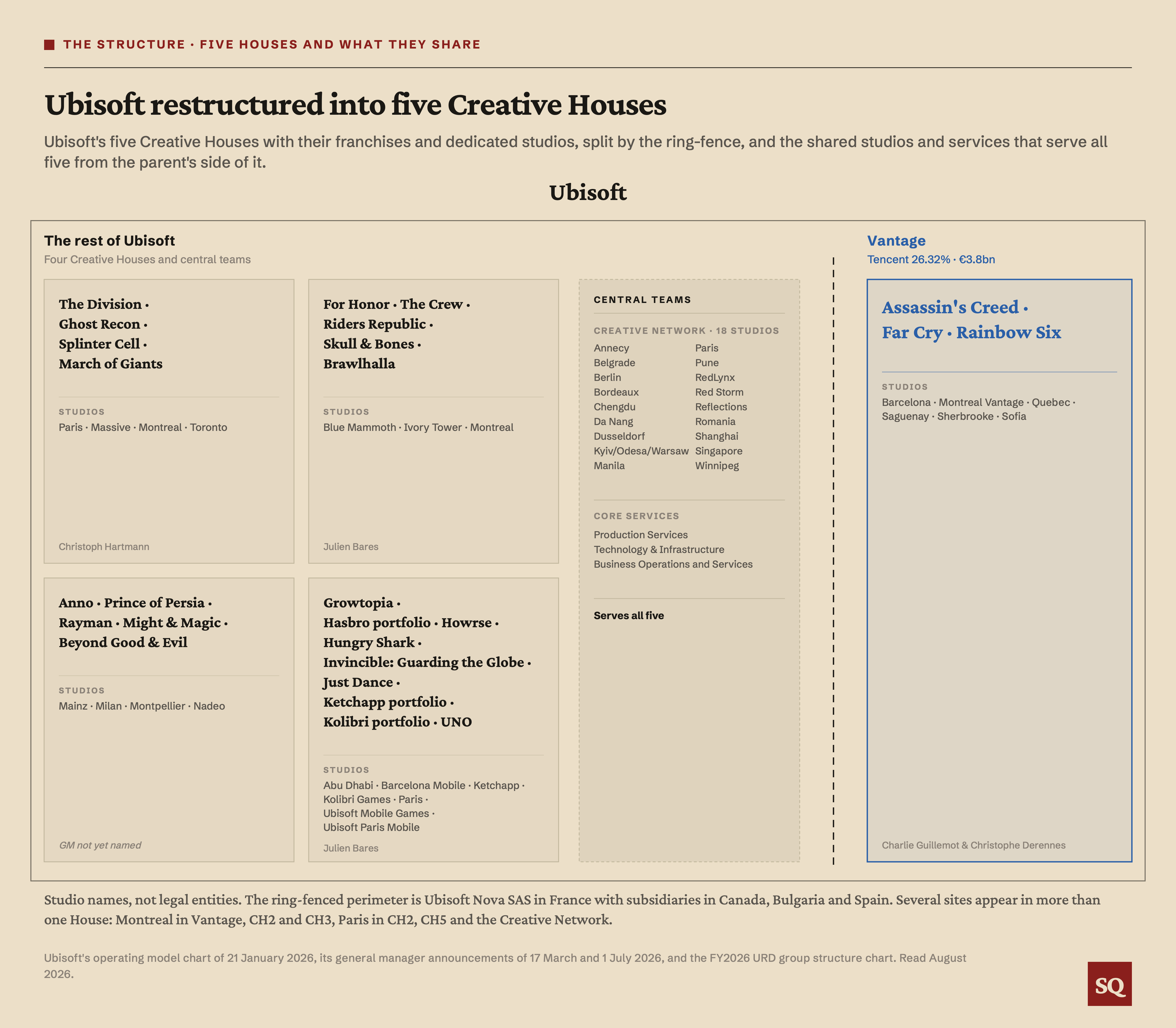
Since the Vantage deal completed, Ubisoft re-structured into ‘Creative Houses’ - five Houses drawn around genre and brand, each with its own leadership, and with Vantage co-led by Charlie Guillemot, who is Yves Guillemot’s son. As part of this, the various developer studios were also put into houses too, and notably the developers behind the franchises in Vantage (AC, FC, R6) also sit in the Vantage entity.
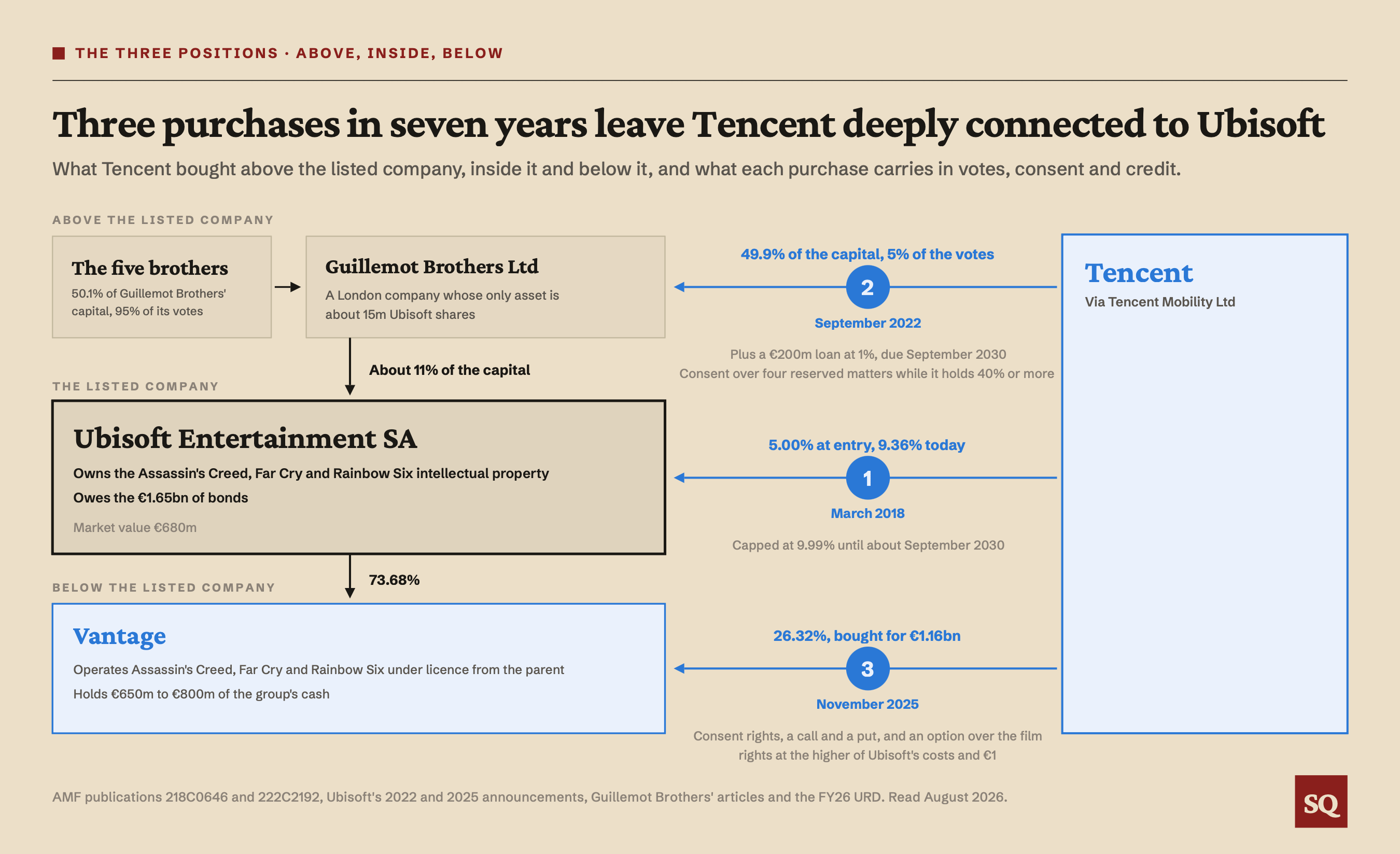
If you’ve read this far, this puts Tencent as having three unique ties to Ubisoft:
Through the Guillemot Brothers entity that owns shares in Ubisoft
Directly through equity in the Ubisoft company itself
Through a minority stake in the Vantage entity
In aggregate, Tencent has about 15% economic interest in Ubisoft across these three deals, and about 37% of the key franchises (AC, FC and R6), but only 8.5% voting interest which comes from its direct equity ownership in the publicly listed entity of Ubisoft.
What the share price implies today
So now we’re up to speed on this history, what does the current share price imply? Ubisoft trades around €5 a share, some 95% below its July 2018 peak, with a market cap near €680m. When the Vantage deal closed with Tencent in November 2025, this unit was priced at €3.8bn, Ubisoft's share of that one studio is worth nearly 5x the whole listed company.
The market values the remaining Creative Houses well below zero
Taking the value of Vantage at Tencent’s price (€3.8bn), and doing a reverse Sum-of-the-Parts on the company’s value and the market prices the remaining four houses well below zero. When the deal was announced in March 2025 the shares reached €14.48, and the gap was far narrower then. Today, at €5, the four houses are priced at between −€1.6bn and −€1.7bn.
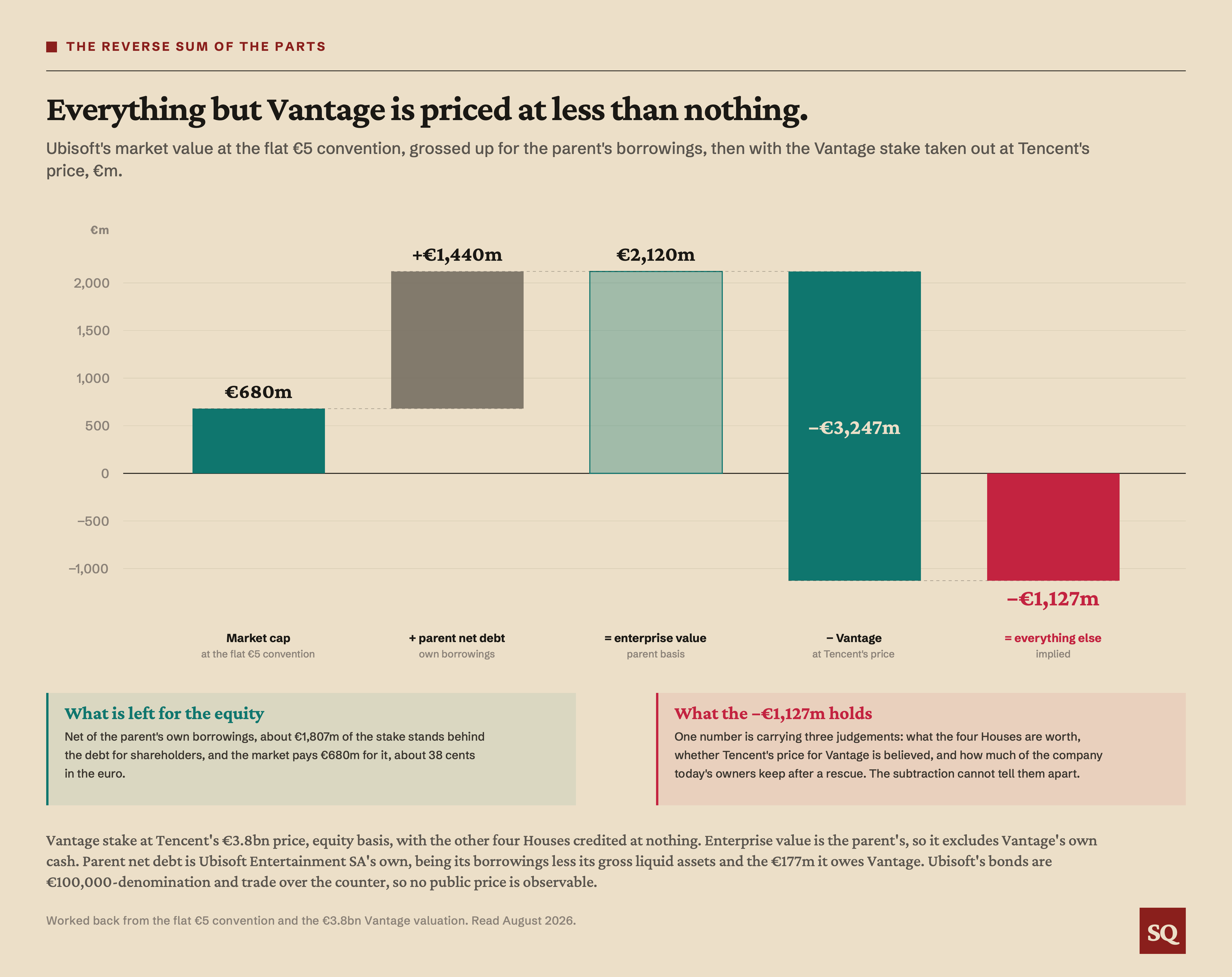
At first this looks hard to believe, given that surely four creative houses would be worth something? Yet this becomes a question around the ranking of equity shareholders against the remaining creditors.
Ubisoft has faced execution issues on its portfolio for the past few years, struggling to create commercially successful games, which has brought into question the risk of solvency of the business if this track record continues. If (and I say if, as this is hypothetical) Ubisoft had to declare insolvency, then common equity shareholders would be the last group to receive anything.
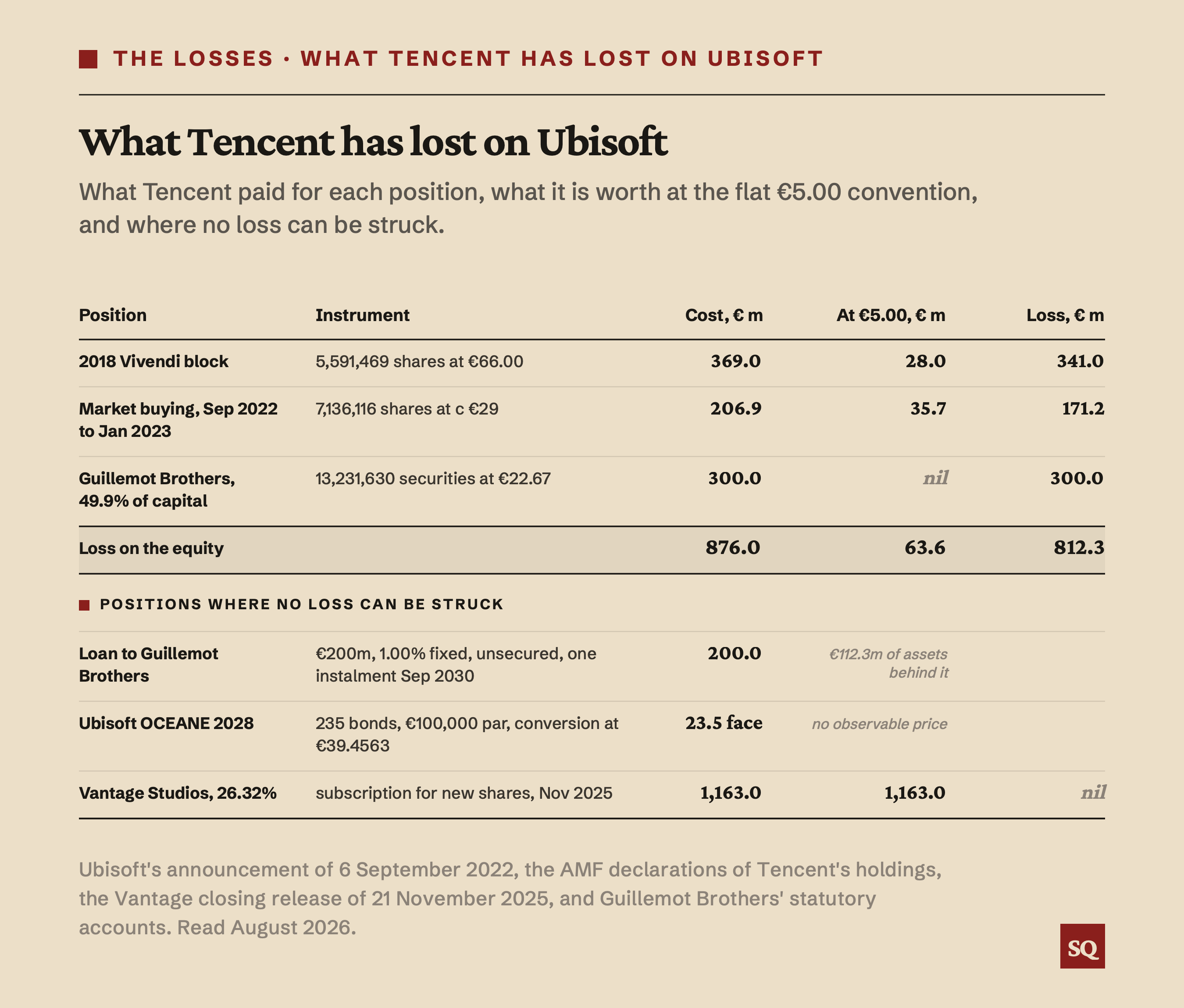
Tencent has already lost about €811m in their position in Ubisoft since investing in the company through its own equity positions directly in the company and through Guillemot Brothers Ltd. Yet Vantage is structured such that if Ubisoft had to sell its stake, Tencent could exercise its first right to acquire the remaining 73.68% in Vantage, which are the crown jewels of the business, and with an exclusive, perpetual right to the franchises (AC, FC and R6), which would continue operating as a separate entity.
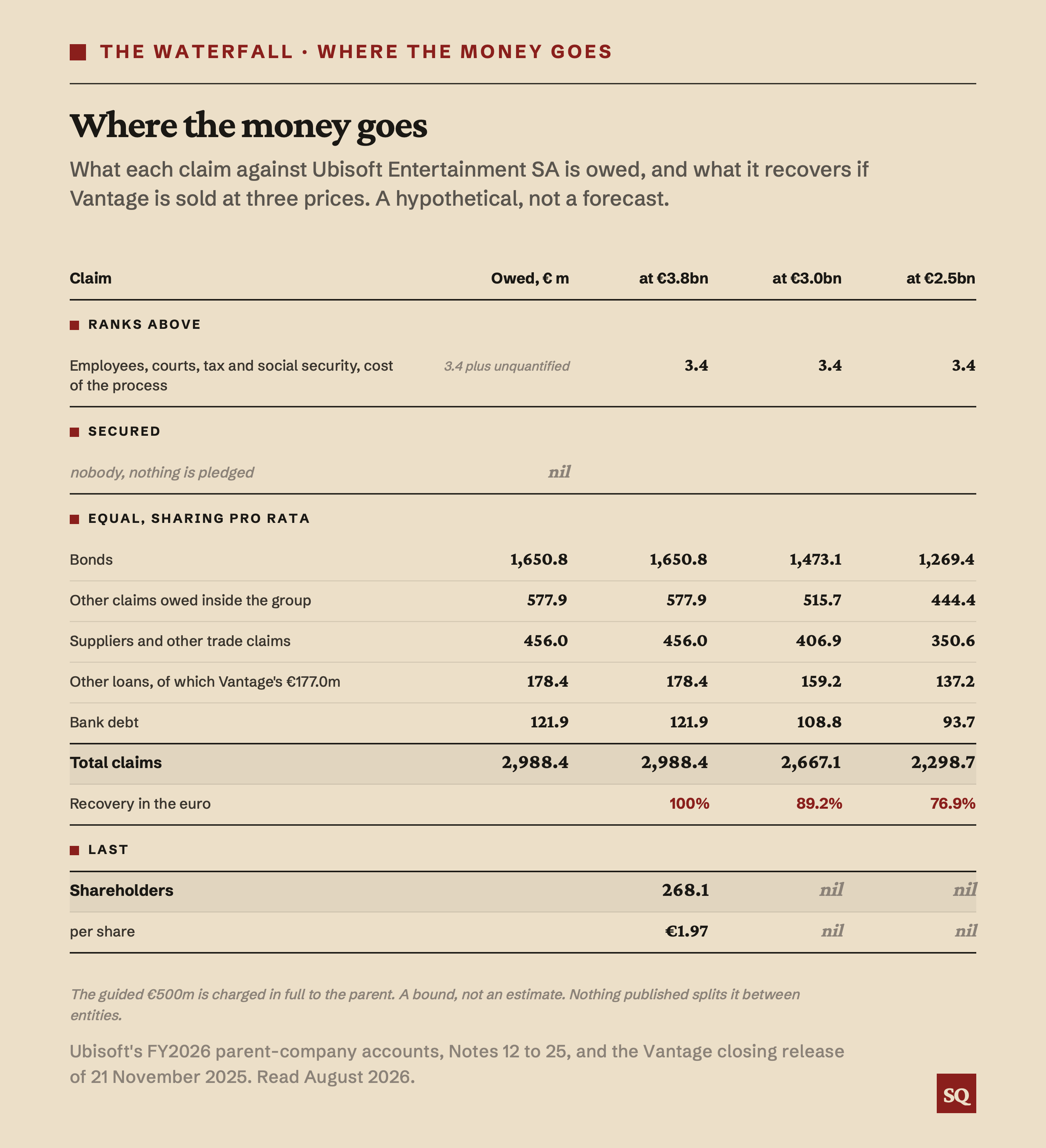
Bondholders would then be the first to be paid back from the proceeds of the sale of Vantage to Tencent from the Ubisoft parent company. If this were to happen, then there would be no guarantee that Vantage would reach the valuation already implied (€3.8bn) as at this point, given that insolvency proceedings would mean the best outcome would be to have a buyer for the business, rather than not. There is a floor, and it prices Tencent’s own stake if a buyer takes control of Ubisoft, and it sets the EV no lower than the EBIT multiple that buyer pays for the whole of Ubisoft. It also carries its own carve-out: where Vantage’s earnings are zero or negative the multiple does not apply at all, and Vantage’s published result is a loss of €592.0m.
Outside of Tencent bidding for Vantage, the likelihood of another company looking to acquire it would be low, if Tencent’s offer was not accepted. This is simply because Tencent is already deeply entrenched into the capital structure at all levels through both a loan to Guillemot Brothers Ltd and through the cash it put into Vantage, which Vantage has since lent up to the parent. So anyone else who decided to acquire Vantage, would then need to satisfy Tencent as a shareholder in the entity, which would be another complexity in operating the business henceforth.
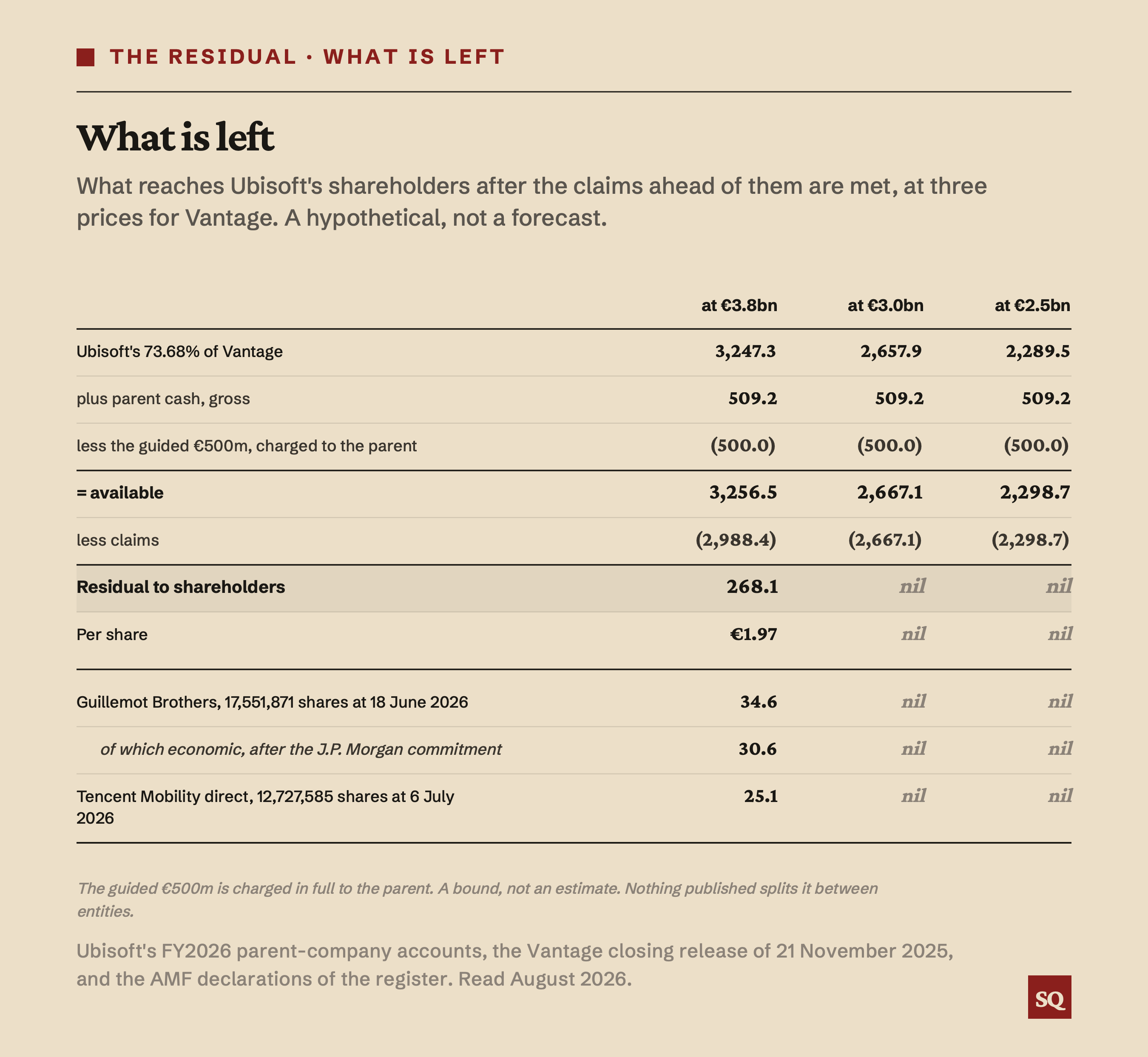
Once a price for Vantage is agreed, and Tencent acquired it, then the proceeds would first be used to payback the credit holders (before equity holders) given that they rank higher in the order of claims. Anything after this, would then be used to payback common equity holders, which includes Tencent who hold 9.36%.
So what the share price is assuming today, is in effect, an insolvency scenario, and how much common equity shareholders would receive back from any proceeds from Vantage after all other holders are paid back first.
Looking at how much Tencent has all-in invested into Ubisoft would also mean the actual cost of acquiring Vantage would be 24% higher than the headline figure (€3.8bn) at a cost of €4.7bn, and any decrease in the value of the entity, would also impact Tencent’s own value of its Ubisoft equity. So paying a lower valuation for Vantage isn’t necessarily in Tencent’s interest.
The near term catalyst: The first bill comes due on 15 November 2026
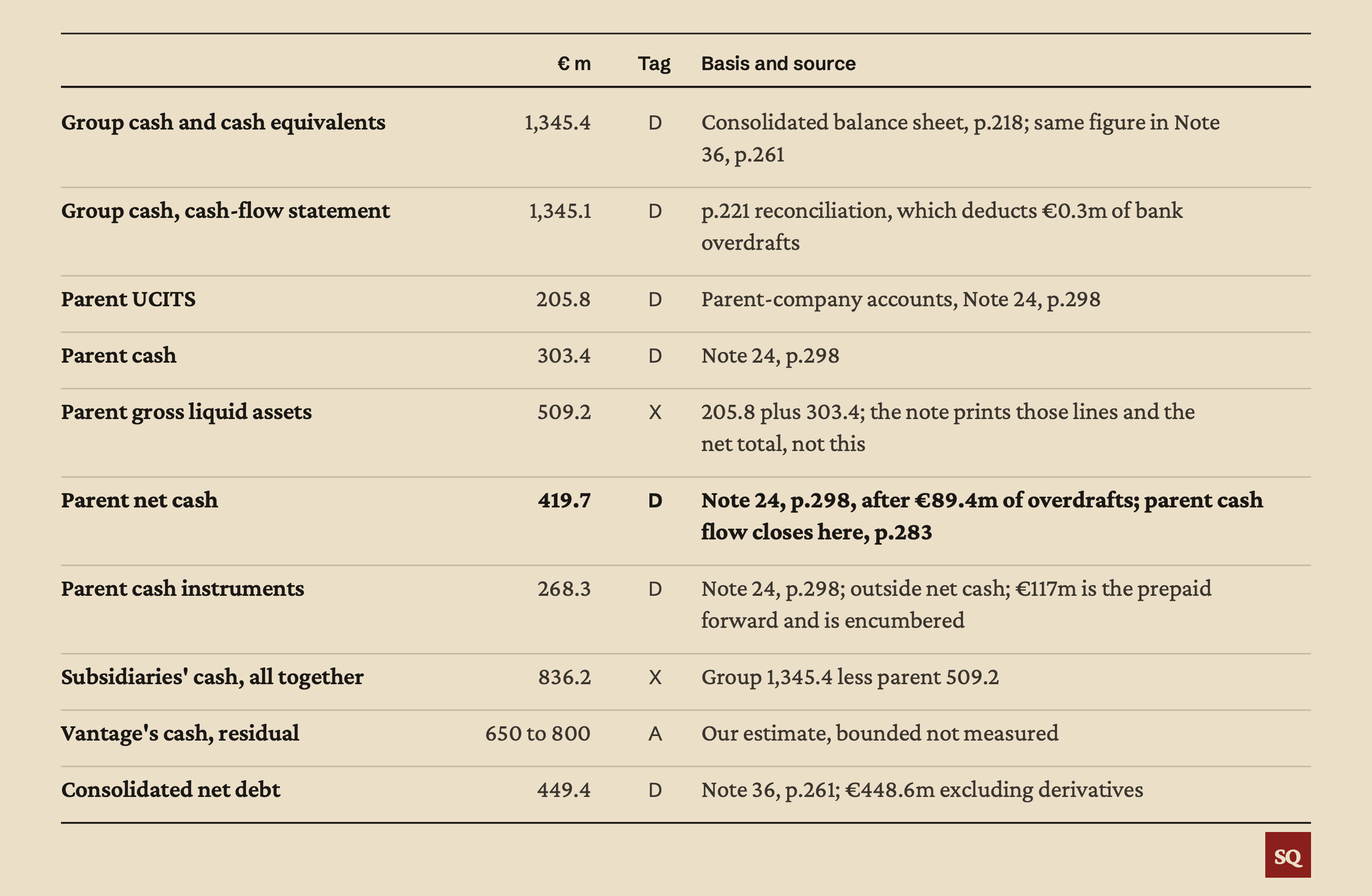
The next clear catalyst for Ubisoft is on 15 November 2026 when the holders of Ubisoft’s 2028 convertible can hand it back for €481m. Given that Ubisoft has withdrawn its RCF, there is no credit line it can draw on to pay this back as the parent company holds €509m which covers the bill and given the success of Assassin's Creed Black Flag Resynced (9th July), possibly more, but what it does not cover is a year of running the business, with Ubisoft guiding to free cash flow consumption of up to €500m across FY27 out of the same account.
Whether the holders exercise the put is their decision (not Ubisoft’s), and on the terms in front of them they almost certainly do. The equity option that would make the convertible worth keeping is worthless (converting at €39.46 against €5 share) so what they hold is a claim that pays a little over par on 15 November 2026, set against holding two more years for a par redemption and a 2.375% coupon.
The six ways through the wall
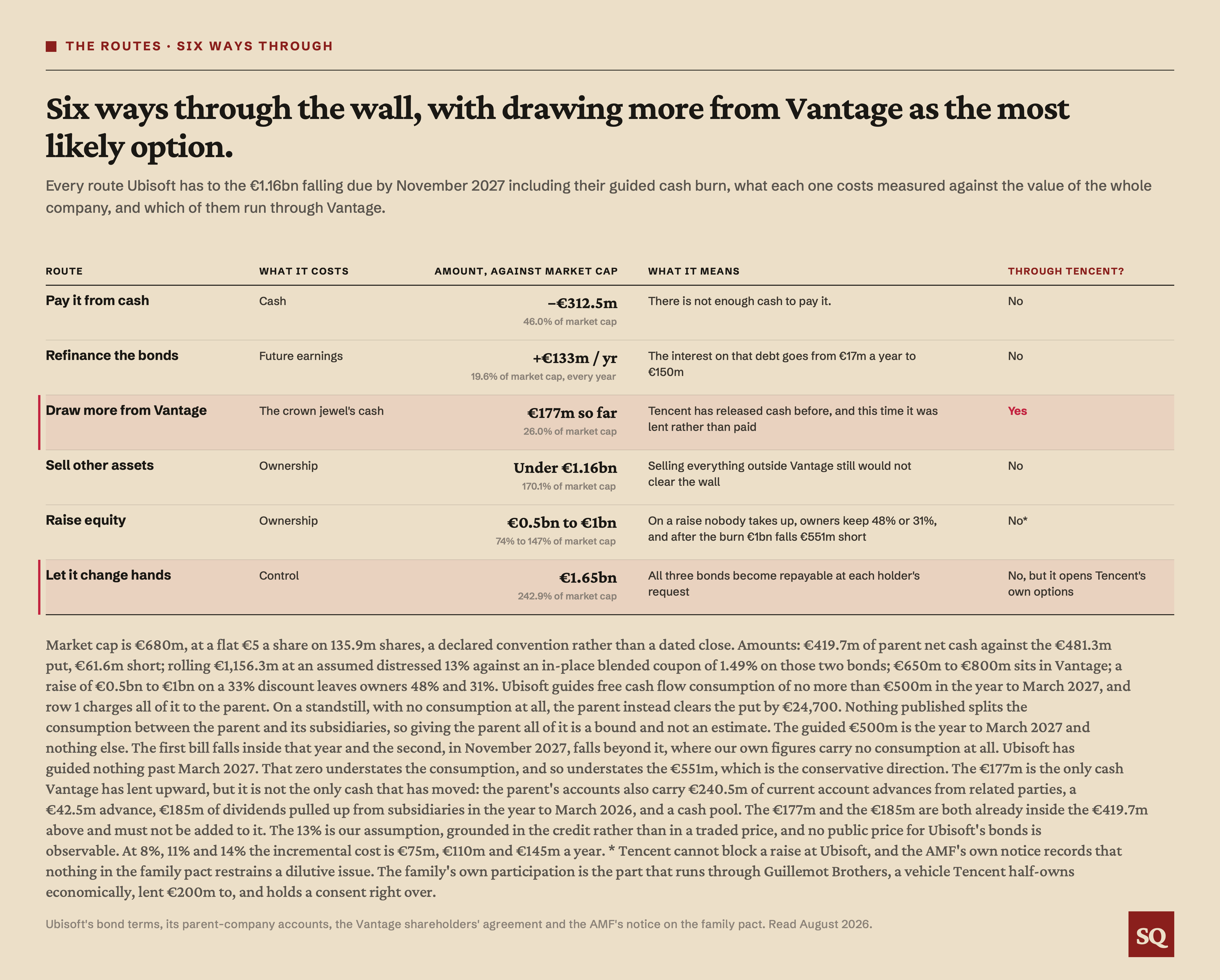
Assuming that they did need cash to pay the convertible in November given the negative FCF guidance, Ubisoft would need to find a way to increase the cash on their balance sheet and there are six ways in which Ubisoft could re-finance themselves at this point:
Pay it from cash on hand.
Refinance the bonds.
Draw more cash from Vantage.
Sell other assets.
Raise equity.
Let the company change hands.
Two of these options require Ubisoft reaching for the cash in Vantage, and both require consent from Tencent to lend to it.
There is realistically one choice and if we look at the possible options, we can rule out the following options to present the most likely outcome:
They cannot pay it from cash unless the underlying business has improved: This depends on the success of Assassin’s Creed Black Flag Resynced and the back-catalogue/live service element of the business. Yet, this is unlikely to work given the large FCF burn forecasted for FY27 (between March 26-27) up to €500m.
Re-financing the bonds, will increase the interest required on their debt substantially: Given the 2.375% coupon if the equity converts, this would be well below current market base rates and is a great deal for Ubisoft. If we assumed that debt investors would require an 8% coupon, generous for a borrower in this position, this would add an annual interest cost of €75m/year.
Selling other assets when the market implies a negative valuation for them is difficult: As the market is already pricing the remaining houses well below the current market cap of the company, a suitable/desired valuation would be difficult to achieve and any buyer would need a) a suitable strategy/rationale for acquiring these assets but b) would likely have increased leverage in a negotiation if they knew Ubisoft needed the cash and c) need to take time to work through how the remaining Central Teams may or may not fit into their business, which is complex.
Raising equity would be expensive for the company and heavily dilute shareholders: Given the sentiment of the shares, it would be difficult to raise cash without a heavy subscription discount (we assume 33%) to cover the risk that they would be taking on the next few years of the shares. Additionally, finding enough investors to cover the book would also need to be a consideration.
Effectively, this leaves Ubisoft with one likely option:
Tencent would need to agree to loan additional money to the parent company or increase their equity stake in Vantage: In doing so, they would likely want to ask for something in return in addition to the coupon on any loan that ultimately takes them closer to Vantage or they get closer to Vantage if they acquire more equity.
What can change the story
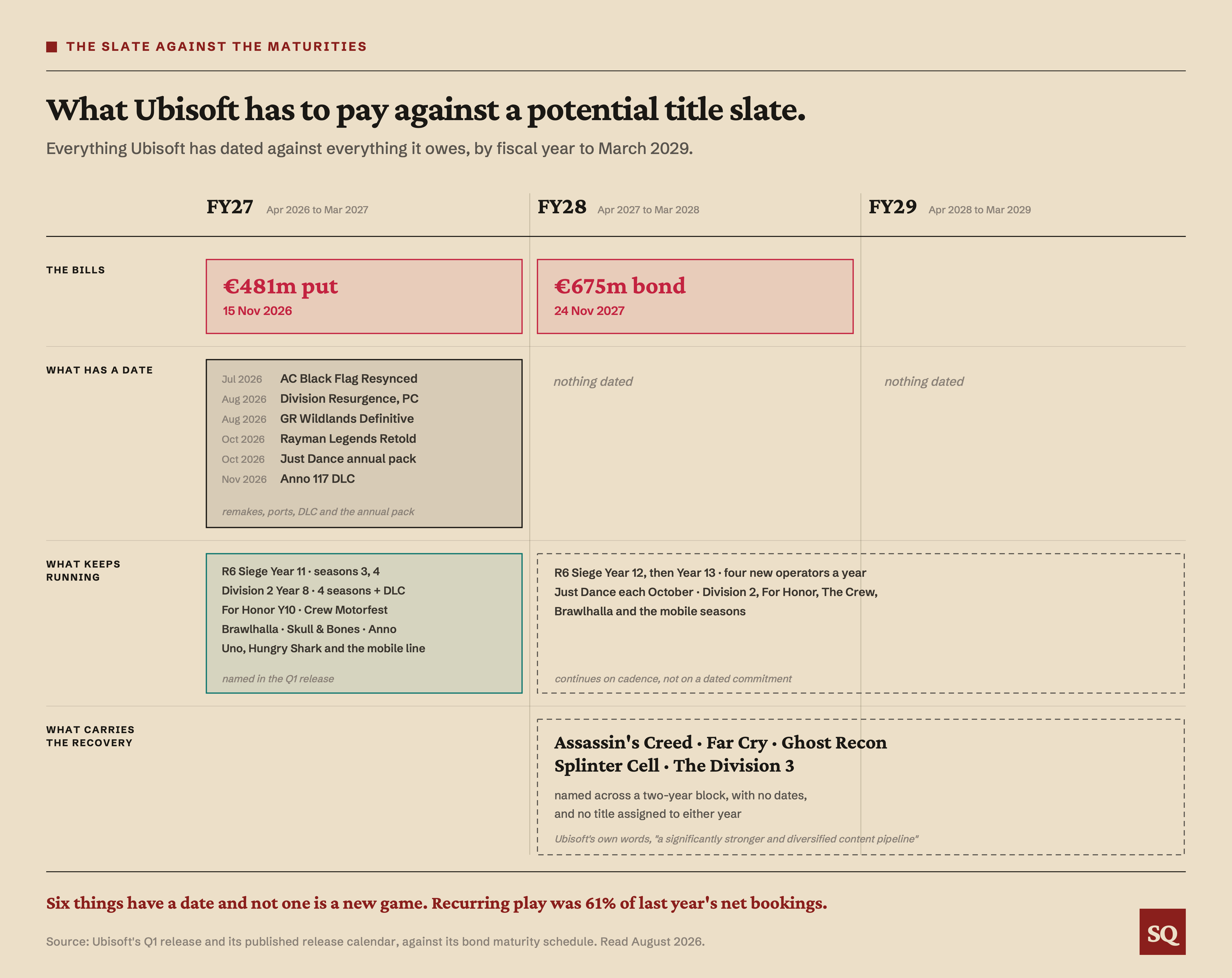
Yet the requirement for any additional cash from Tencent could be alleviated if the business substantially improves in time. Everything Ubisoft has dated for this year is a remake, a port, a piece of downloadable content or the annual Just Dance. The games that would take bookings back to where the recovery needs them, a new Assassin’s Creed and a third Division among them, are named as brands across the two years after.
The live games are in good health, with Rainbow Six Siege going back to four new operators a year, a full season roadmap on The Division 2, and recurring play making up most of last year’s bookings. Grant all of that, and a return to profit still needs bookings up by more than a third in a single year, which live content has never delivered on its own.
Ultimately, who ends up with the crown jewels is one of belief - do you believe that the business will improve? Then Ubisoft remains as-is with the Guillemot brothers in control. If you believe the business does not improve, then Tencent likely ends up with Vantage.
Appendix
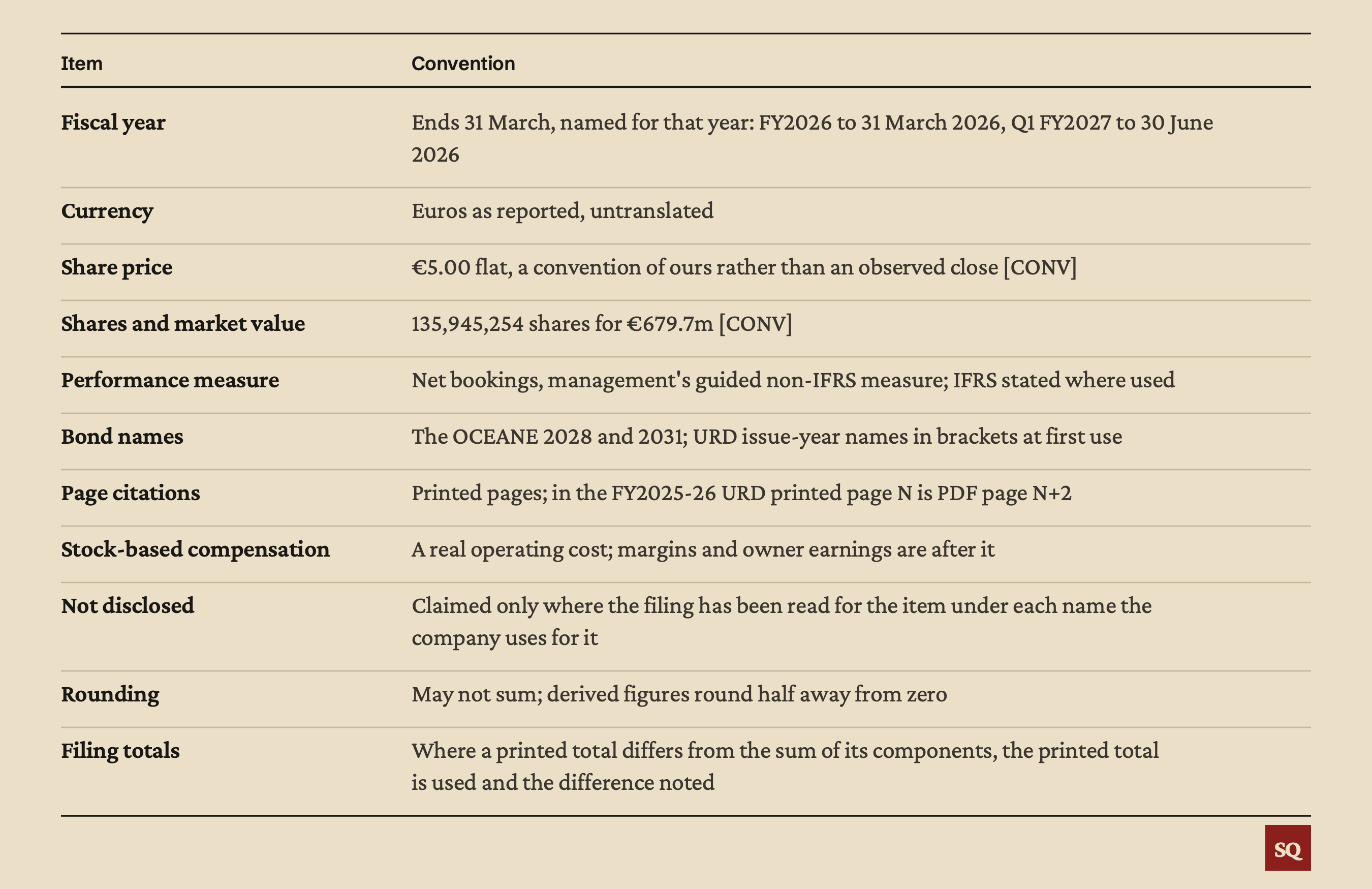
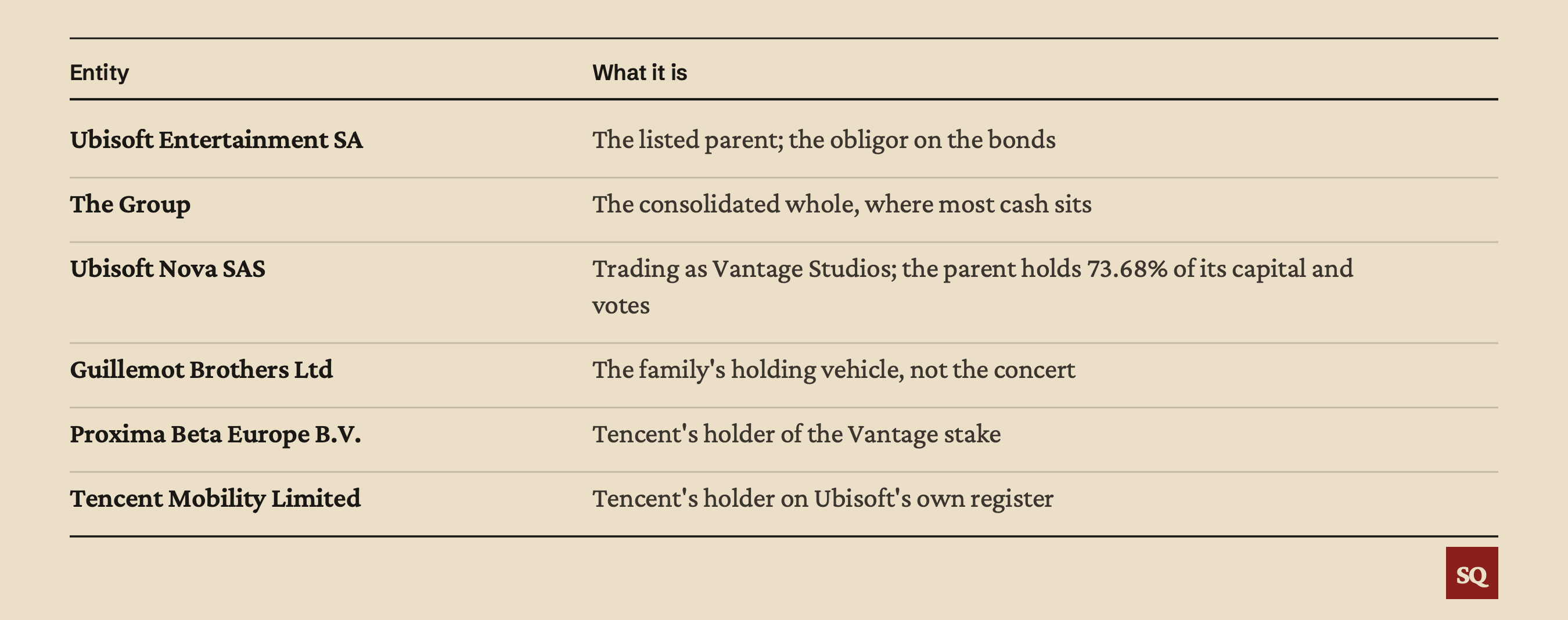
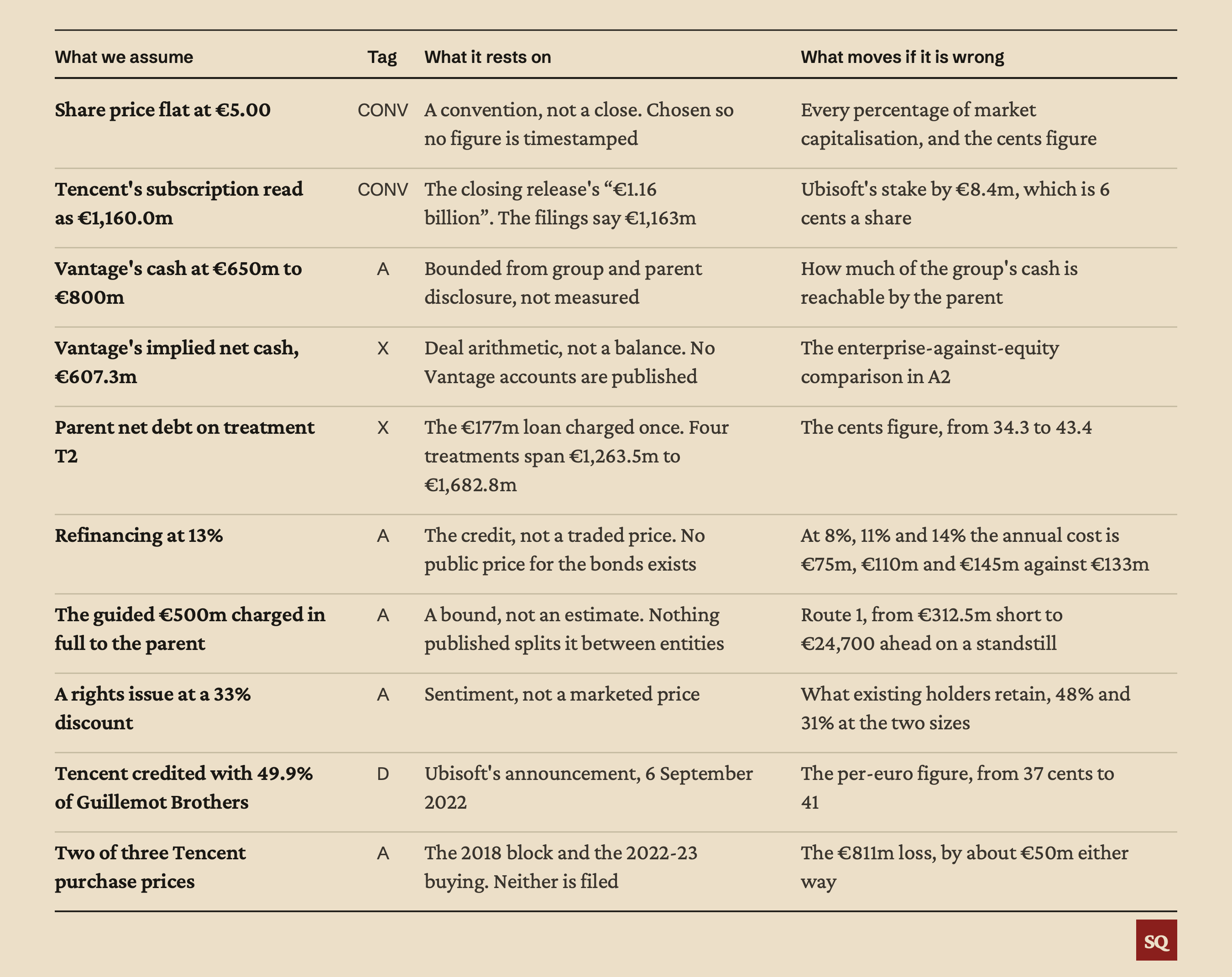
Every figure here comes from a filing, a release, or arithmetic shown beside it. Tags: D disclosed, X derived by arithmetic from disclosed figures, A our assumption, G company guidance, P press-reported, CONV rests on a convention we declare. The share price is one of those conventions, a flat €5.00 on 135,945,254 shares for a market capitalisation of €679.7m, chosen so every price-based figure rests on one basis a reader can rescale. Four entities never interchange: Ubisoft Entertainment SA, the listed parent and the obligor on the bonds; the Group, the consolidated whole; Ubisoft Nova SAS, trading as Vantage Studios, 73.68% held and holding the games; and Guillemot Brothers Ltd, the family’s vehicle.
A1. What we hold constant
A2. What Tencent’s price implies for Vantage
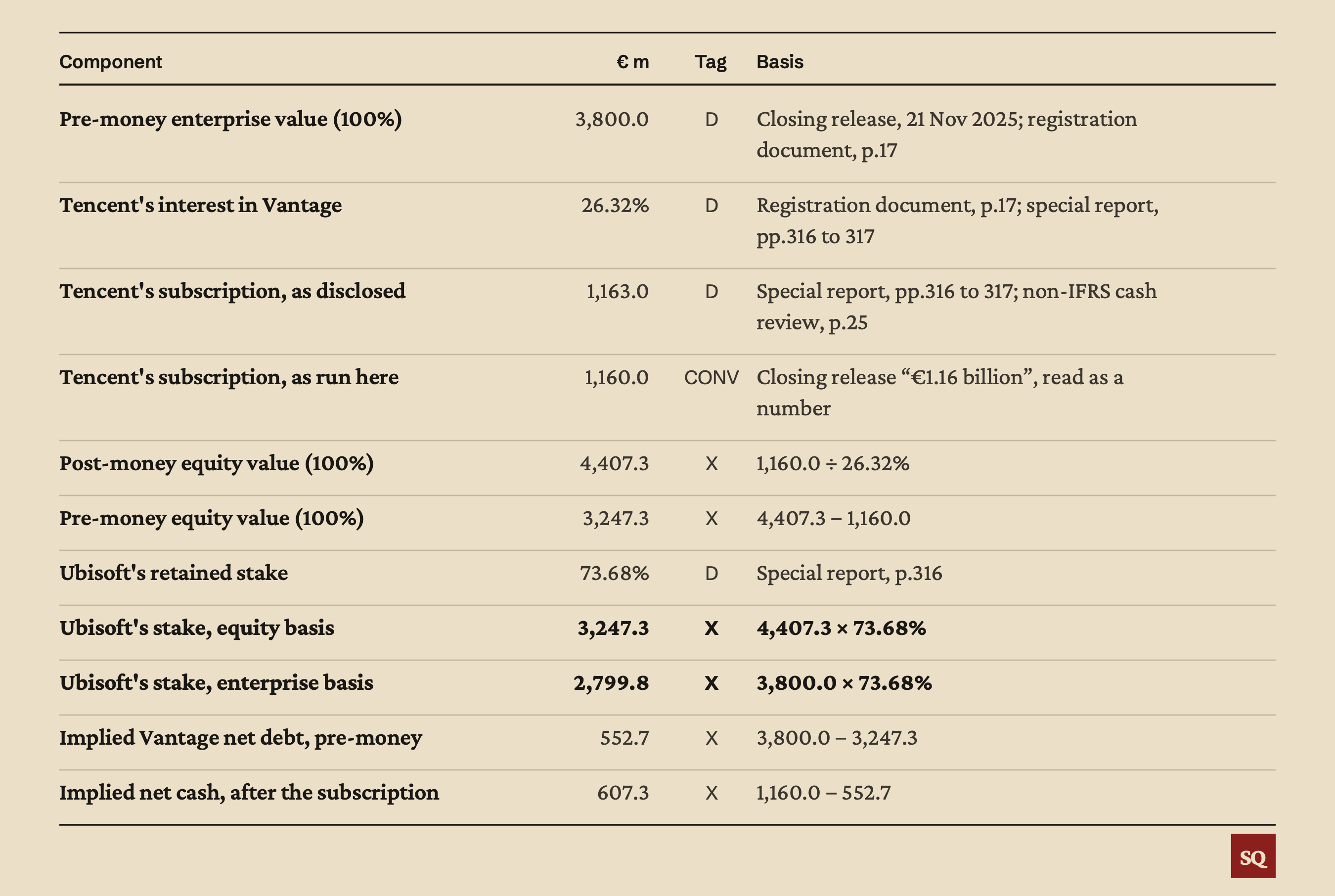
Tencent bought 26.32% of Vantage Studios for a figure the closing release rounds to €1.16bn and the filings state as €1,163m. We run the rounded form, which understates Ubisoft’s stake by €8.4m, or 6 cents a share.
Both cash lines are implied by the deal arithmetic rather than observed. No Vantage balance sheet is published and no price per Vantage share is disclosed.
A3. Where the cash sits
House structure and franchise assignment from the 21 January 2026 reset release; leadership from Ubisoft’s own announcements of 17 March 2026 and 1 July 2026. The five Houses became operative on 1 April 2026.
A4. What the parent owes
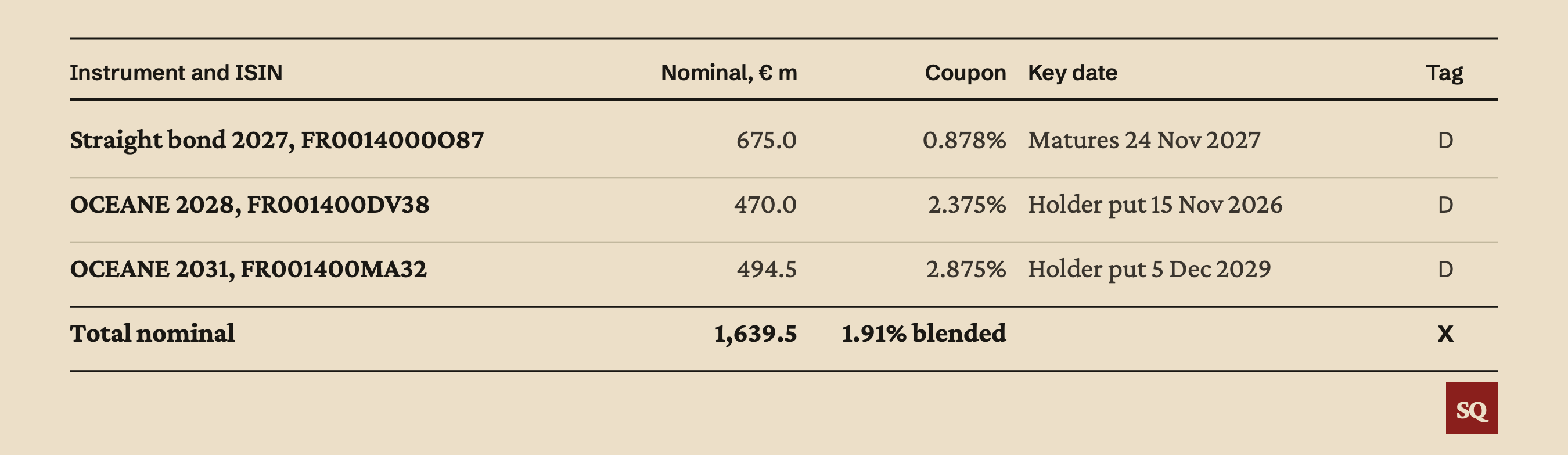

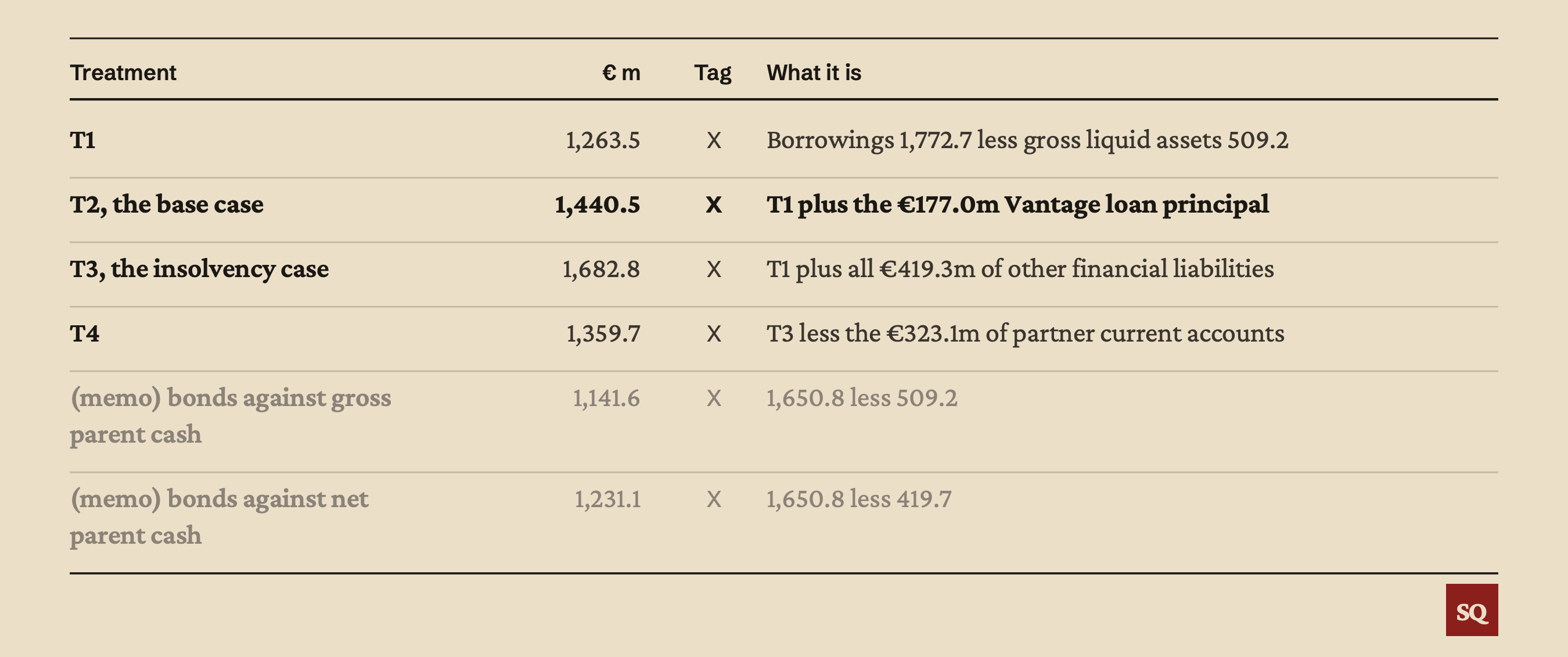
The €177m Vantage loan sits outside borrowings, in other financial liabilities. Charging it, which is the base case, makes the intra-group loan value-neutral: what stands behind the debt is €1,806.8m whether measured before the loan or after it. Leaving it out implies the loan created €177m of value.
A5. What stands behind the debt
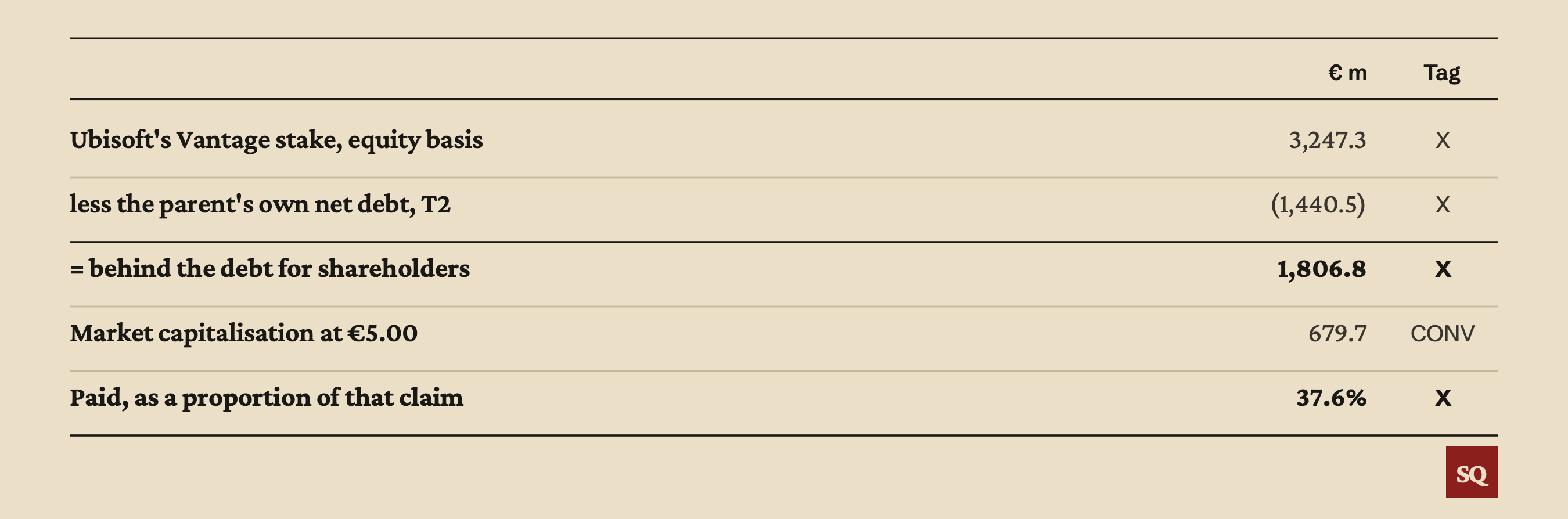
On the treatment we use, a shareholder pays about 38 cents for each euro of what stands behind the debt. Across all four treatments the figure runs from 34.3 to 43.4 cents.
A6. The six routes, priced
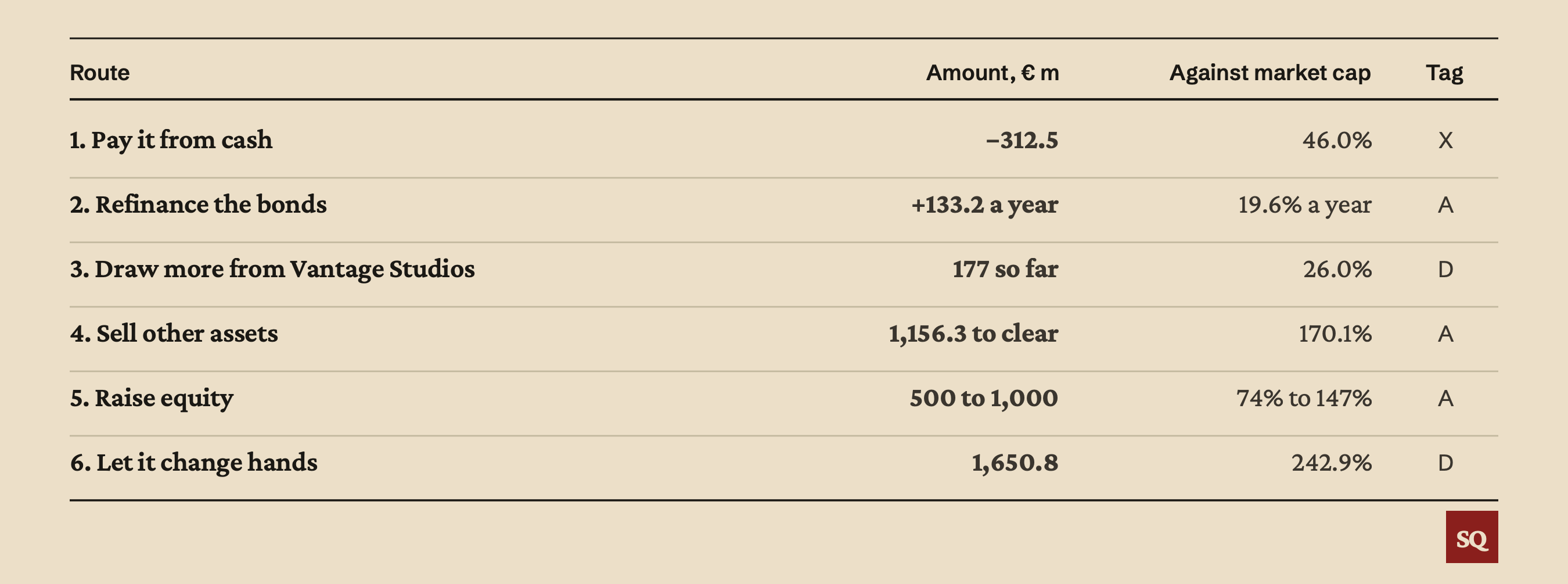
Route 1 charges the guided cash consumption in full to the parent. Route 5 clears none of the three walls: the near stack at €1,156.3m, the FY2029 funding hole at €1,551.3m and the full stack at €1,650.8m.
A7. Tencent’s own position
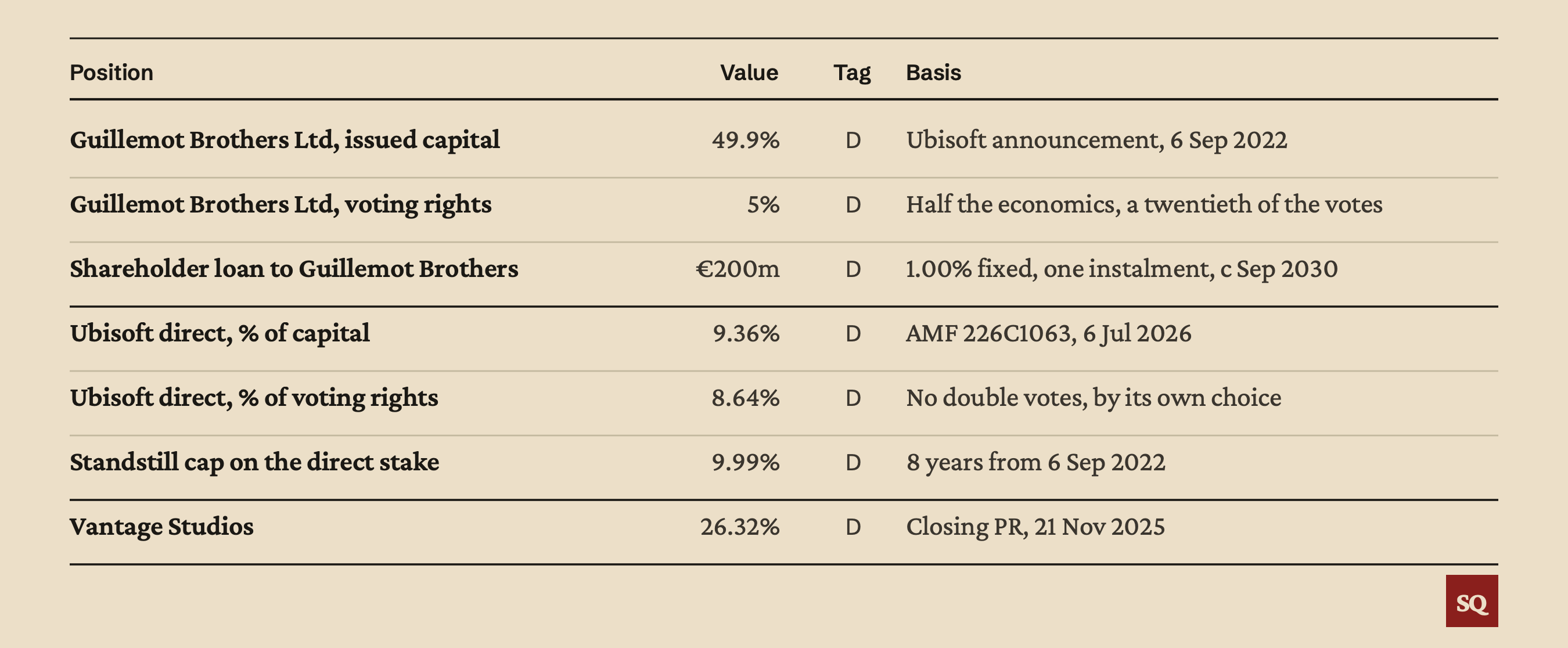
We credit Tencent with 49.9% of Guillemot Brothers’ economics, which is the share Ubisoft’s own 2022 announcement discloses and the conservative reading for the argument the article makes. On the whole vehicle the per-euro figure moves from 37 cents to 41.
A8. What we assume, and what moves if we are wrong
Ten figures in this piece are ours rather than Ubisoft’s. Each is tagged where it appears; this is the register.
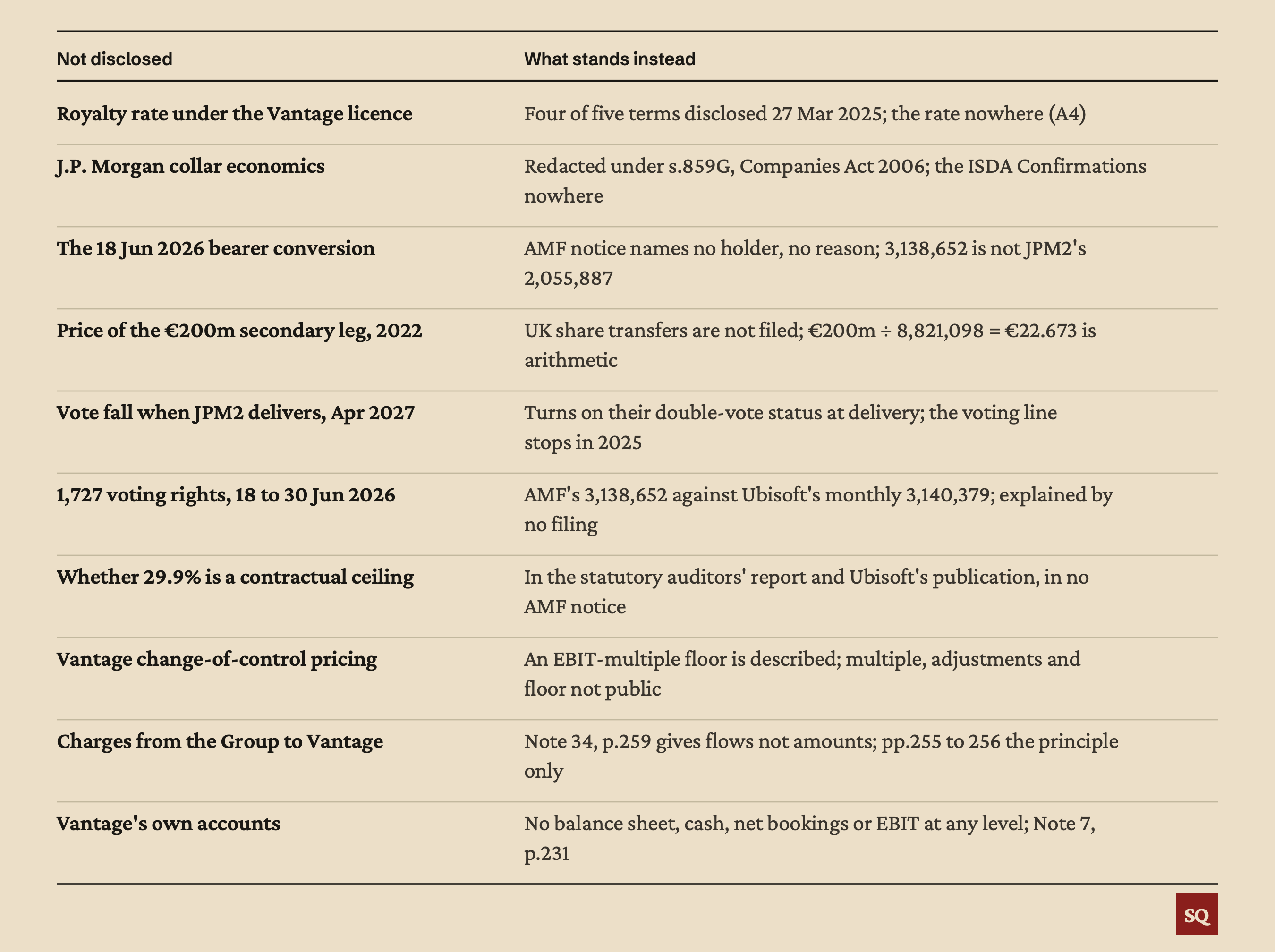
A9. What Ubisoft does not publish