


We looked at 79 listed games companies and 34 government schemes. The boom in games tax credits reads as industry policy, and in the accounts of those companies it is an earnings story, with dependence running from a couple of points of profit at EA to a credit worth more than the whole of Ubisoft’s.
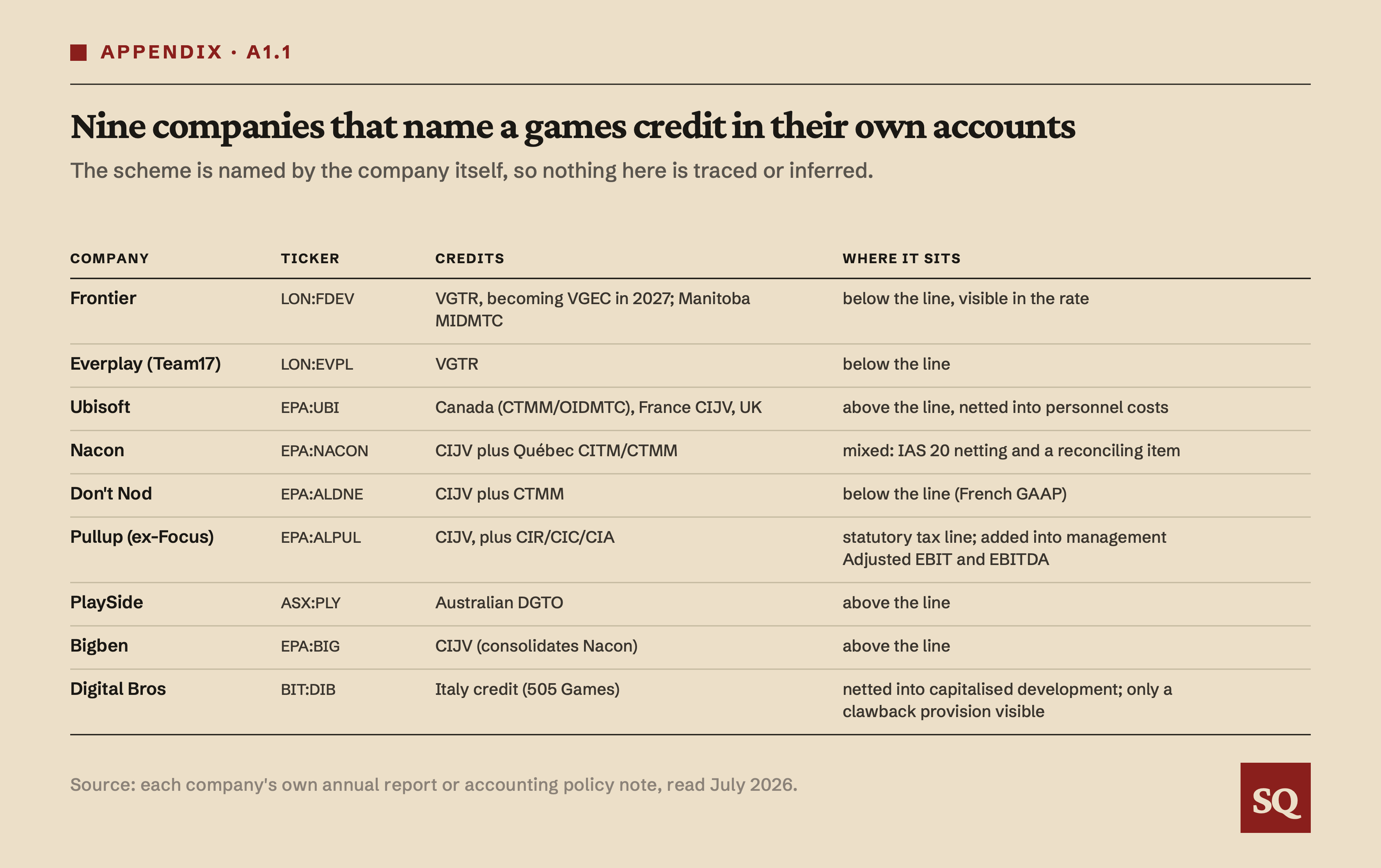
21 of them can be shown to claim a games credit, and 9 name it in their own accounts. Rockstar’s British studio has claimed over half a billion pounds of UK relief in ten years, and Take-Two’s accounts never say which countries its credits come from.
The landscape has started to move with Québec cutting the cash value of its credit while others extend or retreat, and due to differences in disclosure of accounts, the market cannot see which companies the gains/cuts lands on.
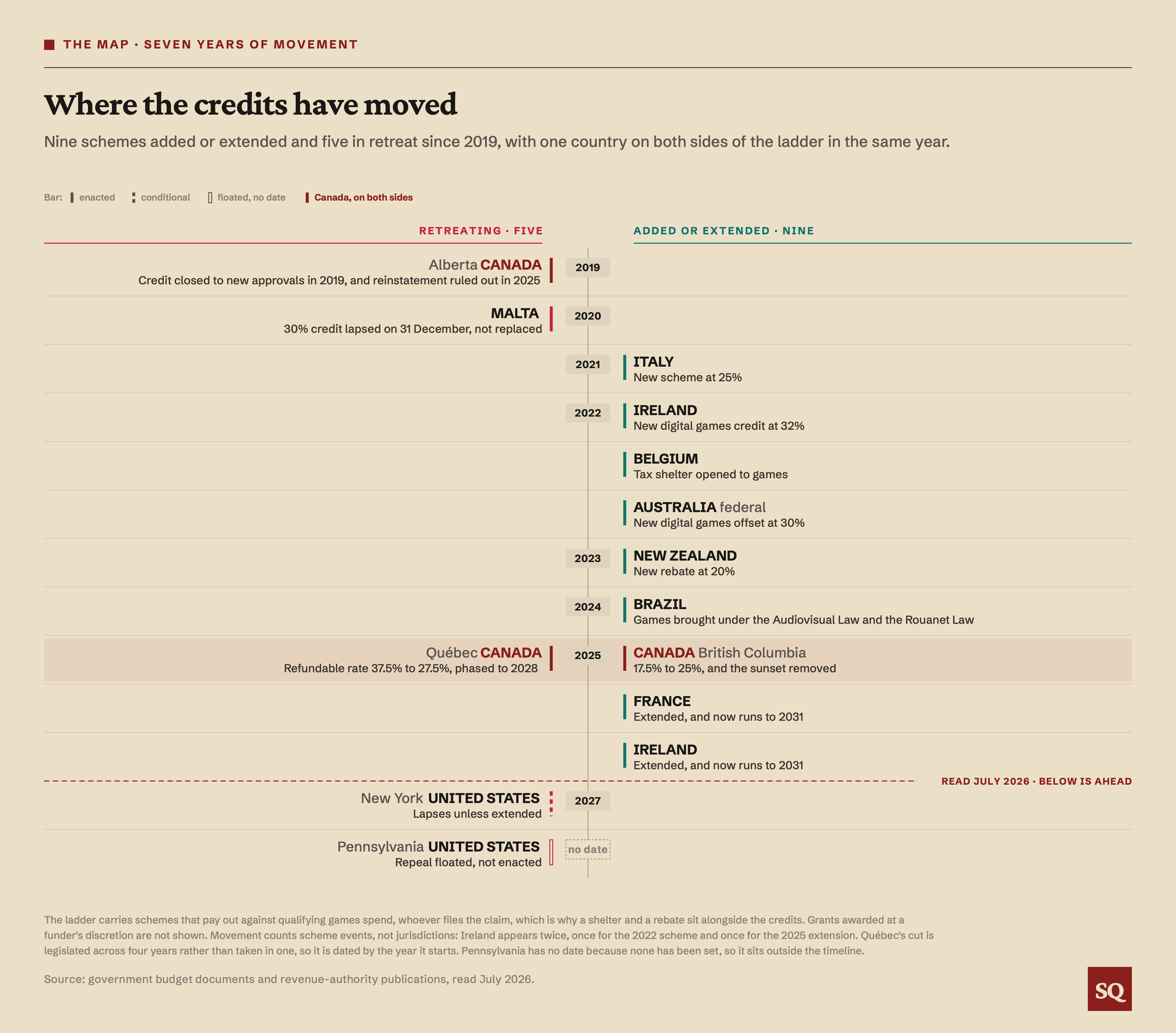
The number of national schemes has roughly doubled in five years, as Ireland, Italy, Belgium, Australia and New Zealand each wrote one where none had existed, and the easy read is of an industry winning more support every year. The additions have kept coming, British Columbia lifting its credit to 25% and making it permanent, Ireland and France now running to 2031, and Brazil bringing games under two of its cultural incentive laws, but so have the withdrawals: Alberta has abandoned reinstatement, Pennsylvania has floated repeal, New York has left its credit to lapse after 2027, and Québec, which runs the largest of the Canadian credits, has begun cutting the cash it actually pays out.
The schemes differ on what they ask of a game and on how much they will pay any one company.
What the scheme asks of the game: The culturally tested schemes, in the UK, France, Ireland and Italy, gate on a test certifying the game is British, or French, or Italian. Québec asks something narrower and sets its rate by it: 37.5% for a title commercialised in French, 30% for one that is not. Australia and New Zealand ask nothing of the kind and subsidise development of any sort.
How much money one company can take: France stops at €6m a year and Italy at €1m, so no single major studio draws much from either. The Canadian labour credits in Québec, Ontario and British Columbia set no company ceiling and scale with local headcount, and neither does the UK, which caps only the share of a game’s costs that qualifies.
Several parties take a share of this money, and they do not want the same thing from it. The state wants jobs and a domestic industry; the small studio treats the credit as the difference between shipping and not; the worker’s wage is the base the largest credits are paid on; the large employer is what those credits exist to keep in place. The biggest claimants of all are studios you cannot see from the parent’s accounts, Rockstar’s British company among them, alongside privately held ones like Larian. And at the end of the chain sits the investor in a listed studio, holding whatever share of this reaches the accounts.
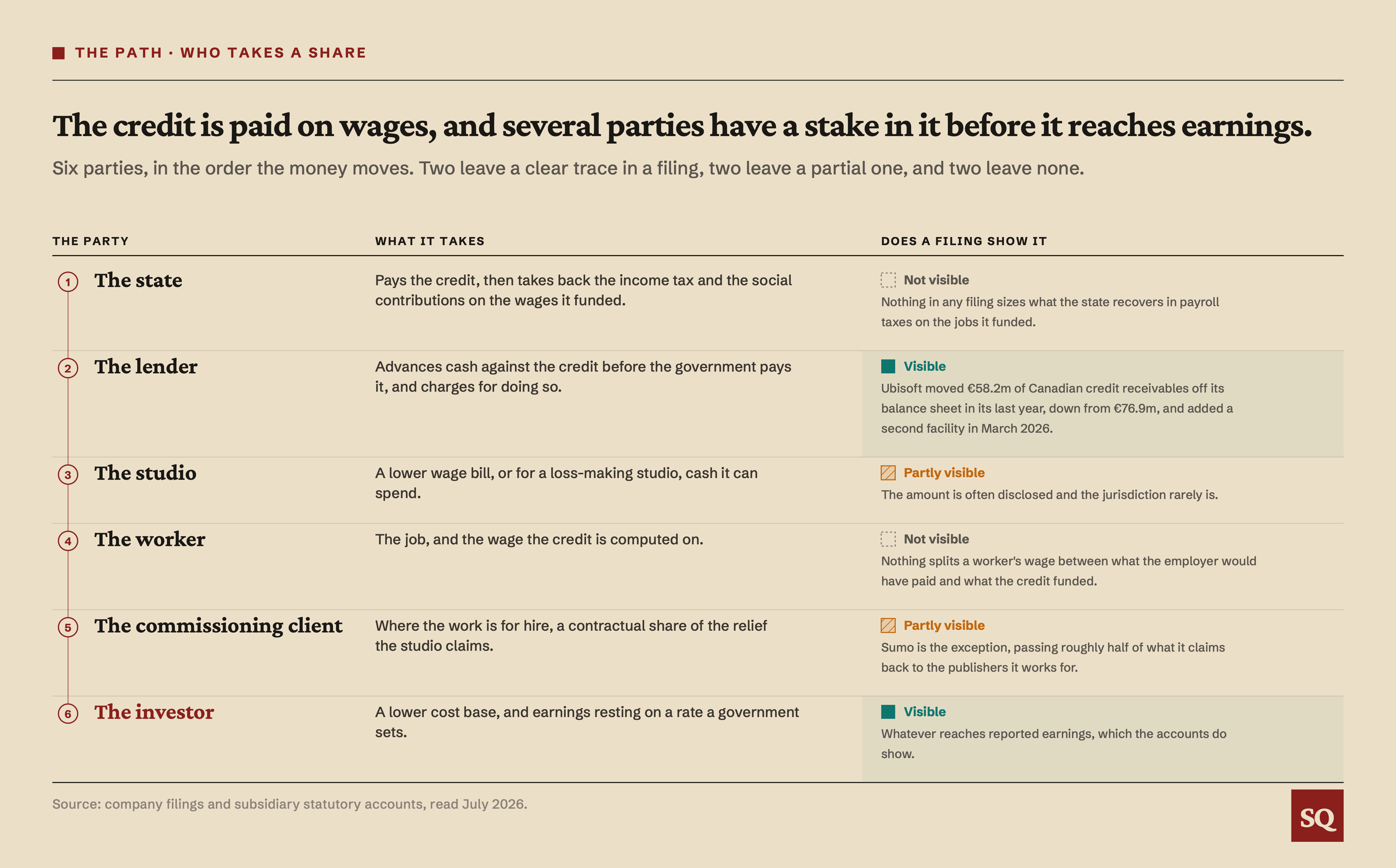
A studio that does claim one receives either cash or a reduction in the tax it owes, and inside a listed group it is just earnings, carried into the reported result like any other line. How much of that result it accounts for runs from almost nothing at one studio to more than the whole of it at another, and the accounts are the last place you would learn which: the credit is more often bundled into a wider line, netted into costs, or dropped on materiality than named outright. And the schemes are changing underneath all of it, with Québec now paying out less cash than it used to.
Where a company is listed tells you nothing about the credits it draws
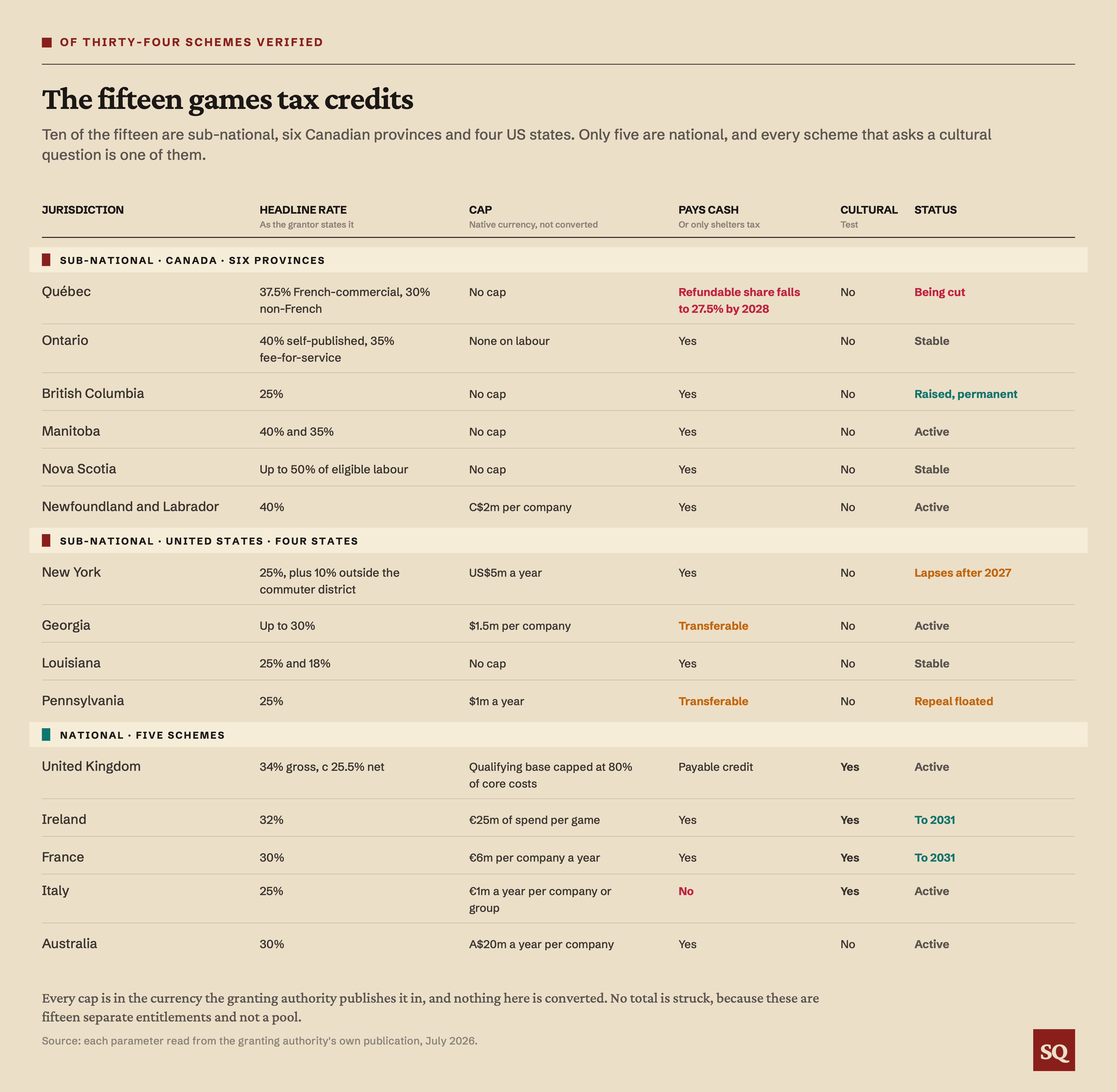
Headline rates run from Louisiana’s 18% to Nova Scotia’s 50% of eligible labour, and the rate on its own does not tell you how much a company can actually get. A cap sets a ceiling on what any one claimant can take, which is why France’s €6m a year and Italy’s €1m bound what even a large studio can draw from them, while the Canadian labour credits and the UK set no company ceiling at all and scale with how much a studio spends locally. And most of these credits are refundable, which means the government pays out in cash even when the studio owes no tax.
A studio building a game spends for years before it sells anything, so it is loss-making for most of a development cycle by construction, and a credit that only reduces a tax bill is worth nothing to it in those years. A refundable credit arrives as cash while the game is still being made.
They are not all tax credits either, since Belgium runs an investor shelter, New Zealand a rebate paid by its broadcasting funder, and Germany and the Czech Republic grants, so governments have not converged on one instrument. The games-specific schemes are also only one of two things holding a studio’s tax bill down. Alongside them run the general regimes it shares with every other software company, Poland’s 5% IP box, China’s 15% high-tech rate, ordinary research credits, the concessions in Israel, Cyprus and Singapore, and for most listed studios those matter more.
Who claims the games-specific credits is narrower than the number of schemes suggests. We found those schemes by working outward from where these companies have studios, so a country none of them builds in is one we never looked at. Of the seventy-nine listed games companies we looked at, only about twenty can be shown to claim one at all; for most of the rest, the only lever visible in the accounts is a general regime. A company claims where its games are made rather than where its shares trade, so a studio developing in Québec claims in Québec whatever exchange its parent is quoted on. People Can Fly is listed in Warsaw and draws from Québec, Take-Two is listed in New York and claims through Edinburgh, and Sega is in Tokyo and takes UK relief through its British studios.
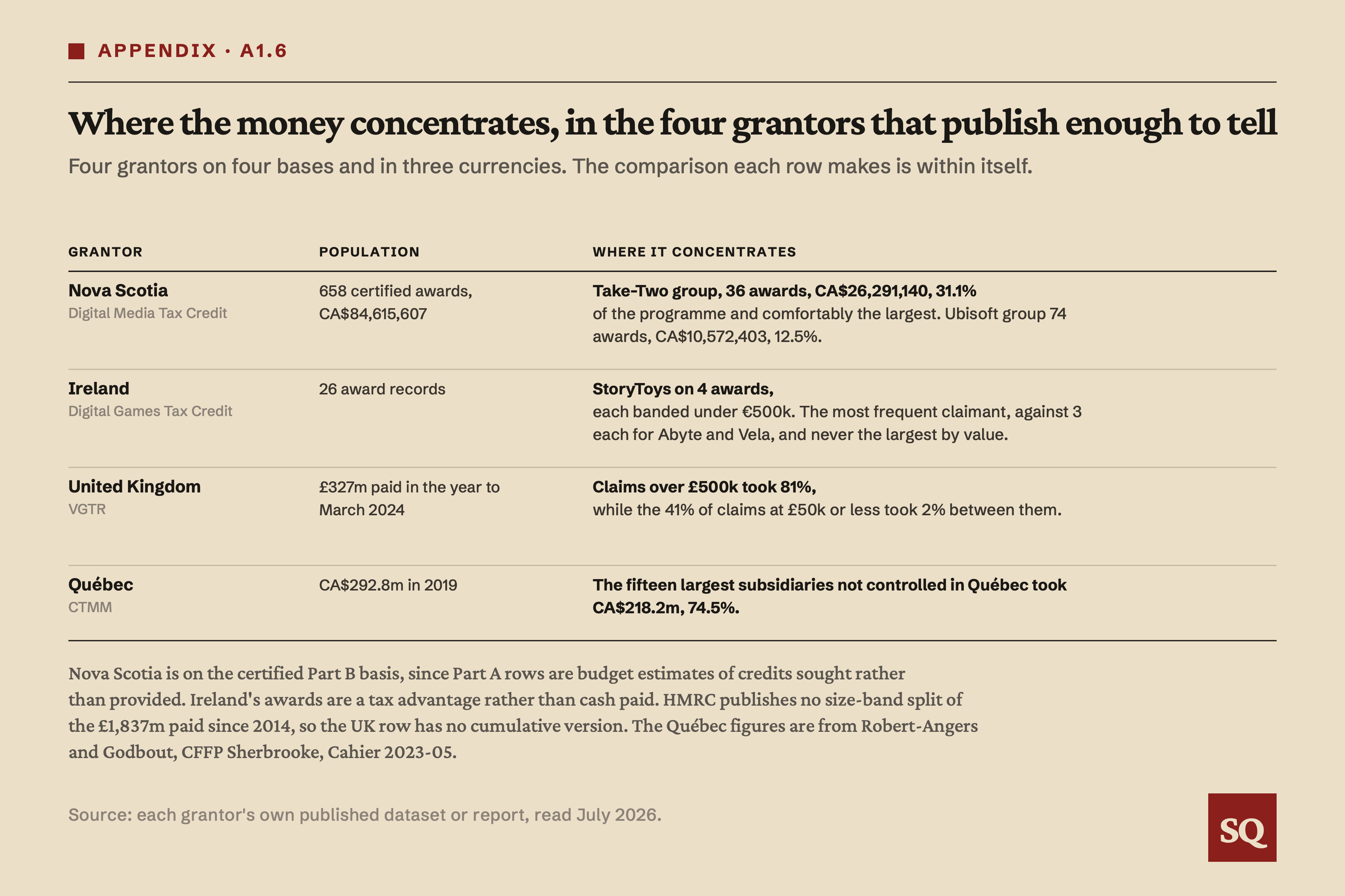
By number most claims are small, and the capped schemes keep them that way. Where there is no company cap the money concentrates, and the largest claims belong to subsidiaries of listed groups. Rockstar’s British studio alone has claimed £504m of UK relief over ten years. In the year to March 2024 two in five UK claims were small enough to take 2% of the money between them, while the largest claims took 81% of it, and in 2019 the fifteen biggest subsidiaries controlled from outside Québec took nearly three-quarters of that province’s credit.
Where the credit becomes the profit
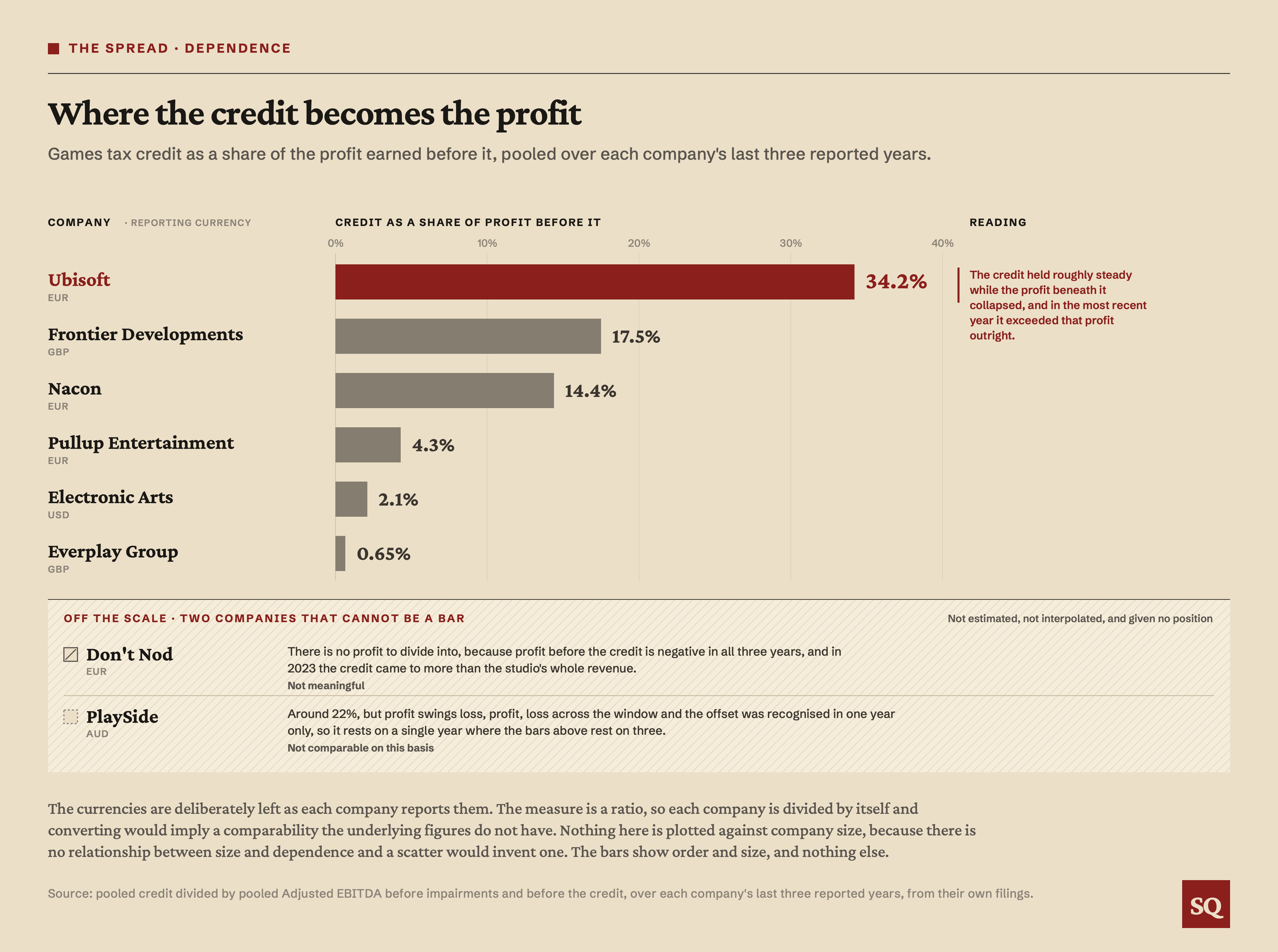
A games credit can be a rounding in a large publisher’s results or the largest single item in a small studio’s, and the exhibit ranks each company by how much of its profit the credit accounts for. At the low end sit EA, whose only disclosed credit is a general research one and which pays above the US federal statutory rate even though its Codemasters studio claims millions in relief of its own, and Everplay, whose UK games relief has shrunk to almost nothing. At the high end is Ubisoft, where the credit runs to about a third of the profit the business makes before it. Don’t Nod sits outside the ranking, because it has made no profit in any of the three years for the credit to be a share of, and in 2023 its credit came to more than its whole revenue.
When the studio is profitable
For a profitable studio the credit is margin, a few points added to an operating profit the company would post without it, and it shows up as a lower tax rate. A low rate on its own says nothing about where it came from, and the general regimes produce lower ones than any games credit does. Where a low rate lasts, a general regime is usually behind it: CD Projekt’s comes from Poland’s research relief and its patent box, both of which sit in the general corporate tax code. A games credit sits in a scheme written for one sector, so a government can change it without touching the code every other company uses, and several are now doing exactly that.
When the studio is losing money
In a loss-making studio the credit stops being margin and becomes the operating result itself, which is what Ubisoft’s last three years show: its releases slipped and its profit fell away while the credit itself barely moved. In the most recent year what Ubisoft drew in credits and grants exceeded everything the business earned before them.
There is also no tax bill left to reduce, so the credit is not a rate at all; it is cash, and only if it is refundable. That is why Don’t Nod could draw its French and Québec credits as working capital while it was losing money, and why a non-refundable credit would have given it nothing until it was profitable again. That distinction is what Québec is now changing, converting its credit from the first kind into the second, on exactly the studios least able to use it.
An investor cannot see what a company draws, or from where
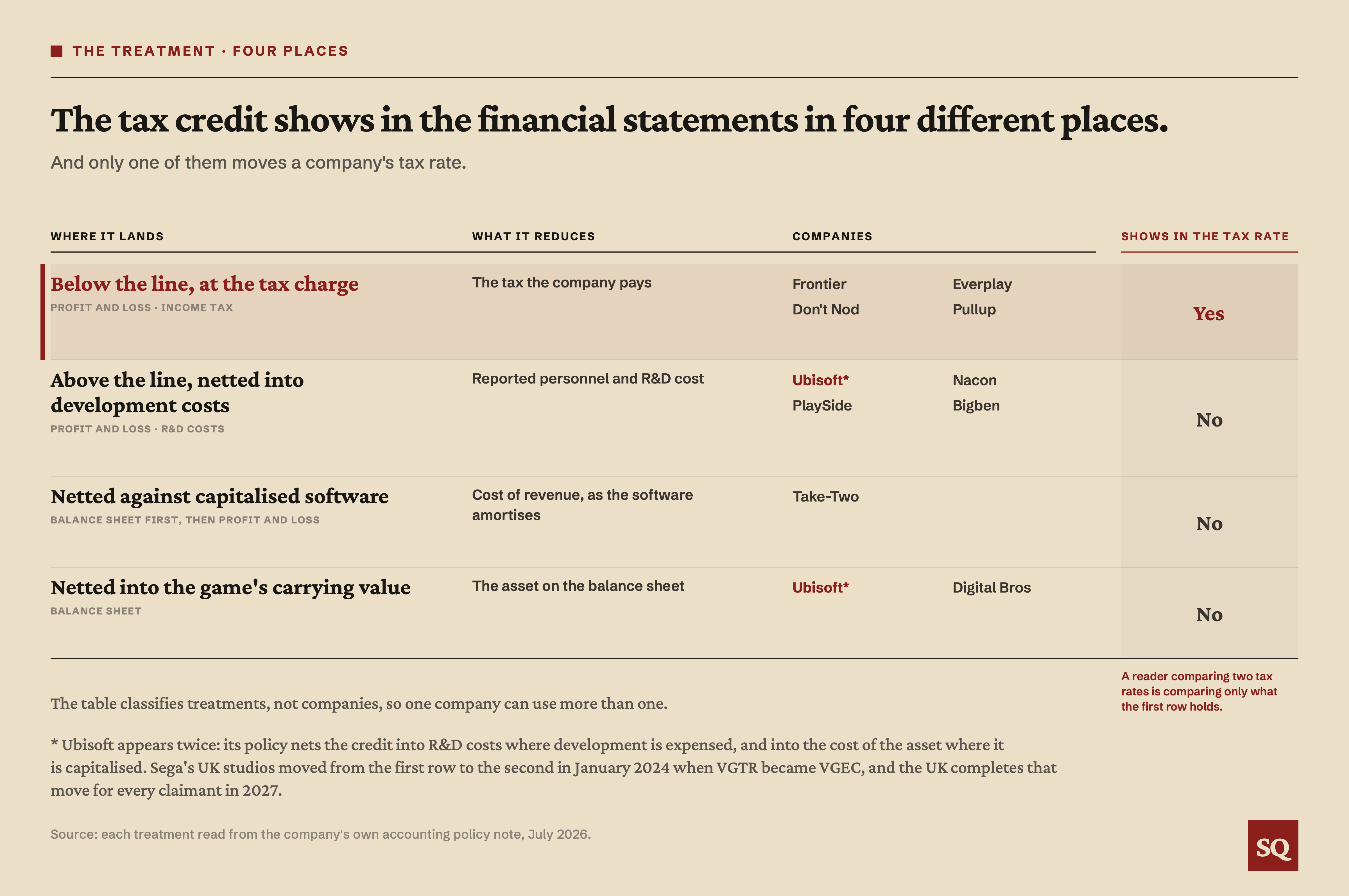
Among the companies that claim a games credit, only a few show it clearly. The self-listed pure-plays name it outright, and so does Ubisoft, which sets its credit out country by country. The larger, more diversified filers, Take-Two among them, take it against the cost of the games instead, where it reduces what the development is carried at rather than what the company pays in tax. The amounts are there in the accounts, and the country that paid them is not. At Digital Bros it is not a line at all. The Canadian grant its studios draw is netted straight into what the game is carried at on the balance sheet, and the Italian relief surfaces only as a provision against incentives that may have to be repaid. For most of the companies whose studios draw a credit, it does not appear in the group accounts in any form.
The difference is not that some companies are more forthcoming than others. A credit is easy to see in a small studio that claims it directly, and hard to see in a large group that consolidates many studios, where the same relief becomes a small item inside a far larger set of accounts. Frontier claims in two countries and names both reliefs in full, down to the few hundred thousand it draws from Manitoba; a group like Take-Two runs credits through studios in several countries, and by the time they reach the consolidated accounts they are one line among many. Both are reporting under the rules that apply to them. The credit is simply less visible the further it travels up through a group.
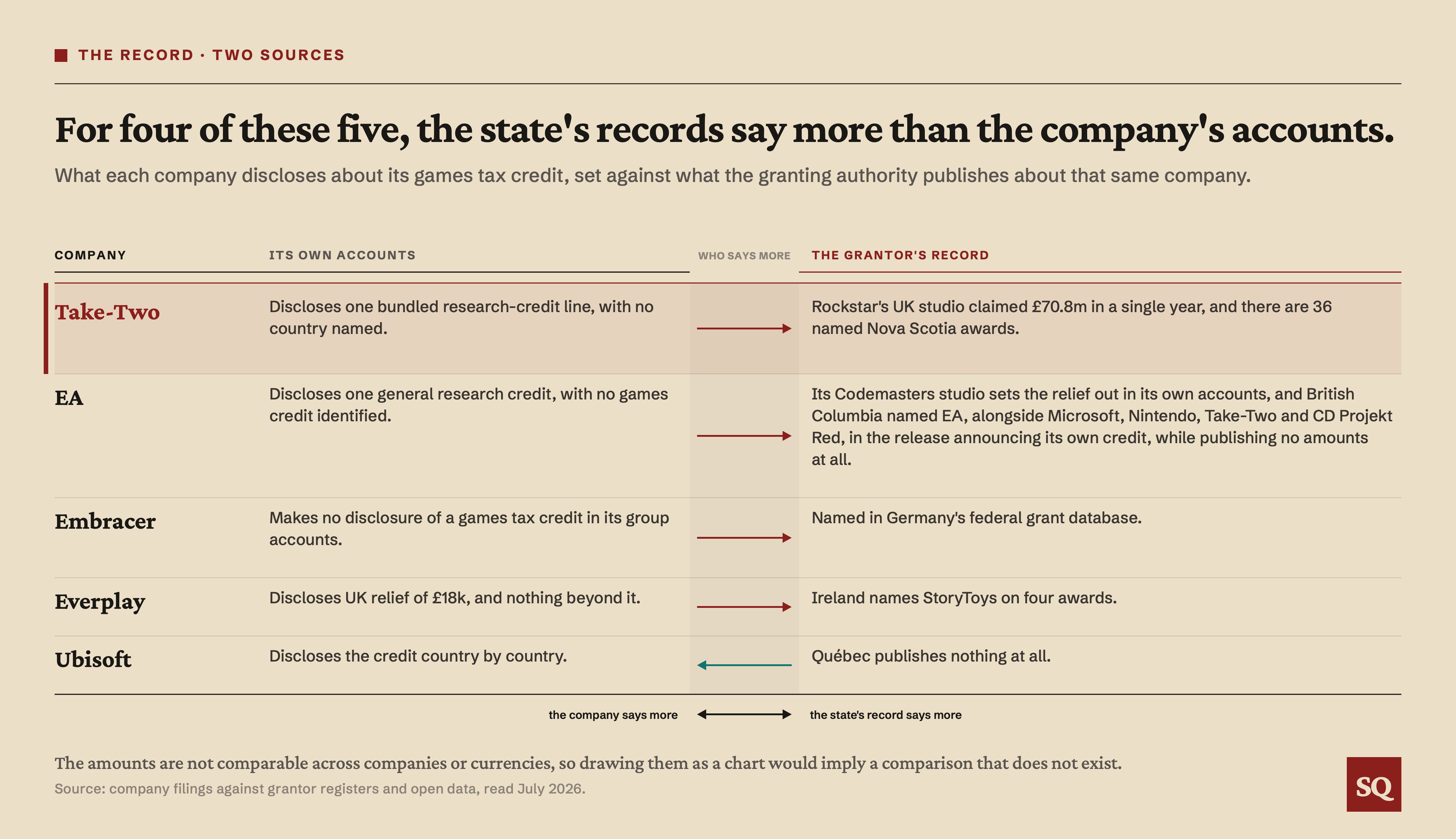
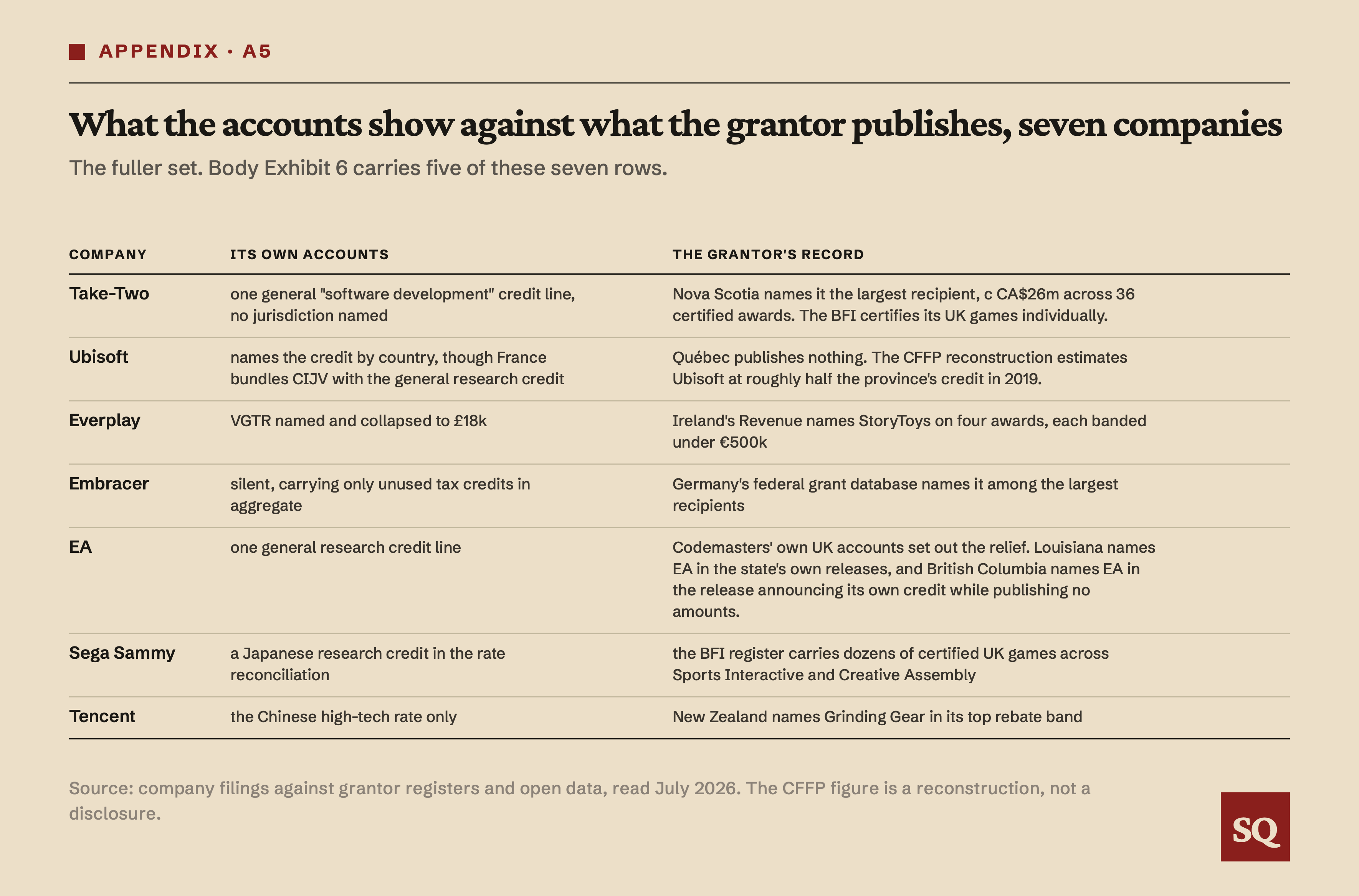
The financial accounts of the video games companies are part of the story, and some governments publish their own records of the recipients of tax credits in their region. Take-Two’s studios between them take the largest share of Nova Scotia’s credit, close to a third of everything the province has certified, and its filings name no Canadian jurisdiction at all. British Columbia publishes no recipient list of any kind, and then announced the rise in its credit to 25% in a release naming Microsoft, Nintendo, EA, Take-Two and CD Projekt Red as developers operating in the province, with a supportive quote from the chief operating officer of EA SPORTS Studios. EA’s British studios set out the UK relief they claim in their own accounts, and none of it reaches EA’s group filings; EA’s Vancouver studio sits in a province that will put the company’s name in a press release and publish nothing about what it pays.
Other large groups sit the same way, their studios named on public recipient lists their filings never mention. Read from the grantor’s side, the set of listed companies drawing on these credits is wider than the filings show, and the exposure an investor cares about is often visible only there. The reconstruction reaches only as far as each grantor allows, and Ireland and Nova Scotia publish every recipient by name while Québec publishes none.
Québec is paying the credit against tax bills its studios do not have
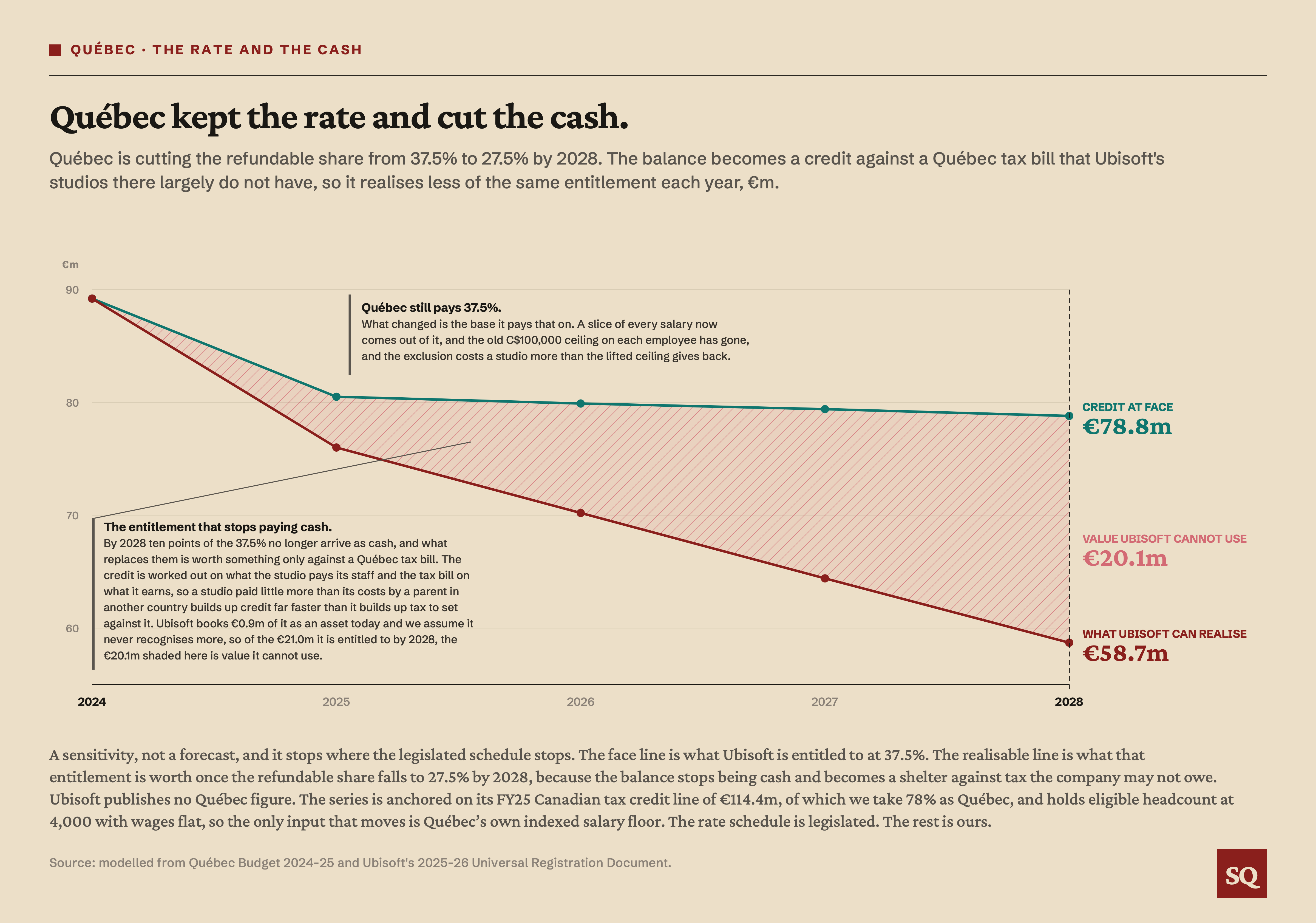
Québec has changed the tax credit it pays its video-game studios in two ways at once.
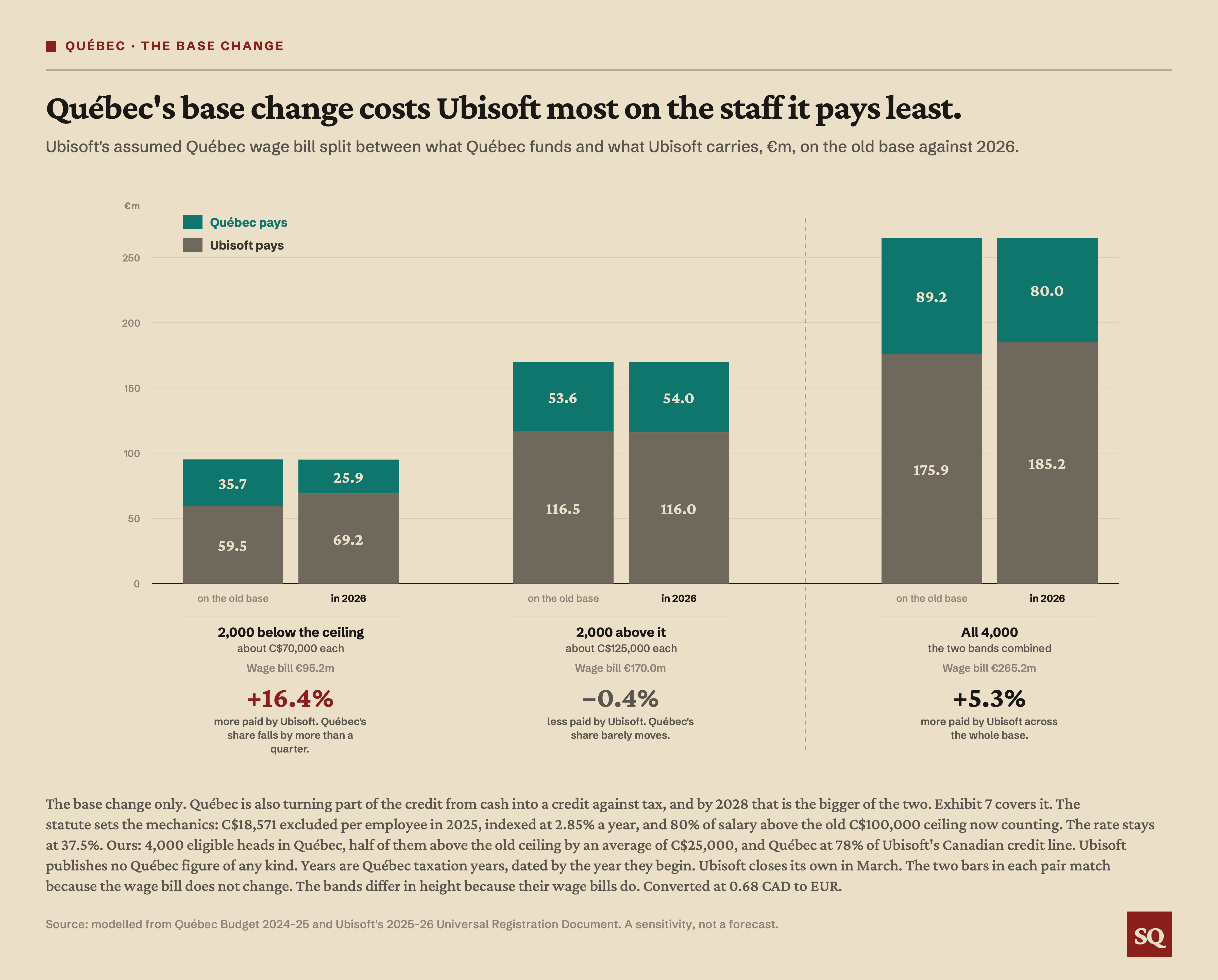
It changed the base the credit is worked out on: A fixed first slice of every salary is now excluded, and the old ceiling on how much of any one salary counts has gone. For example, the excluded slice is Québec's basic personal amount, about C$18,500 a head and indexed each year,so a studio with four thousand eligible staff has roughly C$74m less payroll counting toward the credit each year.
It is converting the credit from cash into a tax reduction, in stages: The credit used to arrive as cash whether or not the studio owed Québec any tax. Part of it is now non-refundable, which means it only reduces a Québec tax bill, so a studio that owes no Québec tax gets nothing from that part.
A studio that develops games for a foreign parent earns most of its profit outside the province, in the company that owns the game, and so it owes little Québec tax for a non-refundable credit to reduce. The part it cannot use never reaches the balance sheet, because a company books a deferred tax asset only so far as it expects the profit to use it against, and for a studio doing contract development for a parent elsewhere that profit may never come. The years it spends most on Québec labour are the years between games, when it earns least, so it accrues the most credit exactly when it has the least Québec profit to absorb it. Most of the province’s large studios are built on that model. Ubisoft says only that the payment of some of its Canadian credits depends on taxable income being generated, and carries under a million euros of deferred tax against the whole pool.
Who the change is for
Québec’s finance ministry says the changes were meant to improve the fairness and impact of the credits, in a labour market it describes as no longer what it was when they were written. Taking a first slice out of every salary costs a studio in proportion to how many people it employs, while lifting the ceiling on each individual salary hands money back only where that salary is high. A studio with a few well-paid people gains on both counts, and one with a large mid-paid workforce loses on both. The chief executive of one Montréal studio read that as the province deciding it wanted high-paying jobs rather than locally owned companies.
Making part of the credit non-refundable sorts the studios by something else. A non-refundable credit is worth its face only against a Québec tax bill, so it holds its value at a studio that owns what it makes and books the profit in the province, and loses most of it at a studio developing under contract for a parent elsewhere, however well that studio trades. Those are not the same two groups. Québec’s largest employers tend both to pay well and to develop under contract for a parent somewhere else, so the salary change treats them kindly and the refundability change does not.
For Ubisoft, the two changes take about a third off its Québec credit by the end of the decade, worth roughly a tenth of the last operating profit the group reported, at a time when the group no longer reports an operating profit at all. None of that is large against revenue, and none of it reaches the tax rate, because a credit netted into development costs falls on operating profit instead.
The exposure runs well beyond Ubisoft: the same Montréal studios do work for a long list of listed parents, among them Take-Two, EA, Embracer, Bandai Namco, Sony and Microsoft, almost none of which put a figure on what the province pays them. Nacon, a smaller French claimant that also draws Québec’s credit, has entered judicial reorganisation.
Closing
The jobs the credits support are real, and every one of these studios sits in a place that decided to write a credit to keep them there. Whether those studios would exist, or stay, without the money is a question the public numbers cannot settle, and it is not the one we set out to answer.
More jurisdictions offer a games credit than did five years ago, and several of the biggest are worth less than they were. Québec is turning part of its own into something most of its large studios cannot use, New York’s lapses after 2027 and Alberta’s is gone, while British Columbia raised its own and made it permanent over the same period.
The dependence belongs to the company, not the industry. For a company that leans on a credit it can be the difference between an operating profit and a loss, which is where EA’s Codemasters sits at the subsidiary level and where Ubisoft now sits at the group, and it rarely shows in the group accounts as more than a single line. Capcom keeps its development in Japan and runs a margin near 40% with nothing behind it but an ordinary tax credit any Japanese manufacturer could claim. The question for the rest is how much of their profit a government is currently paying for, and how long it intends to keep paying it.
More from The Side Quest
Sony: When do you switch off physical distribution? Sony is ending PlayStation disc production in January 2028. A platform switches physical off when demand for the object falls below the cost of the channel that carries it.
Jason Della Rocca (Griffin, Execution Labs, ex-IGDA): “Zero-to-evidence is where the market failure is” Most funds now wait for proof that players want a game, and reaching that proof often runs on savings, a grant if your country has one, or an incubator place if you can get one.
Microsoft and Xbox: Separable, but still staying Microsoft has done everything you would do before selling Xbox. We priced seven ways of doing it, and every one it can execute itself is worth less than doing nothing.
AppLovin vs Unity: are two of the market’s favourite ad engines worth it? We read the job postings on both sides of this market, the ad networks and the studios that buy from them, to test whether AppLovin’s and Unity’s ad-engine growth is worth what the market pays.
Epic Games: what is it worth, and what did the generosity cost? Fortnite pays for four free layers. The cash Epic captures is worth about $7.5bn; the tools it under-monetises lift fair value toward $14bn, and the last mark sits in between.
Roblox: A great company lost on valuation - It owns the most complete stack in interactive entertainment yet profits from it the least, and rising costs are eating into what little is left.
AI won’t make AAA games materially cheaper to develop - the productivity gains are real, but two-thirds of the value leaves the P&L to the AI vendors before it reaches the bottom line.
Appendix
Every figure here comes from a company’s own filing, a subsidiary’s statutory accounts, or the granting authority’s own publication, and each carries its source and the date it was read. Where a number is inferred rather than disclosed, it says so at the point of use.
The claiming universe is seventy-nine listed games companies, each read from its own primary filing, with a three-year trace across parent and subsidiary accounts run on every candidate claimant. The scheme map covers thirty-four jurisdictions. That is not a survey of the world: we worked outward from where these seventy-nine companies build, so a country none of them builds in was never examined, and the count should be read as the floor it is.
A1. The claiming universe: who claims a games credit, and who shows it
Classification rule: owning a development studio in a credit jurisdiction is not a claim. Only a traced claim counts, meaning (a) the subsidiary’s own statutory accounts name the credit, (b) a grantor’s record names the company or its title, or (c) a parent line ties arithmetically to games-credit activity. Studio footprint alone establishes only that a company could claim and that its accounts are silent, which is a different fact and is never written as a claim.
The universe: 81 baseline less AppLovin (games business sold, closed 30-Jun-2025) less Thunderful (delisted from Nasdaq First North; last trading day 24-Feb-2026, Atari compulsory redemption) = 79, with Nazara IN.
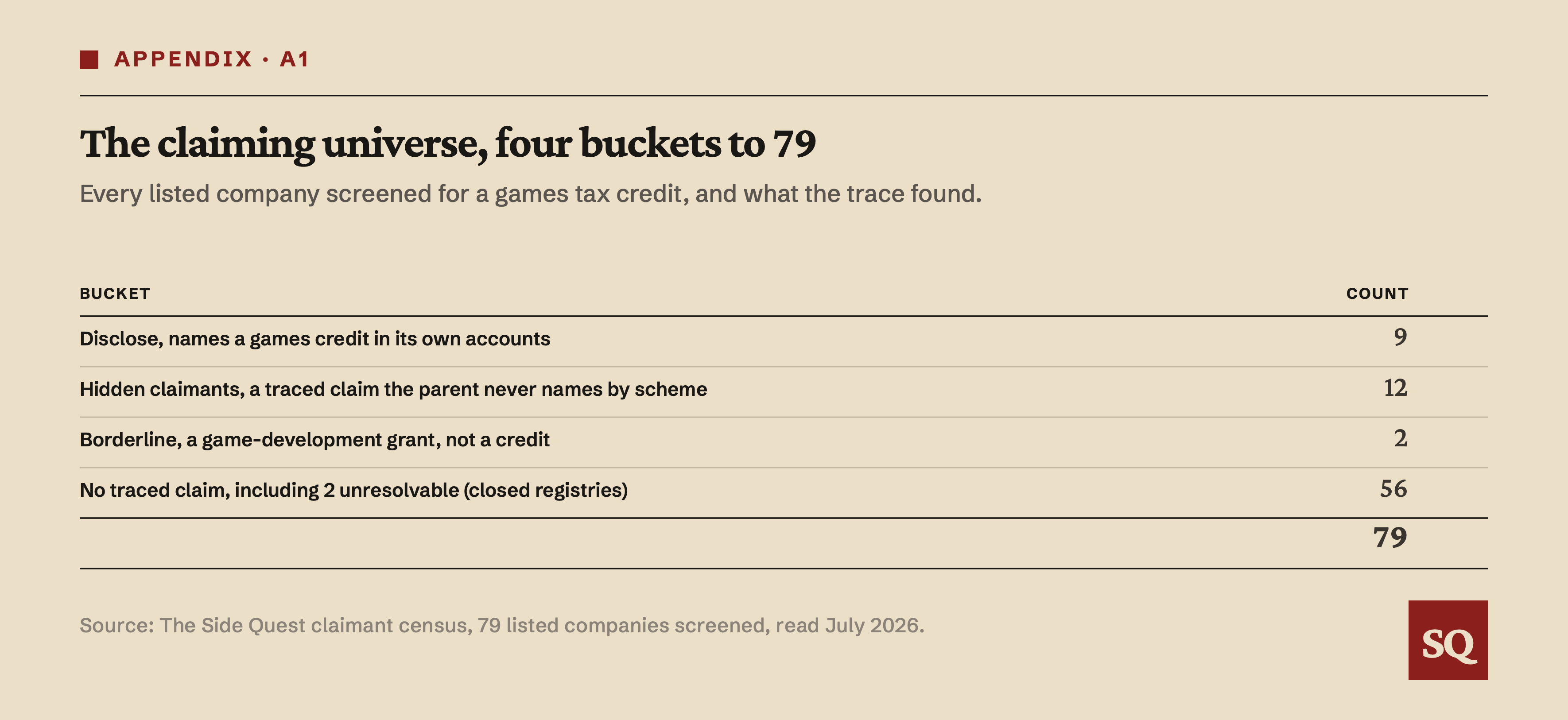
The finding: among the companies that claim, more than half never name it. Twenty-one of the roughly eighty listed games companies claim a games credit. Nine name it in their own accounts. Twelve do not, and their claims are visible only in a subsidiary’s own filings or a grantor’s register.
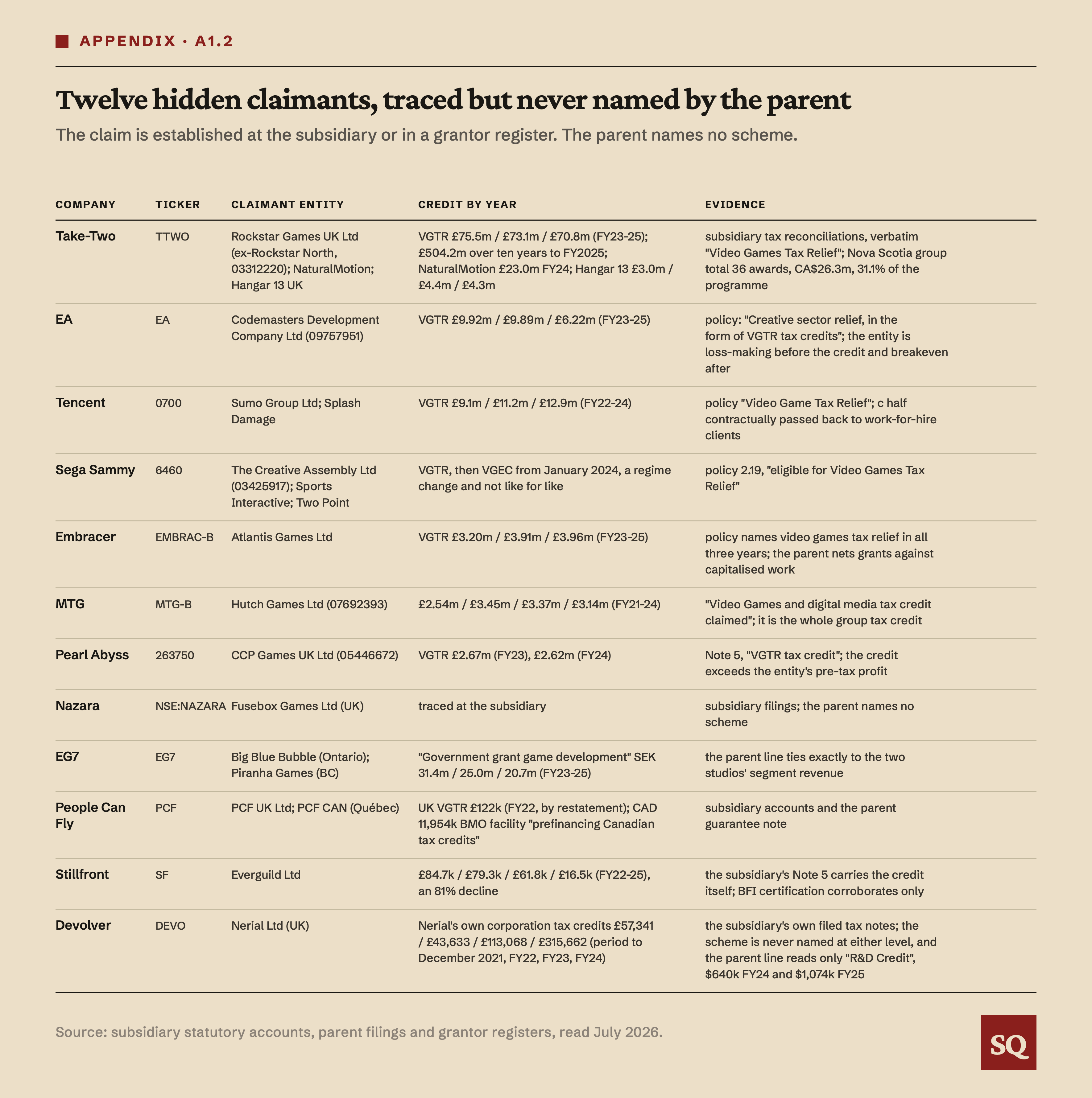
The scale of what the group accounts omit: Rockstar’s UK studio alone claimed £70.8m of VGTR in FY2025 and £504.2m across the ten years to FY2025 (Rockstar Games UK Ltd, CH 03312220, from eleven filed sets of accounts). Take-Two’s own tax reconciliation names a separate US Research & development credit of $45.1m (FY26); its production credits never reach the tax line at all, being netted against capitalised software under IAS 20 by analogy, reducing cost of revenue by $75.5m (FY26) and $167.4m (FY25) with $283.4m of grant receivables outstanding. The amounts are disclosed; the jurisdictions and schemes never are.
A1.1 Names a games credit in its own accounts (9)
A1.2 Hidden claimants: the claim is traced, the parent names no scheme (12)
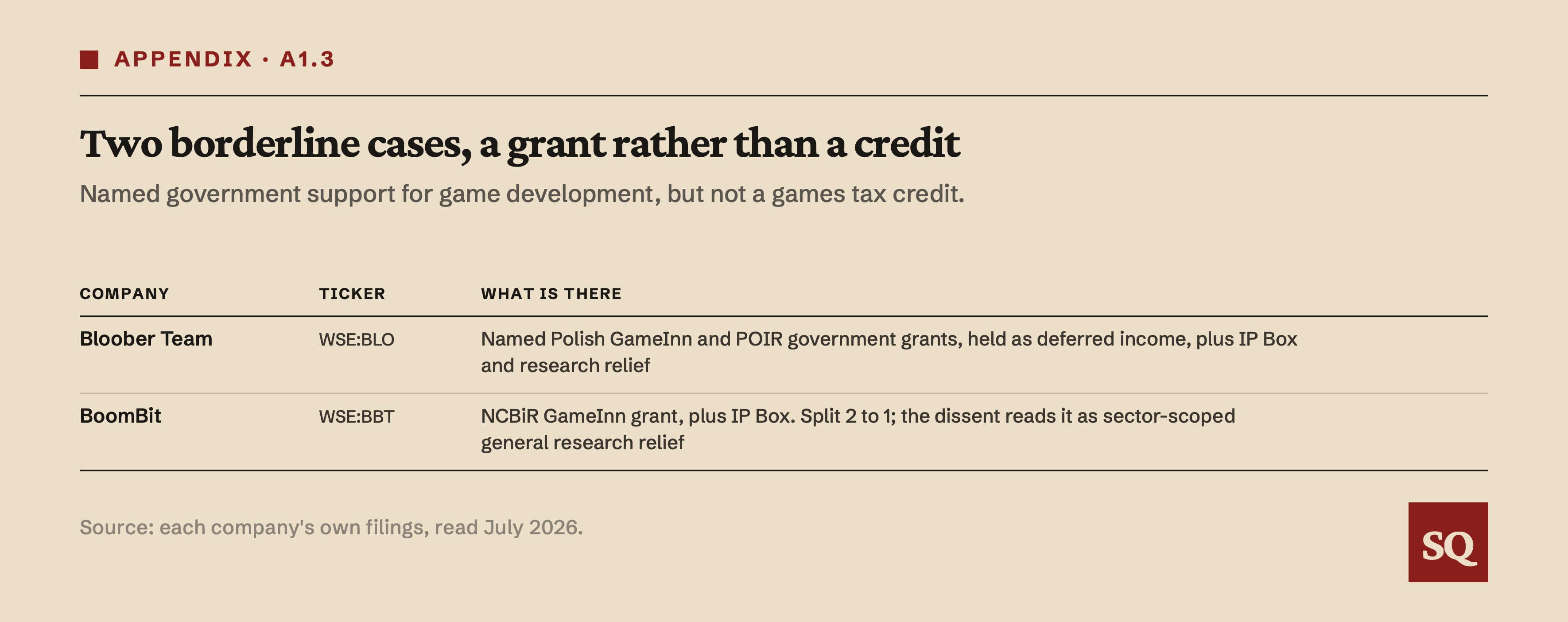
A1.3 Borderline: a game-development grant, not a credit (2)
A1.4 No traced claim (56)
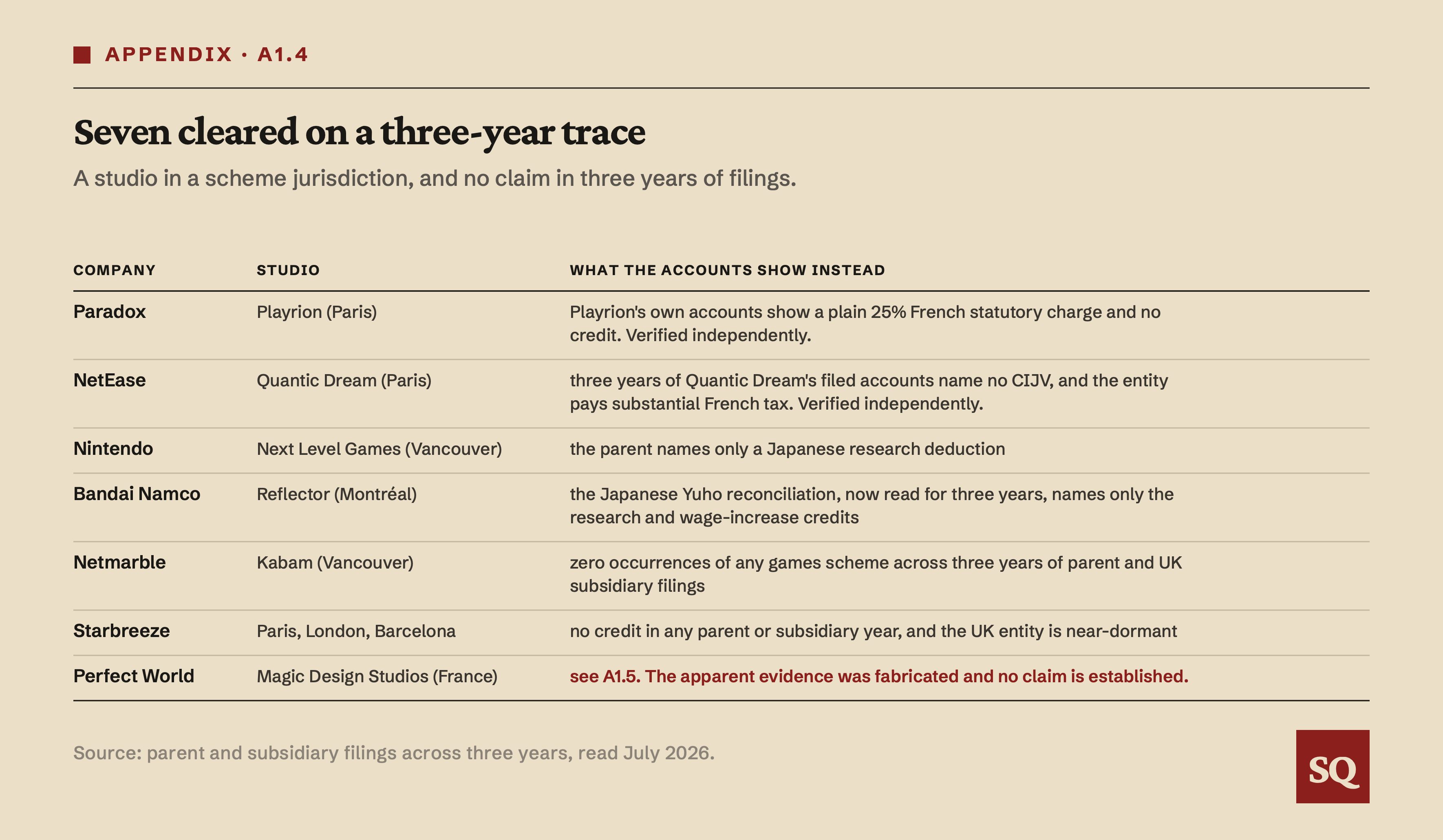
Cleared on a three-year trace (7). Each owns a development studio in a credit jurisdiction, and three years of parent and subsidiary accounts show no games credit in any year:
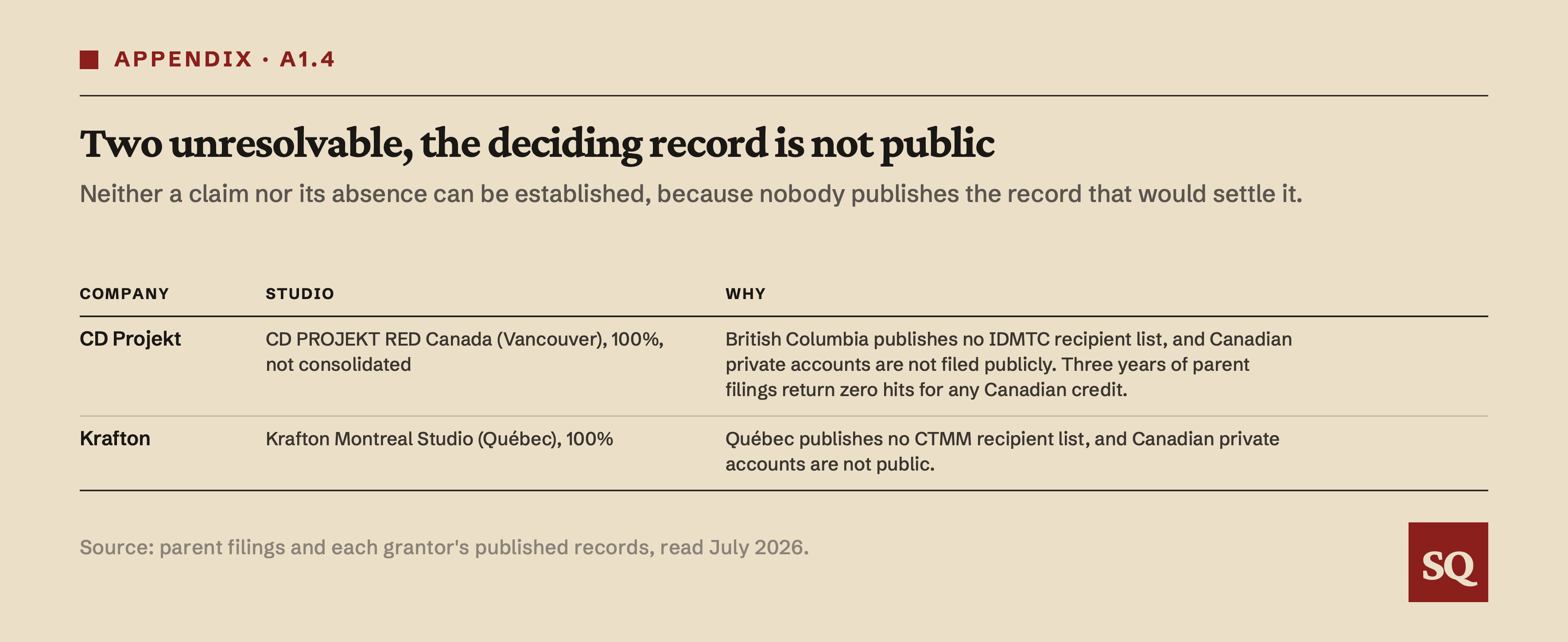
Unresolvable, the deciding record is not public (2). Neither is a claimant on the evidence, and neither can be cleared:
No games credit and no studio in a credit jurisdiction (46). These reach their effective rate on general regimes only, and are the clean controls: Capcom, Koei Tecmo, Konami, Nexon, Square Enix, Kadokawa (Japan); NCsoft, Nexon Games, Shift Up, Webzen (Korea); Roblox, Playtika, Unity, GDEV, DoubleDown, PLAYSTUDIOS, Snail, Skillz (US); 11 bit, PlayWay, CI Games, Ten Square, Huuuge, Creepy Jar (Poland); Remedy, G5, Coffee Stain, Maximum, Nitro (Nordics); Bilibili, XD, Kingsoft, G-bits, 37 Interactive, Century Huatong, Giant, NetDragon (China); Sea, Gravity, IGS, Soft-World, Userjoy, Asiasoft (Taiwan/SEA); tinyBuild, Azerion, Atari SA.
A1.5 How the universe was verified, and what it cannot settle
Method: every company was read from its own primary filing, and all 22 candidate claimants were then traced across three years of parent accounts and the named subsidiaries’ own statutory accounts (Companies House, CRO, French greffe filings), against grantor registers including the BFI cultural-test register and the Nova Scotia and Ireland recipient lists.
What three years showed that one would not: four companies with only a studio footprint turned out to be claimants on their subsidiaries’ accounts (EA, Tencent, Embracer, Stillfront), six were cleared (Paradox, NetEase, Nintendo, Bandai Namco, Netmarble, Starbreeze), and two cannot be settled either way (CD Projekt, Krafton). A latest-year check would have missed all of it.
A certificate is not a claim. A BFI certificate attests that a game passed the cultural test, which the Corporation Tax Act 2009 (s1217CB) makes a precondition of claiming rather than evidence that anything was claimed. Applying that distinction separates two cases: MAG Interactive holds certificates and its subsidiary accounts carry no credit, so it is not written as a claimant, while Devolver and Stillfront are claimants on their subsidiaries’ own filed tax notes rather than on certification.
Time-series findings a single-year check would have missed: EA’s UK claim is falling (£9.9m → £6.2m) and its claiming entities are being dissolved (three Codemasters entities struck off in Mar-2024, Codemasters Group Holdings dissolved Apr-2026); Stillfront’s Everguild claim has fallen 81%; Sega’s UK studios moved from VGTR to VGEC in Jan-2024, changing the credit from a below-the-line tax item to taxable above-the-line income.
A1.6 Grantor populations, read from the official datasets
A2. The scheme map
Thirty-four jurisdiction-level schemes were verified against the grantors’ own published sources on 28 and 29 July 2026, each parameter carrying its source and the date it was read. Fifteen are games tax credits. Nineteen are not, and the exhibit labels the instrument rather than presenting them as equivalent.
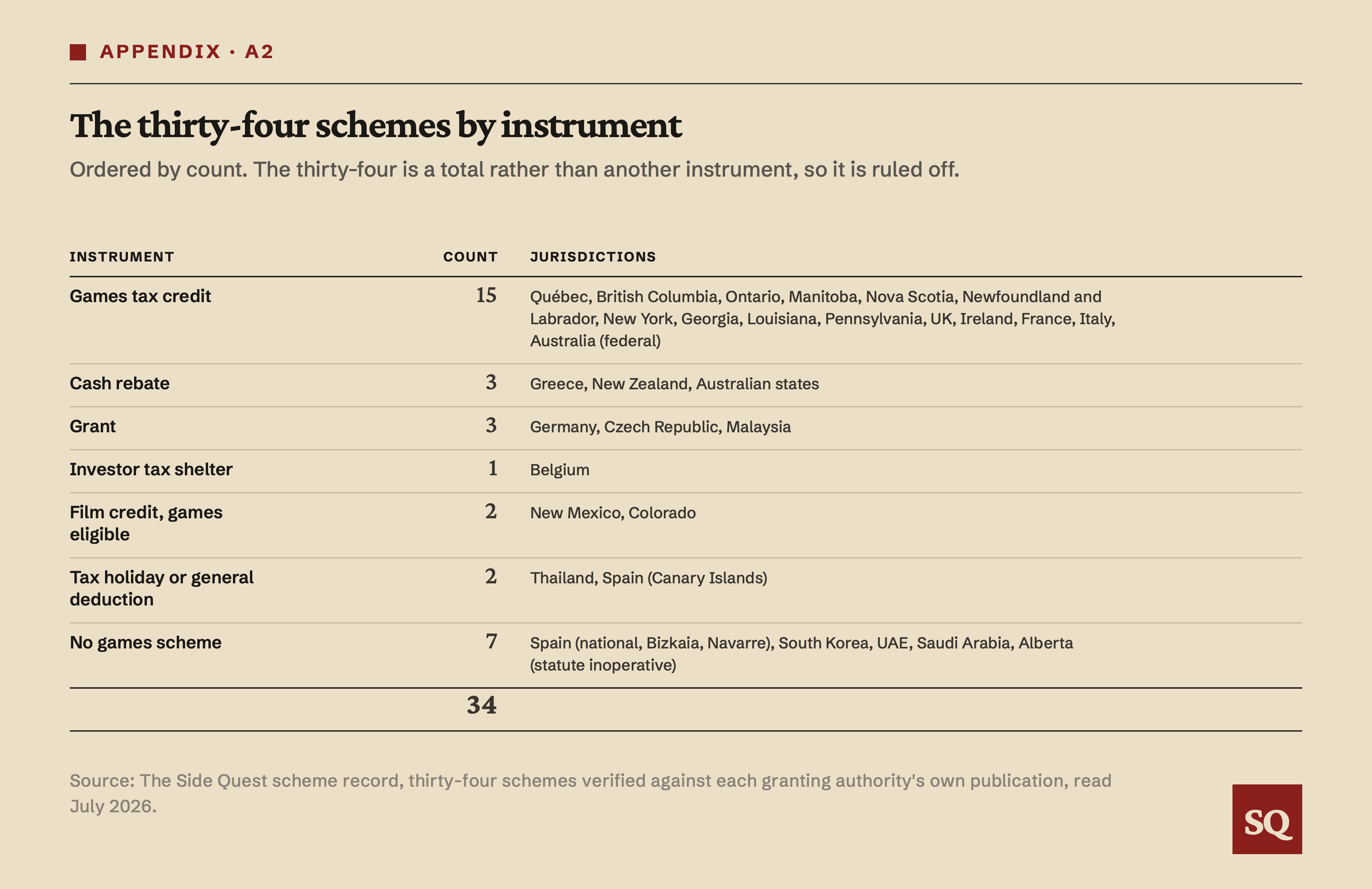
Of the fifteen games tax credits, five are national (UK, Ireland, France, Italy, Australia) and ten are sub-national, all of them Canadian provinces or US states. The “menu has roughly doubled” claim in the opening rests on national schemes, twelve of them with ten operational, and not on this credit count.
The base the doubling is measured from. The opening claim needs a denominator, so we dated every national scheme in the population against a single question, could a video games company claim it on 1 January 2019, and five of them could.
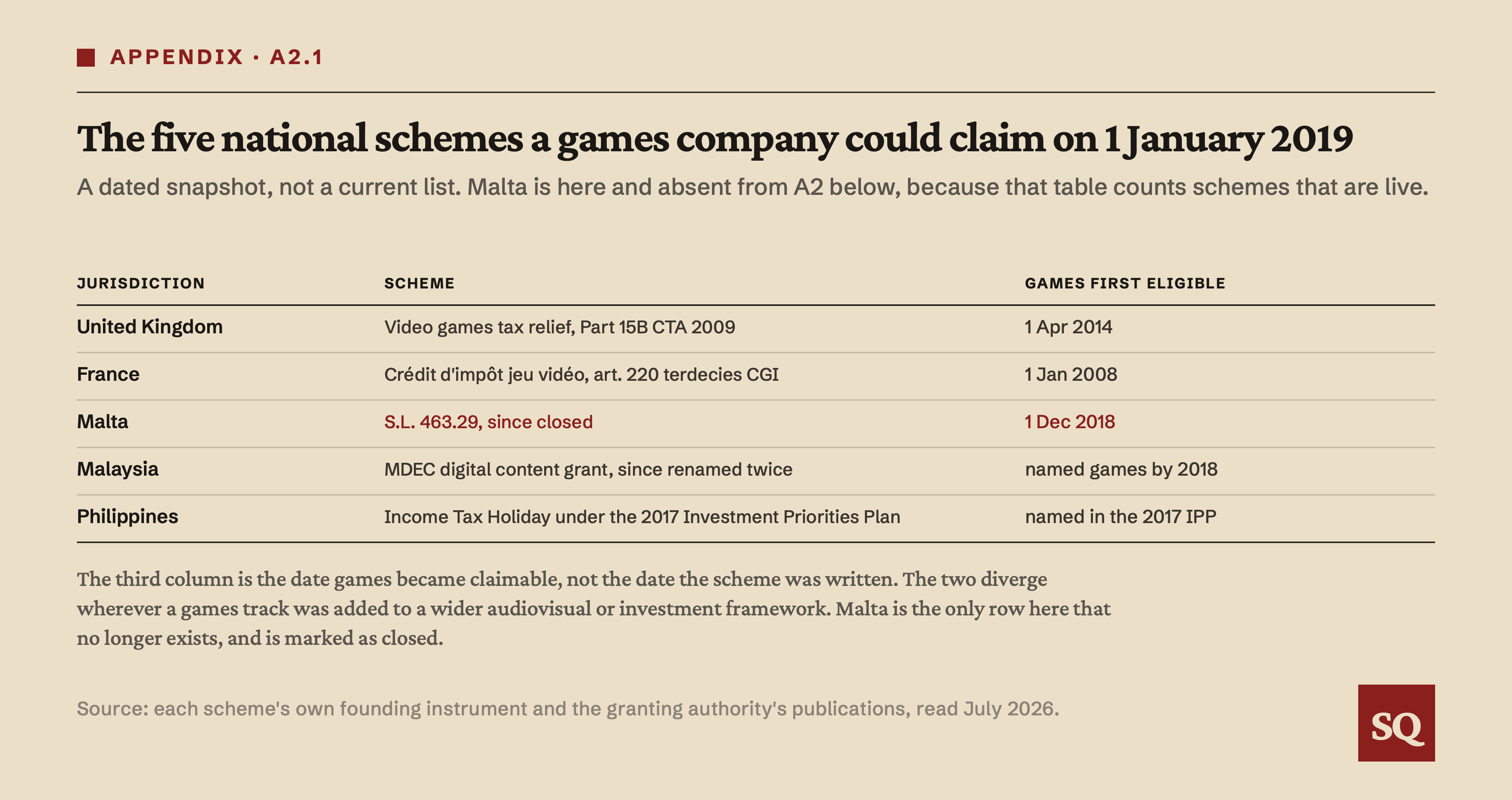
That is five in 2019 against ten operational now. Two things in the count would each have moved it:
Malta was live on the baseline date and is not in the current thirty-four, which counts only live schemes. A 2019 base cannot be built by filtering today’s population by date, because that silently drops every scheme that closed inside the window. Alberta is the same shape sub-nationally.
The Philippines changed the vehicle, not the eligibility. Its current regime dates to 2021, but “game development” was expressly named in the 2017 Investment Priorities Plan, in force on the baseline date. Dating it by the current instrument would have counted an administrative reorganisation as growth.
We date each scheme from when games became claimable under it. Several run inside wider audiovisual or investment frameworks that games were admitted to later, and Italy is the clearest case: the framework law is Legge 220/2016, but games reach it only through the implementing decree of 12 May 2021, and the tax codes created for the 2016 credits in October 2018 contain no videogames code at all.
Each row was dated against the granting authority’s own text. Where a scheme names games in law but requires a further instrument before anyone can file, we date it to the instrument, which is set out under conventions in A7.
A2.1 The games tax credits
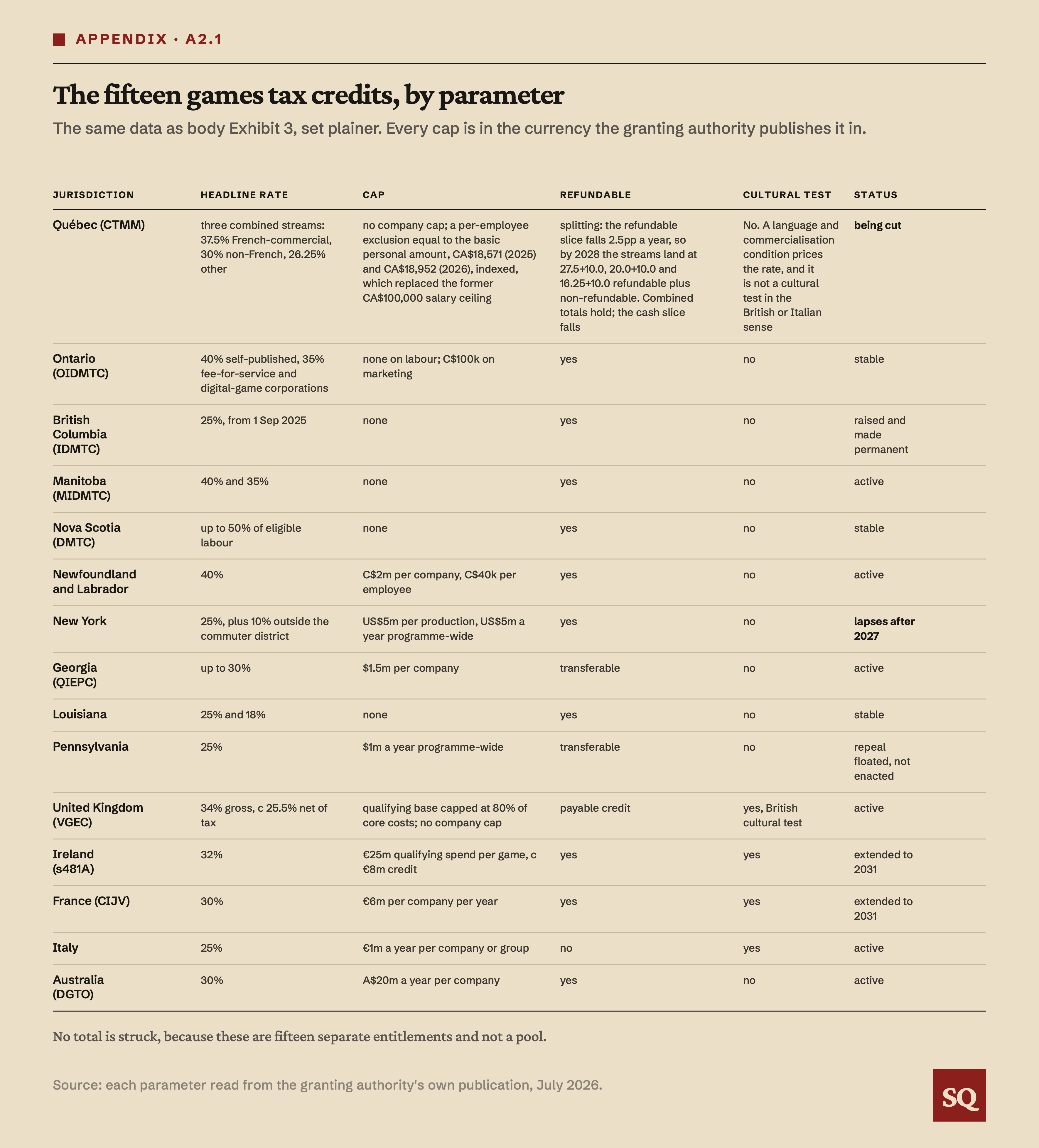
Malta ran a 30% credit capped at €200,000 per undertaking over three rolling fiscal years. The scheme lapsed on 31 December 2020 and Malta Enterprise lists it among closed measures, which is why Malta does not appear above.
A note on the cultural-test column. Four schemes run a cultural test proper, in the UK, Ireland, France and Italy, each certifying that the game is culturally British, Irish, French or Italian. Québec is not one of them, and our scheme record carries it as no test. What Québec runs is a language and commercialisation condition that selects between three rates rather than deciding eligibility, which is a materially different instrument and is set out in the row above. Greece runs a cash rebate rather than a credit and sits outside this table.
A2.2 The general regimes named in the body
§1 states that the games-specific schemes are only one of two things holding a studio’s tax bill down, and names four general regimes. They sit outside the fifteen games tax credits and outside the thirty-four verified schemes, so they are recorded here rather than in the table above.
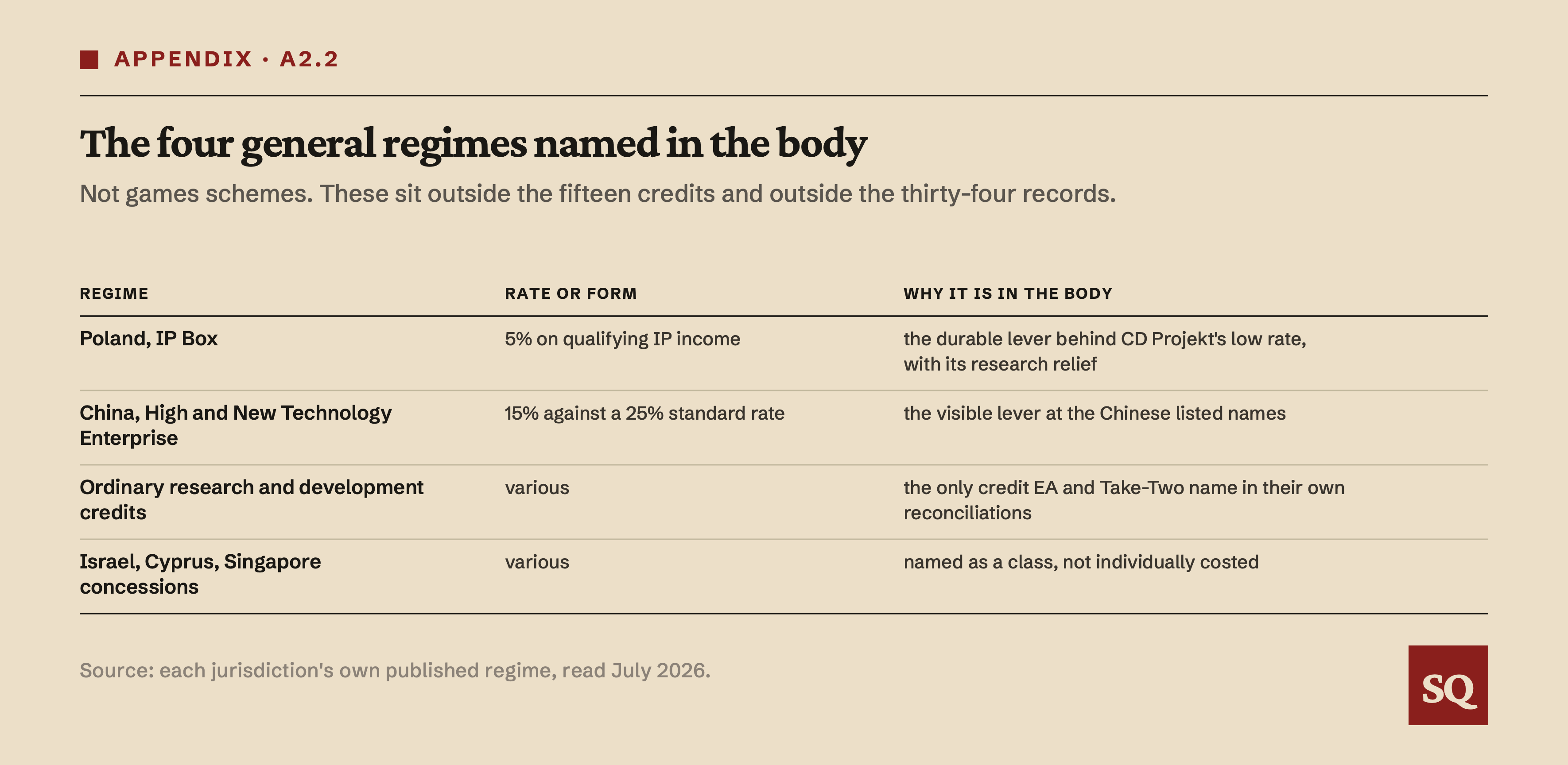
These are lighter records than the thirty-four above. Each rate was confirmed against the granting authority’s own text, and neither is a games scheme, so neither enters the fifteen.
A3. Where a credit lands in the accounts
The same relief reaches four different lines depending on the reporting framework and the filer, which is why amounts are not comparable across companies and why only the first of the four moves an effective tax rate.
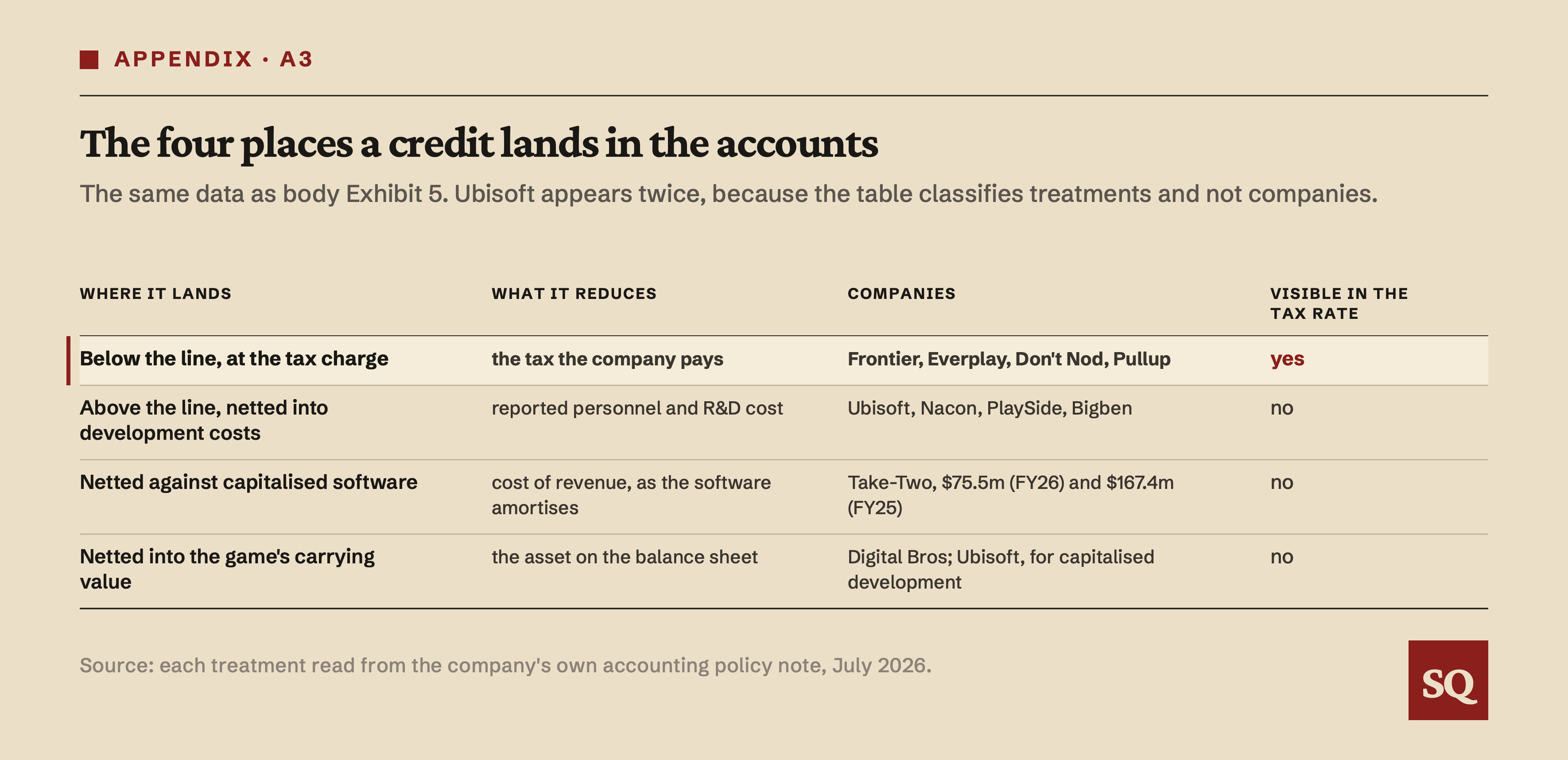
Sega’s UK studios moved from VGTR to VGEC in January 2024, which shifted them from the first row to the second. The trend across the frameworks runs the same way, from a visible tax item toward an invisible operating one, and the UK completes that move for everyone in 2027.
A company can sit in two rows. Ubisoft’s own accounting policy states that income from these incentives is presented as a reduction to R&D costs in the income statement, and that for capitalised research and development costs it is instead recorded as a reduction in the cost of the asset. So the expensed portion reaches the operating result immediately and the capitalised portion reaches it later, through amortisation. The classification is of treatments, not of companies, and the exhibit should be read that way.
A3.1 Where the credit sits in Ubisoft’s income statement
The exhibit that carries this is built on the statement below rather than on a model, so every figure is a filing figure.
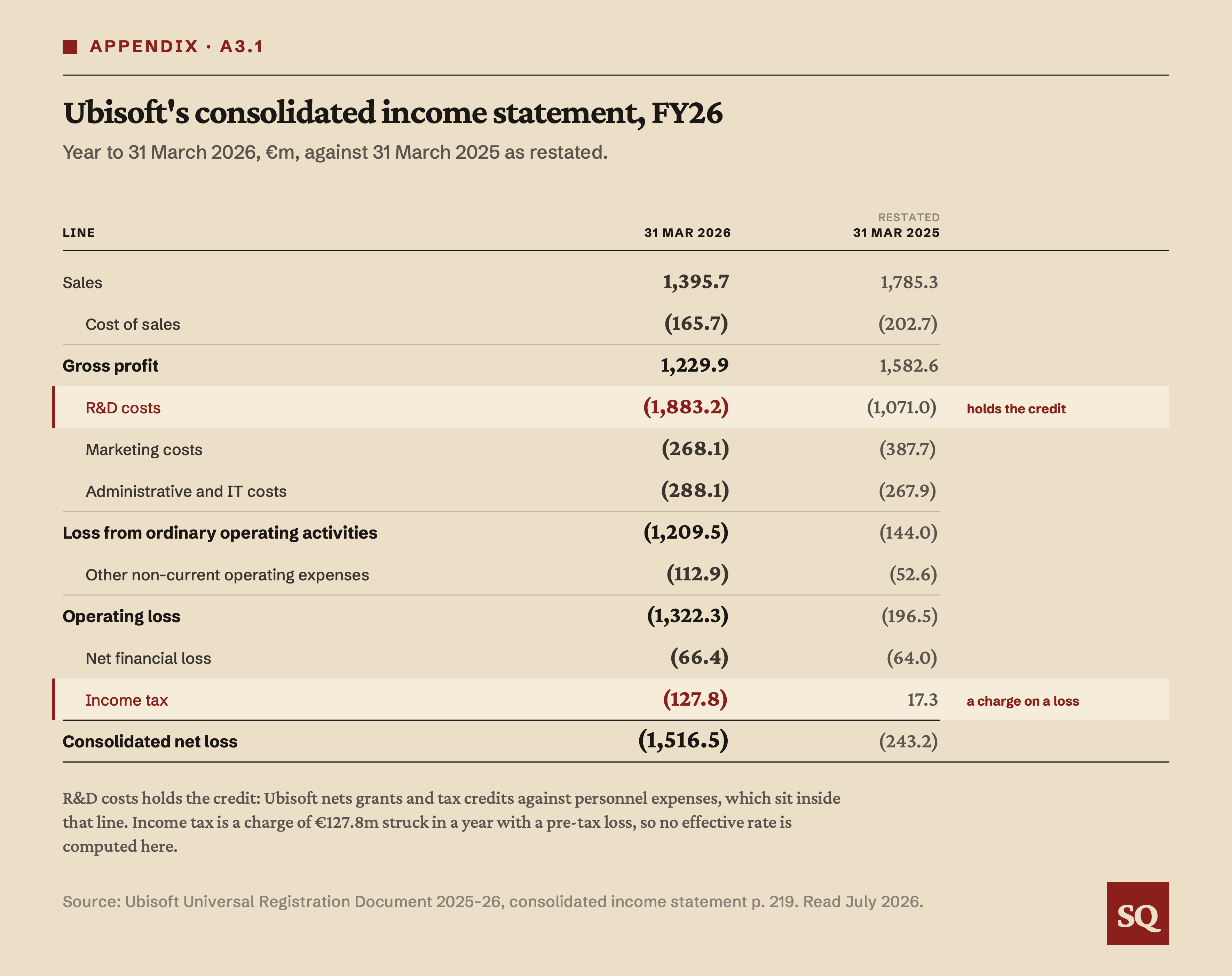
Grants and tax credits are presented as a reduction inside personnel expenses, which sit within R&D costs. Personnel expenses recognised in operating income were €1,113.1m, being salaries of €975.0m and payroll taxes of €254.2m, less €151.4m of grants and credits, plus €35.4m of stock-based compensation.
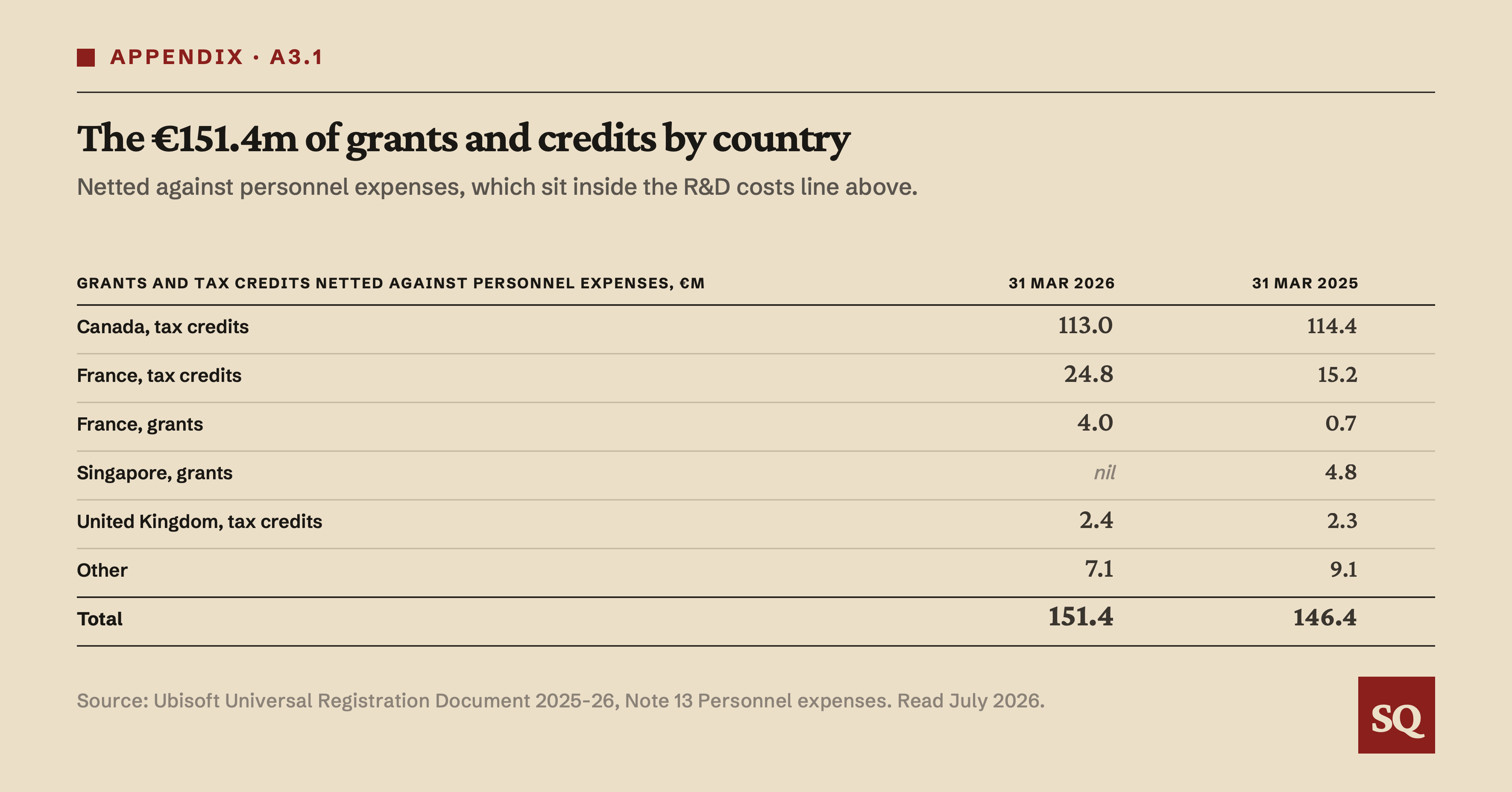
Two things follow, and the exhibit carries both. The credit reduces an operating cost line, so any reduction in it lands on the operating result and on nothing above it. And the income tax line is a charge of €127.8m struck on a pre-tax loss of €1,388.7m, so a reader looking for a games subsidy in the effective tax rate will not find one at this company and would not have found one in a good year either. No effective rate is shown, because the ratio of a charge to a loss is not a rate a reader can use.
Ubisoft’s only statement about realisability is a footnote to the Canada line: the payment of some tax credits is contingent upon the generation of taxable income. It names no province, so the Québec attribution in the analysis is ours and is flagged as inferred.
A4. Earnings dependency
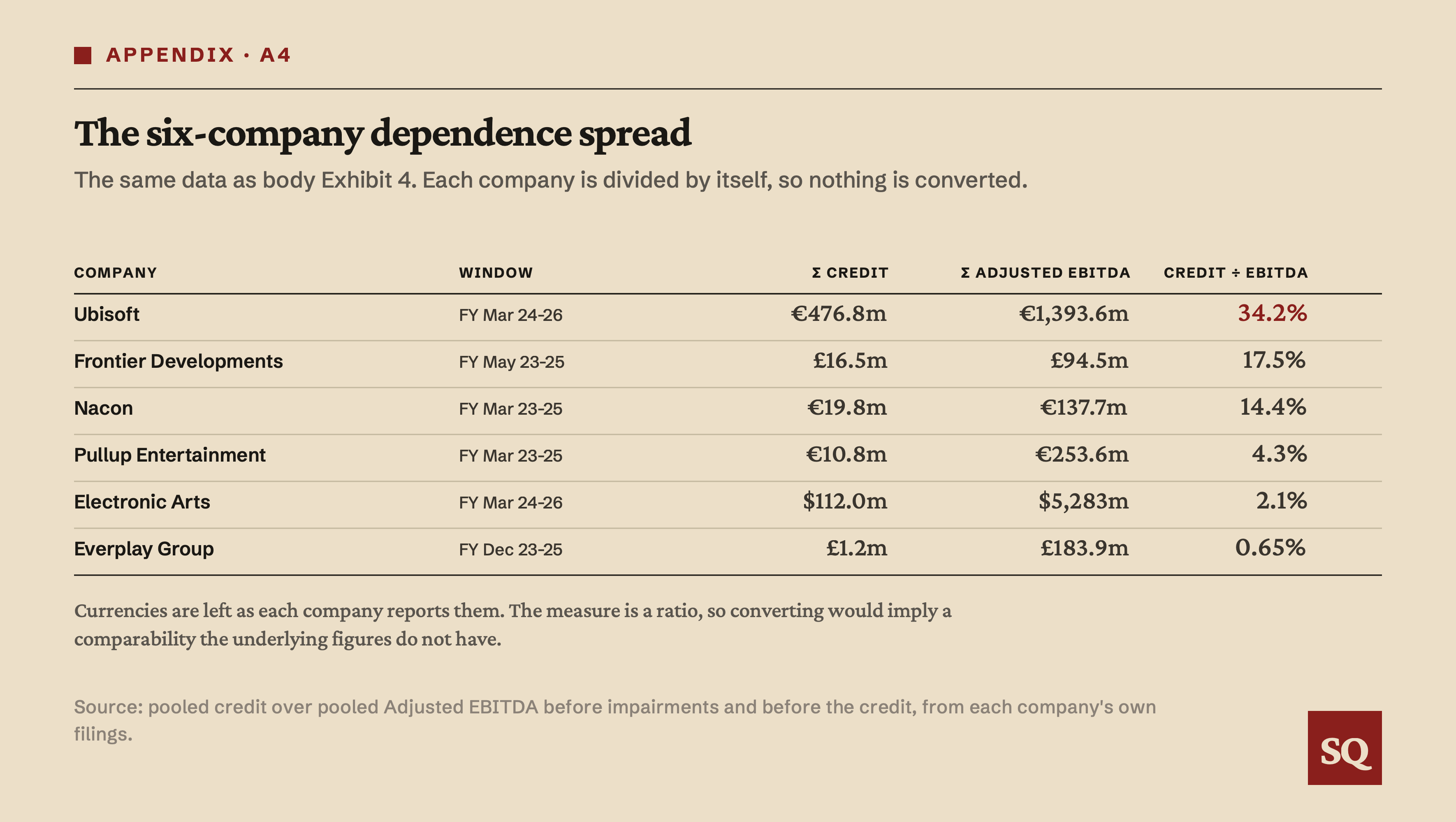
Metric: pooled games credit ÷ pooled Adjusted EBITDA, taken before impairments and before the credit itself, over each company’s latest three reported years. Pooling rather than averaging annual ratios stops a single weak year dominating. Where a credit sits inside reported EBITDA it is subtracted back out of the denominator, so the ratio measures the credit against the profit earned without it.
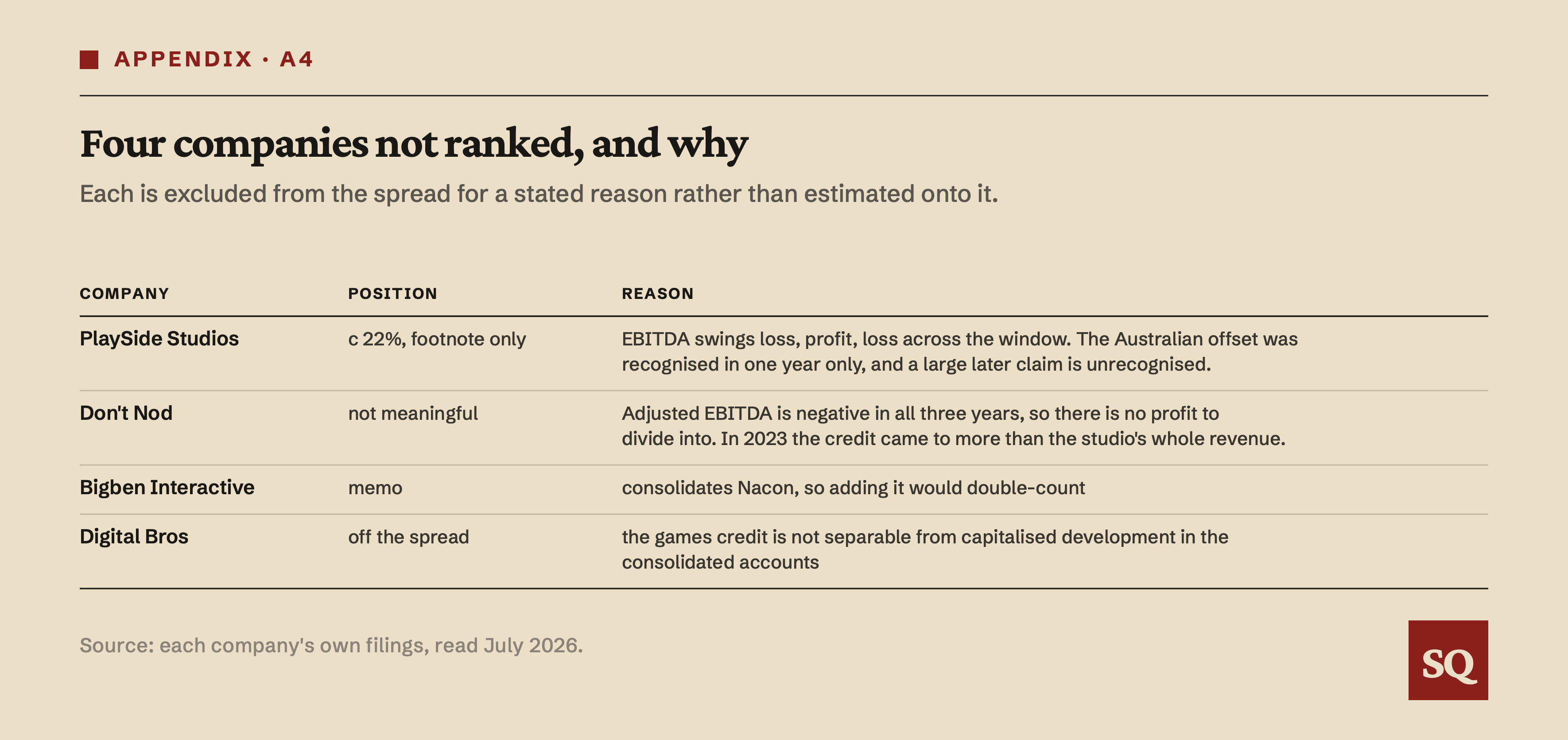
Not ranked, and why:
Ubisoft’s 34.2% is company-specific driven rather than a structural claim: the credit held roughly steady while profit collapsed, and in the most recent year the credit exceeded pre-credit Adjusted EBITDA outright.
A5. What the accounts show against what the grantor publishes
A5.1 The transparency spectrum
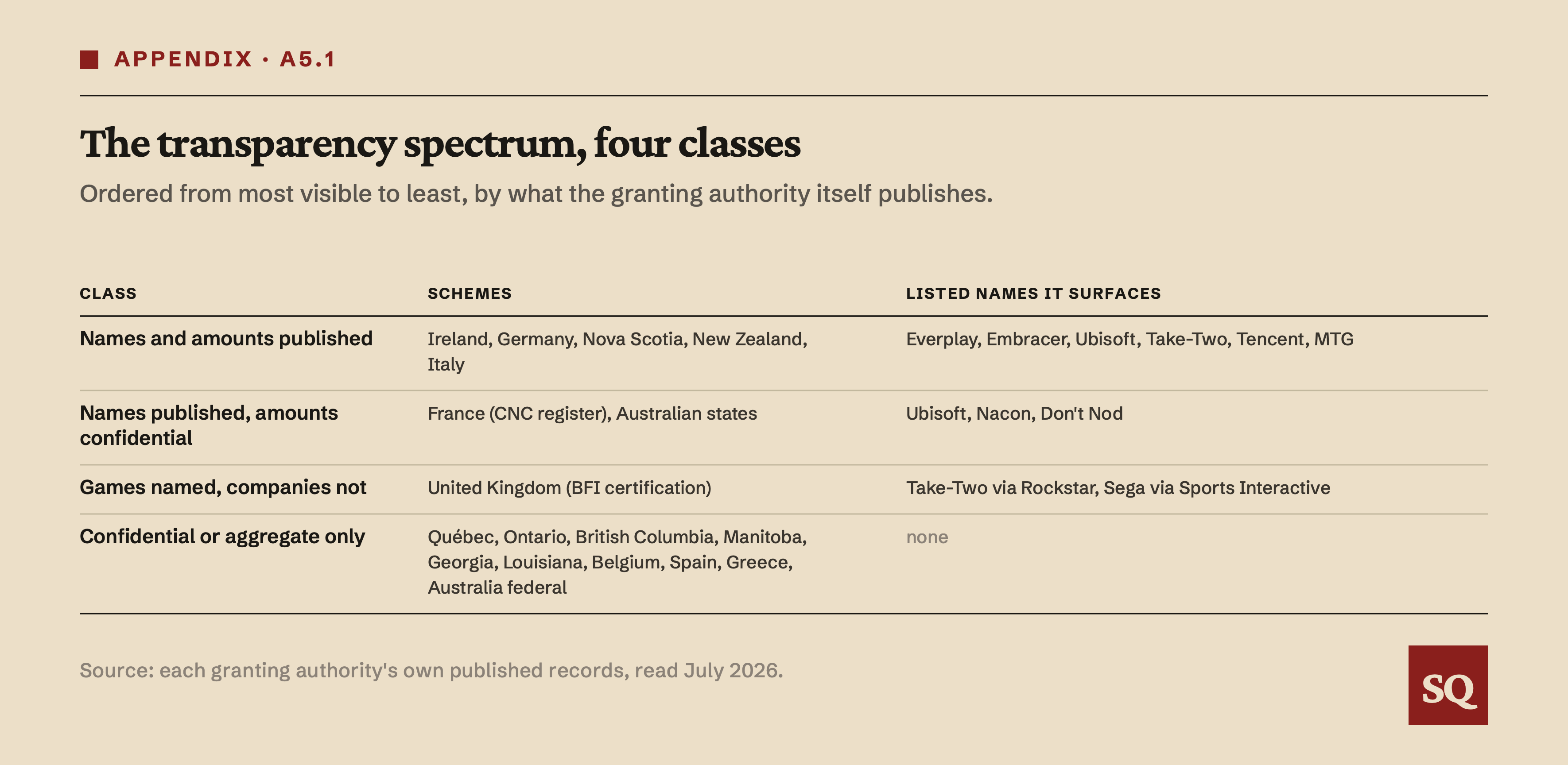
Visibility does not track size. Québec runs the largest of the Canadian credits and publishes no recipients at all, while Australia’s flagship federal offset has no register either, so its only visible claimant is the one that discloses voluntarily.
Ireland and New Zealand publish amounts in bands rather than in figures, and New Zealand holds even the bands back for two years after it pays, describing each studio’s rebate as commercially sensitive until then, so its most recent round is names only.
A5.2 British Columbia: named in the announcement, absent from the record
British Columbia publishes no IDMTC recipient list, so nothing establishes what any company draws or ranks one claimant against another. It does, however, name companies when it suits the announcement. The release of 7 July 2025 confirming the credit was rising from 17.5% to 25% and becoming permanent, effective 1 September 2025, names Microsoft, Nintendo, EA, Take-Two and CD Projekt Red as developers operating in the province, and carries a supportive quote from Natali Altshuler, chief operating officer of EA SPORTS Studios: “Long-term support like this reflects the Province’s recognition of the industry’s value and enables companies like ours to continue contributing to B.C.’s creative and innovative economy.” Premier David Eby is quoted in the same release.
Two things this does and does not establish. It does show the grantor publicly associating five listed groups with the credit, and one of them publicly welcoming it, while publishing nothing about amounts. It does not establish that any of them claims, still less that any is among the largest claimants: being named as a developer operating in a province is footprint, not a traced claim, and the standing rule in A1 applies unchanged. An earlier characterisation of EA Vancouver as “one of the largest BC IDMTC claimants” carried in the studio-to-parent map was unsourced and has been struck, because BC publishes no data from which any such ranking could be derived.
Two of the five named sit in classifications this release does not move. CD Projekt and Krafton remain unresolvable in A1.4 for exactly this reason, that the deciding BC and Québec records are not public. Nintendo remains cleared on its own filings, which name only a Japanese research deduction.
A6. The Québec reform, modelled through Ubisoft
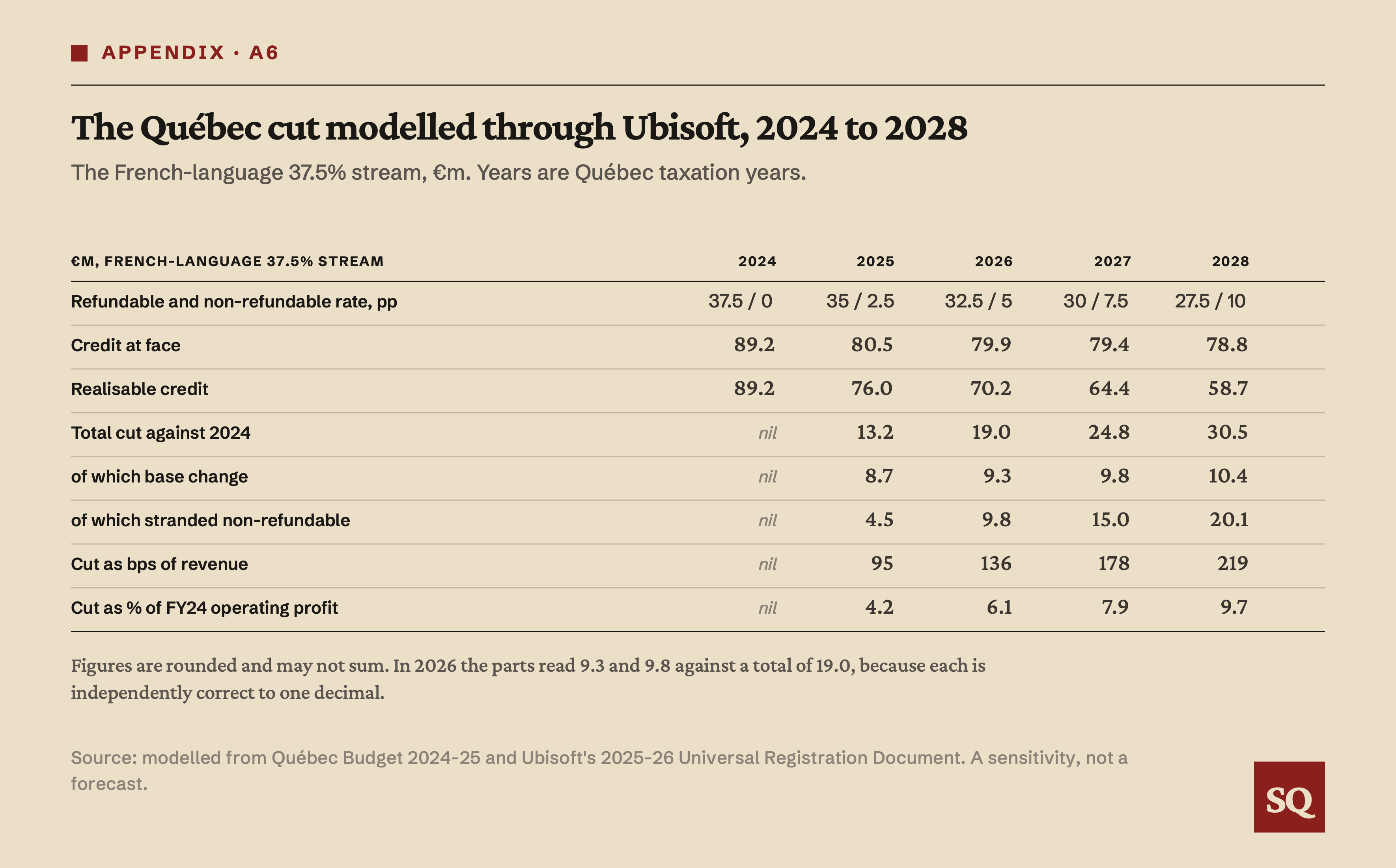
Québec made two changes at once. It narrowed the base, removing the old C$100,000 per-employee ceiling while excluding a first slice of each salary equal to the basic personal amount. And it is converting the credit from refundable to partly non-refundable, 2.5 percentage points a year from 2025, holding the headline rate at 37.5% throughout.
We value the non-refundable slice at what Ubisoft could realise against it, capped at the €0.9m of deferred tax it recognises in its FY26 accounts and held flat through 2028, rather than at face. That is the load-bearing judgement. At face value the 2028 cut is €10.4m against €30.5m at the cap, so roughly two thirds of it comes from this one assumption, and the face reading is the right one for a company with Québec taxable income to absorb the credit. Ubisoft’s own accounts say only that payment of some of its Canadian credits depends on taxable income being generated, and name no province, so the Québec attribution is ours and is inferred.
A6.1 Who the two changes favour, and why they do not agree
The reform is usually described as one cut. It is two, and they sort the province’s studios on different axes.
The base change sorts by wage level. Excluding a first slice of every salary costs a studio in proportion to headcount, since the exclusion is per employee and set at the basic personal amount. Lifting the old CA$100,000 eligible-salary ceiling returns money only where a salary exceeds it. A studio with few, well-paid people gains on the first and loses little on the second; a studio with a large mid-paid workforce loses on the first and gains nothing from the second. Québec’s finance ministry frames the package as improving “the fairness and impact of these tax credits … in a context where the Quebec labor market is no longer what it was when these tax credits were created” (Charles-Étienne Bélisle, Ministry of Finance, 26 Mar 2025). A Montréal studio head read the same change as “the government saying we don’t really care about locally owned studios. We really just want high-paying jobs” (Chris Chancey, ManaVoid Entertainment, 26 Mar 2025). Both readings are consistent with the mechanics; the article attributes each rather than adjudicating.
The refundability change sorts by where profit is booked. A non-refundable slice is worth its face only against a Québec tax bill. It therefore holds full value at a studio that owns what it makes and books profit in the province, and loses most of its value at a studio developing under contract for a parent elsewhere, however profitably that studio trades. Québec’s own schedule states the consequence directly: for studios whose credits exceed their Québec tax, which is most large studios, the cash value falls about 10 points by 2028, while it is preserved for a Québec taxpayer.
The two do not select the same companies. The province’s largest employers are disproportionately the high-wage, foreign-parent contract studios, which sit on the favourable side of the wage axis and the unfavourable side of the profit-location axis. Ubisoft is the modelled case, and it is net worse off on both mechanisms: the base change costs it €8.7m in 2025 rising to €10.4m in 2028, and the stranded non-refundable slice costs €4.5m rising to €20.1m, so the mechanism that looks technical is the one that grows.
Basis: the rate streams and the exclusion threshold are Québec’s own published schedule, and the two quotes are verified against their sources. The characterisation of which studios are high-wage or contract-model is a judgement drawn from the studio-to-parent map and is flagged as inferred, not disclosed.
Swappable assumptions, all inferred and flagged as such: eligible Québec headcount 4,000, the Québec share of the Canadian credit line 0.78, half of eligible staff above the old ceiling by an average of C$25,000, and a normalised operating-income base of −€306m rather than the FY26 impairment trough.
A6.2 How the Québec series is built, year by year
Four things are held fixed across all five years, and they matter more than any single figure below.
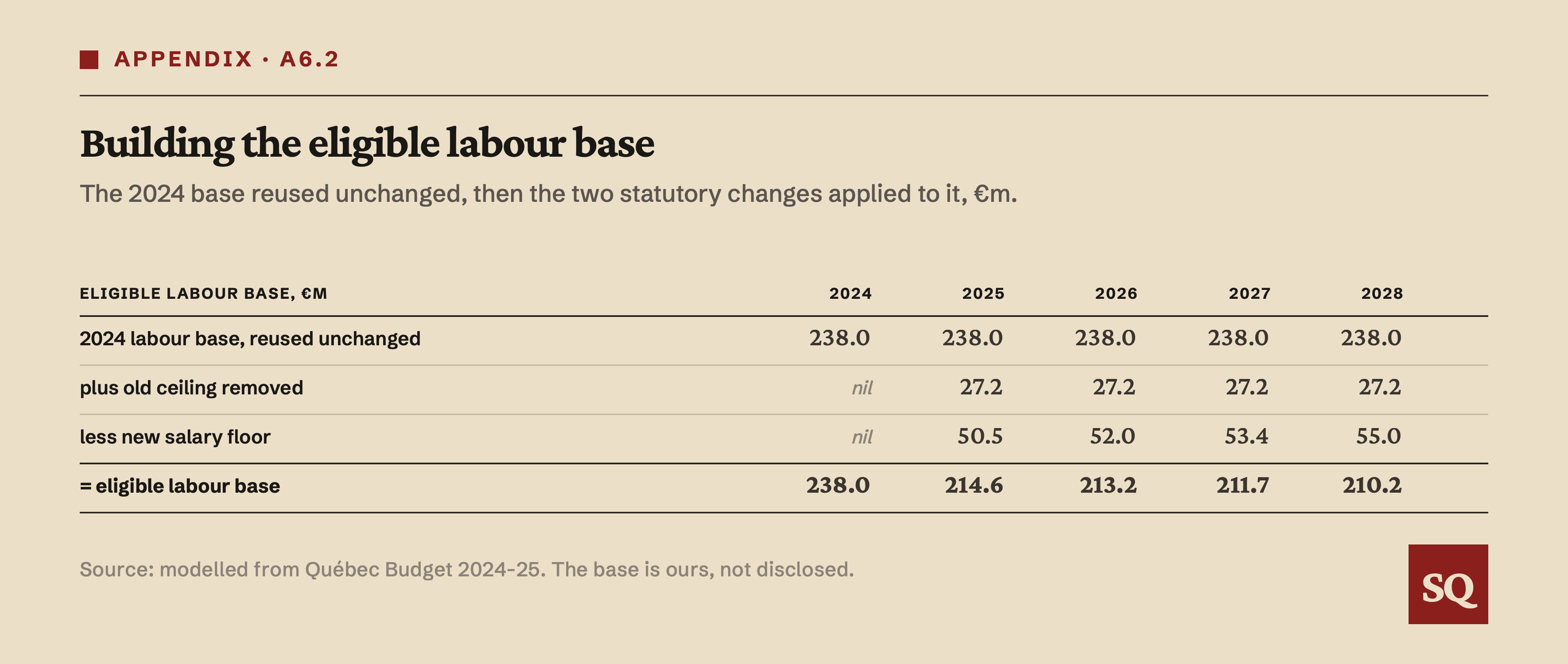
Eligible Québec headcount is 4,000, inferred, because Ubisoft discloses no Québec or Canadian headcount split.
Wages do not grow, so the labour base moves only when Québec changes the rules.
Québec is assumed to be 78% of the Canadian credit line, inferred, and this sets the scale of everything.
FX is 0.68 CAD to EUR.
There is no revenue, margin or release schedule anywhere in the chain, which is what makes this a sensitivity rather than a forecast.
Building the base. Ubisoft publishes no Québec figure, so the base is built backwards from its FY25 Canadian tax credit line of €114.4m, of which we take 78% as Québec. That gives €89.2m of Québec credit, and dividing by the 37.5% rate implies the labour base it must have been earned on. Every later year starts from that same figure and applies the two legislated changes to it. Removing the old C$100,000 per-head ceiling adds back 80% of the salary above it, worth a flat €27.2m a year because wages are held still. Québec’s new per-employee exclusion then comes out, at C$18,571 a head in 2025 and indexed at 2.85% a year, and that indexation is the only moving part in the whole model.
Turning the base into cash. The rate applied to that base is 37.5% in every year and never falls. What changes is how much of it arrives as cash, because Québec is converting 2.5 points a year into a credit worth something only against a Québec tax bill. Ubisoft recognises €0.9m of deferred tax against the whole pool in its FY26 accounts, and we assume it never recognises more, so the non-refundable slice is capped there in every year. That cap is the load-bearing judgement in this section, since it assumes recognition never rises even as the entitlement quadruples.
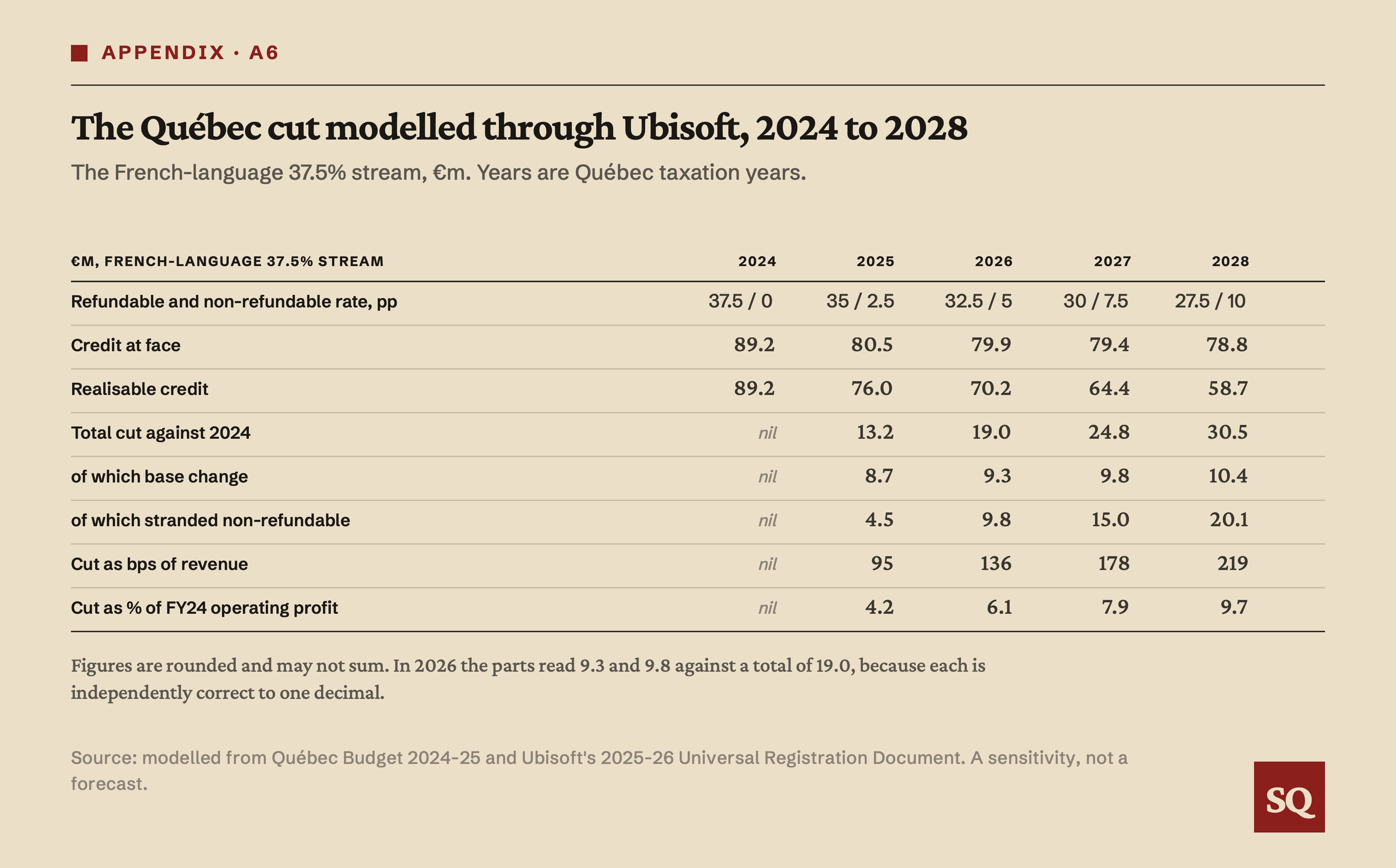
The cut against 2024 splits two ways. The narrower base is the net of both base changes, the floor exclusion less the ceiling add-back. The stranded amount is the non-refundable slice less what Ubisoft recognises, and it is the shaded area on Exhibit 7.
Two things the full series makes visible. The credit at face barely moves after 2025, falling €1.7m across three years, because nothing in the business is allowed to change and only Québec’s indexed floor moves. And the non-refundable slice grows from nothing to €21.0m while the recognised amount stays pinned at €0.9m, so by 2028 the model writes off 96% of it. The widening gap is that cap, not the rate schedule.
A known asymmetry, stated rather than fixed. The model indexes Québec’s salary floor at 2.85% a year while holding wages flat. Those are two sides of one subtraction, so letting the floor grow while freezing pay erodes the base slightly faster than it should. Holding the floor at its 2025 value instead would put the 2028 realisable credit at €59.9m rather than €58.7m, and the total cut at €29.3m rather than €30.5m, about 4%. It does not change the argument, and it errs in the direction that makes the cut look larger, which is why it is declared here.
The arithmetic is exact; the answer is only as good as the two inferred inputs, the 78% Québec share which sets the scale and the 4,000 heads with a C$25,000 average excess which set the rate of erosion. Both are listed as swappable in A6.
A7. Conventions
Currency is native throughout. No figure is converted except where a comparison demands it, and the rate and its date are stated at the point of use.
Credit ÷ Adjusted EBITDA is the controlling dependence metric. Credit ÷ revenue is kept as a secondary reference only, because it distorts a studio that capitalises its development.
Adjusted EBITDA is taken before impairments and before the credit. Nacon’s earn-out reversals, which are non-cash income booked when acquired studios miss targets, are stripped out.
Disclosed against inferred is flagged on every input. Nothing inferred is presented as disclosed.
A claim must be traced. Owning a development studio in a credit jurisdiction is not evidence that a company claims. Public silence is not evidence that it does not.
A scheme is dated from when a company could use it, not from when it entered the statute. Where a law names games but requires a further instrument before anyone can file, we date it to the instrument. Greece is the case that sets it: digital games are named in the original law of August 2017, with their own activity code and cultural test, but applications only opened with the ministerial decision of 12 April 2019. Belgium is the same shape, enacted in March 2019 and unusable until 2022. The alternative convention is defensible and would move Greece into the 2019 base; we take the operational reading because the article’s claim is about schemes companies draw on.
A games tax credit has a games-specific track; a general scheme that games happen to qualify for does not become one. This is why New Mexico and Colorado sit under film credits rather than in the fifteen, and why Georgia’s interactive entertainment credit and Louisiana’s digital interactive media credit are in. Applied consistently, it also keeps Argentina’s knowledge-economy regime and Georgia’s international-company status outside the fifteen, though both name games in statute.
Funder-side reliefs count as schemes. Belgium’s shelter relieves the investor rather than the studio, and Brazil’s routes run through cultural incentive laws, so neither is a production credit paid to a developer on its own spend. Both reach studios and both are things a government did, so they sit in the scheme map and on the movement exhibit, and outside the fifteen games tax credits.
Sources are the companies’ own filings, the subsidiaries’ statutory accounts where a parent is silent, and the grantors’ published registers. Secondary sources may locate a primary document but are never the authority for a figure.