


TL;DR
Roblox’s May 2025 move from Delaware to Nevada wasn’t really about the DExit trend or franchise tax savings. It was a defensive governance architecture built to protect management.
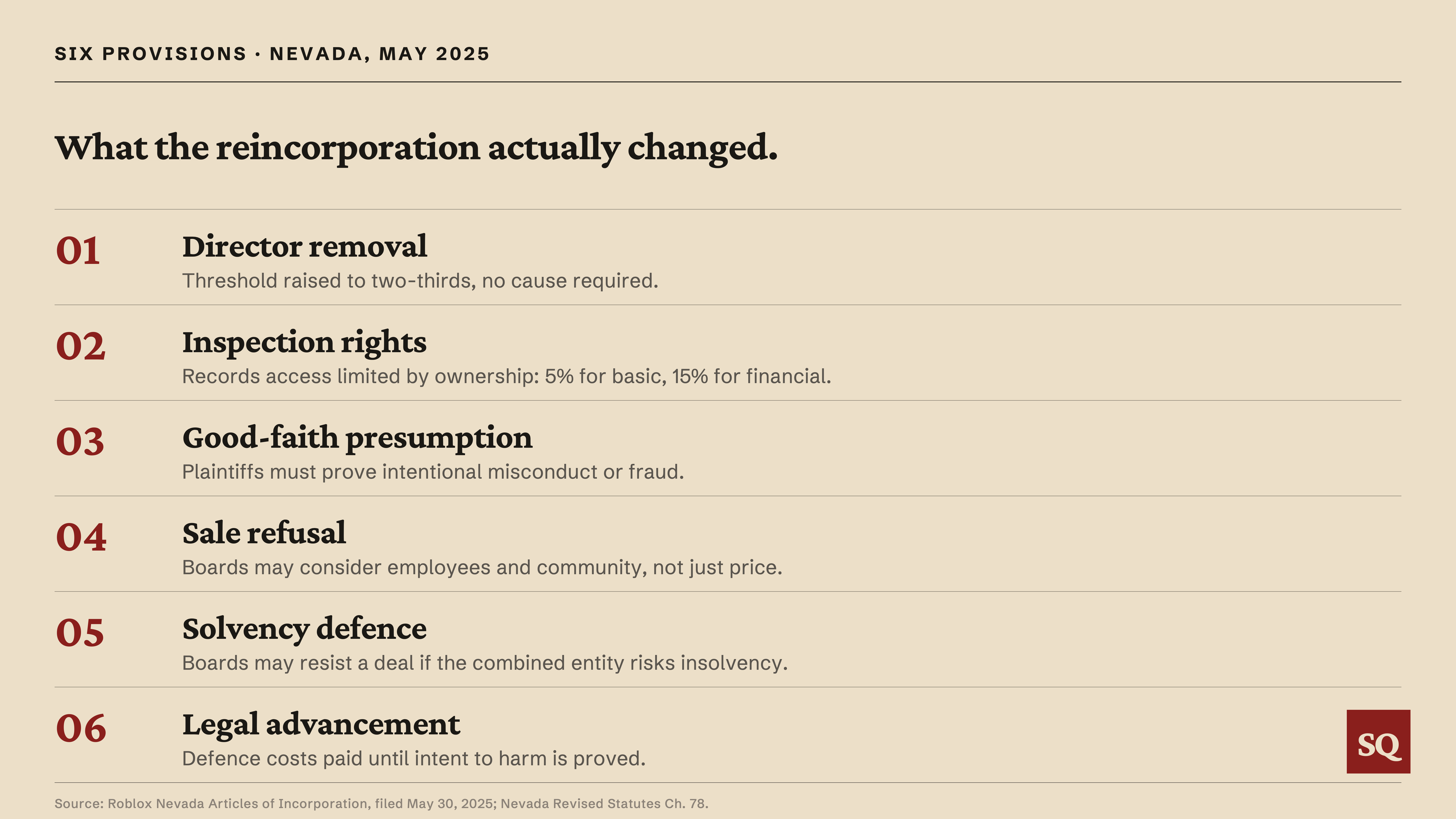
Six specific provisions, including restricted document access, presumed good faith, pre-funded legal defence, harder director removal, statutory authority to refuse a sale, and a solvency-based takeover defence, together raise the cost of holding Baszucki and the board personally accountable.
The timing isn’t a coincidence. With 146 child-safety lawsuits now active against the company, the protections Nevada offers have become urgent. Baszucki had the votes to install them before his 60.9% voting control expires by 2036.
In May 2025, Roblox completed one of the more consequential corporate governance moves in recent gaming history. It reincorporated from Delaware to Nevada. The move was framed as part of the broader DExit trend, with companies leaving Delaware in response to its increasingly unpredictable judicial environment, and the official rationale was unremarkable. Nevada offers a “predictable, statute-focused legal environment.” Delaware’s litigation atmosphere had become uncertain. The board had conducted a “rigorous and thoughtful analysis.”
The reincorporation isn’t primarily about Delaware’s litigation climate. It’s a defensive governance architecture designed to protect Roblox’s management and Baszucki personally from the wave of litigation now underway against the company. It was built precisely because Baszucki had the votes today to install protections that will outlast his voting power tomorrow.
What you need to know first
Delaware has been the corporate home of more than 60% of Fortune 500 companies for decades. It earned that position through the most sophisticated body of corporate case law in the US, run by its specialised Court of Chancery, which operates quickly and predictably with rules companies and lawyers have understood for generations.
Then came a series of decisions that spooked the controlled-company world. The most significant was Tornetta v. Musk. In 2024, the Delaware Court of Chancery found that Elon Musk, despite holding only a 21.9% stake in Tesla, exercised sufficient influence over the board to taint the approval process for his $56 billion compensation package. The court rescinded the award. When Tesla’s shareholders voted overwhelmingly to ratify it a second time, the court still said no. The message was unambiguous. In Delaware, shareholder approval isn’t a reliable safe harbour if a judge decides the process was compromised by a controlling influence.
For founders with significant but sub-majority stakes running their own boards, this was existential. Any board decision made while a founder was in the room could potentially be unwound, regardless of how shareholders voted on it.
The exodus began. Tesla went to Texas. TripAdvisor, Dropbox, The Trade Desk, and dozens of others headed to Nevada. By the time Roblox filed its proposal in April 2025, it was the 18th company in that year’s proxy season to propose leaving Delaware.
Now consider Roblox specifically. David Baszucki, co-founder and CEO, holds Class B shares that carry 20 votes per share. Those shares give him approximately 60.9% of total voting power despite owning only around 7% of the economic interest. He is simultaneously CEO, President, Chair of the Board, and the platform’s founder. Today, he can outvote anyone on anything.
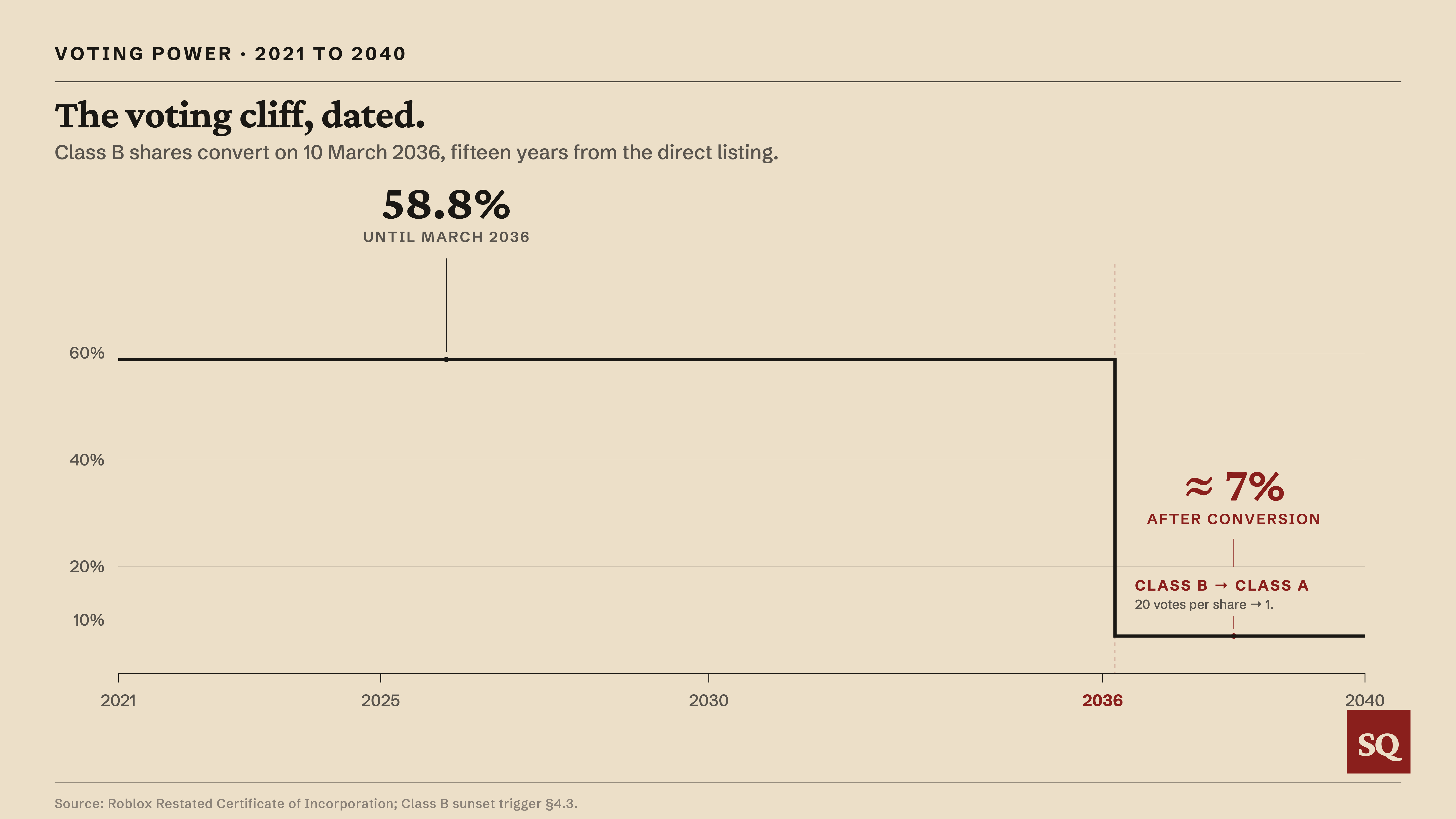
But that ends. The Class B shares automatically convert to ordinary Class A shares no later than March 10, 2036, fifteen years from Roblox’s 2021 direct listing. Several earlier triggers can accelerate this, including his death, disability, or voluntary resignation. After conversion, Baszucki goes from 60.9% voting power to roughly 7%. He can no longer outvote institutional pressure or block governance changes. The mechanisms that currently make him untouchable simply expire.
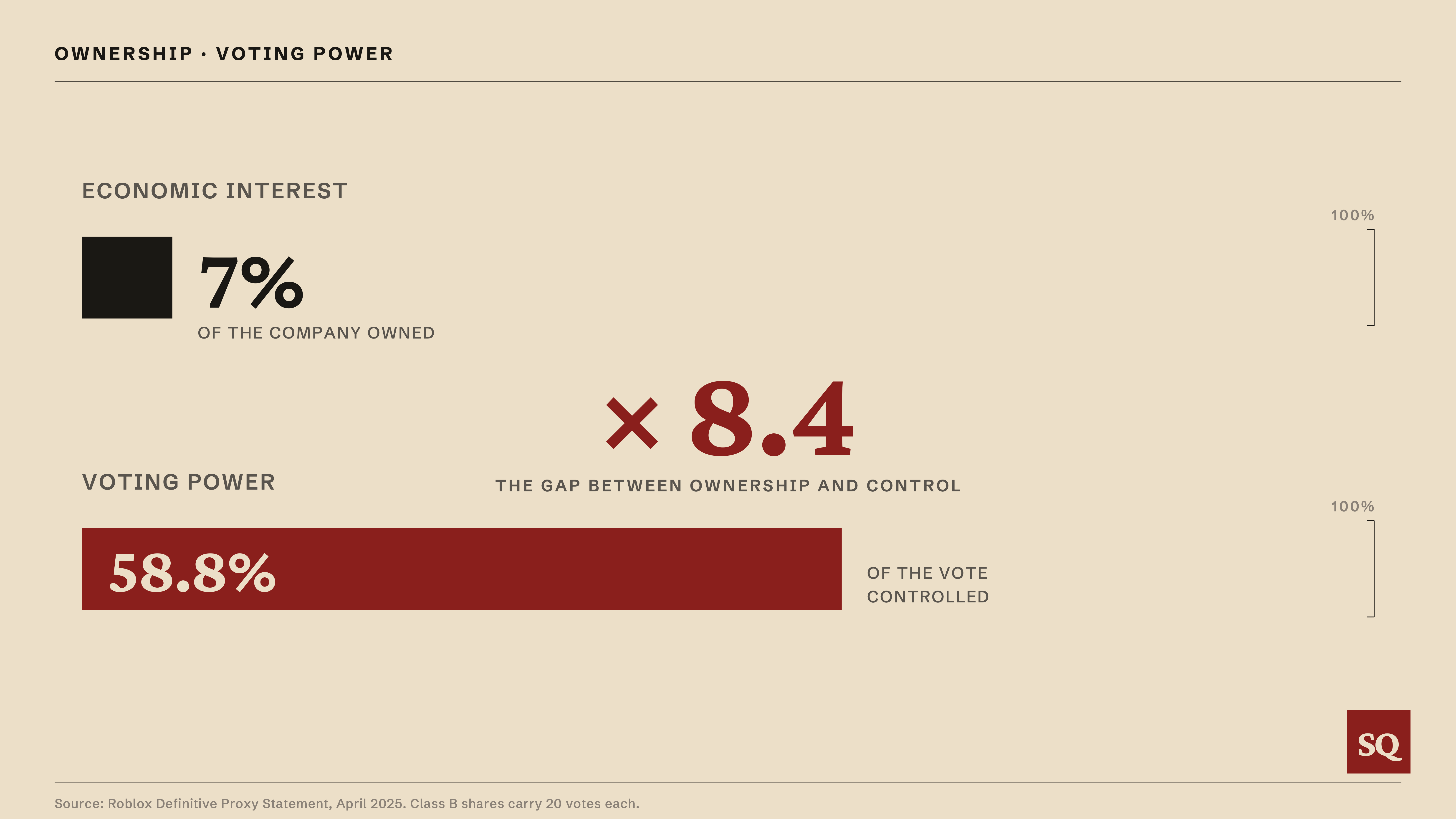
This is the lens through which the Nevada move makes sense. The reincorporation was completed eleven years before the cliff, using voting power that was guaranteed to deliver the outcome. What Baszucki installed are six provisions that defend against the litigation already happening today, and that survive him losing voting control in 2036.
How Nevada law shields Roblox
Activists can no longer credibly threaten the board
The way an activist hedge fund actually wins isn’t usually by removing directors. It’s by threatening to. Build a 5% stake, run a public pressure campaign, line up enough shareholders for a majority vote, and the board starts negotiating. Boards settle, agree to buybacks, change strategy, or quietly negotiate a CEO exit because the threat of removal is real.
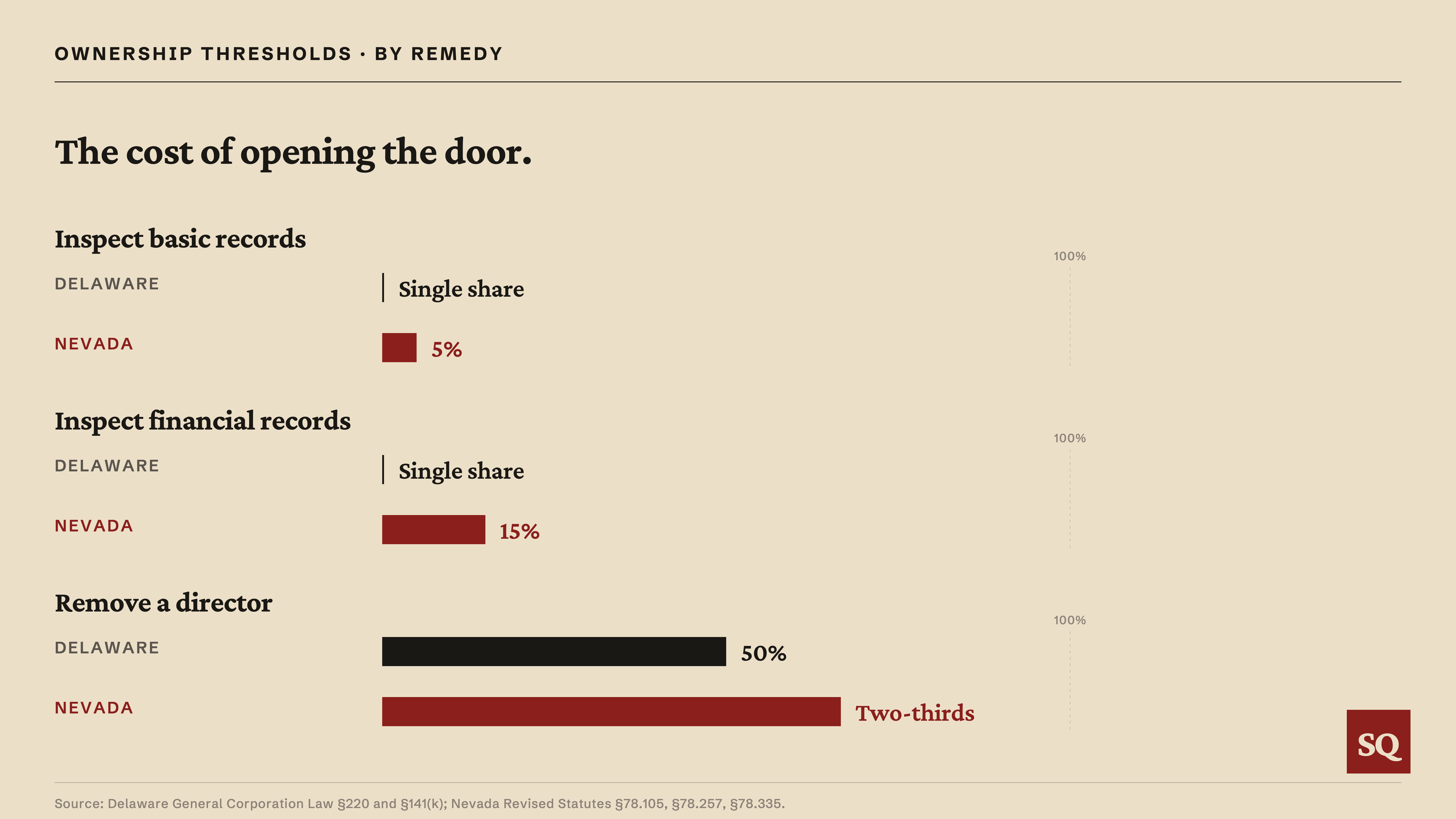
Nevada changes the math. Roblox’s own proxy explains it bluntly: in Delaware, directors on a classified board can be removed for cause by a majority vote. In Nevada, the default is two-thirds, with no cause requirement at all.
Two-thirds is the number to focus on. Baszucki currently controls 58.8% of votes himself, which means any activist needs to win essentially every remaining institutional shareholder to clear the threshold.
Even after 2036, when his super-votes expire and his stake drops to roughly 7%, the two-thirds bar persists. An activist owning 10% of post-conversion Roblox would still need to convince holders of another 57% to vote with them, against a board controlling the meeting calendar and proxy machinery. Not impossible, but close enough that the credible threat disappears.
Without that threat, activists lose the leverage they’d normally use to force change. The remaining tools are public pressure and litigation. As we’ll see in the next two provisions, Nevada has tightened both of those routes too.
Plaintiffs cannot access the documents they need
The 146 families now consolidated in the federal MDL against Roblox are trying to prove a specific thing: that Roblox made conscious decisions to deprioritise child safety in favour of growth metrics. That kind of claim lives or dies on internal documents. Board minutes. Budget memos. Slack messages between executives. Presentations showing how moderation spending was weighed against engagement targets.
In Delaware, those documents were potentially accessible. Any shareholder with a credible basis to suspect wrongdoing could demand internal records under Section 220 of the Delaware General Corporation Law. It’s the opening move in most serious activist campaigns and derivative lawsuits. You demand the documents, you read what management actually said internally, and you build your case from there.
In Nevada, that route is essentially closed. The threshold to inspect even basic records is 5% ownership. For financial records, it’s 15%, and those rights don’t apply to public SEC filers anyway, including Roblox. At Roblox’s roughly $40 billion market cap, you’d need around $2 billion of stock just to look at the articles of incorporation.
Plaintiffs are now limited to what Roblox chooses to disclose publicly and what they can extract through federal court discovery, which is a much narrower and more contested process. And there’s a parallel battle going on at the same time. Roblox’s terms of service push user disputes into private arbitration, which keeps internal documents sealed entirely. The arbitration shield is being challenged under a 2022 federal law called the Ending Forced Arbitration of Sexual Assault and Sexual Harassment Act, and a California court ruled against Roblox in late 2025. If that ruling holds and arbitration falls, federal court discovery becomes the main route for plaintiffs to access internal records. The Nevada inspection rights restrictions exist to make sure shareholder demands don’t become a parallel route.
Forced arbitration was the first wall around Roblox’s internal documents. Nevada’s inspection rights are the second.
The standard for challenging the board rises sharply
When Tesla’s shareholders approved Elon Musk’s compensation package, they did so by overwhelming margins. Twice. The Delaware Court of Chancery rescinded it anyway. Why? Because the court was willing to look past the vote count and ask whether the process by which the board approved the package was genuinely independent. It found that Musk had exerted enough influence over directors who were supposed to be at arm’s length from him that the approval was tainted at the source. Shareholder ratification couldn’t fix it.
That ruling is the single most important piece of context for the Nevada move. It established that in Delaware, a controlling founder can lose even when shareholders are on his side, if a judge concludes the boardroom process was compromised.
In Nevada, the starting point is the opposite. Directors are presumed by statute to have acted in good faith, on an informed basis, in the interests of the corporation. To rebut that presumption, a challenger has to prove intentional misconduct or fraud. Negligence is not enough. Poor judgment is not enough. A founder influencing supposedly independent directors is not enough, unless you can show the influence crossed into deliberate wrongdoing.
For Roblox, this matters in a very specific way. If a derivative shareholder suit argued that Baszucki’s board approved decisions to cut moderation spending because he wanted better profitability metrics for Wall Street, a Nevada court would start by presuming the board acted properly. Plaintiffs would have to prove the board didn’t just make a bad call. They would have to prove the board made a fraudulent or intentionally wrongful one.
Combined with the inspection rights provision we just covered, you can see the closed loop. You need internal documents to prove intent. You can’t get the documents because of the ownership thresholds. The mechanisms ordinary plaintiffs use to hold a board accountable have all been raised just out of reach of anyone who isn’t already a major holder.
The board can legally refuse a sale
In Delaware, once a sale process is triggered, the board has one primary obligation: get the best possible price for shareholders. This is the Revlon doctrine, and it has teeth. A board that rejects a premium offer on vague “long-term value” grounds faces real legal exposure.
Nevada works differently. Directors are explicitly permitted to consider employees, the community, and the long-term interests of the corporation, not just price. None of these factors needs to be the dominant consideration. The board can weigh them all without being required to demonstrate that they maximised shareholder value.
For Roblox, this is substantive. Imagine an activist accumulates a 12% stake in 2027, with the 2036 voting cliff visible on the horizon, and pushes the board to explore a sale. They argue Roblox is worth more to a strategic acquirer than as a standalone company. They might be right. They might even have an interested buyer.
Under Nevada, Roblox’s board can formally and legally reject that pressure. They can cite the 144 million daily users, many of them children, whose community would be disrupted. The 24,500 developers whose livelihoods depend on the platform. The proprietary infrastructure that no acquirer fully understands. The long-term independence of the platform as a creative ecosystem.
A Delaware board making the same argument has to fight uphill. A Nevada board has statutory authority for it. That is not just a theoretical difference. It is a permission slip for management to say no, and have the law on their side when they do.
This provision matters most after 2036. While Baszucki has 58.8% of the vote, he can simply outvote any sale he opposes. Once the Class B shares convert and his voting block drops to roughly 7%, that direct power disappears. The constituency considerations provision is the statutory replacement for it. The protection survives the founder.
Roblox’s losses become a takeover defence
Nevada statute allows a board to resist a change of control if it believes the resulting entity might become insolvent within a reasonable time. On its face, this sounds like a niche provision that would rarely apply. For Roblox specifically, it’s tailor-made.
Roblox ran a $1.07 billion GAAP net loss in fiscal 2025, the company’s largest annual loss in three years. The company has never reported a profitable year since going public in 2021, and consensus expectations put GAAP profitability several years away.
Any meaningful leveraged offer therefore has to absorb a cost structure that has been unprofitable for half a decade, with no near-term path to changing that. The board has a defensible, numbers-backed argument that virtually any leveraged acquisition creates real insolvency risk for the combined entity. And critically, this argument doesn’t require bad faith. It’s just financial analysis.
That makes it almost impossible for a bidder to overcome. They could present their own financial analysis showing the deal works. The board can simply disagree, and a Nevada court is required by statute to presume the board’s assessment was made in good faith. To rebut that presumption, the bidder would have to prove the board didn’t genuinely believe its own analysis, which is a much higher bar than just showing the math could work the other way. The combination is close to a perfect shield against a leveraged takeover.
Like the constituency considerations provision, this one matters most after 2036. While Baszucki controls the vote, he can block any transaction directly. Once the Class B shares convert, the solvency defence is the board’s statutory replacement.
Executive legal bills are paid until the last appeal
Indemnification agreements between companies and their executives are routine. Roblox has them with every officer and director. Each agreement requires the company to advance legal defence costs as litigation arises, before any determination of fault, on the basis of nothing more than an undertaking to repay if the executive ultimately loses.
The question is what triggers the company’s right to stop paying. In most states, including Delaware, that protection ends if the executive’s conduct crosses into “recklessness” or “gross negligence.” A judge looking at a long evidentiary trail and concluding management was recklessly indifferent to a known harm can cut off the funding.
Nevada effectively raised that bar to intentional misconduct. The advancement of expenses continues unless plaintiffs can prove directors actually wanted the harm to happen. Negligence, gross negligence, even recklessness, none of it is enough on its own. The cheques keep flowing through every appeal.
For Baszucki personally, this matters in a very specific way. He is named or potentially named in a meaningful share of the federal MDL cases. Under Nevada, his personal financial exposure to the MDL grinding through years of discovery, motions, trial, and appeals is essentially zero. The company pays. Even if specific decisions are eventually found indefensible, the legal bills only become his to repay if a court finds he intended the underlying harm.
In complex litigation that means five or more years of high-end legal fees on the company’s tab, paid by Roblox shareholders.
So why did Roblox really leave Delaware?
The honest answer is that Nevada gives Roblox’s management a meaningfully stronger defensive position at exactly the moment they need one.
The litigation pipeline is large and growing. The 146 federal cases consolidated in MDL 3166 are working through procedural questions now, but the underlying facts they will test are decisions Roblox made under Delaware governance. Three of the six Nevada provisions respond to that situation directly. Documents become harder to access. The standard for challenging board decisions rises sharply. Executive legal defence is pre-funded regardless of outcome.
The 2036 voting cliff is the second pressure. While Baszucki has 58.8% of the vote, he can outvote anyone on anything. After 2036, when his Class B shares automatically convert, that drops to roughly 7%. The other three Nevada provisions are responsive to that timeline. Director removal becomes nearly impossible. The board can refuse a sale on non-financial grounds. A solvency-based defence is available against leveraged offers.
What makes Roblox’s case worth examining isn’t that any single provision is unusual. Several other companies in the DExit wave have adopted similar provisions. What’s worth examining is the combination, the timing, and the situation the company finds itself in. The structure was installed during an active SEC investigation, with the federal MDL pipeline visibly building, and eleven years before the founder’s voting control expires. Roblox built it when it could be built, with the votes available to build it, against a backdrop of converging external pressure.
The settlement pattern is informative about what Nevada is really protecting against. Roblox has settled with three state AGs, West Virginia, Alabama and Nevada, for $35.8 million combined, with five state actions still active. These cases were brought under state consumer protection statutes seeking civil penalties and operational commitments. They were always going to be settleable for fixed amounts, because that’s how state consumer protection enforcement works. The federal MDL is a fundamentally different category of case. The 146 plaintiffs are individuals seeking compensatory damages for specific harms suffered as children, brought as tort claims rather than regulatory enforcement. Settlement, if it comes, would require the kind of discovery process that produces internal documents and depositions. That’s the pressure point Nevada is designed to constrain.
For investors, the question isn’t whether the structure is legal. It clearly is. The question is whether you’re comfortable owning a company where the standard mechanisms institutional shareholders use to hold management accountable have been systematically tightened, and where the legal costs of any challenge are pre-funded by the company itself.
For the 146 families in the federal MDL, the question is somewhat different.
Appendix
Primary sources: Roblox filings
Roblox Corporation, Definitive Proxy Statement (DEF 14A), filed April 17 2025. SEC EDGAR
Roblox Corporation, Form 8-K (reincorporation completion and voting results), filed June 2 2025. SEC EDGAR
Roblox Corporation, Annual Report on Form 10-K for fiscal year ended December 31 2024 (filed February 18 2025).
Roblox Corporation, 2026 Proxy Statement and 2025 Annual Report (filed April 16 2026).
Roblox Corporation, Nevada Articles of Incorporation as filed May 30 2025. q4cdn.com
The Hindenburg report and SEC investigation
Hindenburg Research, “Roblox: Inflated Key Metrics For Wall Street And A Pedophile Hellscape For Kids”, October 8 2024. hindenburgresearch.com
Bloomberg coverage of share price reaction (9.4% intraday decline). bloomberg.com
SEC active investigation confirmed: Game Developer, February 7 2025. gamedeveloper.com
SEC Case Closing Report obtained via FOIA, dated May 13 2025: Bloomberg, August 15 2025. bloomberg.com (subscription required)
Hunterbrook Media, full investigative thread on SEC and FTC probes. hntrbrk.com
Federal multidistrict litigation and state actions
In re: Roblox Corporation Child Sexual Exploitation and Assault Litigation, MDL No. 3166, JPML Transfer Order dated December 12 2025 — primary source citing 79 actions and tag-alongs at MDL formation. jpml.uscourts.gov
Updated MDL case count (146 as of April 1 2026): King Law Firm docket tracking. robertkinglawfirm.com
Consumer Notice MDL update (April 2026). consumernotice.org
Nebraska AG lawsuit, March 2026: NBC News. nbcnews.com
Los Angeles County lawsuit, February 2026: NBC News. nbcnews.com
Forced arbitration and the EFAA
Anapol Weiss summary of California EFAA rulings and 800-parent open letter. anapolweiss.com
ABC News coverage of board letter and arbitration appeal. abcnews.com
Ending Forced Arbitration of Sexual Assault and Sexual Harassment Act of 2021 (Public Law 117-90). congress.gov
The DExit trend and Delaware case law
Tornetta v. Musk (Tesla compensation case): Morris James 2025 Delaware case law review. morrisjames.com
Maffei v. Palkon (TripAdvisor reincorporation): Torys LLP. torys.com
Delaware SB 21 amendments, March 25 2025: Fenwick & West. fenwick.com
Nevada Revised Statutes § 78.335 (director removal threshold). law.justia.com
State of US reincorporation in 2025 — DExit data: Glass Lewis. glasslewis.com
Harvard Law School Forum on Corporate Governance — “Is DExit Real?”, January 2026. corpgov.law.harvard.edu
Summary of Nevada, Delaware and Texas corporate law changes: Harvard Law School Forum, July 2025. corpgov.law.harvard.edu