


TLDR
A frontier AI model built a complete, playable World of Warcraft style MMO in a weekend, for roughly $1,000 of compute, and Levy Street gave it away, because in the CEO’s words, code is no longer a moat.
With the code free, the value moved and a community of strangers became the development team, and a memecoin the founders did not launch, and at first possibly a scam, turned into the funding.
For video game studios the lesson is an old one: AI commoditises the code and the derivative content, and what is left, original IP, creativity, taste and community, may be a head start more than a moat.
I sat down with Levy Street’s Max Polaczuk and Reuben Horne, the team behind World of Claudecraft. The full interview is below:
The base of World of Claudecraft was built on a weekend, on a model that was gone in three days
Max Polaczuk was not trying to build a game. The chief executive of Levy Street, a Wellington AI company, he had been using classic MMOs as a testing ground for reinforcement-learning research, and when Claude Fable 5 launched days earlier, he pointed it at the job of generating a faithful MMO sandbox to train inside. It quickly did, in his words, “a lot more than that.” Over the next two days, with his colleague Reuben Horne, who leads the project, driving much of the build, the model produced three zones running from level 1 to 20, a dungeon in each, procedurally generated terrain and enemies, several character classes and towns, and a soundtrack written programmatically in TypeScript. Levy Street, founded by the team behind Sportsflare, the esports-betting firm Entain acquired in 2023, posted the result to Reddit, and it went viral.
Three days after it launched, Fable 5 was pulled worldwide under a US government directive, and Levy Street, based in New Zealand, lost access to the model that had built the game. The game still runs, but the tool that made it is no longer available. The game is also a near-exact clone, since the character classes, the ability names, the resource bars and the logo silhouette all come straight from vanilla World of Warcraft, over original and openly licensed art. So the weekend did not show that an AI can invent a game. It showed that an AI can reproduce a well-documented one almost for free.
The code was the cheap part, so they open-sourced it
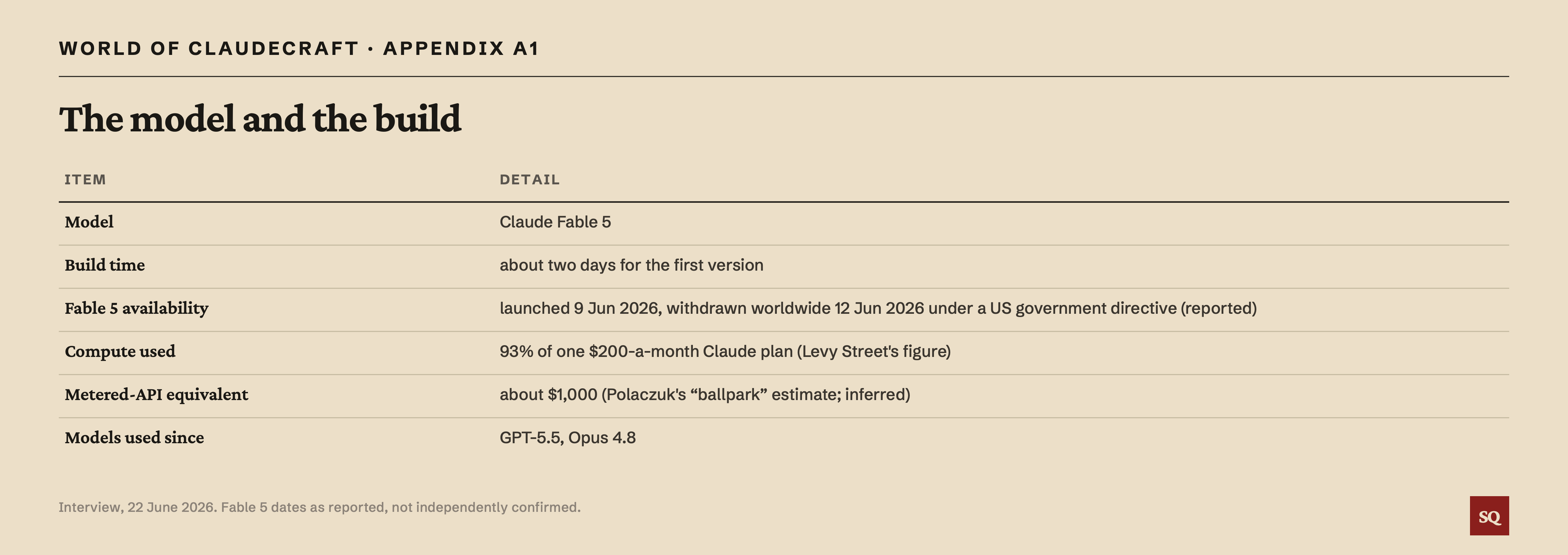
The build used 93 percent of a $200 monthly subscription, which measures how much of a plan they burned rather than what the compute was worth. Metered on the Fable API, Polaczuk reckons the same work would have cost “in the ballpark of around, say, $1,000.” A good deal more has been spent since, across community members supporting the project with their own Claude usage.
Levy Street put the code on GitHub “for no money,” to show what the company can do at the frontier of these models, and putting it in public let people check the claim. “You can check the GitHub, you can see exactly the traces of it,” he said, rather than let anyone wonder whether it really took a weekend to build. The decision mirrors his view that code “no longer might be a moat,” and “we’re less sensitive about our code these days,” a shift since AI changed the role of coding.
The code itself was never worth much: an MMO like World of Warcraft has existed for decades and is exhaustively documented in wikis and fan pages. The model knew it before it started, “such a well-documented thing,” in Polaczuk’s words, its rules and feel “trained into the model.” If the code is the part a model can reproduce, the value is somewhere else.
The players are also developing the game
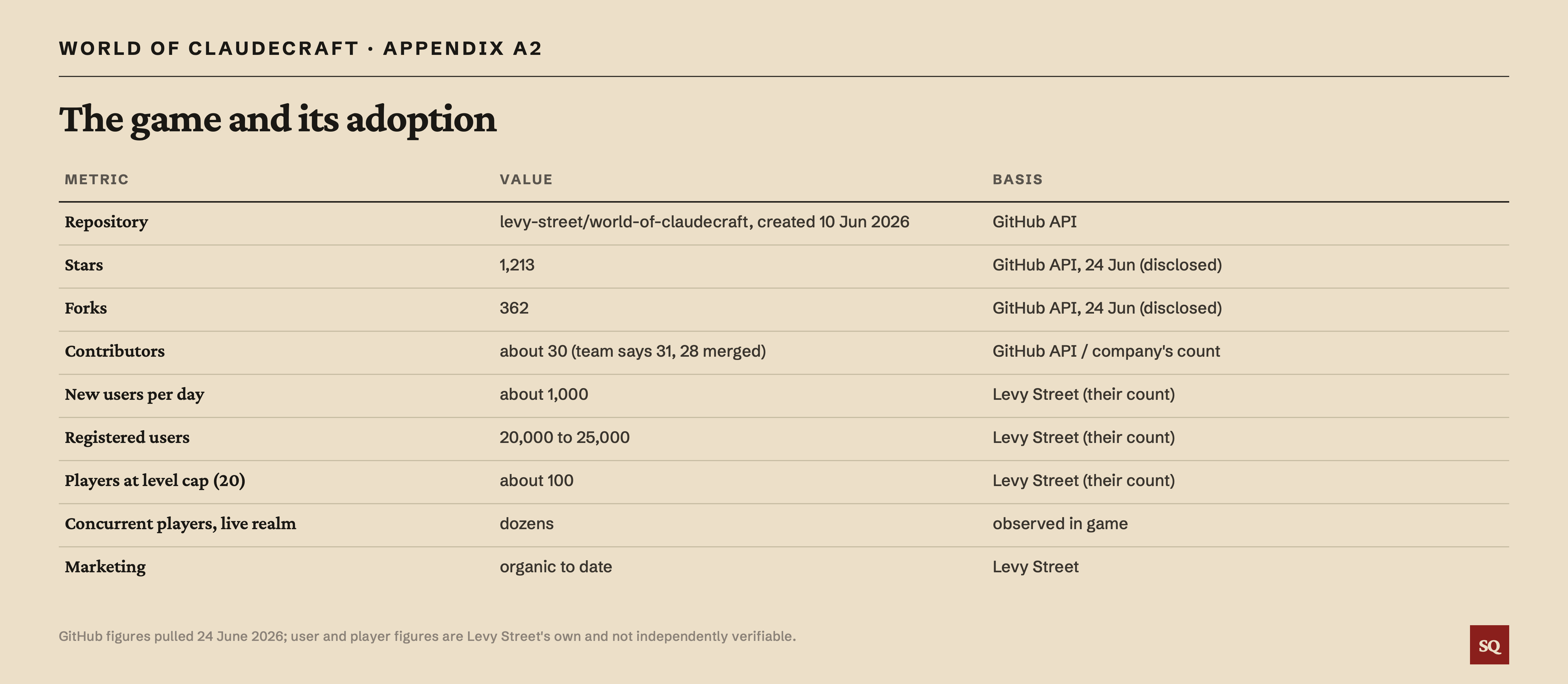
The repository has drawn about 1,100 GitHub stars and more than 300 forks, and its contributor list has gone from three people at Levy Street to roughly thirty, most of them strangers. One of them, by the team’s account, “has never coded in his life,” and he shipped a working hardcore mode on a feature branch, while another built an arena. A Spanish professional composer joined to write real music over the model’s, and someone else started turning out new weapon art. The people Polaczuk is most interested in are the ones who love games and never learned to build them, who can now watch their taste show up in the game for the first time.
When the code is the cheap part, this human layer is the asset, and numbers on that before (NCsoft: The Importance of Commanders in Guild Wars 2): unpaid player-commanders plausibly generate between 2.5 and 6.5 percent of that game’s annual revenue.
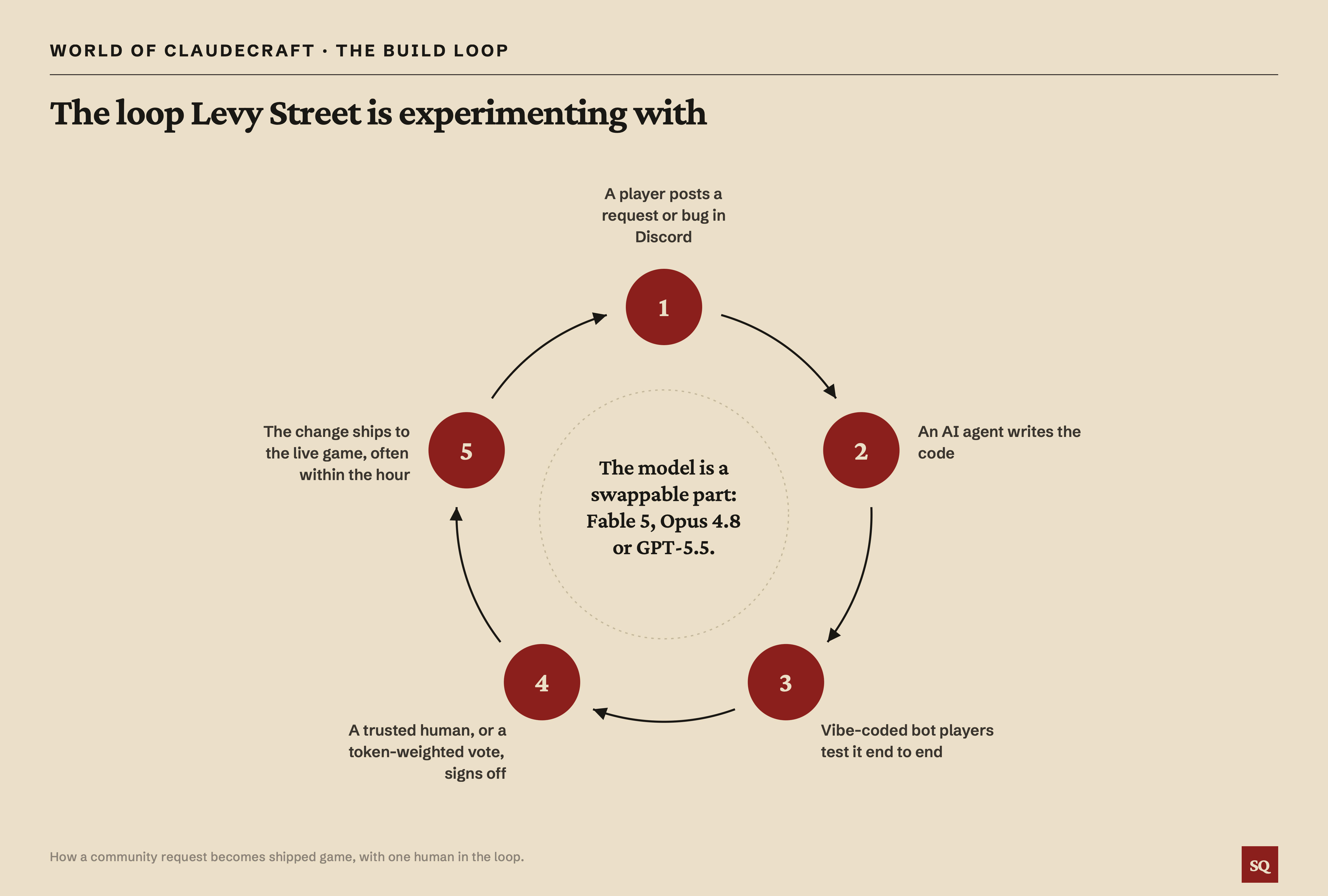
On top of the repository they are wiring a loop. An agent listens to the Discord, and when a feature request or a bug report comes in, it writes the code and tests it end to end against bot players that were themselves vibe-coded. If a trusted human then signs off, the change ships, sometimes within the hour. They are toying with putting that sign-off to a community vote, weighted by the token. A request becomes shipped game with one human in the loop, and that loop, not the code, is what Levy Street is actually trying to own. The case has been made from the other side of the industry (AI in Video Games: Own the Loop): once a model can regenerate the code on demand, the durable asset is the loop a studio owns around it, the evaluations and player data and tuning that compound, while the model underneath stays a swappable rental.
Levy Street reports about 1,000 new users a day and 20,000 to 25,000 registered, with around a hundred players now at the level cap and one who ground for 30 hours straight on launch day, all of it organic, with paid marketing starting shortly. On the live realm, concurrent players run in the dozens against those tens of thousands of registrations.
Yet not everyone welcomed it. In the AI and vibe-coding subreddits the game was a hit, but in r/gaming it was “AI slop,” and by Polaczuk’s account his post was downvoted into the ground and his account banned, with the few who defended it as cool and open-source pushed down alongside him. He is even-handed about it, plenty of gamers are pro-AI, but the loudest voices “weren’t having a bar of it,” and “I can understand why.” That hostility is part of why the two crowds that did show up, the AI builders and the crypto-native players, “had to band together” as the frontier-tech outsiders mainstream gaming wanted no part of.
The audience who came are from the crypto community
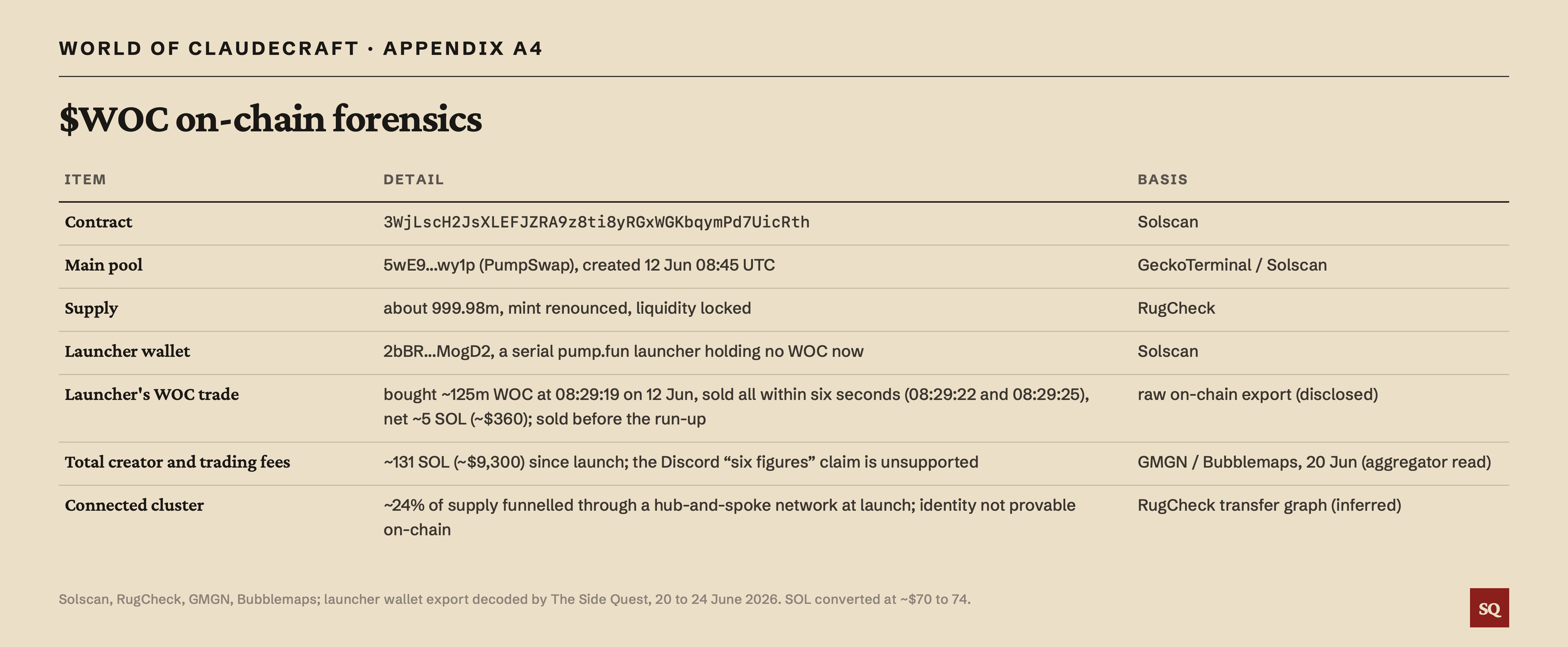
At launch, the founders did not launch a crypto token. They put the game out as a showcase, not a business, and then, as it went viral on Twitter as well as Reddit, their phones started going. The messages, in Polaczuk’s telling, were “hey, there’s some money for you, someone’s made a token.” A stranger had spun up a $WOC memecoin off the moment. “No, it’s a scam,” was the first reaction, and they distanced themselves. With no endorsement, the token went to near zero.
What changed their mind was who was playing: “The majority of the players on the server had come from crypto,” Polaczuk said, and he is keen that they were there to play, not just to flip a coin: “they were grinding and grinding.” Grinding, though, is also what a crypto crowd does when it expects a token to reward the effort, and the project’s own Discord points that way, with players pre-farming the game in anticipation of the token being wired in. Whatever the motive, the audience was crypto-native, and with the abandoned token sitting at near zero, one of those players bought it “when it was basically nothing.” The team warmed to it, accepted the creator rewards, and the coin became what crypto calls a community takeover.
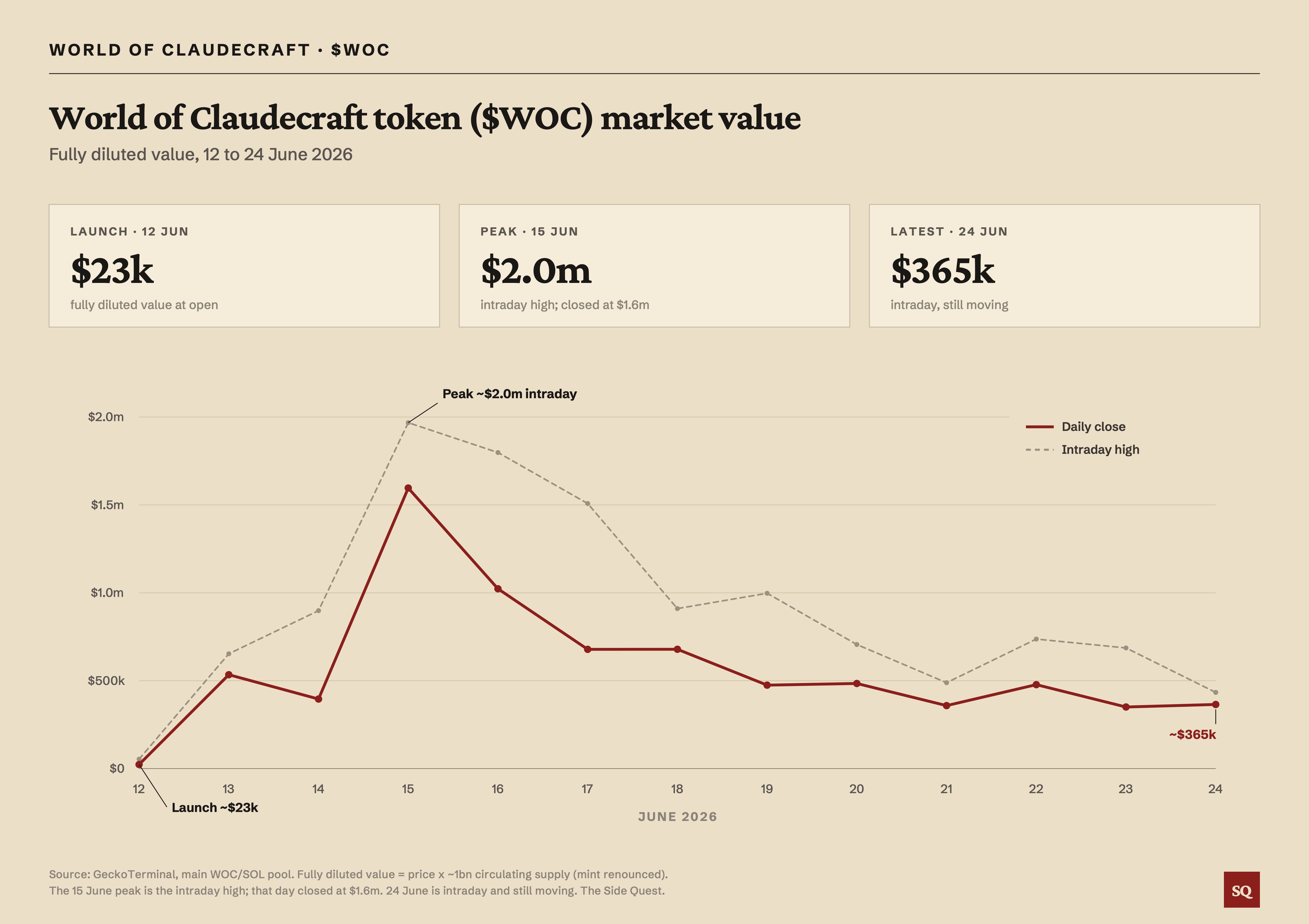
Within three days of launch it ran to a fully diluted value of about $2m, and it has been sliding ever since. The sums behind that line are small, because the fees the token has thrown off are modest, the wallet that launched it cleared only a few hundred dollars and was gone within seconds, and the largest connected block of holders, about a quarter of the supply, cannot be tied to anyone on-chain, the team included. “I know some of the top holders personally” in the Discord, Polaczuk said, “but with respect to a connected set of wallets, I’m not too sure.” None of the wallets anyone has traced holds a fortune.
The donate button on the game raised nothing, while the creator rewards let the team pay a dividend to their top community contributors, which Polaczuk calls “a really interesting financing model, kind of like crowdfunding.” The roadmap leans further in. Wallet connection is already live, and the plans after it are PvP prize tournaments, a cosmetics store and player housing, along with an idea of splitting into two servers, one crypto and one not, and confining anything that resembles play-to-earn to the crypto side, gated on what the community wants.
Levy Street’s answer is that none of it is separate. Asked whether the game, the crypto and the firm’s financial-AI work were one strategy or three bets, Polaczuk described a portfolio company that tries a lot, shuts down what fails, and doubles down on what works, with each new model opening “a new capability that you couldn’t quite just do before.” On that account the game is one experiment, the institutional investment-research product another, and the token simply the financing that lets an open-source game pay its contributors. The juxtaposition an outsider notices, a community coin alongside AI sold to financial institutions, is to them just two lines of one portfolio.
Built on Fable 5, which was withdrawn within three days
When the model vanished, the fallout, in Reuben Horne’s account, was real but contained. Losing Fable was “definitely... noticeable”: “I can’t make great music anymore,” he said, the programmatic music having been a Fable specialty, “but now we’ve got a composer,” and rich environment generation was “a bit of a loss” he is “looking forward to being able to do that again.” Against that, “we now have like 30 contributors,” and the game kept producing. “We’re still being able to create new content, new quests, the new raid,” he said, now on other frontier models like GPT-5.5 and Opus 4.8.
The risk is real and was entirely outside their control: the capability a product like this runs on can be deprecated by a vendor, or pulled by a government, on a few days’ notice. But more survived the change than didn’t. Fable was uniquely good at a narrow set of things, the music and the environments, and those are what degraded, while the rest of the work moved to other models without much drama and a community that had formed only after launch absorbed the slack. This was less a bad bet than a reminder that the ground under any frontier-model product can shift without warning, and that what carries you through is what you have built around the model rather than the model itself.
What this means for the video games industry
On the founders’ own account, the model did not invent this game, it reproduced one, and it is far better at reproducing a documented design than at originating a new one. Polaczuk is explicit that they are not chasing a triple-A title: the realistic target is a browser or mobile game, not a prompt that returns “a game,” let alone anything close to an 80 percent version of one. Horne puts the gain in plainer terms, as a tooling edge for “agile teams” that can now do “more with less.”
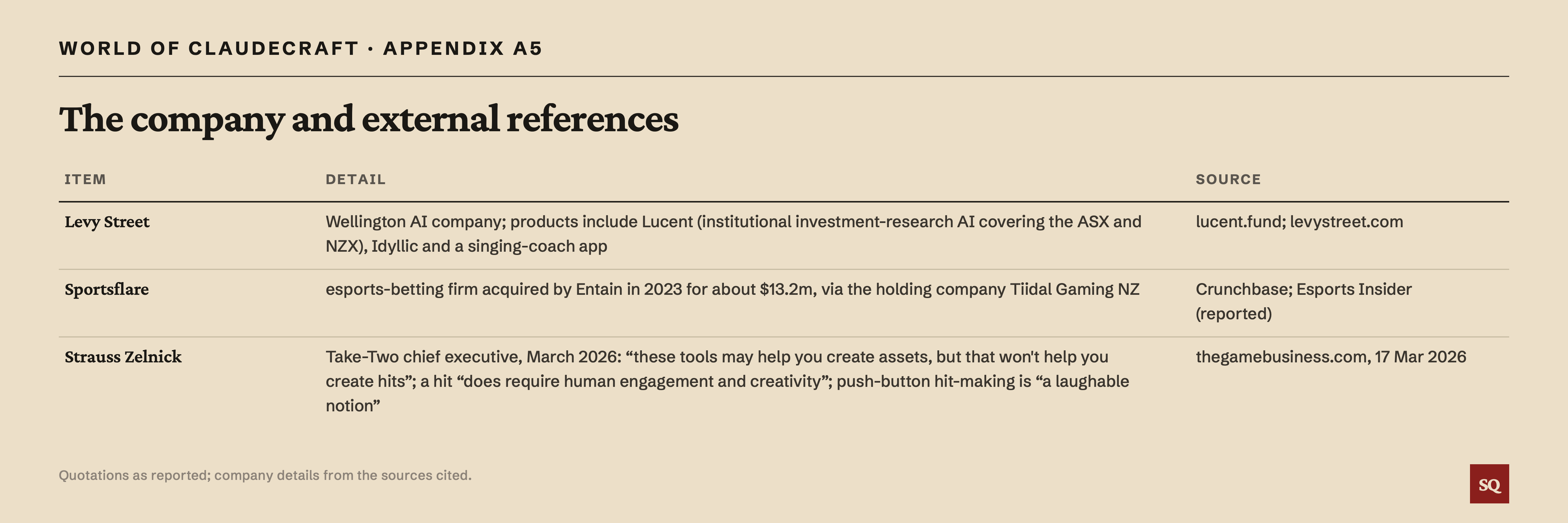
If that were the whole lesson, listed studios could rest on a distinction their best-known boss has been drawing for a year. Strauss Zelnick, who runs Take-Two, put it plainly in March when he said, “these tools may help you create assets, but that won’t help you create hits.” A hit, he said, “is a completely different animal and does require human engagement and creativity,” and the idea of pushing a button to “generate a hit” is “a laughable notion.” On that reading AI takes the assets, the boilerplate and the derivative, while the original creative leap, the part that makes the money, stays human. World of Claudecraft fits the theory, because a model reproduced the assets of an MMO in a weekend and did not make a hit. Analysis on AAA game development also points to this, with the work AI takes on is the cheap, derivative part, and savings leaves the publisher P&L, going straight to the model and cloud vendors (See: AI won't make AAA games materially cheaper to develop).
Levy Street does not think the clone is the ceiling and their bet is that imitation can spawn originality, since League of Legends started as a clone of DotA and enough iteration carried it somewhere “completely different.” Run that loop with a community feeding requests and “agents cooking in the background,” they argue, and a derivative can end up “something unrecognised, even if the roots are a more standard pattern.”
They hedge the leap when they ask, “is it going to one-shot a completely original game? probably if you drive it... maybe, yet to be seen,” but they are not reserving ideation for people forever, and they expect the machine to get there eventually, while Zelnick is betting it will not. Both cannot be right, and the gap between them is the question for anyone holding a games stock.
The first half of Zelnick’s distinction is already true, because the code and the derivative content are being commoditised in front of us. The second half is where the risk sits. If a community, cheap models and enough iteration can manufacture originality over time, even slowly, then original IP stops being a permanent moat and becomes a head start, one that decays unless its owner keeps extending it. That is a narrower claim than Levy Street’s and a more demanding one than Zelnick’s, because a catalogue is worth holding only for as long as the studio keeps adding to it.
Studio, community, or coin?
Ask Levy Street what World of Claudecraft is and you get four answers:
It is a showcase for an AI consultancy.
It is a candidate first title for the “AI-native minigame studio” they might raise money to build.
It is a community that ships its own features.
It is the collateral for a memecoin they did not launch.
Polaczuk’s own version is that “it’s all an experiment, I think, at this stage,” run “day by day,” inside a portfolio company that means to keep “doubling down on the winners” and cut the rest.
Once the game costs only about $1,000 and a weekend, the game stops being the business. What is left to be a business is whatever captures the attention the game created, whether a consulting pipeline, a community, a token, a studio, or none of them. Levy Street is running it in the open, the repository public and the receipts on-chain, and they are as unsure as anyone watching which way it resolves.
The weekend settled one question, which is that a faithful clone of a much-loved game is now nearly free to make. Everything since has been the harder question, the one the rest of the industry is walking towards. When the game itself costs almost nothing, what is left that someone will pay for, and who ends up holding it?
More from The Side Quest
Microsoft and Xbox: Too small to sell, too strategic to spin - On the numbers, Xbox is worth about $49bn, a rounding error to Microsoft. It won’t be sold, and any separation keeps a grip on the data its games generate.
AI in Video Games: Own the Loop - why a studio keeps its value only if it owns the content-generating learning loop, not the model. Uses Guild Wars 3 as a worked example.
AI won’t make AAA games materially cheaper to develop - the productivity gains are real, but two-thirds of the value leaves the P&L to the AI vendors before it reaches the bottom line.
Hyperscalers: The debt that doesn’t look like debt - how Microsoft, Amazon, Alphabet, Oracle and Meta are funding the AI capex boom, and why their reported leverage understates what they actually owe.
Why Roblox really left Delaware - reading the Delaware-to-Nevada reincorporation as a move to shield management amid active litigation.
Appendix
A figure-by-figure record. On-chain numbers come from public Solana data; figures Levy Street gave about its own game are attributed to the company and flagged where they cannot be checked from outside; external facts carry a source and a date. All interview quotes were checked against the per-participant audio recording, not the auto-generated transcript. Dollar values are rounded and may not sum.
A1. The model and the build
The game was generated with Claude Fable 5 over about two days in mid-June 2026, then open-sourced. The model was available only briefly; the interview confirms it is no longer accessible and that new content now runs on other frontier models.
A2. The game and its adoption
GitHub figures are public and were pulled directly. The user and player figures are Levy Street’s own and cannot be verified from outside the company; the article attributes them accordingly.
A3. $WOC market value (the chart)
Fully diluted value (FDV) is the token price times the circulating supply of about 999.98m. The mint is renounced and the supply is fully circulating, so FDV approximates market capitalisation. The series is computed from the main WOC/SOL pool’s daily price.
Source: GeckoTerminal, main WOC/SOL pool (PumpSwap), pulled 24 Jun 2026.
A4. $WOC on-chain forensics
The token is a pump.fun fair-launch memecoin: mint renounced, liquidity locked, no presale. A serial token-launcher created it, and the team adopted it after it was abandoned, what crypto calls a community takeover.
A5. The company and external references
A6. Conventions
Data is as of 24 June 2026. Currency is US dollars unless stated, with SOL converted at the prevailing rate over the window. Fully diluted value is the token price times the circulating supply of about 999.98m, used as a proxy for market capitalisation because the mint is renounced and the supply fully circulating. Figures are rounded and may not sum. Disclosed figures (the GitHub API, the raw on-chain exports, the price series) are distinguished inline from the one inferred figure (the wallet cluster) and from Levy Street’s own counts that cannot be checked from outside. “(reported)” marks a figure taken from the press or an on-chain aggregator rather than a filing or a raw export.